Resource Center
Research, guides, and real-world insights on online proctoring; helping your program deliver results that are fair, trustworthy, and defensible.
10M+
Assessments secured
Zero
Data breaches in 12+ years
98%
Client retention rate
120+
Resources published
Featured article

Integrity Advocate Ranks #1 for Online Proctoring Usability for the Third Consecutive Season
9
min read
Integrity Advocate has been ranked #1 for Online Proctoring Usability on G2 for the third consecutive season. Based on verified customer feedback, we also earned five Fall 2026 badges recognizing usability, ease of use, support, and overall leadership.
All resources
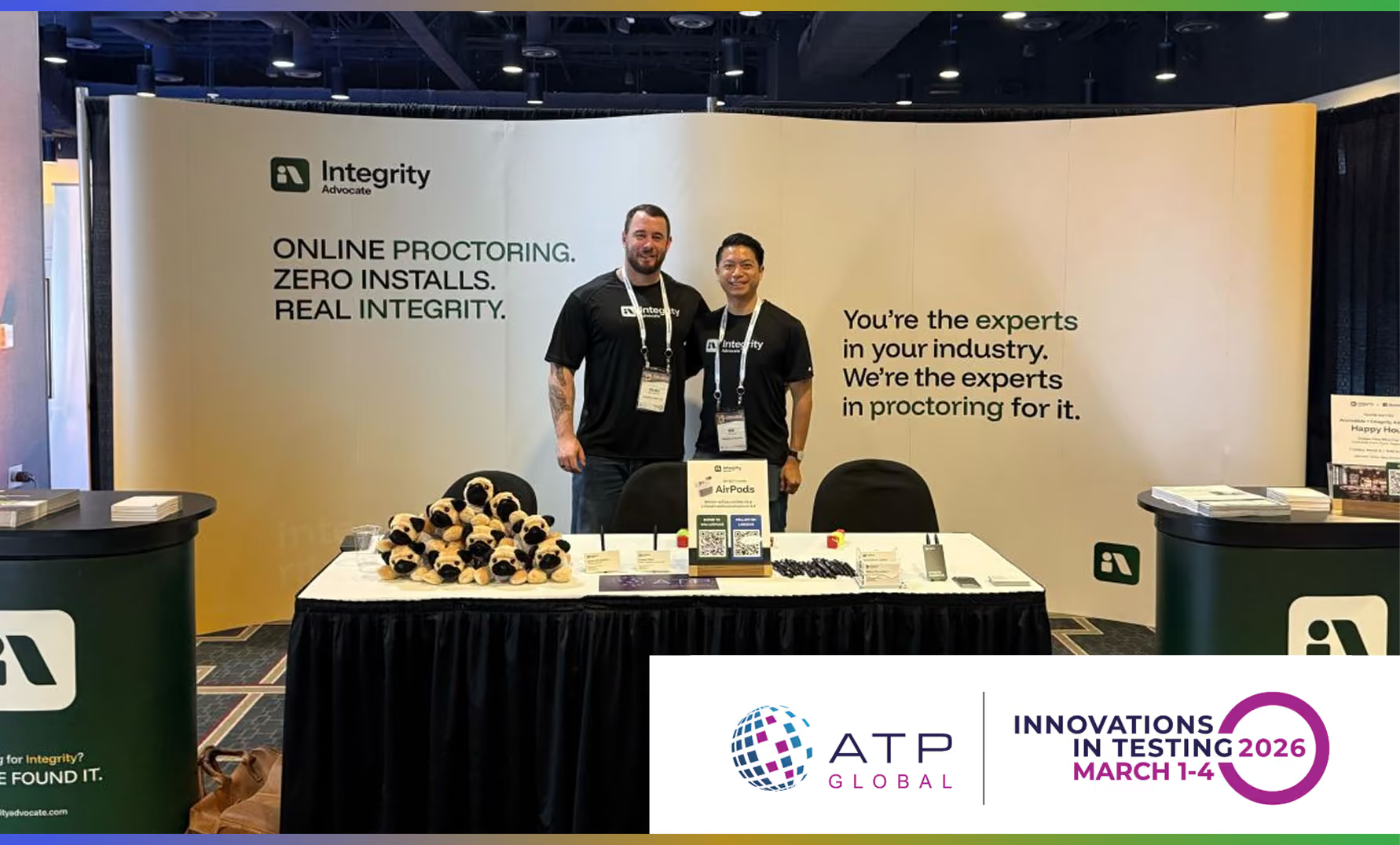
ATP Innovations in Testing 2026: Key Takeaways
March 16, 2026
|
3
min read
At ATP Innovations in Testing 2026, direct conversations at the Integrity Advocate booth surfaced three consistent themes: organizations moving away from traditional LMS platforms toward standalone assessment tools, strong interest in combining secure exam delivery with digital credentialing through the Accredible partnership, and a noticeable increase in organizations proactively seeking to partner with Integrity Advocate. Broader conference sessions reinforced that generative AI is reshaping the assessment lifecycle, security challenges are evolving quickly, and candidate experience is becoming a competitive differentiator for certification bodies. This post recaps what the conversations revealed and where Integrity Advocate fits into the industry's direction.
Balancing Assessment Security and Privacy Within Modern Online EdD Programs
May 22, 2026
|
6
min read
Online EdD programs face a growing tension: assessments must be secure, but doctoral learners expect their privacy to be respected. In this guest post, Research.com's Stephanie Dion explores how institutions can move beyond surveillance-heavy models toward verification-based systems, risk-based authentication, and faculty preparedness that protect both academic integrity and learner trust.

What Makes a Proctored Result Defensible? A Guide for Compliance and Certification Programs
August 18, 2026
|
5
min read
When a candidate challenges an exam result, an automated flag isn't enough to defend it. This post breaks down what "defensible" actually requires: verified identity, a documented human judgment behind every flagged session, and an audit trail that connects evidence to outcome. It also covers what regulators and accrediting bodies look for, and why liability for a flawed process typically lands on the program running the assessment, not the software vendor.

Manufacturing & Warehousing Safety: The Hidden Cost of Unverified Training
October 21, 2025
|
3
min read
In manufacturing and warehousing, safety training often becomes a checklist: toolbox talks, refresher videos, signed attendance sheets. But when a forklift collision, chemical spill, or lockout failure occurs, those documents rarely hold up. OSHA and WHMIS investigators increasingly require verifiable certification records, not just completion logs. This post examines the hidden costs of unverified training in industrial environments, what defensible certification actually requires, and how Integrity Advocate's hybrid proctoring delivers audit-ready proof that every worker on the floor is legitimately certified.

How Integrity Advocate Prevents Cheating in Online Exams
October 17, 2025
|
3
min read
Online assessments should be fair, secure, and accessible. As exam tools evolve, so do attempts to game them. This post explains how Integrity Advocate prevents the most common forms of online cheating, including hidden plugins, impersonation, unauthorized devices, and off-camera assistance, through a privacy-first combination of identity verification, AI-assisted monitoring, and human review that keeps evidence audit-ready and the learner experience low-friction.
Can Claims of GDPR Compliance by Proctoring Companies Be Trusted?
September 20, 2023
|
3
min read
Many proctoring companies claim GDPR compliance, but those claims are largely self-reported and rest on frameworks that have already been legally challenged. The EU-US Privacy Shield was invalidated in 2020, and its replacement relies on self-certification that does not resolve the underlying conflict between the US Patriot Act and GDPR's prohibition on non-consensual data disclosure. This post examines why US-based data storage creates a structural GDPR problem, what the DPF self-certification actually involves, and why Integrity Advocate's Canadian infrastructure and Privacy by Design architecture represent a substantively different approach.

What Defensible Assessment Looks Like in 2026
April 7, 2026
|
3
min read
AI tools have changed what cheating looks like, and most proctoring systems were built for a different problem. This post covers why an automated flag alone can't defend an outcome, and what a defensible assessment record requires in 2026.

What It Takes to Successfully Roll Out Online Proctoring Inside an LMS
April 15, 2026
|
6
min read
Rolling out online proctoring inside an LMS doesn't have to be disruptive. This guest post from uxpertise shares six practical steps for a smooth launch, plus how CMRAO cut support requests by 80% after switching to Integrity Advocate.

What CXC's Rise in AI Misuse Means for Certifying Bodies Still Relying on Automated-Only Proctoring
September 9, 2026
|
4
min read
CXC's 2026 results show exam irregularities nearly doubling since 2023, with AI misuse tracked as a distinct violation category for the first time. The takeaway for certifying bodies: automated detection is built to flag behavior, not to judge intent, and AI-assisted cheating often leaves no behavioral signal at all. Human review is what turns an automated flag into a decision a program can defend when a result is challenged.