Resource Center
Research, guides, and real-world insights on online proctoring; helping your program deliver results that are fair, trustworthy, and defensible.
10M+
Assessments secured
Zero
Data breaches in 12+ years
98%
Client retention rate
120+
Resources published
Featured article

Integrity Advocate Ranks #1 for Online Proctoring Usability for the Third Consecutive Season
9
min read
Integrity Advocate has been ranked #1 for Online Proctoring Usability on G2 for the third consecutive season. Based on verified customer feedback, we also earned five Fall 2026 badges recognizing usability, ease of use, support, and overall leadership.
All resources

More Flags ≠ More Security: How Smarter Review Saves Admins Time and Stress
January 12, 2026
|
3
min read
Flag overload is one of the most common and least discussed problems in online proctoring. When AI-only systems flag everything from background noise to lighting changes, administrators are left sorting through queues of low-risk alerts to find the few that actually matter. This post explains why more flags do not equal more security, how human review filters out noise before it reaches the administrator queue, and what a smarter review model looks like in practice, including a side-by-side comparison of AI-only versus AI plus human review across flagging volume, admin workload, and decision quality.
The Credential Security Trifecta: Designing a Defensible Credential Ecosystem
February 25, 2026
|
3
min read
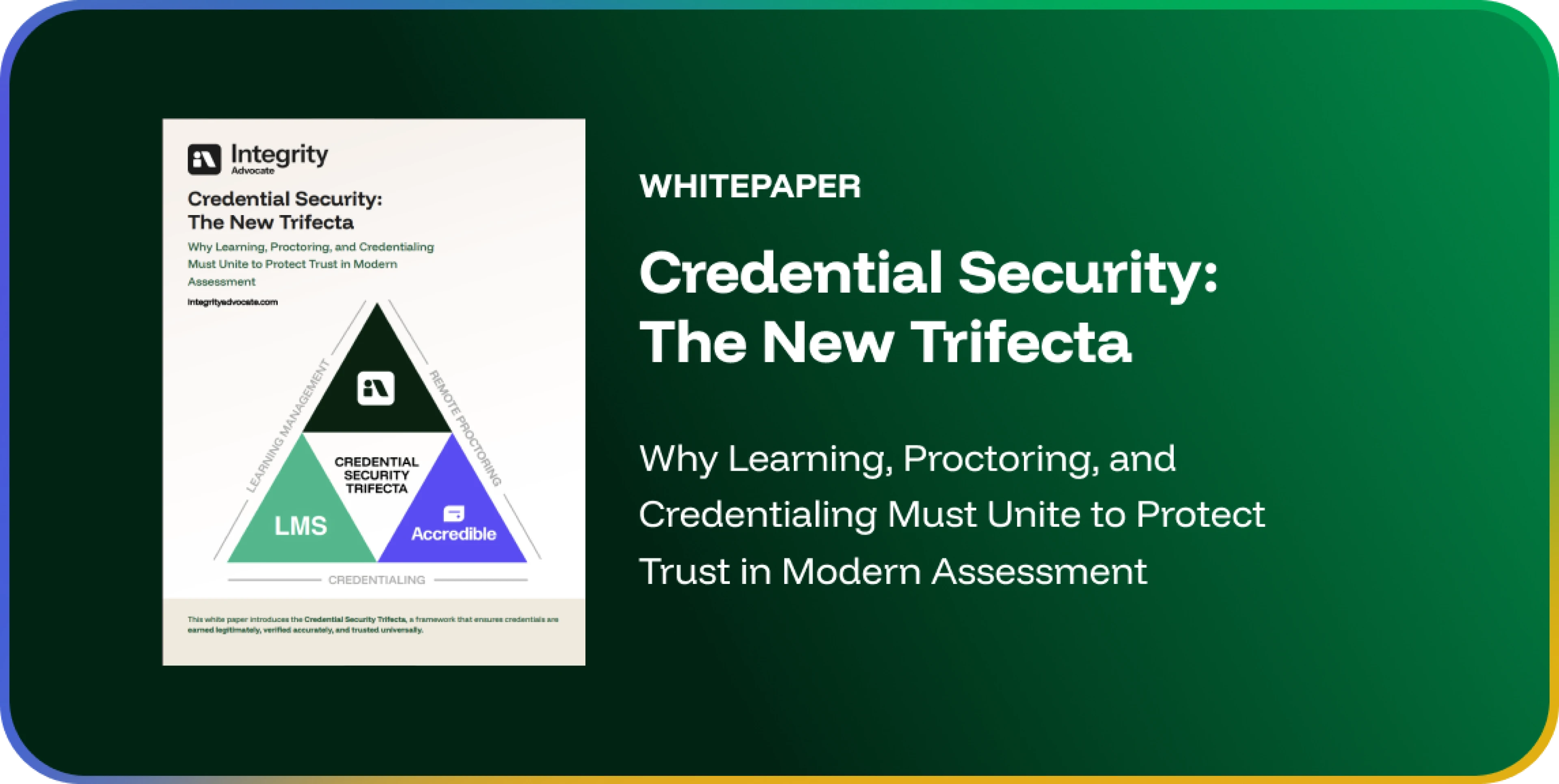
Credential integrity depends on more than a single tool. It requires identity verification, assessment oversight, credential issuance, and long-term validation to operate as one connected system. As digital credentials become more visible and portable across LinkedIn profiles and employer systems, organizations need to be able to answer a harder question than "was this test monitored": is this credential defensible? This post introduces the Credential Security Trifecta, a framework connecting Learning & Assessment Infrastructure, Identity & Integrity Verification, and Secure Digital Credential Issuance into a unified chain of trust, and points to the full whitepaper for the risk landscape, common blind spots, and an implementation model.

Who We’re Certifying Matters: Why Assessment Security Must Evolve With the Credential Landscape
February 24, 2026
|
5
min read
Assessment security has expanded beyond preventing cheating to protecting the long-term credibility of every credential an organization issues. Remote and hybrid delivery, AI tools reshaping candidate behavior, rising employer scrutiny of credential validity, and the rapid expansion of digital credentialing are all converging to make this a strategic rather than operational question. This post examines why credential credibility now depends on assessment security design, what the risks of getting it wrong look like across higher education, professional certification, and workforce training, and why connected, integrated systems are the only approach that produces defensible outcomes at scale.

Modern Proctoring Requires Anytime, Anywhere Access
December 15, 2025
|
4
min read
Online assessments no longer happen in controlled environments. They happen at kitchen tables and job sites, on personal phones and employer-managed laptops, across time zones and bandwidth conditions that institutions cannot control. Proctoring solutions built for a single, standardized testing environment are increasingly out of step with how people actually learn, train, and certify. This post examines the reality of modern testing environments, why device-agnostic and low-bandwidth-optimized design is now a baseline expectation, and how flexible access strengthens rather than weakens assessment integrity.
Why Privacy-First Proctoring Will Define Online Assessment in 2026 (and Beyond)
December 8, 2025
|
5
min read
In 2025, privacy became the deciding factor in whether organizations adopt, keep, or replace their proctoring vendor. Learners are more vocal about surveillance. Legal and privacy teams are asking harder questions. Accreditation bodies are demanding clearer, more defensible data practices. This post explains what privacy-first proctoring actually means architecturally rather than as a marketing claim, how Integrity Advocate implements it across five specific design decisions, and why privacy-first will lead vendor decisions in 2026 as regulatory requirements tighten and learner trust becomes a measurable program outcome.
Feature Update: Enhanced Video Feed Out for More Efficient Review
September 19, 2025
|
2
min read
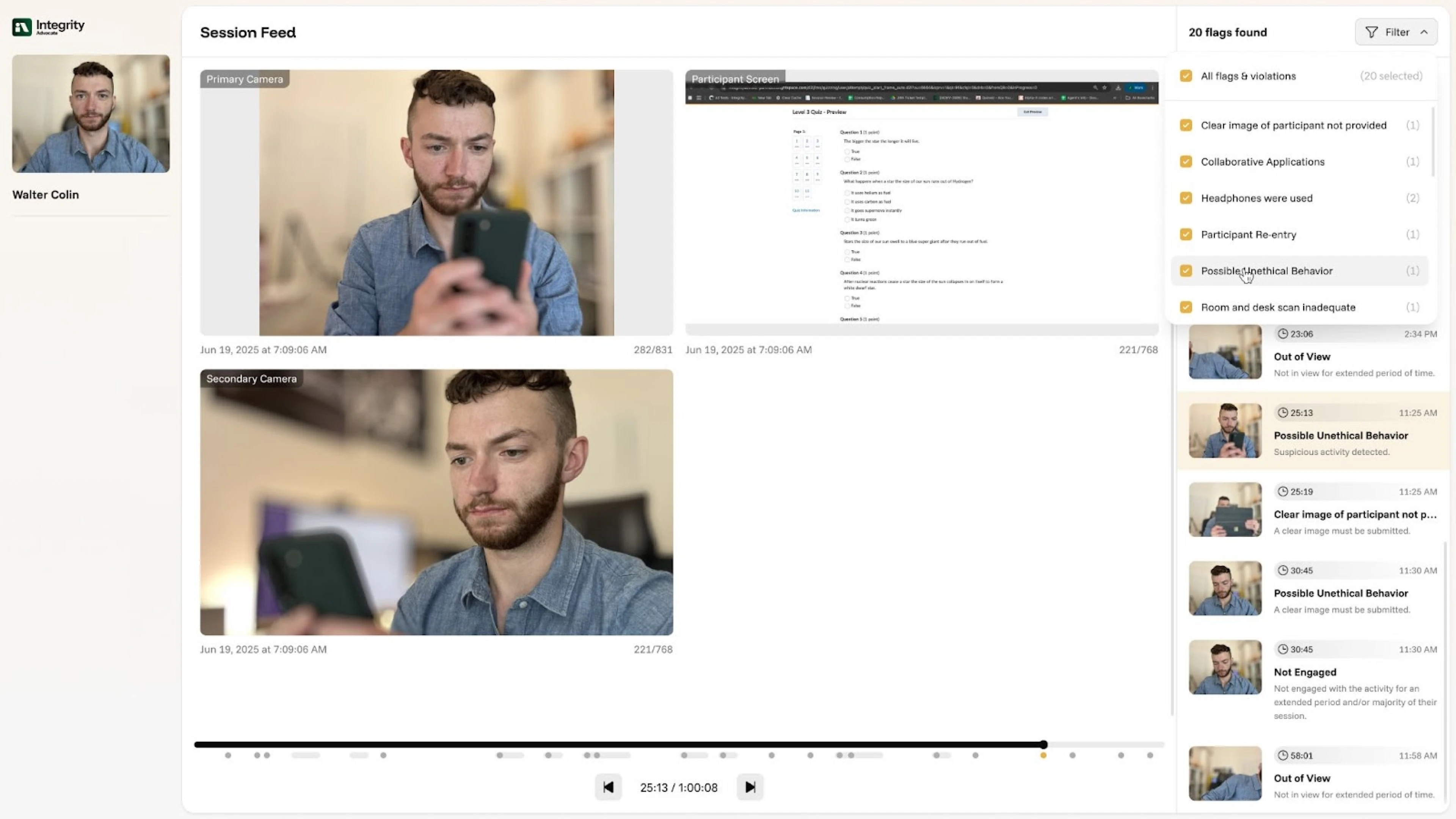
Integrity Advocate has released a major enhancement to Video Feed Out, one of the most requested updates from client administrators. Violations and flags are now marked directly in the session timeline, allowing admins to jump between flagged events instantly, filter by violation type, and review audio snippets that distinguish flagged from unflagged moments, all without toggling between the session feed and a separate violations report page.

How Training Leaders Keep Compliance Simple and Scalable
July 25, 2025
|
5
min read
Compliance looks different across workplace safety, healthcare, corporate training, and professional credentialing, but the pressure feels the same. When the systems meant to help compliance leaders do their jobs, from LMS platforms to proctoring tools to verification workflows, add complexity instead of removing it, compliance becomes a bottleneck. This post examines why operational efficiency should be a compliance requirement in its own right, what breaks when training infrastructure cannot keep up, and what a system that actually works looks like for the compliance program managers responsible for keeping everything on track.

How To Lose A Client to a Competitor in 10 Ways
May 22, 2025
|
3
min read
Good technology is the baseline. What keeps clients is how a partner shows up when things get complicated. This post walks through the ten most common reasons organizations switch proctoring providers, from poor support and compliance abandonment to privacy shortcuts and platforms that cannot scale, and explains how Integrity Advocate is built to do the opposite at every turn.

Integrity vs. Surveillance: Is Your Proctoring Tool Monitoring Learners or Surveilling Them?
July 2, 2024
|
4
min read
There is a meaningful difference between monitoring and surveillance in online proctoring, and most programs have not thought carefully about which one they are actually doing. Monitoring confirms identity, verifies participation, and produces a defensible result. Surveillance collects everything it can, flags anything it does not recognize, and leaves programs to sort out the noise. This post draws that distinction clearly, explains what privacy-first proctoring actually looks like in practice, and makes the case for why human review is the only thing that makes an assessment result genuinely defensible when it is challenged.