September 15, 2020
|
5 min read
Why Most Remote Proctoring Companies Don't Want You to Read Their Privacy Policy
Most proctoring companies collect far more personal data than test takers realize, and their privacy policies say so explicitly. This post breaks down what proctoring providers are actually collecting, shares four real privacy policy excerpts that should concern any organization, and explains how Integrity Advocate's Privacy by Design approach limits collection, mandates deletion, and keeps learner data out of the hands of third parties.


Consider two scenarios.
In the first, security cameras in a school record a student walking through the hallways and interacting with friends. The school stores the recording indefinitely as part of the student record and shares it with other organizations.
That feels wrong.
In the second scenario, cameras capture the same student bullying a younger student. Only the portion of the recording showing the behavior is retained, and it is shared with the organizations responsible for taking appropriate action.
That feels reasonable. There is a legitimate purpose, a proportionate response, and a clear limit on what gets shared and why.
Remote proctoring technology is an extension of the same principle. The question is whether the companies providing it are applying that principle, or ignoring it entirely.
What Proctoring Companies Are Actually Collecting
Most people assume online proctoring captures what it needs to verify identity and monitor an assessment session. The reality, based on the privacy policies of many proctoring providers, is considerably broader.
Many proctoring services collect, intentionally and unintentionally, personal information that includes:
- Social security numbers, driver's license numbers, and passport numbers
- Biometric information including facial geometry, physiological and behavioral characteristics, and genetic data
- IP addresses and device identifiers
- Full browsing history, search history, and records of interactions with websites and applications
- Medical information including physical and mental health conditions
- Drug use history and political affiliations
- Footage of children, spouses, and other individuals who happen to be in the same space as the person being proctored
This is not a hypothetical. This is what the privacy policies say.
Four Things You Will Find in Proctoring Privacy Policies
The following are real excerpts from proctoring company privacy policies currently in use. Read them carefully.
1. "By accessing and using our Services, you consent to allow free exchange of proctoring information between [Proctoring Service Company] and your educational institution. We, or vendors on our behalf, may track the websites you visited before and after our websites as part of the traffic data described above for our internal business purposes."
2. "If your institution has consented, we may also use third-party solutions to process selected data."
3. "We may disclose information, including video and audio recording of your exam session, to your educational institution/certifying entity upon request. Your information may be sold or transferred as part of that transaction."
4. "We cannot ensure or warrant the security of any information you transmit to us or store on the Services, and you do so at your own risk."
Students and workers taking online assessments are required to submit to proctoring. They do not have the option to choose a different provider or opt out. That disparity in power makes these policies more than a legal formality. It makes them an ethical issue.
Why Privacy by Design Is the Only Acceptable Standard
The school camera analogy holds here too. We expect schools to share footage of students only when there is a legitimate reason and only to the extent necessary. We should expect the same from proctoring technology.
Privacy by Design is not a compliance label. It is an architectural commitment — the decision to build data minimization, purpose limitation, and deletion into the product from the start, rather than adding privacy language to a policy document after the fact.
That is how Integrity Advocate is built.
What Integrity Advocate Collects and What It Deletes
Integrity Advocate collects only what is necessary to verify a learner's identity and confirm whether they followed the rules set by the organization running the assessment. Nothing more.
The approach is similar to how PayPal operates as an intermediary in a financial transaction, protecting both parties without either side needing to expose more than is required. Integrity Advocate sits between the organization and the test taker's personal data, sharing only what is needed and only when there is a documented reason.
In practice, that means:
- With the exception of a single identity photo, all recordings of the user and their desktop are deleted within 24 hours if no rule violations are found
- When a session is flagged, only the minimum information required to document the concern is shared with the organization
- As a Canadian company, Integrity Advocate operates outside US government jurisdiction. In the unlikely event of a compelled disclosure, the data available on the vast majority of users would be limited to a first and last name and a facial image represented as a string of code
Read the privacy policies of other proctoring providers and ask how many of them can say the same.
What to Look for Before Choosing a Proctoring Provider
Before signing a contract with any proctoring platform, your organization should be able to answer the following questions from their privacy policy and data processing documentation:
- What personal information is collected, and is collection limited to what is necessary?
- Is data sold, transferred, or shared with third parties beyond the assessment organization?
- How long is data retained, and what triggers deletion?
- Is the vendor subject to US government data requests, and what would they be required to disclose?
- Is there a human review process, or are automated findings shared directly with the institution?
If the answers are not clearly documented, that is an answer in itself.
{{post-cta}}
Keep reading
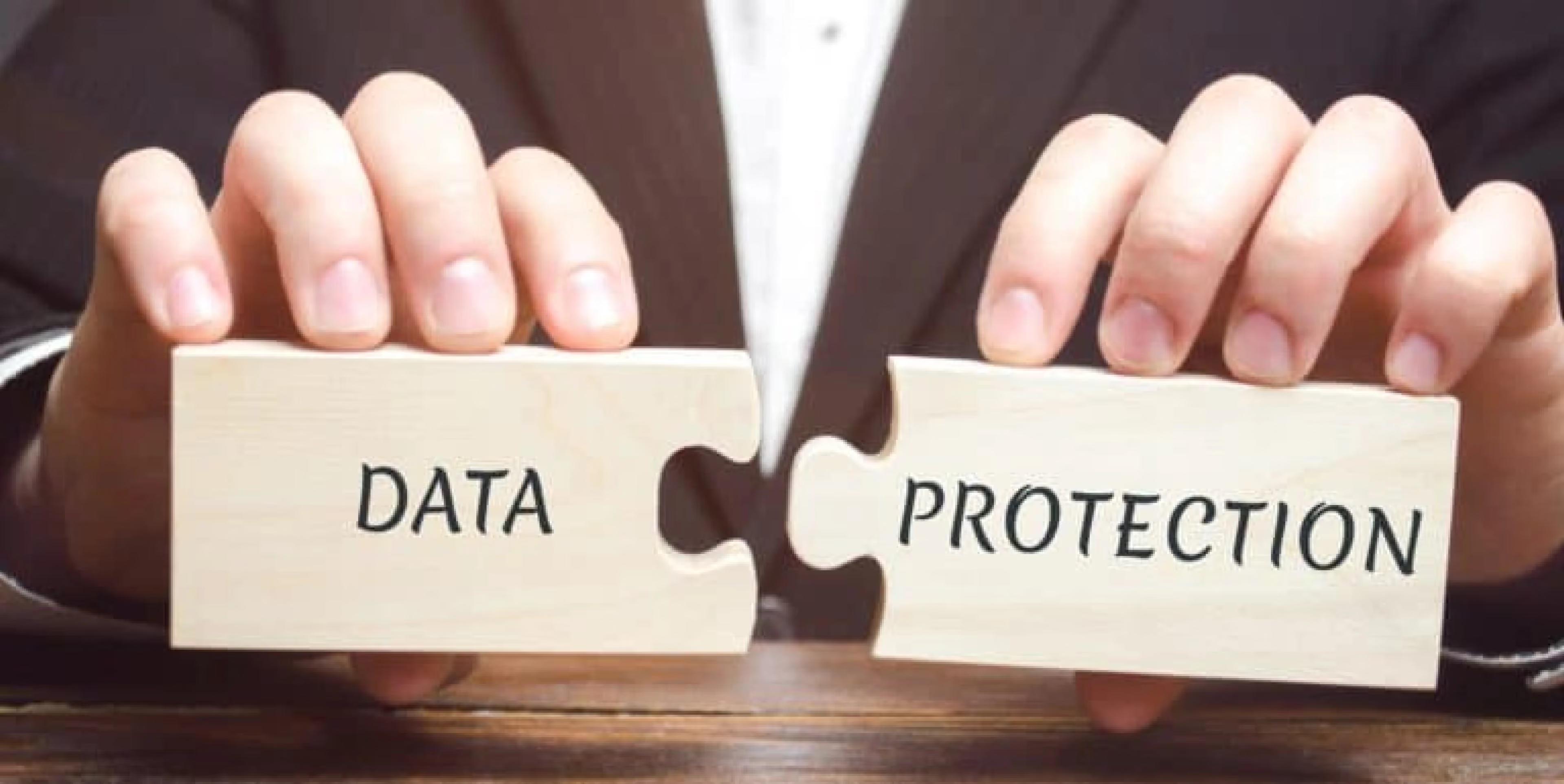
Is Your Proctoring Solution a Security and Privacy Threat?
August 27, 2023
|
5 min read
The US Department of Education's Privacy Technical Assistance Center has documented how data breaches and malware attacks have affected education systems across every sector. Most online proctoring services require browser extensions or plugins that create exactly the kind of installation-based malware vector that security researchers flag as high risk. This post examines the threat, what organizations should require from their proctoring vendors, and why a no-installation approach eliminates the risk at the source.
The US Department of Education's Privacy Technical Assistance Center published a presentation titled Security Threats: Education Systems in the Crosshairs, in which security advisor Mike Tassey documented how data breaches, hacks, and privacy incidents have affected organizations across virtually every sector, from NASA and Citigroup to local school systems.
The warning is directly relevant to any organization using online proctoring. The data that proctoring services collect, including names, government-issued ID, biometric images, and session recordings, is exactly the kind of information that makes education systems a target.
The Threat Landscape Has Changed
Cyber-theft has become fully commoditized. There is an active black market for personal data, and an underground economy where over two million pieces of malware are built and sold every year. This malware is designed to gather precisely the kind of information proctoring platforms collect: Social Security numbers, addresses, birth dates, and identity credentials.
Tassey specifically noted that children's identities are particularly valued by data thieves because they are, in his words, fresh. A child's identity may go undetected for years before the theft is discovered, making it a high-value target for long-term fraud.
The alarming part is how malware typically gets onto devices. It is not usually through pirated software or poor security settings. It enters through plugins and browser extensions that users install themselves, often for legitimate purposes. The installation is the vector.
Why Proctoring Plugins Create Specific Risk
Most online proctoring services require users to install browser extensions or plugins to enable monitoring. Each of these installations represents an opportunity for malware to enter the device, either during the initial installation or through a subsequent update, without the user's knowledge or permission.
Tassey's research notes that on average there are one to five bugs for every 1,000 lines of code. For organizations that have not completed independent code reviews of the proctoring software they deploy, those bugs represent an unexamined attack surface. Malware can be introduced into code updates without detection, meaning a plugin that was clean at installation may not remain so.
At minimum, organizations should be instructing learners to disable or uninstall proctoring plugins and extensions immediately after use. The risk does not end when the exam does.
What a Code Review Should Cover
Organizations that require learners to install proctoring software should conduct, or require their vendor to provide evidence of, a code review that addresses:
- Potential malware embedded in the plugin or extension code
- Errors or vulnerabilities that could be exploited by third parties
- Whether the software receives automatic updates, and what review process governs those updates
- What data the software transmits, to where, and under what conditions
If a vendor cannot provide clear answers to these questions, the software should not be deployed on learner devices.
The Case for No-Installation Proctoring
The most effective way to eliminate installation-based security risk is to remove the installation requirement entirely. Integrity Advocate's platform is browser-based and requires no plugin, extension, or application installation in most cases. There is nothing to install, nothing running in the background after the session ends, and no update mechanism that could introduce malware without the user's knowledge.
For use cases that do require a lockdown browser, Integrity Advocate's solution uses fully open source code, does not accept automatic updates after installation, and does not transmit data beyond what is required for the session. The code is publicly available for inspection.
The US Department of Education's guidance on protecting student privacy points to the same principle: the safest data handling approach minimizes what is collected, minimizes how long it is retained, and minimizes the software footprint on learner devices.
{{post-cta}}
Why Privacy-First Proctoring Will Define Online Assessment in 2026 (and Beyond)
December 8, 2025
|
5 min read
In 2025, privacy became the deciding factor in whether organizations adopt, keep, or replace their proctoring vendor. Learners are more vocal about surveillance. Legal and privacy teams are asking harder questions. Accreditation bodies are demanding clearer, more defensible data practices. This post explains what privacy-first proctoring actually means architecturally rather than as a marketing claim, how Integrity Advocate implements it across five specific design decisions, and why privacy-first will lead vendor decisions in 2026 as regulatory requirements tighten and learner trust becomes a measurable program outcome.
In 2025, one theme rose above all others in the world of online proctoring: privacy is now a deciding factor in whether organizations adopt, keep, or replace their proctoring vendor. As remote exams and digital credentialing continue to scale, institutions are realizing that effective proctoring isn’t just about stopping misconduct, it’s about doing it in a way that respects the people behind every assessment. This shift has been driven by a few powerful forces:
- growing public discomfort with invasive surveillance
- stricter global and institutional data protection requirements
- accreditation bodies demanding clearer, more defensible privacy practices
- test-takers becoming more vocal about what they will, and won’t, accept
It’s no longer enough to secure exams; organizations also have to secure trust. And that begins with privacy.
From “Nice to Have” to Non-Negotiable
Only a few years ago, privacy considerations were something addressed near the end of a vendor evaluation. Today, they’re the starting point. Learners, legal teams, regulators, and internal privacy officers are asking tougher, more detailed questions:
- What exactly is being recorded?
- How long is the data stored, and who can access it?
- Do test-takers have to install software on personal devices?
- Is biometric data being captured or saved?
- Does the system monitor more than is truly needed?
These aren’t niche concerns, they’re fundamental expectations. And when programs can’t answer these questions confidently, trust and adoption suffer.
This is why privacy-first proctoring has moved from a helpful differentiator to a baseline requirement for any institution serious about delivering fair, modern, and defensible assessments.
What Privacy-First Proctoring Actually Means
Many proctoring tools call themselves “privacy-friendly,” but privacy-first is something different. It’s not a marketing angle, it’s an architectural choice. It shapes how the system is built, what data it collects, and how it interacts with both learners and administrators.
Here’s what privacy-first looks like in practice with Integrity Advocate:
1. Minimal Data Collection: Only What’s Necessary
Integrity Advocate collects only what is needed to confirm identity and verify participation. No scanning of personal files, no continuous background monitoring, no broad access to the device.
This approach aligns with global data minimization standards and simplifies conversations with privacy and compliance teams.
2. A No-Install, Browser-Based Experience
Because Integrity Advocate runs directly in the browser and works within your LMS, there’s no software to download or manage, which means:
- No risk of lingering software on personal devices
- No conflicts with corporate firewalls
- Fewer technical issues and exam-day barriers
- A far less intrusive experience for test-takers
Privacy improves, and so does usability.
3. No Biometric Template Storage
While some proctoring tools rely on building biometric profiles, Integrity Advocate verifies identity without storing facial templates or other high-risk biometric data.
With global privacy regulations tightening, avoiding biometric storage removes one of the most sensitive risk categories for institutions.
4. Clear, Time-Bound Retention and Encrypted Storage
Transparency matters. Institutions want to know:
- how long exam data is kept
- how it’s encrypted
- who can access it
- when and how it’s deleted
Integrity Advocate supports strict retention timelines and secure storage practices, reducing long-term exposure and easing accreditation and audit reviews.
5. Privacy by Design, Not Added Later
Every feature of Integrity Advocate, from identity verification to participation monitoring to human review, is built with privacy constraints in mind. We don’t add privacy after development; we design around it from the start.
That mindset results in a system that is respectful, compliant, and aligned with the expectations of modern digital assessment.
Why Privacy-First Proctoring Will Lead Vendor Decisions in 2026
The move toward privacy-first proctoring isn’t slowing down, it’s accelerating. Several trends point to why institutions will prioritize these solutions in the coming year:
1. Regulatory and Accreditation Requirements Are Rising
Regulatory environments worldwide are becoming more prescriptive about personal data use. Institutions are expected to demonstrate:
- data minimization
- justified data collection
- documented retention and deletion practices
- strong encryption protocols
- thoughtful handling of sensitive data
A privacy-first proctoring partner reduces compliance burden and institutional risk.
2. Learner Trust Drives Program Success
When test-takers feel uncomfortable or monitored too aggressively, exam anxiety rises, completion rates fall, and complaints increase. Trust isn’t just a philosophical concept, it affects outcomes.
Privacy-first proctoring improves the entire assessment experience by reducing friction and creating a clearer, more respectful process for learners.
3. Usability and Privacy Are Now Interconnected
Many of the decisions that protect privacy also make proctoring easier to use:
- No installs → fewer technical failures
- Minimal monitoring → fewer permissions and pop-ups
- Embedded LMS workflows → less confusion for learners
- Transparent policies → fewer escalations on exam day
When privacy improves, usability improves, and your program benefits immediately.
4. Intrusive Tools Are Becoming Harder to Justify
Solutions that require extensive device access, deep installs, or full desktop monitoring are facing increasing resistance, from learners, privacy teams, IT departments, and regulators.
Organizations that adopted heavy client-based tools early in the remote testing surge are now looking for alternatives that carry less risk, less friction, and less complexity.
Privacy-first proctoring offers exactly that.
Privacy-First Doesn’t Mean Less Secure, It Means More Responsible
A common misconception is that privacy-first design compromises security. In reality, the opposite is true. Effective proctoring is not about collecting more data; it’s about collecting the right data in the right way.
Integrity Advocate balances:
- identity verification
- participation and engagement monitoring
- AI-assisted analysis
- human oversight for context
- transparent, reviewable reporting
This approach strengthens fairness, defensibility, and trust without relying on invasive surveillance.
As You Plan for 2026, Privacy Should Lead the Conversation
As institutions prepare for the next evolution of remote and hybrid assessment, a few key questions can guide whether your current proctoring approach is still the right fit:
- Can we clearly explain the data our proctoring tool collects and why?
- Would our privacy or legal teams feel comfortable defending these practices?
- Are learners confident and comfortable using our current system?
- Do we rely on unnecessary installs or device access we’d prefer to avoid?
- Would our approach hold up under accreditation or regulatory review?
If any of these questions reveal uncertainty, a privacy-first model may be the solution your program needs.
See How Privacy-First Proctoring Strengthens Both Trust and Integrity
Integrity Advocate proves that you don’t have to choose between protecting exams and protecting people. You can uphold integrity, support fairness, and respect privacy, all within one streamlined, secure solution.
If strengthening trust, improving usability, or modernizing your assessment strategy is on your roadmap for 2026, we’d be happy to show you how privacy-first proctoring can support your goals.
Book a Demo with Integrity Advocate
{{post-cta}}

Who’s Guarding the Guards? The Case for Verified Credentials in Private Security
October 21, 2025
|
5 min read
Private security is one of the fastest-growing sectors in North America, with more than 1.1 million guards employed in the US alone. Many earn their credentials through unproctored online exams that are easy to manipulate and nearly impossible to defend in an audit. A single lapse, whether an untrained guard or an expired credential, can lead to use-of-force incidents, lost client contracts, and license jeopardy. This post examines the verification gap in private security credentialing, the regulatory tightening underway in states including California, New York, and New Mexico, and how hybrid proctoring converts a vulnerable step in the talent pipeline into a source of defensible proof.
The Silent Vulnerability in Private Security
In an industry built on vigilance, one of the biggest risks often hides in plain sight: unverified employee certifications.
Across North America, private security is one of the fastest-growing sectors, employing more than 1.1 million guards in the U.S. and over 100,000 in Canada. Many earn their credentials through un-proctored online exams that are easy to manipulate and nearly impossible to defend if audited.
A single lapse, such as an untrained guard or expired credential, can lead to use-of-force incidents, lawsuits, or terminated client contracts. In a field built on trust and liability protection, that’s a risk no firm can afford.
When “Certified” Doesn’t Mean “Qualified”
Every state and province has its own licensing body, from California’s BSIS Guard Card to Ontario’s 40-hour Basic Security Training. While the curriculum is standardized, the testing process often is not.
Some training providers still issue certificates through basic online exams without confirming who took the test or how it was completed. This opens the door to impersonation, collaboration, or the use of unauthorized aids, issues that stay hidden until a compliance audit or incident brings them to light.
When regulators or clients request proof, “we trusted our vendor” will not hold up. You need verifiable, auditable evidence that every guard earned their credential legitimately.
Regulators Are Increasing Accountability
State licensing boards and auditors are tightening their expectations. Several states, including California, New York, and New Mexico, have strengthened requirements for identity verification in guard licensing renewals and compliance reviews in 2024.
For larger firms and government contractors, missing verification documentation can delay license renewals, restrict site access, or lead to disqualification in competitive bids. The shift from “trained” to “provably trained” is already underway.
The Real-World Cost of Unverified Exams
- Legal exposure: A 2024 Allied Market Research report estimated private security liability claims exceeded $500 million annually, often tied to improper training or credentialing lapses.
- Client contract loss: Many corporate and event-security RFPs now require proof of verified training records. A single failed audit can jeopardize multi-year contracts.
- Reputational damage: News headlines linking “untrained guard” to an incident can spread overnight, eroding years of brand trust.
What Proctoring Really Means and How It Solves the Verification Gap
Proctoring is the process of confirming a test taker’s identity and safeguarding the integrity of the exam. In practice, modern online proctoring combines automated monitoring with human review to validate who is testing and how they complete the assessment.
How it closes the gap:
- Identity verification: Government ID checks and real time presence verification confirm the right person is taking the exam, which strengthens defensibility in audits and investigations.
- Session integrity: Monitoring detects prohibited behaviors such as a second person in view, phone use, or leaving the testing area, creating evidence that the assessment conditions were valid.
- Audit ready records: Each session generates time stamped artifacts that can be retrieved for client audits, regulator reviews, and license renewal cycles.
- Operational fit: Remote exams let trainees certify sooner and supervisors verify results faster, which supports quick onboarding and minimizes scheduling friction.
- Liability reduction: Verifiable results show due diligence, which helps protect contracts and reduce exposure when incidents are reviewed.
For private security, verified testing converts a vulnerable step in the talent pipeline into a source of proof. Each credential is tied to the right person, completed under valid conditions, and backed by records you can defend.
Tailored Pressures Across the Workforce
Security Guard Trainees: Onboarding Fast Without Cutting Corners
Turnover is high and new hires must get licensed quickly to meet client demand. Verified online testing lets recruits certify remotely, saving scheduling time while maintaining defensible compliance. Firms can scale faster without risking audit failures or fraudulent completions.
Bouncers and Venue Guards: Managing High-Risk Environments
In hospitality and nightlife settings, liability is constant. A verified certification process provides proof that staff are trained in de-escalation and use-of-force protocols, protecting both employers and clients if incidents occur.
Armed Guards: Higher Stakes, Higher Standards
For armed roles requiring firearms or use-of-force certification, regulators and insurance carriers expect evidence that each guard completed training personally and ethically. Verified testing creates the defensible record needed for renewal cycles and legal review.
Supervisors and Compliance Managers: Reducing Administrative Risk
Supervisors are responsible for verifying dozens of licenses and renewals at once. Hybrid proctoring eliminates manual record-checking by providing automated audit trails and verifiable data, reducing administrative load and ensuring compliance readiness at all times.
Private Investigators: Protecting Confidentiality and Credibility
Private investigators operate under strict confidentiality and often handle sensitive information that can influence legal outcomes. For them, verified training is not just a requirement but a professional safeguard.
Turning Verification Into a Competitive Advantage
Beyond compliance, verified exams reduce operational friction. Security firms using verified online proctoring report:
- Up to 40% faster onboarding, cutting scheduling delays and improving workforce readiness
- Fewer audit disputes, since each credential is accompanied by a verifiable record
- Higher guard participation and satisfaction, thanks to flexible, remote testing options
Verification isn’t just about preventing cheating. It’s about building efficiency, trust, and defensibility into your entire credentialing process.
Building Trust, One Credential at a Time
Trust in private security is earned by proving readiness, not just claiming it. Verifiable credentials turn training records into operational assurance. They help you pass client audits, maintain site access, and resolve incident reviews with clarity. With privacy-by-design testing and retrievable evidence, you protect your people, your clients, and your reputation without slowing the work.
How Integrity Advocate Helps
Integrity Advocate focuses on the moments that matter in certification, from enrollment to renewal, so your team stays provably qualified.
- Identity proofing at the start: Confirm the right person is enrolled and testing, reducing impersonation risk before it starts.
- Evidence that stands up to review: Store time stamped session artifacts and summaries that are easy to share during audits and investigations.
- Works with your stack: Connect to your LMS or licensing systems to centralize records and minimize duplicate admin work.
- Privacy and accessibility built in: Limit data collection, respect accommodations, and keep policies clear for candidates and supervisors.
- Support when it counts: Access responsive help and standardized verification letters to satisfy client and regulator requests.
- Real Example: Limit data collection, respect accommodations, and keep policies clear for candidates and supervisors, a balance we explore further in how doctoral programs navigate assessment security and privacy
See how Integrity Advocate can help security organizations protect compliance, reduce liability, and strengthen trust. Request a Demo
{{post-cta}}
Frequently asked questions
Find answers to the most commonly asked questions from our clients.
Many proctoring platforms collect significantly more than identity and session data. Depending on the provider, this can include government-issued ID numbers, full browsing and search history, biometric data, medical information, political affiliations, and footage of others in the test taker's environment such as family members or housemates. The only way to know what a specific provider collects is to read their privacy policy in full.
Retention practices vary widely by provider. Integrity Advocate deletes all session recordings and desktop recordings within 24 hours of a completed session where no rule violations are found. Only a single identity photo is retained beyond that point.
US-based proctoring companies are subject to US government data requests, including those made under laws that may not require notification to the individual. As a Canadian company, Integrity Advocate operates outside US jurisdiction. In the unlikely event of a compelled disclosure, the data available on the vast majority of users would be limited to a name and a facial image represented as a string of code.
Privacy by Design means that data minimization and privacy protections are built into the product architecture from the start, not added as policy language after the fact. For proctoring, it means the platform collects only what is necessary, deletes what is not needed, and limits sharing to what is required to document a specific finding. It is the difference between a platform that is private by default and one that is private only when required by law.
Look for clear answers to five questions: what is collected and is it limited to what is necessary; whether data is sold or shared with third parties; how long data is retained and what triggers deletion; whether the vendor is subject to US government data requests; and whether there is a human review process before findings are shared with the institution.