
Detect the tools. Protect the results.
CounterAI™ cheating detection built for what comes next
CounterAI™ helps identify AI-assisted cheating through behavior-based detection, contextual review, and human-verified evidence, so your program can respond defensibly while staying ahead of evolving threats.
Our approach to AI cheating detection
Detect AI misuse without chasing every new tool
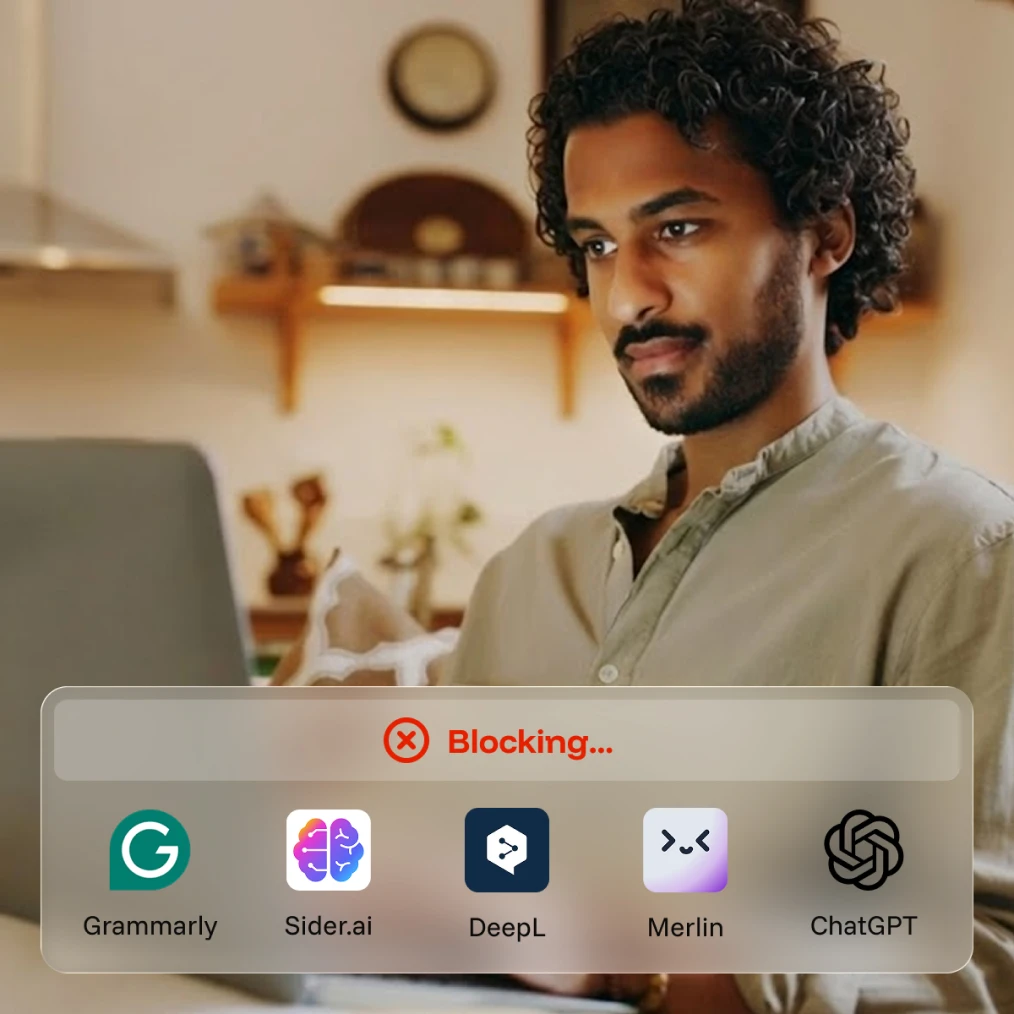
AI cheating is not static. Tools evolve and adapt quickly, which makes tool-by-tool detection difficult to sustain. CounterAI™ focuses on how AI misuse shows up during an assessment: unusual behavior, evasion attempts, interaction patterns, and risk signals that are evaluated in context.
Detects behavior patterns associated with AI assistance
Blocks or interrupts unauthorized use of AI assisted apps that may compromise the integrity of your assessments when risk is identified
Evaluates flagged activity with human review before outcomes are confirmed
Why Behavior detection matters
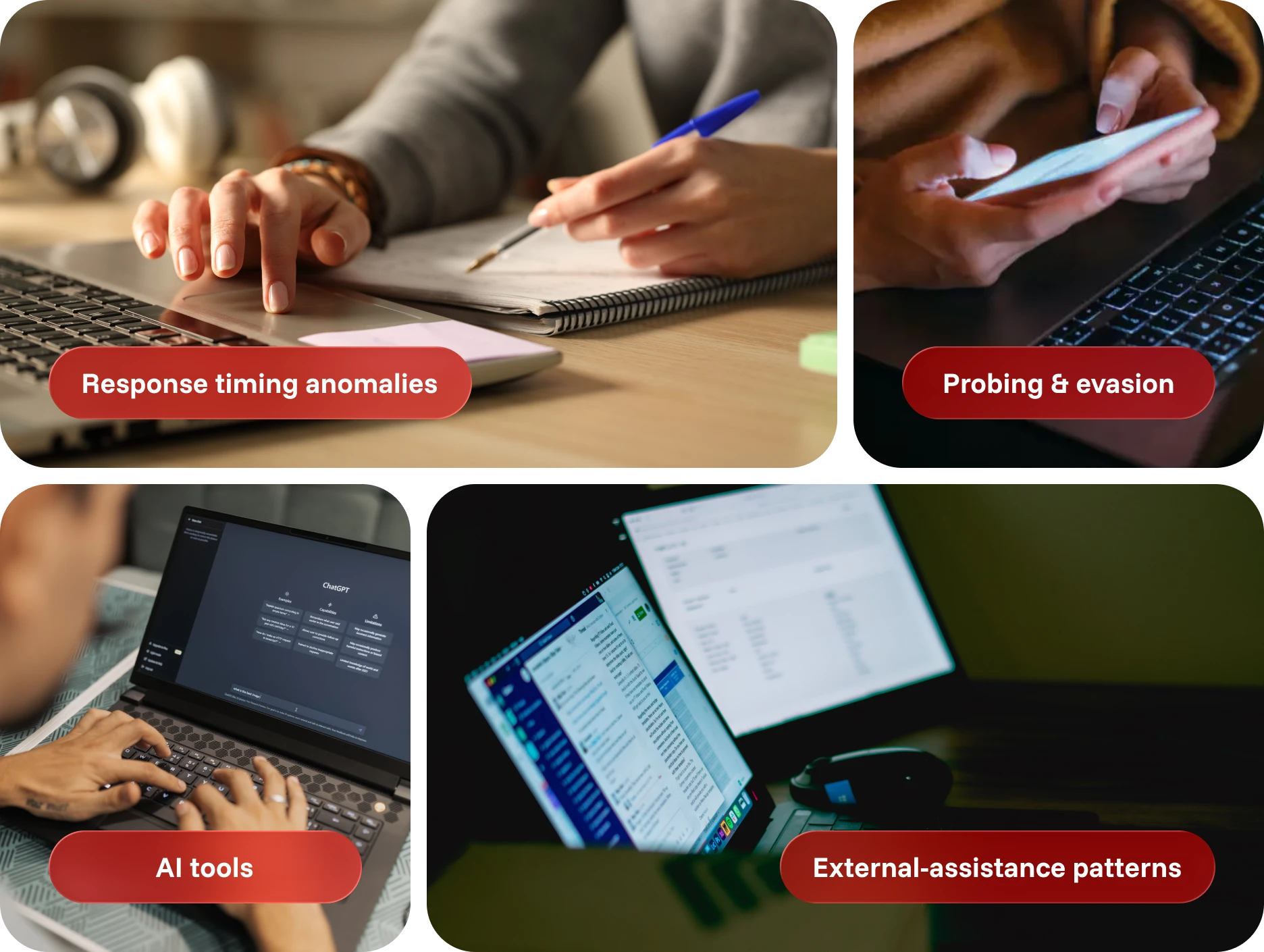
AI-assisted cheating changes quickly. New apps, extensions, copilots, and renamed tools can appear faster than detection lists can be updated. A sustainable approach looks beyond the tool itself and identifies how someone is attempting to evade oversight.
CounterAI™ is designed to recognize patterns of AI misuse, probing, and external assistance, helping your program stay ahead of new threats without depending on a constantly changing catalog of tools.
Built on security doctrine
A holistic security approach to AI cheating detection
CounterAI™ operates within Integrity Advocate’s broader security-based proctoring framework, where multiple controls work together to prevent, detect, evaluate, and respond to risk. That means AI cheating signals are considered alongside behavioral, environmental, and situational context.
Deterrence
Visible oversight discourages misuse before it starts.
Situational awareness
Behavioral baselining helps separate normal activity from meaningful risk.
Counter-surveillance
Evasion behaviors are detected, even when tools are renamed or disguised.
Proportional response
Actions are matched to risk, helping avoid unnecessary escalation.
Evidence-based outcomes
Decisions are documented, explainable, and ready for review.
Download the Security Based Proctoring Ebook
Learn how CounterAI™ fits into a broader integrity framework.
OUR HUMAN APPROACH
AI can flag risk. Human review applies the context
Automated detection can identify suspicious patterns, but it cannot fully understand intent, context, or the surrounding assessment environment on its own. Integrity Advocate adds trained human review to every CounterAI™ flag, helping ensure decisions are based on corroborated evidence rather than isolated signals.
A real person confirms what happened, applies program rules, and documents the decision, giving test takers a fair process and your organization a defensible record.
ADVANCED SECURITY OPTIONS
Layered protection for higher-risk assessments
CounterAI™ works alongside additional security controls that reduce opportunity, capture context, and help reviewers understand what happened during the assessment.

Onscreen content protection
Blocks risky on-screen actions, like copying, printing, and shortcuts that could enable cheating or content theft, keeping test content secure throughout the exam.

Room scan
Before the exam begins, test-takers pan their camera to show their workspace, confirming there are no unauthorized materials while minimizing extra personal data captured.

Second camera
An optional second camera provides a wider view of the testing space for high-stakes exams, adding another layer of oversight without disrupting the test-taker’s experience.
HOW WE COMPARE
Three approaches to AI cheating detection, only one is built for context
Tool lists and lockdown browsers can help, but they often miss the bigger picture. Integrity Advocate combines behavioral detection, layered controls, human review, and audit-ready evidence.
END-TO-END WORKFLOW
From AI risk signal to human-verified outcome
Every flagged event follows a connected review process that combines detection, context, evidence, and human judgment; creating a secure, time-stamped record your program can rely on for appeals, audits or compliance reporting.
Identity verified first
The assessment begins with identity verification, helping confirm the right person is in the session.
Session proctored and monitored
Monitoring establishes context across behavior, attention, navigation, environment, and interaction patterns.
AI and risk detection in real time
CounterAI™ identifies signals of unauthorized AI assistance, evasion, or suspicious interaction patterns.
Audit-ready, human-verified record
A trained reviewer evaluates the evidence, confirms the outcome, and creates an audit-ready record.
TRUSTED BY PROGRAMS WORLDWIDE
Programs worldwide rely on Integrity Advocate for outcomes that are fair, trustworthy, and defensible
Over 10 million sessions proctored, zero breaches in 12+ years, 98% client retention, and the #1 spot on G2 for ease of use.



WHAT OUR CLIENTS SAY
“The technology and artificial intelligence—I don't want to say changes daily, but I'd be joking if I didn't say it wasn't. And the Integrity Advocate team is responsive, is good at teaching us the ropes about what to look for, is constantly updating their system.”


AI cheating detection you can actually stand behind.
Every flag reviewed by a real person. No installs. Zero breaches in 12 years. See how Integrity Advocate works and what it means for your program.
10M+
Total sessions proctored
65+
Languages supported
98%
Client retention rate
Resources on AI cheating detection
Explore our latest educational resources and industry insights on AI-assisted cheating and assessment security.

Most Proctoring Tools React to Cheating. This Approach Prevents It.
July 9, 2026
|
5 min read
Most proctoring platforms are built to detect cheating after it happens. Integrity Advocate's security-based framework is designed to prevent it through deterrence, proportional response, and human-reviewed evidence, with Counter-AI as one component of a broader system built to adapt as threats evolve. This post introduces the framework and links to the full white paper.
There is a meaningful difference between a proctoring system that catches violations after they happen and one designed so that violations are less likely to happen in the first place.
Most platforms focus on detection: flag the behavior, generate a report, let the program sort out what it means. The problem with that model is that it puts the burden on test takers, creates false positives, and produces results that are hard to stand behind when challenged.
Integrity Advocate takes a different approach, one grounded in a principle that applies equally well in physical security, public safety, and assessment integrity: the most effective systems deter problems before they occur, respond proportionally when they do, and produce evidence that holds up to scrutiny.

Download the Whitepaper
Deterrence First
The presence of proctoring changes behavior. Most test takers who know their session is being monitored by a real person, not just logged by an algorithm, approach the assessment the way it was intended. No intervention needed.
This is why the combination of visible monitoring and human review is more effective than automated detection alone. It is not just about catching the problem. It is about creating conditions where the problem is far less likely to arise.
Proportional Response
Not every behavioral signal warrants the same response. A proportional approach distinguishes between a minor anomaly and a genuine concern, applying appropriate controls without penalizing test takers for things that do not actually matter.
This is what separates a system that generates noise from one that produces clarity. Fewer false positives. Less administrative burden. More defensible outcomes.
Evidence That Holds Up
When a result is challenged, the question is not whether the system flagged something. It is whether a person reviewed it, made a judgment, and documented their reasoning.
Integrity Advocate's human review process ensures that every flagged session is assessed by a trained reviewer before any outcome is recorded. That is what makes the result defensible, and what allows programs to stand behind what they issue.
Built for What Comes Next
AI cheating tools are the most urgent current threat, and Integrity Advocate's Counter-AI capability addresses them directly. But a sustainable integrity strategy cannot be built around detecting one category of tool. It has to be designed to adapt as threats evolve.
That is the difference between a feature and a framework.
{{post-stat-highlight}}
The full white paper walks through exactly how this works in practice, including how each control layer functions, how Counter-AI fits within the broader system, and what proportional enforcement looks like for programs of different sizes and risk levels.
{{post-cta}}

Integrity vs. Surveillance: Is Your Proctoring Tool Monitoring Learners or Surveilling Them?
July 2, 2024
|
5 min read
There is a meaningful difference between monitoring and surveillance in online proctoring, and most programs have not thought carefully about which one they are actually doing. Monitoring confirms identity, verifies participation, and produces a defensible result. Surveillance collects everything it can, flags anything it does not recognize, and leaves programs to sort out the noise. This post draws that distinction clearly, explains what privacy-first proctoring actually looks like in practice, and makes the case for why human review is the only thing that makes an assessment result genuinely defensible when it is challenged.
There is a difference between monitoring and surveillance. Most programs running online assessments haven’t thought carefully about which one they’re actually doing, and that gap is where trust starts to erode.
Monitoring confirms that the right person completed the assessment, stayed engaged, and followed the rules. Surveillance collects everything it can, flags anything it doesn’t recognize, and leaves the program to sort out what any of it means.
One produces a defensible result. The other produces liability.
If your proctoring tool accesses the file system of a personal device, stores recordings your team will never review, or generates hundreds of automated flags with no human judgment behind them, it’s not monitoring. It’s surveillance. And your learners know the difference.
What monitoring is actually supposed to do
Every program administering online assessments has the same core need: confirm identity, verify participation, and produce a result that holds up to scrutiny.
That’s it.
You’re not trying to catalog everything that happens in a candidate’s home. You’re not trying to build a behavioral profile. You’re trying to answer three questions:
- Was this the right person?
- Did they complete the assessment under appropriate conditions?
- Can you stand behind the result if it’s challenged?
A well-designed proctoring approach answers all three. An over-engineered one tries to answer questions nobody asked, and in doing so, creates new problems. More data. More noise. More privacy exposure. And a test-taking experience that generates complaints before a single result is issued
Where surveillance starts
Privacy-first proctoring is not a softer version of security. It’s a more precise one.
It starts with a design principle: collect only what is necessary to confirm identity and verify engagement. Nothing beyond that scope. No recordings stored by default. No system-level device access. No behavioral data used outside the bounds of the specific assessment.
In practice, that looks like this:
No downloads or extensions. The assessment runs in a browser. No software installs, no hidden permissions, no access to personal files or background applications. A test taker can sit the exam on any device without IT involvement or configuration.
Proportionate data collection. Every feature and every data point collected should have a clear answer to the question: why does this make the result more defensible? If the answer is “it doesn’t,” it shouldn’t be collected. Surveillance produces volume. Monitoring produces clarity.
Data minimization by design. The only data collected is what’s needed to produce a defensible result: identity verification, participation confirmation, and a reviewable record of any flagged behavior. Sensitive data, including ID images, is deleted within 24 hours.
Compliance built in, not bolted on. GDPR, PIPEDA, FERPA, and SOC2 compliance aren’t checkbox items. They reflect a commitment to proportionate data collection, the kind of approach that holds up when regulators or institutional counsel start asking questions.
Human review is what makes the result defensible
Here’s what automated flags can’t tell you: whether a behavior was actually a problem.
An algorithm can detect that a second face appeared in the frame. It cannot tell you that the second face belongs to a child who walked in, not an accomplice. It can flag an unusual eye movement pattern. It cannot determine whether that pattern indicates academic dishonesty or a medical accommodation. It can detect a background sound. It cannot decide whether that sound matters.
Those determinations require a person.
At Integrity Advocate, every flagged session is reviewed by a trained human reviewer before any outcome is issued. Not as a premium tier. Not as an add-on. As the standard, at every price point.
That’s the difference between a defensible result and an automated flag you have to explain to a grievance committee.
Programs that rely on automated proctoring alone are producing outcomes they cannot fully stand behind. When a result is challenged, and eventually one will be, “the algorithm flagged it” is not a sufficient answer. A documented, human-reviewed decision is.
The question your program should be asking
Before your next contract renewal or platform evaluation, ask this: what does your current proctoring tool collect, and who reviews it before a result is issued?
If the answer is “a lot” and “no one,” that’s the surveillance model. It may feel thorough. It isn’t defensible.
Privacy-first online proctoring isn’t about doing less. It’s about doing exactly what’s necessary, with human judgment behind every decision that matters. That’s what produces results your program can stand behind. It’s what earns trust from your learners. And it’s what holds up when the stakes are highest.
Integrity doesn’t require surveillance. It requires precision.
{{post-cta}}
What Defensible Assessment Looks Like in 2026
April 7, 2026
|
5 min read
AI tools have changed what cheating looks like, and most proctoring systems were built for a different problem. This post covers why an automated flag alone can't defend an outcome, and what a defensible assessment record requires in 2026.
We talk to a lot of programs right now that are dealing with the same thing. AI tools have changed what cheating looks like, and most proctoring systems were built for a problem that’s no longer the only one on the table. The gap is showing up in appeals, in complaints, and in outcomes that are getting harder and harder to defend.
What’s actually happening out there
The classic image of cheating a second phone, a friend on the other side of the room, notes taped to a monitor is still real. But it’s not the conversation we’re having with most programs anymore. The harder stuff is subtler.
AI writing tools can produce a natural, well-reasoned answer in seconds. Paraphrasing tools can disguise lifted content well enough to pass similarity checks. And the behavioral signals that used to flag something suspicious eye movements, typing pace, browser switching don’t tell you much when the assistance is happening invisibly, in another tab or on another device entirely.
The problem isn’t that AI cheating is impossible to catch. It’s that catching it requires a level of context and judgment that an algorithm alone doesn’t have.
An algorithm can tell you something looked unusual. It can’t tell you what actually happened or whether it matters. That part still requires a person.
Why a flag without a human isn't enough anymore
Automated proctoring was designed to catch visible, definable behaviors tab switching, phone use, an unauthorized person on screen. For those cases, it works. But AI-assisted cheating often leaves no visible trace at all.
So when an automated system flags something in this environment, what it's actually telling you is: something here didn't fit the expected pattern. That's a starting point, not a conclusion. The problem is when programs treat it like one.
A wrongful finding based on an automated flag isn't just uncomfortable it can seriously damage a student's record or a professional's career. And when that decision gets challenged, "the system flagged it" isn't a defensible answer. You need a record of what actually happened and a human judgment behind the decision.
{{post-stat-highlight}}
What it actually takes to be defensible
Defensibility isn't really about technology. It's about being able to look anyone in the eye a student, a candidate, a regulator, a board member and explain clearly why a decision was made and what it was based on.
In this environment, that takes three things:
- Human review on every flag, before any decision goes out. Not as an appeal process. Before the outcome is issued.
- Reviewers who are looking at AI-use patterns specifically, not just traditional integrity signals, and who understand the difference between something suspicious and something definitively wrong.
- A complete session record identity verification, monitoring log, what was flagged, what the reviewer saw, what was decided ready to export the moment someone asks.
What actually changes with human review
One question to sit with
If an outcome from one of your proctored exams was challenged today by a student, a candidate, an employer, an accreditor what could you actually put in front of them? An automated flag, or a complete human-reviewed record of what happened and why?
For programs where the result genuinely matters, that's not a rhetorical question. It's the one worth answering before you need to.
We built Integrity Advocate around exactly this human review on every flagged session, a complete audit trail for every outcome, and the kind of defensibility that holds up when someone actually pushes back.
{{post-cta}}
Frequently asked questions
Find answers to the most commonly asked questions from our clients.
AI cheating detection identifies signs that a test taker may be using unauthorized AI tools or external assistance during an assessment. Integrity Advocate’s CounterAI™ looks beyond tool names by evaluating behavioral and interaction signals in context.
CounterAI™ is designed to identify AI misuse patterns, not only known tool names. That helps protect programs as tools are renamed, embedded into browsers, added through extensions, or replaced by new technologies.
Depending on the risk level, the session may be blocked, interrupted, flagged, or reviewed. Integrity Advocate uses a proportional approach, meaning actions are based on corroborated risk signals rather than a single isolated indicator.
Every flagged session is reviewed by a trained professional. Reviewers evaluate the evidence, session context, and program rules before confirming an outcome.
CounterAI follows Integrity Advocate's privacy-by-design standards. We collect only what's necessary, evidence is redacted if sensitive content is detected, and data handling meets GDPR, FERPA, and PIPEDA requirements.