
Regulated Industries
Because safety starts before stepping onto the job
Help ensure the right people earn the qualifications that matter with trusted assessments backed by verified identity, human review, and documented evidence.

BUILT FOR REGULATED WORKFORCES
Know every result can stand up to scrutiny
When training determines who can operate equipment, enter a jobsite, prepare food, or perform regulated work, a passing score is not enough. Integrity Advocate helps confirm the right person completed the assessment and provides evidence your team can confidently stand behind.
Industries We Support
Trusted by organizations where qualifications matter
Whether you're qualifying workers, issuing certifications, or meeting regulatory requirements, Integrity Advocate helps protect the integrity of every assessment.
Construction & workplace safety
Verify required safety training and workforce qualifications across jobsites and contractors.
Food safety
Protect food handler certifications while simplifying high-volume online testing.
Oil, gas & utilities
Deliver secure assessments for distributed workforces without sacrificing compliance.
Transportation
Support licensing and workforce qualification programs with consistent assessment processes.
Regulatory & compliance organizations
Maintain defensible assessment records that withstand audits and investigations.
Environmental & industrial safety
Protect certification programs that support safe operations and regulatory compliance.
THE COST OF GETTING IT WRONG
When assessments determine who can work safely, getting it right matters
For regulated organizations, assessments help determine who is ready to work safely. When someone earns a qualification, organizations need confidence the right person completed the assessment fairly, and evidence to stand behind that decision.
Help ensure qualified individuals are ready for safety-critical work.
Support audits, investigations, and accreditation reviews.
Protect the credibility of your training and certification programs.
Help ensure qualified individuals are prepared to protect the people who rely on their work.

Defensible assessment process
Every workforce qualification should stand up to scrutiny
Integrity Advocate helps organizations document each stage of the assessment process so results can be trusted long after testing is complete.

VERIFIED BY HUMAN REVIEW
Real qualifications deserve real oversight
Every qualification represents a person trusted to perform real work. When those decisions affect worker safety, customers, or the public, context matters.
Human reviewers help ensure every assessment result is fair, accurate, and backed by evidence your organization can confidently stand behind.
WHAT OUR CLIENTS SAY
"We have put hundreds of thousands of users through this virtual proctoring successfully. Huge cost savings for my clients, in the many many millions of dollars per year in savings by allowing them to move costly in-person only training online. It works with all mainstream browsers and it's extremely easy to use. Having confidence in the knowledge that the people we are issuing safety training completion records to is invaluable."

CUSTOMER STORY
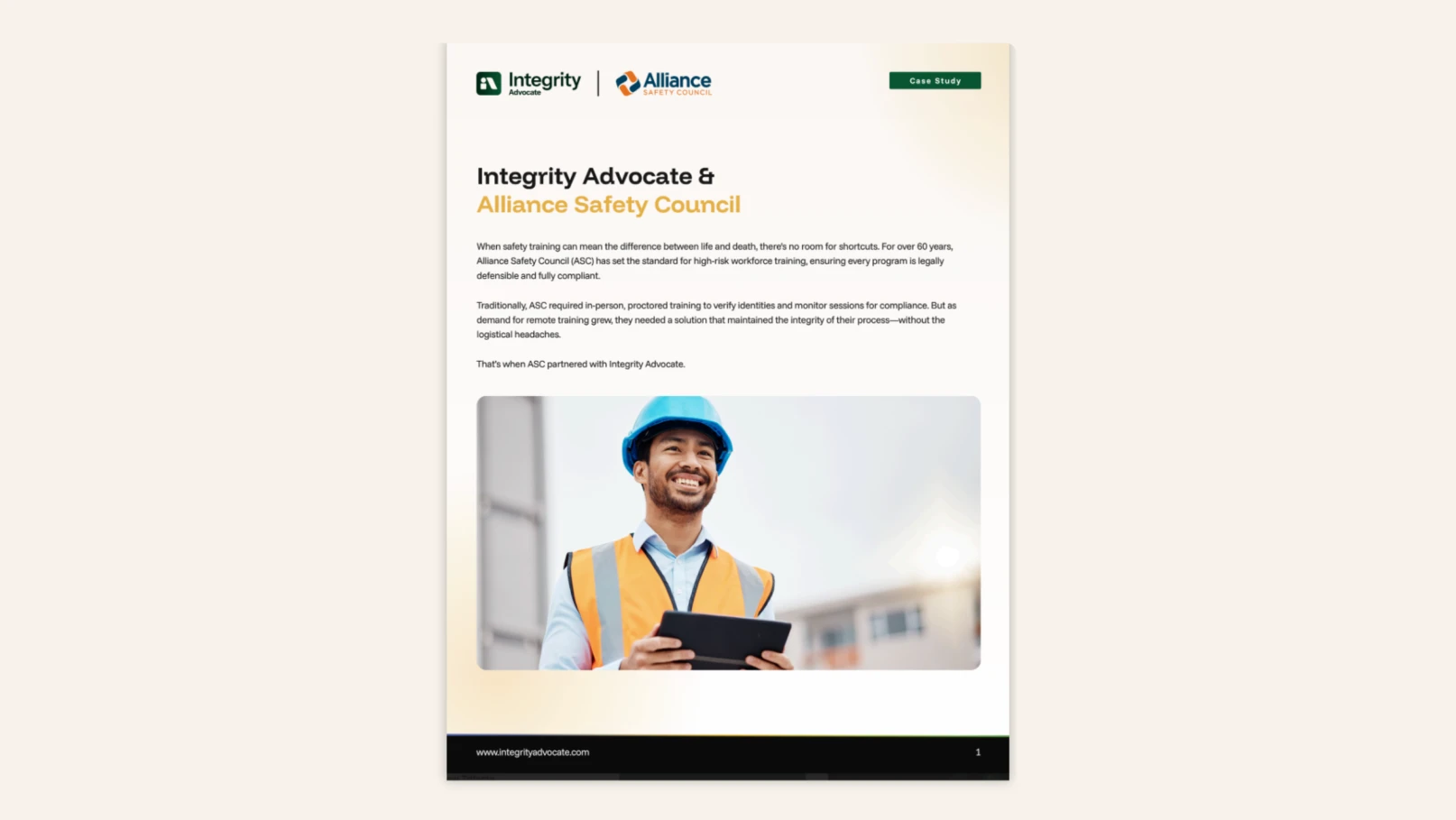
See how Alliance Safety Council expanded remote workforce training without compromising compliance.
As demand for remote training grew, Alliance Safety Council needed to verify learner identity, document participation, and maintain legally defensible records; without adding complexity for learners or administrators.
ADDITIONAL RESOURCES
Strengthen your compliance and assessment strategy
Explore practical guidance on assessment integrity, identity verification, compliance, and protecting workforce readiness.

The Certification Integrity Gap in Construction: Why Compliance Alone Won’t Keep Workers, or Projects, Safe
October 20, 2025
|
5 min read
The construction industry spends an estimated $1.6 billion annually on safety training. Yet in 2023, nearly one in five workplace fatalities still occurred in construction. When online certifications can be completed by clicking through questions without genuine engagement, the credential offers the appearance of compliance without the substance. This post examines the certification integrity gap in construction, how unverified credentials create liability for general contractors and specialty trades alike, and how Integrity Advocate's hybrid proctoring model delivers audit-ready verification that holds up under OSHA, WHMIS, and Red Seal review.
The Compliance Illusion
Every construction leader understands the stakes: a single safety lapse can cost lives, delay multimillion-dollar projects, and tarnish reputations. Yet despite billions invested in training and certification each year, preventable incidents persist.
{{post-stat-highlight}}
Unverified online certifications are fast becoming construction’s hidden vulnerability. Without verification, a “passed” test may only prove that someone clicked through questions, not that they understand life-critical protocols. In an audit or an incident review, that’s a liability no company can afford.
The New Certification Landscape
With remote training and hybrid workforces on the rise, the way construction professionals earn their safety and trade credentials has changed. But verification hasn’t kept pace.
Key challenges include:
- Identity uncertainty: Who actually took the exam?
- Scalability gaps: Remote worksites and rotating crews make in-person proctoring impractical.
- Audit exposure: Clients and regulators increasingly demand proof of authenticity, not just certificates.
- Worker pushback: Time-intensive testing processes create friction, especially for subcontractors or traveling trades.
The Role of Proctoring in Safety Certification
Before diving into solutions, it’s worth clarifying what proctoring really means in the world of safety training. In construction, the stakes are quite high, these aren’t just grades, they’re life-critical credentials that authorize someone to operate equipment, enter confined spaces, or oversee site safety.
A proctor, whether human, AI, or both, acts as an independent witness during the certification exam. Their job is to confirm that the right person is taking the test, that the environment is secure (no outside help, no unauthorized devices), and that results are credible enough to stand up under regulatory scrutiny.
When done right, proctoring transforms certification from a “check-the-box” exercise into a defensible process that protects workers, employers, and the public. That’s where Integrity Advocate’s approach goes beyond traditional models.
Integrity Advocate’s Verification Model: Proctoring That’s Built for the Jobsite
Traditional, classroom-style proctoring wasn’t designed for rotating crews, remote sites, or tight build schedules. Integrity Advocate adapts proctoring to how construction really works: on demand, in the field, and defensible.
How it works: hybrid by design
Our system monitors each session and flags anomalies, for example, multiple faces in frame, device switching, or the presence of unauthorized materials, then routes them to trained human reviewers who ensure fairness, context, and accurate decisions. Automation gives you scale, humans provide judgment.
What you get: outcomes that hold up under scrutiny
- Proof of identity on every session so you know the right person earned the credential.
- Audit-ready records to defend compliance in OSHA, WHMIS, or Red Seal reviews.
- Scalable deployment across GCs, specialty subs, and training providers—one standard everyone can trust.
- Low-friction experience for workers with no installs required in typical workflows, no rigid scheduling, and minimal disruption to site operations.
“A certificate means little if you can’t verify who earned it. Our hybrid model ensures every credential is defensible, to regulators, insurers, and clients alike.” — Brandon Smith, CEO, Integrity Advocate
General Contractors: Protecting the Entire Project Ecosystem
For general contractors, compliance risk doesn’t stop at your payroll. Every subcontractor, temp crew, and vendor working under your supervision impacts your safety record.
Because many projects require proof of OSHA 10/30 or provincial equivalents, you’re accountable for ensuring every badge on site reflects legitimate training. There are some issues that make this harder than it should be:
- Limited visibility into subcontractor credentialing
- Time-sensitive project schedules that discourage retesting
- Exposure to client audits and insurance verification
How Integrity Advocate helps:
- Provides a unified verification layer across all participating vendors
- Delivers defensible records you can produce during audits or pre-qualification checks
- Enables remote certification that doesn’t delay mobilization or disrupt project flow
The result: General contractors gain peace of mind knowing certifications can be trusted, and project risk is measurably reduced.
Electrical & Specialty Trades: Ensuring Safety in High-Risk Environments
In electrical, mechanical, and other specialty trades, a single oversight can be catastrophic. Arc flash hazards, confined spaces, and fall protection failures often trace back to incomplete or falsified training records.
Industry snapshot:
- Electrical work represents 8% of all fatal construction injuries, with electrocution ranking consistently among OSHA’s “Fatal Four.”
- Trade licensing and safety certifications, like Red Seal, WHMIS, or Fall Protection, are mandatory, yet verification often ends at “check the box.”
Smaller firms often rely on external training vendors, which can lead to technicians sharing logins or completing online assessments without supervision, ultimately reducing control over verification quality.
How Integrity Advocate helps:
- Embeds proctoring verification directly within your existing LMS or vendor training modules.
- Produces audit-ready session logs proving that the credential was earned under secure, monitored conditions.
- Offers mobile access for traveling technicians or field supervisors who need to certify between job sites.
Impact: Electrical and specialty trades can now demonstrate compliance not just on paper, but in proof that holds up under inspection or litigation.
Union vs. Non-Union: Balancing Standardization and Autonomy
Union-affiliated construction programs often maintain rigorous training pipelines through joint apprenticeship training committees (JATCs) and safety schools. Non-union contractors, by contrast, frequently rely on a mix of vendor-provided e-learning and on-site toolbox talks.
For unionized organizations, the challenge lies in verifying distributed training across locals and maintaining uniform standards, as unverified digital testing can quickly erode the hard-earned trust of regulators and clients.
For non-union firms, limited internal training infrastructure often leads to reliance on external providers that may not guarantee exam integrity, putting project bids at risk when verifiable credentials are required for participation.
How Integrity Advocate bridges both worlds:
- Enables consistent verification protocols across union and non-union sites.
- Provides neutral, third-party assurance that credentials meet defensibility standards.
- Supports collaboration with union training councils or private academies to integrate secure testing workflows.
Where to Start
- Identify high-risk credentials > Fall Protection, Confined Space, WHMIS, OSHA 10/30, Red Seal Trade Exams.
- Map current verification gaps > Who issues certificates? Are results defensible?
- Pilot Integrity Advocate with one crew or certification type.
- Scale enterprise-wide > once verified results demonstrate reduced audit findings and increased compliance confidence.
Key Takeaway
Compliance without verification is a false sense of security. In an industry where one overlooked hazard can stop a project, or cost a life, construction leaders must evolve from “certified” to “verified.”
{{post-cta}}

The Hidden Risk in Food Service & Hospitality Certifications: Why "Passing the Test" Isn’t Enough
October 17, 2025
|
5 min read
Restaurants and hospitality operators invest in food safety and alcohol service certifications to protect their business, their team, and the public. But when those exams are taken online without identity verification or participation monitoring, the certification offers the appearance of compliance without the substance. This post examines the hidden costs of unverifiable certifications in food service, how impersonation and exam shortcuts create real liability, and how Integrity Advocate integrates with ServSafe, TIPS, FoodSafe, and Smart Serve to deliver verifiable, audit-ready compliance without disrupting operations.
The Compliance Illusion
Every restaurant leader knows the checklist: ServSafe, TIPS, Food Handler, Smart Serve. You invest in training, pay the fees, and trust your team to complete the certifications that keep your business compliant. But what if those certifications, the very ones meant to protect your reputation, aren’t as secure as they seem?
Across North America, restaurants are facing mounting pressure from regulators, insurers, and brand auditors to prove their certifications are valid. And with exams increasingly taken online, the risk of fraud, impersonation, and shortcut-taking has never been higher.
The Hidden Costs of “Paper” Certifications
When a certification lacks integrity, it’s more than a technicality, it’s a liability.
- Brand damage: One unqualified employee can trigger foodborne illness outbreaks or alcohol violations that make headlines.
- Fines and legal exposure: State and provincial regulators impose six-figure penalties for non-compliance or falsified records.
- Lost productivity: Retesting, re-training, and audit disputes drain your managers’ time and budgets.
In short, paper-based trust isn’t enough in a digital world.
How Modern Proctoring Protects More Than Just Exams
Integrity Advocate was built to solve this problem, helping organizations in food service, hospitality, and beyond safeguard both their certification integrity and their reputation.
Here’s how it works: simple, secure, and human-first.
Integrity Advocate integrates directly into the systems you already rely on, like ServSafe, TIPS, FoodSafe, or your existing LMS or training portal, without requiring any downloads, separate logins, or complicated setup. Employees launch their certification exam just as they normally would, and our solution runs quietly behind the scenes, verifying their identity and maintaining exam integrity from start to finish.
Our platform is built on Privacy by Design, meaning we collect only what’s necessary to confirm identity and compliance, nothing more. Test takers aren’t subjected to invasive screen captures or unnecessary data storage. Instead, they experience a respectful, transparent process that keeps them focused on the assessment itself.
“Integrity Advocate works on all devices. We don’t hear any complaints, you don’t need to download any applications. The validation is very quick, the turnaround is very quick, the support is great, and it’s on demand.” Ellie Johnson, Operations Manager, Smart Serve Ontario (Responsible Alcohol Service Program) See Smart Serve’s Experience →
During the exam, AI technology detects behaviors that could compromise integrity, such as another person entering the frame, device switching, or unauthorized materials in view. When something is flagged, a certified human reviewer steps in to interpret context, eliminating false positives and ensuring fair, accurate results.
Because Integrity Advocate works within existing environments, it adapts to the unique demands of restaurants and hospitality operations: high turnover, tight schedules, and constant compliance pressure. The result is a secure, no-install, hybrid proctoring solution that protects your brand, respects your team, and simplifies compliance without disrupting service or adding complexity.
Our platform combines AI-driven detection with human review, ensuring every exam session is verified, secure, and defensible in an audit.
Built for Real-World Operations
Restaurants don’t have time to coordinate in-person testing or manage complex software. That’s why Integrity Advocate integrates directly with leading certification providers, including ServSafe, TIPS, and FoodSafe, so your staff can certify from anywhere, anytime, on any device.
With no installs, no scheduling headaches, and no disruption to service, your teams can stay compliant without missing a shift.
Peace of Mind for Every Role
- Owners & Franchisees: Reduce liability and protect your brand.
- GMs & Operations Leaders: Simplify compliance so you can focus on running the business.
- HR & Training Managers: Ensure every record is verifiable and audit-ready.
- Compliance Officers: Gain a tamper-proof trail that satisfies even the toughest inspections.
Compliance That’s More Than a Checkbox
Food safety and alcohol compliance shouldn’t be about checking a box, they should be about protecting people, communities, and livelihoods.
At Integrity Advocate, we believe technology should simplify compliance, not complicate it. That’s why our approach is rooted in Privacy by Design, Human Oversight, and Seamless Integration, the same principles that guide every industry we serve.
“I would highly recommend Integrity Advocate to anyone doing high- or low-stakes testing. The relationship, the support, the overall product is top of the line.”
Chris Viso, Founder, My Food Service License (ServSafe Training Partner) Read the Story
Request a Demo to see how food service & hospitality institutions across North America are transforming compliance from a liability into a competitive advantage.
{{post-cta}}

ANSI/ASSP Z490.1-2024 Is Here. Is Your Training Compliant?
May 15, 2025
|
5 min read
The ANSI/ASSP Z490.1-2024 update consolidates in-person and online Safety, Health and Environmental training into a single unified standard for the first time. Organizations can no longer simply assign a course and mark it complete. They must verify who completed the training, confirm active participation, prevent unauthorized assistance, and maintain a record that holds up to regulatory scrutiny. This guide walks safety and compliance teams through what has changed, where most current systems fall short, and how to meet the new standard without overhauling existing infrastructure.
A no-nonsense guide for safety and compliance teams adapting to ANSI/ASSP Z490.1-2024
The rules have changed. And if you’re in charge of keeping workers safe, delivering training or meeting compliance standards, you’ve likely felt the ripple.
The ANSI/ASSP Z490.1-2024 is no minor update. For the first time, both in-person and online Safety, Health and Environmental (SH&E) training are held to the same gold standard.
It’s no longer enough to say training was “offered.” You have to prove it was delivered, received and understood by the right person, in the right way, with a record to show for it.
The challenge? Most current systems weren’t built for that.
Here’s what this shift means for compliance, what to prioritize first and how to avoid the missteps that can cost you.
What’s actually new?
The ANSI/ASSP Z490.1-2024 update brings some big changes. It consolidates what were once two separate standards—Z490.1 for in-person training and Z490.2 for eLearning—into a single, unified standard for all Safety, Health and Environmental (SH&E) training.
That means no matter how your training is delivered, the expectations are the same.
You can’t just assign a course and call it complete. You have to:
- Verify the identity of the learner,
- Confirm the learner’s participation in the training,
- Prevent unauthorized assistance (human or AI),
- Communicate results promptly,
- And have a record that stands up to scrutiny.
Regulators want to see due diligence from organizations that take safety and accountability seriously. Organizations need systems that demonstrate training was handled with care, intention and oversight.
The compliance gap: identity, participation and proof
Traditional LMS’ rely on user credentials to grant access. But usernames and passwords don’t confirm who actually completed the training or whether they were even in the room.
That’s a problem. Because when safety is on the line, assumptions can cost lives.
Training is meant to protect people and prepare them for the risks they face and the responsibilities they carry. If you can’t confirm who took the training or whether they were engaged, there’s more than just compliance at stake. You’re carrying a safety risk, a legal liability and a missed opportunity to do right by your workforce.
The updated ANSI/ASSP standard puts the responsibility squarely on the employer. In the event of an incident, “we assigned the module” won’t hold up. To truly protect your organization and your people, you need training that’s verifiable. That means:
- Identity verification that confirms the right person took the training
- Participation monitoring that confirms they were present and engaged
- Data protection that respects user privacy while keeping your records defensible
It's more than business
Safety incidents put everything under the microscope. Leadership. Processes. Credibility. It’s not just your operations on the line, it’s trust. And behind that?
People’s lives. The ones training is meant to protect.
Common missteps in online training we’ve seen
Even with the best intentions, training programs can fall short, particularly when the systems in place weren’t built with today’s standards in mind.
If your current setup relies on a simple login and password, there may be gaps you haven’t considered. And if you’re using software that requires downloads or installations, you might be introducing friction for learners.
Here are a few areas where we often see room for improvement:
- Unverified attendance records that can’t confirm who actually completed the training
- Limited or no tracking of learner engagement
- Software installs that conflict with device security protocols
- Surveillance methods that may violate privacy laws
- No clear audit trail to support due diligence when it matters most
The good news is that these are fixable gaps. There are better, easier ways to meet compliance requirements today without compromising user experience, privacy or peace of mind.
What due diligence really looks like
No matter your industry—construction, food service, healthcare, manufacturing—safety training exists for a reason. Not to fill a quota. Not to tick a box.
We know you care about your workforce. You wouldn’t be reading this if you didn’t. But caring isn’t always enough, especially when systems are outdated, fragmented or easy to bypass.
Real responsibility means having a system that holds up under pressure. But how do you build a system like that without overhauling everything?
It doesn’t have to be complicated. The right tools do the heavy lifting quietly in the background, verifying identity and participation without interrupting the learning experience. No software installs. No extra logins. No support tickets flooding your inbox.
Just reliable, responsible training that works (because it’s built to).
How to get started without starting over
Already delivering training digitally? Great. You don’t need to scrap your system—you just need to make sure it can hold up under today’s standards.
Here are a few questions to help you evaluate where you stand:
- Can we confirm who completed each training session?
- Can we demonstrate that participants were engaged throughout?
- Could we confidently show this information to a regulator or investigator?
If any of those questions give you pause, it might be time to take a closer look.
Taking the Integrity Advocate approach
At Integrity Advocate, we don’t just provide tools. We partner with you to navigate compliance confidently, especially when standards change and the pressure’s on.
We help organizations meet the ANSI/ASSP Z490.1-2024 standard with:
✓ No-install identity verification and participation monitoring
✓ Mobile-friendly access that meets your learners where they are
✓ Privacy by Design to protect your organization and your people
✓ Human reviews for fairness, discretion and accountability
✓ Seamless integration and full support within your existing LMS
Need help interpreting what this new standard means for your organization? We’ll guide you through it. Meeting with regulators or external reviewers? We’ve been there too, and we’ll sit in right beside you.
Rethinking safety training in light of ANSI/ASSP Z490.1-2024
The latest ANSI update is the perfect moment to pause and reassess how we deliver training, protect our teams and uphold accountability.
Integrity Advocate is here to help you make this shift with confidence. From no-install record and review proctoring to industry-leading support levels, we make it easier to meet the standard. When training is verifiable, ethical and accessible, it doesn’t just check a box—it builds trust, saves time and protects lives.
We believe compliance can be better. And when we work together, it is.
{{post-cta}}
Frequently asked questions
Find answers to the most commonly asked questions.
Integrity Advocate helps regulated organizations verify participant identity, document assessment activity, and maintain audit-ready records that support compliance reviews, investigations, and workforce qualification decisions.
When assessments determine whether someone is qualified to perform safety-critical work, organizations need confidence in the results. Integrity Advocate helps verify identity, support fair assessment outcomes, and document the evidence behind every decision.
Each assessment includes time-stamped records, identity verification details, monitoring results, and documented evidence that can help support audits, investigations, and compliance reviews.
Integrity Advocate supports organizations across construction, workplace safety, food safety, energy, transportation, utilities, manufacturing, and other regulated industries where assessment integrity and compliance are essential.
Human review adds the context automated monitoring cannot. Trained reviewers evaluate identity checks and flagged activity to help ensure results are fair, accurate, and defensible when qualification decisions affect safety, compliance, and public trust.

See how Integrity Advocate can strengthen your program.
Book a 30-minute demo and we will walk through what sets Integrity Advocate apart, what it looks like for your specific program type, and how quickly you can get started.
10M+
Total sessions proctored
65+
Languages supported
98%
Client retention rate