
CREDENTIAL PROTECTION
Protect the value of every credential you issue
Connect verified assessment outcomes directly to secure, shareable digital credentials through our Accredible integration. Available as an add-on to any Integrity Advocate product tier.

CLOSE THE CREDENTIAL GAP
A secure exam is only the beginning
Most programs protect the assessment, then issue the credential through a separate process. That disconnect creates opportunities for manual errors, delays, impersonation, and credentials that are difficult to defend when questioned.
Integrity Advocate verifies the participant and confirms the outcome before Accredible issues a secure, verifiable digital credential; connecting assessment to credential in one auditable workflow.
Issue credentials only after required conditions are confirmed
Connect every credential to verified assessment evidence
Eliminate manual reconciliation, delays, and issuance errors
THE CREDENTIAL SECURITY TRIFECTA
Credential security depends on more than a secure exam or a verifiable certificate. It requires every stage of the learning journey to work together as one connected, auditable system.
Protected learning. Verified assessment. Trusted credential.

LMS - Protects the standard
Your LMS delivers the content, assessment, and requirements learners are expected to meet.

Assessment integrity - Protects the authenticity of the result
Integrity Advocate verifies identity, protects the assessment session, and turns performance data into trusted evidence.

Credentialing - Protects outcome over time
Accredible transforms verified achievement into a secure digital credential that can be shared and independently verified.
HOW IT WORKS
From verified assessment to trusted credential
An unbroken chain of trust ensures every credential is backed by verified identity, confirmed outcomes, and documented evidence.
Create the assessment
Learning and assessments are designed and delivered through the LMS.
Verify the participant
The participant’s identity is verified before and during the assessment.
Validate the outcome
The session is securely monitored and the results are validated against program rules.
Issue the credential
Accredible issues a secure, verifiable digital credential backed by trusted assessment evidence.

HUMAN-BACKED OUTCOMES
A flag should never become a credentialing decision on its own
Integrity Advocate’s human review process evaluates flagged activity before an outcome is confirmed. That means credential issuance can be based on documented evidence and reasoned judgment, not an automated score alone. That means the proctoring result we provide is fairer for the learner and more defensible for the program.
HOW WE COMPARE
Protect the credential, not just the assessment.
A secure assessment is only part of the story. Connecting verified assessment outcomes to digital credential issuance helps preserve trust long after the exam is complete.
CREDENTIAL PROTECTION
Turn verified assessment outcomes into trusted credentials
Integrity Advocate and Accredible connect verified identity, human-reviewed assessment outcomes, and secure digital credential issuance in one continuous process. The result is a credential backed by clear evidence from exam to employer verification.

TRUSTED BY PROGRAMS WORLDWIDE
Trusted outcomes. Verifiable credentials.
Over 10 million sessions proctored, zero breaches in 12+ years, 98% client retention, and the #1 spot on G2 for ease of use.



WHAT OUR CLIENTS SAY
"I think most students have studied it and are able to do it on their own... I like to say they're very serious about it too, knowing that it's proctored. They're very serious about getting their certificate, taking the exam, getting a good grade, and I guess proud at the end of it all that they have a Smart Serve certification."

Stand behind every credential you issue
Add Credential Protection to any Integrity Advocate product tier and create a connected, auditable path from verified assessment to secure digital credential.
Less manual work. Stronger evidence. Credentials your program can confidently defend.
10M+
Total sessions proctored
65+
Languages supported
98%
Client retention rate
Resources on credential security
Explore whitepapers, guides, and industry insights on protecting assessment integrity, strengthening credential trust, and building a defensible credentialing process.
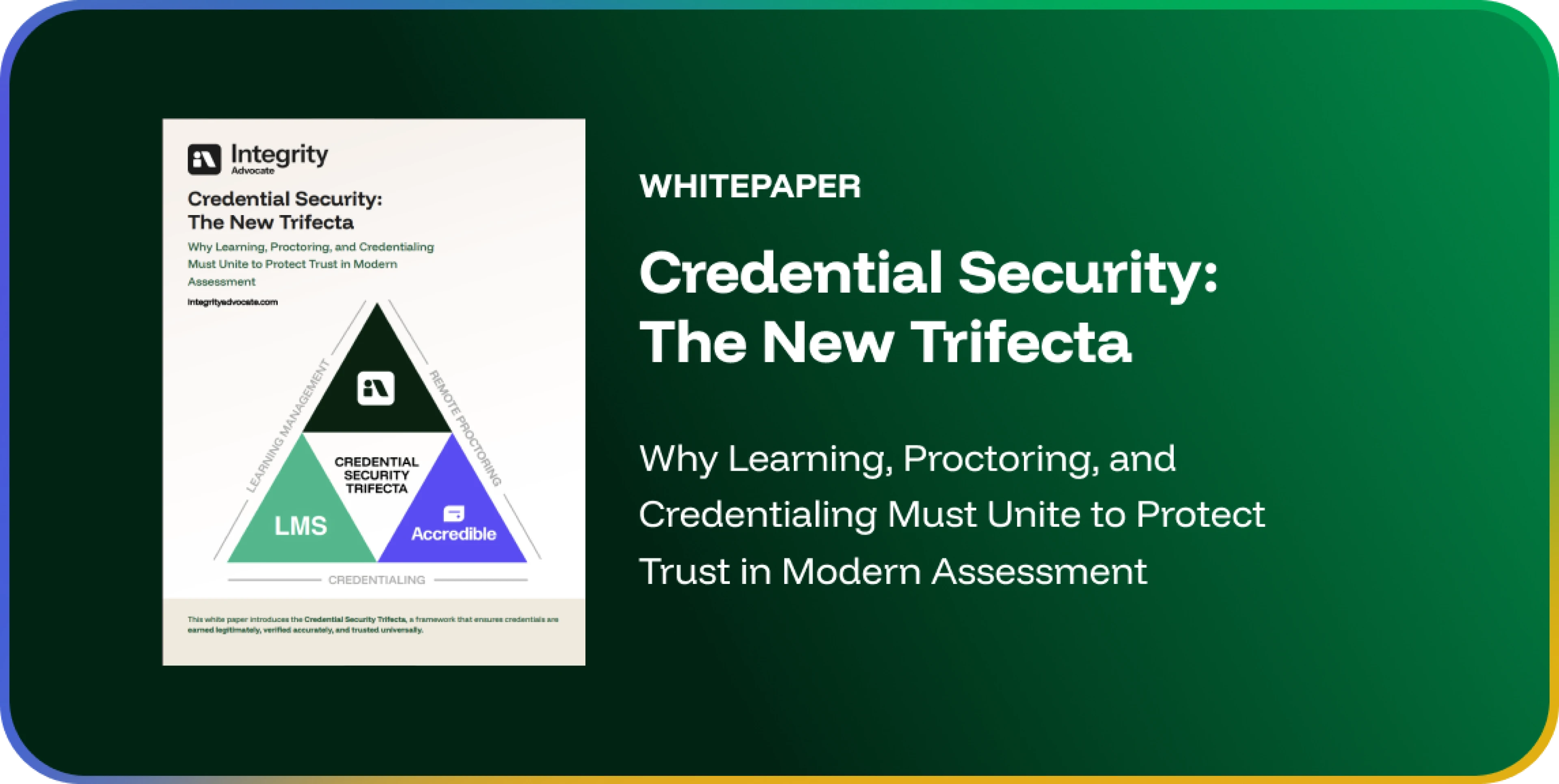
The Credential Security Trifecta: Designing a Defensible Credential Ecosystem
February 25, 2026
|
5 min read
Credential integrity depends on more than a single tool. It requires identity verification, assessment oversight, credential issuance, and long-term validation to operate as one connected system. As digital credentials become more visible and portable across LinkedIn profiles and employer systems, organizations need to be able to answer a harder question than "was this test monitored": is this credential defensible? This post introduces the Credential Security Trifecta, a framework connecting Learning & Assessment Infrastructure, Identity & Integrity Verification, and Secure Digital Credential Issuance into a unified chain of trust, and points to the full whitepaper for the risk landscape, common blind spots, and an implementation model.
Credential integrity is the confidence that a credential truly represents what was earned. It means the right person completed the work, the assessment was conducted fairly, and the credential was issued based on verified performance. That confidence is built across identity verification, assessment oversight, credential issuance, and long-term validation.
As digital credentials become more visible, portable, and high-stakes, organizations are being asked a more important question: Can you defend how this credential was earned?
That question requires more than a proctoring solution. It requires a system.
In our latest whitepaper, The Credential Security Trifecta, we outline a practical framework for designing a defensible credential ecosystem, one that connects learning, verification, and issuance into a coherent chain of trust.
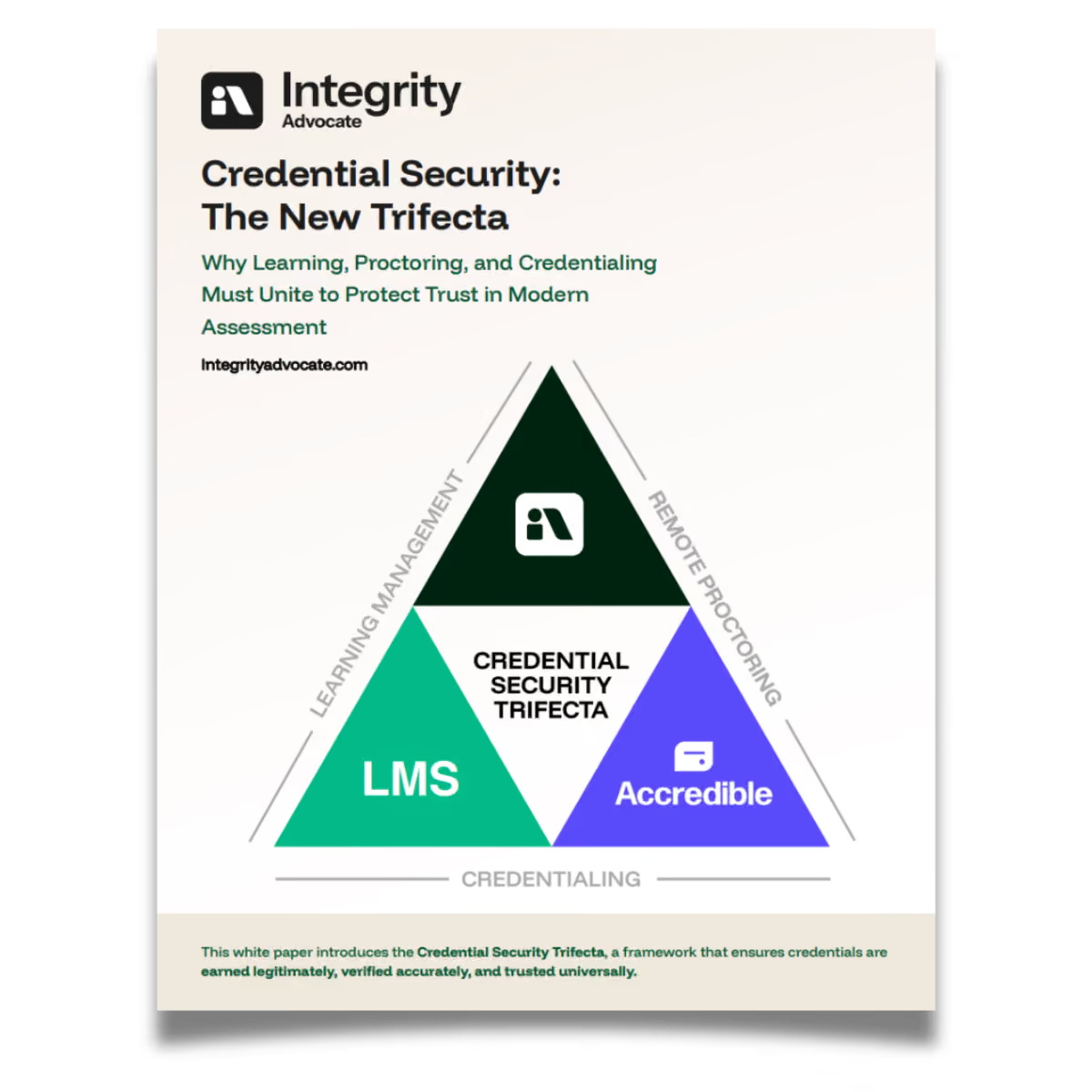
Credential Security: The New Trifecta
Why Learning, Proctoring, and Credentialing Must Unite to Protect Trust in Modern Assessment
The Shift From Exam Security to Credential Security
For years, assessment security focused primarily on preventing misconduct during testing. That remains important. But today’s risk environment has expanded.
AI-enabled misconduct, identity fraud, contract cheating, and synthetic digital documents have changed the landscape. At the same time, digital credentials are widely shared across LinkedIn profiles, employer systems, and workforce platforms. They are public representations of institutional trust.
And the stakes are higher than ever. In an AI-accelerated world, institutions must be able to answer a fundamental question: can we confidently verify who earned this credential — and whether it was earned fairly? When credentials influence hiring decisions, promotions, licensure, and professional standing, the consequences of getting it wrong are significant.
That means the integrity conversation must move beyond: “Was this test monitored?” to: “Is this credential defensible?”
Credential security is not just about detecting misconduct. It’s about ensuring that identity, performance, and issuance are connected in a way that can withstand scrutiny.
Why Fragmented Systems Create Risk
Most organizations operate across three separate layers:
- A learning management system where instruction and assessment occur.
- An integrity or proctoring solution that verifies identity and behavior.
- A credentialing platform that issues digital certificates or badges.
Each layer may function well independently. The risk emerges in the gaps between them. If these systems are not intentionally aligned, you may lack:
- A clear documentation trail from identity verification to issuance
- Audit-ready evidence of how integrity was upheld
- A consistent standard across programs
- Confidence that only verified outcomes result in credentials
That fragmentation makes defensibility harder when questions arise from employers, regulators, or internal leadership.
The Credential Security Trifecta Framework
The whitepaper introduces the Credential Security Trifecta, a framework that connects three essential components into a unified architecture:
Learning & Assessment Infrastructure: Where learning is delivered and performance is measured.
Identity & Integrity Verification: Where identity is confirmed, assessment conduct is reviewed, and integrity decisions are documented to ensure performance is legitimate and defensible.
Secure Digital Credential Issuance: Where verified performance becomes a tamper-resistant, independently verifiable credential.
When these three components operate as an integrated system rather than isolated tools, they form a defensible chain of trust.
This shifts the posture from reactive security to intentional design.
What a Defensible Credential Ecosystem Looks Like
A defensible ecosystem does not rely on assumptions. It provides clarity. It enables leadership teams to answer, with confidence:
- How do we verify identity at scale?
- How do we document integrity decisions?
- How do we ensure credentials are only issued for verified performance?
- How do we validate credentials long after they are awarded?
These are governance questions as much as technical ones. They impact compliance, employer trust, learner confidence, and institutional reputation.
Designing for defensibility requires alignment across technology, process, and policy.
What You’ll Learn in the Whitepaper
The full whitepaper expands on:
- The evolving risk landscape impacting credential credibility
- Where organizations most commonly experience blind spots
- How to evaluate your current architecture
- Strategic questions leadership teams should be asking
- A practical model for implementing the Credential Security Trifecta
It is written for certification bodies, higher education leaders, workforce programs, and assessment teams responsible for protecting credential value.
If you are evaluating how your organization connects assessment integrity with credential issuance, this framework will provide clarity.
Download the whitepaper

Who We’re Certifying Matters: Why Assessment Security Must Evolve With the Credential Landscape
February 24, 2026
|
5 min read
Assessment security has expanded beyond preventing cheating to protecting the long-term credibility of every credential an organization issues. Remote and hybrid delivery, AI tools reshaping candidate behavior, rising employer scrutiny of credential validity, and the rapid expansion of digital credentialing are all converging to make this a strategic rather than operational question. This post examines why credential credibility now depends on assessment security design, what the risks of getting it wrong look like across higher education, professional certification, and workforce training, and why connected, integrated systems are the only approach that produces defensible outcomes at scale.
Assessment security is no longer just about preventing cheating. It is about protecting the credibility of credentials across higher education, K-12, professional certification, associations, and workforce training.
Online exams, hybrid delivery, AI tools, and digital credentials are reshaping how learning is validated. As these systems evolve, organizations must move beyond a narrow focus on proctoring and ask a more strategic question:
Who are we certifying, and what does that credential truly represent?
The answer to that question determines whether employers trust degrees, whether associations defend certifications, and whether workforce credentials maintain real economic value.
This is where assessment security and credential integrity converge.
What Is Changing in Assessment Security in 2026?
Across sectors, several structural shifts are driving change:
- Remote and hybrid assessment delivery is now mainstream
- AI tools are reshaping how candidates interact with exams
- Privacy expectations are increasing
- Employers are scrutinizing credential validity more closely
- Digital credentialing is expanding rapidly
The online proctoring market reflects this momentum. Industry analysis shows that U.S. revenue is projected to grow from approximately $281 million in 2024 to more than $800 million by 2031, driven by online learning adoption, corporate upskilling, and global credential demand.
Growth alone does not equal trust. As scale increases, so does the responsibility to ensure defensible, fair, and meaningful outcomes.
Why Assessment Security Now Impacts Credential Credibility
Historically, assessment security focused on catching misconduct. Today, the focus must expand to protecting the long-term value of the credential itself.
Forward-thinking programs are no longer asking only how to monitor exams. They are asking how to protect integrity across the entire assessment lifecycle, from design to delivery to defensibility.
This shift affects every sector:
Higher Education
Institutions must defend the academic integrity of degrees delivered in online and hybrid formats. If employers question exam security, they question institutional standards. This tension is especially pronounced in doctoral programs, where balancing assessment security and privacy in online EdbD programs requires institutions to protect both rigor and learner trust.
K-12 Education
Digital testing is embedded into classrooms. Student privacy and fairness are as important as misconduct prevention.
Professional Certification and Associations
Certifications signal competence and readiness. Weak exam controls undermine member trust and regulatory standing.
Workforce Training and Corporate Credentialing
Employers rely on credentials as hiring signals. If assessments are unreliable, businesses lose confidence in workforce readiness programs.
Assessment security is no longer an operational decision. It is a strategic credibility decision.
The Risks of Getting Assessment Security Wrong
When assessment integrity systems fail, the consequences extend far beyond a single testing event.
Risk to Individuals
If security controls are too weak, unqualified individuals may earn credentials they have not legitimately achieved. In regulated industries such as healthcare, finance, or technical trades, that risk can impact safety and compliance.
If controls are too aggressive or poorly implemented, legitimate candidates may be unfairly flagged or disadvantaged. In K-12 and higher education, overly intrusive tools can increase anxiety, create equity concerns, and erode trust in institutions.
Risk to Workplaces
Employers depend on certifications and degrees as reliable indicators of competence. If credential integrity is inconsistent, organizations add additional screening layers, duplicate assessments, or question the issuing body altogether.
When trust declines, the credential loses value in the labor market.
Risk to Programs and Institutions
- Higher education institutions face reputational risk.
- Certification bodies face regulatory scrutiny.
- Associations risk declining member confidence.
- Workforce programs risk employer disengagement.
The cost of weak assessment security is not just fraud. It is long-term erosion of credibility.
How AI Is Redefining Online Exam Security
AI in online exams is both a challenge and an inflection point.
Research indicates widespread AI usage in academic environments, influencing integrity patterns and candidate behavior.
AI has changed how candidates prepare, how responses are generated, how external assistance is accessed.
But AI also presents an opportunity. It pushes organizations to rethink what authentic demonstration of competence looks like.
Effective assessment security now combines intelligent detection systems with contextual human review. Machine analysis can surface patterns. Human judgment ensures fairness and proportional response.
AI is not simply a threat. It is accelerating the need for smarter, connected systems.
Not All Proctoring Models Address Risk in the Same Way
Organizations today operate across a spectrum of proctoring models:
- Paper-based in-person exams
- Live remote proctoring
- Automated AI monitoring
- Browser lockdown tools
- Hybrid in-person and remote systems
- Unproctored low-stakes assessments
Each approach carries trade-offs in scalability, cost, privacy, defensibility, and candidate experience.
The challenge is not selecting a single method. The challenge is ensuring the method fits within a connected credential ecosystem.
Siloed systems introduce risk.
If identity verification happens in one platform, exam delivery in another, proctoring in a third, and credential issuance in yet another, organizations may lack a defensible chain linking candidate identity to verified outcome to issued credential.
Paper testing without digital audit trails can be difficult to defend at scale.
Unproctored online exams may be appropriate for low-stakes contexts but insufficient for high-stakes certification.
Fully automated monitoring without contextual human review may raise fairness concerns.
Disconnected systems make audit readiness difficult.
Assessment security must be designed as part of a larger system.
Why Connected Systems Matter in Modern Credentialing
The future of online proctoring and credential security is not about surveillance intensity. It is about integration and defensibility.
A modern assessment ecosystem should:
- Integrate directly with the LMS
- Align with digital credential platforms
- Support explainable review processes
- Maintain privacy-conscious data practices
- Scale across in-person, remote, and hybrid delivery
Security should not be layered on top of the credential process. It should be embedded within it.
This is particularly critical in higher education, associations, and workforce certification programs where auditability and long-term defensibility are essential.
Frequently Asked Questions About Assessment Security in 2026
Why is assessment security more important now than before?
Because remote and hybrid testing has scaled dramatically, AI tools are reshaping candidate behavior, and employers are scrutinizing credential validity more closely.
Is online proctoring enough to protect credential integrity?
No single tool is sufficient. Online proctoring must be part of a connected system that includes identity verification, review processes, and credential issuance alignment.
How should institutions choose a proctoring partner?
Institutions should look for partners who understand connected ecosystems, audit readiness, privacy considerations, and sector-specific requirements across higher education, K-12, certification, and workforce training.
Looking Ahead: Connecting Assessment Integrity to Credential Trust
The future of assessment security is not only about protecting exams.
It is about ensuring that every credential issued represents verified identity, authentic performance, and defensible standards.
Because in 2026 and beyond, who we certify matters as much as how we secure the assessment.
And the institutions that understand that connection will lead.
Building a Defensible Credential Ecosystem
If you are evaluating how your program protects exam integrity, candidate identity, and long-term credential value, the next step is understanding how these systems connect.
{{post-cta}}

Accredible and Integrity Advocate Partner to Deliver Proctoring and Digital Credentialing
February 25, 2026
|
5 min read
Accredible and Integrity Advocate have announced a strategic partnership that connects verified online proctoring directly to secure digital credential issuance. The integration ensures credentials are automatically issued only to verified test takers who complete assessments without misconduct, closing the critical gap that exists when proctoring and credentialing systems operate independently. Initial support is available for D2L Brightspace environments, with a unified offering for new customers launching in Spring 2026.
Press Release
FOR IMMEDIATE RELEASE | Mountain View, Calif. & Calgary, AB, Canada (March 2026)
New integration connects verified online proctored exams with digital credential issuance, protecting trust from test to certification
Accredible, the world’s leading digital badging platform, and Integrity Advocate, the most trusted online proctoring solution, today announced a strategic partnership to connect verified proctoring with secure digital credential issuance. The integration ensures credentials are automatically issued only to verified test takers who complete assessments without misconduct, helping programs preserve trust, defensibility, and brand integrity at scale.
As remote and online assessment continues to scale, credential fraud and assessment misconduct pose significant risks to program integrity and organizational reputation. While many testing and certification programs rely on proctoring or digital credentialing solutions independently, these systems are often deployed in isolation. The result is a critical gap: exams may be monitored and verified, but credentials are issued separately without a defensible, auditable link back to verified assessment participation.
The Accredible and Integrity Advocate partnership closes that gap by connecting assessment integrity directly to credential issuance. Integrity Advocate handles identity verification and ensures no exam misconduct. When a test taker passes an exam with verified human results, Accredible automatically issues secure, tamper-proof digital credentials within the program’s existing Learning Management System (LMS). Test administrators configure credentialing and proctoring rules within the LMS, and the system enforces them consistently at any scale.
{{post-block-quote}}
For testing and certification teams, the integration reduces manual reconciliation, simplifies exception handling, and strengthens defensibility across audits, appeals, and accreditation reviews. Programs can scale with confidence, knowing credentials are awarded consistently and backed by verified assessment evidence. Test takers experience fair, secure assessments and timely delivery of verifiable credentials, while employers and regulators gain a reliable way to verify authenticity long after the exam — protecting the value of the credential and every legitimate credential holder.
“A credential is only as trustworthy as the process that created it,” said Danny King, CEO and co-founder of Accredible. “This partnership gives programs a defensible way to protect their brand and stand behind every credential they award at scale.”
The Accredible and Integrity Advocate integration is available now, with initial support for D2L Brightspace environments. In Spring 2026, the companies will launch a unified offering that enables new customers to purchase both proctoring and credentialing services together. Existing customers can add credentialing or proctoring capabilities through their current provider relationship.
Accredible and Integrity Advocate will be showcasing the integration at the ATP Innovations in Testing Conference, March 1-4, 2026. To learn more about the integration, visit integrityadvocate.com/lms-integrations/accredible.
About Integrity Advocate
Integrity Advocate delivers modern online proctoring that protects assessment integrity through identity verification and intelligent exam monitoring. Trusted by certification bodies, training organizations, and educational institutions, Integrity Advocate supports compliance and accreditation with clear, audit-ready records, without compromising privacy or accessibility. Learn more at integrityadvocate.com.
About Accredible
Accredible is the world’s leading digital badging platform, enabling education and training leaders to increase learner engagement and drive program growth. Over 2,300 organizations, including Google, IAPP, McGraw Hill, Rutgers, Skillsoft, and the University of Cambridge, rely on Accredible to manage and measure everything from issuing digital certificates and badges to visualizing learning pathways to spotlighting certified learners. Founded in 2013, Accredible has helped issue and verify over 170 million career-advancing credentials. To learn more, visit accredible.com.
{{post-cta}}
Frequently asked questions
Find answers to common questions about our products, features, integrations, and approach to assessment integrity.
This integration is ideal for certification bodies, professional associations, higher education institutions, workforce training providers, and any organization that issues credentials based on verified assessments.
Integrity Advocate works alongside your existing LMS and integrates with Accredible to automate digital credential issuance without disrupting your existing workflows.
After an assessment is completed, Integrity Advocate verifies identity and confirms the assessment outcome. Once your organization's requirements are met, Accredible automatically issues the appropriate digital credential.
A credential is only as trustworthy as the process behind it. Connecting assessment integrity with credential issuance helps reduce fraud, eliminate manual processes, and provide a defensible record that employers, regulators, and other stakeholders can trust.
The Credential Protection add-on connects verified assessment outcomes from Integrity Advocate to secure digital credential issuance through our Accredible integration. It creates a trusted, auditable connection between the assessment and the credential awarded.