Protecting the integrity of online assessments

Privacy-first online proctoring that combines intelligent detection with expert human review for fair, defensible outcomes.

#1 in online proctoring
for ease of use
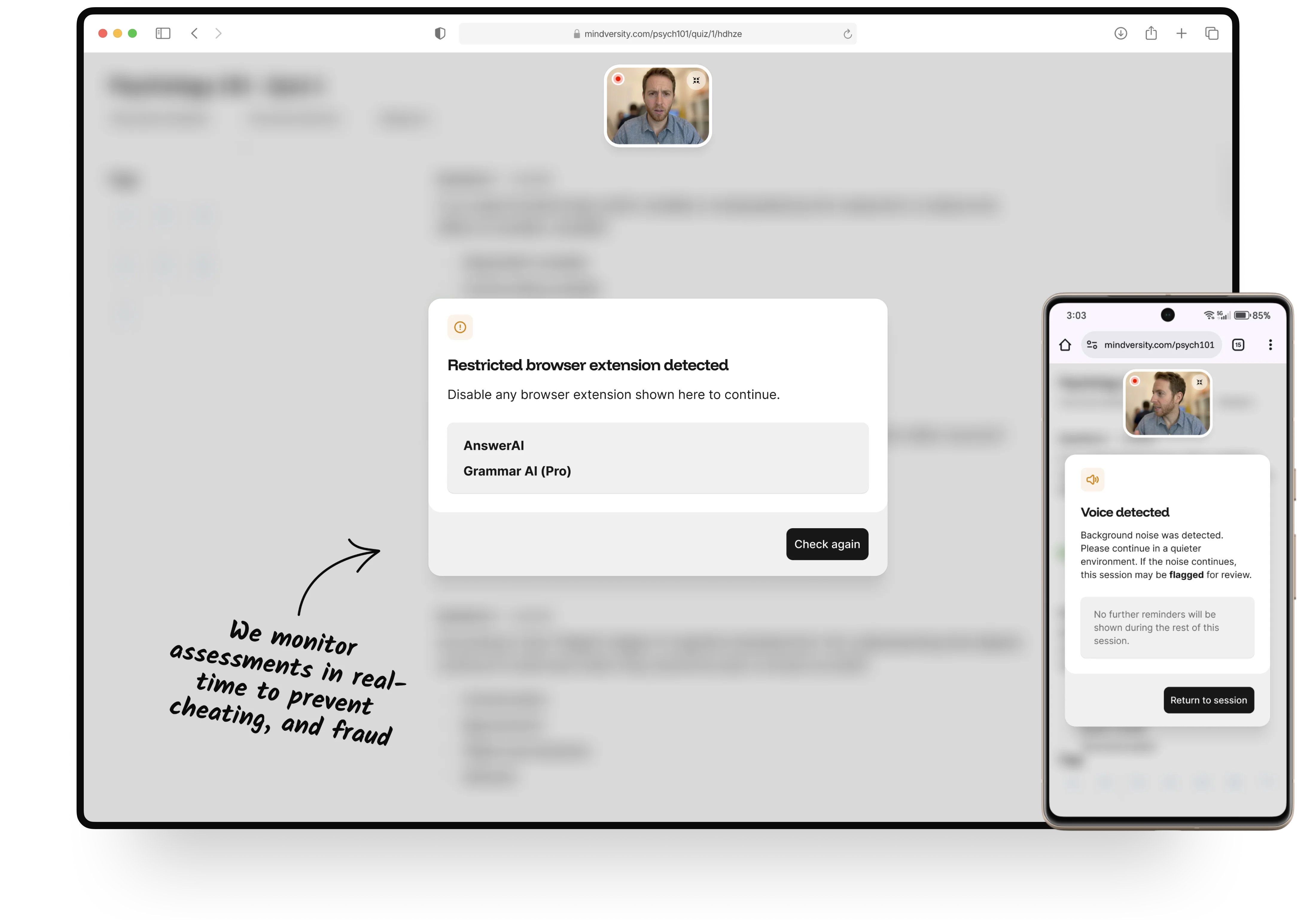
Browser shows alerts about restricted extensions and detected voice during online exam proctoring.

Why choose us?

Online proctoring built around people, not just technology

Protect assessment integrity without losing sight of the people taking the assessment. Our privacy-first approach combines intelligent detection, trained human review, and a seamless browser-based experience for fair, defensible outcomes.

More than

10M+

Total sessions proctored

More than

65+

Languages supported

Lower than

1%

Support rate

More than

98%

Client retention rate

How Integrity Advocate protects every exam, start to finish

From verifying identity before an assessment to monitoring participation and reviewing results afterward, Integrity Advocate protects every stage with technology and trained human oversight.
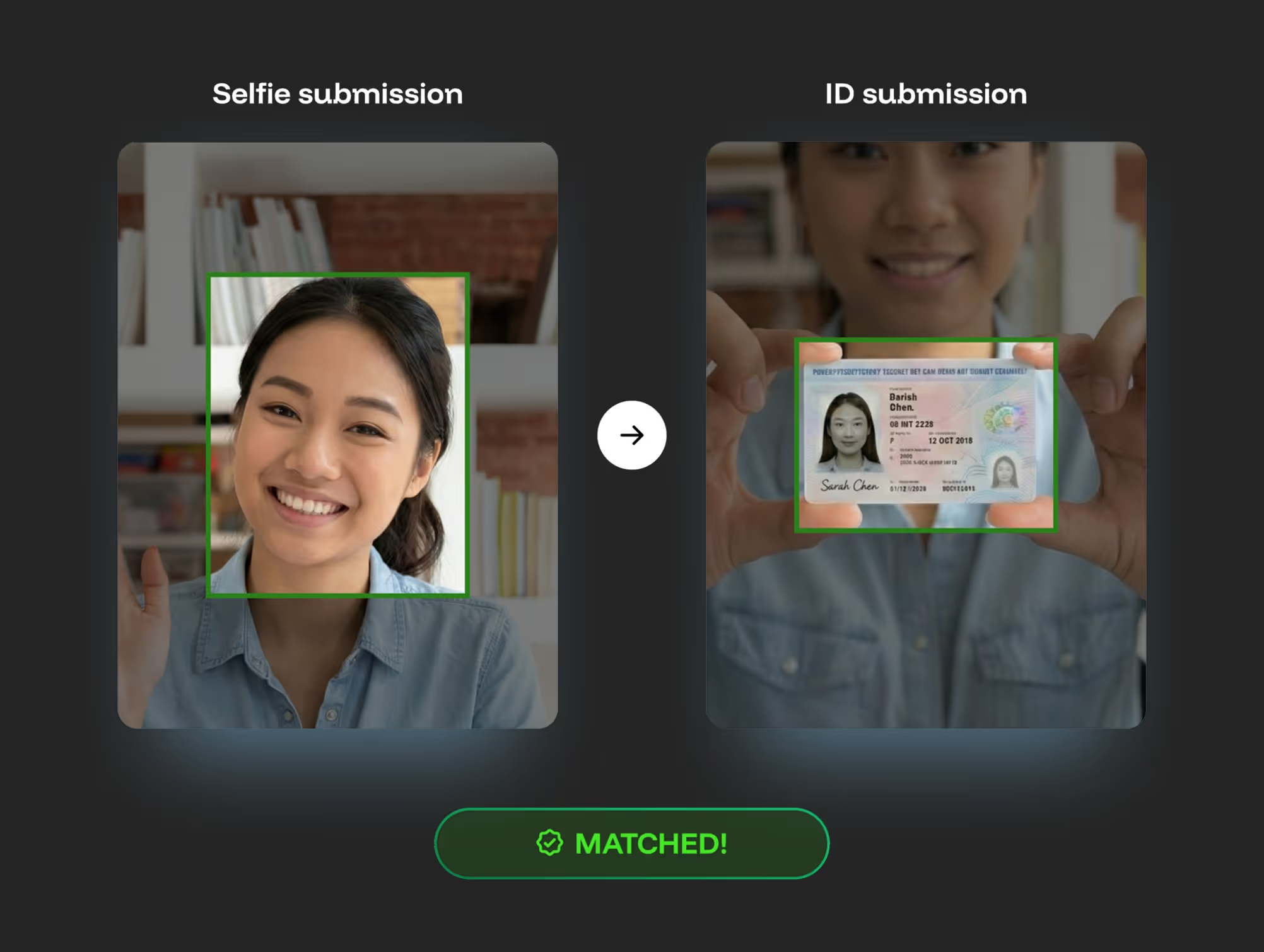
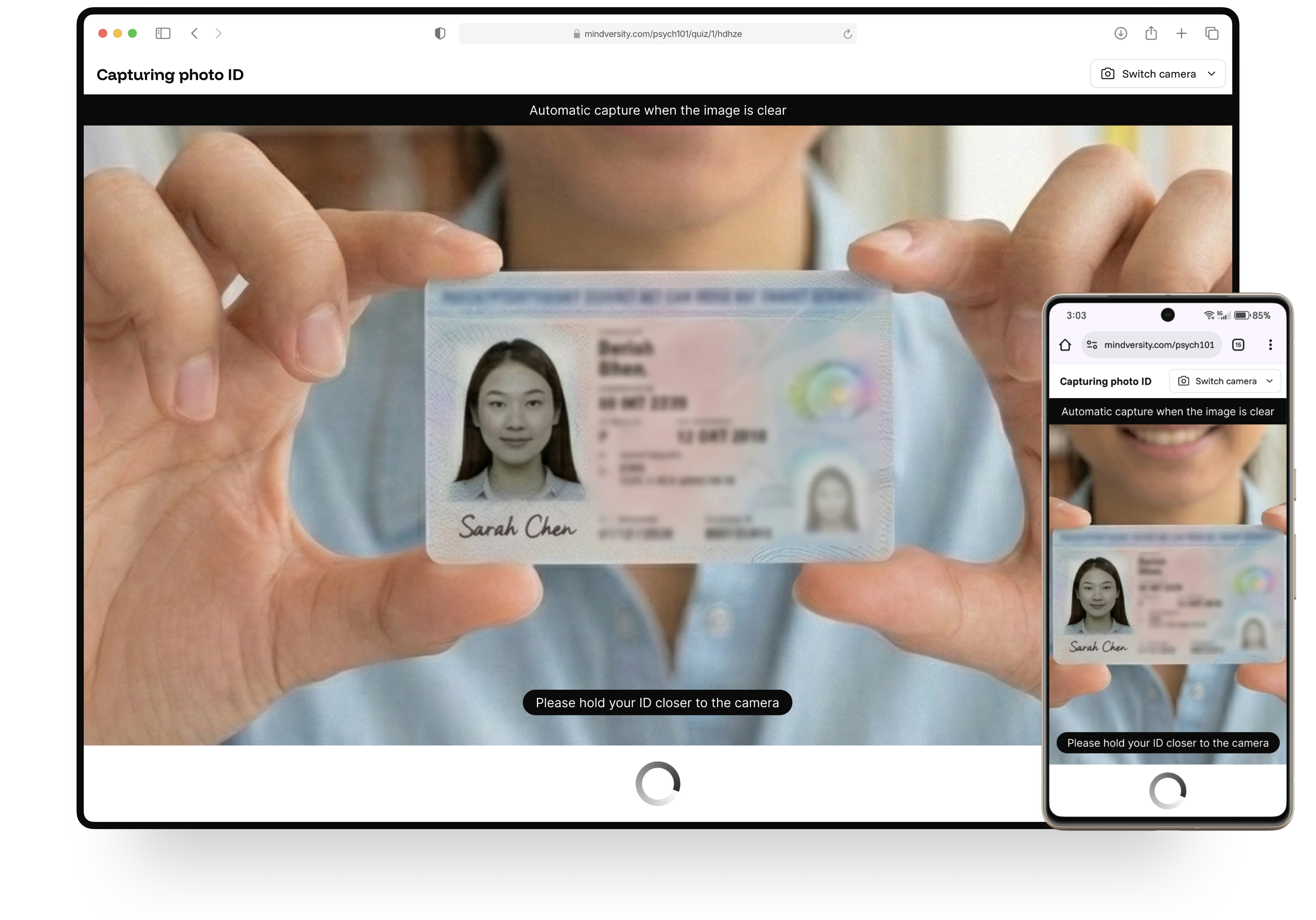
Side-by-side images showing selfie submission on left and ID submission on right with a matched confirmation below.

PRE SESSION

Know the right person is taking every assessment

Test-takers submit a selfie and valid ID, which are reviewed and cross-referenced to verify identity before testing begins.

Human review confirms identity and adds context to identity checks

Only essential information is collected

Personal data follows your retention settings

DURING SESSION

Intelligent detection.

Verified by Human Review™

Integrity Advocate combines intelligent detection with trained human review to identify potential violations and evaluate them in context. The result is greater accuracy, consistency, and confidence in every outcome.
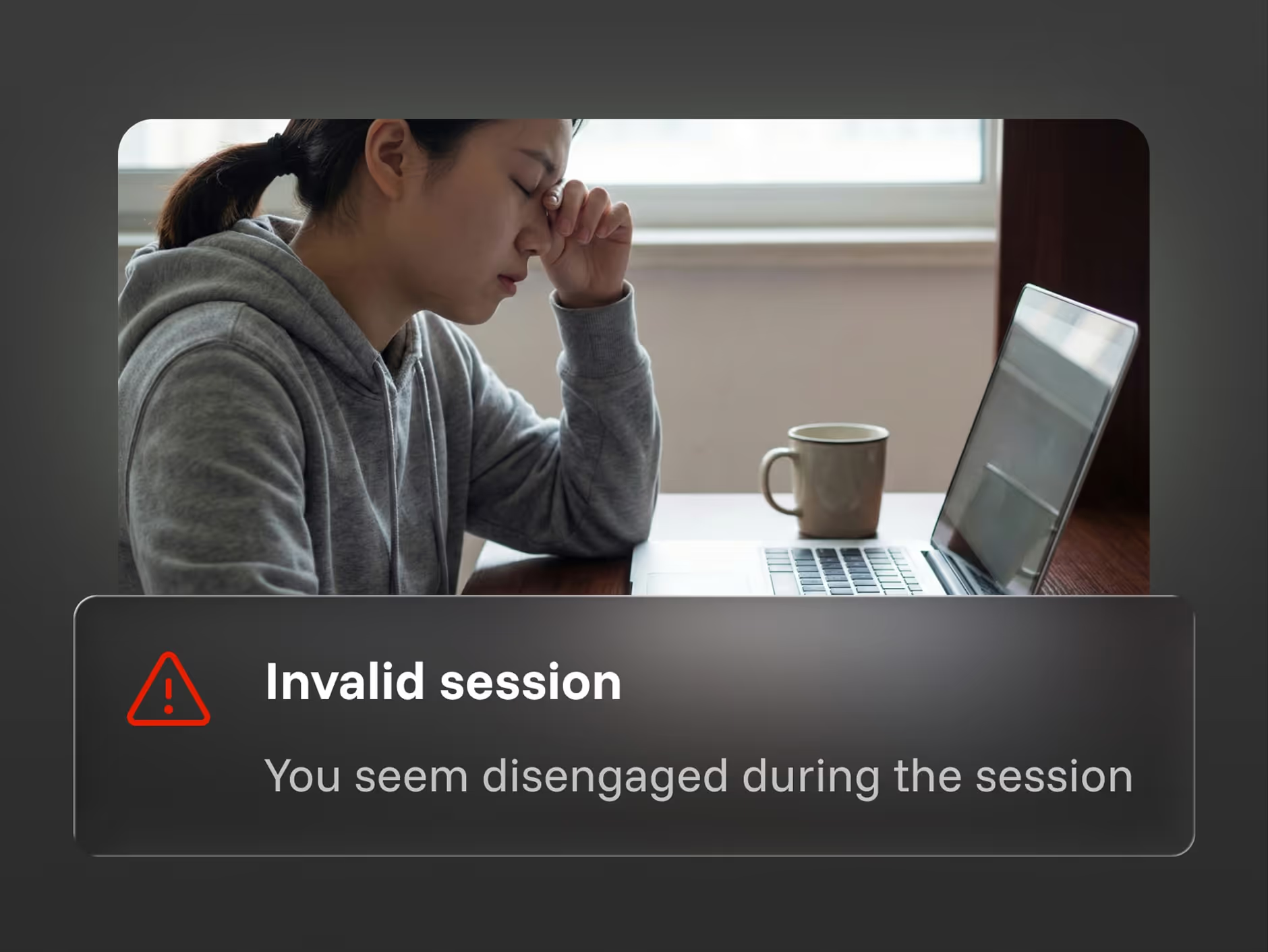
Tired woman in gray hoodie sitting at a desk with laptop and mug, eyes closed, pinching nose bridge.

Participation monitoring

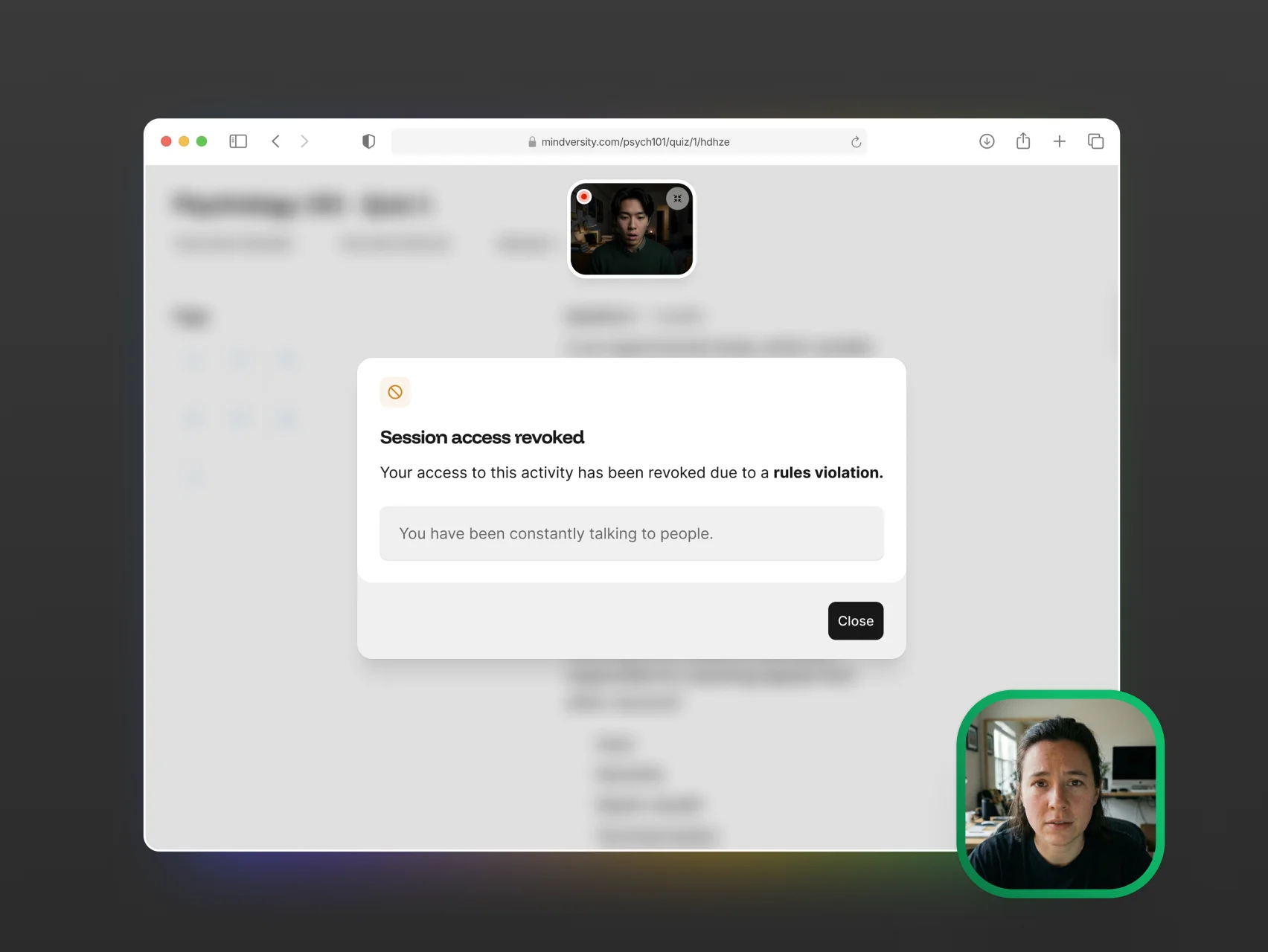
Confirm test-takers remain present and engaged throughout the assessment.

Online quiz screen with a session revoked warning for rules violation of constant talking.

Hybrid proctoring

Combine intelligent detection with human judgment for fair, consistent assessment decisions.

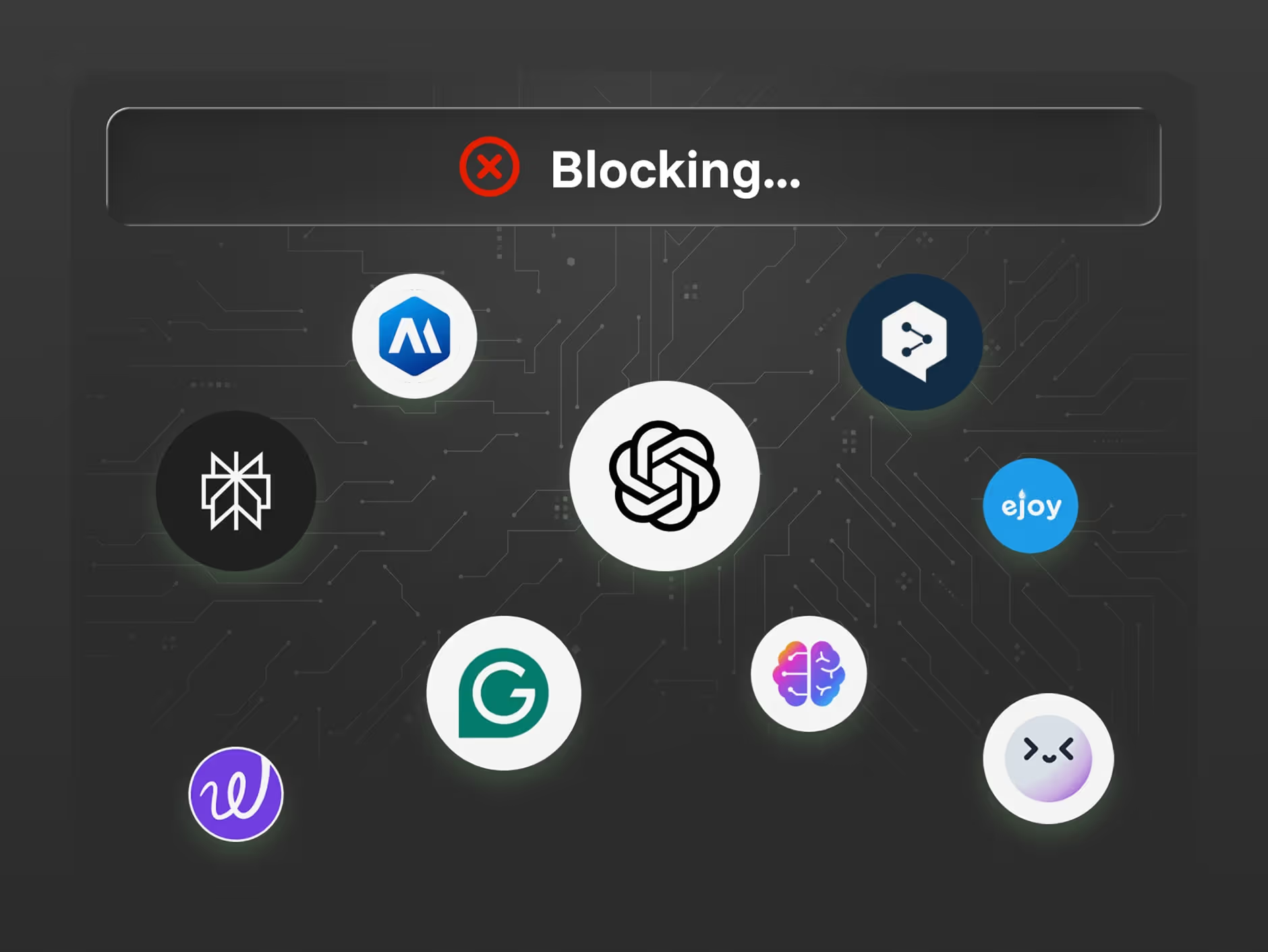
Interface showing AI logos being blocked with a red cross and 'Blocking...' text at top.

CounterAI™

Stay ahead of AI-assisted cheating with behavior-based detection and human review.

POST SESSION

Trusted results.

Seamless credential delivery.

Review clear, time-stamped, human-verified results. Seamlessly issue credentials that are easy to share and verify.
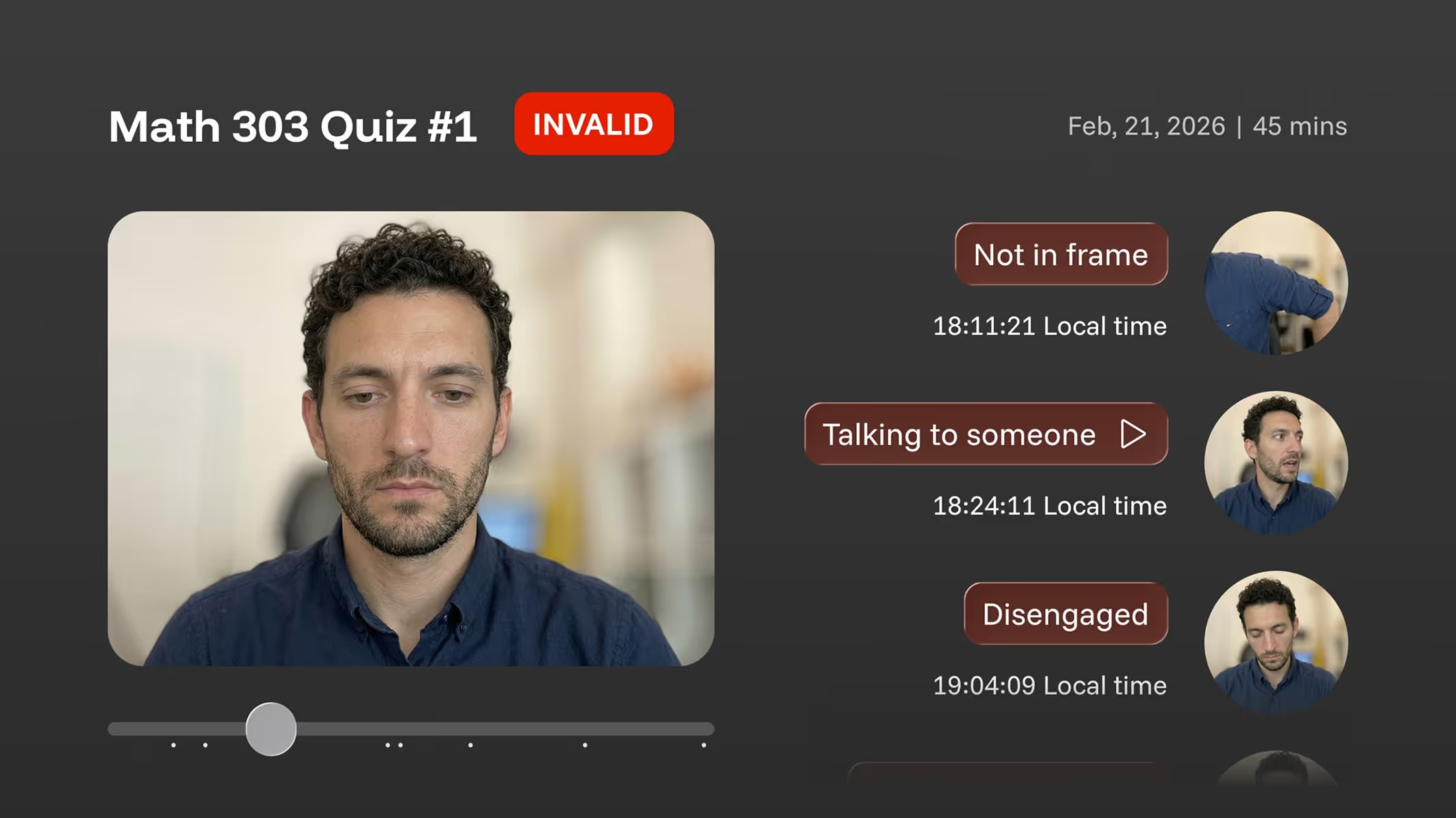

Monitor showing man with status labels: Not in frame, Talking to someone, Disengaged with timestamps on quiz screen.

Defensible outcomes

Clear end of exam reports that support reviews, appeals, and compliance. Every decision is backed by evidence.

Man sitting on a sofa holding a tablet with a digital certificate for food safety inspector training.

Verifiable credential issuance

Connect verified identity, proctored assessment results, and credential issuance in one seamless chain of trust.

BUILT DIFFERENTLY

Online proctoring without the tradeoffs

Protect assessment integrity with simple access, flexible technology, privacy-first design, and trained human review.

No installation

Launch directly from the browser without downloads, extensions, or complicated setup.

Any device

Proctor across computers, Chromebooks, tablets, and mobile devices without limiting where assessments can happen.

Privacy-first

Collect only what’s necessary, protect participant data, and put privacy at the center of every assessment.

Human reviewed

Trained reviewers evaluate potential concerns in context, helping deliver fair, consistent, and defensible outcomes.

WHO WE SERVE

Protecting programs wherever assessments happen

Across education, credentialing, associations, workforce training, and high-compliance industries, Integrity Advocate was built to protect assessments, programs, and the people taking them.


Young woman wearing gray sweater types on a laptop at a wooden desk in a cozy room.

Education

Support academic integrity while also protecting student privacy through proctoring that integrates seamlessly into the systems that learners already use.

Chef in white uniform uses tablet in a commercial kitchen with stainless steel pots and appliances.

Training Programs

Deliver secure, scalable training assessments with proctoring built to work across devices, limited bandwidth, and real-world workforce environments.

Woman with glasses in orange shirt working on a desktop computer at a desk in a home office.

Certifying & awarding bodies

Safeguard credential value with proctoring built for high-stakes assessments, defensible decisions, and lasting trust among stakeholders.

Designed with security, privacy, and accessibility at the core

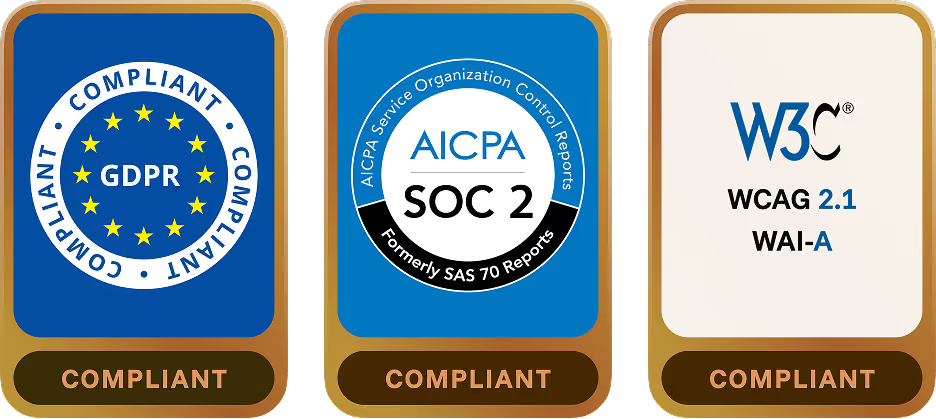
Our compliance with GDPR, AICPA SOC 2, and W3C WCAG 2.1 Level A standards means you can trust us to keep your information secure while delivering an accessible experience to all users.
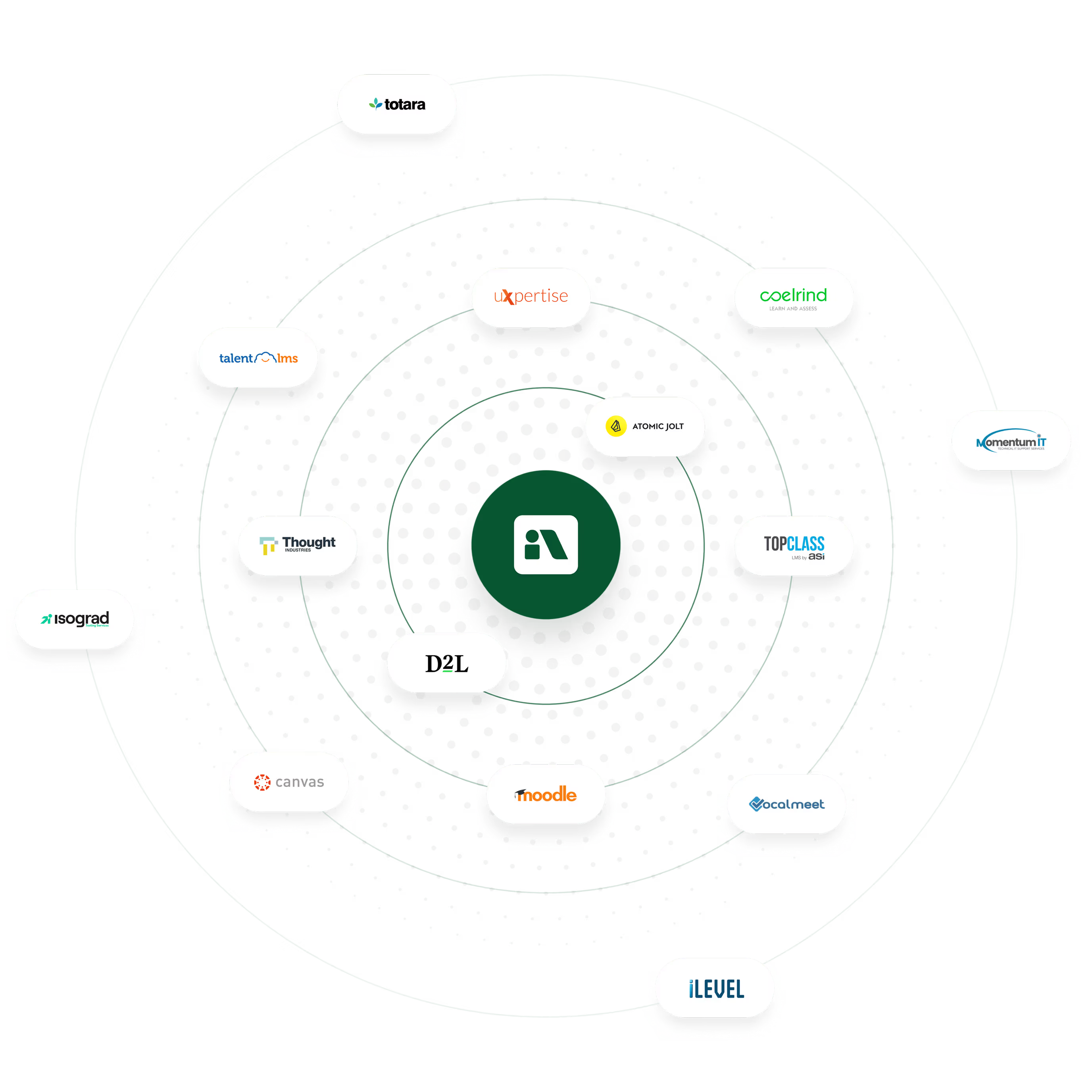
Proctoring that fits right into the systems you already use

Integrate online proctoring directly into your existing LMS and training platforms to simplify setup, keep assessments connected, and create a seamless experience for administrators and test-takers.
What do our clients say about us?

Man in a dark suit and blue tie outdoors with a blurred building and tree in the background.

Integrity Advocate works on all devices. We don't hear any complaints, you don't need to download any applications. The validation is very quick, the turnaround is very quick, the support is great, and it's on demand. We are confident in our partnership, the technology, and the customer support. We firmly believe that Integrity Advocate understands this space better than most.
Richard Anderson, Executive Director of Smart Serve Ontario
White sailboat icon next to the word CourseCareers on a blue gradient background.

We have thousands and thousands of people taking these online tests, and we need a very seamless, frictionless process so people aren't emailing support or having a bad taste in their mouth for our company. Integrity Advocate was that solution.
Troy Buckholdt, CEO of Course Careers
Skills & Education Group logo with navy square and white corner on a coral background.

A unique selling point for the project is that humans are reviewing the proctor sessions and we're not relying on technology. This ensures fair, accurate outcomes.

Elaine Barker, Head of Center Support at Skills and Education Group
Smiling middle-aged man with short gray hair and beard wearing a beige blazer and blue shirt.

We were able to scale up dramatically through our integration with Integrity Advocate. There was a point at which we maybe had a few thousand students being e-proctored, to the point now where every one of our students is e-proctored through the payroll compliance professional designation... And that ramp-up happened in less than three months.

Steven Van Alstine, Vice President of Professional Standards and Education | National Payroll Institute

Explore the latest in assessment integrity

Practical guidance on online proctoring, AI-assisted cheating, privacy, and building assessment programs you can trust.
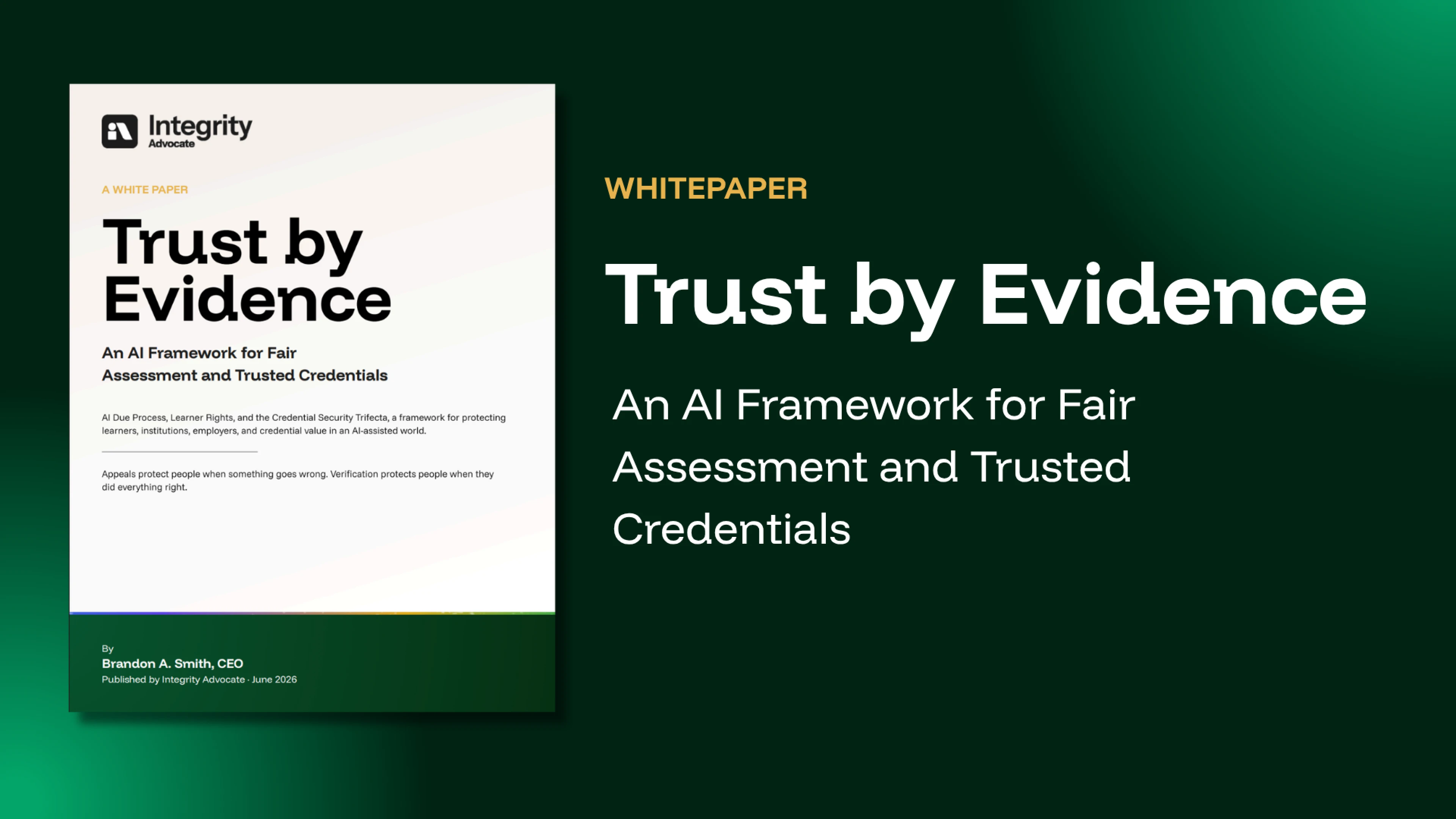
Trust by Evidence whitepaper cover, an AI framework for fair assessment and trusted credentials
Whitepapers

Trust by Evidence: A New Framework for Defensible AI Decisions

July 22, 2026

|

5 min read

Integrity Advocate has released a new whitepaper, Trust by Evidence, introducing a framework that connects AI due process, learner rights, and credential security into one model for defensible AI-assisted assessment. This post walks through what the framework covers, why AI adoption alone no longer settles the integrity question, and links to the full whitepaper download.

Assessment integrity used to mean one thing: was the exam monitored? That question is no longer enough. AI now plays a role in identity verification, proctoring flags, authorship review, scoring, and credential validation, and each of those touchpoints can be challenged.

Confidence in an outcome isn't just about whether AI was accurate. It's about whether the decision it contributed to can be explained, reviewed, appealed, and verified after the fact.

As AI becomes embedded deeper into assessment, institutions are being asked a more pointed question: Can you defend the decision AI helped you make?

That question requires more than accurate technology. It requires a system.

In our latest whitepaper, Trust by Evidence, CEO Brandon A. Smith introduces a framework that connects AI due process, learner rights, and credential security into one model for defensible outcomes.

{{download-resource-cta}}

The Shift From AI Adoption to Defensible Outcomes

For the past several years, the conversation in education and credentialing has centered on adoption: which AI tools to use, how to deploy them, how accurate they are. That conversation is largely settled. Most programs already use AI somewhere in the assessment lifecycle.

What hasn't been settled is defensibility. When an AI-influenced decision is challenged, whether by a learner, an employer, or a regulator, an institution needs to answer a specific set of questions: was there notice, meaningful human review, supporting evidence, and a path to appeal? If any of those answers are unclear, the decision isn't defensible, and the institution is exposed right along with the learner.

The next major challenge in education isn't AI adoption. It's building outcomes that hold up under scrutiny.

Why Treating AI as a Single Safeguard Creates Risk

Many programs rely on AI to do one job: flag anomalies. That model treats a flag as a finding rather than a signal, and it breaks down under three conditions:

  1. No documented process exists for what happens after a flag is raised.
  2. Human review means approving the AI's output rather than independently evaluating it.
  3. There's no clear path for the learner to respond, and no record for the institution to point to later.

Any one of those gaps makes an outcome difficult to defend. Together, they create real exposure, not just to individual learners, but to the institution's accreditation standing, employer trust, and legal risk.

The Trust by Evidence Framework

The whitepaper introduces Trust by Evidence, a framework that connects three ideas typically treated in isolation:

AI Due Process: A fair, documented process for any consequential decision AI contributes to, so a flagged learner has an actual process to walk through rather than a black box to accept.

The Learner Rights Layer: Seven specific rights, to know, to meaningful human review, to explanation, to evidence, to appeal, to proportionality, and to verification, that turn "the system flagged it" into a decision an institution can explain and stand behind.

The Credential Security Trifecta: A secure chain of trust connecting learning, assessment, and credentialing, where a weakness in any one layer undermines the others.

Individually, each idea is familiar. Together, they hold up under scrutiny from everyone with a stake in the outcome: the learner, the institution, employers, regulators, and the public.

What a Defensible AI-Assisted Decision Looks Like

A defensible process doesn't rely on confidence in the algorithm. It provides an actual record. It lets an institution answer, with certainty:

  • Was the individual notified that AI was involved?
  • Did a qualified reviewer examine the evidence, not just the score?
  • Could the individual respond before a consequence was applied?
  • Is there a documented, time-bound appeal path?
  • Can the outcome be explained to someone outside the institution?

These are governance questions as much as technical ones. Answering them well protects accreditation standing, employer trust, and learner confidence all at once.

What You'll Learn in the Whitepaper

The full whitepaper expands on:

  • Why algorithmic due process, procedural justice, and automation bias research all point toward the same conclusion for education
  • The Defensible Outcomes Responsibility Matrix, a governance tool for assigning clear ownership across vendors, institutions, and credential issuers
  • The five-stage AI Appeals Framework, walked through with a real worked example of a contested proctoring flag
  • Sector-specific guidance for K-12, higher education, workforce certification, and employers
  • A candid discussion of the framework's limitations, including cost, scale, and surveillance risk

It's written for compliance leads, credentialing bodies, assessment teams, and program leaders responsible for the outcomes their institution has to stand behind.

{{post-cta}}

Assessment Security
A woman takes an online exam while a proctor appears on her computer screen, demonstrating hybrid AI and human-reviewed proctoring.
Blogs & articles

Why Hybrid AI + Human Review Delivers Fairer, More Accurate Proctoring

December 10, 2025

|

5 min read

AI-only proctoring is fast but context-blind, flagging neurodivergent behaviors, assistive technology, and environmental interruptions as suspicious. Human-only proctoring is fair but cannot scale consistently or cost-effectively. Hybrid AI plus human review combines the speed and pattern recognition of automation with the contextual judgment, empathy, and accountability that only people can provide. This post examines where each model falls short, what hybrid review actually delivers, and why it is becoming the baseline expectation for institutions that need proctoring to be both strong and humane.

As assessment programs continue to grow in scale and complexity, institutions are rethinking how proctoring decisions are made. Early AI-only solutions promised efficiency, but the reality often included something very different: false positives, confusing flags, and test-takers who felt judged by a system that didn’t understand their context. This AI-only proctoring trend has led to unnecessary administrative burden, increased support tickets, and growing distrust from test-takers.

On the other end of the spectrum, human-only proctoring doesn’t scale easily, can be inconsistent across reviewers, and often comes with higher costs and scheduling constraints.

That’s why more organizations are turning to a hybrid model, where AI handles detection at scale and human reviewers bring the context, nuance, and judgment needed to make fair, defensible decisions.

This hybrid approach blends the consistency and speed of automation with the nuance, empathy, and real-world judgment that only people can provide.

Why AI Alone Isn’t Enough

AI is very good at spotting patterns: movement in the frame, changes in lighting, new objects entering the screen, or shifts in gaze. It can scan hours of video in seconds and flag moments that stand out against the norm.

But exams don’t happen in lab conditions. They happen in real homes, workplaces, libraries, training centers, and shared spaces, with real life happening in the background.

AI alone struggles with:

  • Involuntary movements: such as fidgeting, or sensory self-regulation
  • Neurodivergent behaviors: like breaking eye contact, or using comfort objects
  • Assistive technology: screen readers, alternative input devices, or captioning tools
  • Environmental interruptions: family members walking by, doors opening, sudden noises
  • Cultural differences: different norms around eye contact, gestures, or communication
  • Shared environments: where other people may reasonably be nearby

What looks “suspicious” to an algorithm might simply be a student thinking, a parent checking on a child, or a worker taking an exam in the field.

When AI misreads these situations, it creates:

  • unnecessary stress for test-takers
  • extra work for administrators
  • credibility questions about the results

That’s where human review becomes critical.

Why Human Alone Isn’t Enough

While human reviewers bring empathy, judgment, and contextual understanding to proctoring, relying on people alone creates a different set of challenges. Human-only models struggle with consistency, scalability, and efficiency, especially as assessment programs grow.

Human-only proctoring often leads to:

  • Inconsistent interpretations: different reviewers may judge the same behavior differently
  • Limited scalability: staffing constraints make it difficult to support large testing volumes
  • Scheduling friction: requiring live availability for every exam window
  • Higher operational costs: cost per session rises quickly when scaling human labor
  • Slower turnaround times: reviews, escalations, and decisions depend on human bandwidth
  • Greater potential for bias: unconscious assumptions may influence interpretations

And importantly, human-only oversight simply can’t match AI’s ability to scan long sessions efficiently, identify subtle environmental changes, or pattern-match at scale.

This creates an environment where:

  • test-takers may be treated differently depending on who reviews their session
  • administrators face delays waiting for manual review
  • institutions absorb higher labor costs and logistical complexity
  • stakeholders question the consistency and defensibility of evaluation outcomes

Human review is essential, but oftentimes not sufficient on its own.

Taken together, these two extremes paint a clear picture:

  • AI alone is fast, but too rigid and context-blind to be fully fair.
  • Humans alone are contextual and empathetic, but too limited and inconsistent to scale.

Institutions don’t need more of one or the other, they need both working together.

That’s where a hybrid AI + human review model comes in: AI handles detection at scale, while human reviewers bring the nuance, judgment, and fairness needed to make defensible decisions.

The Best of Both Worlds: Hybrid Review

A hybrid AI + human model brings together the strengths of both approaches while minimizing their limitations. Instead of choosing between speed or fairness, institutions get a workflow that delivers both, and at scale.

In a hybrid system, AI surfaces moments that may require attention, scanning for patterns and anomalies far faster than any human could. Then, trained human reviewers step in to evaluate those moments with the context, nuance, and judgment that AI simply cannot provide.

This creates a review process that is:

Faster and more efficient

AI handles the heavy lifting of detection, dramatically reducing the time humans spend reviewing full sessions or searching for notable moments.

More accurate and reliable

Human reviewers validate AI-identified events, preventing false positives and ensuring that only meaningful issues are flagged for institutions.

Fair for every test-taker

Whether a learner is using assistive technology, or simply nervous, human context helps ensure they aren’t penalized for normal or unavoidable behavior.

Transparent and defensible

Hybrid review creates clear audit trails that document both automated observations and human decisions, a critical requirement for accreditation, appeals, and internal accountability.

Consistent across sessions

AI provides consistency in detection, while humans ensure fairness in interpretation. Together, they reduce the variability and bias that can occur with human-only models.

Scalable for growing programs

AI enables institutions to handle large volumes of exams, while human reviewers are focused on meaningful, high-value decisions rather than routine monitoring.

By combining precision with empathy, hybrid review delivers a level of balance that neither AI nor humans can achieve alone. It’s a model built for modern assessments, diverse, distributed, and held to increasingly high expectations of fairness and trust.

Why Hybrid Review Is Becoming the New Baseline

More and more institutions are putting hybrid review on their “must have” list when evaluating proctoring solutions. Some of the biggest drivers include:

1. Reducing False Positives

False accusations or unnecessary investigations damage trust. Hybrid review reduces these incidents by ensuring that flagged behavior is double-checked by a human before it’s escalated or recorded as misconduct.

2. Supporting Diverse Learners

Assessment programs serve test-takers with a wide range of needs, backgrounds, and environments. Hybrid models are better equipped to ensure that neurodivergent learners, disabled test-takers, and individuals using assistive tools are treated fairly.

3. Improving Defensibility

When results are challenged, institutions need to show not just that a flag was raised, but that it was reviewed thoughtfully. Human-reviewed outcomes, supported by clear evidence, are easier to defend and explain.

4. Building Trust in the Process

When learners know there are humans involved, not just algorithms, they’re more likely to perceive the system as fair. That perception matters for participation, satisfaction, and long-term credibility.

5. Aligning With Evolving Policies

Many regulatory and professional bodies are now paying closer attention to how high-stakes decisions are made. Hybrid proctoring aligns with expectations for human oversight in processes that can impact credentials, careers, and educational pathways.

How Integrity Advocate’s Hybrid Approach Stands Apart

Hybrid review isn’t an add-on for Integrity Advocate, it’s at the core of how the system works.

Our approach:

  • Uses AI to assist, not replace, human decision-making
  • Ensures that all flagged moments receive human validation
  • Keeps the focus on identity, participation, and policy-relevant behavior, not unnecessary surveillance
  • Respects privacy by operating within a privacy-first, minimal-data framework
  • Delivers clear, actionable reporting that teams can understand without needing to decode raw AI outputs

This combination of privacy-first design, seamless LMS integration, and hybrid AI + human review gives institutions what they’ve been asking for: integrity that is both strong and humane.

Building Fairness Into Every Review

Fairness shouldn’t depend on which exam a learner takes or which proctor happens to be on duty that day. It should be built into the system.

Hybrid AI + human review moves proctoring closer to that ideal by:

  • balancing speed with judgment
  • combining detection with understanding
  • pairing integrity safeguards with respect for test-takers

For institutions, it means more reliable outcomes, fewer disputes, and a stronger foundation of trust. For learners, it means being seen as a person, not just a set of data points.

If your program is looking to reduce friction, elevate accuracy, and strengthen confidence in your assessment process, hybrid review is one of the highest-impact changes you can make. Book a Demo today!

{{post-cta}}

Human Review
Woman smiling while typing on a laptop at home, representing a comparison guide to the top online proctoring platforms.
Blogs & articles

Top Proctoring Tools in 2026, Ranked by What Actually Matters

April 6, 2026

|

5 min read

Not sure which proctoring tool fits your program? This guide compares the top 10 platforms of 2026, breaks down the three proctoring models, and shares the one vendor question that determines what your results are actually worth.

The market for best online proctoring tools has grown fast, and so has the noise around it. The global online proctoring market is projected to grow from $700 million in 2023 to over $2.1 billion by 2030. Remote learning is standard. AI-assisted cheating is a real and growing threat. And programs across education, credentialing, and workforce training are under more pressure than ever to issue results that are trusted, accurate, and defensible.

In many ways, the tools have kept up with that growth. But not all of them have kept up in the right ways. Some have leaned hard into automation at the expense of fairness. Others have added AI features without answering the question programs actually need answered: when a result is challenged, can you stand behind it?

The market has largely framed this as a choice. Speed and scale on one side. Human judgment and defensibility on the other. What most programs actually need is both, without having to trade one for the other. That is what this list is really about.

What to Evaluate Before You Look at a Single Tool

Feature lists are easy to produce. What matters is whether a platform solves the problems that actually cost programs time, money, and credibility. Here is the framework worth using:

Can you defend a result?

When a flagged incident leads to a consequence, someone will ask how that decision was made. AI alone cannot answer that question in a way that holds up to scrutiny. You need a documented human review trail. Not an algorithm output. A process.

Is privacy built in or bolted on?

Data privacy requirements are not going away. FERPA, GDPR, and emerging state-level frameworks all affect how proctoring data can be collected, stored, and used. Platforms that treat privacy as a compliance checkbox are a liability. The ones built around data minimization from the ground up are not.

Does the experience reflect well on your program?

Proctoring that feels invasive or surveillance-heavy creates friction, complaints, anxiety, and lower completion rates. The process should feel fair to the person going through it. When it does, you get fewer disputes and better outcomes.

Who supports your program beyond kickoff?

Implementation support, responsive account management, and an onboarding process that actually works. Client retention rates tell you more than case studies.

Does it cover the full assessment journey?

Identity verification before the exam. Monitoring during it. Clean, documented results after. Gaps in any of those stages are gaps in your program’s integrity.

The Three Proctoring Models

Every tool on this list falls into one of three categories. The model matters as much as the features.

Model 01

Live Proctoring

A human proctor monitors the session in real time, with the ability to intervene as the exam happens. Strongest for high-stakes exams where immediate response matters.

The trade-off: scheduling windows and per-session costs make it hard to scale for programs running high volumes.

Human-led
Model 02

Automated AI Proctoring

Algorithms monitor the session only, with no human involvement. Low cost and high volume make it accessible at scale.

The trade-off: flag rates of 15 to 20 percent mean the review burden comes back to your institution. Your staff sorts the incidents, not your vendor.

AI-only
Model 03

Hybrid Proctoring

AI detection paired with human review. The right balance of scale and defensibility, when implemented correctly.

The quality varies significantly depending on one thing: whether human review is mandatory on every flag, or available as a paid upgrade. That question changes everything.

AI + Human

The most important question to ask any vendor: Is human review mandatory on every flag, or is it an add-on? That distinction determines what your results are actually worth.

Top 10 Online Proctoring Tools in 2026

1. Integrity Advocate

Best for: Education, professional certification, and any program where results need to be defensible.

Integrity Advocate is built on one principle. Every AI flag is reviewed by a real person before it becomes an outcome. Not as an add-on. Not a premium tier. That is how the platform works, for every client, on every exam. AI identifies. Humans verify. Your program gets results that are fair, accurate, and built to hold up.

The platform is browser-based and requires no installation on student devices. No downloads, no extensions, no IT bottleneck. It works across any device, browser, and LMS, including Chromebooks. Test takers show up and take the exam.

Privacy is built into the architecture from the ground up. No unnecessary data storage, no invasive browser installs, and zero data breaches across more than 12 years of operation. That is not a claim. It is a record.

Coverage spans the full assessment lifecycle. Identity verification, exam monitoring, human review, and credential delivery through the Accredible integration all run on one platform with no gaps between stages.

With a 98 percent client retention rate, the relationship Integrity Advocate builds with programs is a meaningful part of the value. Programs stay because the relationship works, not just the technology.

Key strengths Mandatory human review on every flag, privacy by design, zero breaches in 12 years no install, works on any device or LMS, full assessment journey coverage, 98% client retention

2. ProctorU (Meazure Learning)

Best for: High-stakes certification and licensing exams.

ProctorU offers live human proctoring with real-time intervention capability. Strong audit trails and 24/7 scheduling make it a reliable option for high-stakes professional exams. Examity has been folded into this platform. Per-session pricing and scheduling requirements limit scalability for programs running high volumes with flexible timing needs.

3. Proctor360

Best for: Programs that need high environmental security and flexible proctoring configurations.

Proctor360's standout feature is its proprietary 360 Total View headset, which captures a complete view of the testing environment. It supports multiple proctoring modes including AI auto-proctoring, single and multi-camera live, and recorded review. Highly configurable for institutions that want different security levels across different exam types. Integrates with Canvas, Moodle, and Blackboard. Human review availability depends on the configuration and tier selected.

4. Talview

Best for: Large enterprises running high-volume, complex assessments.

Talview has invested significantly in AI capability, including a multi-layer security framework and behavioral analysis tools. It operates across more than 120 countries and handles significant scale. The platform skews toward enterprise hiring and large institutional clients. Mid-market education and certification programs may find it designed for a larger and more complex buyer than their needs require.

5. Honorlock

Best for: Higher education institutions running frequent, mid-stakes exams.

Honorlock combines AI monitoring with on-demand live proctors and is well established in the higher education market. Human review is available but not mandatory on every flagged incident, which means your institution may still be making decisions on contested results. Pricing is competitive for volume.

6. Proctorio

Best for: High-volume, lower-stakes exams where cost is the primary driver.

Fully automated with no human proctors involved. Proctorio tracks eye movement, audio, and keystrokes and delivers a low per-exam cost that makes it accessible at scale. The trade-off, however, is real: flag review is handed back to your institution. If 15 to 20 percent of your exams are flagged and your staff is sorting through them, the savings on the tool may not reflect the actual cost to your program.

7. Respondus (LockDown Browser + Monitor)

Best for: Institutions already embedded in its LMS ecosystem.

Respondus is widely adopted in higher education and functions primarily as a lockdown browser with a monitoring layer. It works best as a deterrent within a broader integrity approach rather than a standalone proctoring solution. There is no live or mandatory human review component, and the platform requires a browser extension on student devices.

8. PSI Bridge

Best for: Government licensing exams.

Enterprise-grade security with strong identity verification and regulatory compliance, built specifically for high-stakes professional and government licensing exams. Well suited to that context and less flexible for mid-market education programs that need a more configurable setup.

9. Proctortrack

Best for: Programs that need tiered options and pricing flexibility.

Proctortrack offers multiple monitoring modes from automated to live, giving institutions flexibility to match oversight levels to exam stakes. Human review availability depends on the tier selected. Evaluate carefully what is and is not included at each pricing level before committing.

10. Mercer Mettl

Best for: Corporate hiring and skills-based assessments.

Mercer Mettl combines psychometric testing with proctoring in one platform and integrates well with HR systems. Built for the recruitment context. Programs in academic or professional certification settings will find it designed for a different buyer and a different workflow.

How the Top Tools Compare

Integrity Advocate vs. The Rest

Most proctoring platforms share a feature list. Not all of them share a philosophy. Here is how Integrity Advocate compares on the things that actually determine whether your results hold up.

Feature Integrity Advocate Typical Competitor
Review & Accuracy
Human ReviewWho reviews flagged incidents Every flag, every time Premium tier only
False Positive RiskAI flags that turn out to be nothing Filtered before it reaches you Lands in your team's queue
Defensible Audit TrailCan you explain every decision Documented human review on file Algorithm output only
Privacy & Data
Data BreachesTrack record since launch Zero in 12+ years Varies by vendor
Data MinimizationWhat gets stored after the exam Only violations retained All session recordings stored
Privacy by DesignBuilt in vs. added on Architecture-level privacy Compliance checkbox
Learner Experience
Installation RequiredFriction before the exam starts No install, no extensions Browser extension required
Device CompatibilityWhat devices can learners use Any device, any browser No phones, iPads, or tablets
Surveillance FeelHow the process feels to learners Post-exam review, not live watching Live monitoring creates anxiety
Platform & Integration
LMS CompatibilityWorks with your existing tools Any LMS Limited integrations
Full Assessment JourneyCoverage before, during, and after ID verify through credential delivery Exam monitoring only
Exam Type FlexibilityHigh-stakes and low-stakes Any exam type Pricing not customizable by stakes
Partnership & Trust
Client Retention RatePrograms that stay long term 98% Varies by vendor
Admin WorkloadTime spent reviewing flags Fewer flags, less noise Complex reporting adds burden
G2 RecognitionPeer-reviewed performance Leader, Easiest To Use, Best Usability Varies by vendor
One thing no other platform can say: Every flagged session is reviewed by a real person before it becomes an outcome. Not as a paid upgrade. Not on request. That is just how Integrity Advocate works.

Want to see how Integrity Advocate performs for your specific program? We will walk you through it in 30 minutes.

Book a Demo

How to Choose the Right Tool for Your Program

The right platform depends on what your program actually needs to protect.

If your exams carry real consequences, certifications, academic credentials, professional licensing, your results need to be auditable. In practice, that requires mandatory human review and a documented process, not an algorithm output. Start there.

If privacy compliance is a growing concern, look for platforms where data minimization is structural, not a feature toggle. Ask vendors specifically what data is stored, for how long, and where. Zero breaches in 12 years is a different answer than a privacy policy page.

If learner experience matters to your completion rates and your program's reputation, choose a tool that requires no installation and has been validated by learners as fair. Those programs see fewer disputes and better outcomes.

If implementation burden is a concern, ask vendors what onboarding actually looks like beyond the kickoff call. Client retention rates tell you more than any case study will.

The Bottom Line

Most proctoring platforms will tell you they deliver trusted results. The question worth asking is how. If the answer is AI monitoring and a flag report, that is a starting point, not a complete answer. The programs that make defensible, fair, and accurate assessment decisions are the ones that pair AI detection with documented human review, protect learner data by design, and work with a platform that treats their program like a partner.

The tools that deliver all three, without asking you to trade one for another, are the ones worth your time.

See it in action

Results you can
actually stand behind.

Every flag reviewed by a real person. No installs. Zero breaches in 12 years. See how Integrity Advocate works and what it means for your program.

Human review on every flag No install required 98% client retention Zero breaches in 12 years
Recognized on G2 G2 Spring 2026 Leader G2 Spring 2026 Easiest To Use G2 Spring 2026 Best Usability
Book a Demo No commitment. 30 minutes.
We will show you exactly how it works.
Proctoring Comparison
Smiling woman in gray polo shirt using a tablet with an ID badge clipped to her shirt.
To get support, please visit support center

Frequently asked questions

Find answers to commonly asked questions.

Integrity Advocate helps organizations protect online assessments from identity verification through final review. Test-takers verify their identity, complete their assessment with monitoring in place, and trained human reviewers evaluate potential violations in context to deliver clear, defensible results.

No. Integrity Advocate launches directly from the browser with no downloads or extensions required, making it easier for test-takers to get started while reducing technical barriers and support needs.

Intelligent technology identifies potential violations and trained human reviewers evaluate them in context. This combination brings human judgment to automated detection, helping programs achieve accurate, consistent, and defensible outcomes at scale.

Integrity Advocate works across computers, Chromebooks, tablets, and mobile devices, giving programs the flexibility to deliver secure assessments across a wide range of environments and test-taker needs.

Integrity Advocate takes a privacy-first approach, collecting only the information needed to protect assessment integrity and limiting unnecessary access to test-taker devices and data. Organizations also maintain control over how long assessment data is retained.

Integrity Advocate combines intelligent detection with trained human review, privacy-first design, no-install access, and support across devices. The result is secure online proctoring that protects assessment integrity without creating unnecessary barriers for programs or test-takers.

Integrity Advocate is built for organizations across education, credentialing, associations, workforce training, and high-compliance industries. The platform supports programs that need to protect their assessments, their organization, and the people taking them.