October 14, 2026
|
5
min read
What E-ATP 2026 Taught Us About Building Assessments People Can Trust
Integrity Advocate CEO Brandon A. Smith led three sessions at E-ATP 2026 in Rome. This recap covers five takeaways for assessment programs: deterrence before detection, privacy as the standard, the trust chain from exam to credential, AI as a mirror for assessment design, and fair access by design.

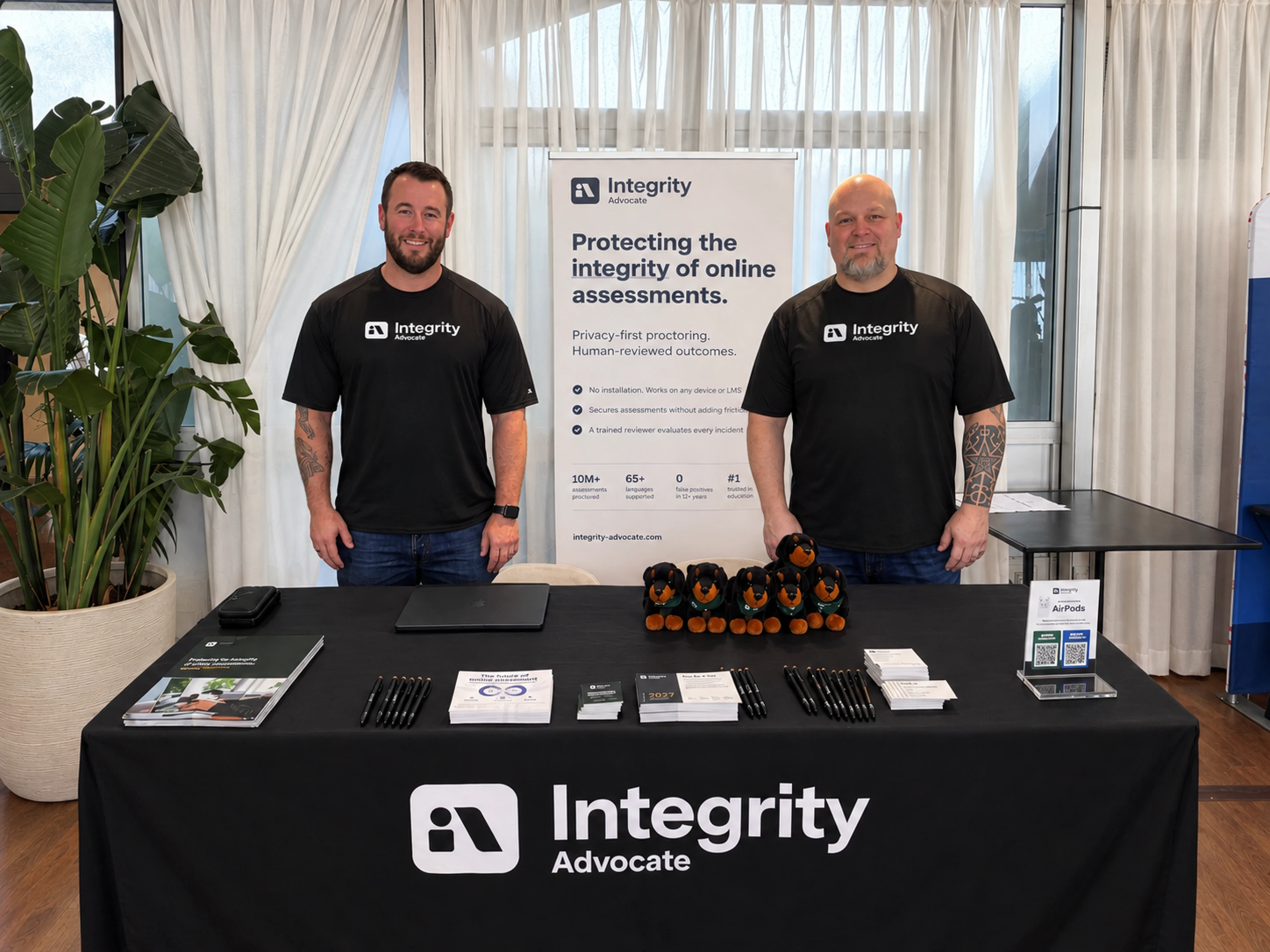
Integrity Advocate just wrapped three days at the E-ATP 2026 Conference in Rome, held October 7 to 9 under the theme Building Assessment for Good. The theme fit closely with what we came to talk about: building assessment security people can trust.
Integrity Advocate attended as a sponsor, met with assessment leaders , and led three sessions with CEO Brandon A. Smith. Here are the five ideas that stood out most, and what they mean for programs that need every result to hold up.
1. Strong integrity programs prevent more than they detect
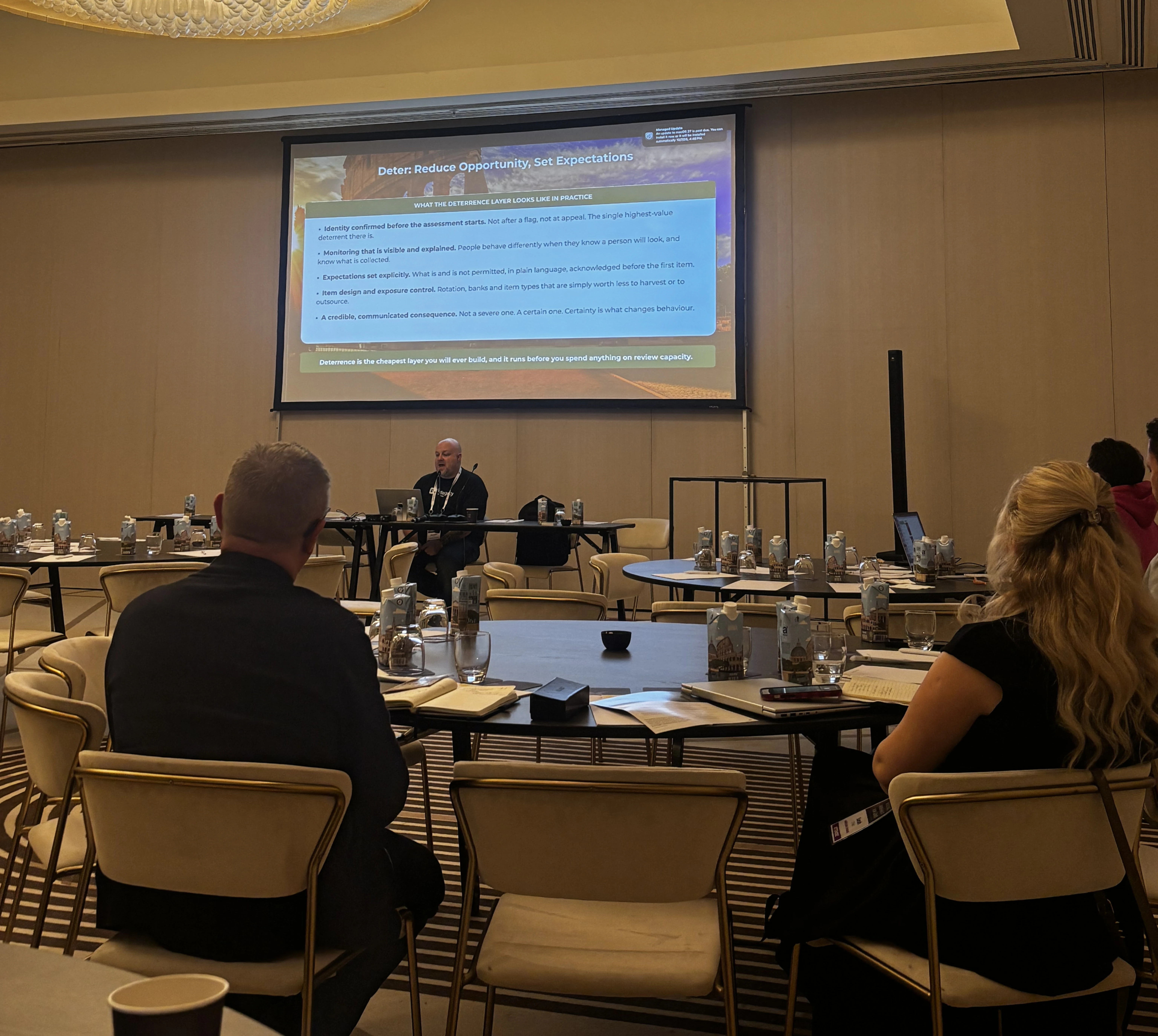
The strongest integrity programs are not measured by how many incidents they flag. They are designed so that fewer people attempt misconduct in the first place. That was the focus of Brandon's first session, From Detection to Deterrence: Building Assessment Security Before the Flag.
In his presentation, Brandon talked about how deterrence starts long before exam day. Clear expectations, visible identity verification, and test takers who understand how oversight works all shape behavior before a session begins. When security is built into the whole assessment lifecycle, the flag becomes a backstop rather than the main line of defense.
For program leaders, this changes the question worth asking of any proctoring approach. Instead of asking how much it detects, ask how much it prevents, and how well your team can explain what happens when something does get flagged.
2. Proctoring has to earn trust, and privacy is the standard
In a room full of European testing leaders, privacy is not a footnote. It's the baseline every proctoring decision has to meet. Brandon's second session, Audit It. Challenge It. Fix It: Redesigning Proctoring for Privacy and Trust, explored what it takes for oversight to earn that trust.
The session centered on three principles. Privacy has to be an architectural decision made at the design stage, not a policy written after the fact. Data should be collected only when it serves a clear purpose and kept only as long as each program needs it. And every decision about a test taker should be something the program can audit, explain, and revisit if it is challenged.
That last point connects privacy directly to defensibility. When a trained reviewer examines a flagged session and records a reasoned judgment, the program has something it can stand behind. An automated flag on its own gives a test taker nothing to respond to and gives the program nothing to defend.
3. A credential is only as defensible as the evidence behind it
Digital credentials make it easy for employers and regulators to verify that someone earned a certification. But a verified badge only confirms that a credential was issued. It cannot, on its own, show that the assessment behind it was secure.
In his final session on Friday, The Trust Chain: Connecting Assessment Integrity to Defensible Digital Credentials, Brandon connected those two halves. The session followed the integrity evidence from the exam session all the way to the credential. In our view, a credential's trust depends on every link along the way, including identity verification, session monitoring, human review of any flags, and a documented outcome.
For certifying and awarding bodies, this is where integrity becomes visible to the outside world. When each stage of the assessment is documented and connected to the credential, a program can answer the question every stakeholder eventually asks: how do we know this result is real?
4. AI is a mirror for what assessments really measure
Dr. Luca Longo's opening keynote offered one of the most useful reframes of the week. He reframed AI as a mirror. If an AI tool can pass an assessment, that raises a harder question about what the assessment was measuring in the first place.
From our perspective, the reframe matters because AI-assisted misconduct is already here, and much of it leaves no visible behavioral signal for an automated system to catch. An algorithm can report that something looked unusual. It cannot tell whether an answer reflects a strong candidate or a generated response, and it cannot weigh the context around a pattern.
Programs will need to respond on two fronts. Assessment design has to keep evolving toward tasks that reward genuine skill. And when a session raises questions, the decision needs a trained person with context, because a wrongful finding based on an automated flag does real damage to a candidate and to the program that issued it.
5. Fair access is a design choice
The conference closed with a panel on multilingual, cross-border assessment, and it was a fitting end to a week about building assessment for good. It was a reminder that for programs serving candidates across countries and languages, fair access is a design choice.
In practice, we think that means proctoring that works on the devices candidates already have, without installs or technical hurdles that disadvantage people with less support. It means instructions and interfaces candidates can understand in their own language. And it means a review process that applies the same standard to every candidate, wherever they test.
When access is designed in, more candidates can demonstrate what they know, and programs can grow across borders without lowering their standards.
What this means for your program
Our biggest takeaway from Rome is that trust in assessment is built by design, not added after a flag goes up. Programs that prevent misconduct, protect privacy, document their decisions, and connect integrity evidence to the credentials they issue are the ones whose results will hold up.
That is the approach Integrity Advocate takes. We secure the full assessment lifecycle, from identity verification before the exam to validated results after it, and a trained reviewer examines every flagged session before any outcome is issued. The result is assessment that is fair, trustworthy, and defensible.
Thank you to everyone who joined our sessions and visited us at Booth #18, to Accredible for partnering on The Trust Chain, and to E-ATP for an outstanding event. We are already looking forward to next year.
If you want to talk through how these ideas apply to your program, our team would be glad to help.
Keep reading

ATP Innovations in Testing 2026: Key Takeaways
March 16, 2026
|
3
min read
At ATP Innovations in Testing 2026, direct conversations at the Integrity Advocate booth surfaced three consistent themes: organizations moving away from traditional LMS platforms toward standalone assessment tools, strong interest in combining secure exam delivery with digital credentialing through the Accredible partnership, and a noticeable increase in organizations proactively seeking to partner with Integrity Advocate. Broader conference sessions reinforced that generative AI is reshaping the assessment lifecycle, security challenges are evolving quickly, and candidate experience is becoming a competitive differentiator for certification bodies. This post recaps what the conversations revealed and where Integrity Advocate fits into the industry's direction.

Assessment Security Is Changing. Is Your Strategy Built for What Is Next?
February 17, 2026
|
4
min read
Assessment security has changed fundamentally. AI-assisted misconduct, global remote testing at scale, rising privacy expectations, and credentials tied to real professional consequence have all shifted the landscape at once. This post traces how assessment delivery has evolved from in-person exams to global remote testing, examines what each shift has required from integrity programs, and makes the case for why a modern assessment security strategy needs layered detection, human judgment, privacy-first design, and a partner built to adapt as the landscape continues to change.

Privacy by Design vs. Privacy Policy: The Technical Difference That Matters for Assessment Programs
October 8, 2026
|
4
min read
A privacy policy states what a vendor intends to do with data, while privacy by design limits what it can technically collect and keep. Here is how to tell the difference before you sign.
Frequently asked questions
Find answers to the most commonly asked questions from our clients.
The E-ATP 2026 Conference took place in Rome from October 7 to 9 under the theme Building Assessment for Good.
CEO Brandon A. Smith led three sessions: From Detection to Deterrence, Audit It. Challenge It. Fix It, and The Trust Chain, presented with Accredible.
AI-assisted misconduct often leaves no visible behavioral signal. A trained reviewer can weigh context that an automated flag cannot, which makes each decision fair and defensible.