September 16, 2025
|
5 min read
AI-Powered Online Proctoring Software Needs Human Oversight
AI-powered proctoring can monitor at scale, but it cannot understand context, weigh consequences, or defend a certification decision to a regulator or accreditor. In safety-critical industries where a missed harness check or a wrongly credentialed healthcare worker can cost lives, the blind spots of automated-only proctoring become serious liabilities. This post examines what AI cannot do in high-stakes assessment, what standards like ANSI/ASSP Z490.1-2024, ISO/IEC 17024, and NCCA require in terms of defensibility and human oversight, and why the right model is AI plus human judgment rather than either alone.


Automation promises speed. But in compliance, speed without accuracy can be devastating.
AI is now woven into training and certification. It monitors test-takers, flags anomalies, and produces reports at a pace no human could match. For compliance leaders facing relentless pressure, it looks like the ideal solution: scalable, efficient, impartial.
But here’s the catch: AI doesn’t grasp the stakes of being wrong.
- A missed harness check on a construction site isn’t just noncompliance, it can mean a fatal fall.
- An overlooked question in food safety training isn’t just a technicality, it can trigger a life-threatening allergic reaction.
- A nurse credentialed without proper oversight isn’t simply a paperwork error, it’s a direct risk to patient safety.
AI-powered online proctoring software can detect patterns, but it can’t weigh consequences. It can’t tell the difference between distraction and dishonesty. It can’t stand in front of an accreditor or regulator and defend a decision.
And compliance leaders know the stakes. 64% of frontline workers say injuries they’ve experienced or witnessed could have been prevented with better training, according to a YouGov survey of more than 2,000 workers in Australia, the UK, and the US. When proctoring systems prioritize speed over judgment, gaps spill from the classroom into the workplace.
{{post-stat-highlight}}
That’s why proctoring can’t be left to automation alone. Judgment, accountability, and defensibility require a human in the loop.
AI’s blind spots
For all its processing power, AI often misses the context, fairness, and consequences behind the data.
Pattern vs. context
AI can spot anomalies, but it can’t understand people. To the algorithm, a student glancing away as their child enters the room looks no different than someone searching for an answer. Without human judgment, honest learners get flagged, reputations suffer, and trust in the system erodes, all while true violations can still slip by unnoticed.
Risks of misjudgment
The real danger isn’t just inaccuracy, it’s the consequences. A nursing candidate wrongly flagged can lose months of progress, along with trust in the system meant to support them. Meanwhile, a missed violation on a commercial driving exam could place an unqualified driver behind the wheel of your company’s vehicle, endangering both reputation and public safety.
Bias and accessibility
AI models are not neutral. From lighting conditions to facial recognition inaccuracies, automation can inadvertently disadvantage test-takers with disabilities, those in non-standard testing environments, or individuals from diverse cultural backgrounds. This creates inequities that undermine the fairness of certification processes. At Integrity Advocate, we work to eliminate these inequities, making the certification process seamless, accessible, and fair for every test-taker.
No sense of consequences
Perhaps the greatest blind spot is this: AI doesn’t “understand” what a mistake means. It cannot connect a failed harness safety check to a potential fall on a job site. It doesn’t grasp that mishandled food safety could trigger an allergen outbreak. Without that ethical and practical awareness, AI remains a tool that must be guided by human oversight.
Certifications in focus: why proctoring integrity matters
The stakes of proctoring reach far beyond academia. They’re practical and sometimes life-or-death.
Consider a few high-stakes examples:
- Nursing exams and clinical credentials ensure healthcare workers can safely treat patients.
- Electrical licenses confirm that workers can install and maintain systems without risking fires or electrocution.
- Commercial Driver’s Licenses (CDL) certify drivers who transport goods and passengers across public roads.
- ServSafe and OSHA certifications guard against foodborne illness and workplace hazards.
These certifications aren’t just personal milestones. They validate competence in roles that protect lives and communities. Without trustworthy proctoring, credentials lose credibility. Organizations risk liability, and the public loses trust in the professionals meant to safeguard them.
AI-Only Proctoring Falls Short
When the stakes are high, oversight must be more than automated pattern recognition. AI can monitor, record, and flag, but it cannot fully understand context or consequences. Relying on AI alone risks undermining the very certifications designed to protect lives and communities.
ANSI and accreditation frameworks: compliance by design
The updated ANSI/ASSP Z490.1-2024 standard sets clear expectations for safety, health, and environmental (SH&E) training.
For compliance leaders, a few key takeaways stand out:
- Reliability and fairness are non-negotiable.
- Oversight and defensibility must be built into training and assessment.
- Documentation and accountability are essential in the event of an audit or incident.
These requirements go beyond what automation alone can provide. Standards demand human verification, ethical review, and the ability to defend every certification decision.
Beyond ANSI: ISO and NCCA
International standards like ISO/IEC 17024 and U.S. frameworks like the National Commission for Certifying Agencies (NCCA) reinforce the same principle: defensible certification requires human oversight. Without it, organizations risk failed audits, loss of accreditation, and legal exposure.
Hybrid Online Proctoring: AI Detection + Human Discretion
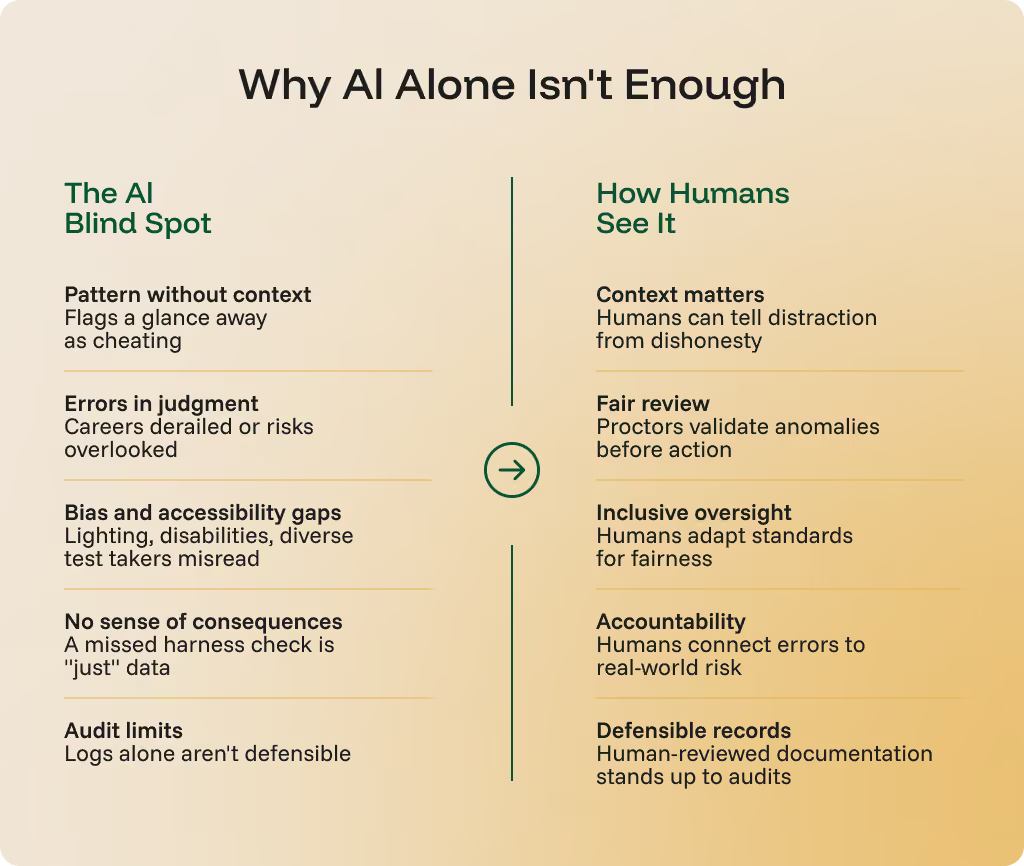
The answer is not to reject AI, but to integrate it thoughtfully. The most effective approach is AI plus human oversight, where technology enhances efficiency, but people ensure fairness, context, and compliance.
Scalable monitoring with human review
AI can monitor at scale, flagging potential anomalies. But those red flags should be reviewed by trained human proctors who can interpret context and make defensible decisions.
Audit trails and documentation
Human oversight is essential for building robust audit trails. When compliance checks or regulatory audits arise, organizations must show that their proctoring process was fair, valid, and defensible. Documentation reviewed and validated by people is far more credible than machine logs alone.
Automation accelerates, human judgment protects
AI has transformed training and monitoring with unprecedented speed and scale. Yet in safety-critical industries, automation is a tool, not a safeguard. True protection comes from human judgment, ethical oversight, and alignment with compliance standards.
With standards like ANSI/ASSP Z490.1-2024 raising the bar for defensibility, organizations must recognize that proctoring isn’t just a technical step, it’s a compliance-critical safeguard that protects lives, preserves trust, and ensures training fulfills its purpose.
Smart systems drive efficiency. Human oversight delivers safety. Together, they make compliance simple, scalable, and defensible.
Online proctoring software built for compliance and trust
When compliance is defensible, organizations, and the people they serve, are safer. That’s why proctoring must go beyond automation.
At Integrity Advocate, we combine AI efficiency with human oversight to ensure every training program is verifiable, fair, and aligned with the latest standards. That means:
- Confirmed identities
- Monitored participation
- Defended credentials
No guesswork. No blind spots. Just compliance you can stand behind.
Ready to safeguard your compliance? Let’s leverage the combined power of AI and human oversight, together.
{{post-cta}}
64% of frontline workers say injuries they’ve experienced or witnessed could have been prevented with better training, according to a YouGov survey of more than 2,000 workers in Australia, the UK, and the US.
Keep reading

More Flags ≠ More Security: How Smarter Review Saves Admins Time and Stress
January 12, 2026
|
5 min read
Flag overload is one of the most common and least discussed problems in online proctoring. When AI-only systems flag everything from background noise to lighting changes, administrators are left sorting through queues of low-risk alerts to find the few that actually matter. This post explains why more flags do not equal more security, how human review filters out noise before it reaches the administrator queue, and what a smarter review model looks like in practice, including a side-by-side comparison of AI-only versus AI plus human review across flagging volume, admin workload, and decision quality.
If you are using an online proctoring tool, and your post-exam review process feels overwhelming, it’s usually not because too little is being flagged, it’s because too much is.
As online and remote assessments scale, many programs respond by tightening controls and increasing automation. On paper, it sounds like a strong security posture. In practice, it often creates a different problem entirely: flag overload.
And that overload lands squarely on administrators.
The Hidden Cost of “Too Many Flags”
When AI-only proctoring systems flag everything from background noise to lighting changes, administrators are left sorting through long queues of low-risk alerts to find the few that actually matter.
That leads to:
- Hours spent reviewing non-issues
- Increased stress during post-exam review cycles
- Slower score releases and decision-making
- Fatigue that makes true violations harder to spot
More data doesn’t automatically mean better security. In many cases, it creates more work — without improving outcomes.
A simple rule of thumb:
More flags ≠ more security.
Why Post-Exam Review Is Where Programs Feel the Pain
The post-exam phase is where integrity decisions become real. This is the moment where:
- Administrators must determine if a violation truly occurred
- Programs need defensible outcomes they can stand behind
- Appeals, audits, or compliance reviews may follow
When every flagged event is treated equally, administrators are forced into a reactive role, reviewing volume instead of focusing on risk.
That’s where smarter review models make the biggest difference.
How Human Review Changes the Equation
Integrity Advocate was designed to reduce noise, not increase it.
Instead of passing every automated flag directly to administrators, Integrity Advocate uses highly trained human reviewers to evaluate context before an incident ever reaches your queue.
Human reviewers can:
- Distinguish normal behavior from suspicious activity
- Understand environmental and accessibility factors
- Identify patterns that automation alone can’t
- Filter out false positives before they create work
The result? Administrators see fewer, higher-quality incidents, and only when action is truly needed.
AI vs. Human Review: A Practical Comparison
Here’s a simple way to think about the difference:
Automation is powerful, but without human judgment, it often creates more work than it removes.
What This Means for Administrators
When human review is built into the process:
- Post-exam review time drops significantly
- Admins spend time on real integrity issues, not noise
- Stress and cognitive load are reduced
- Decisions are easier to defend and explain
Security becomes proactive instead of reactive, and review workflows become sustainable, even at scale.
Smarter Security Is About Focus, Not Surveillance
Strong assessment security isn’t about watching everything. It’s about identifying what actually matters, and acting with confidence when it does.
By combining AI efficiency with human judgment, Integrity Advocate helps programs protect assessment integrity without overwhelming the people responsible for it.
Because the goal isn’t more flags. It’s better outcomes.
{{post-cta}}

Who Is Liable When Proctoring Goes Wrong? Lessons From Global Legislation and Cases
May 2, 2024
|
5 min read
Courts and regulators across Canada, the EU, and the United States have consistently found that organizations deploying proctoring tools bear liability for how participant data is handled, not the software vendors they use. CASL, GDPR, BIPA, and the Cleveland State Fourth Amendment case all point to the same conclusion: the organization collecting data is the accountable party. This post examines each case and framework and explains what organizations need to do to reduce their exposure.
When a proctoring tool violates a participant's privacy, who is responsible? The software vendor? The organization that deployed it? Both?
Recent legislation and court decisions from Canada, the UK, and the United States have answered this question with increasing clarity: the liability rests with the organization running the testing, not the software provider. For anyone deploying online proctoring, this is not an abstract legal point. It is a direct operational risk.
The Core Issue
Organizations that deliver online training and testing have a legitimate need to confirm who is taking their assessments and that participants are engaging in good faith. Meeting that need often requires collecting sensitive personal data: ID images, biometric verification, session recordings, and audio. The question of who bears legal responsibility for how that data is handled has been answered by courts and regulators in ways that most organizations have not fully reckoned with.
The consistent finding across multiple jurisdictions is that the data-collecting organization, not the software vendor, is the accountable party.
CASL: The Canadian Perspective
Canada's Anti-Spam Legislation was created in 2014 to reinforce best practices in electronic communications and combat spam and related cyber threats. Among its provisions, CASL requires organizations to obtain consent and written acknowledgement before using invasive computer programs, and to provide users with assistance in removing such programs afterwards.
Under CASL, software is considered invasive if it interferes with the user's control of their computer system by opening programs, printing, or accessing files without their knowledge, or if it changes system settings, preferences, or commands without their knowledge.
Online proctoring tools that block restricted sites, monitor web use, require camera access, or install browser extensions clearly fall within this definition. And most proctoring plugins do not provide uninstall assistance, remaining active by design after the session ends to reduce support overhead for the vendor.
The risk for organizations: CASL violations carry regulatory penalties of up to $10 million per violation. If your proctoring system leaves you liable to CASL noncompliance, that exposure belongs to you, not your vendor.
GDPR: The Global Standard That Places Liability on the Data Owner
The EU's General Data Protection Regulation has established a universal standard for data privacy that reaches any organization handling the personal data of EU residents, regardless of where that organization is based.
Under GDPR, the organization running the testing is the data controller, while the proctoring tool is the data processor. Fines for inappropriate collection, storage, transfer, or deletion of personal data fall on the data controller, not the data processor.
Ireland's Data Protection Commission made this distinction explicit in a judgment against Slane Credit Union Limited, stating that processors cannot be used by controllers as a legislative safety net, and that it is essential that due diligence is carried out to ensure the protection of personal data.
GDPR fines can reach 20 million euros or 4% of a company's total worldwide annual revenue, whichever is higher. The liability for how a proctoring vendor handles learner data belongs to the organization that chose to deploy it.
BIPA: The Illinois Warning
American organizations are increasingly coming under regulatory scrutiny for proctoring practices. Illinois' Biometric Information Privacy Act is one of the most consequential examples.
BIPA places liability on organizations when biometric data is collected or used in a way that violates participant privacy, including failing to secure written consent and failing to publish a retention schedule outlining when data will be permanently destroyed.
Two landmark cases illustrate how serious this exposure can be.
BNSF Railway Co. was subject to a $228 million jury verdict for scanning the fingerprints of truck drivers without consent. The case was eventually settled for $75 million. The third-party vendor that provided the scanning technology was not implicated in the charges.
White Castle System Inc. faced a separate BIPA lawsuit in which the Illinois Supreme Court ruled that claims accrue with each individual finger scan, exposing the restaurant chain to a potential liability in the billions of dollars. White Castle ultimately settled for approximately $10 million. Again, the vendor supplying the technology was not the party held accountable.
The pattern across both cases is consistent: the organization that deployed the biometric technology bore the liability. The software vendor did not.
Cleveland State: A Fourth Amendment Violation
In 2022, a federal court found that Cleveland State University's remote testing requirement of a room scan constituted unreasonable search and seizure in violation of students' Fourth Amendment rights.
Cleveland State used two separate proctoring providers to facilitate these scans. Both were named in the decision. Neither was fined. The university bore the consequences.
This case illustrates two important points. First, the room scan requirement itself was the violation, regardless of which vendor implemented it. Second, choosing a proctoring tool that conducts room scans does not transfer the legal risk to the vendor. The organization that required the scan is the one that faces the consequences when that requirement is found to violate participant rights.
What This Means for Online Training and Testing Providers
These cases are not outliers. They reflect a consistent and accelerating trend in privacy legislation globally: organizations are responsible for the actions of any third-party software, plugins, or services they deploy. Vendor liability does not substitute for organizational accountability.
For organizations delivering online training and testing, this has direct implications for vendor selection. The question is not just whether a proctoring tool works. The question is whether deploying it creates liability for your organization under CASL, GDPR, BIPA, or other applicable legislation.
The steps that reduce that liability are straightforward: choose a vendor with documented privacy practices, confirm that data handling complies with the legislation applicable to your jurisdiction and your learners' jurisdictions, require clear data deletion timelines, and ensure that any software deployed on learner devices complies with consent and removal requirements.
How Integrity Advocate Approaches This
Integrity Advocate is designed to reduce the compliance exposure that comes with deploying a proctoring tool, not to add to it.
No installation is required in most cases, which eliminates CASL's invasive software provisions entirely for the majority of deployments. Data is collected only for its stated purpose and deleted by default within 24 hours of session completion. Consent is obtained before any data collection begins. Data is stored in GDPR-designated jurisdictions. Room scans are optional rather than mandatory, and can be enabled or disabled based on the organization's assessment of their necessity and proportionality.
These are not policy commitments. They are architectural decisions built into how the platform works.
{{post-cta}}

Integrity vs. Surveillance: Is Your Proctoring Tool Monitoring Learners or Surveilling Them?
July 2, 2024
|
5 min read
There is a meaningful difference between monitoring and surveillance in online proctoring, and most programs have not thought carefully about which one they are actually doing. Monitoring confirms identity, verifies participation, and produces a defensible result. Surveillance collects everything it can, flags anything it does not recognize, and leaves programs to sort out the noise. This post draws that distinction clearly, explains what privacy-first proctoring actually looks like in practice, and makes the case for why human review is the only thing that makes an assessment result genuinely defensible when it is challenged.
There is a difference between monitoring and surveillance. Most programs running online assessments haven’t thought carefully about which one they’re actually doing, and that gap is where trust starts to erode.
Monitoring confirms that the right person completed the assessment, stayed engaged, and followed the rules. Surveillance collects everything it can, flags anything it doesn’t recognize, and leaves the program to sort out what any of it means.
One produces a defensible result. The other produces liability.
If your proctoring tool accesses the file system of a personal device, stores recordings your team will never review, or generates hundreds of automated flags with no human judgment behind them, it’s not monitoring. It’s surveillance. And your learners know the difference.
What monitoring is actually supposed to do
Every program administering online assessments has the same core need: confirm identity, verify participation, and produce a result that holds up to scrutiny.
That’s it.
You’re not trying to catalog everything that happens in a candidate’s home. You’re not trying to build a behavioral profile. You’re trying to answer three questions:
- Was this the right person?
- Did they complete the assessment under appropriate conditions?
- Can you stand behind the result if it’s challenged?
A well-designed proctoring approach answers all three. An over-engineered one tries to answer questions nobody asked, and in doing so, creates new problems. More data. More noise. More privacy exposure. And a test-taking experience that generates complaints before a single result is issued
Where surveillance starts
Privacy-first proctoring is not a softer version of security. It’s a more precise one.
It starts with a design principle: collect only what is necessary to confirm identity and verify engagement. Nothing beyond that scope. No recordings stored by default. No system-level device access. No behavioral data used outside the bounds of the specific assessment.
In practice, that looks like this:
No downloads or extensions. The assessment runs in a browser. No software installs, no hidden permissions, no access to personal files or background applications. A test taker can sit the exam on any device without IT involvement or configuration.
Proportionate data collection. Every feature and every data point collected should have a clear answer to the question: why does this make the result more defensible? If the answer is “it doesn’t,” it shouldn’t be collected. Surveillance produces volume. Monitoring produces clarity.
Data minimization by design. The only data collected is what’s needed to produce a defensible result: identity verification, participation confirmation, and a reviewable record of any flagged behavior. Sensitive data, including ID images, is deleted within 24 hours.
Compliance built in, not bolted on. GDPR, PIPEDA, FERPA, and SOC2 compliance aren’t checkbox items. They reflect a commitment to proportionate data collection, the kind of approach that holds up when regulators or institutional counsel start asking questions.
Human review is what makes the result defensible
Here’s what automated flags can’t tell you: whether a behavior was actually a problem.
An algorithm can detect that a second face appeared in the frame. It cannot tell you that the second face belongs to a child who walked in, not an accomplice. It can flag an unusual eye movement pattern. It cannot determine whether that pattern indicates academic dishonesty or a medical accommodation. It can detect a background sound. It cannot decide whether that sound matters.
Those determinations require a person.
At Integrity Advocate, every flagged session is reviewed by a trained human reviewer before any outcome is issued. Not as a premium tier. Not as an add-on. As the standard, at every price point.
That’s the difference between a defensible result and an automated flag you have to explain to a grievance committee.
Programs that rely on automated proctoring alone are producing outcomes they cannot fully stand behind. When a result is challenged, and eventually one will be, “the algorithm flagged it” is not a sufficient answer. A documented, human-reviewed decision is.
The question your program should be asking
Before your next contract renewal or platform evaluation, ask this: what does your current proctoring tool collect, and who reviews it before a result is issued?
If the answer is “a lot” and “no one,” that’s the surveillance model. It may feel thorough. It isn’t defensible.
Privacy-first online proctoring isn’t about doing less. It’s about doing exactly what’s necessary, with human judgment behind every decision that matters. That’s what produces results your program can stand behind. It’s what earns trust from your learners. And it’s what holds up when the stakes are highest.
Integrity doesn’t require surveillance. It requires precision.
{{post-cta}}
Frequently asked questions
Find answers to the most commonly asked questions from our clients.
AI can detect patterns and flag anomalies at scale, but it cannot interpret context, understand consequences, or make defensible decisions. In high-stakes certification environments, an algorithm cannot distinguish between a distracted learner and a dishonest one, cannot account for disability-related behavior, and cannot stand before a regulator to justify a decision. Human oversight provides the judgment layer that converts automated signals into fair, defensible outcomes.
AI-only proctoring has three significant blind spots in safety-critical environments. First, it cannot understand context, treating innocent behavior and genuine violations identically. Second, it cannot weigh consequences, missing the difference between a technical flag and a life-safety risk. Third, it introduces bias through lighting conditions, facial recognition inaccuracies, and non-standard testing environments that can disadvantage test-takers with disabilities or from diverse backgrounds. Each of these blind spots becomes a compliance risk when the certification at stake protects lives.
Any certification where competency protects public safety requires defensible proctoring. This includes nursing and clinical credentials, electrical licenses, commercial driver's licenses, food safety certifications like ServSafe, and workplace safety credentials like OSHA training. The common thread is that a wrongly issued or wrongly denied credential in these categories creates direct risk to lives, not just paperwork problems.
ANSI/ASSP Z490.1-2024 requires that training programs verify learner identity, confirm active participation, and maintain records that hold up to regulatory scrutiny. The standard does not require surveillance of an entire desktop, collection of data beyond what is needed for verification, or long-term retention of sensitive information. The spirit of the standard is accountability, not overcollection. If your current proctoring system makes compliance feel like risk exposure, the approach needs to change.
ANSI/ASSP Z490.1-2024 requires that safety training be reliable, fair, and documented in a way that holds up to audit. ISO/IEC 17024 and the National Commission for Certifying Agencies frameworks reinforce the same principle for credentialing bodies: defensible certification requires human verification, ethical review, and the ability to justify every certification decision. Automated logs alone do not satisfy these requirements.