August 4, 2022
|
5 min read
Integrity Advocate Announces Integration with Canvas LMS
Integrity Advocate has completed its integration with Canvas LMS, enabling institutions and organizations using Canvas to deploy identity verification, participation monitoring, and online proctoring directly within their existing LMS environment without end user installation requirements.


Calgary, Alberta — August 4, 2022 — Integrity Advocate today announced the completion of their integration with Canvas LMS, one of the world's leading learning management systems.
Integrity Advocate's services include the verification of learner identity, monitoring of training participation, and the proctoring and invigilation of online examinations across all devices and browsers, without the requirement of end user installation or a high speed internet connection.
What the Canvas Integration Means for Your Institution
The Canvas integration extends Integrity Advocate's reach to institutions and organizations already operating within the Canvas ecosystem, allowing them to deploy identity verification and proctoring directly within their existing LMS environment without additional technical overhead.
Integrity Advocate supports Higher Education, K-12, Associations, Designation Providers, and Corporate Training organizations in ensuring the integrity of their online events through the verification of learner identity, participation, and rule compliance.
"We're committed to making online learning the best experience it can possibly be," says Integrity Advocate's CTO. "We've developed an incredibly powerful suite of digital tools that support the integrity of online learning. We're incredibly excited to integrate with Canvas LMS."
For more information on remote proctoring for Canvas, visit our integrations page.
{{post-cta}}
Keep reading
Integrity Advocate Announces Integration with D2L Brightspace
June 26, 2024
|
5 min read
Integrity Advocate has announced a partnership with D2L, integrating identity verification, participation monitoring, ExposeAI detection, and live proctoring directly into D2L Brightspace. The integration requires no participant installation and generated a 0.65% support rate in 2023, giving Brightspace users a streamlined way to maintain assessment integrity against AI-powered cheating tools.
Integrity Advocate has announced a new partnership with D2L, bringing identity verification, participation monitoring, and AI detection capabilities directly into the D2L Brightspace learning management system.
Why This Partnership Matters Now
The emergence of AI-powered browser plugins has introduced a new challenge for online assessment. These tools can covertly answer exam questions on a participant's behalf without requiring them to leave the assessment page, and they are increasingly easy to obtain and use. Organizations relying on standard LMS controls have no mechanism to detect them.
The Integrity Advocate and D2L partnership addresses this directly, giving Brightspace users access to Integrity Advocate's full suite of monitoring capabilities, including ExposeAI, within their existing platform environment.
{{post-block-quote}}
What D2L Brightspace Users Now Have Access To
The integration gives D2L Brightspace users access to Integrity Advocate's full monitoring suite, seamlessly embedded within Brightspace and fully responsive across all devices.
This includes ExposeAI, Integrity Advocate's purpose-built detection capability for AI-powered browser plugins, as well as live proctoring services for assessments requiring real-time invigilation.
The integration requires no installation from participants. Integrity Advocate is available on demand, around the clock, on any device and browser, without plugins, extensions, or system configuration changes.
In 2023, just 0.65% of Integrity Advocate users required support, a figure that reflects the low friction of the platform for learners and the reduced administrative burden for organizations running assessments at scale.
About Integrity Advocate
Integrity Advocate is an online proctoring platform that delivers end-to-end assessment security backed by human review, so every result your program issues is fair, trustworthy, and defensible. Integrity Advocate serves Higher Education, K-12, Certifying Bodies, and Training Providers across the globe.
About D2L
D2L is a leading provider of cloud-based learning technology, offering the Brightspace learning management system to educational institutions and organizations worldwide.
{{post-cta}}

AI Cheating Tools Are Outpacing LMS Defenses. Integrity Advocate Built a Solution
August 17, 2023
|
5 min read
GPT-powered browser plugins can now prefill answers to online exam questions the moment they appear, and LMS platforms have no effective countermeasures. Integrity Advocate's ExposeAI is a purpose-built detection capability that identifies AI-assisted cheating during assessment sessions, integrating directly into the existing monitoring suite without any client-side installation. This post explains how these tools work, why they matter for certified training programs, and how ExposeAI addresses the threat.
A few years ago, the concern about AI in online assessments was theoretical. Today it is not. GPT-powered browser plugins can prefill answers to multiple choice exam questions the moment they appear on screen, regardless of the topic or difficulty level. The learner does not need to read the question. They do not need to understand it. The answer is already there.
Integrity Advocate has been tracking this development closely. The response is ExposeAI, a new detection capability built directly into Integrity Advocate's monitoring suite.
How GPT-Powered LMS Plugins Work
Learning Management System plugins powered by generative AI have proliferated rapidly. Among the tools currently in use are Github Copilot, AnswersAI, ConchAI, Jasper, ChatSonic, Coursology, Hyperwrite, Quillbot, and Monica, among dozens of others that continue to emerge.
These tools share several characteristics that make them particularly difficult to address through standard LMS countermeasures:
- They are inexpensive or free to obtain
- They require no technical expertise to install or activate
- Once installed, they operate automatically and continuously
- They are designed to conceal their presence and adapt to detection attempts
- New variants emerge faster than most platforms can respond
As a result, organizations relying on their LMS provider to develop effective countermeasures are unlikely to find one. LMS companies have no current solutions to this threat, and the nature of these plugins makes them unlikely to be eradicated through platform-level defenses alone.
The integrity of online assessments and certifications depends on a different approach.
Why This Matters for Assessment Integrity
The implications extend beyond academic dishonesty. For organizations issuing certifications that carry regulatory or legal weight, an assessment completed with AI assistance is not a valid measure of knowledge or competency. The certification it produces is as hollow as one issued without any training at all.
The same worker who received a fraudulent safety certification from a provider that did not deliver training could receive an equally fraudulent certification from an organization that delivered the training but could not prevent AI tools from completing the assessment on the learner's behalf. The outcome is the same: a credential that does not reflect what the person actually knows.
Introducing ExposeAI
ExposeAI is Integrity Advocate's purpose-built response to AI-assisted assessment fraud. It can be incorporated into Integrity Advocate's existing monitoring suite without any technical effort from clients, and works across the full range of devices and browsers that Integrity Advocate supports, from mobile to desktop.
ExposeAI is designed to detect the presence and use of GPT-powered plugins during an assessment session, giving organizations the visibility they need to maintain the integrity of their certification and training programs in an environment where AI tools are becoming standard equipment for learners looking to shortcut the process.
This is part of Integrity Advocate's broader commitment to staying ahead of the threats that matter most to the programs it serves. Human review remains at the core of every session. ExposeAI adds a layer of detection specifically designed for the AI-assisted cheating methods that automated systems alone cannot reliably identify.
The Broader Picture
AI cheating tools are not a passing trend. They are becoming cheaper, more capable, and more widely available. Organizations that do not have a response to this threat are issuing certifications they cannot stand behind.
Integrity Advocate's approach combines human review with purpose-built AI detection, so the results your program issues reflect what learners actually know, not what an algorithm answered for them.
{{post-cta}}

What It Takes to Successfully Roll Out Online Proctoring Inside an LMS
April 15, 2026
|
5 min read
Rolling out online proctoring inside an LMS doesn't have to be disruptive. This guest post from uxpertise shares six practical steps for a smooth launch, plus how CMRAO cut support requests by 80% after switching to Integrity Advocate.
Guest blog by uxpertise
Rolling out online proctoring inside a Learning Management System (LMS) can feel daunting—for administrators and learners alike. Concerns around usability, learner stress, and an increase in customer support requests often slow adoption.
The reality is that when online proctoring is implemented thoughtfully, it can be seamless, learner-friendly, and highly effective—while actually reducing operational complexity.
Based on uxpertise’s experience supporting regulators and credentialing bodies, here’s what it truly takes to successfully roll out online proctoring inside an LMS, while ensuring reliable results and a positive learner experience.
Watch the webinar recording
1. Choose an LMS With Proctoring Already Integrated
One of the most important decisions happens before rollout even begins.
Whenever possible, organizations should choose an LMS with online proctoring already integrated, rather than relying on disconnected third-party tools. An integrated approach:
- Simplifies onboarding for administrators and learners
- Enables faster deployment of proctored exams
- Reduces technical friction and user confusion
- Minimizes IT and support dependencies
When proctoring is built directly into the LMS, learners stay in a single, familiar environment—no juggling platforms, no unnecessary steps.
2. Pilot Before Scaling
Before launching to your full learner population, run a pilot test with internal staff or a small group of learners.
A pilot helps you:
- Validate exam workflows end-to-end
- Identify usability or communication gaps
- Confirm rules and technical requirements
- Gather real user feedback
This step alone can prevent a large volume of avoidable support requests and ensures a smoother full-scale rollout.
3. Prepare Learners With Clear, Simple Resources
Learner preparation is one of the biggest drivers of success.
We recommend creating:
- A short video tutorial explaining the proctoring experience
- A simple written guide outlining key steps
- A practice proctored exam so learners can test the process in advance
Practice exams are especially effective. They reduce anxiety, build confidence, and ensure learners know exactly what to expect—long before exam day.
4. Clearly Communicate Exam Rules and Requirements
Transparency builds trust and compliance.
Make sure learners understand:
- Identification requirements (for example, government-issued ID)
- What is not permitted (phones, notes, additional devices)
- The need for a quiet, private testing environment
- Technical requirements such as camera, microphone, and internet connection
Clear expectations upfront significantly reduce issues during the exam and lower post-exam support inquiries.
5. Let Learners Know What Happens After the Exam
Many learners are uncertain about what happens once an exam is submitted.
Communicate clearly:
- How exams are reviewed
- When results will be available
- Whether any additional verification may occur
- How to get help if they have questions
This clarity reinforces confidence in the integrity of the process and reduces unnecessary follow-up requests.
6. Prioritize User Friendliness and Reliable Results
Successful online proctoring should support learners—not intimidate them.
A well-integrated solution:
- Is intuitive and easy to use
- Requires minimal technical knowledge
- Produces reliable, defensible outcomes
- Strengthens trust in assessment integrity
When learners feel supported, adoption increases and confidence in the system grows.
{{post-stat-highlight}}
Case Study: CMRAO’s 80% Reduction in Support Requests After Switching Proctoring Technology
CMRAO, a uxpertise client, had been delivering online exams using a different proctoring solution within the uxpertise LMS. While functional, the experience created friction for learners and resulted in a high volume of customer support requests.
When uxpertise made the decision to switch technology providers and integrate Integrity Advocate directly into the LMS, the impact was immediate.
After the transition, CMRAO experienced:
- An 80% reduction in customer support requests
- A noticeably easier experience for learners
- No required software downloads
- A more intuitive, user-friendly interface
- A truly seamless, all-in-one assessment environment
By combining an integrated proctoring solution with clear learner preparation and guidance, CMRAO significantly improved both learner experience and operational efficiency.
A Successful Rollout Is About Preparation, Not Complexity
Rolling out online proctoring inside an LMS doesn’t need to be complex or disruptive.
By choosing an integrated solution, piloting before launch, preparing learners proactively, and focusing on usability, organizations can:
- Reduce support requests
- Improve learner confidence
- Maintain high standards of integrity
- Scale assessments with confidence
At uxpertise, we believe the most effective proctoring solutions are the ones learners trust—because everything simply works.
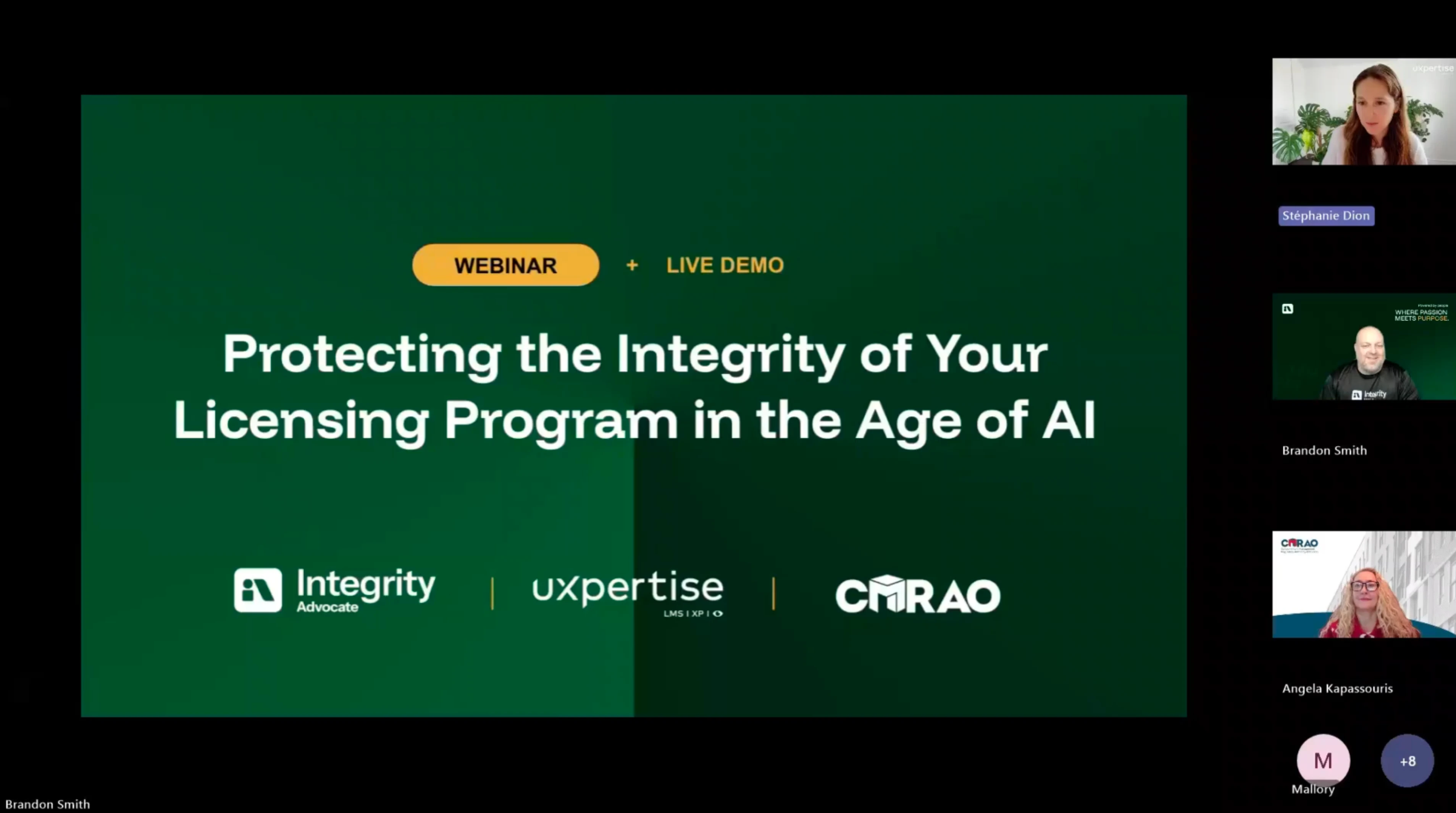
Access our webinar on-demand
Ahead of the Curve: Building Trustworthy Licensing Programs in a Changing Assessment Security Landscape
Why modern regulators and credentialing bodies need integrated systems, not disconnected tools, to stay credible, compliant, and confident.
Protecting your licensing program
in the age of AI.
Watch our joint session with uxpertise and CMRAO to see how leading credentialing bodies are securing exam integrity without sacrificing the candidate experience.


Ready when you are.
Frequently asked questions
Find answers to the most commonly asked questions from our clients.
Yes. Integrity Advocate is fully integrated with Canvas LMS, allowing institutions and organizations to deploy identity verification, participation monitoring, and online proctoring directly within their existing Canvas environment.
No. Integrity Advocate works across all devices and browsers without requiring end users to install any plugin, extension, or application. Test takers can launch their session directly from within Canvas without any technical setup.
Integrity Advocate's Canvas integration is available to Higher Education institutions, K-12 schools, professional associations, designation providers, and corporate training organizations already using Canvas as their learning management system.