June 19, 2026
|
5 min read
Key Takeaways from eAA | What “The Trust Imperative” Actually Means for Assessment Right Now
At the 2026 e-Assessment Association International Conference in London, the central theme was trust - specifically, how assessment programs can stay ahead of rapidly evolving AI-enabled cheating while preserving human oversight, candidate experience, and the credibility of every credential they issue.

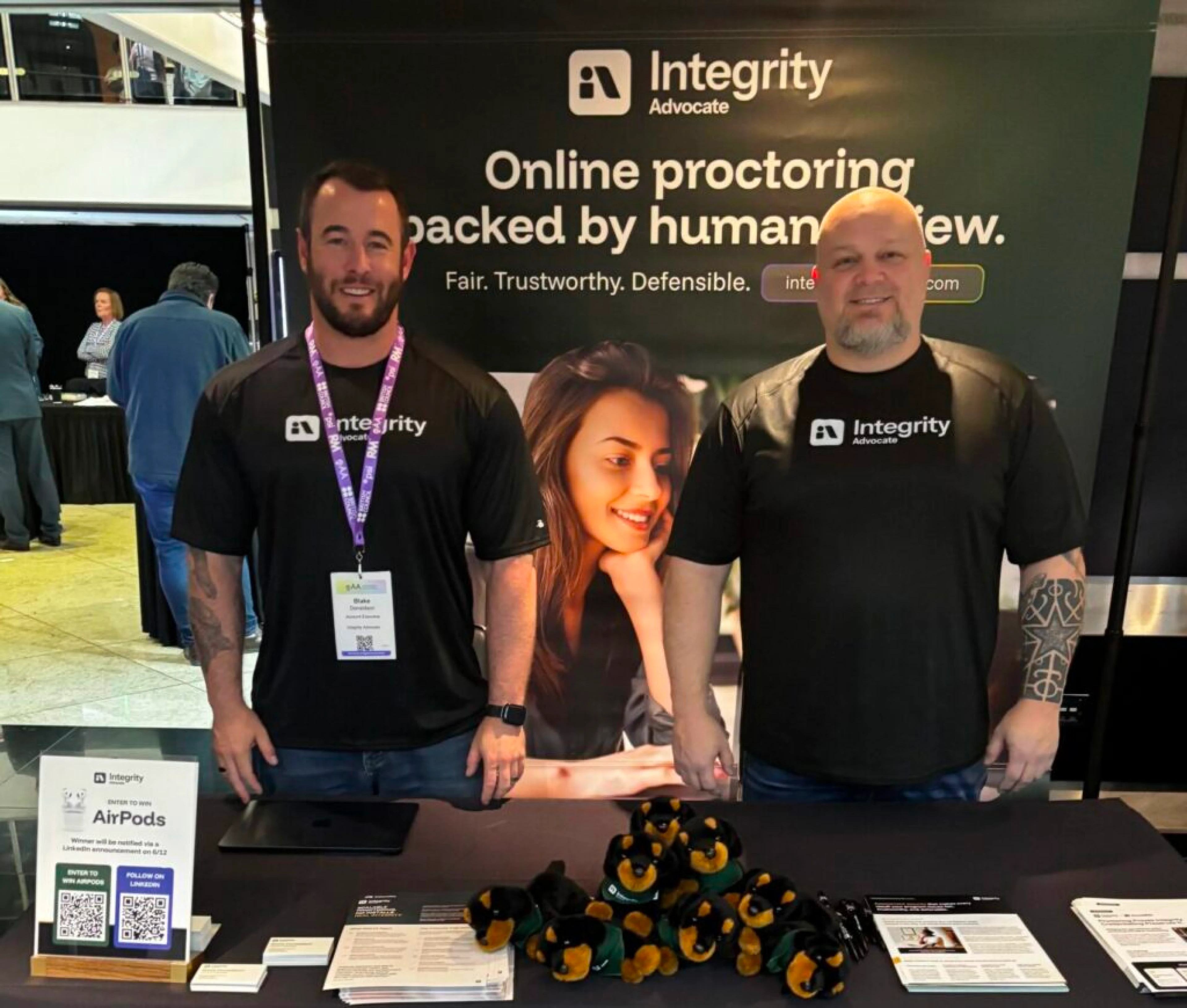
Last week I was in London for the e-Assessment Association’s 2026 International Conference, and if I had to distill three days of conversations, keynotes, and hallway debates into a single word, it would be this: trust.
Not trust as a buzzword. Trust as a genuine crisis question. As AI capabilities accelerate and new tools emerge faster than most teams can keep up with, the field is being forced to reckon with something foundational: do assessment results still mean what we say they mean?
That tension ran through nearly every session I attended, and it’s one our industry can’t afford to get wrong.

The Threat Landscape Is Moving Fast
One of the clearest messages from the conference was that assessment security is no longer a static problem. Cheating technologies are growing more sophisticated by the month. What worked two years ago may not be sufficient today, and relying on yesterday’s approach while hoping for the best is not a strategy.
At the same time, there’s a real risk of overcorrecting. Security measures that create friction, penalize legitimate candidates, or feel invasive erode trust from a different direction. The most mature programs in the room were the ones thinking about security, accessibility, and candidate experience as a unified design challenge rather than competing priorities.

Human Oversight Is Not Negotiable
One point emerged from this conference without serious debate: keeping a human in the loop is not optional. Multiple sessions, including remarks from several CEOs, affirmed that governance, transparency, and meaningful human involvement are essential to maintaining confidence in assessment outcomes.
This is not a novel position for us at Integrity Advocate. It is the architecture we have built around since day one. But it was validating to hear it stated so clearly and so universally, particularly at a moment when the industry is under pressure to automate everything in the name of efficiency.
When an assessment result affects someone’s career, their credential, their livelihood, cutting corners on human review is not a cost savings. It is a liability.
Candidate Experience Is Now a Trust Variable
Something I found particularly valuable in this year’s programming was the explicit connection being drawn between candidate experience and assessment integrity. Fairness used to be discussed almost exclusively through the lens of psychometrics and policy. That framing is expanding.
How candidates are treated during an assessment, whether the process feels transparent, whether accommodations are genuinely accessible, whether the communication is clear, these factors now register as trust signals for institutions, employers, and regulators alike. A technically sound exam delivered badly is still a trust problem.

The Takeaway I’m Bringing Home
The strongest assessment programs are designing trust in from the beginning, not retrofitting it as a compliance requirement after the fact. That principle is easy to say and genuinely hard to operationalize, especially when the tooling, the regulations, and the threat environment are all shifting simultaneously.
What gives me optimism is that the people in that room in London were asking the right questions. The eAA has always been a community that takes this work seriously, and this year’s conference reflected that.
AI is not going away. The integrity gap will not close on its own. But with the right governance structures, the right human oversight, and a genuine commitment to candidate experience, it is a solvable problem.
I’m leaving with new ideas, new connections, and renewed conviction that this is exactly the work worth doing.
{{post-cta}}
Keep reading
Trust by Evidence: A New Framework for Defensible AI Decisions
July 22, 2026
|
5 min read
Integrity Advocate has released a new whitepaper, Trust by Evidence, introducing a framework that connects AI due process, learner rights, and credential security into one model for defensible AI-assisted assessment. This post walks through what the framework covers, why AI adoption alone no longer settles the integrity question, and links to the full whitepaper download.
Assessment integrity used to mean one thing: was the exam monitored? That question is no longer enough. AI now plays a role in identity verification, proctoring flags, authorship review, scoring, and credential validation, and each of those touchpoints can be challenged.
Confidence in an outcome isn't just about whether AI was accurate. It's about whether the decision it contributed to can be explained, reviewed, appealed, and verified after the fact.
As AI becomes embedded deeper into assessment, institutions are being asked a more pointed question: Can you defend the decision AI helped you make?
That question requires more than accurate technology. It requires a system.
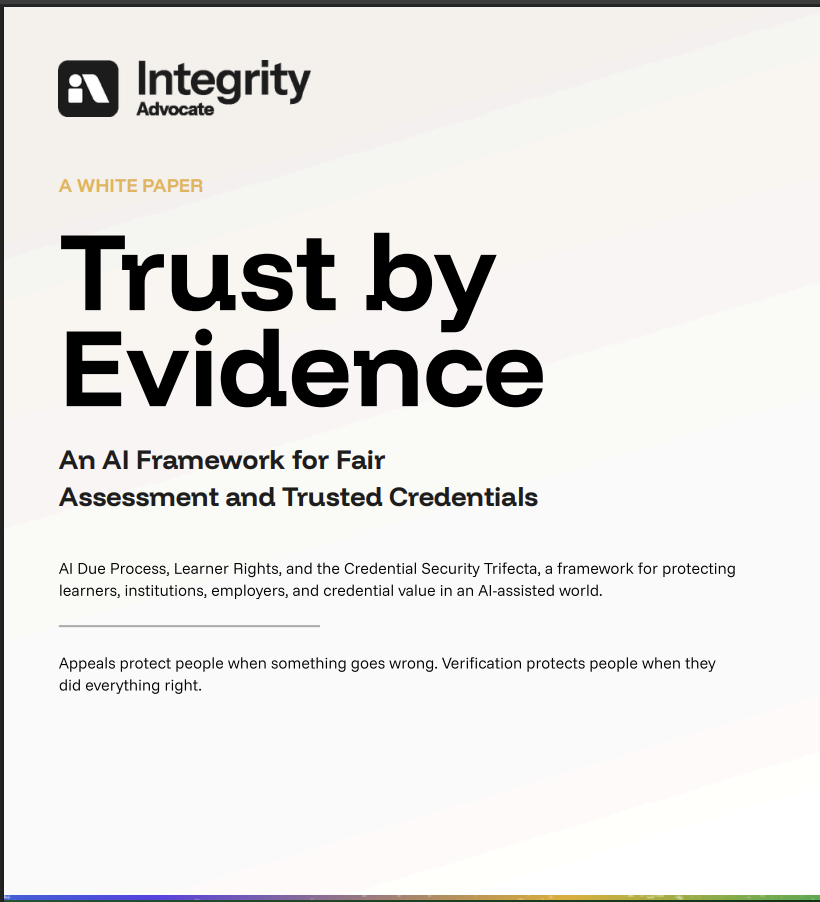
In our latest whitepaper, Trust by Evidence, CEO Brandon A. Smith introduces a framework that connects AI due process, learner rights, and credential security into one model for defensible outcomes.
Download the whitepaper
The Shift From AI Adoption to Defensible Outcomes
For the past several years, the conversation in education and credentialing has centered on adoption: which AI tools to use, how to deploy them, how accurate they are. That conversation is largely settled. Most programs already use AI somewhere in the assessment lifecycle.
What hasn't been settled is defensibility. When an AI-influenced decision is challenged, whether by a learner, an employer, or a regulator, an institution needs to answer a specific set of questions: was there notice, meaningful human review, supporting evidence, and a path to appeal? If any of those answers are unclear, the decision isn't defensible, and the institution is exposed right along with the learner.
The next major challenge in education isn't AI adoption. It's building outcomes that hold up under scrutiny.
Why Treating AI as a Single Safeguard Creates Risk
Many programs rely on AI to do one job: flag anomalies. That model treats a flag as a finding rather than a signal, and it breaks down under three conditions:
- No documented process exists for what happens after a flag is raised.
- Human review means approving the AI's output rather than independently evaluating it.
- There's no clear path for the learner to respond, and no record for the institution to point to later.
Any one of those gaps makes an outcome difficult to defend. Together, they create real exposure, not just to individual learners, but to the institution's accreditation standing, employer trust, and legal risk.
The Trust by Evidence Framework
The whitepaper introduces Trust by Evidence, a framework that connects three ideas typically treated in isolation:
AI Due Process: A fair, documented process for any consequential decision AI contributes to, so a flagged learner has an actual process to walk through rather than a black box to accept.
The Learner Rights Layer: Seven specific rights, to know, to meaningful human review, to explanation, to evidence, to appeal, to proportionality, and to verification, that turn "the system flagged it" into a decision an institution can explain and stand behind.
The Credential Security Trifecta: A secure chain of trust connecting learning, assessment, and credentialing, where a weakness in any one layer undermines the others.
Individually, each idea is familiar. Together, they hold up under scrutiny from everyone with a stake in the outcome: the learner, the institution, employers, regulators, and the public.
What a Defensible AI-Assisted Decision Looks Like
A defensible process doesn't rely on confidence in the algorithm. It provides an actual record. It lets an institution answer, with certainty:
- Was the individual notified that AI was involved?
- Did a qualified reviewer examine the evidence, not just the score?
- Could the individual respond before a consequence was applied?
- Is there a documented, time-bound appeal path?
- Can the outcome be explained to someone outside the institution?
These are governance questions as much as technical ones. Answering them well protects accreditation standing, employer trust, and learner confidence all at once.
What You'll Learn in the Whitepaper
The full whitepaper expands on:
- Why algorithmic due process, procedural justice, and automation bias research all point toward the same conclusion for education
- The Defensible Outcomes Responsibility Matrix, a governance tool for assigning clear ownership across vendors, institutions, and credential issuers
- The five-stage AI Appeals Framework, walked through with a real worked example of a contested proctoring flag
- Sector-specific guidance for K-12, higher education, workforce certification, and employers
- A candid discussion of the framework's limitations, including cost, scale, and surveillance risk
It's written for compliance leads, credentialing bodies, assessment teams, and program leaders responsible for the outcomes their institution has to stand behind.
{{post-cta}}
What Defensible Assessment Looks Like in 2026
April 7, 2026
|
5 min read
AI tools have changed what cheating looks like, and most proctoring systems were built for a different problem. This post covers why an automated flag alone can't defend an outcome, and what a defensible assessment record requires in 2026.
We talk to a lot of programs right now that are dealing with the same thing. AI tools have changed what cheating looks like, and most proctoring systems were built for a problem that’s no longer the only one on the table. The gap is showing up in appeals, in complaints, and in outcomes that are getting harder and harder to defend.
What’s actually happening out there
The classic image of cheating a second phone, a friend on the other side of the room, notes taped to a monitor is still real. But it’s not the conversation we’re having with most programs anymore. The harder stuff is subtler.
AI writing tools can produce a natural, well-reasoned answer in seconds. Paraphrasing tools can disguise lifted content well enough to pass similarity checks. And the behavioral signals that used to flag something suspicious eye movements, typing pace, browser switching don’t tell you much when the assistance is happening invisibly, in another tab or on another device entirely.
The problem isn’t that AI cheating is impossible to catch. It’s that catching it requires a level of context and judgment that an algorithm alone doesn’t have.
An algorithm can tell you something looked unusual. It can’t tell you what actually happened or whether it matters. That part still requires a person.
Why a flag without a human isn't enough anymore
Automated proctoring was designed to catch visible, definable behaviors tab switching, phone use, an unauthorized person on screen. For those cases, it works. But AI-assisted cheating often leaves no visible trace at all.
So when an automated system flags something in this environment, what it's actually telling you is: something here didn't fit the expected pattern. That's a starting point, not a conclusion. The problem is when programs treat it like one.
A wrongful finding based on an automated flag isn't just uncomfortable it can seriously damage a student's record or a professional's career. And when that decision gets challenged, "the system flagged it" isn't a defensible answer. You need a record of what actually happened and a human judgment behind the decision.
{{post-stat-highlight}}
What it actually takes to be defensible
Defensibility isn't really about technology. It's about being able to look anyone in the eye a student, a candidate, a regulator, a board member and explain clearly why a decision was made and what it was based on.
In this environment, that takes three things:
- Human review on every flag, before any decision goes out. Not as an appeal process. Before the outcome is issued.
- Reviewers who are looking at AI-use patterns specifically, not just traditional integrity signals, and who understand the difference between something suspicious and something definitively wrong.
- A complete session record identity verification, monitoring log, what was flagged, what the reviewer saw, what was decided ready to export the moment someone asks.
What actually changes with human review
One question to sit with
If an outcome from one of your proctored exams was challenged today by a student, a candidate, an employer, an accreditor what could you actually put in front of them? An automated flag, or a complete human-reviewed record of what happened and why?
For programs where the result genuinely matters, that's not a rhetorical question. It's the one worth answering before you need to.
We built Integrity Advocate around exactly this human review on every flagged session, a complete audit trail for every outcome, and the kind of defensibility that holds up when someone actually pushes back.
{{post-cta}}

Assessment Security Is Changing. Is Your Strategy Built for What Is Next?
February 17, 2026
|
5 min read
Assessment security has changed fundamentally. AI-assisted misconduct, global remote testing at scale, rising privacy expectations, and credentials tied to real professional consequence have all shifted the landscape at once. This post traces how assessment delivery has evolved from in-person exams to global remote testing, examines what each shift has required from integrity programs, and makes the case for why a modern assessment security strategy needs layered detection, human judgment, privacy-first design, and a partner built to adapt as the landscape continues to change.
Credentials that carry real professional consequence. The landscape has shifted and it is not slowing down.
In the video above, we trace how assessment delivery has evolved from in-person exams to global remote testing and why each shift has required a new approach to protecting integrity. Today’s environment requires a modern assessment security strategy designed for AI, scale, and trust.
The Landscape Has Shifted
Assessment did not begin online. It moved there. For decades, integrity relied on physical oversight in classrooms and testing centers. As programs expanded, online exams increased access and flexibility. Then the COVID surge accelerated remote assessment almost overnight. What began as an emergency solution became a long-term operating model for many institutions and credentialing bodies.
As delivery models evolved, security had to evolve as well. The challenge now is that change is happening faster and across more dimensions at once.
The AI Era Has Changed the Risk Equation
Generative AI has fundamentally altered how information is accessed, created, and submitted. Tools powered by artificial intelligence can draft essays, solve complex problems, generate code, and replicate writing styles within seconds.
Wiley’s large-scale academic integrity research found that a growing percentage of students acknowledge using AI tools in academic settings, and many instructors report increased concern about AI-assisted misconduct in online exams. The issue is not theoretical. It is active and expanding.
Traditional remote proctoring models were built to detect visible behaviors such as a second person in the room or suspicious movements. AI-assisted misconduct often leaves fewer visible signals. The risk is increasingly digital rather than physical.
Programs must now account for:
- AI-generated responses submitted during online exams
- Real-time AI assistance on secondary devices
- Screen-to-phone workflows that avoid camera detection
- Rapidly evolving generative AI tools
At the same time, institutions cannot simply increase surveillance. Wiley research also shows that student trust and perceptions of fairness directly influence engagement and compliance. Excessively invasive monitoring can undermine that trust.
Modern assessment security in the AI era requires a layered approach:
- Intelligent detection signals
- Contextual analysis
- Trained human review
- Clear, defensible documentation
AI can identify patterns at scale. Human expertise provides interpretation and fairness. The objective is not to monitor more. It is to respond intelligently to how misconduct has evolved.
Scale and Access Have Redefined Expectations
Programs now serve global audiences across time zones and devices. Certification pathways are expanding, workforce training is accelerating. According to recent industry market analysis, the global online proctoring market is projected to continue growing at a strong compound annual growth rate over the next several years, driven by remote testing demand and enterprise credentialing needs.
As access scales, candidates expect experiences that are simple, device-friendly, and reliable. Programs need solutions that integrate into their LMS platforms, require minimal setup, and support growth without creating operational strain.
Research from Wiley indicates that students are more likely to report positive testing experiences when the process is straightforward and transparent. Complexity and technical barriers reduce confidence in the assessment process.
Modern assessment protection must:
- Work across devices and real-world environments
- Minimize unnecessary technical hurdles
- Integrate directly with LMS systems
- Scale without increasing manual administrative work
Ease of use is no longer a convenience. It is directly tied to program adoption, student trust, and operational sustainability.
Security must scale as confidently as the programs it protects.
Privacy and Trust Are Non-Negotiable
As digital assessment expands, privacy expectations intensify.
Wiley research highlights that students care deeply about how their data is collected, stored, and used. Concerns around surveillance and data retention influence perceptions of fairness and institutional trust.
At the same time, regulatory frameworks around data protection continue to evolve globally. Institutions must balance integrity with compliance and reputational risk. Security that compromises privacy ultimately weakens credibility.
Programs increasingly seek approaches that:
- Minimize unnecessary data collection
- Avoid excessive long-term storage of exam data
- Provide contextual human review rather than automated punishment
- Deliver defensible and transparent outcomes
Trust is part of assessment integrity. A secure system must protect both the exam and the relationship between the organization and the candidate. Integrity and privacy must coexist.
Credentials Carry Long-Term Consequences
Assessments are no longer isolated academic exercises. They connect directly to employment decisions, professional licensure, workforce mobility, and digital credential verification. Industry market analysis shows that employers increasingly rely on verified credentials as part of hiring and advancement decisions.
When exam integrity is compromised, the value of the credential is compromised. When credentials lose credibility, the entire ecosystem is affected.
Programs are therefore focusing not only on detection but on defensibility:
- Clear audit trails
- Consistent enforcement standards
- Transparent review processes
- Long-term protection of credential credibility
Assessment security is about preserving trust in outcomes, not simply preventing violations during a single session.
Why a Tool Is No Longer Enough
In this environment, selecting a proctoring solution becomes a strategic decision. Organizations need more than software that flags behavior. They need a partner that:
- Understands AI-era risks
- Invests in research and thought leadership
- Balances intelligent detection with human judgment
- Supports scalable growth
- Adapts to evolving regulations and technology
Security is no longer a static feature. It is an evolving system. Standing still is the greatest risk.
Built for What Is Next
Integrity Advocate was designed for this reality. We combine AI-powered detection with trained human review to deliver assessment security that adapts to your program’s needs. We prioritize privacy, minimize unnecessary data storage, and support flexible proctoring options that work across devices and environments.
More importantly, we treat assessment integrity as an ongoing partnership. Three things are certain:
The landscape will continue to change.
Technology will continue to advance.
New risks will continue to emerge.
The organizations that succeed will be those who choose strategies and partners built to evolve alongside them. Is your strategy is built for what is next?
{{post-cta}}
Frequently asked questions
Find answers to the most commonly asked questions from our clients.
Human-in-the-loop proctoring combines AI flagging with human review to ensure every assessment decision is defensible. Rather than relying on automated systems alone, a trained reviewer evaluates flagged behavior before any action is taken, reducing false positives and protecting candidates from unfair outcomes.
Yes. How candidates are treated during a remote exam directly impacts trust in the result. When the process feels opaque, inaccessible, or invasive, it undermines confidence in the credential, not just the experience. Leading assessment programs now treat fairness, transparency, and accommodation as integrity variables, not afterthoughts.
AI is making cheating more sophisticated and harder to detect, which means assessment security can no longer be static. Programs that rely on yesterday's approach are increasingly exposed. The most effective response combines AI detection with human oversight and a commitment to candidate experience, so security measures don't create new trust problems while solving old ones.
Yes. Integrity Advocate's model is designed to scale without increasing administrative burden. Because human reviewers filter incidents before they reach administrators, the workload on program staff remains manageable even as assessment volume grows. The review process becomes more efficient as it scales, not more overwhelming.
The pace is significant. At the time of writing, several dozen GPT-powered LMS plugins were actively in use, with new ones emerging daily. The speed of development in this space means that static detection methods become outdated quickly. Integrity Advocate's approach is designed to adapt as the threat evolves.