May 10, 2026
|
5 min read
Payroll Certification Programs Are No Longer Just Delivering Exams. They’re Delivering Trust.
Legacy testing infrastructure puts credential trust at risk. See why payroll certification programs are modernizing, what a "trust engine" looks like, and the real-world results from the National Payroll Institute, including a 57% drop in integrity incidents.


For decades, payroll certification programs operated within a relatively stable testing model. Candidates tested in controlled environments. Exams were delivered in classrooms or testing centers. Proctors supervised sessions physically. And the credibility of the designation was largely tied to the rigor of the exam itself.
That environment no longer exists. Today’s payroll associations and certification bodies are serving remote, digitally connected professionals who expect flexible testing experiences that work on any device, from anywhere, without technical friction or invasive surveillance.
At the same time, employers, regulators, and stakeholders are demanding stronger assurance that certifications remain credible, defensible, and independently verifiable.
This shift fundamentally changes the role of certification organizations.
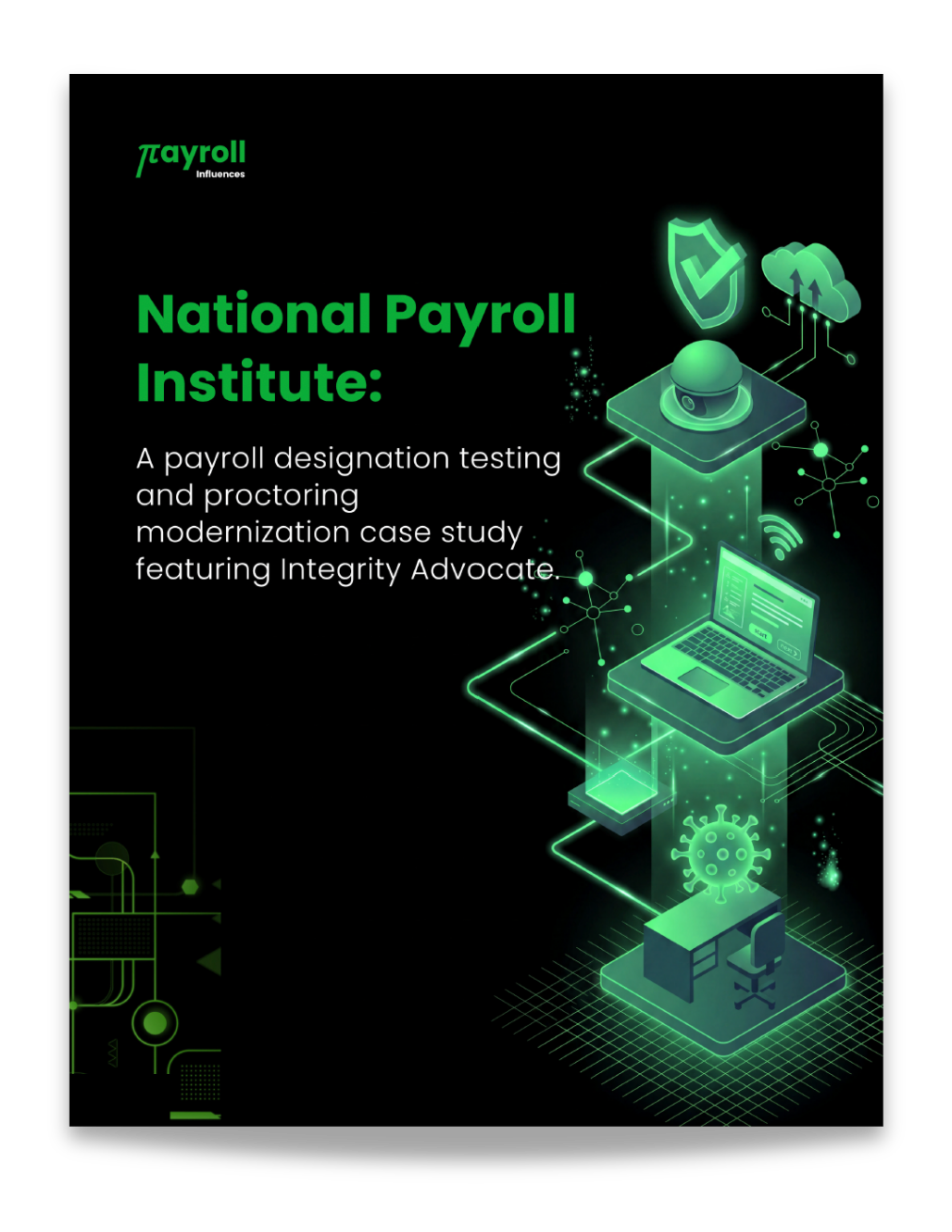
As the new Payroll Influences eBook, Enabling a Trust Engine: A Modern Blueprint for Scalable Payroll Certification Testing, explains:
{{post-stat-highlight}}
And that distinction matters more than ever.
Download the free guide
The Credential Is Only as Trusted as the Process Behind It
In a digital-first testing environment, the exam itself is no longer the only thing being evaluated, candidates evaluate the experience, employers evaluate the credibility of the designation, program administrators evaluate operational risk, and stakeholders increasingly evaluate whether the certification process can withstand scrutiny, disputes, appeals, and governance requirements.
That means credential trust is now directly connected to:
- Identity verification
- Evidence-backed integrity decisions
- Candidate experience
- Accessibility
- Privacy practices
- Operational consistency
- Defensible audit trails
Programs that fail to modernize these areas risk something much larger than isolated technical issues. They risk erosion of designation value itself. The report refers to this growing challenge as the certification “Testing Risk Stack.”
The Hidden Costs of Legacy Testing Infrastructure
Many certification programs still rely on testing models designed for another era. The assumptions behind traditional proctoring systems; controlled rooms, supervised desktops, mandatory downloads, rigid browser restrictions, increasingly clash with modern candidate expectations and operational realities.
The Certification “Testing Risk Stack”
This is one of the most important shifts happening in assessment security right now: The biggest risk is no longer simply cheating, the biggest risk is loss of trust in the credential itself.
AI Has Changed the Integrity Conversation, But Not in the Way Most Programs Think
AI-driven integrity threats are accelerating across education, certification, and workforce training environments. But many organizations have responded by increasing automation and surveillance instead of improving verification quality. That approach often creates new problems:
- Higher false positive rates
- More candidate distrust
- Increased appeals
- Poorer learner experiences
- Greater operational burden
The report makes a critical distinction: “AI alone creates false flags. Surveillance erodes trust. Mandatory installs block access.”
This is where many legacy proctoring models break down. Detection alone is not defensibility. Programs still need context, evidence, and human review to produce fair and trustworthy outcomes. This aligns closely with Integrity Advocate’s broader approach to Security-Based Proctoring; a framework focused on verified outcomes, evidence-backed review, and proportional response instead of surveillance-heavy automation.
Related reading:
- Security-Based Proctoring Whitepaper
- The Credential Security Trifecta Whitepaper
What Modern Certification Testing Actually Looks Like
The report outlines a more sustainable model for modern certification programs, one built around what it calls a “Trust Layer.” Rather than relying on fragmented tools, modern programs are increasingly connecting:
- LMS or testing platforms
- Human-reviewed online proctoring
- Digital credentialing systems
Together, these systems create what the report describes as “An end-to-end chain of evidence from session to credential.”
The Modern Certification Workflow
This is a major evolution from “flag generation” toward defensible outcome validation.
Real-World Results: National Payroll Institute
One of the strongest sections of the report highlights how the National Payroll Institute modernized its certification testing infrastructure with Integrity Advocate. NPI faced challenges familiar to many certification organizations:
- Technical failures
- Limited accessibility support
- Operational strain
- Candidate frustration
- Scalability concerns
After implementing Integrity Advocate’s browser-native, low-friction, human-reviewed proctoring model, the organization reported:
Modernization Outcomes
Equally important, the organization improved both operational efficiency and candidate experience without introducing heavier surveillance or technical barriers. That balance is becoming a defining competitive advantage for certification programs.
What Payroll Associations Should Prioritize in a Testing Partner
The report outlines several key capabilities modern certification organizations should prioritize when evaluating online proctoring and assessment security partners:
Low-Friction Participation
Candidates should be able to test without downloads, plugins, or complicated setup requirements.
Human Verification
Human-reviewed incidents reduce false positives and improve fairness and defensibility.
Privacy-First Infrastructure
Modern programs need strong data minimization and responsible retention practices.
Accessibility and Inclusion
Multilingual support, accommodation readiness, and flexible testing experiences improve participation and reduce barriers.
Defensible Evidence Trails
Programs need audit-ready evidence and reviewable integrity decisions that can withstand appeals and scrutiny.
These capabilities are no longer “nice-to-have” operational features, they are becoming core drivers of credential trust and market credibility.
The Future of Certification Is Defensible, Verifiable, and Low Friction
The organizations that will lead the next decade of credentialing are not simply the ones with the hardest exams, they are the ones capable of proving:
- Who took the exam
- How integrity decisions were made
- Whether outcomes can withstand scrutiny
- That the process was fair, accessible, and privacy-conscious
Trust is becoming infrastructure, and certification programs that proactively modernize now will be better positioned to:
- Protect designation value
- Increase employer confidence
- Improve learner participation
- Reduce operational burden
- Scale securely in an AI-driven environment
As the report concludes:
"The strongest partner doesn’t just proctor the exam; they connect verified outcomes to credential issuance.”
{{post-cta}}
“Payroll associations are no longer in the exam business. They’re in the trust business.”
Keep reading

Case Study: How the National Payroll Institute Cut Integrity Incidents in Half
July 24, 2026
|
5 min read
When the National Payroll Institute (NPI) moved its Payroll Compliance Professional and Payroll Leadership Professional designations online, its first proctoring solution created more problems than it solved. After switching to Integrity Advocate, NPI proctored more than 30,000 exams with fewer than 1% of users requiring support, cut academic integrity incidents from an average of 86 per month to 37, and reduced incident review time from weeks to 48 hours.
The National Payroll Institute issues two professional designations, the Payroll Compliance Professional and the Payroll Leadership Professional, held today by more than 21,000 members. Integrity is one of NPI's four core values, so when the COVID-19 pandemic forced a rapid shift away from honor-based, supervisor-led proctoring, NPI needed an online solution that could uphold that standard at scale.
Key Outcomes
- 57% reduction in academic integrity incidents, from an average of 86 per month down to 37
- Fewer than 1% of users require technical support
- More than 30,000 exams proctored with a seamless experience
Challenge
NPI's first attempt at online proctoring didn't hold up. The system required plugin downloads, ran on a limited set of browsers, and offered no French-language support for the 12% of NPI's membership that operates in French. Close to half of students hit a technical issue during their exam. For a body responsible for validating the competency of more than 17,000 PCP and 4,000 PLP designation holders, that wasn't a minor inconvenience. It was a threat to the credibility of the credential itself.
{{post-block-quote}}
A Complete Transformation in User Experience
After switching to Integrity Advocate, the technical support burden that used to consume staff time became close to invisible. Integration with NPI's D2L Brightspace LMS meant students could move directly from coursework into a proctored exam without separate logins or downloads, and the entire implementation took a single 45-minute setup meeting, compared to weeks of troubleshooting under the previous system.
"We're getting very little feedback," Pacella said. "And that's amazing. That speaks volumes. That's exactly what we want. You don't hear about software that works well typically... But if it didn't work, you better believe we're going to hear about it a lot."
Dramatic Improvement in Academic Integrity
Paired with a proactive integrity education module, NPI's average dropped from 86 incidents per month to 37, a reduction of more than half, and the improvement held steady over time.
"We went from an average of 86 incidents per month, and it dropped more than in half, down to 37," Pacella said. "And that's been very consistent since we implemented some of these resources and things for people to understand what academic integrity means."
The reduction wasn't just about fewer incidents. It was about quality. The incidents that remained were genuine violations, not technical false positives or misunderstandings about proctoring protocols. That let NPI's review committees spend their time on legitimate concerns instead of sorting through noise, producing more consistent, more defensible decisions.
Seamless Student Experience
Daniela Kwiatkowski, NPI's Manager of Learning and Professional Development, experienced the system firsthand when she took one of NPI's own courses. Her experience highlighted how the technology disappeared into the background, letting students focus on demonstrating their professional competency.
"Before you do it for the first time, you're thinking, how am I going to do this?" Kwiatkowski said. "I moved the camera to one corner and then I forgot about it, and it was easy to forget about it. It wasn't constantly there... now I could focus on the exam, which is what we want people to do."
Scaling Success Across the Organization
NPI's growth didn't stop once the technical problems were solved. According to Steven Van Alstine, Vice President of Professional Standards and Education, NPI moved from proctoring a few thousand students to e-proctoring every student pursuing the Payroll Compliance Professional designation, a ramp-up that happened in under three months.
"We were able to scale that up dramatically through our move to D2L Brightspace and the integration with Integrity Advocate," Van Alstine said. "There was a point at which we maybe had a few thousand students being e-proctored, to the point now where every one of our students is e-proctored... and that ramp-up happened in less than three months."
That rapid scaling extended across NPI's mixed delivery model, including partnerships with public and private academic institutions alongside direct-to-student programs, without requiring different standards across channels.
Administrative Efficiency and Confidence
Decision-making that previously took weeks now happens within 48 hours, with clear evidence and streamlined processes. The administrative team developed communication templates and tracking systems to ensure consistent, fair handling of every incident.
"Giving someone a zero on an exam or failing a course is a big deal," Kwiatkowski said. "I cannot emphasize it enough... Having the peace of mind to know this is an incident that was flagged for the right reasons... we are very confident that this is legitimate."
Advice for Other Organizations
NPI's guidance to other certifying bodies is straightforward: technical due diligence up front saves significant time later.
"There are a lot of products out there," Pacella said. "And you're going to reach out to them, and the sales team will talk a big game about all the wonderful things they can do. Take your time and understand the technical aspects of implementation before making a decision."
{{post-cta}}
OnDemand Webinar: 30K Proctored Exams, Zero Headaches: National Payroll Institute Keeps Support Under 1%
June 2, 2025
|
5 min read
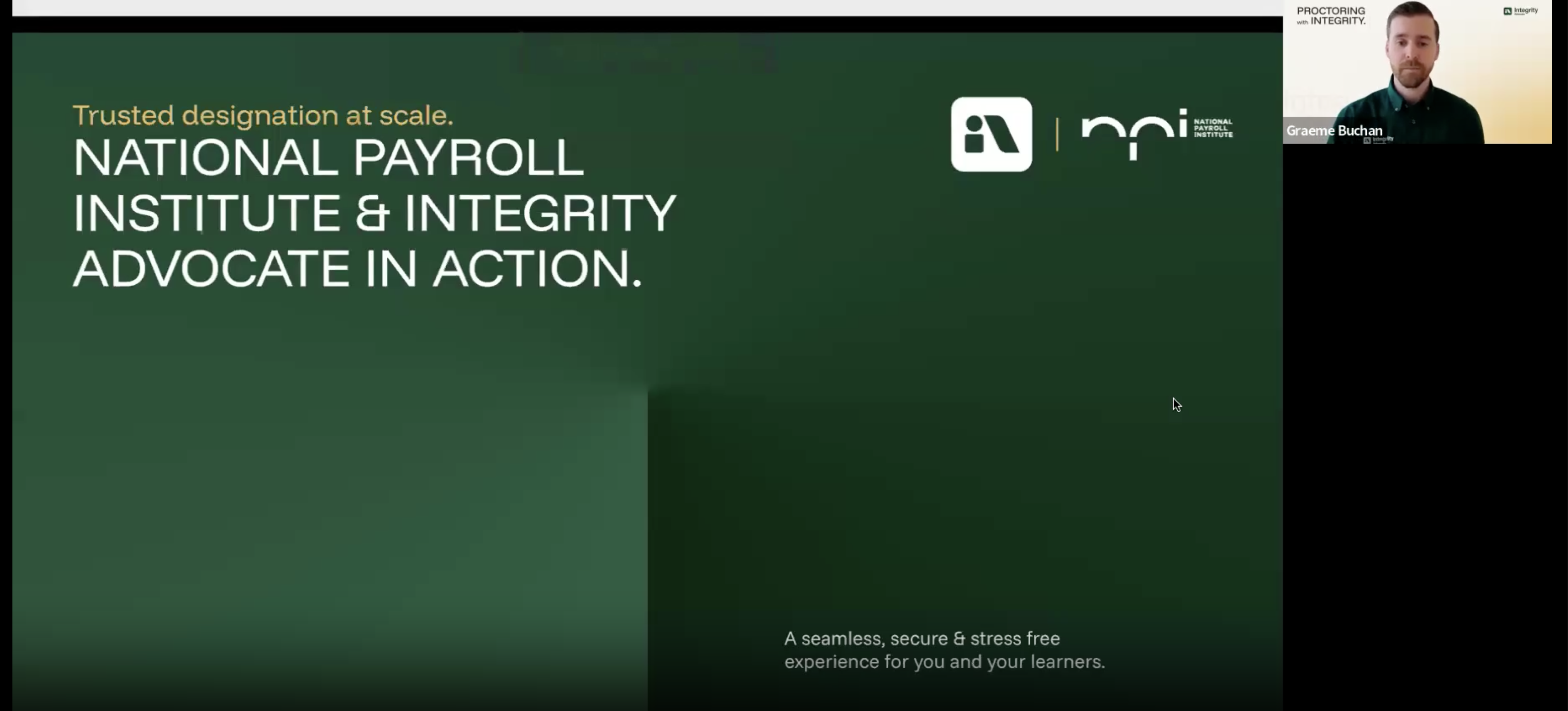
Before Integrity Advocate, nearly 50% of National Payroll Institute students experienced issues with online proctoring. After implementation, that figure dropped to virtually zero. This webinar recap covers NPI's full transformation: a 57% reduction in academic integrity incidents, 30,000 or more exams proctored seamlessly, sub-1% support rates, and a scaling from a few thousand to every student being e-proctored in less than three months. Three NPI leaders share what the experience looked like from the inside and what they would tell other organizations considering a proctoring solution.
Date
Originally aired: June 24, 2025
How Integrity Advocate Transformed Online Proctoring for the National Payroll Institute
Solution: Integrity Advocate E-Proctoring Platform
{{post-stat-highlight}}
Before implementing Integrity Advocate in 2020, the National Payroll Institute (NPI) faced significant challenges with its existing online proctoring solution. With over 15,000 course registrations annually and a growing need for remote assessment integrity, NPI was eager to ensure a seamless experience for users and administrators.
The COVID-19 pandemic forced NPI to rapidly pivot from its honor-based supervisor proctoring system to a fully online solution. Technical issues, compatibility problems, and frustrated students plagued their first attempt at online proctoring. The situation became critical as NPI's membership had grown from 4,000 members decades ago to over 17,000 PCP designation holders and 4,000 PLP designation holders, all requiring reliable assessment integrity.
Christopher Pacella, Manager of Professional Accreditation and Standards, knew there had to be a better way. The previous system required plugin downloads, only worked on specific browsers, lacked French language support for their 12% francophone membership, and caused technical headaches for students and administrators. With integrity being one of NPI's four core values, the technical barriers undermined their fundamental mission.
{{post-block-quote}}
The reality was apparent - their proctoring system needed a complete overhaul to support NPI's mission of maintaining the highest standards of professional payroll excellence.
A Complete Transformation in User Experience
Fast-forward to today using Integrity Advocate, and the transformation has been remarkable. What used to be a source of constant technical support tickets has become virtually invisible to users. The seamless integration with D2L Brightspace meant students could focus on their assessments rather than troubleshooting technology. This transformation was particularly crucial for NPI's diverse student population, which includes many professionals who returned to education later in their careers and may not be as comfortable with complex technical systems.
"We're getting very little [feedback]. And that's amazing. That speaks volumes. That's exactly what we want. You don't hear about software that works well typically... But if it didn't work, you better believe we're going to hear about it a lot. And that was the big difference between the system that we previously had, where we heard all sorts of feedback, and Integrity Advocate, where it just works." - Christopher Pacella, Manager of Professional Accreditation and Standards
The implementation process was remarkably smooth, requiring only a 45-minute setup meeting compared to the weeks of troubleshooting that characterized their previous solution. This efficiency allowed NPI's technical team to redirect their efforts from crisis management to strategic educational initiatives that better serve their members.
Dramatic Improvement in Academic Integrity
One of the most significant improvements was in academic integrity incident management. NPI saw remarkable results after implementing a comprehensive academic integrity education module combined with Integrity Advocate's seamless proctoring. The institute's proactive approach to education and reliable technology created an environment where students understood expectations and could meet them without technical barriers.
"We went from an average of 86 incidents per month, and it dropped more than in half, down to 37. And that's been very consistent since we implemented some of these resources and things for people to understand what academic integrity means." - Christopher Pacella, Manager of Professional Accreditation and Standards
The reduction wasn't just about fewer incidents - it was about quality. The remaining incidents were genuine violations rather than accidental technical issues or misunderstandings about proctoring protocols. This improvement meant that NPI's review committees could focus their time on legitimate concerns rather than sorting through technical false positives, leading to more consistent and fair decision-making processes.
Seamless Student Experience
The transformation was equally dramatic for students. Daniela Kwiatkowski, Manager of Learning and Professional Development, experienced the system firsthand when she took one of NPI's courses. Her experience highlighted how the technology disappeared into the background, allowing students to concentrate on demonstrating their professional competency. This was particularly important for NPI's student population, many of whom are working professionals balancing career responsibilities with continuing education requirements.
"Before you do it for the first time, you're thinking, how am I going to do this? I've to write this exam that's stressful enough, and somebody will be watching me... I moved the camera to one corner and then I forgot about it, and it was easy to forget about it. It wasn't constantly there. [Like] oh, it's watching you. It was put in a corner, now [I could] focus on the exam, which is what we want people to do." - Daniela Kwiatkowski, Manager of Learning and Professional Development
This improvement in user experience had cascading effects throughout the organization. Students could focus on demonstrating their payroll expertise rather than wrestling with technology. The reduced anxiety around the proctoring process meant that assessment results better reflected actual knowledge and competency. This directly supported NPI's goal of ensuring that designation holders truly possess the skills they represent to employers.
Scaling Success Across the Organization
The partnership with Integrity Advocate enabled NPI to scale its proctoring operations dramatically while maintaining quality and integrity. This scalability proved crucial during the pandemic when remote learning accelerated rapidly, but it continues to support NPI's growing membership and expanding course offerings. The ability to handle volume without compromising academic integrity standards has become a competitive advantage for the organization.
"We were able to scale that up dramatically through our move to D2L Brightspace and the integration with Integrity Advocate. There was a point at which we maybe had a few thousand students being e-proctored, to the point now where every one of our students is e-proctored through the payroll compliance professional designation... And that ramp-up happened in less than three months." - Steven Van Alstine, Vice President of Professional Standards and Education
The rapid scaling capability also supported NPI's diverse delivery methods, including partnerships with public and private academic institutions alongside their direct-to-student programs. This flexibility has allowed NPI to expand its reach while maintaining consistent standards across all delivery channels.
Administrative Efficiency and Confidence
From an administrative perspective, the transformation was equally impressive. Decision-making that previously took weeks now happens within 48 hours, with clear evidence and streamlined processes. The administrative team developed communication templates and tracking systems that ensure consistent and fair handling of all incidents. This systematic approach has created a defensible process that stands up to appeals and maintains the organization's reputation for fairness and integrity.
"Giving someone a zero on an exam or failing a course is a big deal. I cannot emphasize it enough... Having the peace of mind to know this is an incident [that was] flagged for the right reasons. We can see that this is a violation, [it] gives us the peace of mind to say, okay, we know that if we're going to give them a zero or fail them or whatever the consequences are, we are very confident that this is legitimate." - Daniela Kwiatkowski, Manager of Learning and Professional Development
The administrative experience became so streamlined that what used to consume significant staff time troubleshooting technical issues now allows the team to focus on genuine student support and educational excellence. This shift has improved job satisfaction for staff members who can now concentrate on meaningful educational work rather than technical crisis management.
Advice for Other Organizations
Having experienced both the challenges of problematic proctoring solutions and the success of the right partnership, the NPI team offers clear guidance for other organizations. Their journey from a 50% student issue rate to virtually zero technical problems provides valuable lessons for any organization considering e-proctoring solutions. The team emphasizes the importance of thorough due diligence and learning from organizations that have successfully navigated similar transformations.
"There are a lot of products out there. And you're going to reach out to them, and the sales team will talk a big game about all the wonderful things they can do. Take your time and understand the technical aspects of implementation before making a decision. And if you want to save yourself a lot of time, start with Integrity Advocate, because we've already done that research for you and know that it works." - Christopher Pacella, Manager of Professional Accreditation and Standards
The NPI team's recommendation reflects their comprehensive experience with multiple solutions and their understanding of the actual costs of implementation challenges. Their advice emphasizes that the initial technology decision impacts not just technical performance but also student experience, administrative efficiency, and ultimately the organization's ability to fulfill its educational mission.
Watch the webinar recording
{{post-cta}}
AI Cheating Tools Are Outpacing LMS Defenses. Integrity Advocate Built a Solution
August 17, 2023
|
5 min read
GPT-powered browser plugins can now prefill answers to online exam questions the moment they appear, and LMS platforms have no effective countermeasures. Integrity Advocate's ExposeAI is a purpose-built detection capability that identifies AI-assisted cheating during assessment sessions, integrating directly into the existing monitoring suite without any client-side installation. This post explains how these tools work, why they matter for certified training programs, and how ExposeAI addresses the threat.
A few years ago, the concern about AI in online assessments was theoretical. Today it is not. GPT-powered browser plugins can prefill answers to multiple choice exam questions the moment they appear on screen, regardless of the topic or difficulty level. The learner does not need to read the question. They do not need to understand it. The answer is already there.
Integrity Advocate has been tracking this development closely. The response is ExposeAI, a new detection capability built directly into Integrity Advocate's monitoring suite.
How GPT-Powered LMS Plugins Work
Learning Management System plugins powered by generative AI have proliferated rapidly. Among the tools currently in use are Github Copilot, AnswersAI, ConchAI, Jasper, ChatSonic, Coursology, Hyperwrite, Quillbot, and Monica, among dozens of others that continue to emerge.
These tools share several characteristics that make them particularly difficult to address through standard LMS countermeasures:
- They are inexpensive or free to obtain
- They require no technical expertise to install or activate
- Once installed, they operate automatically and continuously
- They are designed to conceal their presence and adapt to detection attempts
- New variants emerge faster than most platforms can respond
As a result, organizations relying on their LMS provider to develop effective countermeasures are unlikely to find one. LMS companies have no current solutions to this threat, and the nature of these plugins makes them unlikely to be eradicated through platform-level defenses alone.
The integrity of online assessments and certifications depends on a different approach.
Why This Matters for Assessment Integrity
The implications extend beyond academic dishonesty. For organizations issuing certifications that carry regulatory or legal weight, an assessment completed with AI assistance is not a valid measure of knowledge or competency. The certification it produces is as hollow as one issued without any training at all.
The same worker who received a fraudulent safety certification from a provider that did not deliver training could receive an equally fraudulent certification from an organization that delivered the training but could not prevent AI tools from completing the assessment on the learner's behalf. The outcome is the same: a credential that does not reflect what the person actually knows.
Introducing ExposeAI
ExposeAI is Integrity Advocate's purpose-built response to AI-assisted assessment fraud. It can be incorporated into Integrity Advocate's existing monitoring suite without any technical effort from clients, and works across the full range of devices and browsers that Integrity Advocate supports, from mobile to desktop.
ExposeAI is designed to detect the presence and use of GPT-powered plugins during an assessment session, giving organizations the visibility they need to maintain the integrity of their certification and training programs in an environment where AI tools are becoming standard equipment for learners looking to shortcut the process.
This is part of Integrity Advocate's broader commitment to staying ahead of the threats that matter most to the programs it serves. Human review remains at the core of every session. ExposeAI adds a layer of detection specifically designed for the AI-assisted cheating methods that automated systems alone cannot reliably identify.
The Broader Picture
AI cheating tools are not a passing trend. They are becoming cheaper, more capable, and more widely available. Organizations that do not have a response to this threat are issuing certifications they cannot stand behind.
Integrity Advocate's approach combines human review with purpose-built AI detection, so the results your program issues reflect what learners actually know, not what an algorithm answered for them.
{{post-cta}}
Frequently asked questions
Find answers to the most commonly asked questions from our clients.
Payroll certification programs are modernizing because candidate expectations, remote participation, AI-related integrity risks, and employer demands for defensible credentialing have changed significantly. Legacy testing systems built for classroom environments often create technical friction, privacy concerns, and operational inefficiencies in digital-first certification programs.
Outdated proctoring systems can create:
- Higher false positive rates
- Increased candidate frustration
- Technical support burdens
- Inconsistent integrity decisions
- Privacy and governance concerns
- Reduced trust in certification outcomes
These issues can ultimately impact credential value, employer confidence, and certification program reputation.
Human review helps reduce false accusations and provides context that automation alone cannot accurately assess. AI can identify potential risk signals during an exam session, but trained reviewers help determine whether those signals represent actual misconduct or normal candidate behavior. This improves fairness, consistency, and trust in the certification process.
Payroll associations should prioritize partners that offer:
- Browser-native delivery
- Human-reviewed integrity decisions
- Audit-ready evidence reporting
- Privacy-first data practices
- LMS integration
- Accessibility and multilingual support
- Scalable operational support
- Defensible incident workflows
The right partner should support both credential integrity and candidate trust.
Integrity Advocate helps payroll certification programs deliver secure, defensible, and low-friction testing experiences without invasive technology or heavy operational burden. Its browser-native platform, human-reviewed integrity process, privacy-first approach, and audit-ready reporting help organizations protect credential trust while improving candidate experience and scalability.