
SÉCURITÉ ET CONFIDENTIALITÉ
La sécurité protège les données. La confidentialité protège les personnes. Ensemble, elles protègent la confiance.
De la collecte des données à l'examen des évaluations, chaque décision est prise pour protéger les personnes, les programmes et les certifications qui dépendent de nous.

COMMENT NOUS PROTÉGEONS LES DONNÉES
Sécurisation des données à tous les niveaux
Integrity Advocate ne collecte que les informations nécessaires pour fournir des évaluations sécurisées et équitables. Votre organisation conserve le contrôle de la conservation et de la suppression des données, avec des protections de la vie privée intégrées à chaque étape de la plateforme.

COMMENT NOUS PROTÉGEONS LES PERSONNES
Confidentialité dès la conception
La confidentialité consiste à protéger les personnes, pas seulement les informations. Nous ne collectons que ce qui est nécessaire, ne vendons jamais les données des participants et permettons aux organisations de contrôler la conservation des données.
VALIDATION INDÉPENDANTE
Vérifié selon des normes reconnues
Des audits indépendants et des cadres de confidentialité reconnus permettent de valider les pratiques de sécurité, de confidentialité et d'accessibilité intégrées à Integrity Advocate.
SOC
SOC 2 Type II
Contrôles de sécurité audités par un organisme indépendant.
RGPD
RGPD
Conçu pour soutenir la conformité au RGPD.
FERPA
Conforme à la norme FERPA
Prend en charge les protections FERPA pour les dossiers des étudiants.
LPRPDE
Conforme à la LPRPDE
Conçu pour respecter les exigences de la LPRPDE du Canada en matière de confidentialité.
WCAG
WCAG 2.1
Accessible par conception pour chaque participant.
PBD
Protection de la vie privée dès la conception
Conçu avec la confidentialité dès le départ.
NOTRE APPROCHE
La sécurité et la confidentialité intégrées à chaque niveau
Nous prenons des décisions réfléchies sur les données collectées, leur protection, les personnes y ayant accès et leur suppression.
Collecte de données minimale
Nous collectons uniquement les informations nécessaires pour vérifier l'identité, protéger l'intégrité des évaluations et documenter les résultats.
Conservation contrôlée par l'organisation
Votre organisation détermine la durée de conservation des dossiers d'évaluation et le moment de leur suppression.
Validation indépendante
Les contrôles de sécurité sont régulièrement testés par le biais d'audits tiers et d'examens continus.
Aucune donnée n'est vendue. Jamais.
Les données des participants sont utilisées uniquement pour soutenir votre programme d'évaluation, et non à des fins publicitaires, de courtage de données ou toute autre finalité non liée.
QUAND LA CONFIANCE EST MISE À L'ÉPREUVE
Une sécurité qui résiste à l'examen
Lorsqu'un organisme d'accréditation, un régulateur, un employeur ou un participant demande comment une évaluation a été protégée, vous avez besoin de plus que de simples politiques. Il vous faut des dossiers clairs, des pratiques validées de manière indépendante et des preuves solides sur lesquelles vous pouvez vous appuyer.
Facilitez les audits, les examens d'accréditation et le contrôle interne grâce à une documentation claire.
Appuyez vos décisions d'évaluation sur des preuves, des examens vérifiés et des dossiers cohérents.
Offrez aux participants, aux employeurs et aux régulateurs une plus grande confiance dans l'intégrité de votre programme.
Adaptez-vous à l'évolution des exigences en matière de confidentialité, de sécurité et d'accessibilité sans avoir à repenser toute votre approche.
CE QUE DISENT NOS CLIENTS
"La Colombie-Britannique possède certaines des lois sur la protection de la vie privée les plus strictes au monde et, après plus de 10 ans d'expérience, nous maîtrisons les processus et les normes nécessaires pour évaluer la conformité des nouveaux systèmes en matière de confidentialité et de cybersécurité. Integrity Advocate était la solution idéale à cet égard."

D'AUTRES RAISONS DE NOUS CHOISIR
La sécurité est le fondement. La confiance repose sur bien plus.
Découvrez les principes et les capacités qui distinguent Integrity Advocate des solutions entièrement automatisées.
Examen humain vérifié
L'IA identifie les modèles. Des spécialistes formés apportent le contexte et le jugement que l'automatisation ne peut offrir.
Aucune installation
Les évaluations sécurisées se lancent directement dans le navigateur ; aucun téléchargement ni obstacle informatique.
Fonctionne sur tous les appareils
Proposez des évaluations sécurisées sur ordinateurs portables, Chromebooks, tablettes et appareils mobiles.
L'accessibilité par conception
Gérez les aménagements et proposez des expériences de test inclusives sans compromettre l'intégrité.
Conçu pour la simplicité
Une facilité d'utilisation plébiscitée signifie moins de demandes d'assistance et une meilleure expérience globale.
Intégrations fluides
Connectez-vous aux LMS et aux plateformes d'apprentissage que votre organisation utilise déjà.
Ressources sur la sécurité et la confidentialité
Découvrez nos analyses sur la protection des données des participants, le renforcement de l'intégrité des évaluations et l'instauration d'un climat de confiance.

Integrity Without Intrusion: How Integrity Advocate Protects Exam-Taker Privacy
November 12, 2025
|
5 min de lecture
Too many proctoring solutions swing too far toward surveillance, turning what should be a fair, secure process into an uncomfortable experience that undermines learner trust. This post explains how Integrity Advocate's privacy-first approach protects exam integrity without intrusion: data minimization by design, no downloads or device control, hybrid AI plus human review that assesses flags after the session rather than popping in mid-exam, and transparent audit-ready summaries that protect everyone involved without long video recordings or invasive monitoring.
In the era of remote learning and online credentialing, online exam proctoring must ensure test integrity, but it should also respect the people taking those exams. Too often, proctoring solutions swing too far toward surveillance, turning what should be a fair, secure process into an uncomfortable experience that feels invasive.
At Integrity Advocate, we believe there’s a better way. Our privacy-first proctoring approach is designed to protect integrity without intrusion, ensuring assessments remain credible, compliant, and human-centered.
Privacy by Design: From the Ground Up
Privacy isn’t an afterthought; it’s baked into every layer of our technology.
Integrity Advocate operates on a data-minimization model: we collect only what’s necessary to confirm identity and verify exam integrity, nothing more.
Unlike many proctoring platforms, we don’t store recordings by default, and we never use test-taker data to train AI models or for analytics beyond the scope of an assessment.
Our system is compliant with global privacy frameworks, including GDPR, PIPEDA, and FERPA, giving institutions and exam takers confidence that their data is handled ethically and securely.
No Downloads, No Device Control
Traditional proctoring tools often require software installs that grant deep access to personal computers, screen control, keystroke tracking, among other invasive practices.
Integrity Advocate takes a completely different approach. Our solution runs entirely in the browser, no downloads, no extensions, and no hidden permissions.
This means:
- No access to personal files or background apps
- No system takeovers or “remote eyes” on your device
- No need for test takers to perform awkward scans
It’s a lightweight, seamless setup that works on any modern device while preserving privacy and accessibility.
Human + AI Oversight: Fair, Not Fearful
AI is powerful, but context matters. That’s why Integrity Advocate uses a hybrid proctoring model, AI handles the heavy lifting of detecting potential issues (like multiple faces or device switching), while trained human reviewers provide the judgment and nuance that algorithms can’t.
We don’t use live proctors who “pop in” on test takers mid-exam. Instead, our reviewers assess potential flags after the session, ensuring normal, non-cheating behavior isn’t misread as a violation.
This hybrid model ensures accuracy without anxiety, maintaining exam integrity while respecting test-taker dignity.
Transparent, Defensible Results
Instead of long video recordings, administrators receive concise, context-rich summaries of any flagged activity. Each flag includes time stamps, screenshots, and reviewer note, giving decision-makers the information they need to take confident, defensible action.
This approach protects everyone involved, reducing false positives, simplifying audits, and maintaining transparency without compromising privacy.
No “Big Brother” Surveillance
Pop-in monitoring. Forced webcam scans. Mandatory software installs. These are hallmarks of the old way of proctoring, one that prioritizes control over trust.
Integrity Advocate rejects that approach. We believe secure testing environments don’t have to feel like surveillance. By combining smart automation, human oversight, and privacy-by-design principles, we deliver integrity without intrusion; ensuring a calm, fair, and respectful testing experience for every exam taker.
The Future of Testing Is Human
As remote and hybrid testing continue to expand, institutions face a choice: maintain integrity through invasive monitoring, or adopt technology that balances security with humanity. At Integrity Advocate, we’ve made our choice clear, privacy isn’t a compromise, it’s a commitment.
Because integrity means more than preventing cheating. It means respecting the people behind every test.
Interested in learning how Integrity Advocate can help your organization maintain exam integrity, without compromising privacy?
{{post-cta}}
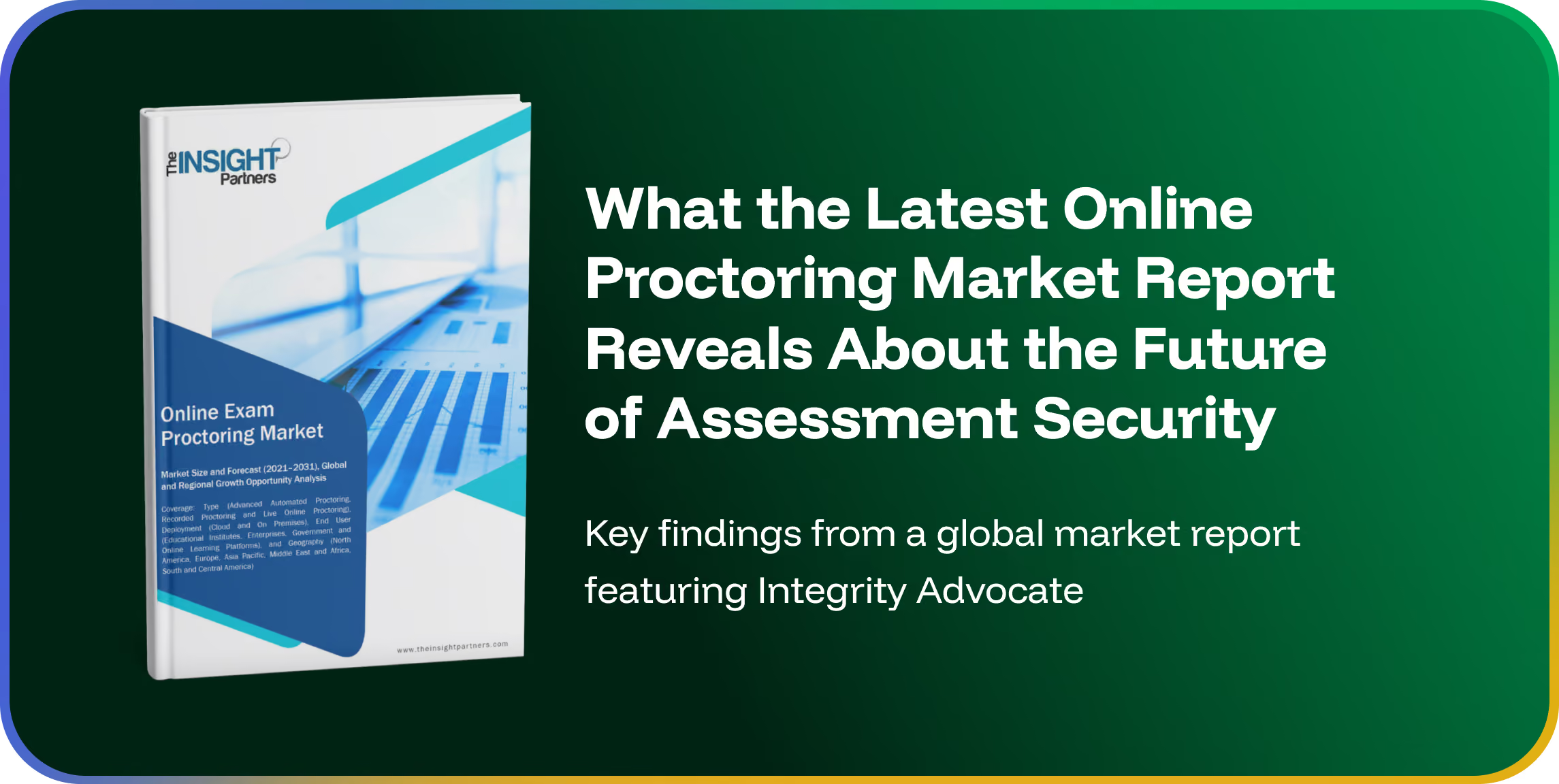
What the Latest Online Proctoring Market Report Reveals About the Future of Assessment Security
January 30, 2025
|
5 min de lecture
The Insight Partners has released its Online Exam Proctoring Market Global Analysis and Forecast to 2031 report, featuring Integrity Advocate as part of its company analysis. The US market alone is projected to grow from $281.09 million in 2024 to $803.92 million by 2031 at a CAGR of 16.4%. This post highlights the four most important signals from the report for assessment programs planning ahead, from the sustained role of distance learning in driving demand to the growing recognition that AI alone is not sufficient and that trust, fairness, and auditability are becoming central concerns rather than secondary considerations.
The online exam proctoring market is continuing to grow, not just in size, but in complexity.
According to a recent global market report from The Insight Partners, online proctoring is being adopted across a widening range of use cases, including higher education, workforce training, professional certification, and regulated industries. Integrity Advocate was featured in the report as part of its company analysis, alongside other providers operating in the space.
Below are several key insights from the report, and what they signal for assessment programs planning for the years ahead.
The Online Proctoring Market Is Experiencing Sustained Growth
The report projects strong growth for the global online exam proctoring market through 2031, driven by continued expansion of online and hybrid learning models, workforce upskilling, and remote certification.
While growth varies by region, North America remains one of the largest and fastest-growing markets. In the United States alone, the online exam proctoring market is expected to grow from $281.09 million in 2024 to $803.92 million by 2031, representing a compound annual growth rate (CAGR) of 16.4%.
This growth reflects a broader shift in how organizations deliver and validate assessments, particularly as remote testing becomes a permanent part of education and professional development.
Online Learning Adoption Continues to Fuel Demand
One of the primary drivers cited in the report is the sustained adoption of online and distance learning.
The report notes:
“The online exam proctoring market has experienced significant growth, driven by increasing adoption of e-learning solutions, rising demand from the corporate sector, and the cost-effectiveness of online exam proctoring.”
In the U.S., this trend is reinforced by enrollment data. According to figures cited in the report, approximately 53% of postsecondary students were enrolled in at least one distance education course in fall 2022, underscoring how normalized online learning, and by extension, online assessment, has become.
As online assessments become more common, expectations around exam integrity, identity verification, and defensibility continue to rise.
AI Is a Key Market Driver, But Not the Whole Solution
AI-enhanced proctoring is identified as a major growth opportunity in the report, particularly as organizations look to scale assessment programs efficiently.
At the same time, the report emphasizes that online proctoring relies on multiple layers of oversight, noting that modern solutions often combine:
“video, audio, artificial intelligence (AI), machine learning (ML), biometric authentication, and other monitoring tools to track candidate behavior during an online exam.”
This multi-signal approach reflects a growing recognition that exam integrity cannot rely on automation alone, especially in higher-stakes environments where results may be challenged, audited, or tied to professional outcomes.
Trust, Fairness, and Auditability Are Becoming Central Concerns
Beyond growth projections, the report highlights a shift in why organizations adopt online proctoring, not just to prevent cheating, but to protect the credibility of outcomes.
Online proctoring is increasingly used to:
“ensure the credibility of online assessments and maintain academic and professional standards in remote testing environments.”
As assessment programs scale, decisions made during and after an exam must be explainable and defensible. This is pushing organizations to look beyond point solutions and consider how assessment security operates across the full lifecycle, before, during, and after the exam.
What This Means for Assessment Programs
One of the clearest signals from the data is that assessment security is evolving into a system-level concern.
Programs that succeed long-term will be those that:
- Balance AI automation with human oversight
- Protect exam integrity without excessive data collection
- Support transparent, audit-ready decisions
- Maintain trust with test-takers, institutions, and credentialing bodies
As online proctoring continues to expand into higher-stakes use cases, these considerations are becoming central, not optional.
Access the Full Market Report
For those who want to explore the full data, forecasts, and regional analysis, the complete Online Exam Proctoring Market – Global Analysis & Forecast to 2031 report is available for download.
This report was produced by The Insight Partners. Integrity Advocate is featured in the report and is sharing access for educational purposes.
{{download-resource-cta}}
{{post-cta}}

More Flags ≠ More Security: How Smarter Review Saves Admins Time and Stress
January 12, 2026
|
5 min de lecture
Flag overload is one of the most common and least discussed problems in online proctoring. When AI-only systems flag everything from background noise to lighting changes, administrators are left sorting through queues of low-risk alerts to find the few that actually matter. This post explains why more flags do not equal more security, how human review filters out noise before it reaches the administrator queue, and what a smarter review model looks like in practice, including a side-by-side comparison of AI-only versus AI plus human review across flagging volume, admin workload, and decision quality.
If you are using an online proctoring tool, and your post-exam review process feels overwhelming, it’s usually not because too little is being flagged, it’s because too much is.
As online and remote assessments scale, many programs respond by tightening controls and increasing automation. On paper, it sounds like a strong security posture. In practice, it often creates a different problem entirely: flag overload.
And that overload lands squarely on administrators.
The Hidden Cost of “Too Many Flags”
When AI-only proctoring systems flag everything from background noise to lighting changes, administrators are left sorting through long queues of low-risk alerts to find the few that actually matter.
That leads to:
- Hours spent reviewing non-issues
- Increased stress during post-exam review cycles
- Slower score releases and decision-making
- Fatigue that makes true violations harder to spot
More data doesn’t automatically mean better security. In many cases, it creates more work — without improving outcomes.
A simple rule of thumb:
More flags ≠ more security.
Why Post-Exam Review Is Where Programs Feel the Pain
The post-exam phase is where integrity decisions become real. This is the moment where:
- Administrators must determine if a violation truly occurred
- Programs need defensible outcomes they can stand behind
- Appeals, audits, or compliance reviews may follow
When every flagged event is treated equally, administrators are forced into a reactive role, reviewing volume instead of focusing on risk.
That’s where smarter review models make the biggest difference.
How Human Review Changes the Equation
Integrity Advocate was designed to reduce noise, not increase it.
Instead of passing every automated flag directly to administrators, Integrity Advocate uses highly trained human reviewers to evaluate context before an incident ever reaches your queue.
Human reviewers can:
- Distinguish normal behavior from suspicious activity
- Understand environmental and accessibility factors
- Identify patterns that automation alone can’t
- Filter out false positives before they create work
The result? Administrators see fewer, higher-quality incidents, and only when action is truly needed.
AI vs. Human Review: A Practical Comparison
Here’s a simple way to think about the difference:
Automation is powerful, but without human judgment, it often creates more work than it removes.
What This Means for Administrators
When human review is built into the process:
- Post-exam review time drops significantly
- Admins spend time on real integrity issues, not noise
- Stress and cognitive load are reduced
- Decisions are easier to defend and explain
Security becomes proactive instead of reactive, and review workflows become sustainable, even at scale.
Smarter Security Is About Focus, Not Surveillance
Strong assessment security isn’t about watching everything. It’s about identifying what actually matters, and acting with confidence when it does.
By combining AI efficiency with human judgment, Integrity Advocate helps programs protect assessment integrity without overwhelming the people responsible for it.
Because the goal isn’t more flags. It’s better outcomes.
{{post-cta}}
Questions fréquentes
Trouvez les réponses aux questions les plus fréquentes de nos clients.
Integrity Advocate collecte uniquement les informations nécessaires à la réalisation d'évaluations sécurisées. Les données sont chiffrées, ne sont jamais vendues et sont gérées selon des politiques de conservation configurables, contrôlées par votre organisation.
Oui. Integrity Advocate fait l'objet d'audits SOC 2 Type II indépendants afin de valider les contrôles de sécurité mis en œuvre pour protéger les données des clients et des participants.
Oui. Notre plateforme est conçue pour accompagner les organisations devant se conformer au RGPD, à la FERPA, à la LPRPDE et aux autres exigences en matière de confidentialité.
Une sécurité renforcée protège les données d'évaluation, tandis que la confidentialité protège les participants. Associées à une vérification humaine rigoureuse et à des preuves documentées, ces pratiques aident les organisations à garantir des résultats d'évaluation justes, défendables et fiables.

Découvrez une sécurité fondée sur la confiance.
Planifiez une démonstration personnalisée pour découvrir comment Integrity Advocate protège les données des participants, respecte les exigences mondiales en matière de confidentialité et aide les organisations à fournir des résultats d'évaluation sécurisés et défendables.
10 M+
Nombre total de sessions surveillées
65+
Langues prises en charge
98%
Taux de fidélisation de la clientèle