
RATED #1 FOR EASE OF USE ON G2
Security shouldn't create more work
Customers rank Integrity Advocate #1 for ease of use, praising its simple implementation, intuitive experience, and responsive support.
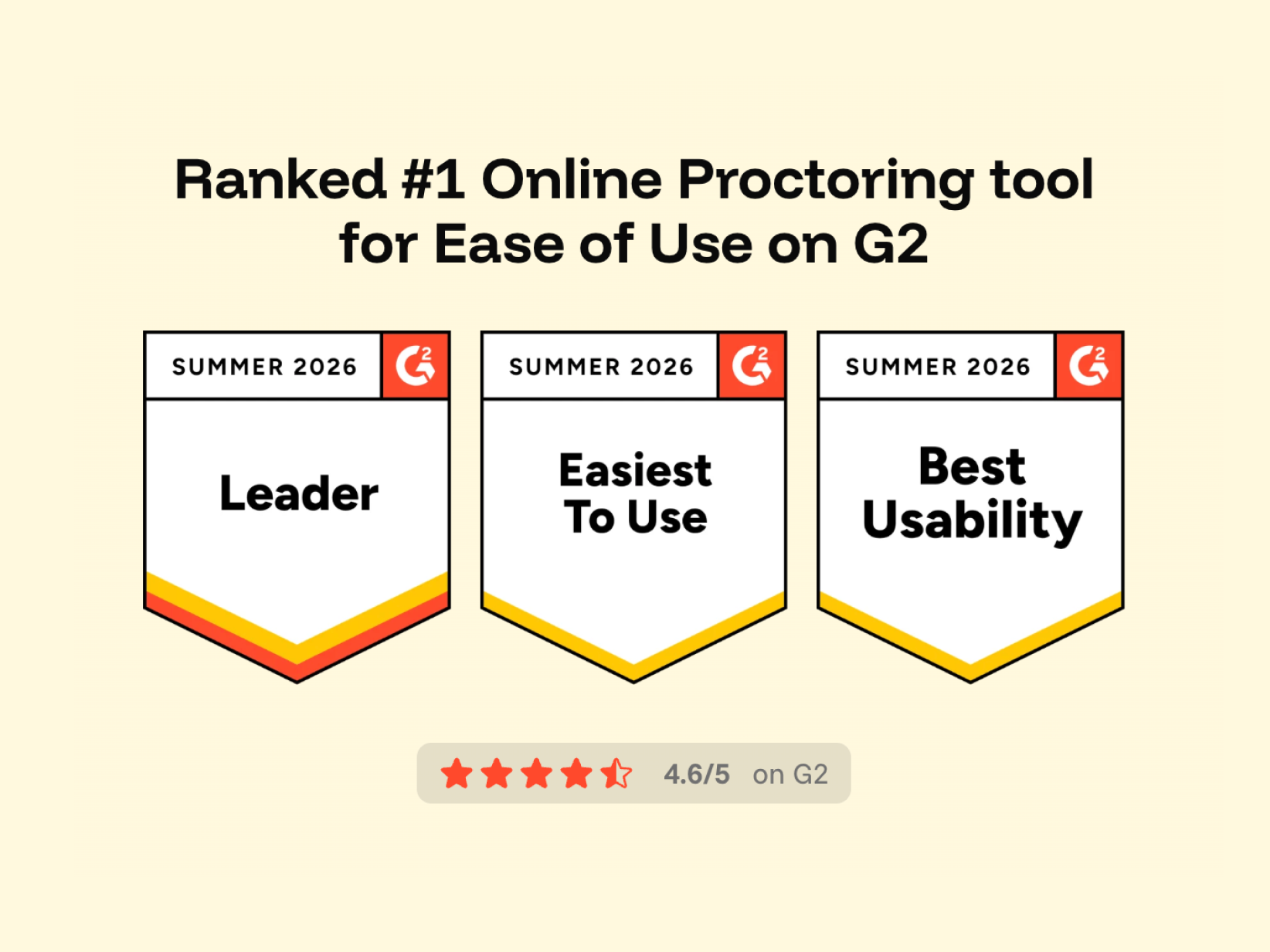
VERIFIED BY OUR CUSTOMERS
Why customers rate us #1
Integrity Advocate makes secure assessments easier to launch, manage, and complete. Customers consistently praise the simple experience, seamless integrations, and responsive support.
SIMPLICITY BENEFITS EVERYONE
Less friction. Stronger delivery.
When online proctoring is simple to deploy, manage, and use, everyone benefits. From learners to administrators and IT teams, Integrity Advocate removes unnecessary complexity without compromising security.
Participants
A familiar, browser-based experience with no downloads or complicated setup.
Administrators
Simple tools, intuitive workflows, and faster review from start to finish.
IT teams
Deploy without software installs, browser extensions, or ongoing maintenance.
Organizations
Scale secure assessments while reducing support requests and operational effort.
DESIGNED TO REMOVE COMPLEXITY
Simplicity built into every step
Ease of use goes beyond the assessment experience. Integrity Advocate helps teams reduce support, save time, and deliver secure assessments with less effort.
No installs and human-reviewed results help reduce technical issues and unnecessary escalations.
Simple LMS integrations help your team launch quickly within existing workflows.
A browser-based experience gets learners into assessments without downloads or complicated setup.
Responsive, expert support helps your team solve problems quickly when assistance is needed.
Participants can complete assessments across laptops, desktops, tablets, Chromebooks, and mobile devices.

SIMPLE BY DESIGN. SECURE AT EVERY LEVEL.
Ease of use without compromise
A simpler experience does not mean lighter protection. Integrity Advocate helps organizations run secure, defensible assessments without adding unnecessary friction for participants, administrators, or IT teams.

Verified #1
Rated #1 because customers experience it
Verified G2 reviews consistently describe the same experience: easy to implement, easy to manage, easy for learners, and backed by responsive support.
Hear from our customers
The difference customers experience every day
Across education, certification, workforce training, and regulated industries, customers consistently describe: a platform that's easy to implement, easy to use, and backed by a responsive team.
"We went from having close to 50% of our students having issues with the online proctoring to almost no one, we're so pleased with how things have gone."
Christopher Pacella, Manager of Professional Accreditation and Standards at the National Payroll Institute
"The most user friendly identity verification software available. The user interface for the student is easy to understand and straightforward. Nothing to download and just follow the prompts."
Verified User in Education Management
“Integrity Advocate is really easy to use, really fun to work with, and very responsive. There’s always a quick turnaround for change requests; they’ve kept us updated. I would recommend them 100%.”
Fabienne Bailey, Director for Business Growth and Transformation at AIM Qualifications and Assessment Group
"Both the support and sales teams have been consistently responsive, approachable, and invested in helping us succeed. They treat us like partners, not just clients, and genuinely listen to feedback as the platform evolves."
Tom Tarrant, Principal of InformNet- Manitoba’s Online High School
"It's incredibly convenient and has significantly reduced the amount of tech support we need to provide, streamlining our operations. The ease of use and hassle-free setup make it an invaluable tool for our needs."
Ford W., Learning Management Systems Administrator
"Integrity Advocate was super easy to implement as a platform, and it's easy to navigate and easy to manage. On top of that, the support team has always been very helpful and very responsive anytime we need to reach out."
Jordan Straus, Manager of Instructional Design & Development Blyth Academy
Ease of use starts long before test day
Students shouldn't have to think about the technology before they can demonstrate what they know. Hear how National Payroll Institute reduced friction and created a smoother assessment experience with Integrity Advocate.
Resources on browser-based assessment delivery
Explore insights on browser-based proctoring and simplifying secure assessment delivery.
Integrity Advocate Is Ranked #1 for Online Proctoring on G2. Here’s What That Means.
May 29, 2026
|
5 min de lecture
Integrity Advocate ranked #1 in the G2 Summer 2026 Usability Index for Online Proctoring, its second consecutive season at the top. This post breaks down what the ranking measures, how IA scored against Honorlock, Proctorio, and Meazure Learning, and the design decisions behind the results: no-install access, human review on every flag, and privacy by design.
Integrity Advocate ranked #1 in the G2 Usability Index for Online Proctoring, for the second consecutive season. G2’s rankings are built entirely on verified reviews from real users: the administrators, directors, and instructors who actually run exams on these platforms every day. They rated us best, and that matters.
Here’s a look at what the ranking measures, what the data shows, and why it reflects something real about how IA is built.
What Is the G2 Usability Index?
G2 is the largest peer-to-peer software review platform in the world. Their Usability Index ranks products within a category based on three user-rated dimensions:
- Ease of Use — how intuitive the platform is for test takers and administrators
- Ease of Administration — how much overhead it takes to set up and manage
- Meets Requirements — whether the platform actually does what programs need it to do
Every score comes from authenticated, verified reviews. Companies cannot pay to improve their position. There is no sponsorship or placement influencing the results. The index score reflects what users say nothing more.
The Summer 2026 Rankings
Here is how the full category stacked up in the G2 Summer 2026 Usability Index:
Source: G2 Usability Index for Online Proctoring, Summer 2026. Products ordered by index score.
Integrity Advocate holds a 0.38-point lead over the second-ranked platform and a 1.21-point lead over the lowest-ranked platform in the category. In an index where scores cluster tightly, that gap is significant.
Above Category Average Across Every Dimension
G2 scores IA above the category average on every metric the Usability Index measures:
No other platform in the category leads the field on all three dimensions simultaneously.
What the Data Looks Like Head to Head
Numbers tell the story more clearly than positioning claims. Here’s how IA compares to the platforms most programs evaluate side by side:
Integrity Advocate vs. Honorlock
- Ease of Use: 94% vs. 90%
- Ease of Admin: 92% vs. 93%
- User Adoption: 76% vs. 50% (+26 points)
- G2 Index Score: 8.45 vs. 8.07
The user adoption gap is the one worth paying attention to. A 26-point difference in adoption rates suggests that one platform is meaningfully easier for test takers to actually use — not just to set up.
Integrity Advocate vs. Proctorio
- Ease of Use: 94% vs. 89% (+5 points)
- Ease of Admin: 92% vs. 87% (+5 points)
- Meets Requirements: 91% vs. 89% (+2 points)
- G2 Index Score: 8.45 vs. 7.94
Integrity Advocate vs. Meazure Learning
- Ease of Use: 94% vs. 75% (+19 points)
- Meets Requirements: 91% vs. 77% (+14 points)
- Ease of Admin: 92% vs. 83% (+9 points)
- G2 Index Score: 8.45 vs. 7.24
Why IA Scores Where It Does
Rankings don’t come from nowhere. The G2 scores reflect specific, deliberate decisions we made about how to build this platform.
No install. Any device. Any browser. Test takers don’t download anything. There’s no browser extension, no IT ticket, no pre-exam anxiety about whether the software will work. They log in and start. Administrators don’t field support calls about setup. That’s a direct driver of a 94% Ease of Use rating — 6 points above average.
Human review on every flag. At every pricing tier. Most platforms treat human review as a premium feature. At IA, a trained reviewer assesses every flag before any outcome is issued — regardless of which plan a program is on. That’s not an add-on. It’s the standard. When a result gets challenged by a student, an employer, or an accreditor, there’s a reasoned judgment behind it, not just an automated flag.
Privacy first, by design. We collect only what is necessary. The platform is FERPA, GDPR, and PIPEDA compliant. Zero data breaches across more than a decade of operation. Programs that have faced scrutiny for invasive proctoring practices know what’s at stake. IA is built to keep programs defensible on that front.
Results that hold up. From identity verification before the exam to reviewed outcomes after it, every stage connects into one documented record. When something is challenged, administrators have what they need to respond. That completeness shows up in the “Meets Requirements” score.
What Users Are Actually Saying
These reviews are authenticated and verified by G2.
{{post-block-quote}}
The Numbers Behind the Platform
The G2 ranking reflects a platform that has been in continuous operation for over a decade:
- 98% client retention — programs that stay because the platform keeps working, year after year
- Zero data breaches — across more than 12 years of operation
- 10M+ proctored sessions — at scale, across credentialing bodies, institutions, and training providers
- 4.5 stars on G2 — based on 23 verified reviews
See the Full G2 Report
The G2 Summer 2026 Usability Index for Online Proctoring is available in full. If you’re evaluating platforms, it’s worth reading the methodology alongside the scores.
Access the G2 Report | Request a Demo
Integrity Advocate is a browser-based online proctoring platform built for credentialing organizations, education institutions, and training providers. Human review is included in every session, at every pricing tier, by default.

Why Ease of Use & No-Install Proctoring Matters More Than Ever
December 11, 2025
|
5 min de lecture
Proctoring works best when it is almost invisible. When the first interaction a learner has with a proctoring tool involves downloading a launcher, requesting elevated permissions, or troubleshooting errors, it introduces friction before a single question is answered. That friction drives anxiety, failed assessment starts, elevated support tickets, and lower perceived fairness. This post examines why ease of use has become a competitive advantage in proctoring, how no-install design reduces friction while maintaining integrity, and what the market is actually asking for as institutions rethink their assessment experience in 2026.
Proctoring isn’t just about catching cheaters, it’s about creating an experience that preserves trust, reduces barriers, and supports learners as they engage with assessments. As remote and hybrid testing become standard across education and workforce programs, one trend stands out: ease of use has become a competitive advantage in proctoring.
Proctoring works best when it’s almost invisible. It should quietly protect the integrity of an assessment while blending into the systems learners already know and trust. Proctoring should feel familiar, launching learners into their exams in the same environments they already use every day rather than pushing them into unfamiliar tools or workflows. When that doesn’t happen, friction shows up fast.
Technical friction, like downloads, extra logins, and multi-step setup flows, doesn’t just slow learners down. It reduces confidence, increases support needs, and indirectly becomes one of the biggest hidden costs of remote assessment.
In this post, we unpack why ease of use, especially no-install proctoring, matters in the new year and beyond, and how it impacts learners, administrators, and institutional outcomes.
Friction Isn’t Just an Annoyance, It’s a Barrier
For many test-takers, the first interaction with a proctoring tool sets the tone for the entire assessment. When that interaction involves:
- downloading a launcher
- requesting elevated permissions
- or troubleshooting unexpected errors…
…it introduces friction before a single question is answered.
That friction can lead to:
- Increased anxiety and distraction
- Failed assessment starts
- Elevated support tickets
- Accessibility barriers
- Lower perceived fairness
And while traditional proctoring vendors often treat installations and extensions as standard, learners often do not.
A privacy-first, no-install approach eliminates these barriers at the source, protecting not just the exam, but the experience. That mindset aligns directly with our philosophy of integrity without intrusion, where security and user respect coexist.
"The service itself is easy to use and is popular among our students. The implementation process went smoothly." - Verified G2 review
Where Ease Meets Respect: The Privacy Equation
As institutions invest in stronger security, a natural tension arises: how do you ensure integrity without breaching privacy? Many legacy solutions err on the side of surveillance, using broad access and extensive permissions to “cover every angle.” But in doing so, they often end up collecting data that goes well beyond what’s necessary for integrity, raising concerns that many programs simply don’t want to inherit.
That’s a central theme in discussions around where secure proctoring ends and privacy invasion begins.
A no-install experience helps resolve this tension by minimizing the data surface area, collecting only what’s essential for validating identity and behavior, and doing so in a way that feels transparent, logical, and fair to learners.
What the Market Is Actually Asking For
There’s a misconception in proctoring that more technology equals better security. But feedback from educators, training leaders, and certification bodies tells a different story: they want tools that are secure and intuitive.
In fact, recent industry thought leadership underscores how the expectations for remote assessment are shifting, away from invasive, heavy-tech tools and toward solutions that balance trust, simplicity, and integrity.
Ease of use is not just a “nice-to-have" it’s becoming a requirement for programs that care about candidate satisfaction, equity, and outcomes.
Lessons from 2025: What We’re Seeing in Adoption
In our 2025 Year in Review, one clear trend emerged: programs that reduce friction for learners are better positioned for success. That doesn’t mean sacrificing security, it means rethinking how proctoring integrates into existing workflows.
Simpler start flows mean fewer abandoned exams, fewer escalations to support teams, and a better overall test-taker experience. When learners feel respected, not surveilled, institutions see:
- Higher completion rates
- Fewer pre-exam failures
- Less demand on support staff
- More positive perceptions of assessment fairness
This has real implications for retention, reputation, and operational efficiency.
Ease of Use Is Security, Too
Security and ease of use are not opposites. In fact, when done right, they reinforce each other:
- A calm, confident test-taker is easier to assess fairly.
- Fewer tech barriers means fewer false positives in behavior analysis.
- Intuitive workflows reduce administrative overhead.
- Transparent experiences build trust.
In 2026 and beyond, proctoring will be defined not just by what it protects, but by how it protects it, and that starts with the experience learners have from the moment they click “Start.”
See How “Invisible” Proctoring Could Work in Your Program
If you’re rethinking your proctoring approach for the next year, this is a great time to evaluate whether your current tools are adding unnecessary friction.
- Are learners installing separate apps just to start an exam?
- Are support tickets piling up around exam launch?
- Are privacy questions slowing down adoption?
We’d be happy to walk through how a privacy-first, no-install model could fit your environment and security requirements.
Book a demo to see what invisible, easy-to-use proctoring can look like in practice.
{{post-cta}}

The Hidden ROI of a Great User Experience in Online Proctoring
June 25, 2025
|
5 min de lecture
User experience in online proctoring is not a design preference. It is a business outcome. When learners struggle to launch an assessment, verify their identity, or navigate an unfamiliar platform, the consequences are measurable: abandoned exams, avoidable support tickets, missed compliance deadlines, and credential risk. This post makes the business case for frictionless proctoring, connects UX directly to compliance standards like ANSI/ASSP Z490.1-2024 and GDPR, and provides a practical checklist for evaluating any proctoring platform against both criteria.
User experience is more than aesthetics.
It’s ease of access.
It’s stress reduction.
It’s whether your learners can start and finish a high-stakes training exam without technical hiccups, confusion or a call to support.
In industries that rely on secure assessments—like workplace safety, certification and professional training—where compliance pressure meets real-world complexity, UX can be the quiet variable that makes or breaks success.
Too often, organizations prioritize visual polish over functionality, choosing sleek-looking platforms that create more problems than they solve. Others hyper-focus on security and compliance (as they should!) but overlook how the platform actually performs under pressure. If users can’t launch a test, verify their identity easily or navigate the process with confidence, the tool stops being an asset and starts being a liability.
Let’s talk about the return on doing things right.
The business case for better UX
In high-stakes, compliance-driven environments, the design of your proctoring solution directly influences learner behavior and, by extension, business outcomes.
Research on online learning consistently shows that confusing, hard-to-navigate systems discourage learners and disrupt behavioral engagement. As one study put it: “A disorganized LMS will discourage students and create unnecessary frustration.”
That frustration has consequences.
When learners struggle to access, understand or complete assessments, organizations pay the price:
- Learners abandon exams or disengage midway
- Administrators are pulled into unnecessary troubleshooting
- Support teams are overwhelmed with avoidable tickets
- Compliance goals are missed due to incomplete or invalid training
Each of these pain points eats into your ROI through lost time, missed certifications or reputational risk. That’s why a streamlined, no-install solution like Integrity Advocate doesn’t just support the user—it safeguards the entire training program. By eliminating friction, reducing confusion and boosting learner confidence, good UX becomes a subtle but powerful business advantage.
Compliance and the new standard of accountability
Frameworks like ANSI/ASSP Z490.1-2024 and GDPR may focus on occupational safety and data privacy domains, but they share a common expectation: systems must be built with the user in mind.
The updated ANSI standard raises the bar for training programs, emphasizing not just content but how that content is delivered. Training must be accessible, effective and verifiable. GDPR reinforces the same principle from a privacy angle. Its mandate for data minimization requires that organizations collect only what’s necessary, building trust by reducing exposure and respecting user boundaries.
So when training fails to meet compliance standards like these—when it’s ineffective, inaccessible, or poorly delivered—the consequences aren’t just digital. They’re human. That’s why standards like ANSI/ASSP Z490.1-2024 are evolving to ensure training does more than meet requirements. It needs to stick. It needs to protect.
What does user-centric compliance look like?
- Training that works on any device, with no downloads or technical hurdles
- Seamless identity verification that doesn't require excessive data collection
- Monitoring that confirms engagement without violating user privacy
- Support that’s fast, helpful and always available
When tech gets in the way, trust breaks down
When students describe what makes a great learning experience, the message is clear. According to EDUCAUSE’s 2025 Student and Technology Report, only 34% of students who believe their institution is “behind the times” in technology adoption are satisfied with their learning tech and support services. In contrast, 85% of students who perceive their institution as cutting-edge report high satisfaction.
Satisfaction starts with tools that reduce stress, not add to it.
- Learners want intuitive login systems and reliable access
- Confusing platforms disrupt focus and lead to disengagement
- Technical issues with assessments erode confidence in the entire credentialing process
Users themselves are asking for simpler, more seamless platforms. When it’s not, even minor friction points can become trust breakers. As one EDUCAUSE respondent summed up clearly: “Any technological issues I have had... have been quickly righted by IT support or professors.”
That level of responsiveness builds trust. In higher education, students often rely on IT or instructors to step in when tech fails. But in workforce training, compliance testing or professional certification environments, that safety net rarely exists. There's no time for help desk tickets or make-up exams when the stakes are high and the schedules are tight.
That’s where reliability becomes ROI.
The cost of getting it wrong
Compliance standards were developed for a reason. Gaps in your training system’s integrity don’t just show up in learner complaints online—they show up in audit findings, reputational hits and real-world risk.
- Retesting costs: Every invalid assessment leads to rework. For many organizations, this results in lost hours, disrupted schedules and, in some industries, extended periods of non-compliance.
- Lost productivity: If learners can’t complete their training, they can’t start work. That’s downtime for the team and delays for you.
- Brand and credential risk: For those in sectors such as certifying bodies and training organizations, a poor test experience reflects directly on the value of your credential. If people don’t trust the process, they won’t trust the outcome.
In other words, poor UX isn't just frustrating. It costs you.
What to look for in a proctoring platform
Whether you're onboarding a new training partner or auditing an existing tool, use this quick checklist to evaluate user experience and compliance-readiness:
- Can users start and finish an assessment without admin or IT support?
- Does the platform work reliably across devices and browsers?
- Does it avoid installs, downloads or browser plug-ins that introduce friction or risk?
- Are identity checks fast, secure and designed to minimize the amount of personal data collected or stored?
- Is participation monitored in a way that ensures compliance—ideally with the added context and fairness of human review?
- What percentage of users require support, and how quickly are those issues resolved?
If your answer to any of these is “we’re not sure,” it might be time to reevaluate.
Online proctoring, trusted by organizations who can’t afford to get it wrong
For safety regulators, credentialing bodies, global corporations and training providers, failure can be costly.
When assessments go wrong, the fallout can include everything from invalid credentials to regulatory penalties. In some jurisdictions, failure to meet standards such as CASL (Canada’s Anti-Spam Legislation) can result in fines of up to $10 million per violation—and yes, that includes tools that improperly collect or store data.
It’s why Integrity Advocate has long championed a privacy-by-design approach to compliance. We don’t just secure the testing environment, we protect organizations, individuals and the integrity of the process itself.
- When fewer than 0.58% of users require support, your admin team stays focused.
- When assessments run seamlessly, your learners stay engaged.
- When every step—from identity verification to participation monitoring—is intuitive, ethical and effective, your organization saves time, reduces risk and strengthens credibility.
That’s the hidden ROI of great user experience. And it’s our standard.
{{post-cta}}
Questions fréquentes
Find answers to the most commonly asked questions.
Integrity Advocate is designed to remove unnecessary complexity from online proctoring. With no software downloads, intuitive workflows, seamless LMS integrations, and responsive support, organizations can launch and manage secure assessments with less effort.
No. Integrity Advocate combines identity verification, configurable security settings, AI-assisted monitoring, human review, and audit-ready evidence in a simple, browser-based experience. Ease of use and strong security work together.
Most organizations are able to implement Integrity Advocate quickly because it integrates with existing learning and assessment platforms and requires no software installation for participants.
No. Participants launch assessments securely in their browser without downloading applications or installing browser extensions, reducing technical barriers before testing begins.
Intuitive administration tools, browser-based delivery, and seamless integrations reduce support requests, simplify deployment, and eliminate the maintenance associated with traditional proctoring software.

See how simple secure assessments can be.
Schedule a personalized walkthrough to see how Integrity Advocate protects participant data, supports global privacy requirements, and helps organizations deliver secure, defensible assessment outcomes.
10M+
Total session proctored
65+
Languages supported
98%
Client retention rate