Resource Center
Research, guides, and real-world insights on online proctoring; helping your program deliver results that are fair, trustworthy, and defensible.
10M+
Assessments secured
Zero
Data breaches in 12+ years
98%
Client retention rate
120+
Resources published
Featured article

Trust by Evidence: A New Framework for Defensible AI Decisions
Integrity Advocate has released a new whitepaper, Trust by Evidence, introducing a framework that connects AI due process, learner rights, and credential security into one model for defensible AI-assisted assessment. This post walks through what the framework covers, why AI adoption alone no longer settles the integrity question, and links to the full whitepaper download.
Assessment integrity used to mean one thing: was the exam monitored? That question is no longer enough. AI now plays a role in identity verification, proctoring flags, authorship review, scoring, and credential validation, and each of those touchpoints can be challenged.
Confidence in an outcome isn't just about whether AI was accurate. It's about whether the decision it contributed to can be explained, reviewed, appealed, and verified after the fact.
As AI becomes embedded deeper into assessment, institutions are being asked a more pointed question: Can you defend the decision AI helped you make?
That question requires more than accurate technology. It requires a system.
In our latest whitepaper, Trust by Evidence, CEO Brandon A. Smith introduces a framework that connects AI due process, learner rights, and credential security into one model for defensible outcomes.
Download the whitepaper
The Shift From AI Adoption to Defensible Outcomes
For the past several years, the conversation in education and credentialing has centered on adoption: which AI tools to use, how to deploy them, how accurate they are. That conversation is largely settled. Most programs already use AI somewhere in the assessment lifecycle.
What hasn't been settled is defensibility. When an AI-influenced decision is challenged, whether by a learner, an employer, or a regulator, an institution needs to answer a specific set of questions: was there notice, meaningful human review, supporting evidence, and a path to appeal? If any of those answers are unclear, the decision isn't defensible, and the institution is exposed right along with the learner.
The next major challenge in education isn't AI adoption. It's building outcomes that hold up under scrutiny.
Why Treating AI as a Single Safeguard Creates Risk
Many programs rely on AI to do one job: flag anomalies. That model treats a flag as a finding rather than a signal, and it breaks down under three conditions:
- No documented process exists for what happens after a flag is raised.
- Human review means approving the AI's output rather than independently evaluating it.
- There's no clear path for the learner to respond, and no record for the institution to point to later.
Any one of those gaps makes an outcome difficult to defend. Together, they create real exposure, not just to individual learners, but to the institution's accreditation standing, employer trust, and legal risk.
The Trust by Evidence Framework
The whitepaper introduces Trust by Evidence, a framework that connects three ideas typically treated in isolation:
AI Due Process: A fair, documented process for any consequential decision AI contributes to, so a flagged learner has an actual process to walk through rather than a black box to accept.
The Learner Rights Layer: Seven specific rights, to know, to meaningful human review, to explanation, to evidence, to appeal, to proportionality, and to verification, that turn "the system flagged it" into a decision an institution can explain and stand behind.
The Credential Security Trifecta: A secure chain of trust connecting learning, assessment, and credentialing, where a weakness in any one layer undermines the others.
Individually, each idea is familiar. Together, they hold up under scrutiny from everyone with a stake in the outcome: the learner, the institution, employers, regulators, and the public.
What a Defensible AI-Assisted Decision Looks Like
A defensible process doesn't rely on confidence in the algorithm. It provides an actual record. It lets an institution answer, with certainty:
- Was the individual notified that AI was involved?
- Did a qualified reviewer examine the evidence, not just the score?
- Could the individual respond before a consequence was applied?
- Is there a documented, time-bound appeal path?
- Can the outcome be explained to someone outside the institution?
These are governance questions as much as technical ones. Answering them well protects accreditation standing, employer trust, and learner confidence all at once.
What You'll Learn in the Whitepaper
The full whitepaper expands on:
- Why algorithmic due process, procedural justice, and automation bias research all point toward the same conclusion for education
- The Defensible Outcomes Responsibility Matrix, a governance tool for assigning clear ownership across vendors, institutions, and credential issuers
- The five-stage AI Appeals Framework, walked through with a real worked example of a contested proctoring flag
- Sector-specific guidance for K-12, higher education, workforce certification, and employers
- A candid discussion of the framework's limitations, including cost, scale, and surveillance risk
It's written for compliance leads, credentialing bodies, assessment teams, and program leaders responsible for the outcomes their institution has to stand behind.
{{post-cta}}
All resources

Why Do Regulators Consider Some Certifications Fraudulent?
April 3, 2023
|
5 min read
A registered training organization in Australia was charged with issuing fraudulent certifications after participants left training early. The RCMP uncovered a counterfeiting operation selling fake H2S Alive and First Aid certifications to workers who had completed no training at all. This post examines what makes a certification fraudulent, what the legal consequences are for employers, and how identity verification and participation monitoring protect organizations from the same exposure.
Most people assume fraud means stealing or pretending to be someone else. In the world of workplace training and certification, the definition is broader than that. Fraud is also when a person receives credit for something they did not, in fact, do.
That definition has real consequences for employers, and two recent cases make it impossible to ignore.
When Certifications Become Fraudulent
In Australia, a registered training organization was charged with issuing false documents to multiple trainees. The organization marked participants as attending a full two-day training when they had actually left at noon each day. Participants received certifications to operate forklifts and erect scaffolding without meeting the full training requirements. The organization faced significant financial penalties as a result.
In Canada, the Royal Canadian Mounted Police uncovered a large-scale counterfeiting operation selling fake training certifications for safety credentials including H2S Alive and First Aid/CPR. H2S Alive is issued to people working with hydrogen sulphide, a highly flammable and toxic chemical. The people who purchased these certificates did not miss half a course. They did not participate in any training at all.
In both cases, employees and their colleagues were put at risk. That risk includes injury, loss of limb, and death.
Why This Happens More Often Than Organizations Realize
It is far too common for certificates to be issued without confirming identity or full participation. Most people do not think twice about the consequences of leaving a training session early. Few would assume that attending training where identity and attendance are not confirmed could result in a regulator declaring their certificate fraudulent.
But that is exactly what happens.
Employers carry a legal and moral responsibility to protect their employees and their organization from risk. Employee certifications are a promise to colleagues, clients, and regulators that your workforce meets industry standards. If you cannot demonstrate that your employees actually completed the required training, that promise is hollow and the certification that represents it may be worthless.
Without a trusted mechanism to verify identity and participation, the consequences range from reputational damage to financial penalties to legal action.
Who Is at Greatest Risk
Workers who operate heavy machinery or work with dangerous chemicals face the highest physical risk from fraudulent certifications. But employees across all roles must be able to demonstrate proof of training that holds up to scrutiny.
The Australian case resulted in financial penalties and a loss of public trust. For organizations in regulated industries, that combination of reputational and financial damage can have lasting consequences that far exceed the cost of implementing proper verification in the first place.
How Organizations Are Addressing This
The solution starts with how training organizations are selected and evaluated. For in-person training, careful vetting of providers is essential. For online training, which now accounts for the majority of workplace learning, the training organization must use an identity verification and participation monitoring solution.
Effective online proctoring uses a combination of human review and AI to verify that the right employee takes the right training and stays engaged throughout, without adding significant cost or administrative burden.
Safety-conscious businesses and industry safety organizations are increasingly requiring verified training, allowing them to take advantage of online delivery without compromising legal compliance or risk management. This trend is accelerating across industries where the consequences of unverified training are most severe.
Choosing verified online training gives employers documented evidence that their workforce completed training as required, evidence that holds up in regulatory investigations and legal proceedings.
{{post-cta}}

New Frontiers in Online Certification: Dog-Friendly Training
March 21, 2023
|
5 min read
A pug recently completed alcohol service, forklift operation, emergency response, and boat operator certifications online, without identity verification or participation monitoring. The serious point: when online training programs skip these measures, credentials become meaningless and liability follows. This post makes the case for verified online training with Integrity Advocate through a story that is hard to forget.
Recently, the Integrity Advocate team has taken notice of a new trend in online training. No, it's not AI for once.
From skilled trades to professional certifications, more training providers are eliminating barriers and making programming accessible to a whole new class of learners: dogs.
Historically, things like ID verification and subject matter knowledge have prevented our canine friends from obtaining professional credentials. But now, with training increasingly delivered online and compliance measures often left optional, dogs are getting certified to do things and go places they have never been allowed to before.
How Does a Dog Get Certified?
Most providers do not advertise the dog-friendliness of their training. But once you see how easy it is to create an account without a valid ID or ace an exam using a GPT-powered plugin, it is clear that accessibility has taken on a whole new meaning.
So far, we know of at least one pug, probably the most certified dog in the world right now, that has successfully completed the following online certifications:
Alcohol service certification: She has achieved the requirements necessary to work in the hospitality industry as it relates to responsible alcohol service. Just do not ask her to make you a martini.
Forklift operation certification: According to her credentials, she understands the fundamentals of safe forklift use and is a valuable asset in warehouse and logistics industries.
Emergency response certification: She is CPR and AED certified. No thumbs? No problem. She can provide life-saving first aid assistance in emergencies, according to this certification.
Boat operator licensing: Dogs love water, so it was only natural for a pug like her to get her boat license. And with all the other work she has been doing, having time to relax at the lake is more important than ever.
The Secret to Her Success
How did a pug become the most certified pug in the world?
Simple: none of the training programs she completed required participation monitoring or identity verification.
She got a little help setting up her account and paying the test fee. But after that, it was all canine. Thanks to a few study aid browser plugins, the fact that she could not read or answer the questions herself did not stop her from earning a perfect score.
What This Actually Means for Your Training Program
As more training moves online and more organizations cut corners on measures like identity verification and browser monitoring, we fully expect to see a rise in professionally certified dogs. Pugs, golden retrievers, even the occasional overachieving border collie. All ready to serve alcohol, drive forklifts, and perform CPR.
Unfortunately for the canine certification community, regulatory bodies are not amused. The Standards Council of Canada has introduced new standards requiring that the person's identity has been confirmed prior to or at the time of the training, and that the training is completed by the person whose identity was confirmed.
In other words: dogs need not apply.
While this may be disappointing news for our four-legged friends, it is a step in the right direction for organizations that care about credibility, safety, and compliance.
Twenty years ago, it would have been unthinkable for a pug to get forklift certified. Today, it only takes a few minutes. If that is not a red flag, we do not know what is.
The Serious Point Behind the Joke
Online training without identity verification and participation monitoring is not just a compliance gap. It is a liability. When anyone, or anything, can complete a certification without confirming who they are or whether they genuinely engaged with the content, the credential becomes meaningless. And in industries where those credentials are supposed to protect public safety, meaningless credentials are dangerous.
Integrity Advocate verifies learner identity and confirms participation in every session, so the certifications your program issues mean what they are supposed to mean.
{{post-cta}}
Is Your Online Proctoring Platform GDPR Compliant? What Organizations Need to Know
February 1, 2023
|
5 min read
GDPR applies to any organization serving EU-based learners, regardless of where the organization is headquartered, and online proctoring platforms that collect biometric and session data from EU learners must meet all seven of its core principles. This guide walks through each GDPR Article 5 principle and explains how Integrity Advocate meets it, from data minimization and purpose limitation to proactive learner transparency, 24-hour deletion, and zero data breaches across more than a decade of operation.
If your organization serves learners based in the European Union, or if you are an EU-based organization serving anyone anywhere, the General Data Protection Regulation applies to you. GDPR is not just a European concern. It is one of the most far-reaching privacy laws in the world, and online proctoring platforms that collect identity data, session recordings, and behavioral information from EU-based learners are squarely within its scope.
Non-compliance carries serious consequences. Fines under GDPR are measured as a percentage of annual global turnover, with maximum penalties reaching 4% of annual revenue or 20 million euros, whichever is higher.
This guide explains what GDPR requires, how its seven key principles apply to online proctoring, and how Integrity Advocate is built to meet each one.
What Is GDPR and Who Does It Apply To?
The General Data Protection Regulation came into effect on May 25, 2018. It is designed to protect the privacy of EU citizens and to harmonize data privacy laws across Europe. GDPR applies if the organization collecting or processing data is based in the EU, or if the data subject, meaning the individual person, is based in the EU. This applies to all organizations regardless of where they are headquartered.
According to the European Commission, personal data is any information relating to an individual, whether it relates to their private, professional, or public life. For online proctoring, this includes names, email addresses, facial images, government-issued ID, session recordings, IP addresses, and behavioral monitoring data. All of it falls within GDPR's definition and all of it must be handled accordingly.
Why GDPR Matters for Online Proctoring Specifically
GDPR places particular pressure on proctoring services because of the sensitivity of the data they collect and the power imbalance between the platform and the test taker. Learners are required to submit to proctoring to access their assessment. They cannot negotiate the terms or choose a different provider. That makes the obligation on the proctoring platform to handle their data responsibly even more significant.
GDPR requires data protection by design, meaning privacy protections must be built into the product from the start, not added as policy language after a complaint. It also redefines consent, requiring that it be freely given, specific, informed, and unambiguous. For proctoring platforms, that means generic terms and conditions acceptance does not constitute valid GDPR consent for the collection of biometric and session data.
Any data breach must be reported to the relevant supervisory authority within 72 hours and to affected individuals if the breach relates to identity or financial data.
GDPR's Seven Key Principles and How Integrity Advocate Meets Each One
GDPR Article 5 sets out seven key principles for the lawful processing of personal data.
1. Lawfulness, Fairness, and Transparency (Article 5(1)(a))
Personal data must be processed lawfully, fairly, and in a transparent manner.
Integrity Advocate has made protecting learner privacy the foundational goal of its platform. Every user is informed of what data is being collected, what may be shared, and what will be deleted, before any collection begins. This transparency applies equally to institutions and to the learners they serve.
2. Purpose Limitation (Article 5(1)(b))
Personal data must be collected for specified, explicit, and legitimate purposes and not processed in a manner incompatible with those purposes.
Integrity Advocate restricts the processing of learner information to its stated purpose: verifying identity and confirming participation in the rules established by the client organization. It acts as an intermediary between the institution and the learner's personal data, protecting against any redistribution of that data beyond what is necessary to support a documented rule violation.
3. Data Minimization (Article 5(1)(c))
Personal data must be adequate, relevant, and limited to what is necessary for the purposes for which it is processed.
Integrity Advocate's data minimization approach eliminates unnecessary collection at every stage. Where a learner's image has been previously validated, the platform eliminates the need for ID resubmission on return visits. Government-issued ID images are deleted within 24 hours of submission. Browsing history, desktop files, and program inventories are not collected.
4. Accuracy (Article 5(1)(d))
Personal data must be accurate and, where necessary, kept up to date. Inaccurate data must be erased or rectified without delay.
Integrity Advocate provides every user with a copy of the data retained about them, the review findings, and the reviewer notes after their session is completed. This allows learners to verify the accuracy of the information held about them and the conclusions drawn from it, without needing to submit a formal request.
5. Storage Limitation (Article 5(1)(e))
Personal data must be kept in a form that permits identification of data subjects for no longer than is necessary for the purposes for which it was collected.
Integrity Advocate deletes all unnecessary data after session completion, defined as data not required to document who participated or to support a documented rule violation. The limited data retained is deleted after 24 months unless a specific client or regulatory requirement necessitates a different retention period.
6. Integrity and Confidentiality (Article 5(1)(f))
Personal data must be processed in a manner that ensures appropriate security, including protection against unauthorized processing, accidental loss, destruction, or damage.
Integrity Advocate encrypts all user data in transit and at rest and completes as much data processing as possible on the user's device, minimizing online traffic and the volume of data transmitted to servers. Data for UK-based learners is retained within the UK or on Canadian servers based on client preference. Integrity Advocate has maintained zero data breaches across 12 or more years of operation.
7. Accountability (Article 5(2))
The controller is responsible for demonstrating compliance with all six principles above.
Integrity Advocate supports its client organizations in meeting their accountability obligations by providing the documentation, audit trail, and data handling practices that demonstrate GDPR compliance. The platform's Privacy by Design architecture means compliance is not managed through reactive policy responses. It is built into how the system works.
Data Transfers Outside the EU
GDPR places restrictions on transferring personal data to countries outside the EU unless those countries provide an adequate level of data protection. Canada has been recognized by the European Commission as providing adequate protection under GDPR, which means data transfers from the EU to Integrity Advocate's Canadian servers meet GDPR requirements by default.
For organizations with specific data residency requirements, Integrity Advocate also supports storage within the EU and in other jurisdictions based on client preference.
The Lawful Basis for Processing in Online Proctoring
GDPR requires that every instance of data processing have a lawful basis. For online proctoring, the most relevant bases are legitimate interests and legal obligation, though the appropriate basis depends on the specific context and jurisdiction. Organizations deploying proctoring platforms should confirm with their legal team which lawful basis applies to their specific program.
Integrity Advocate's data processing practices are designed to be compatible with whichever lawful basis your organization relies on, with data minimization and purpose limitation ensuring that processing remains within the boundaries of that basis.
Built for Global Privacy Compliance
GDPR is the most internationally recognized privacy framework and often sets the standard that other jurisdictions follow. Integrity Advocate is designed to support compliance across GDPR, PIPEDA, FIPPA, PIPA, POPIA, FERPA, CCPA, and the Victorian PDP Act simultaneously, with the same Privacy by Design architecture underlying each framework.
{{post-cta}}
Is Your Online Proctoring Platform CCPA Compliant? What California Organizations Need to Know
January 3, 2023
|
5 min read
The California Consumer Privacy Act gives California consumers rights over their personal information including the right to know, delete, opt out, and since 2023, the right to correct and limit use of sensitive data. This guide explains how each CCPA right applies to online proctoring and how Integrity Advocate meets each one by default through its Privacy by Design architecture, including proactive learner notification, automatic data deletion, and a strict no-sale policy on personal data.
The California Consumer Privacy Act gives California consumers significant control over their personal information. For online proctoring platforms that collect identity data, facial images, and session recordings from California-based test takers, CCPA compliance is directly relevant to how that data must be handled, disclosed, and deleted.
This guide explains what CCPA requires, how it has been strengthened since 2018, and how Integrity Advocate is built to meet and exceed its requirements.
What Is the CCPA and Who Does It Apply To?
The California Consumer Privacy Act of 2018 was established to give consumers more control over the personal information that businesses collect about them. It has since been strengthened by the California Privacy Rights Act, which came into effect on January 1, 2023, adding new consumer rights and expanding the scope of covered businesses.
CCPA applies to for-profit businesses that do business in California and meet at least one of the following thresholds: annual gross revenue over $25 million, buying or selling the personal information of 100,000 or more consumers or households per year, or deriving 50 percent or more of annual revenue from selling personal information.
Integrity Advocate does not fall within these threshold criteria. However, through its adherence to Privacy by Design principles, Integrity Advocate meets and exceeds CCPA's requirements by default. For organizations using Integrity Advocate that are themselves subject to CCPA, this means your proctoring vendor is not creating compliance risk on your behalf.
CCPA Consumer Rights and How Integrity Advocate Meets Each One
The Right to Know
Consumers have the right to know what personal information a business collects about them, how it is used, and whether it is shared or sold.
Integrity Advocate provides this transparency proactively, without requiring any action from the test taker. After every completed and reviewed session, Integrity Advocate emails each user a copy of the data retained about them, the review findings, and the reviewer notes. Test takers can verify exactly what information was collected and what conclusions were drawn from it, without needing to submit a formal request.
The Right to Delete
Consumers have the right to request that businesses delete personal information collected from them, and to require their service providers to do the same.
Integrity Advocate addresses this by default. All unnecessary data, defined as data not required to document who participated in the session or to support a documented rule violation, is deleted automatically after session completion. The limited data retained is deleted after 24 months unless a specific client or regulatory requirement necessitates a different retention period. Data can also be deleted earlier upon individual request.
The Right to Opt Out
Consumers may request that businesses stop selling their personal information. Businesses cannot sell personal information after receiving an opt-out request, and must wait at least 12 months before asking the consumer to opt back in.
Integrity Advocate has never sold, shared, or transferred personal information to any third party. The Integrity Advocate privacy policy explicitly states that users own their personal data and it cannot be sold under any conditions. There is nothing to opt out of because the sale of personal data is not and has never been part of how Integrity Advocate operates.
The Right to Non-Discrimination
Businesses cannot deny goods or services, charge a different price, or provide a different level of service to consumers who exercise their CCPA rights.
Because Integrity Advocate provides all CCPA rights to every user by default, there is no scenario in which a user exercising their rights would result in different treatment. The protections are built into the platform, not granted on request.
The Right to Correct (Added by CPRA 2023)
The California Privacy Rights Act added the right for consumers to request correction of inaccurate personal information held by a business.
Integrity Advocate's human review process directly supports this right. Every flagged session is assessed by a trained reviewer before any finding is recorded, significantly reducing the likelihood of inaccurate information entering the record in the first place. Where a test taker believes information is inaccurate, the documented session record and human reviewer notes provide the basis for a meaningful correction process.
The Right to Limit Use of Sensitive Personal Information (Added by CPRA 2023)
The CPRA added the right for consumers to limit how businesses use sensitive personal information, including biometric data.
Integrity Advocate collects biometric data, specifically facial images for identity verification, only for the stated purpose of confirming learner identity. This data is not used for any secondary purpose, is not shared beyond what is required to document a specific finding, and is deleted within 24 hours of session completion for compliant users.
Why Privacy by Design Matters for CCPA Compliance
CCPA compliance is easier to demonstrate when privacy protections are built into the product architecture rather than managed through policy responses to individual requests. Integrity Advocate's Privacy by Design approach means that data minimization, deletion timelines, and disclosure limitations are not reactive measures. They are foundational design decisions that apply to every user in every session by default.
For organizations using Integrity Advocate that are themselves subject to CCPA, this means the proctoring vendor you have chosen is not creating compliance exposure on your behalf. It means your learners' data is handled in a way that meets California's privacy standards without requiring your team to manage it.
CCPA and the Broader Privacy Landscape
CCPA is one of several privacy frameworks relevant to US organizations using online proctoring. Depending on the nature of your program and the location of your learners, FERPA, BIPA, GDPR, and other state-level privacy laws may also apply. Integrity Advocate is designed to support compliance across multiple frameworks simultaneously, with the same Privacy by Design architecture underlying each.
{{post-cta}}

Integrity Advocate Announces Integration with Canvas LMS
August 4, 2022
|
5 min read
Integrity Advocate has completed its integration with Canvas LMS, enabling institutions and organizations using Canvas to deploy identity verification, participation monitoring, and online proctoring directly within their existing LMS environment without end user installation requirements.
Calgary, Alberta — August 4, 2022 — Integrity Advocate today announced the completion of their integration with Canvas LMS, one of the world's leading learning management systems.
Integrity Advocate's services include the verification of learner identity, monitoring of training participation, and the proctoring and invigilation of online examinations across all devices and browsers, without the requirement of end user installation or a high speed internet connection.
What the Canvas Integration Means for Your Institution
The Canvas integration extends Integrity Advocate's reach to institutions and organizations already operating within the Canvas ecosystem, allowing them to deploy identity verification and proctoring directly within their existing LMS environment without additional technical overhead.
Integrity Advocate supports Higher Education, K-12, Associations, Designation Providers, and Corporate Training organizations in ensuring the integrity of their online events through the verification of learner identity, participation, and rule compliance.
"We're committed to making online learning the best experience it can possibly be," says Integrity Advocate's CTO. "We've developed an incredibly powerful suite of digital tools that support the integrity of online learning. We're incredibly excited to integrate with Canvas LMS."
For more information on remote proctoring for Canvas, visit our integrations page.
{{post-cta}}

Is Your Online Proctoring Platform Compliant with Victoria's PDP Act? What Australian Organizations Need to Know
December 4, 2023
|
5 min read
Victoria's Privacy and Data Protection Act 2014 sets 10 Information Privacy Principles that govern how public sector organizations and their vendors must handle personal information, and online proctoring platforms fall squarely within their scope. This guide walks through each principle and explains how Integrity Advocate meets it, from collection limitation and data minimization to human review, proactive learner transparency, and transborder data protections.
If your organization is a Victorian public sector body, or works with one, the Privacy and Data Protection Act 2014 governs how personal information must be handled. For online proctoring platforms that collect identity data, session recordings, and behavioral information from learners, compliance with the PDP Act is not optional. It is a condition of operating within Victoria's public sector ecosystem.
The PDP Act's 10 Information Privacy Principles set the minimum standard for how Victorian public sector organizations must manage personal information. This guide walks through each principle and explains how Integrity Advocate meets it.
What Is the PDP Act and Who Does It Apply To?
The Privacy and Data Protection Act 2014 is Victoria's primary privacy legislation for the public sector. Schedule 1 of the Act contains the Information Privacy Principles, which set out the minimum standards for how Victorian public sector organizations collect, use, disclose, store, and manage personal information.
The PDP Act applies to Victorian government departments, agencies, statutory authorities, and other public sector bodies. When a Victorian public sector organization uses an online proctoring platform, the vendor handling learner data becomes accountable to PDP Act standards. Choosing a vendor that does not meet those standards creates compliance risk for your organization.
The 10 Information Privacy Principles and How Integrity Advocate Meets Each One
1. Collection
Organizations can only collect personal information if it is necessary to fulfill one or more of their functions. Collection must be by lawful and fair means, not in an unreasonably intrusive way, and individuals must be notified of the collection through a Collection Notice consistent with the organization's Privacy Policy.
Integrity Advocate collects only the data required to verify a learner's identity and confirm their participation in an assessment session. Data minimization options eliminate the need for ID resubmissions where a learner's image has already been validated. Government-issued ID images are deleted within 24 hours of submission where used.
2. Use and Disclosure
Personal information can only be used and disclosed for the primary purpose for which it was collected, or for a secondary purpose that would be reasonably expected. Disclosure is also permitted in limited circumstances such as with individual consent or for law enforcement purposes.
Integrity Advocate restricts the processing of learner information to its stated purpose of verifying identity and confirming participation. It acts as an intermediary between the organization and the learner's personal data, protecting against the redistribution of personal information where it is not necessary to support a documented rule violation.
3. Data Quality
Organizations must keep personal information accurate, complete, and up to date, verifying accuracy at the time of collection and checking it periodically while it is in use.
Integrity Advocate provides every user with a copy of their retained data, review findings, and reviewer notes after their session is completed. This allows learners to verify the accuracy of the information held about them and the conclusions drawn from it.
4. Data Security
Organizations must protect personal information from misuse, loss, unauthorized access, modification, or disclosure, and must take reasonable steps to destroy or permanently de-identify personal information when it is no longer needed.
Integrity Advocate encrypts all user data in transit and at rest and completes as much data processing as possible on the user's device, minimizing online data transmission. Unnecessary data is deleted promptly after session completion. Any data retained beyond the immediate session is deleted after 24 months unless a specific client or regulatory requirement necessitates a different retention period.
5. Openness
Organizations must have clearly expressed policies on how they manage personal information, and individuals must be able to request access to those policies.
Integrity Advocate requires informed consent from every user before any personal information is collected. The privacy policy explains why information is being requested, how it will be used, and how it will be destroyed. It is available in over 70 languages to ensure genuine informed consent across diverse learner populations.
6. Access and Correction
Individuals have the right to seek access to their own personal information and to request corrections where necessary. Organizations may only refuse in limited circumstances defined by the PDP Act.
Integrity Advocate provides full access capabilities to authorized administrators and users through its secure API and LMS integrations. Users can review all data retained about them immediately after initial processing, as well as the findings of that processing, without needing to submit a formal access request.
7. Unique Identifiers
The use of unique identifiers is only permitted where an organization can demonstrate it is necessary to carry out functions efficiently. There are also restrictions on adopting unique identifiers assigned by other organizations.
Integrity Advocate uses unique identifiers specifically to reliably segregate learner data and to minimize the transmission of personally identifiable information. Identifiers are not used beyond this operational purpose.
8. Anonymity
Where lawful and practicable, individuals should have the option of transacting with an organization without identifying themselves.
Identity verification is a core function of online proctoring and anonymity is therefore not practicable at the point of use. However, once collected information is no longer required for its stated purpose, all data is either deleted or anonymized. The system is designed to minimize the period during which identifiable information is retained.
9. Transborder Data Flows
If personal information travels outside Victoria, privacy protection must travel with it. Organizations can only transfer personal information outside Victoria if the individual consents or the recipient is subject to a law substantially similar to the Victorian IPPs.
Integrity Advocate's default servers are located in Canada, a jurisdiction recognized for its strong privacy laws and substantially equivalent privacy protections. Storage in numerous other jurisdictions is also available and determined based on client preference and jurisdictional requirements.
10. Sensitive Information
The PDP Act places special restrictions on the collection of sensitive information, including racial or ethnic origin, political opinions, religious beliefs, trade union membership, sexual preferences, and criminal record. Organizations can only collect sensitive information in defined circumstances.
Integrity Advocate does not request, collect, retain, or transmit sensitive information as defined under the PDP Act as part of its services.
Why Human Review Matters for PDP Act Compliance
The Data Quality principle requires that personal information used to make decisions about individuals be accurate and complete. For online proctoring, this requirement has direct implications for how session flags are handled.
Automated proctoring systems generate flags based on algorithmic pattern detection. If an automated flag is inaccurate, the decision made on the basis of it is inaccurate, and the organization is exposed to a data quality challenge under the PDP Act. Integrity Advocate addresses this through human review. Every flagged session is assessed by a trained reviewer before any outcome is recorded, ensuring that the information your organization acts on is accurate and defensible.
Built for Australian Organizations
The PDP Act is one of several privacy frameworks relevant to Australian organizations using online proctoring. Depending on the nature of your program and the location of your learners, the Australian Privacy Act 1988, GDPR for international learners, and other state-level legislation may also apply. Integrity Advocate is designed to support compliance across multiple frameworks simultaneously.
{{post-cta}}
OnDemand Webinar: Protecting the Integrity of your Licensing Program in the Age of AI
March 25, 2026
|
5 min read
What does it take to protect a licensing program in the age of AI? This on-demand webinar covers the full lifecycle approach, from integration to credential issuance, with CMRAO's real-world results across 2,800+ exams.
Click Here to Access the On-Demand Webinar
AI has made cheating easier, faster, and harder to spot, and most licensing programs weren't built for it. This session brought together Integrity Advocate, uxpertise, and CMRAO to show what the threat actually looks like today, and what a modern, integrated approach to assessment security does about it. Brandon walked through why real protection covers the full lifecycle: seamless systems integration before the exam starts, identity verification and active monitoring during it, and verifiable credential issuance once it's done. Disconnected tools leave gaps at every stage. A fully integrated system doesn't.
CMRAO shared their real-world experience delivering the Excellence in Condominium Management program through uxpertise LMS with Integrity Advocate proctoring built in. Across more than 2,800 exam sessions, 8% were flagged as invalid, a number that would have been higher without a system in place. The live demo showed exactly how it works: one platform, no installs, and a human reviewer behind every flag.
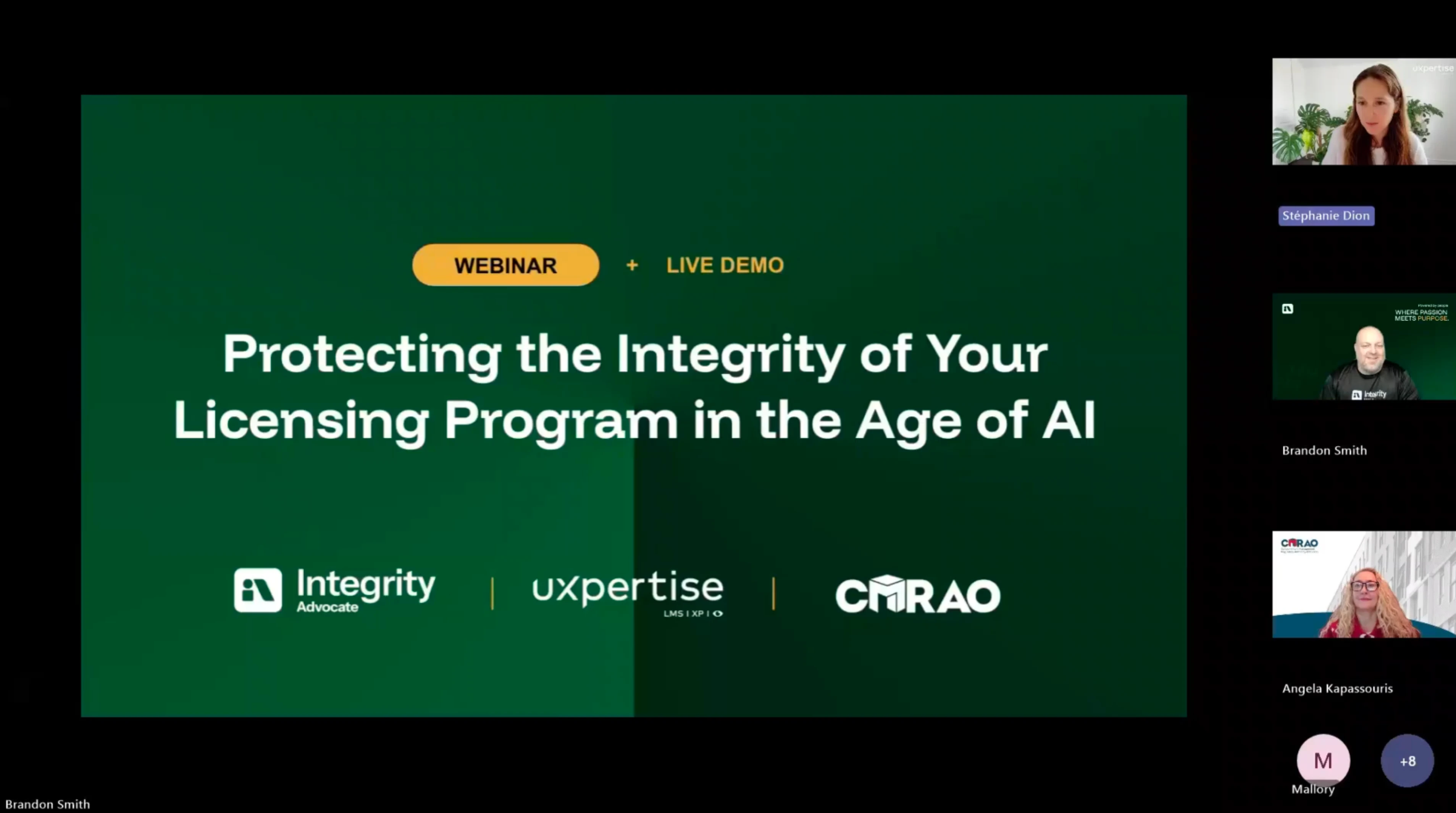
Watch the webinar recording
Key Takeaways
Real protection covers the full lifecycle
Proctoring alone is not enough. Protecting a licensing program means addressing every stage: seamless systems integration before the exam, identity verification and active monitoring during it, and verifiable credential issuance after. Gaps at any stage are gaps that get exploited.
Seamless integration is the difference
When Integrity Advocate proctoring runs natively inside uxpertise LMS, candidates move from coursework to credentialed exam in one place, with no downloads or plug-ins. The result is less friction for candidates, less overhead for administrators, and a tighter, more defensible program.
The results speak for themselves
Since launching on uxpertise with Integrity Advocate proctoring, CMRAO has delivered over 2,800 exam sessions with 8% flagged as invalid. The system deters cheating, catches it when it happens, and gives CMRAO the confidence to issue licences with integrity.
{{post-cta}}

Top Proctoring Tools in 2026, Ranked by What Actually Matters
April 6, 2026
|
5 min read
Not sure which proctoring tool fits your program? This guide compares the top 10 platforms of 2026, breaks down the three proctoring models, and shares the one vendor question that determines what your results are actually worth.
The market for best online proctoring tools has grown fast, and so has the noise around it. The global online proctoring market is projected to grow from $700 million in 2023 to over $2.1 billion by 2030. Remote learning is standard. AI-assisted cheating is a real and growing threat. And programs across education, credentialing, and workforce training are under more pressure than ever to issue results that are trusted, accurate, and defensible.
In many ways, the tools have kept up with that growth. But not all of them have kept up in the right ways. Some have leaned hard into automation at the expense of fairness. Others have added AI features without answering the question programs actually need answered: when a result is challenged, can you stand behind it?
The market has largely framed this as a choice. Speed and scale on one side. Human judgment and defensibility on the other. What most programs actually need is both, without having to trade one for the other. That is what this list is really about.
What to Evaluate Before You Look at a Single Tool
Feature lists are easy to produce. What matters is whether a platform solves the problems that actually cost programs time, money, and credibility. Here is the framework worth using:
Can you defend a result?
When a flagged incident leads to a consequence, someone will ask how that decision was made. AI alone cannot answer that question in a way that holds up to scrutiny. You need a documented human review trail. Not an algorithm output. A process.
Is privacy built in or bolted on?
Data privacy requirements are not going away. FERPA, GDPR, and emerging state-level frameworks all affect how proctoring data can be collected, stored, and used. Platforms that treat privacy as a compliance checkbox are a liability. The ones built around data minimization from the ground up are not.
Does the experience reflect well on your program?
Proctoring that feels invasive or surveillance-heavy creates friction, complaints, anxiety, and lower completion rates. The process should feel fair to the person going through it. When it does, you get fewer disputes and better outcomes.
Who supports your program beyond kickoff?
Implementation support, responsive account management, and an onboarding process that actually works. Client retention rates tell you more than case studies.
Does it cover the full assessment journey?
Identity verification before the exam. Monitoring during it. Clean, documented results after. Gaps in any of those stages are gaps in your program’s integrity.
The Three Proctoring Models
Every tool on this list falls into one of three categories. The model matters as much as the features.
Top 10 Online Proctoring Tools in 2026
1. Integrity Advocate
Best for: Education, professional certification, and any program where results need to be defensible.
Integrity Advocate is built on one principle. Every AI flag is reviewed by a real person before it becomes an outcome. Not as an add-on. Not a premium tier. That is how the platform works, for every client, on every exam. AI identifies. Humans verify. Your program gets results that are fair, accurate, and built to hold up.
The platform is browser-based and requires no installation on student devices. No downloads, no extensions, no IT bottleneck. It works across any device, browser, and LMS, including Chromebooks. Test takers show up and take the exam.
Privacy is built into the architecture from the ground up. No unnecessary data storage, no invasive browser installs, and zero data breaches across more than 12 years of operation. That is not a claim. It is a record.
Coverage spans the full assessment lifecycle. Identity verification, exam monitoring, human review, and credential delivery through the Accredible integration all run on one platform with no gaps between stages.
With a 98 percent client retention rate, the relationship Integrity Advocate builds with programs is a meaningful part of the value. Programs stay because the relationship works, not just the technology.
Key strengths Mandatory human review on every flag, privacy by design, zero breaches in 12 years no install, works on any device or LMS, full assessment journey coverage, 98% client retention
2. ProctorU (Meazure Learning)
Best for: High-stakes certification and licensing exams.
ProctorU offers live human proctoring with real-time intervention capability. Strong audit trails and 24/7 scheduling make it a reliable option for high-stakes professional exams. Examity has been folded into this platform. Per-session pricing and scheduling requirements limit scalability for programs running high volumes with flexible timing needs.
3. Proctor360
Best for: Programs that need high environmental security and flexible proctoring configurations.
Proctor360's standout feature is its proprietary 360 Total View headset, which captures a complete view of the testing environment. It supports multiple proctoring modes including AI auto-proctoring, single and multi-camera live, and recorded review. Highly configurable for institutions that want different security levels across different exam types. Integrates with Canvas, Moodle, and Blackboard. Human review availability depends on the configuration and tier selected.
4. Talview
Best for: Large enterprises running high-volume, complex assessments.
Talview has invested significantly in AI capability, including a multi-layer security framework and behavioral analysis tools. It operates across more than 120 countries and handles significant scale. The platform skews toward enterprise hiring and large institutional clients. Mid-market education and certification programs may find it designed for a larger and more complex buyer than their needs require.
5. Honorlock
Best for: Higher education institutions running frequent, mid-stakes exams.
Honorlock combines AI monitoring with on-demand live proctors and is well established in the higher education market. Human review is available but not mandatory on every flagged incident, which means your institution may still be making decisions on contested results. Pricing is competitive for volume.
6. Proctorio
Best for: High-volume, lower-stakes exams where cost is the primary driver.
Fully automated with no human proctors involved. Proctorio tracks eye movement, audio, and keystrokes and delivers a low per-exam cost that makes it accessible at scale. The trade-off, however, is real: flag review is handed back to your institution. If 15 to 20 percent of your exams are flagged and your staff is sorting through them, the savings on the tool may not reflect the actual cost to your program.
7. Respondus (LockDown Browser + Monitor)
Best for: Institutions already embedded in its LMS ecosystem.
Respondus is widely adopted in higher education and functions primarily as a lockdown browser with a monitoring layer. It works best as a deterrent within a broader integrity approach rather than a standalone proctoring solution. There is no live or mandatory human review component, and the platform requires a browser extension on student devices.
8. PSI Bridge
Best for: Government licensing exams.
Enterprise-grade security with strong identity verification and regulatory compliance, built specifically for high-stakes professional and government licensing exams. Well suited to that context and less flexible for mid-market education programs that need a more configurable setup.
9. Proctortrack
Best for: Programs that need tiered options and pricing flexibility.
Proctortrack offers multiple monitoring modes from automated to live, giving institutions flexibility to match oversight levels to exam stakes. Human review availability depends on the tier selected. Evaluate carefully what is and is not included at each pricing level before committing.
10. Mercer Mettl
Best for: Corporate hiring and skills-based assessments.
Mercer Mettl combines psychometric testing with proctoring in one platform and integrates well with HR systems. Built for the recruitment context. Programs in academic or professional certification settings will find it designed for a different buyer and a different workflow.
How the Top Tools Compare
How to Choose the Right Tool for Your Program
The right platform depends on what your program actually needs to protect.
If your exams carry real consequences, certifications, academic credentials, professional licensing, your results need to be auditable. In practice, that requires mandatory human review and a documented process, not an algorithm output. Start there.
If privacy compliance is a growing concern, look for platforms where data minimization is structural, not a feature toggle. Ask vendors specifically what data is stored, for how long, and where. Zero breaches in 12 years is a different answer than a privacy policy page.
If learner experience matters to your completion rates and your program's reputation, choose a tool that requires no installation and has been validated by learners as fair. Those programs see fewer disputes and better outcomes.
If implementation burden is a concern, ask vendors what onboarding actually looks like beyond the kickoff call. Client retention rates tell you more than any case study will.
The Bottom Line
Most proctoring platforms will tell you they deliver trusted results. The question worth asking is how. If the answer is AI monitoring and a flag report, that is a starting point, not a complete answer. The programs that make defensible, fair, and accurate assessment decisions are the ones that pair AI detection with documented human review, protect learner data by design, and work with a platform that treats their program like a partner.
The tools that deliver all three, without asking you to trade one for another, are the ones worth your time.
Results you can
actually stand behind.
Every flag reviewed by a real person. No installs. Zero breaches in 12 years. See how Integrity Advocate works and what it means for your program.


We will show you exactly how it works.

AI-Only, Live, or Hybrid: Which Proctoring Model Is Right for Your Program?
April 7, 2026
|
5 min read
Before you compare proctoring features or pricing, the model underneath matters most. This post breaks down AI-only, live, and hybrid proctoring, where each fits, and why not all hybrid models are actually hybrid.
Not all proctoring tools work the same way. Before you compare features, pricing, or integrations, the most important decision is the model underneath the platform. If you get that wrong, everything else falls apart.
There are three approaches to online proctoring. Each has a legitimate use case. Each has a real trade-off. And one of them is consistently misunderstood as the safe middle ground when, in practice, not all hybrid models are equal.
As the market scales, programs are under more pressure than ever to choose the right model. Here is what each one actually means and what it means for your program.
The Three Proctoring Models
1. AI-Only Proctoring
AI-only platforms monitor sessions using algorithms. They track eye movement, audio patterns, browser behavior, and screen activity. When the system detects something outside expected parameters, it flags it. The report goes to your institution. Your team decides what to do with it.
The appeal is real. These tools are low cost, highly scalable, and require minimal vendor involvement. For programs running thousands of low-stakes assessments, that efficiency matters.
49% of students globally participated in online learning by March 2025 — driving demand for proctoring that scales without sacrificing accuracy. Source: Business Research Insights, 2026
The risk is also real. AI-only platforms typically flag 15 to 20 percent of all sessions. Many of those flags are not genuine integrity violations. Without a human reviewing the flag before it reaches your inbox, your team is doing that work. The savings on the tool often do not account for the time your staff spends sorting through incidents.
"When a result is challenged, the answer 'the algorithm flagged it' is not a defensible audit trail."
For programs where outcomes carry weight, that gap is a liability.
AI-only works when stakes are low, volume is high, and your institution has capacity to review flags internally.
2. Live Human Proctoring
Live proctoring puts a trained human proctor in the session in real time. The proctor monitors the exam as it happens, can communicate with the test taker, and can intervene if something goes wrong.
The accuracy is high. The human judgment is present. The audit trail is strong. For high-stakes licensing exams, certification bodies with regulatory requirements, and professional credentials where disputes are foreseeable, live proctoring has historically been the answer.
The trade-offs are scheduling and cost. Test takers need to book a time slot. Proctors need to be available. Per-session pricing adds up quickly at scale. For programs delivering hundreds or thousands of exams across flexible windows, the logistics become unworkable.
48% Of students expressed discomfort with webcam-based monitoring during exams — a signal that the model you choose directly affects learner trust in your program. Source: Business Research Insights survey, 2023
Live proctoring is also more intrusive for the learner. Being watched in real time creates anxiety that can affect performance. For programs that care about the experience of their test takers, that friction is worth accounting for.
Live proctoring works when stakes are high, volume is manageable, scheduling is structured, and real-time intervention is a non-negotiable requirement.
3. Hybrid Proctoring: The Model That Varies Most
Hybrid proctoring combines AI monitoring with human review. In principle, it offers the best of both approaches. In practice, it depends entirely on one question: when does the human review happen, and is it mandatory?
Many platforms that describe themselves as hybrid use AI for detection and offer human review as an optional tier or a paid escalation. That is not a genuine hybrid. It is AI-only with an appeal process.
Integrity Advocate is built on this model. Human review is not an upgrade.
Hybrid proctoring with mandatory human review delivers scale without shifting the review burden to your institution.
The Question to Ask Every Vendor
When a flag is raised, who reviews it, and when?
If the answer is your team reviews it, or a human reviews it if you escalate, you are looking at AI-only with extra steps. If the answer is our reviewers examine every flag before it becomes an outcome, you are looking at a genuine hybrid. That question takes 30 seconds and tells you more than a 90-minute demo will.
{{post-cta}}