Ease of Use
+7 pts above avg
95%
IA
95%
AVG
88%

Research, guides, and real-world insights on online proctoring; helping your program deliver results that are fair, trustworthy, and defensible.
Assessments secured
Data breaches in 12+ years
Client retention rate
Resources published

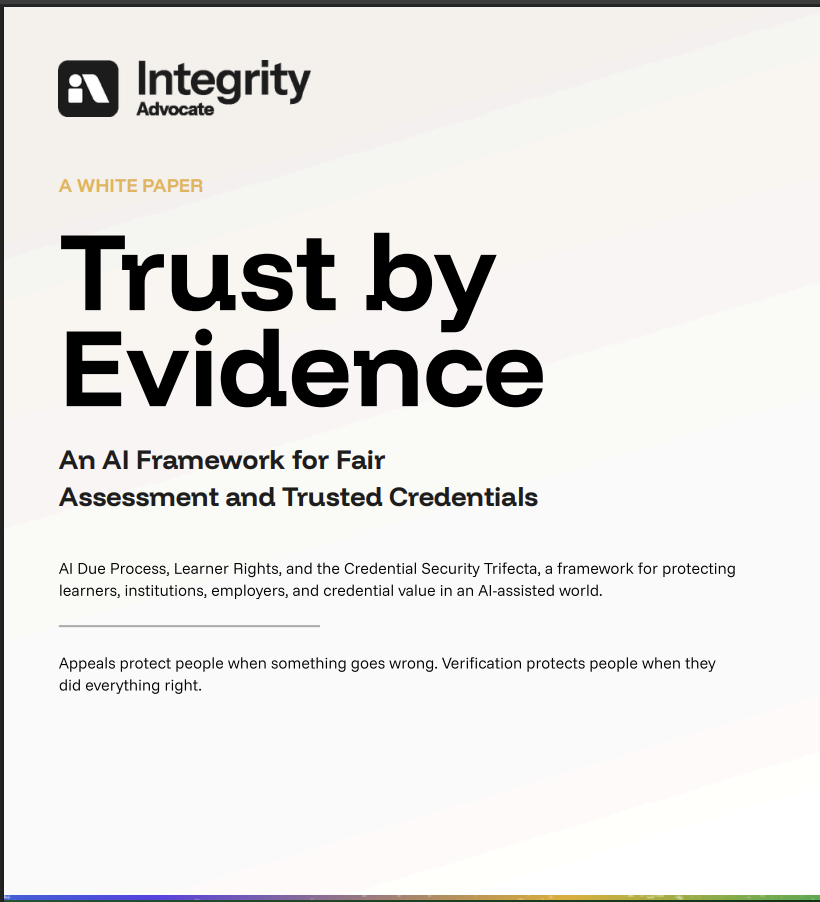
Integrity Advocate has released a new whitepaper, Trust by Evidence, introducing a framework that connects AI due process, learner rights, and credential security into one model for defensible AI-assisted assessment. This post walks through what the framework covers, why AI adoption alone no longer settles the integrity question, and links to the full whitepaper download.
Assessment integrity used to mean one thing: was the exam monitored? That question is no longer enough. AI now plays a role in identity verification, proctoring flags, authorship review, scoring, and credential validation, and each of those touchpoints can be challenged.
Confidence in an outcome isn't just about whether AI was accurate. It's about whether the decision it contributed to can be explained, reviewed, appealed, and verified after the fact.
As AI becomes embedded deeper into assessment, institutions are being asked a more pointed question: Can you defend the decision AI helped you make?
That question requires more than accurate technology. It requires a system.
In our latest whitepaper, Trust by Evidence, CEO Brandon A. Smith introduces a framework that connects AI due process, learner rights, and credential security into one model for defensible outcomes.
For the past several years, the conversation in education and credentialing has centered on adoption: which AI tools to use, how to deploy them, how accurate they are. That conversation is largely settled. Most programs already use AI somewhere in the assessment lifecycle.
What hasn't been settled is defensibility. When an AI-influenced decision is challenged, whether by a learner, an employer, or a regulator, an institution needs to answer a specific set of questions: was there notice, meaningful human review, supporting evidence, and a path to appeal? If any of those answers are unclear, the decision isn't defensible, and the institution is exposed right along with the learner.
The next major challenge in education isn't AI adoption. It's building outcomes that hold up under scrutiny.
Many programs rely on AI to do one job: flag anomalies. That model treats a flag as a finding rather than a signal, and it breaks down under three conditions:
Any one of those gaps makes an outcome difficult to defend. Together, they create real exposure, not just to individual learners, but to the institution's accreditation standing, employer trust, and legal risk.
The whitepaper introduces Trust by Evidence, a framework that connects three ideas typically treated in isolation:
AI Due Process: A fair, documented process for any consequential decision AI contributes to, so a flagged learner has an actual process to walk through rather than a black box to accept.
The Learner Rights Layer: Seven specific rights, to know, to meaningful human review, to explanation, to evidence, to appeal, to proportionality, and to verification, that turn "the system flagged it" into a decision an institution can explain and stand behind.
The Credential Security Trifecta: A secure chain of trust connecting learning, assessment, and credentialing, where a weakness in any one layer undermines the others.
Individually, each idea is familiar. Together, they hold up under scrutiny from everyone with a stake in the outcome: the learner, the institution, employers, regulators, and the public.
A defensible process doesn't rely on confidence in the algorithm. It provides an actual record. It lets an institution answer, with certainty:
These are governance questions as much as technical ones. Answering them well protects accreditation standing, employer trust, and learner confidence all at once.
The full whitepaper expands on:
It's written for compliance leads, credentialing bodies, assessment teams, and program leaders responsible for the outcomes their institution has to stand behind.
{{post-cta}}

April 7, 2026
|
5 min read
AI tools have changed what cheating looks like, and most proctoring systems were built for a different problem. This post covers why an automated flag alone can't defend an outcome, and what a defensible assessment record requires in 2026.
We talk to a lot of programs right now that are dealing with the same thing. AI tools have changed what cheating looks like, and most proctoring systems were built for a problem that’s no longer the only one on the table. The gap is showing up in appeals, in complaints, and in outcomes that are getting harder and harder to defend.
The classic image of cheating a second phone, a friend on the other side of the room, notes taped to a monitor is still real. But it’s not the conversation we’re having with most programs anymore. The harder stuff is subtler.
AI writing tools can produce a natural, well-reasoned answer in seconds. Paraphrasing tools can disguise lifted content well enough to pass similarity checks. And the behavioral signals that used to flag something suspicious eye movements, typing pace, browser switching don’t tell you much when the assistance is happening invisibly, in another tab or on another device entirely.
The problem isn’t that AI cheating is impossible to catch. It’s that catching it requires a level of context and judgment that an algorithm alone doesn’t have.
An algorithm can tell you something looked unusual. It can’t tell you what actually happened or whether it matters. That part still requires a person.
Automated proctoring was designed to catch visible, definable behaviors tab switching, phone use, an unauthorized person on screen. For those cases, it works. But AI-assisted cheating often leaves no visible trace at all.
So when an automated system flags something in this environment, what it's actually telling you is: something here didn't fit the expected pattern. That's a starting point, not a conclusion. The problem is when programs treat it like one.
A wrongful finding based on an automated flag isn't just uncomfortable it can seriously damage a student's record or a professional's career. And when that decision gets challenged, "the system flagged it" isn't a defensible answer. You need a record of what actually happened and a human judgment behind the decision.
{{post-stat-highlight}}
Defensibility isn't really about technology. It's about being able to look anyone in the eye a student, a candidate, a regulator, a board member and explain clearly why a decision was made and what it was based on.
In this environment, that takes three things:
If an outcome from one of your proctored exams was challenged today by a student, a candidate, an employer, an accreditor what could you actually put in front of them? An automated flag, or a complete human-reviewed record of what happened and why?
For programs where the result genuinely matters, that's not a rhetorical question. It's the one worth answering before you need to.
We built Integrity Advocate around exactly this human review on every flagged session, a complete audit trail for every outcome, and the kind of defensibility that holds up when someone actually pushes back.
{{post-cta}}

April 15, 2026
|
5 min read
Rolling out online proctoring inside an LMS doesn't have to be disruptive. This guest post from uxpertise shares six practical steps for a smooth launch, plus how CMRAO cut support requests by 80% after switching to Integrity Advocate.
Guest blog by uxpertise
Rolling out online proctoring inside a Learning Management System (LMS) can feel daunting—for administrators and learners alike. Concerns around usability, learner stress, and an increase in customer support requests often slow adoption.
The reality is that when online proctoring is implemented thoughtfully, it can be seamless, learner-friendly, and highly effective—while actually reducing operational complexity.
Based on uxpertise’s experience supporting regulators and credentialing bodies, here’s what it truly takes to successfully roll out online proctoring inside an LMS, while ensuring reliable results and a positive learner experience.
One of the most important decisions happens before rollout even begins.
Whenever possible, organizations should choose an LMS with online proctoring already integrated, rather than relying on disconnected third-party tools. An integrated approach:
When proctoring is built directly into the LMS, learners stay in a single, familiar environment—no juggling platforms, no unnecessary steps.
Before launching to your full learner population, run a pilot test with internal staff or a small group of learners.
A pilot helps you:
This step alone can prevent a large volume of avoidable support requests and ensures a smoother full-scale rollout.
Learner preparation is one of the biggest drivers of success.
We recommend creating:
Practice exams are especially effective. They reduce anxiety, build confidence, and ensure learners know exactly what to expect—long before exam day.
Transparency builds trust and compliance.
Make sure learners understand:
Clear expectations upfront significantly reduce issues during the exam and lower post-exam support inquiries.
Many learners are uncertain about what happens once an exam is submitted.
Communicate clearly:
This clarity reinforces confidence in the integrity of the process and reduces unnecessary follow-up requests.
Successful online proctoring should support learners—not intimidate them.
A well-integrated solution:
When learners feel supported, adoption increases and confidence in the system grows.
{{post-stat-highlight}}
CMRAO, a uxpertise client, had been delivering online exams using a different proctoring solution within the uxpertise LMS. While functional, the experience created friction for learners and resulted in a high volume of customer support requests.
When uxpertise made the decision to switch technology providers and integrate Integrity Advocate directly into the LMS, the impact was immediate.
After the transition, CMRAO experienced:
By combining an integrated proctoring solution with clear learner preparation and guidance, CMRAO significantly improved both learner experience and operational efficiency.
Rolling out online proctoring inside an LMS doesn’t need to be complex or disruptive.
By choosing an integrated solution, piloting before launch, preparing learners proactively, and focusing on usability, organizations can:
At uxpertise, we believe the most effective proctoring solutions are the ones learners trust—because everything simply works.
Ahead of the Curve: Building Trustworthy Licensing Programs in a Changing Assessment Security Landscape
Why modern regulators and credentialing bodies need integrated systems, not disconnected tools, to stay credible, compliant, and confident.
Watch our joint session with uxpertise and CMRAO to see how leading credentialing bodies are securing exam integrity without sacrificing the candidate experience.



May 18, 2026
|
5 min read
All proctoring vendors say they verify identity, but they don't all mean the same thing. Explore where automated-only ID checks fall short and what to ask when evaluating a platform.
There’s a difference between an algorithm saying “these two images match” and a trained person saying “I reviewed this ID and confirmed it.” One is a data point. The other is evidence. When a result gets challenged, you need evidence. Here’s something worth knowing about online proctoring vendors: they all say they verify identity. What they don’t all mean is the same thing. And that gap, between capturing an image and actually confirming who someone is, is where a lot of programs are quietly sitting on risk they haven’t fully thought through. If you’re currently evaluating proctoring platforms, or you’re starting to wonder what your current vendor actually does when a test taker shows up to an exam, this is for you. We’re going to cover what identity verification in online assessment actually looks like, where automated-only systems run into trouble, and what it takes to produce a result that holds up when it counts. What identity verification actually means in an online exam context
The basics are simple. Identity verification confirms that the person taking your assessment is the person who enrolled for it. Most platforms handle this by asking test takers to hold a government-issued ID up to their camera, capturing a live photo, and comparing the two. What varies, a lot, is what happens after those images are captured. In a fully automated system, an algorithm makes the comparison and moves on. In Integrity Advocate’s human-reviewed system, a trained reviewer examines the ID and live photo after the session is completed, verifying both that the ID is a genuine match and that the same person was there for the entire assessment. That’s a meaningfully different thing.
That might sound like a subtle difference right now. It won’t feel subtle when you’re sitting across from an accreditor, or responding to a candidate appeal, or explaining your identity controls to a regulatory body. “Our algorithm flagged it” and “a trained reviewer verified the ID match and confirmed the same person was present for the entire session” don’t carry the same weight in that room.
Before you evaluate any solution, it’s worth being clear about what you’re actually protecting against. Identity verification in online assessment is mainly a defence against three things.
Someone other than the enrolled candidate sits the exam. Could be a friend, a sibling, or a professional impersonator hired through a contract cheating service. In high-stakes contexts, professional certification, regulatory licensing, safety-critical credentials, the consequences go well beyond academic dishonesty. They touch public trust in the credential itself. That’s a different kind of problem.
Proxy testing is impersonation at scale, and it’s growing. The same infrastructure that made remote work possible made organized contract cheating more accessible too. Professional exam-sitters exist. They’ve been around for years and they’ve gotten more sophisticated as online testing has expanded.
What makes proxy testing particularly hard to catch with automation is that the person attempting the ID check is often well-prepared. They may have a convincing fake or borrowed ID. They may have done this before, for other clients, on other platforms. An algorithm looking for obvious facial mismatches isn’t going to catch someone who’s specifically prepared to pass that check.
{{post-stat-highlight}}
Automated systems compare images. They measure how closely two images match. They’re not built to assess whether a document looks legitimate, whether something about it seems off, or whether the context around the ID presentation is consistent with someone who is genuinely who they say they are.
If you need a recent illustration of just how thin that defense is: a UK nonprofit surveyed around 1,300 children aged 9 to 16 and found that about half believe online age verification checks are easy to bypass. One documented method was drawing a fake mustache on their face with a makeup pencil. A 12-year-old was verified as 15. It worked. Other workarounds included pointing webcams at video game characters and making unusual facial expressions until the software stopped trying. TechCrunch covered it in May 2026.
These are AI systems built specifically for facial verification. A makeup pencil broke them. In an exam context, where a candidate may have a professional credential, a licence, or a career on the line, the motivation to try something is considerably higher; and the workarounds available are more sophisticated than drawn-on facial hair. Automated ID checks in high-stakes assessments face the same fundamental vulnerability, with significantly higher consequences when something slips through.
Beyond outright manipulation, non-standard ID documents from other countries are a real operational headache for automated systems. A document that an algorithm can’t parse correctly – because it looks different from its training data, often gets flagged for the wrong reasons. Not because anything is wrong. Just because it looks unfamiliar. That’s a fairness problem as much as it is a fraud one.
Speed and scale, those are the real advantages of fully automated ID verification. They’re genuine. The problem is that optimising for speed and scale means accepting trade-offs that start to matter the moment your results have any real consequence attached to them.
When a fully automated system approves an identity check, what it creates is a timestamp and a confidence score. That score tells you how closely two images matched according to the model. It doesn’t tell you that a human looked at the documents and made a judgment call.
The moment an outcome is challenged, that distinction is everything. There’s a big difference between “our algorithm scored the match at 94.3%” and “a trained reviewer examined the ID and the live photo and confirmed the identity match.” One is data. The other is documentation. If you’ve ever had to respond to an accreditor asking about your identity controls, you know which one you want to be holding.
Facial recognition systems are trained on datasets. Those datasets have gaps, and those gaps don’t affect all test takers equally. People with darker skin tones, older candidates, people with facial differences or disabilities, and test takers presenting documents from underrepresented countries, these populations consistently get worse outcomes from automated systems.
In a program serving thousands of test takers across many countries, these aren’t rare edge cases. They’re a predictable share of your assessment cycle. A system that handles them badly is a system that consistently disadvantages specific groups of people. That’s both a fairness problem and a real compliance exposure under frameworks like WCAG and AODA.
A lot of programs serve test takers with documented accommodations. Some of those accommodations affect how a test taker looks at the identity check stage. A test taker with a visual impairment may present their ID differently. Someone with a facial difference may not match their ID photo the way an algorithm expects.
An automated system has no way to know an accommodation exists. A human reviewer can, because that information can be passed to them before the check happens. They apply the context, the check goes smoothly, and the test taker isn’t penalized for something their program already knew about and approved.
Human review at Integrity Advocate isn’t a fallback for when automation fails. It’s the standard for every single check. That changes what the whole process produces, and what you can do with the results.
A trained reviewer looking at an ID document and a live photo is doing something different from what a facial recognition model does. They’re not just asking “do these two images match?” They’re assessing whether the identity claim is plausible, taking in the quality of the document, the context of the photo, whether something feels off. That’s judgment. It’s not something you can fully replicate with a model.
It also means programs can explain what happened. Not just cite a score. “A trained reviewer examined the ID and the live photo and confirmed the match” is a sentence a human can understand, investigate, and stand behind.
At Integrity Advocate, every identity check creates a time-stamped record permanently attached to the session. What was verified, when, and by whom. If an outcome from that session ever gets challenged, the identity verification record is already part of the documentation, not sitting in a separate system you have to dig through.
Appeals rarely come with advance warning. Programs that have a complete, human-confirmed record don’t have to reconstruct anything after the fact. The evidence was created at the moment of verification. It hasn’t changed.
Here’s something that doesn’t get talked about enough: people behave differently when they know a human is watching. A test taker who knows their government-issued ID will be examined by a trained reviewer before the exam starts isn’t approaching that check the same way as someone who knows it’s algorithmic.
Programs that shift from automated-only to human-reviewed verification consistently see a change in the behaviour of the small slice of candidates who were willing to try something. The check itself becomes a deterrent. You catch less because less gets attempted.
If you’re shopping around, or starting to question what your current vendor actually does, here are the questions that cut through the noise.
A lot of platforms say “human review.” What they mean is that a human reviews AI-flagged sessions only, and only when the algorithm decides something is worth escalating. At Integrity Advocate, a trained reviewer looks at every session after it’s completed, verifying the ID match and confirming the same person was present throughout. That’s the question to ask: is every session reviewed, or only the ones the algorithm flags?
Ask to see a sample identity verification record. If the answer is a confidence score and a timestamp, that’s an automated log. A defensible record includes the ID image, the live photo, the match determination, who made it, and when. If you can’t show an accreditor a complete documentation trail, the check isn’t giving you what you actually need.
Ask specifically what happens when a test taker shows up with an ID from a country with an unfamiliar format, or when an accommodation affects how they look at the check stage. If the answer is vague or relies heavily on “the algorithm handles it,” that tells you something important about how these scenarios were thought about when the product was designed.
Identity verification collects sensitive data. Ask specifically what’s collected, how long it’s retained, and whether it’s used for anything beyond the identity check. If you have GDPR, FERPA, or PIPEDA obligations, and most programs doing anything at scale do, you need clear answers here before you commit.
Automated identity verification is better than nothing. That’s true. But if your program issues results that actually mean something, credentials that affect career progression, licences that protect public safety, certifications that carry professional weight, “better than nothing” isn’t where you want to land.
What you need is a check that creates a record you can stand behind. Something that answers not just “did the algorithm approve this?” but “can we show that a qualified person verified this person’s identity before the exam began?” Those are different questions, and they get different responses from the people who ask them.
The cost of getting identity verification wrong doesn’t show up at the time of the exam. It shows up later, when results are challenged, when accreditors start asking questions, when credential fraud surfaces somewhere down the line. By then, piecing together what happened is hard. Having a complete record from the moment of verification isn’t.
{{post-cta}}

May 10, 2026
|
5 min read
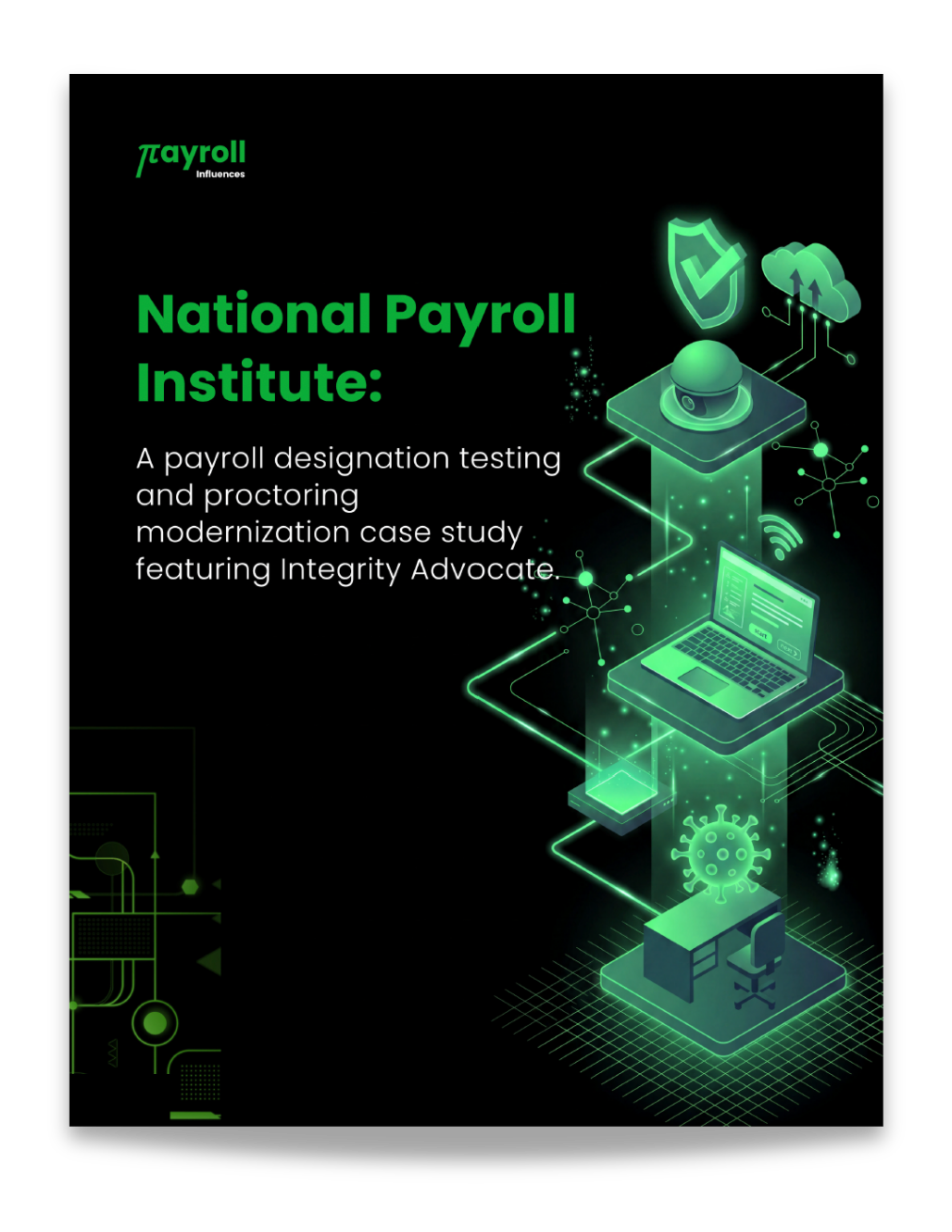
Legacy testing infrastructure puts credential trust at risk. See why payroll certification programs are modernizing, what a "trust engine" looks like, and the real-world results from the National Payroll Institute, including a 57% drop in integrity incidents.
For decades, payroll certification programs operated within a relatively stable testing model. Candidates tested in controlled environments. Exams were delivered in classrooms or testing centers. Proctors supervised sessions physically. And the credibility of the designation was largely tied to the rigor of the exam itself.
That environment no longer exists. Today’s payroll associations and certification bodies are serving remote, digitally connected professionals who expect flexible testing experiences that work on any device, from anywhere, without technical friction or invasive surveillance.
At the same time, employers, regulators, and stakeholders are demanding stronger assurance that certifications remain credible, defensible, and independently verifiable.
As the new Payroll Influences eBook, Enabling a Trust Engine: A Modern Blueprint for Scalable Payroll Certification Testing, explains:
{{post-stat-highlight}}
And that distinction matters more than ever.
In a digital-first testing environment, the exam itself is no longer the only thing being evaluated, candidates evaluate the experience, employers evaluate the credibility of the designation, program administrators evaluate operational risk, and stakeholders increasingly evaluate whether the certification process can withstand scrutiny, disputes, appeals, and governance requirements.
Programs that fail to modernize these areas risk something much larger than isolated technical issues. They risk erosion of designation value itself. The report refers to this growing challenge as the certification “Testing Risk Stack.”
Many certification programs still rely on testing models designed for another era. The assumptions behind traditional proctoring systems; controlled rooms, supervised desktops, mandatory downloads, rigid browser restrictions, increasingly clash with modern candidate expectations and operational realities.
This is one of the most important shifts happening in assessment security right now: The biggest risk is no longer simply cheating, the biggest risk is loss of trust in the credential itself.
AI-driven integrity threats are accelerating across education, certification, and workforce training environments. But many organizations have responded by increasing automation and surveillance instead of improving verification quality. That approach often creates new problems:
The report makes a critical distinction: “AI alone creates false flags. Surveillance erodes trust. Mandatory installs block access.”
This is where many legacy proctoring models break down. Detection alone is not defensibility. Programs still need context, evidence, and human review to produce fair and trustworthy outcomes. This aligns closely with Integrity Advocate’s broader approach to Security-Based Proctoring; a framework focused on verified outcomes, evidence-backed review, and proportional response instead of surveillance-heavy automation.
Related reading:
The report outlines a more sustainable model for modern certification programs, one built around what it calls a “Trust Layer.” Rather than relying on fragmented tools, modern programs are increasingly connecting:
Together, these systems create what the report describes as “An end-to-end chain of evidence from session to credential.”
This is a major evolution from “flag generation” toward defensible outcome validation.
One of the strongest sections of the report highlights how the National Payroll Institute modernized its certification testing infrastructure with Integrity Advocate. NPI faced challenges familiar to many certification organizations:
After implementing Integrity Advocate’s browser-native, low-friction, human-reviewed proctoring model, the organization reported:
Equally important, the organization improved both operational efficiency and candidate experience without introducing heavier surveillance or technical barriers. That balance is becoming a defining competitive advantage for certification programs.
The report outlines several key capabilities modern certification organizations should prioritize when evaluating online proctoring and assessment security partners:
Candidates should be able to test without downloads, plugins, or complicated setup requirements.
Human-reviewed incidents reduce false positives and improve fairness and defensibility.
Modern programs need strong data minimization and responsible retention practices.
Multilingual support, accommodation readiness, and flexible testing experiences improve participation and reduce barriers.
Programs need audit-ready evidence and reviewable integrity decisions that can withstand appeals and scrutiny.
These capabilities are no longer “nice-to-have” operational features, they are becoming core drivers of credential trust and market credibility.
The organizations that will lead the next decade of credentialing are not simply the ones with the hardest exams, they are the ones capable of proving:
Trust is becoming infrastructure, and certification programs that proactively modernize now will be better positioned to:
As the report concludes:
"The strongest partner doesn’t just proctor the exam; they connect verified outcomes to credential issuance.”
{{post-cta}}

May 22, 2026
|
5 min read
Online EdD programs face a growing tension: assessments must be secure, but doctoral learners expect their privacy to be respected. In this guest post, Research.com's Stephanie Dion explores how institutions can move beyond surveillance-heavy models toward verification-based systems, risk-based authentication, and faculty preparedness that protect both academic integrity and learner trust.
The rapid growth of doctoral-level education delivered through digital platforms has transformed how institutions design, deliver, and evaluate learning. While flexibility and accessibility have improved, new challenges have emerged around maintaining academic integrity without compromising learner privacy. Programs must now navigate a complex balance between safeguarding assessments and respecting personal data boundaries.
Modern online learning environments—especially within advanced doctoral pathways—require systems that are both secure and ethically designed. Achieving this balance is critical not only for institutional credibility but also for learner trust.
Doctoral programs have always emphasized rigorous evaluation standards. However, the shift to remote delivery has introduced new vulnerabilities, from identity fraud to unauthorized collaboration. Within an EdD context, where research-based outputs and professional practice are central, the stakes are even higher.
Institutions are increasingly turning to layered assessment strategies that combine human oversight with technological safeguards. Yet, implementing these systems without overstepping privacy expectations remains a nuanced challenge.
Balancing these risks requires thoughtful system design and governance.
One of the most effective approaches to maintaining integrity without excessive monitoring is the use of digital credential verification systems. These tools enable institutions to validate learner achievements and identities through secure, traceable methods.
Rather than relying solely on real-time surveillance, verification systems focus on verifying the authenticity of outcomes. This shift allows institutions to uphold standards while reducing reliance on invasive monitoring practices. Similar conversations around the importance of verified credentials and accountability are explored in Integrity Advocate’s article on the case for verified credentials in private security.
To better understand broader approaches to protecting credentials in digital ecosystems, exploring resources on the future of assessment security and credential integrity can provide additional context.
Recent findings from the OECD highlight that trust in digital education systems is strongly correlated with transparency in data usage and governance. A 2023 report emphasizes that learners are more likely to engage fully when they understand how their data is collected, stored, and protected.
This insight reinforces the importance of designing systems that prioritize both security and transparency, particularly within online doctoral programs.
Creating secure yet respectful assessment environments requires a shift from surveillance-heavy models to privacy-conscious frameworks. Institutions must evaluate each tool and process through both a security and ethical lens, particularly when balancing the need for security with the responsibility of protecting learners and institutional reputation.
These considerations highlight the need for balanced, sustainable solutions.
Remote assessment monitoring remains a critical component of many programs, but it must be implemented thoughtfully. Online proctoring technologies can provide valuable oversight when used appropriately, yet they often raise concerns about privacy and data usage.
Institutions are now exploring hybrid models that combine automated monitoring with human review, reducing reliance on invasive techniques. Recent findings discussed in AI and online exams: what the data reveals about assessment security further highlight how institutions are adopting smarter, risk-based approaches to digital assessment monitoring.
For a deeper look into how monitoring technologies are evolving, the discussion on online proctoring offers valuable industry insights.
Technology alone cannot ensure assessment integrity within modern doctoral education. Faculty members and program administrators play a central role in creating ethical, secure, and privacy-conscious evaluation environments. Without proper training, even advanced assessment systems may be implemented inconsistently, increasing both security risks and learner concerns.
Online EdD programs often involve complex assignments such as research projects, reflective analysis, and applied leadership evaluations. These formats require instructors to understand not only digital assessment tools but also ethical data practices, accessibility considerations, and evolving academic integrity standards.
Institutions that invest in faculty preparedness can improve consistency across assessment processes while strengthening learner trust. Professional development initiatives frequently include training in secure assessment design, responsible use of proctoring technologies, and privacy-focused communication practices. As online doctoral education continues to expand, many academic leaders are also exploring accelerated pathways for advanced educational leadership training through resources such as the Research.com list of shortest online EdD programs, which highlights flexible options for professionals pursuing doctoral advancement.
By prioritizing faculty readiness alongside technological safeguards, institutions can create more balanced online EdD programs that protect both academic integrity and learner privacy.
As education continues to evolve, digital credential verification systems will play an increasingly central role in maintaining trust. These systems offer a scalable solution that aligns with both security requirements and privacy expectations.
Emerging technologies such as decentralized identity and zero-knowledge proofs are set to further enhance verification processes, allowing institutions to confirm authenticity without exposing sensitive data.
Several emerging trends highlighted in what’s changing in assessment security in 2026 are already shaping how institutions approach assessment integrity and learner privacy.
These developments signal a shift toward more ethical and efficient systems.
{{post-cta}}
September 2, 2026
|
5 min read
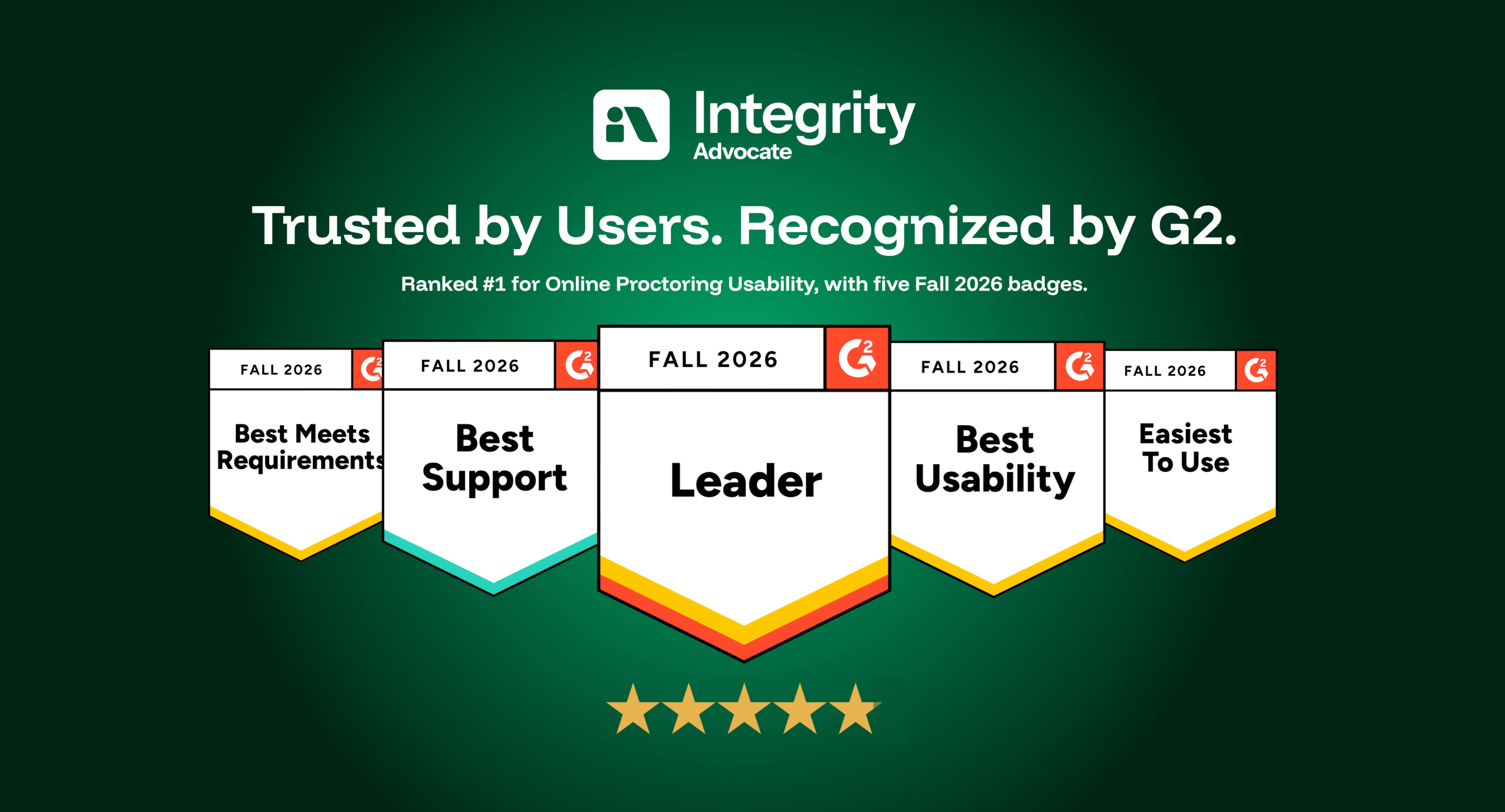
Integrity Advocate has been ranked #1 for Online Proctoring Usability on G2 for the third consecutive season. Based on verified customer feedback, we also earned five Fall 2026 badges recognizing usability, ease of use, support, and overall leadership.
Integrity Advocate has once again been ranked #1 in G2’s Usability Index for Online Proctoring, marking our third consecutive season at the top of the category.
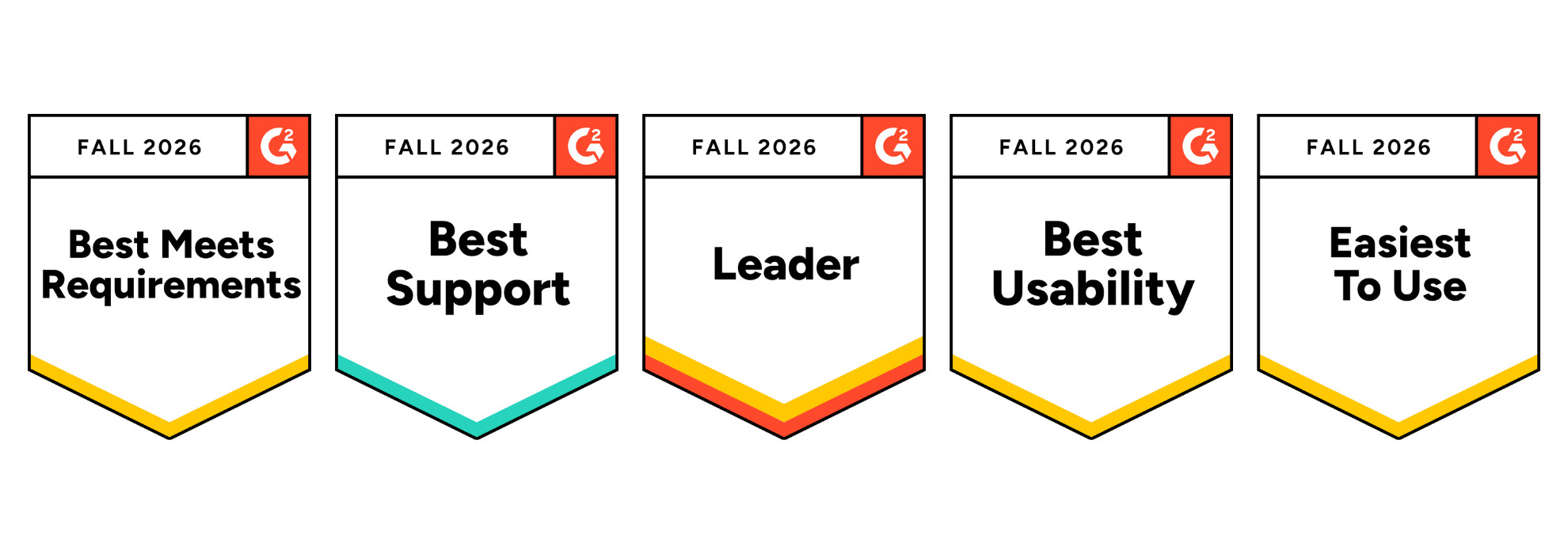
In the Fall 2026 report, Integrity Advocate earned an overall G2 Index Score of 8.60, ahead of Honorlock, Proctorio, Quilgo, Talview, and Meazure Learning. We also earned five G2 badges, including Best Usability, Easiest to Use, and Best Meets Requirements, and were recognized as a Leader in the online proctoring category.
These recognitions are based on feedback from verified users. For us, that is what makes them meaningful. They reflect the experiences of the people who administer assessments, support test takers, and rely on the results.
Integrity Advocate earned the highest overall score in the Fall 2026 Online Proctoring Usability Index:
This is not only another first-place ranking. Our overall index score increased from 8.45 in Summer 2026 to 8.60 in Fall 2026, extending Integrity Advocate’s position at the top of the category.
G2 is the largest peer-to-peer software review platform in the world. Their Usability Index ranks products within a category based on three user-rated dimensions:
Every score comes from authenticated, verified reviews. Companies cannot pay to improve their position. There is no sponsorship or placement influencing the results. The index score reflects what users say about their experience with the product.
Integrity Advocate scored above the online proctoring category average across every usability measure included in the report:
User adoption stands out in particular. Integrity Advocate scored 17 points above the category average and 28 points above Honorlock.
That matters because a platform can have an impressive feature list and still create friction when people are asked to use it. Strong adoption suggests that the experience works in practice, not only during a product demonstration.
In addition to ranking first in the Usability Index, Integrity Advocate earned five G2 badges for Fall 2026 and was recognized as a Leader in online proctoring.
The Best Usability, Easiest to Use, and Best Meets Requirements badges reinforce something we have always believed: assessment security should be strong without being unnecessarily complicated.
Organizations should not have to choose between protecting an assessment and delivering an experience people can successfully use.
Online proctoring sits at a sensitive point in the assessment experience. Test takers may already be under pressure, while administrators need to protect exam integrity without creating unnecessary technical problems or support demands.
A platform that is difficult to access or manage can lead to:
Integrity Advocate was designed to remove those barriers.
There is no software to install and no browser extension to manage. The platform works across devices and browsers and integrates into existing assessment workflows. Test takers can access their assessments without navigating a separate, unfamiliar system, while administrators gain clear evidence and the context needed to evaluate results.
Usability is not separate from assessment integrity. When a platform works consistently, more attention can remain where it belongs: on the assessment and the credibility of its outcome.
Ease of use should never require an organization to compromise on accuracy or defensibility.
Integrity Advocate combines intelligent detection with Verified Human Review™ to provide context behind potential assessment violations. Instead of asking administrators to make decisions based only on an automated flag, our proctoring solutions can provide a clear, reviewable record supported by human judgment.
The result is an approach that protects assessment integrity while remaining practical for the people responsible for administering the program and fair to the people taking the assessment.
Across reviews, users consistently highlight the qualities reflected in the Fall 2026 report: straightforward implementation, ease of use for learners and administrators, seamless LMS integration, responsive support, and a privacy-first approach to assessment integrity.
As one verified user shared:
{{post-block-quote}}
That experience is what the rankings ultimately represent. Not simply a score, but whether the platform helps organizations protect assessments without placing unnecessary friction on their teams or test takers. View more customer stories here.
If you are currently comparing online proctoring solutions, usability should be evaluated alongside security, privacy, and review quality.
Consider asking:
The Fall 2026 G2 results provide an independent view of how leading platforms perform across many of these considerations.
Being ranked #1 once is exciting. Remaining at the top for three consecutive seasons tells a stronger story.
It shows that organizations do not have to accept unnecessary complexity as the price of protecting their assessments. Online proctoring can be secure, privacy-first, easy to administer, and straightforward for test takers.
That is the experience Integrity Advocate was built to provide, and we are grateful to every customer who shared their experience on G2.
The G2 ranking reflects a platform that has been in continuous operation for over a decade:
{{post-cta}}

December 16, 2022
|
5 min read
A training completion record proves that a course was accessed. It does not prove who accessed it or whether they engaged with it. The PricewaterhouseCoopers case, in which fines of over one million Canadian dollars were assessed after staff shared answers to internal training courses, demonstrates what happens when organizations cannot verify who actually completed their training. This post examines the regulatory standard, the insurance gap, and how Integrity Advocate helps organizations build training records that hold up to scrutiny.
Corporate training serves many purposes. Meeting regulatory requirements. Building workforce capabilities. Demonstrating due diligence. But across all of these purposes, the same assumption is made: that a training completion record is proof that training happened.
It is not.
A completion record is proof that training was accessed. It is not proof of who accessed it, whether they engaged with it, or whether the person on record is the person who actually completed it. In a regulatory investigation or legal proceeding, that distinction matters enormously.
PricewaterhouseCoopers is one of the Big Four accounting firms and the second-largest professional services network in the world. In a published regulatory investigation conducted by the Canadian Public Accountability Board, fines of over one million Canadian dollars were assessed after it was found that junior staff, managers, directors, and partners of PwC shared answers to internal training courses on auditing, accounting, and professional independence.
The regulator found that PwC had failed to establish policies and procedures to provide the firm with reasonable assurance that its workforce was completing required training as intended.
This was not a small organization with limited resources. This was one of the most sophisticated professional services firms in the world, with dedicated compliance infrastructure. And still, the internal training program failed to verify that the right people were completing the right training.
If it can happen at PwC, it can happen anywhere.
Conversations with private company leaders reveal a consistent gap in understanding. Regulators generally do not stipulate specific oversight requirements for how training must be delivered or verified. They specify the outcome: that the workforce is trained.
The assumption that providing access to online training satisfies that outcome is where organizations get into trouble. Online training records are proof of training accessed, not training completed, and not by whom. Company leadership often has no evidence of individual workers' participation, and no process in place to obtain it.
When a regulatory investigation or legal action follows a workplace incident, that gap becomes the story.
When facing regulatory or legal action, many organizations turn to insurance protection as a backstop. It is worth understanding what insurance does and does not cover.
Insurance policies do not cover bad faith or gross negligence. The argument that company leaders have demonstrated gross negligence rests on the definition established in Hart v. Kline (1941): gross negligence as an indifference to a legal duty of care. An organization that provided training access without any mechanism to verify who completed it, or whether they engaged with it, may find that argument difficult to counter.
A completion record that cannot confirm identity or participation is not a defense. It is evidence of the gap.
Integrity Advocate works with organizations to close that gap by verifying the identity and confirmed participation of internal personnel in every training session. The result is a record that demonstrates not just that training was accessed, but that the right person completed it and was present throughout.
This eliminates the exposure that comes from unverifiable training records in regulatory investigations, legal proceedings, and insurance disputes.
As one client senior leader put it: "How we deliver information to our personnel is indicative of the importance of that information to them."
The way an organization approaches training verification sends a signal about how seriously it takes what it is training people to do. For compliance training, safety training, and any instruction with regulatory or legal weight, that signal matters.
{{post-cta}}
October 18, 2021
|
5 min read
Most proctoring platforms accumulate years of student identity data, session recordings, and behavioral information, and their privacy policies explicitly allow that data to be transferred in a business sale. This post examines the risk of data stockpiling, the 400,000-student breach that demonstrated what happens when that data is targeted, and how Integrity Advocate's data minimization approach eliminates the risk by not holding data that does not need to exist.
At the heart of genuine privacy protection is a concept that sounds straightforward: data minimization. If personal data is never collected in the first place, it cannot be leaked, hacked, or sold. It cannot be transferred to a buyer in an acquisition. It cannot appear on the dark web.
The problem is that data minimization runs directly against the financial incentives of most technology companies. User data increases company valuation. The more a platform collects and retains, the more it is worth to investors, acquirers, and advertisers. For proctoring companies specifically, years of student behavioral data, identity images, and session recordings represent a significant asset on the balance sheet.
That asset belongs to your learners. And most of them have no idea it is being accumulated.
A review of privacy policies from proctoring companies around the world reveals language like this:
"In the event we sell some or all of our assets, it is possible your personal data could be one of the assets transferred to the purchaser."
"We may disclose your personal information to third parties if we are involved in a merger, acquisition, or sale of any or all of our business and/or our assets to a third party."
These are not edge cases buried in fine print. They are standard provisions in proctoring company privacy policies. They mean that the identity images, session recordings, and behavioral data your learners submitted for the purpose of completing an assessment can be transferred to an entirely different organization without their knowledge or consent.
The volume of data retained and the length of time it is kept directly increases the likelihood that it will be used, intentionally or unintentionally, in ways that harm the individuals it belongs to.
Encryption certificates and security procedures are frequently cited as assurances. They are not guarantees. A well-known proctoring service was breached despite these assurances, resulting in years of data involving over 400,000 students being obtained illegally and shared on the dark web.
The lesson is not that security measures are useless. It is that the most effective security measure is not having the data to begin with. Why would anyone hack a system that holds nothing of value?
Data minimization is not a policy position. It is an architectural decision. It means building a platform that:
Integrity Advocate deletes session recordings and identity images within 24 hours of completion for sessions with no violations. Personal data is not included as a transferable asset in any business transaction. As a Canadian company operating outside US jurisdiction, the data available on the vast majority of users in the unlikely event of a compelled disclosure would be limited to a name and a facial image represented as a string of code.
Before selecting a proctoring provider, organizations should be able to answer these questions from the vendor's privacy policy and data processing documentation:
If the answers are not clearly documented, that is itself an answer.
{{post-cta}}

March 18, 2021
|
5 min read
Online training completion records are not the same as verified training, and courts are making that distinction with real consequences for employers. This post examines the R. v. Rose's Well Services case, the legal standard for due diligence in workforce training, and what organizations in high-risk industries need to do to ensure their online training holds up when it matters most.
Your organization spent money on an online safety training program. Employees completed it. You have completion records. You feel confident that if something goes wrong, you can demonstrate due diligence.
You may be wrong.
Courts and regulators are increasingly drawing a distinction between online training that can be verified and online training that cannot. If your platform cannot confirm who completed the training and whether they actually participated, that training may not count when it matters most.
Workforce training moved from the classroom to the screen gradually, then all at once. The cost savings are real, the scheduling flexibility is genuine, and for many organizations online training is now the only practical option for reaching a distributed workforce.
But the shift to online created a problem that classroom training never had: how do you prove that the right person completed the training, and that they actually engaged with it rather than clicking play and walking away?
In a physical classroom, an instructor can confirm attendance and participation. Online, without the right technology, you cannot. And in high-risk industries, that gap has real legal consequences.
The landmark case of R. v. Rose's Well Services Ltd. made this problem impossible to ignore. During the investigation, an employee admitted to completing online training on behalf of other employees. The employer had training records. The employer had completion data. None of it mattered, because the records could not demonstrate that the right people had actually done the training.
Courts determining fault in workplace incidents use due diligence as a central test. Did the employer take all reasonably practical steps to prevent the incident? Providing online training that cannot be verified does not satisfy that test.
The legal counsel of a multinational energy company put it plainly:
"Making our safety orientation and training available on the web and requesting that personnel take the training without the ability to provide documented evidence that personnel had actually completed the required safety orientation and training would, in my opinion, not be reviewed positively in an analysis of whether a company had satisfied its due diligence requirements in the event of an incident. Due diligence is a company's only defense against a strict liability offense."
That is not a hypothetical risk. It is a legal opinion from inside a major organization that had already thought carefully about what their online training program would look like in front of a judge.
Without identity verification, there is no way to confirm that the person who registered for the training is the person who completed it. The Rose's Well Services case is not an isolated incident. Proxy completion is a known problem in workplace training, particularly for mandatory compliance courses that employees view as a checkbox rather than a learning opportunity.
Completion records show that a course was finished. They do not show that anyone watched it, read it, or absorbed any of it. A learner who clicks play, leaves the room, and returns to click through the assessment has a completion record identical to one who engaged with every module. In a regulatory investigation, that distinction matters.
Even if training was completed legitimately, an employer who cannot provide documented evidence of who completed it and how they participated is in a weak position. Regulators and courts do not give credit for training that cannot be verified.
Some organizations, including Spectra Energy, have responded to this problem by removing online training from high-risk content categories entirely, citing security concerns around confirming student attendance. That is a significant operational step backward.
The Chartered Professionals in Human Resources of Alberta has taken a different position, advising that technology exists that mitigates the issues facing compromised training by verifying both the identity and participation of trainees.
That technology exists. The question is whether your organization is using it.
Verified online training confirms three things that unverified training cannot:
Integrity Advocate has worked with organizations across construction, mining, oil and gas, and other high-risk industries to help hundreds of thousands of personnel complete training online in a way that meets regulatory standards and holds up as evidence of due diligence.
The difference between online training that counts and online training that does not is not the content of the course. It is whether you can prove who did it and that they were there for it.
Organizations running online workforce training face a straightforward decision. Implement training without identity verification and participation monitoring, and accept the legal and regulatory exposure that comes with it. Or implement training with the technology to verify both, and be able to demonstrate due diligence if it ever matters in court.
With Integrity Advocate, that second option does not require rebuilding your training program. It works with your existing LMS and course content, adding the verification layer that transforms a completion record into a defensible document.
{{post-cta}}