October 1, 2025
|
5 min read
When AI Outsmarts Exams: Safeguarding the Value of Your Credentials
GPT-4 has scored in the 90th percentile on the Bar Exam, 93% on the US Medical Licensing Exam Step 1, and outperformed average test-takers on the SAT, LSAT, and graduate-level law school exams. When AI can pass the same high-stakes exams certifying bodies have relied on for decades, the credibility of those credentials is at risk. This post examines what is at stake when AI can bypass traditional exam security, where legacy tools fall short, and what a hybrid AI plus human review approach looks like for certifying bodies that need to protect the value of their credentials without compromising the candidate experience.

{{post-stat-highlight}}
These are the same high-stakes exams certifying bodies have relied on for decades to ensure that only qualified professionals enter the workforce.
So what happens when artificial intelligence can pass those very exams with ease?
The New Reality
High-stakes exams are no longer immune to disruption. With AI models like GPT-4 demonstrating near-perfect performance on medical, legal, and professional exams, certifying bodies must adapt to safeguard credential integrity.

For today's institutions, the value of your credential rests on one thing: trust in the exam process.
- Employers trust that certified professionals are competent.
- Regulators trust that licensing exams protect the public.
- Members trust that earning the credential reflects real skill and knowledge.
But if candidates can quietly lean on AI to generate passing answers, the credibility of the exam, and by extension, the credential itself, is at risk.
What’s at Stake
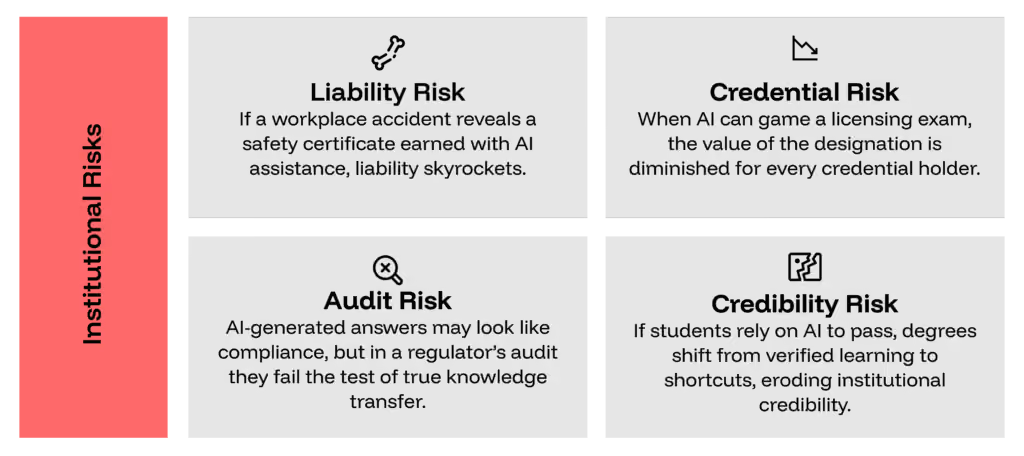
The credibility of your credential is its greatest asset. If candidates can bypass exam integrity with AI, the value of your certification program is immediately at risk.
- Credential devaluation: If AI shortcuts are widely suspected, your certification may lose its prestige and competitive advantage.
- Erosion of employer trust: Companies may question whether certified professionals truly demonstrate the required competencies.
- Regulatory and legal exposure: In fields like healthcare, aviation, or finance, compromised certifications can introduce public risk and liability.
- Member dissatisfaction: Candidates who earn their credential fairly may feel devalued if peers can “game the system.”
Why Traditional Exam Security Falls Short
Most exam security measures were designed for a pre-AI world. Legacy tools weren’t designed to detect AI-enabled misconduct. Lockdown browsers, AI-only monitoring, and human-only oversight leave dangerous gaps.
- Lockdown browsers can be bypassed or may not prevent candidates from using a second device.
- AI-only proctoring often misflags normal behaviors, leading to false accusations and poor candidate experiences.
- Human-only oversight can’t scale cost-effectively and risks overlooking subtle AI-assisted cheating.
The reality is clear: new threats require new solutions.
A Path Forward: Hybrid Security for the AI Era
To protect the integrity of credentials, institutions must embrace approaches designed for this new landscape. That means:
- Conducting a security audit: Evaluate whether current proctoring methods are resilient against AI-enabled cheating.
- Adopting hybrid proctoring: Combine AI’s efficiency with the judgment and nuance of human review to catch what machines alone cannot.
- Reducing friction for candidates: Security doesn’t have to come at the expense of user experience. Solutions should be no-install, device-agnostic, and low-support-burden to maintain accessibility.
- Communicating proactively: Show members, employers, and regulators that your organization is addressing AI head-on — not waiting for a scandal to spark change.
Protecting the Value of Certification
Your credential is more than a certificate or a badge. It represents trust, competence, and reputation. In the age of AI, safeguarding that trust means ensuring exams are secure, fair, and credible.
Because if AI can pass your exams, and nothing is done to respond, the profession itself is at risk.
At Integrity Advocate, we believe the path forward is clear: privacy-first, hybrid online proctoring. Unlike one-dimensional solutions, our approach combines the precision of AI with the judgment of human oversight to deliver both security and fairness.
With our no-install, friction-free platform, candidates can focus on their exam while organizations maintain the highest standards of integrity. Our hybrid solution ensures:
- Robust identity verification – confirming the right person is taking the exam.
- Smart monitoring – AI detects potential issues while human reviewers provide context and fairness.
- Actionable oversight – suspicious activity is clearly identified and presented to assessment administrators for confident decision-making.
- Candidate-first experience – no installs, device-agnostic access, and minimal technical barriers keep the exam environment stress-free.
By uniting technology with human judgment, Integrity Advocate helps certifying bodies protect credential value without compromising the candidate experience.
Ready to safeguard your credential in the AI era? Let’s talk.
Sources:
- Kung, T. H., et al. “Performance of ChatGPT on USMLE: Potential for AI-Assisted Medical Education Using Large Language Models.” JMIR Medical Education. 2023. Link
- Chiu, T. Y., et al. “Comparing performance of GPT-3.5, GPT-4, and GPT-4o on USMLE, PLAB, HKMLE, and NMLE medical licensing examinations.” BMC Medical Education. 2024. Link
- Reuters. “Artificial intelligence is now an A law student, study finds.” June 2025. Link
{{post-cta}}
In 2023, GPT-4 scored 93% on the U.S. Medical Licensing Exam (USMLE Step 1) and ranked in the 90th percentile on the Bar Exam. It has also outperformed average test-takers on the SAT, LSAT, and even graduate-level law school exams.
Keep reading
AI Cheating Tools Are Outpacing LMS Defenses. Integrity Advocate Built a Solution
August 17, 2023
|
5 min read
GPT-powered browser plugins can now prefill answers to online exam questions the moment they appear, and LMS platforms have no effective countermeasures. Integrity Advocate's ExposeAI is a purpose-built detection capability that identifies AI-assisted cheating during assessment sessions, integrating directly into the existing monitoring suite without any client-side installation. This post explains how these tools work, why they matter for certified training programs, and how ExposeAI addresses the threat.
A few years ago, the concern about AI in online assessments was theoretical. Today it is not. GPT-powered browser plugins can prefill answers to multiple choice exam questions the moment they appear on screen, regardless of the topic or difficulty level. The learner does not need to read the question. They do not need to understand it. The answer is already there.
Integrity Advocate has been tracking this development closely. The response is ExposeAI, a new detection capability built directly into Integrity Advocate's monitoring suite.
How GPT-Powered LMS Plugins Work
Learning Management System plugins powered by generative AI have proliferated rapidly. Among the tools currently in use are Github Copilot, AnswersAI, ConchAI, Jasper, ChatSonic, Coursology, Hyperwrite, Quillbot, and Monica, among dozens of others that continue to emerge.
These tools share several characteristics that make them particularly difficult to address through standard LMS countermeasures:
- They are inexpensive or free to obtain
- They require no technical expertise to install or activate
- Once installed, they operate automatically and continuously
- They are designed to conceal their presence and adapt to detection attempts
- New variants emerge faster than most platforms can respond
As a result, organizations relying on their LMS provider to develop effective countermeasures are unlikely to find one. LMS companies have no current solutions to this threat, and the nature of these plugins makes them unlikely to be eradicated through platform-level defenses alone.
The integrity of online assessments and certifications depends on a different approach.
Why This Matters for Assessment Integrity
The implications extend beyond academic dishonesty. For organizations issuing certifications that carry regulatory or legal weight, an assessment completed with AI assistance is not a valid measure of knowledge or competency. The certification it produces is as hollow as one issued without any training at all.
The same worker who received a fraudulent safety certification from a provider that did not deliver training could receive an equally fraudulent certification from an organization that delivered the training but could not prevent AI tools from completing the assessment on the learner's behalf. The outcome is the same: a credential that does not reflect what the person actually knows.
Introducing ExposeAI
ExposeAI is Integrity Advocate's purpose-built response to AI-assisted assessment fraud. It can be incorporated into Integrity Advocate's existing monitoring suite without any technical effort from clients, and works across the full range of devices and browsers that Integrity Advocate supports, from mobile to desktop.
ExposeAI is designed to detect the presence and use of GPT-powered plugins during an assessment session, giving organizations the visibility they need to maintain the integrity of their certification and training programs in an environment where AI tools are becoming standard equipment for learners looking to shortcut the process.
This is part of Integrity Advocate's broader commitment to staying ahead of the threats that matter most to the programs it serves. Human review remains at the core of every session. ExposeAI adds a layer of detection specifically designed for the AI-assisted cheating methods that automated systems alone cannot reliably identify.
The Broader Picture
AI cheating tools are not a passing trend. They are becoming cheaper, more capable, and more widely available. Organizations that do not have a response to this threat are issuing certifications they cannot stand behind.
Integrity Advocate's approach combines human review with purpose-built AI detection, so the results your program issues reflect what learners actually know, not what an algorithm answered for them.
{{post-cta}}

AI-Powered Online Proctoring Software Needs Human Oversight
September 16, 2025
|
5 min read
AI-powered proctoring can monitor at scale, but it cannot understand context, weigh consequences, or defend a certification decision to a regulator or accreditor. In safety-critical industries where a missed harness check or a wrongly credentialed healthcare worker can cost lives, the blind spots of automated-only proctoring become serious liabilities. This post examines what AI cannot do in high-stakes assessment, what standards like ANSI/ASSP Z490.1-2024, ISO/IEC 17024, and NCCA require in terms of defensibility and human oversight, and why the right model is AI plus human judgment rather than either alone.
Automation promises speed. But in compliance, speed without accuracy can be devastating.
AI is now woven into training and certification. It monitors test-takers, flags anomalies, and produces reports at a pace no human could match. For compliance leaders facing relentless pressure, it looks like the ideal solution: scalable, efficient, impartial.
But here’s the catch: AI doesn’t grasp the stakes of being wrong.
- A missed harness check on a construction site isn’t just noncompliance, it can mean a fatal fall.
- An overlooked question in food safety training isn’t just a technicality, it can trigger a life-threatening allergic reaction.
- A nurse credentialed without proper oversight isn’t simply a paperwork error, it’s a direct risk to patient safety.
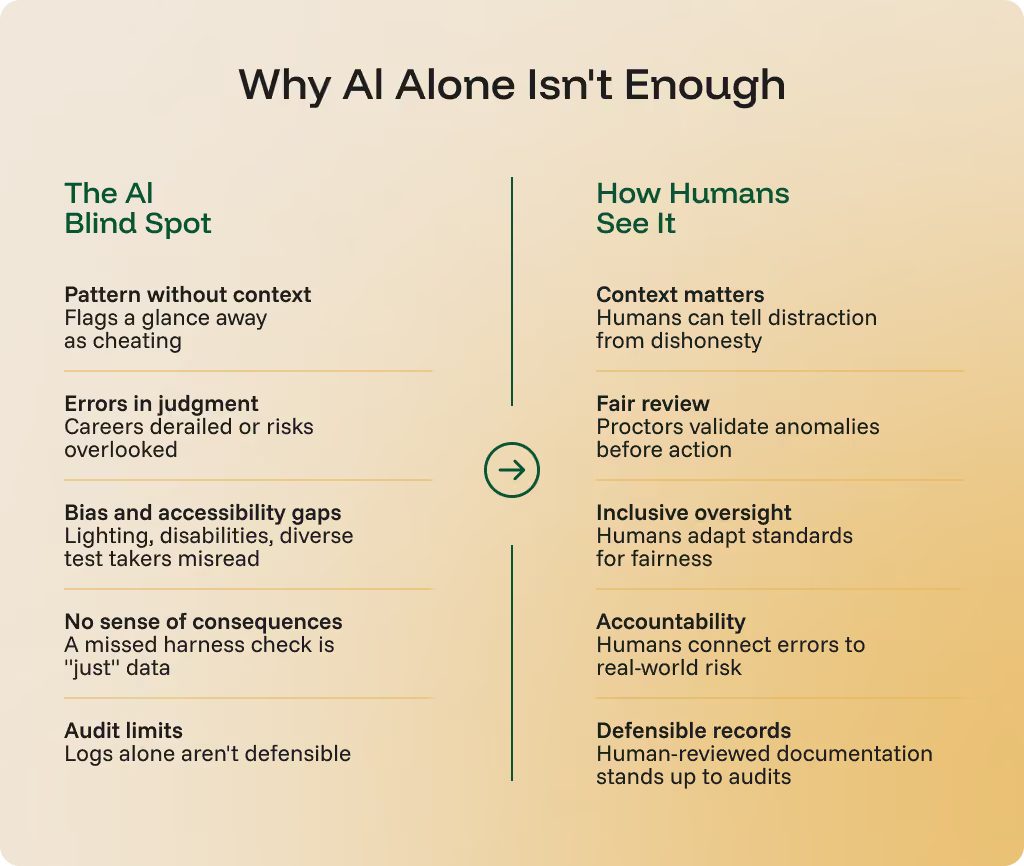
AI-powered online proctoring software can detect patterns, but it can’t weigh consequences. It can’t tell the difference between distraction and dishonesty. It can’t stand in front of an accreditor or regulator and defend a decision.
And compliance leaders know the stakes. 64% of frontline workers say injuries they’ve experienced or witnessed could have been prevented with better training, according to a YouGov survey of more than 2,000 workers in Australia, the UK, and the US. When proctoring systems prioritize speed over judgment, gaps spill from the classroom into the workplace.
{{post-stat-highlight}}
That’s why proctoring can’t be left to automation alone. Judgment, accountability, and defensibility require a human in the loop.
AI’s blind spots
For all its processing power, AI often misses the context, fairness, and consequences behind the data.
Pattern vs. context
AI can spot anomalies, but it can’t understand people. To the algorithm, a student glancing away as their child enters the room looks no different than someone searching for an answer. Without human judgment, honest learners get flagged, reputations suffer, and trust in the system erodes, all while true violations can still slip by unnoticed.
Risks of misjudgment
The real danger isn’t just inaccuracy, it’s the consequences. A nursing candidate wrongly flagged can lose months of progress, along with trust in the system meant to support them. Meanwhile, a missed violation on a commercial driving exam could place an unqualified driver behind the wheel of your company’s vehicle, endangering both reputation and public safety.
Bias and accessibility
AI models are not neutral. From lighting conditions to facial recognition inaccuracies, automation can inadvertently disadvantage test-takers with disabilities, those in non-standard testing environments, or individuals from diverse cultural backgrounds. This creates inequities that undermine the fairness of certification processes. At Integrity Advocate, we work to eliminate these inequities, making the certification process seamless, accessible, and fair for every test-taker.
No sense of consequences
Perhaps the greatest blind spot is this: AI doesn’t “understand” what a mistake means. It cannot connect a failed harness safety check to a potential fall on a job site. It doesn’t grasp that mishandled food safety could trigger an allergen outbreak. Without that ethical and practical awareness, AI remains a tool that must be guided by human oversight.
Certifications in focus: why proctoring integrity matters
The stakes of proctoring reach far beyond academia. They’re practical and sometimes life-or-death.
Consider a few high-stakes examples:
- Nursing exams and clinical credentials ensure healthcare workers can safely treat patients.
- Electrical licenses confirm that workers can install and maintain systems without risking fires or electrocution.
- Commercial Driver’s Licenses (CDL) certify drivers who transport goods and passengers across public roads.
- ServSafe and OSHA certifications guard against foodborne illness and workplace hazards.
These certifications aren’t just personal milestones. They validate competence in roles that protect lives and communities. Without trustworthy proctoring, credentials lose credibility. Organizations risk liability, and the public loses trust in the professionals meant to safeguard them.
AI-Only Proctoring Falls Short
When the stakes are high, oversight must be more than automated pattern recognition. AI can monitor, record, and flag, but it cannot fully understand context or consequences. Relying on AI alone risks undermining the very certifications designed to protect lives and communities.
ANSI and accreditation frameworks: compliance by design
The updated ANSI/ASSP Z490.1-2024 standard sets clear expectations for safety, health, and environmental (SH&E) training.
For compliance leaders, a few key takeaways stand out:
- Reliability and fairness are non-negotiable.
- Oversight and defensibility must be built into training and assessment.
- Documentation and accountability are essential in the event of an audit or incident.
These requirements go beyond what automation alone can provide. Standards demand human verification, ethical review, and the ability to defend every certification decision.
Beyond ANSI: ISO and NCCA
International standards like ISO/IEC 17024 and U.S. frameworks like the National Commission for Certifying Agencies (NCCA) reinforce the same principle: defensible certification requires human oversight. Without it, organizations risk failed audits, loss of accreditation, and legal exposure.
Hybrid Online Proctoring: AI Detection + Human Discretion
The answer is not to reject AI, but to integrate it thoughtfully. The most effective approach is AI plus human oversight, where technology enhances efficiency, but people ensure fairness, context, and compliance.
Scalable monitoring with human review
AI can monitor at scale, flagging potential anomalies. But those red flags should be reviewed by trained human proctors who can interpret context and make defensible decisions.
Audit trails and documentation
Human oversight is essential for building robust audit trails. When compliance checks or regulatory audits arise, organizations must show that their proctoring process was fair, valid, and defensible. Documentation reviewed and validated by people is far more credible than machine logs alone.
Automation accelerates, human judgment protects
AI has transformed training and monitoring with unprecedented speed and scale. Yet in safety-critical industries, automation is a tool, not a safeguard. True protection comes from human judgment, ethical oversight, and alignment with compliance standards.
With standards like ANSI/ASSP Z490.1-2024 raising the bar for defensibility, organizations must recognize that proctoring isn’t just a technical step, it’s a compliance-critical safeguard that protects lives, preserves trust, and ensures training fulfills its purpose.
Smart systems drive efficiency. Human oversight delivers safety. Together, they make compliance simple, scalable, and defensible.
Online proctoring software built for compliance and trust
When compliance is defensible, organizations, and the people they serve, are safer. That’s why proctoring must go beyond automation.
At Integrity Advocate, we combine AI efficiency with human oversight to ensure every training program is verifiable, fair, and aligned with the latest standards. That means:
- Confirmed identities
- Monitored participation
- Defended credentials
No guesswork. No blind spots. Just compliance you can stand behind.
Ready to safeguard your compliance? Let’s leverage the combined power of AI and human oversight, together.
{{post-cta}}

ANSI/ASSP Z490.1-2024 Is Here. Is Your Training Compliant?
May 15, 2025
|
5 min read
The ANSI/ASSP Z490.1-2024 update consolidates in-person and online Safety, Health and Environmental training into a single unified standard for the first time. Organizations can no longer simply assign a course and mark it complete. They must verify who completed the training, confirm active participation, prevent unauthorized assistance, and maintain a record that holds up to regulatory scrutiny. This guide walks safety and compliance teams through what has changed, where most current systems fall short, and how to meet the new standard without overhauling existing infrastructure.
A no-nonsense guide for safety and compliance teams adapting to ANSI/ASSP Z490.1-2024
The rules have changed. And if you’re in charge of keeping workers safe, delivering training or meeting compliance standards, you’ve likely felt the ripple.
The ANSI/ASSP Z490.1-2024 is no minor update. For the first time, both in-person and online Safety, Health and Environmental (SH&E) training are held to the same gold standard.
It’s no longer enough to say training was “offered.” You have to prove it was delivered, received and understood by the right person, in the right way, with a record to show for it.
The challenge? Most current systems weren’t built for that.
Here’s what this shift means for compliance, what to prioritize first and how to avoid the missteps that can cost you.
What’s actually new?
The ANSI/ASSP Z490.1-2024 update brings some big changes. It consolidates what were once two separate standards—Z490.1 for in-person training and Z490.2 for eLearning—into a single, unified standard for all Safety, Health and Environmental (SH&E) training.
That means no matter how your training is delivered, the expectations are the same.
You can’t just assign a course and call it complete. You have to:
- Verify the identity of the learner,
- Confirm the learner’s participation in the training,
- Prevent unauthorized assistance (human or AI),
- Communicate results promptly,
- And have a record that stands up to scrutiny.
Regulators want to see due diligence from organizations that take safety and accountability seriously. Organizations need systems that demonstrate training was handled with care, intention and oversight.
The compliance gap: identity, participation and proof
Traditional LMS’ rely on user credentials to grant access. But usernames and passwords don’t confirm who actually completed the training or whether they were even in the room.
That’s a problem. Because when safety is on the line, assumptions can cost lives.
Training is meant to protect people and prepare them for the risks they face and the responsibilities they carry. If you can’t confirm who took the training or whether they were engaged, there’s more than just compliance at stake. You’re carrying a safety risk, a legal liability and a missed opportunity to do right by your workforce.
The updated ANSI/ASSP standard puts the responsibility squarely on the employer. In the event of an incident, “we assigned the module” won’t hold up. To truly protect your organization and your people, you need training that’s verifiable. That means:
- Identity verification that confirms the right person took the training
- Participation monitoring that confirms they were present and engaged
- Data protection that respects user privacy while keeping your records defensible
It's more than business
Safety incidents put everything under the microscope. Leadership. Processes. Credibility. It’s not just your operations on the line, it’s trust. And behind that?
People’s lives. The ones training is meant to protect.
Common missteps in online training we’ve seen
Even with the best intentions, training programs can fall short, particularly when the systems in place weren’t built with today’s standards in mind.
If your current setup relies on a simple login and password, there may be gaps you haven’t considered. And if you’re using software that requires downloads or installations, you might be introducing friction for learners.
Here are a few areas where we often see room for improvement:
- Unverified attendance records that can’t confirm who actually completed the training
- Limited or no tracking of learner engagement
- Software installs that conflict with device security protocols
- Surveillance methods that may violate privacy laws
- No clear audit trail to support due diligence when it matters most
The good news is that these are fixable gaps. There are better, easier ways to meet compliance requirements today without compromising user experience, privacy or peace of mind.
What due diligence really looks like
No matter your industry—construction, food service, healthcare, manufacturing—safety training exists for a reason. Not to fill a quota. Not to tick a box.
We know you care about your workforce. You wouldn’t be reading this if you didn’t. But caring isn’t always enough, especially when systems are outdated, fragmented or easy to bypass.
Real responsibility means having a system that holds up under pressure. But how do you build a system like that without overhauling everything?
It doesn’t have to be complicated. The right tools do the heavy lifting quietly in the background, verifying identity and participation without interrupting the learning experience. No software installs. No extra logins. No support tickets flooding your inbox.
Just reliable, responsible training that works (because it’s built to).
How to get started without starting over
Already delivering training digitally? Great. You don’t need to scrap your system—you just need to make sure it can hold up under today’s standards.
Here are a few questions to help you evaluate where you stand:
- Can we confirm who completed each training session?
- Can we demonstrate that participants were engaged throughout?
- Could we confidently show this information to a regulator or investigator?
If any of those questions give you pause, it might be time to take a closer look.
Taking the Integrity Advocate approach
At Integrity Advocate, we don’t just provide tools. We partner with you to navigate compliance confidently, especially when standards change and the pressure’s on.
We help organizations meet the ANSI/ASSP Z490.1-2024 standard with:
✓ No-install identity verification and participation monitoring
✓ Mobile-friendly access that meets your learners where they are
✓ Privacy by Design to protect your organization and your people
✓ Human reviews for fairness, discretion and accountability
✓ Seamless integration and full support within your existing LMS
Need help interpreting what this new standard means for your organization? We’ll guide you through it. Meeting with regulators or external reviewers? We’ve been there too, and we’ll sit in right beside you.
Rethinking safety training in light of ANSI/ASSP Z490.1-2024
The latest ANSI update is the perfect moment to pause and reassess how we deliver training, protect our teams and uphold accountability.
Integrity Advocate is here to help you make this shift with confidence. From no-install record and review proctoring to industry-leading support levels, we make it easier to meet the standard. When training is verifiable, ethical and accessible, it doesn’t just check a box—it builds trust, saves time and protects lives.
We believe compliance can be better. And when we work together, it is.
{{post-cta}}
Frequently asked questions
Find answers to the most commonly asked questions from our clients.
AI models including GPT-4 have demonstrated the ability to pass some of the most rigorous professional certification exams in the world. GPT-4 scored 93% on the US Medical Licensing Exam Step 1, ranked in the 90th percentile on the Bar Exam, and outperformed average test-takers on the SAT, LSAT, and graduate-level law school exams. These are the same exams certifying bodies have relied on to ensure only qualified professionals enter their fields. When AI can pass these exams reliably, the trust that gives those credentials their value is directly threatened.
When candidates can use AI to generate passing answers without demonstrating genuine competence, the credential loses its ability to signal real knowledge and skill. Employers begin to question whether certified professionals are truly qualified. Regulators in safety-critical fields like healthcare, aviation, and finance face increased public risk. Members who earned their credentials fairly feel the value of their achievement diminished. The cumulative effect is credential devaluation that undermines the entire certification program.
Most exam security tools were designed before generative AI existed as a practical threat. Lockdown browsers prevent access to certain websites but cannot stop candidates from using AI tools on a second device. AI-only proctoring flags unusual behavior but cannot detect AI-generated answers submitted through normal exam interaction. Human-only oversight cannot scale to review every session at the volume most certifying bodies require. Each approach has gaps that AI-assisted cheating can exploit.
Hybrid proctoring combines AI efficiency with human judgment. AI monitors sessions at scale and flags potential anomalies. Trained human reviewers then assess those flags in context before any outcome is recorded. This approach catches what automated systems alone miss, including subtle AI-assisted behaviors, while avoiding the false positives that AI-only systems generate. The combination delivers the scale of automation and the fairness and defensibility of human review.
Certifying bodies should start with a security audit to evaluate whether current proctoring methods are resilient against AI-enabled cheating. They should consider adopting hybrid proctoring that combines AI detection with human review, ensure their solution is no-install and device-agnostic to maintain accessibility, and communicate proactively to members, employers, and regulators that the organization is taking AI threats seriously rather than waiting for an incident to force a response.
Integrity Advocate uses AI to detect potential issues during assessment sessions and routes every flagged session to a trained human reviewer before any outcome is recorded. Identity is verified at the start of every session. Suspicious activity is clearly documented and presented to administrators for confident decision-making. The platform requires no installation and works on any device, maintaining the accessibility that certification programs require while delivering the security that the AI era demands.