October 9, 2025
|
5 min read
AI vs. Human vs. Hybrid Proctoring: Which Model Best Protects Exam Integrity?
As online testing expands across education, certification, and compliance training, the choice between AI-only, human-only, and hybrid proctoring has real consequences for exam integrity, fairness, and organizational risk. This post breaks down all three models, their pros and cons, and when each is the right fit, concluding that hybrid proctoring delivers the best combination of efficiency, accuracy, and fairness for most modern assessment environments.


The Evolving Landscape of Online Exam Security
As online testing continues to expand across education, certification, and compliance training, choosing the right proctoring model has never been more important.
AI-only tools promise automation and scalability. Human-only options offer fairness and empathy. Hybrid models combine the best of both, but which one truly protects exam integrity?
This article breaks down the three dominant proctoring approaches, their pros and cons, and what to consider when choosing the right fit for your organization.
1. AI-Only Proctoring: Fast, Scalable, and Automated, but Imperfect
AI proctoring tools use algorithms to detect suspicious behavior automatically, from unusual head movements to multiple voices or unauthorized devices.
While these systems offer speed and scalability, they also raise concerns about accuracy and bias.
Pros:
- Monitors large numbers of exams simultaneously
- Automates flagging and reporting
- Reduces administrative workload
Cons:
- High false positive rates (lighting, gaze, or accessibility issues)
- Lacks human context and judgment
- Raises data privacy and fairness concerns
AI-only systems can be efficient but risk misinterpretation, which can reduced trust among test takers.
2. Human-Only Proctoring: Fair and Contextual, but Limited in Scale
Human proctors oversee exams via live or recorded video, making real-time decisions based on context and behavior.
This model prioritizes fairness, empathy, and human oversight, but introduces scalability and scheduling challenges.
Pros:
- Accurate, contextual decision-making
- Builds trust with test takers
- Reduces false flags and misunderstandings
Cons:
- Labor-intensive and difficult to scale globally
- Higher cost per exam
- Limited flexibility for asynchronous or on-demand testing
Human-only proctoring ensures fairness but struggles to keep pace with modern testing needs.
3. Hybrid (AI + Human) Proctoring: The Best of Both Worlds
Hybrid proctoring blends automation and human oversight to deliver accuracy, fairness, and scalability.
AI handles initial detection, while human reviewers verify each flagged event before reports are finalized. This ensures efficiency without sacrificing integrity.
Pros:
- Reduces false positives with human verification
- Scales efficiently across time zones
- Protects privacy and fairness
- Provides auditable, compliant reporting
Cons:
- Requires platform integration
- May introduce slight delays in review turnaround
Hybrid proctoring creates the balance today’s organizations need, efficient technology guided by human discretion.
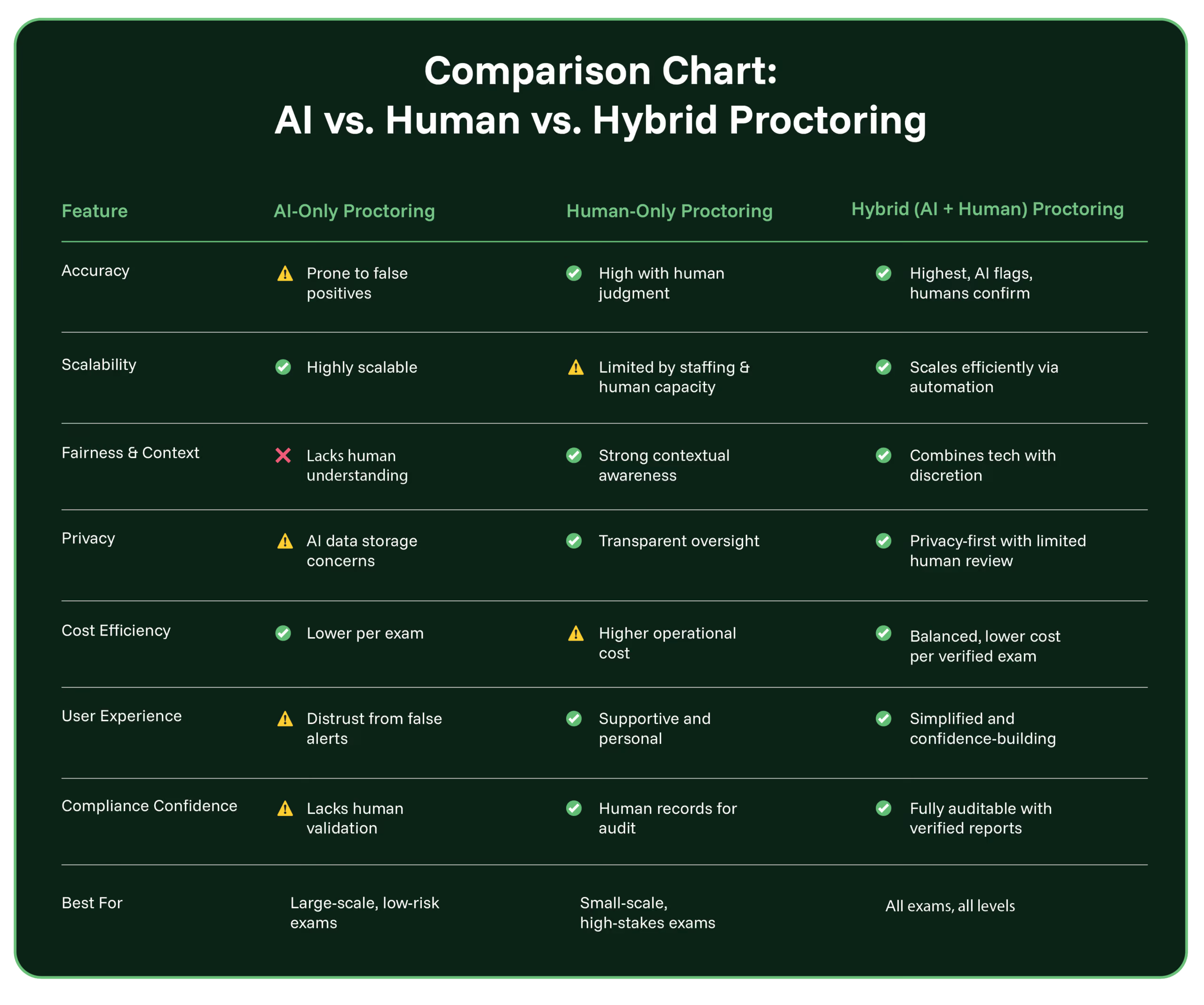
Verdict: Hybrid proctoring delivers the best combination of efficiency, accuracy, and fairness, meeting the evolving needs of modern learning and compliance environments.
When to Use Each Type of Proctoring (and When to Avoid It)
Choosing the right proctoring model isn’t just about features, it’s about fit. Here's when each approach works best, and when it might fall short.
AI-Only Proctoring
AI-only proctoring is a good fit for large-scale, low-stakes testing environments where speed and automation are priorities. It’s ideal for institutions delivering practice exams or formative assessments with minimal impact on final outcomes. If your team is constrained by staffing or budget, and real-time oversight isn’t required, AI-only can offer a fast, lightweight solution.
However, AI-only solutions are risky in high-stakes scenarios like certification, compliance, or licensure exams, especially where fairness, accessibility, and privacy are key concerns. These systems can generate false flags and lack the human context needed to distinguish genuine misconduct from harmless behavior.
Human-Only Proctoring
Human-only proctoring excels in small-group, high-stakes testing scenarios where personal interaction, empathy, and real-time judgment matter most. It's particularly useful for live, synchronous exams or specialized formats like oral exams, interviews, or hands-on assessments. If trust, fairness, and human connection are top priorities, a fully human approach ensures every test-taker is treated with context and care.
That said, this model becomes difficult to scale across large populations or global programs. It also presents challenges for asynchronous testing and tends to be more expensive due to staffing and scheduling demands. Organizations needing rapid turnaround or flexible exam windows may find this model limiting.
Hybrid Proctoring (AI + Human Review)
Hybrid proctoring combines the speed and scalability of AI with the fairness and context of human review, making it ideal for most modern assessment environments. It works especially well for mid- to high-stakes exams delivered at scale, such as workforce certification, compliance training, or higher education finals. Hybrid models support asynchronous access and bring-your-own-device testing, while still delivering human-verified, audit-ready results.
The main limitation is that some hybrid models may involve slight delays between the test and final reporting, depending on review turnaround time.
Why Hybrid Models Are the Future
Organizations are no longer choosing between technology and trust — they’re demanding both. Hybrid proctoring empowers institutions to deliver secure, privacy-compliant, and credible assessments without friction for test takers.
By combining automation and human verification, administrators get:
- Fewer false flags and student disputes
- Stronger audit trails and compliance documentation
- A smoother, more confident test-taking experience
How Integrity Advocate Sets the Standard
Integrity Advocate’s hybrid approach is designed around human-first, privacy-protected verification.
- No software installs required
- Works on any device or browser
- AI-driven detection verified by expert human reviewers
- Transparent, auditable reports administrators can trust
Integrity Advocate’s hybrid proctoring ensures fairness, compliance, and confidence in every assessment.
“Integrity Advocate integrates easily with our current system. It runs smoothly and is aesthetically pleasing; it meets the high standard we have for all our systems. It is also very effective at proctoring while not being too invasive; our users feel comfortable using it. Integrity Advocate strikes the right balance of integrity and privacy, which is hard to find!”
Ready to find the balance between automation and integrity?
Request a Demo to see how Integrity Advocate’s hybrid model redefines online exam security.
{{post-cta}}
Keep reading

AI-Powered Online Proctoring Software Needs Human Oversight
September 16, 2025
|
5 min read
AI-powered proctoring can monitor at scale, but it cannot understand context, weigh consequences, or defend a certification decision to a regulator or accreditor. In safety-critical industries where a missed harness check or a wrongly credentialed healthcare worker can cost lives, the blind spots of automated-only proctoring become serious liabilities. This post examines what AI cannot do in high-stakes assessment, what standards like ANSI/ASSP Z490.1-2024, ISO/IEC 17024, and NCCA require in terms of defensibility and human oversight, and why the right model is AI plus human judgment rather than either alone.
Automation promises speed. But in compliance, speed without accuracy can be devastating.
AI is now woven into training and certification. It monitors test-takers, flags anomalies, and produces reports at a pace no human could match. For compliance leaders facing relentless pressure, it looks like the ideal solution: scalable, efficient, impartial.
But here’s the catch: AI doesn’t grasp the stakes of being wrong.
- A missed harness check on a construction site isn’t just noncompliance, it can mean a fatal fall.
- An overlooked question in food safety training isn’t just a technicality, it can trigger a life-threatening allergic reaction.
- A nurse credentialed without proper oversight isn’t simply a paperwork error, it’s a direct risk to patient safety.
AI-powered online proctoring software can detect patterns, but it can’t weigh consequences. It can’t tell the difference between distraction and dishonesty. It can’t stand in front of an accreditor or regulator and defend a decision.
And compliance leaders know the stakes. 64% of frontline workers say injuries they’ve experienced or witnessed could have been prevented with better training, according to a YouGov survey of more than 2,000 workers in Australia, the UK, and the US. When proctoring systems prioritize speed over judgment, gaps spill from the classroom into the workplace.
{{post-stat-highlight}}
That’s why proctoring can’t be left to automation alone. Judgment, accountability, and defensibility require a human in the loop.
AI’s blind spots
For all its processing power, AI often misses the context, fairness, and consequences behind the data.
Pattern vs. context
AI can spot anomalies, but it can’t understand people. To the algorithm, a student glancing away as their child enters the room looks no different than someone searching for an answer. Without human judgment, honest learners get flagged, reputations suffer, and trust in the system erodes, all while true violations can still slip by unnoticed.
Risks of misjudgment
The real danger isn’t just inaccuracy, it’s the consequences. A nursing candidate wrongly flagged can lose months of progress, along with trust in the system meant to support them. Meanwhile, a missed violation on a commercial driving exam could place an unqualified driver behind the wheel of your company’s vehicle, endangering both reputation and public safety.
Bias and accessibility
AI models are not neutral. From lighting conditions to facial recognition inaccuracies, automation can inadvertently disadvantage test-takers with disabilities, those in non-standard testing environments, or individuals from diverse cultural backgrounds. This creates inequities that undermine the fairness of certification processes. At Integrity Advocate, we work to eliminate these inequities, making the certification process seamless, accessible, and fair for every test-taker.
No sense of consequences
Perhaps the greatest blind spot is this: AI doesn’t “understand” what a mistake means. It cannot connect a failed harness safety check to a potential fall on a job site. It doesn’t grasp that mishandled food safety could trigger an allergen outbreak. Without that ethical and practical awareness, AI remains a tool that must be guided by human oversight.
Certifications in focus: why proctoring integrity matters
The stakes of proctoring reach far beyond academia. They’re practical and sometimes life-or-death.
Consider a few high-stakes examples:
- Nursing exams and clinical credentials ensure healthcare workers can safely treat patients.
- Electrical licenses confirm that workers can install and maintain systems without risking fires or electrocution.
- Commercial Driver’s Licenses (CDL) certify drivers who transport goods and passengers across public roads.
- ServSafe and OSHA certifications guard against foodborne illness and workplace hazards.
These certifications aren’t just personal milestones. They validate competence in roles that protect lives and communities. Without trustworthy proctoring, credentials lose credibility. Organizations risk liability, and the public loses trust in the professionals meant to safeguard them.
AI-Only Proctoring Falls Short
When the stakes are high, oversight must be more than automated pattern recognition. AI can monitor, record, and flag, but it cannot fully understand context or consequences. Relying on AI alone risks undermining the very certifications designed to protect lives and communities.
ANSI and accreditation frameworks: compliance by design
The updated ANSI/ASSP Z490.1-2024 standard sets clear expectations for safety, health, and environmental (SH&E) training.
For compliance leaders, a few key takeaways stand out:
- Reliability and fairness are non-negotiable.
- Oversight and defensibility must be built into training and assessment.
- Documentation and accountability are essential in the event of an audit or incident.
These requirements go beyond what automation alone can provide. Standards demand human verification, ethical review, and the ability to defend every certification decision.
Beyond ANSI: ISO and NCCA
International standards like ISO/IEC 17024 and U.S. frameworks like the National Commission for Certifying Agencies (NCCA) reinforce the same principle: defensible certification requires human oversight. Without it, organizations risk failed audits, loss of accreditation, and legal exposure.
Hybrid Online Proctoring: AI Detection + Human Discretion
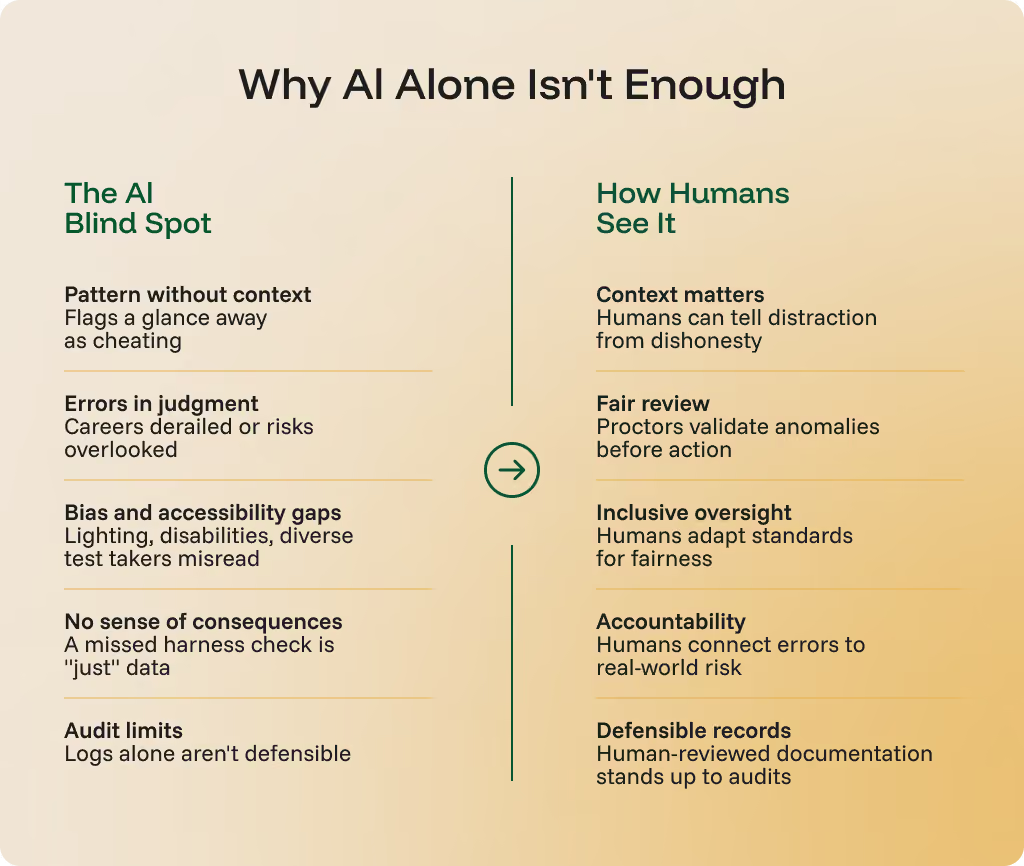
The answer is not to reject AI, but to integrate it thoughtfully. The most effective approach is AI plus human oversight, where technology enhances efficiency, but people ensure fairness, context, and compliance.
Scalable monitoring with human review
AI can monitor at scale, flagging potential anomalies. But those red flags should be reviewed by trained human proctors who can interpret context and make defensible decisions.
Audit trails and documentation
Human oversight is essential for building robust audit trails. When compliance checks or regulatory audits arise, organizations must show that their proctoring process was fair, valid, and defensible. Documentation reviewed and validated by people is far more credible than machine logs alone.
Automation accelerates, human judgment protects
AI has transformed training and monitoring with unprecedented speed and scale. Yet in safety-critical industries, automation is a tool, not a safeguard. True protection comes from human judgment, ethical oversight, and alignment with compliance standards.
With standards like ANSI/ASSP Z490.1-2024 raising the bar for defensibility, organizations must recognize that proctoring isn’t just a technical step, it’s a compliance-critical safeguard that protects lives, preserves trust, and ensures training fulfills its purpose.
Smart systems drive efficiency. Human oversight delivers safety. Together, they make compliance simple, scalable, and defensible.
Online proctoring software built for compliance and trust
When compliance is defensible, organizations, and the people they serve, are safer. That’s why proctoring must go beyond automation.
At Integrity Advocate, we combine AI efficiency with human oversight to ensure every training program is verifiable, fair, and aligned with the latest standards. That means:
- Confirmed identities
- Monitored participation
- Defended credentials
No guesswork. No blind spots. Just compliance you can stand behind.
Ready to safeguard your compliance? Let’s leverage the combined power of AI and human oversight, together.
{{post-cta}}

More Flags ≠ More Security: How Smarter Review Saves Admins Time and Stress
January 12, 2026
|
5 min read
Flag overload is one of the most common and least discussed problems in online proctoring. When AI-only systems flag everything from background noise to lighting changes, administrators are left sorting through queues of low-risk alerts to find the few that actually matter. This post explains why more flags do not equal more security, how human review filters out noise before it reaches the administrator queue, and what a smarter review model looks like in practice, including a side-by-side comparison of AI-only versus AI plus human review across flagging volume, admin workload, and decision quality.
If you are using an online proctoring tool, and your post-exam review process feels overwhelming, it’s usually not because too little is being flagged, it’s because too much is.
As online and remote assessments scale, many programs respond by tightening controls and increasing automation. On paper, it sounds like a strong security posture. In practice, it often creates a different problem entirely: flag overload.
And that overload lands squarely on administrators.
The Hidden Cost of “Too Many Flags”
When AI-only proctoring systems flag everything from background noise to lighting changes, administrators are left sorting through long queues of low-risk alerts to find the few that actually matter.
That leads to:
- Hours spent reviewing non-issues
- Increased stress during post-exam review cycles
- Slower score releases and decision-making
- Fatigue that makes true violations harder to spot
More data doesn’t automatically mean better security. In many cases, it creates more work — without improving outcomes.
A simple rule of thumb:
More flags ≠ more security.
Why Post-Exam Review Is Where Programs Feel the Pain
The post-exam phase is where integrity decisions become real. This is the moment where:
- Administrators must determine if a violation truly occurred
- Programs need defensible outcomes they can stand behind
- Appeals, audits, or compliance reviews may follow
When every flagged event is treated equally, administrators are forced into a reactive role, reviewing volume instead of focusing on risk.
That’s where smarter review models make the biggest difference.
How Human Review Changes the Equation
Integrity Advocate was designed to reduce noise, not increase it.
Instead of passing every automated flag directly to administrators, Integrity Advocate uses highly trained human reviewers to evaluate context before an incident ever reaches your queue.
Human reviewers can:
- Distinguish normal behavior from suspicious activity
- Understand environmental and accessibility factors
- Identify patterns that automation alone can’t
- Filter out false positives before they create work
The result? Administrators see fewer, higher-quality incidents, and only when action is truly needed.
AI vs. Human Review: A Practical Comparison
Here’s a simple way to think about the difference:
Automation is powerful, but without human judgment, it often creates more work than it removes.
What This Means for Administrators
When human review is built into the process:
- Post-exam review time drops significantly
- Admins spend time on real integrity issues, not noise
- Stress and cognitive load are reduced
- Decisions are easier to defend and explain
Security becomes proactive instead of reactive, and review workflows become sustainable, even at scale.
Smarter Security Is About Focus, Not Surveillance
Strong assessment security isn’t about watching everything. It’s about identifying what actually matters, and acting with confidence when it does.
By combining AI efficiency with human judgment, Integrity Advocate helps programs protect assessment integrity without overwhelming the people responsible for it.
Because the goal isn’t more flags. It’s better outcomes.
{{post-cta}}

Assessment Security Is Changing. Is Your Strategy Built for What Is Next?
February 17, 2026
|
5 min read
Assessment security has changed fundamentally. AI-assisted misconduct, global remote testing at scale, rising privacy expectations, and credentials tied to real professional consequence have all shifted the landscape at once. This post traces how assessment delivery has evolved from in-person exams to global remote testing, examines what each shift has required from integrity programs, and makes the case for why a modern assessment security strategy needs layered detection, human judgment, privacy-first design, and a partner built to adapt as the landscape continues to change.
Credentials that carry real professional consequence. The landscape has shifted and it is not slowing down.
In the video above, we trace how assessment delivery has evolved from in-person exams to global remote testing and why each shift has required a new approach to protecting integrity. Today’s environment requires a modern assessment security strategy designed for AI, scale, and trust.
The Landscape Has Shifted
Assessment did not begin online. It moved there. For decades, integrity relied on physical oversight in classrooms and testing centers. As programs expanded, online exams increased access and flexibility. Then the COVID surge accelerated remote assessment almost overnight. What began as an emergency solution became a long-term operating model for many institutions and credentialing bodies.
As delivery models evolved, security had to evolve as well. The challenge now is that change is happening faster and across more dimensions at once.
The AI Era Has Changed the Risk Equation
Generative AI has fundamentally altered how information is accessed, created, and submitted. Tools powered by artificial intelligence can draft essays, solve complex problems, generate code, and replicate writing styles within seconds.
Wiley’s large-scale academic integrity research found that a growing percentage of students acknowledge using AI tools in academic settings, and many instructors report increased concern about AI-assisted misconduct in online exams. The issue is not theoretical. It is active and expanding.
Traditional remote proctoring models were built to detect visible behaviors such as a second person in the room or suspicious movements. AI-assisted misconduct often leaves fewer visible signals. The risk is increasingly digital rather than physical.
Programs must now account for:
- AI-generated responses submitted during online exams
- Real-time AI assistance on secondary devices
- Screen-to-phone workflows that avoid camera detection
- Rapidly evolving generative AI tools
At the same time, institutions cannot simply increase surveillance. Wiley research also shows that student trust and perceptions of fairness directly influence engagement and compliance. Excessively invasive monitoring can undermine that trust.
Modern assessment security in the AI era requires a layered approach:
- Intelligent detection signals
- Contextual analysis
- Trained human review
- Clear, defensible documentation
AI can identify patterns at scale. Human expertise provides interpretation and fairness. The objective is not to monitor more. It is to respond intelligently to how misconduct has evolved.
Scale and Access Have Redefined Expectations
Programs now serve global audiences across time zones and devices. Certification pathways are expanding, workforce training is accelerating. According to recent industry market analysis, the global online proctoring market is projected to continue growing at a strong compound annual growth rate over the next several years, driven by remote testing demand and enterprise credentialing needs.
As access scales, candidates expect experiences that are simple, device-friendly, and reliable. Programs need solutions that integrate into their LMS platforms, require minimal setup, and support growth without creating operational strain.
Research from Wiley indicates that students are more likely to report positive testing experiences when the process is straightforward and transparent. Complexity and technical barriers reduce confidence in the assessment process.
Modern assessment protection must:
- Work across devices and real-world environments
- Minimize unnecessary technical hurdles
- Integrate directly with LMS systems
- Scale without increasing manual administrative work
Ease of use is no longer a convenience. It is directly tied to program adoption, student trust, and operational sustainability.
Security must scale as confidently as the programs it protects.
Privacy and Trust Are Non-Negotiable
As digital assessment expands, privacy expectations intensify.
Wiley research highlights that students care deeply about how their data is collected, stored, and used. Concerns around surveillance and data retention influence perceptions of fairness and institutional trust.
At the same time, regulatory frameworks around data protection continue to evolve globally. Institutions must balance integrity with compliance and reputational risk. Security that compromises privacy ultimately weakens credibility.
Programs increasingly seek approaches that:
- Minimize unnecessary data collection
- Avoid excessive long-term storage of exam data
- Provide contextual human review rather than automated punishment
- Deliver defensible and transparent outcomes
Trust is part of assessment integrity. A secure system must protect both the exam and the relationship between the organization and the candidate. Integrity and privacy must coexist.
Credentials Carry Long-Term Consequences
Assessments are no longer isolated academic exercises. They connect directly to employment decisions, professional licensure, workforce mobility, and digital credential verification. Industry market analysis shows that employers increasingly rely on verified credentials as part of hiring and advancement decisions.
When exam integrity is compromised, the value of the credential is compromised. When credentials lose credibility, the entire ecosystem is affected.
Programs are therefore focusing not only on detection but on defensibility:
- Clear audit trails
- Consistent enforcement standards
- Transparent review processes
- Long-term protection of credential credibility
Assessment security is about preserving trust in outcomes, not simply preventing violations during a single session.
Why a Tool Is No Longer Enough
In this environment, selecting a proctoring solution becomes a strategic decision. Organizations need more than software that flags behavior. They need a partner that:
- Understands AI-era risks
- Invests in research and thought leadership
- Balances intelligent detection with human judgment
- Supports scalable growth
- Adapts to evolving regulations and technology
Security is no longer a static feature. It is an evolving system. Standing still is the greatest risk.
Built for What Is Next
Integrity Advocate was designed for this reality. We combine AI-powered detection with trained human review to deliver assessment security that adapts to your program’s needs. We prioritize privacy, minimize unnecessary data storage, and support flexible proctoring options that work across devices and environments.
More importantly, we treat assessment integrity as an ongoing partnership. Three things are certain:
The landscape will continue to change.
Technology will continue to advance.
New risks will continue to emerge.
The organizations that succeed will be those who choose strategies and partners built to evolve alongside them. Is your strategy is built for what is next?
{{post-cta}}
Frequently asked questions
Find answers to the most commonly asked questions from our clients.
The three main proctoring models are AI-only, human-only, and hybrid. AI-only proctoring uses algorithms to automatically detect and flag suspicious behavior at scale. Human-only proctoring uses live or recorded video reviewed by human proctors who make contextual decisions. Hybrid proctoring combines both, with AI handling initial detection and trained human reviewers verifying every flagged event before any outcome is recorded.
AI-only proctoring generates high rates of false positives, flagging normal behaviors such as lighting variations, gaze patterns, and accessibility-related movements as suspicious. It lacks the human context needed to distinguish genuine misconduct from harmless behavior. It also raises data privacy and fairness concerns, particularly for test-takers with disabilities or those from diverse cultural backgrounds. In high-stakes certification or compliance environments, these limitations create significant liability.
AI-only proctoring is appropriate for large-scale, low-stakes testing where speed and automation are priorities and where a false flag has minimal consequence, such as practice exams or formative assessments. It is not appropriate for certification, licensure, or compliance exams where fairness, accessibility, and defensibility are required.
Human-only proctoring is labor-intensive and difficult to scale globally. It presents challenges for asynchronous or on-demand testing and tends to be more expensive due to staffing and scheduling requirements. Organizations running large-volume certification programs or testing across multiple time zones will find human-only models limiting in both cost and flexibility.
Hybrid proctoring combines the scalability and efficiency of AI with the fairness, context, and defensibility of human review. AI flags potential anomalies at scale, while trained human reviewers verify each flagged event before any report is finalized. This reduces false positives, produces auditable compliance documentation, supports asynchronous and BYOD testing, and delivers a smoother candidate experience than either model alone.
Integrity Advocate uses AI-driven detection to identify potential issues during sessions, then routes every flagged event to an expert human reviewer before any outcome is recorded. The platform requires no software installation, works on any device or browser, and produces transparent audit-ready reports that administrators can trust. This approach ensures fairness, compliance, and confidence without creating friction for test-takers.