July 25, 2024
|
5 min read
Online Alcohol Server Training and the Erosion of Trust
Alcohol server training has significant public health value, supported by research showing statistically significant reductions in alcohol-related traffic crashes following implementation of compulsory server training. But as training moved online, the ability to verify who completed it largely disappeared. This post examines what unverified online alcohol server training means for public health, dram shop liability, and due diligence, and makes the case for verified training as the only standard that preserves the legal and public health value of the certification.


The dangers of alcohol abuse and overconsumption are well known. But given the severity of those risks, and the prevalence of alcohol in our lives, it’s worth thinking about the systems that are in place to prevent one person’s wild night from having a tragic consequence.
How bartenders, servers and business owners are trained has significant public health implications. A research paper by the California Department of Alcoholic Beverage Control found “statistically significant reductions in single-vehicle nighttime traffic crashes (those with high percentage of alcohol involvement) by the end of 1989, following the implementation of compulsory server training” in Oregon.
The California study was released in 1992. Unfortunately, in the decades since, the integrity of instructor-led alcohol server certification has been completely lost as this training has largely moved online. Now, the participation of ‘certified’ servers in actual training is completely unknown and unprovable.
This isn’t to say that online training is bad — there are significant benefits in terms of accessibility and cost savings for participants. But failing to adapt the way we train alcohol servers to this new reality has significantly compromised training outcomes — and put those important public health benefits in jeopardy.
Online vs. In-Person Training
Pre-internet and, more critically, pre-Covid, most alcohol server training was done in-person, and testing was closely monitored. Successful participants were then issued a certificate that verified they had received the necessary training, and satisfied the required outcomes.
That proof of training could be used as a legal defense for a business, their insurance company, or their legal counsel, if they were sued under dram shop laws. (Dram shop laws are legislation designed to protect DUI victims seeking compensation after sustaining long-term injury and disability.)
However, as alcohol server training moved online, businesses lost the ability to demonstrate proof of training to the necessary standards. Even verifying the identity of the participant is difficult — let alone whether or not they took the training or the exam under the prescribed conditions.
In many cases, now, alcohol server certification can be obtained simply by paying for the certificate — there is little oversight, and no process for independently confirming that training was completed.
All of this begs the question — what value is training if it can’t be confirmed? How can businesses mitigate risk, perform due diligence, and avoid liability, while still benefiting from the convenience and cost-savings of online alcohol server training?
The Current Situation
Today, the choice is not between in-person and online training, but between verified and unverified training. Verified training involves additional checks — remote proctoring and ID verification — to hold online training to the same standards as in-person.
Unverified training, on the other hand, involves no additional checks. Individuals, or others on their behalf, can simply create an account, pay for the course and obtain a proof of training card. There is nothing in place to confirm that the course was taken, or that there was any validation of knowledge transfer (ie, an exam.)
We recently tested numerous online responsible alcohol service training providers with a simple criteria: could a dog complete this training? In many cases, yes. A pug has successfully completed online alcohol server training, among dozens of other certifications. If a dog can get certified, what value does this training have to prevent fatalities. or as proof of due diligence in the defense of a lawsuit?
The good news is that some regulators insist on verified training processes. Some businesses, whether they are required to or not, only use online training providers that issue verified training. And some insurance companies are proactively looking at training standards/processes in determining rates.
The world is changing rapidly, and as we rush to adopt new technologies and new ways of doing things, we can’t forget the reason for doing things in the first place. Alcohol server training isn’t a box you check or a form you fill out — it’s a vital defense against serious injury caused by impaired driving. We believe it can be delivered online without losing its legal or public health value. But organizations need to hold it to a higher standard, and demand and invest in verified training. Regulators must adopt consistent, forward-thinking regulatory standards across the board. Only then can we move forward with confidence, knowing that online alcohol server training is as effective as in-person.
We strongly believe that the adoption of verified training standards can save lives while also demonstrating the due diligence of businesses involved in the service of alcohol. Integrity Advocate is very proud that we can be a part of this effort.
{{post-cta}}
Keep reading
What Defensible Assessment Looks Like in 2026
April 7, 2026
|
5 min read
AI tools have changed what cheating looks like, and most proctoring systems were built for a different problem. This post covers why an automated flag alone can't defend an outcome, and what a defensible assessment record requires in 2026.
We talk to a lot of programs right now that are dealing with the same thing. AI tools have changed what cheating looks like, and most proctoring systems were built for a problem that’s no longer the only one on the table. The gap is showing up in appeals, in complaints, and in outcomes that are getting harder and harder to defend.
What’s actually happening out there
The classic image of cheating a second phone, a friend on the other side of the room, notes taped to a monitor is still real. But it’s not the conversation we’re having with most programs anymore. The harder stuff is subtler.
AI writing tools can produce a natural, well-reasoned answer in seconds. Paraphrasing tools can disguise lifted content well enough to pass similarity checks. And the behavioral signals that used to flag something suspicious eye movements, typing pace, browser switching don’t tell you much when the assistance is happening invisibly, in another tab or on another device entirely.
The problem isn’t that AI cheating is impossible to catch. It’s that catching it requires a level of context and judgment that an algorithm alone doesn’t have.
An algorithm can tell you something looked unusual. It can’t tell you what actually happened or whether it matters. That part still requires a person.
Why a flag without a human isn't enough anymore
Automated proctoring was designed to catch visible, definable behaviors tab switching, phone use, an unauthorized person on screen. For those cases, it works. But AI-assisted cheating often leaves no visible trace at all.
So when an automated system flags something in this environment, what it's actually telling you is: something here didn't fit the expected pattern. That's a starting point, not a conclusion. The problem is when programs treat it like one.
A wrongful finding based on an automated flag isn't just uncomfortable it can seriously damage a student's record or a professional's career. And when that decision gets challenged, "the system flagged it" isn't a defensible answer. You need a record of what actually happened and a human judgment behind the decision.
{{post-stat-highlight}}
What it actually takes to be defensible
Defensibility isn't really about technology. It's about being able to look anyone in the eye a student, a candidate, a regulator, a board member and explain clearly why a decision was made and what it was based on.
In this environment, that takes three things:
- Human review on every flag, before any decision goes out. Not as an appeal process. Before the outcome is issued.
- Reviewers who are looking at AI-use patterns specifically, not just traditional integrity signals, and who understand the difference between something suspicious and something definitively wrong.
- A complete session record identity verification, monitoring log, what was flagged, what the reviewer saw, what was decided ready to export the moment someone asks.
What actually changes with human review
One question to sit with
If an outcome from one of your proctored exams was challenged today by a student, a candidate, an employer, an accreditor what could you actually put in front of them? An automated flag, or a complete human-reviewed record of what happened and why?
For programs where the result genuinely matters, that's not a rhetorical question. It's the one worth answering before you need to.
We built Integrity Advocate around exactly this human review on every flagged session, a complete audit trail for every outcome, and the kind of defensibility that holds up when someone actually pushes back.
{{post-cta}}
Why Automated Identity Verification Isn’t Enough for High-Stakes Exams
May 18, 2026
|
5 min read
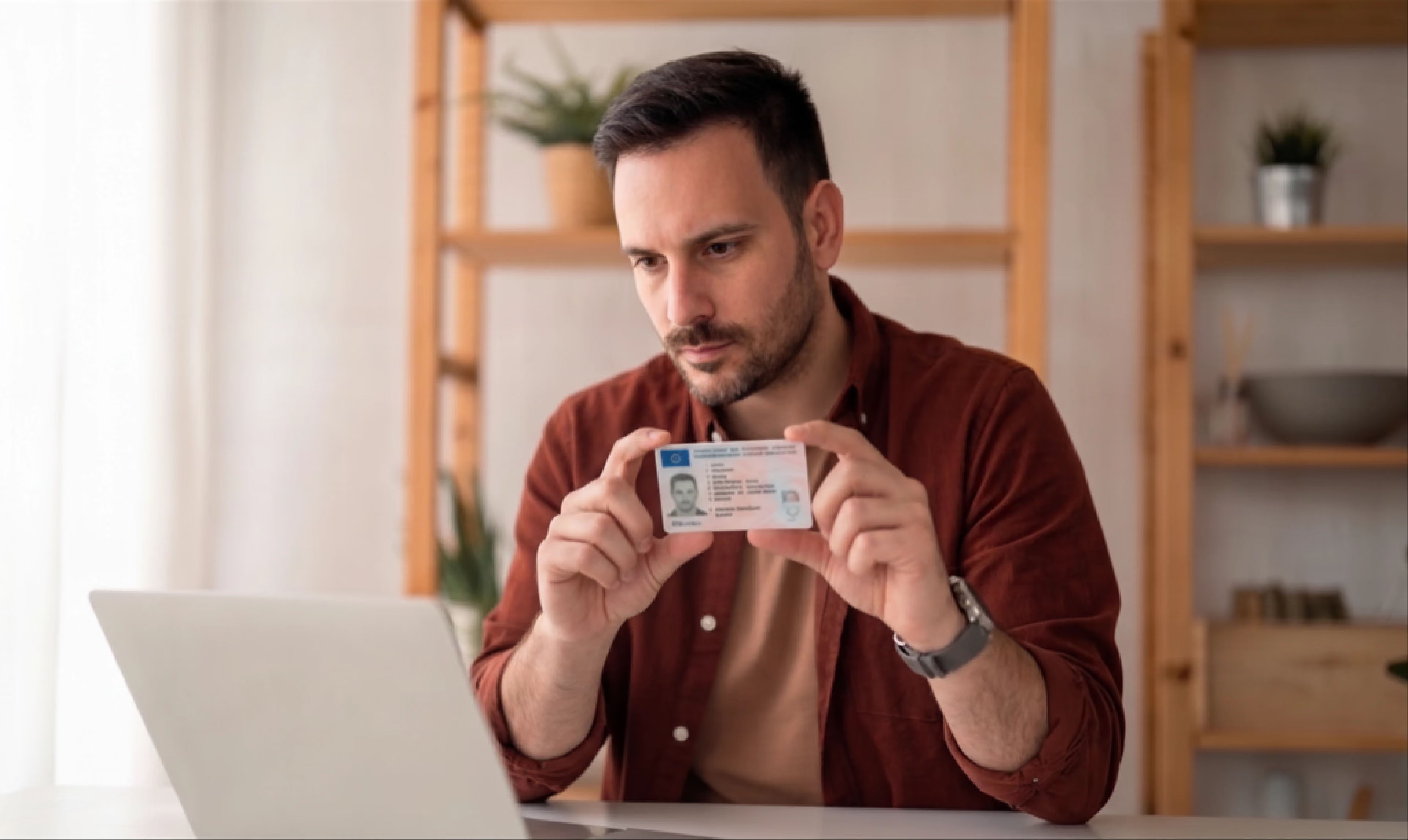
All proctoring vendors say they verify identity, but they don't all mean the same thing. Explore where automated-only ID checks fall short and what to ask when evaluating a platform.
There’s a difference between an algorithm saying “these two images match” and a trained person saying “I reviewed this ID and confirmed it.” One is a data point. The other is evidence. When a result gets challenged, you need evidence. Here’s something worth knowing about online proctoring vendors: they all say they verify identity. What they don’t all mean is the same thing. And that gap, between capturing an image and actually confirming who someone is, is where a lot of programs are quietly sitting on risk they haven’t fully thought through. If you’re currently evaluating proctoring platforms, or you’re starting to wonder what your current vendor actually does when a test taker shows up to an exam, this is for you. We’re going to cover what identity verification in online assessment actually looks like, where automated-only systems run into trouble, and what it takes to produce a result that holds up when it counts. What identity verification actually means in an online exam context
The basics are simple. Identity verification confirms that the person taking your assessment is the person who enrolled for it. Most platforms handle this by asking test takers to hold a government-issued ID up to their camera, capturing a live photo, and comparing the two. What varies, a lot, is what happens after those images are captured. In a fully automated system, an algorithm makes the comparison and moves on. In Integrity Advocate’s human-reviewed system, a trained reviewer examines the ID and live photo after the session is completed, verifying both that the ID is a genuine match and that the same person was there for the entire assessment. That’s a meaningfully different thing.
That might sound like a subtle difference right now. It won’t feel subtle when you’re sitting across from an accreditor, or responding to a candidate appeal, or explaining your identity controls to a regulatory body. “Our algorithm flagged it” and “a trained reviewer verified the ID match and confirmed the same person was present for the entire session” don’t carry the same weight in that room.
The actual threats identity verification is meant to stop
Before you evaluate any solution, it’s worth being clear about what you’re actually protecting against. Identity verification in online assessment is mainly a defence against three things.
Candidate impersonation
Someone other than the enrolled candidate sits the exam. Could be a friend, a sibling, or a professional impersonator hired through a contract cheating service. In high-stakes contexts, professional certification, regulatory licensing, safety-critical credentials, the consequences go well beyond academic dishonesty. They touch public trust in the credential itself. That’s a different kind of problem.
Proxy testing and contract cheating services
Proxy testing is impersonation at scale, and it’s growing. The same infrastructure that made remote work possible made organized contract cheating more accessible too. Professional exam-sitters exist. They’ve been around for years and they’ve gotten more sophisticated as online testing has expanded.
What makes proxy testing particularly hard to catch with automation is that the person attempting the ID check is often well-prepared. They may have a convincing fake or borrowed ID. They may have done this before, for other clients, on other platforms. An algorithm looking for obvious facial mismatches isn’t going to catch someone who’s specifically prepared to pass that check.
{{post-stat-highlight}}
Manipulated or non-standard identity documents
Automated systems compare images. They measure how closely two images match. They’re not built to assess whether a document looks legitimate, whether something about it seems off, or whether the context around the ID presentation is consistent with someone who is genuinely who they say they are.
If you need a recent illustration of just how thin that defense is: a UK nonprofit surveyed around 1,300 children aged 9 to 16 and found that about half believe online age verification checks are easy to bypass. One documented method was drawing a fake mustache on their face with a makeup pencil. A 12-year-old was verified as 15. It worked. Other workarounds included pointing webcams at video game characters and making unusual facial expressions until the software stopped trying. TechCrunch covered it in May 2026.
These are AI systems built specifically for facial verification. A makeup pencil broke them. In an exam context, where a candidate may have a professional credential, a licence, or a career on the line, the motivation to try something is considerably higher; and the workarounds available are more sophisticated than drawn-on facial hair. Automated ID checks in high-stakes assessments face the same fundamental vulnerability, with significantly higher consequences when something slips through.
Beyond outright manipulation, non-standard ID documents from other countries are a real operational headache for automated systems. A document that an algorithm can’t parse correctly – because it looks different from its training data, often gets flagged for the wrong reasons. Not because anything is wrong. Just because it looks unfamiliar. That’s a fairness problem as much as it is a fraud one.
Where automated identity verification falls short
Speed and scale, those are the real advantages of fully automated ID verification. They’re genuine. The problem is that optimising for speed and scale means accepting trade-offs that start to matter the moment your results have any real consequence attached to them.
It produces a log, not a defensible record
When a fully automated system approves an identity check, what it creates is a timestamp and a confidence score. That score tells you how closely two images matched according to the model. It doesn’t tell you that a human looked at the documents and made a judgment call.
The moment an outcome is challenged, that distinction is everything. There’s a big difference between “our algorithm scored the match at 94.3%” and “a trained reviewer examined the ID and the live photo and confirmed the identity match.” One is data. The other is documentation. If you’ve ever had to respond to an accreditor asking about your identity controls, you know which one you want to be holding.
Edge cases aren’t actually that rare
Facial recognition systems are trained on datasets. Those datasets have gaps, and those gaps don’t affect all test takers equally. People with darker skin tones, older candidates, people with facial differences or disabilities, and test takers presenting documents from underrepresented countries, these populations consistently get worse outcomes from automated systems.
In a program serving thousands of test takers across many countries, these aren’t rare edge cases. They’re a predictable share of your assessment cycle. A system that handles them badly is a system that consistently disadvantages specific groups of people. That’s both a fairness problem and a real compliance exposure under frameworks like WCAG and AODA.
Accommodations are invisible to algorithms
A lot of programs serve test takers with documented accommodations. Some of those accommodations affect how a test taker looks at the identity check stage. A test taker with a visual impairment may present their ID differently. Someone with a facial difference may not match their ID photo the way an algorithm expects.
An automated system has no way to know an accommodation exists. A human reviewer can, because that information can be passed to them before the check happens. They apply the context, the check goes smoothly, and the test taker isn’t penalized for something their program already knew about and approved.
What human-reviewed identity verification actually adds
Human review at Integrity Advocate isn’t a fallback for when automation fails. It’s the standard for every single check. That changes what the whole process produces, and what you can do with the results.
Judgment, not just pattern matching
A trained reviewer looking at an ID document and a live photo is doing something different from what a facial recognition model does. They’re not just asking “do these two images match?” They’re assessing whether the identity claim is plausible, taking in the quality of the document, the context of the photo, whether something feels off. That’s judgment. It’s not something you can fully replicate with a model.
It also means programs can explain what happened. Not just cite a score. “A trained reviewer examined the ID and the live photo and confirmed the match” is a sentence a human can understand, investigate, and stand behind.
A record that travels with the session
At Integrity Advocate, every identity check creates a time-stamped record permanently attached to the session. What was verified, when, and by whom. If an outcome from that session ever gets challenged, the identity verification record is already part of the documentation, not sitting in a separate system you have to dig through.
Appeals rarely come with advance warning. Programs that have a complete, human-confirmed record don’t have to reconstruct anything after the fact. The evidence was created at the moment of verification. It hasn’t changed.
Deterrence, not just detection
Here’s something that doesn’t get talked about enough: people behave differently when they know a human is watching. A test taker who knows their government-issued ID will be examined by a trained reviewer before the exam starts isn’t approaching that check the same way as someone who knows it’s algorithmic.
Programs that shift from automated-only to human-reviewed verification consistently see a change in the behaviour of the small slice of candidates who were willing to try something. The check itself becomes a deterrent. You catch less because less gets attempted.
What to look for when you’re evaluating
If you’re shopping around, or starting to question what your current vendor actually does, here are the questions that cut through the noise.
Is a human involved in every check, or just the flagged ones?
A lot of platforms say “human review.” What they mean is that a human reviews AI-flagged sessions only, and only when the algorithm decides something is worth escalating. At Integrity Advocate, a trained reviewer looks at every session after it’s completed, verifying the ID match and confirming the same person was present throughout. That’s the question to ask: is every session reviewed, or only the ones the algorithm flags?
What does the record actually contain?
Ask to see a sample identity verification record. If the answer is a confidence score and a timestamp, that’s an automated log. A defensible record includes the ID image, the live photo, the match determination, who made it, and when. If you can’t show an accreditor a complete documentation trail, the check isn’t giving you what you actually need.
How does it handle non-standard IDs and accommodations?
Ask specifically what happens when a test taker shows up with an ID from a country with an unfamiliar format, or when an accommodation affects how they look at the check stage. If the answer is vague or relies heavily on “the algorithm handles it,” that tells you something important about how these scenarios were thought about when the product was designed.
Where does the privacy risk sit?
Identity verification collects sensitive data. Ask specifically what’s collected, how long it’s retained, and whether it’s used for anything beyond the identity check. If you have GDPR, FERPA, or PIPEDA obligations, and most programs doing anything at scale do, you need clear answers here before you commit.
The bottom line
Automated identity verification is better than nothing. That’s true. But if your program issues results that actually mean something, credentials that affect career progression, licences that protect public safety, certifications that carry professional weight, “better than nothing” isn’t where you want to land.
What you need is a check that creates a record you can stand behind. Something that answers not just “did the algorithm approve this?” but “can we show that a qualified person verified this person’s identity before the exam began?” Those are different questions, and they get different responses from the people who ask them.
The cost of getting identity verification wrong doesn’t show up at the time of the exam. It shows up later, when results are challenged, when accreditors start asking questions, when credential fraud surfaces somewhere down the line. By then, piecing together what happened is hard. Having a complete record from the moment of verification isn’t.
{{post-cta}}

The Hidden Cost of Remote Proctoring
May 8, 2024
|
5 min read
The listed price of an online proctoring tool is rarely the full cost. This post breaks down four hidden expenses that organizations often overlook: the support burden created by installation-based tools, the admin time required to investigate false positive flags from AI-only systems, the customization cost of adapting higher-ed-built tools for non-academic audiences, and the potential legal and regulatory liability when a proctoring system cannot produce defensible records.
Previously on the blog, we’ve made the case for treating online proctoring as an investment — in the safety of your learners, and the integrity of your testing. We’ve detailed some of the emerging threats against fair, secure online assessments, and we’ve shown what can happen when these threats aren’t taken seriously.
But we haven’t done a deep dive into the actual cost of online proctoring. Different providers have different billing models; the specific features you need — ID verification, participation monitoring, recorded vs. live proctoring, etc. — as well as the anticipated volume of exams, will all determine your top-line numbers. And while those numbers are important, they don’t tell the whole story. To really understand the potential cost of remote proctoring, you need to understand the ‘shadow costs’ — hidden expenses that can crop up if you focus exclusively on pricing when making your decision.
(ps. If you're looking for Integrity Advocate's pricing, we recommend contacting our sales team, as our services are generally customizable based on your needs.)
Hidden Cost #1: Support
The number one complaint we hear from prospective customers coming to Integrity Advocate from a competitor is the high cost of support required to get learners set up and running with other solutions. When an online proctoring tool requires learners to install an application or browser plug-in, or make changes to system settings, support rates may be between 30-40%.
Let’s break that down and look at the numbers. If you run 1000 proctored exams a session, and approximately 30% of those require a support call, that’s 300 support calls/session. If each support call takes 10 minutes to resolve, that’s 3000 minutes, or 50 hours, of tech support required on top of the cost of your proctoring service.
Hidden Cost #2: Reviewing (and Re-reviewing)
Another hidden cost of online proctoring involves resolving disputes and correcting ‘false positive’ violation flags. Many of the cheapest online proctoring tools rely heavily on AI to identify rules violations. If these aren’t followed up with a human review, innocent test-takers can easily be penalized. Even putting aside the more insidious biases of AI facial recognition, the technology is still too unreliable to be the final arbiter of ethical behavior in an online exam. AI proctoring systems can — and have — mistakenly identified facial patterns in things like wallpaper and houseplants, leading to false positive rules violations.
And what’s the cost of this? Some proctoring services charge for exam retakes, others don’t. Even if there is no additional fee involved, consider the admin time required to investigate learner complaints and clear violations that have been falsely flagged by low-cost, automated online proctoring tools.
Hidden Cost #3: Accessibility
One underrated question worth asking when considering an online proctoring system is: ‘how easy is it to accommodate my learners’? Especially when running online testing, accommodation is about more than extra time or support: it’s about adapting a system — generally one built with one very specific user/use case in mind — to meet the unique needs of your program.
Most online proctoring tools are built for a higher ed audience. But we’re seeing more and more clients come from food and alcohol server certification, skills trades/health and safety training, and professional certification. On everything from LMS integration, to rule sets, to participation monitoring, these systems may require extensive customization — and additional time and money — to accommodate the unique user base, environmental and technical requirements of a non-higher ed audience.
Hidden Cost #4: Liability
All of the hidden costs we’ve spotlighted before involve, in one way or another, the effort required to get a remote proctoring system working perfectly. But what about when things go wrong? Ultimately, the design and implementation of a proctoring system must take into consideration the worst case scenario.
By this we mean, consider the potential cost of a nightmare scenario — say, for example, an employee on a construction site, who has received health and safety certification from your organization, causes an accident on the job. What are the legal, regulatory or reputation implications if you are unable to prove they participated in the training and completed the requirements fully?
The bottom line is that, ultimately, online proctoring systems aren’t something to cheap out on. This doesn’t mean buying the most expensive option on the market, of course — it means doing your research, and considering the full costs and potential implications of your choice.
{{post-cta}}
Frequently asked questions
Find answers to the most commonly asked questions from our clients.
Dram shop laws are legislation designed to protect victims of alcohol-related incidents, such as DUI crashes, who seek compensation from the businesses that served the impaired individual. Verified alcohol server training can serve as a legal defense for a business, their insurer, or legal counsel in a dram shop lawsuit, demonstrating that staff were properly trained in responsible alcohol service. Unverified training, where participation cannot be confirmed, provides no meaningful defense.
When alcohol server training moved online without verification controls, the ability to confirm who completed the training and whether they engaged with the content disappeared. In many cases, online alcohol server certification can be obtained simply by paying for the course, with no identity check and no exam oversight. A certification issued without confirmed participation cannot serve as proof of training in a legal proceeding or regulatory audit.
Verified online alcohol server training includes identity verification to confirm the participant is who they claim to be, and participation monitoring to confirm they engaged with the content and completed any required assessment under the prescribed conditions. Unverified training has no such controls. Anyone, including people completing the course on behalf of someone else, can create an account, pay the fee, and obtain a certificate.
Unverified training records are difficult to defend in a dram shop lawsuit or regulatory investigation because they cannot confirm who completed the training or whether the required conditions were met. Businesses that rely on unverified training are accepting that their certification records may not hold up when challenged. Verified training produces a documented record that demonstrates genuine participation and is far more defensible.
Integrity Advocate verifies the identity of every participant before the session begins and monitors participation throughout, producing a documented record that confirms the right person completed the training under the required conditions. This record holds up to scrutiny from regulators, insurers, and courts in a way that a standard completion record from an unverified training platform cannot.