October 17, 2025
|
5 min de lecture
How Integrity Advocate Prevents Cheating in Online Exams
Online assessments should be fair, secure, and accessible. As exam tools evolve, so do attempts to game them. This post explains how Integrity Advocate prevents the most common forms of online cheating, including hidden plugins, impersonation, unauthorized devices, and off-camera assistance, through a privacy-first combination of identity verification, AI-assisted monitoring, and human review that keeps evidence audit-ready and the learner experience low-friction.


Online assessments should be fair, secure, and accessible. As online exam tools evolve, so do attempts to game the system, making online cheating prevention a crucial focus. Integrity Advocate helps you prevent cheating without adding complexity, combining identity verification, environment checks, AI-assisted monitoring, and human review to protect integrity while respecting learner privacy.
What privacy-first prevention means, and why we believe in it
Privacy-first prevention protects integrity without collecting more data than necessary or taking intrusive control of a learner’s device. It runs inside your LMS, uses targeted signals rather than full device access, and keeps data retention limited and transparent, which is vital for effective online cheating prevention.
Why we believe in it
Security should earn trust. When learners understand what is collected and why, and when the experience stays accessible and low-burden, participation improves, compliance is easier to maintain, and your outcomes are more defensible.
How it prevents cheating for online exams
- Identity Verification: Verify the right person is taking the online exam or assessment at launch and throughout the session, which reduces impersonation and proxy testing, essential components of online cheating prevention.
- Environment and behavior signals: Detect patterns tied to hidden plugins, unauthorized resources, off-camera help, and device hand-offs while minimizing false positives.
- Hybrid Proctoring: Automation surfaces risk signals at scale, trained human reviewers add context and empathy, and final decisions stay fair and defensible.
- Audit-ready evidence: Time-stamped artifacts and clear notes support quick investigations and policy enforcement.
What we prevent and how
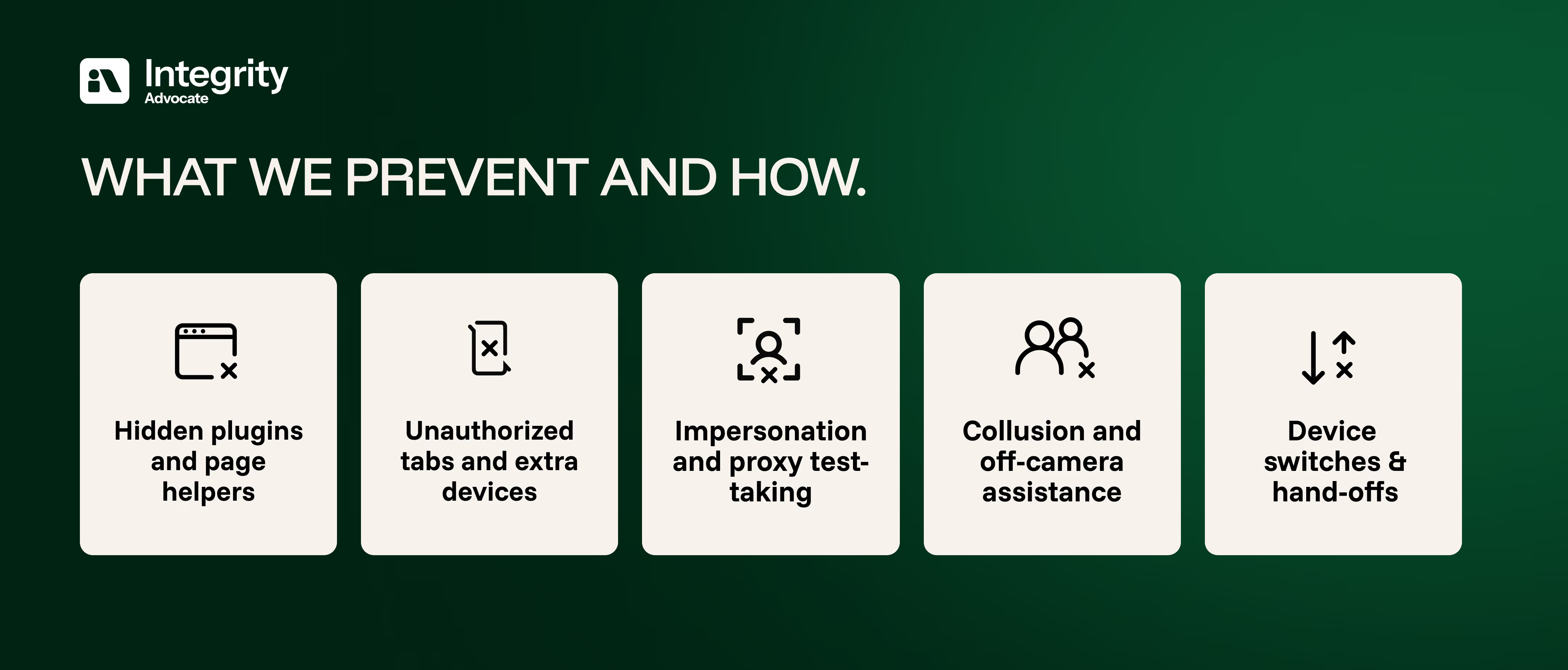
- Hidden plugins and page helpers
We surface indicators of undisclosed browser extensions and on-page answer helpers. Signals and reviewer checks identify prohibited tools, then produce clear, time-stamped evidence for online cheating prevention. - Unauthorized tabs and extra devices
Session behavior and view analysis help flag the use of outside content, second screens, and unapproved devices, aligned to your exam rules. - Impersonation and proxy test-taking
Identity checks check the exam taker to their identification and to their name in the LMS. We confirm the right person at launch and throughout the session. - Collusion and off-camera assistance
We look for signs of remote helpers, verbal cues, and presence of others. - Device switching and session hand-offs
Continuity monitoring and event patterns make mid-exam swaps visible. When something looks off, reviewers step in and your team receives defensible evidence.
Preventing these risks reliably requires the right balance of automation and human judgment to optimize online cheating prevention.
Why hybrid proctoring works
Automation finds patterns at scale and humans add context, fairness, and final judgment. Integrity Advocate blends both to reduce false positives and deliver decisions you can defend to regulators, customers, and accreditors, while keeping the experience seamless for learners with a focus on online cheating prevention.
Designed to fit your LMS and your policies
- No-install launch: Runs where your learners already are.
- Configurable rules: Align settings with your policies and industry needs.
- Accessible and global: Works across devices, bandwidth, and accommodations.
- Audit-ready reporting: Time-stamped evidence and reviewer notes streamline investigations.
What your team gains
- Clear signal, less noise: AI surfaces the right moments, reviewers handle edge cases.
- Privacy by design: Minimal collection and retention aligned to your requirements.
- Scale with confidence: From certification and licensure to workforce training and education.
- Measurable integrity: Trends and outcomes help you refine policies over time.
See it in action
Want to watch how we detect hidden plugins, prevent impersonation, and keep sessions fair without extra burden on learners? Request a demo
{{post-cta}}
Continuer la lecture

AI vs. Human vs. Hybrid Proctoring: Which Model Best Protects Exam Integrity?
October 9, 2025
|
5 min de lecture
As online testing expands across education, certification, and compliance training, the choice between AI-only, human-only, and hybrid proctoring has real consequences for exam integrity, fairness, and organizational risk. This post breaks down all three models, their pros and cons, and when each is the right fit, concluding that hybrid proctoring delivers the best combination of efficiency, accuracy, and fairness for most modern assessment environments.
The Evolving Landscape of Online Exam Security
As online testing continues to expand across education, certification, and compliance training, choosing the right proctoring model has never been more important.
AI-only tools promise automation and scalability. Human-only options offer fairness and empathy. Hybrid models combine the best of both, but which one truly protects exam integrity?
This article breaks down the three dominant proctoring approaches, their pros and cons, and what to consider when choosing the right fit for your organization.
1. AI-Only Proctoring: Fast, Scalable, and Automated, but Imperfect
AI proctoring tools use algorithms to detect suspicious behavior automatically, from unusual head movements to multiple voices or unauthorized devices.
While these systems offer speed and scalability, they also raise concerns about accuracy and bias.
Pros:
- Monitors large numbers of exams simultaneously
- Automates flagging and reporting
- Reduces administrative workload
Cons:
- High false positive rates (lighting, gaze, or accessibility issues)
- Lacks human context and judgment
- Raises data privacy and fairness concerns
AI-only systems can be efficient but risk misinterpretation, which can reduced trust among test takers.
2. Human-Only Proctoring: Fair and Contextual, but Limited in Scale
Human proctors oversee exams via live or recorded video, making real-time decisions based on context and behavior.
This model prioritizes fairness, empathy, and human oversight, but introduces scalability and scheduling challenges.
Pros:
- Accurate, contextual decision-making
- Builds trust with test takers
- Reduces false flags and misunderstandings
Cons:
- Labor-intensive and difficult to scale globally
- Higher cost per exam
- Limited flexibility for asynchronous or on-demand testing
Human-only proctoring ensures fairness but struggles to keep pace with modern testing needs.
3. Hybrid (AI + Human) Proctoring: The Best of Both Worlds
Hybrid proctoring blends automation and human oversight to deliver accuracy, fairness, and scalability.
AI handles initial detection, while human reviewers verify each flagged event before reports are finalized. This ensures efficiency without sacrificing integrity.
Pros:
- Reduces false positives with human verification
- Scales efficiently across time zones
- Protects privacy and fairness
- Provides auditable, compliant reporting
Cons:
- Requires platform integration
- May introduce slight delays in review turnaround
Hybrid proctoring creates the balance today’s organizations need, efficient technology guided by human discretion.
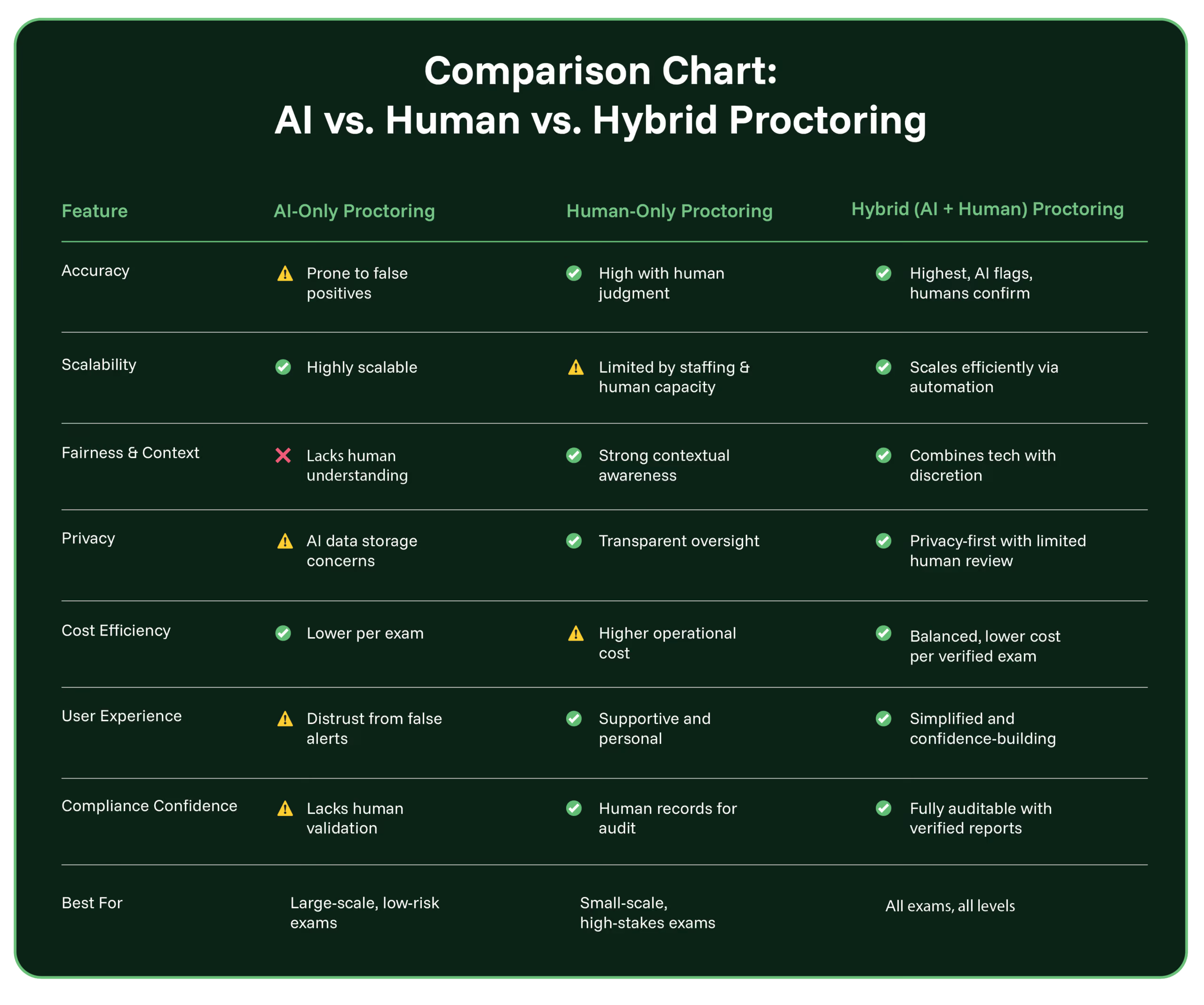
Verdict: Hybrid proctoring delivers the best combination of efficiency, accuracy, and fairness, meeting the evolving needs of modern learning and compliance environments.
When to Use Each Type of Proctoring (and When to Avoid It)
Choosing the right proctoring model isn’t just about features, it’s about fit. Here's when each approach works best, and when it might fall short.
AI-Only Proctoring
AI-only proctoring is a good fit for large-scale, low-stakes testing environments where speed and automation are priorities. It’s ideal for institutions delivering practice exams or formative assessments with minimal impact on final outcomes. If your team is constrained by staffing or budget, and real-time oversight isn’t required, AI-only can offer a fast, lightweight solution.
However, AI-only solutions are risky in high-stakes scenarios like certification, compliance, or licensure exams, especially where fairness, accessibility, and privacy are key concerns. These systems can generate false flags and lack the human context needed to distinguish genuine misconduct from harmless behavior.
Human-Only Proctoring
Human-only proctoring excels in small-group, high-stakes testing scenarios where personal interaction, empathy, and real-time judgment matter most. It's particularly useful for live, synchronous exams or specialized formats like oral exams, interviews, or hands-on assessments. If trust, fairness, and human connection are top priorities, a fully human approach ensures every test-taker is treated with context and care.
That said, this model becomes difficult to scale across large populations or global programs. It also presents challenges for asynchronous testing and tends to be more expensive due to staffing and scheduling demands. Organizations needing rapid turnaround or flexible exam windows may find this model limiting.
Hybrid Proctoring (AI + Human Review)
Hybrid proctoring combines the speed and scalability of AI with the fairness and context of human review, making it ideal for most modern assessment environments. It works especially well for mid- to high-stakes exams delivered at scale, such as workforce certification, compliance training, or higher education finals. Hybrid models support asynchronous access and bring-your-own-device testing, while still delivering human-verified, audit-ready results.
The main limitation is that some hybrid models may involve slight delays between the test and final reporting, depending on review turnaround time.
Why Hybrid Models Are the Future
Organizations are no longer choosing between technology and trust — they’re demanding both. Hybrid proctoring empowers institutions to deliver secure, privacy-compliant, and credible assessments without friction for test takers.
By combining automation and human verification, administrators get:
- Fewer false flags and student disputes
- Stronger audit trails and compliance documentation
- A smoother, more confident test-taking experience
How Integrity Advocate Sets the Standard
Integrity Advocate’s hybrid approach is designed around human-first, privacy-protected verification.
- No software installs required
- Works on any device or browser
- AI-driven detection verified by expert human reviewers
- Transparent, auditable reports administrators can trust
Integrity Advocate’s hybrid proctoring ensures fairness, compliance, and confidence in every assessment.
“Integrity Advocate integrates easily with our current system. It runs smoothly and is aesthetically pleasing; it meets the high standard we have for all our systems. It is also very effective at proctoring while not being too invasive; our users feel comfortable using it. Integrity Advocate strikes the right balance of integrity and privacy, which is hard to find!”
Ready to find the balance between automation and integrity?
Request a Demo to see how Integrity Advocate’s hybrid model redefines online exam security.
{{post-cta}}

Integrity vs. Surveillance: Is Your Proctoring Tool Monitoring Learners or Surveilling Them?
July 2, 2024
|
5 min de lecture
There is a meaningful difference between monitoring and surveillance in online proctoring, and most programs have not thought carefully about which one they are actually doing. Monitoring confirms identity, verifies participation, and produces a defensible result. Surveillance collects everything it can, flags anything it does not recognize, and leaves programs to sort out the noise. This post draws that distinction clearly, explains what privacy-first proctoring actually looks like in practice, and makes the case for why human review is the only thing that makes an assessment result genuinely defensible when it is challenged.
There is a difference between monitoring and surveillance. Most programs running online assessments haven’t thought carefully about which one they’re actually doing, and that gap is where trust starts to erode.
Monitoring confirms that the right person completed the assessment, stayed engaged, and followed the rules. Surveillance collects everything it can, flags anything it doesn’t recognize, and leaves the program to sort out what any of it means.
One produces a defensible result. The other produces liability.
If your proctoring tool accesses the file system of a personal device, stores recordings your team will never review, or generates hundreds of automated flags with no human judgment behind them, it’s not monitoring. It’s surveillance. And your learners know the difference.
What monitoring is actually supposed to do
Every program administering online assessments has the same core need: confirm identity, verify participation, and produce a result that holds up to scrutiny.
That’s it.
You’re not trying to catalog everything that happens in a candidate’s home. You’re not trying to build a behavioral profile. You’re trying to answer three questions:
- Was this the right person?
- Did they complete the assessment under appropriate conditions?
- Can you stand behind the result if it’s challenged?
A well-designed proctoring approach answers all three. An over-engineered one tries to answer questions nobody asked, and in doing so, creates new problems. More data. More noise. More privacy exposure. And a test-taking experience that generates complaints before a single result is issued
Where surveillance starts
Privacy-first proctoring is not a softer version of security. It’s a more precise one.
It starts with a design principle: collect only what is necessary to confirm identity and verify engagement. Nothing beyond that scope. No recordings stored by default. No system-level device access. No behavioral data used outside the bounds of the specific assessment.
In practice, that looks like this:
No downloads or extensions. The assessment runs in a browser. No software installs, no hidden permissions, no access to personal files or background applications. A test taker can sit the exam on any device without IT involvement or configuration.
Proportionate data collection. Every feature and every data point collected should have a clear answer to the question: why does this make the result more defensible? If the answer is “it doesn’t,” it shouldn’t be collected. Surveillance produces volume. Monitoring produces clarity.
Data minimization by design. The only data collected is what’s needed to produce a defensible result: identity verification, participation confirmation, and a reviewable record of any flagged behavior. Sensitive data, including ID images, is deleted within 24 hours.
Compliance built in, not bolted on. GDPR, PIPEDA, FERPA, and SOC2 compliance aren’t checkbox items. They reflect a commitment to proportionate data collection, the kind of approach that holds up when regulators or institutional counsel start asking questions.
Human review is what makes the result defensible
Here’s what automated flags can’t tell you: whether a behavior was actually a problem.
An algorithm can detect that a second face appeared in the frame. It cannot tell you that the second face belongs to a child who walked in, not an accomplice. It can flag an unusual eye movement pattern. It cannot determine whether that pattern indicates academic dishonesty or a medical accommodation. It can detect a background sound. It cannot decide whether that sound matters.
Those determinations require a person.
At Integrity Advocate, every flagged session is reviewed by a trained human reviewer before any outcome is issued. Not as a premium tier. Not as an add-on. As the standard, at every price point.
That’s the difference between a defensible result and an automated flag you have to explain to a grievance committee.
Programs that rely on automated proctoring alone are producing outcomes they cannot fully stand behind. When a result is challenged, and eventually one will be, “the algorithm flagged it” is not a sufficient answer. A documented, human-reviewed decision is.
The question your program should be asking
Before your next contract renewal or platform evaluation, ask this: what does your current proctoring tool collect, and who reviews it before a result is issued?
If the answer is “a lot” and “no one,” that’s the surveillance model. It may feel thorough. It isn’t defensible.
Privacy-first online proctoring isn’t about doing less. It’s about doing exactly what’s necessary, with human judgment behind every decision that matters. That’s what produces results your program can stand behind. It’s what earns trust from your learners. And it’s what holds up when the stakes are highest.
Integrity doesn’t require surveillance. It requires precision.
{{post-cta}}
When AI Outsmarts Exams: Safeguarding the Value of Your Credentials
October 1, 2025
|
5 min de lecture
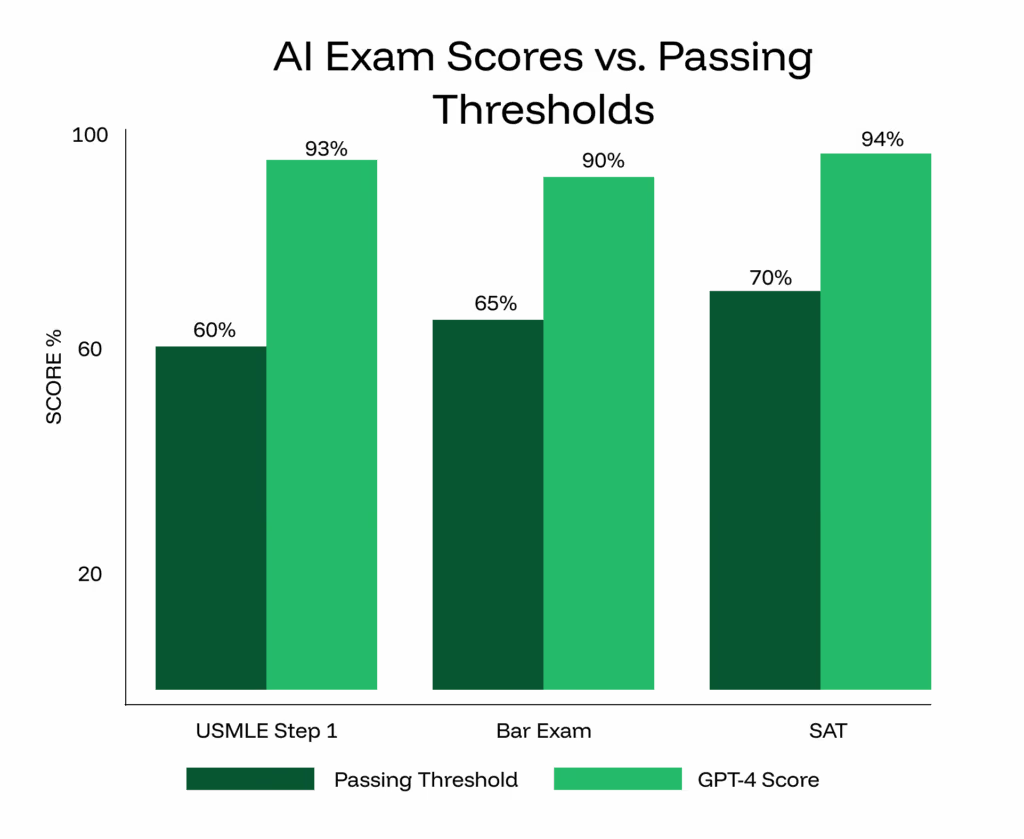
GPT-4 has scored in the 90th percentile on the Bar Exam, 93% on the US Medical Licensing Exam Step 1, and outperformed average test-takers on the SAT, LSAT, and graduate-level law school exams. When AI can pass the same high-stakes exams certifying bodies have relied on for decades, the credibility of those credentials is at risk. This post examines what is at stake when AI can bypass traditional exam security, where legacy tools fall short, and what a hybrid AI plus human review approach looks like for certifying bodies that need to protect the value of their credentials without compromising the candidate experience.
{{post-stat-highlight}}
These are the same high-stakes exams certifying bodies have relied on for decades to ensure that only qualified professionals enter the workforce.
So what happens when artificial intelligence can pass those very exams with ease?
The New Reality
High-stakes exams are no longer immune to disruption. With AI models like GPT-4 demonstrating near-perfect performance on medical, legal, and professional exams, certifying bodies must adapt to safeguard credential integrity.
For today's institutions, the value of your credential rests on one thing: trust in the exam process.
- Employers trust that certified professionals are competent.
- Regulators trust that licensing exams protect the public.
- Members trust that earning the credential reflects real skill and knowledge.
But if candidates can quietly lean on AI to generate passing answers, the credibility of the exam, and by extension, the credential itself, is at risk.
What’s at Stake
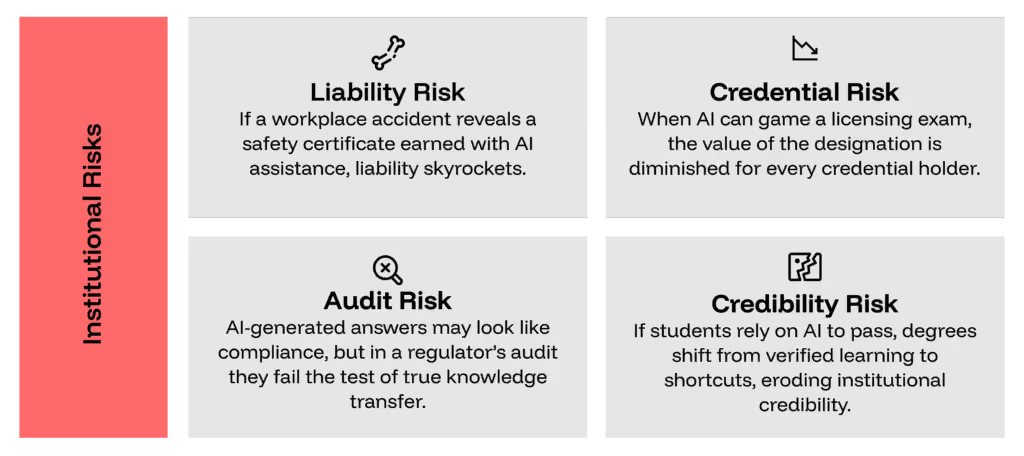
The credibility of your credential is its greatest asset. If candidates can bypass exam integrity with AI, the value of your certification program is immediately at risk.
- Credential devaluation: If AI shortcuts are widely suspected, your certification may lose its prestige and competitive advantage.
- Erosion of employer trust: Companies may question whether certified professionals truly demonstrate the required competencies.
- Regulatory and legal exposure: In fields like healthcare, aviation, or finance, compromised certifications can introduce public risk and liability.
- Member dissatisfaction: Candidates who earn their credential fairly may feel devalued if peers can “game the system.”
Why Traditional Exam Security Falls Short
Most exam security measures were designed for a pre-AI world. Legacy tools weren’t designed to detect AI-enabled misconduct. Lockdown browsers, AI-only monitoring, and human-only oversight leave dangerous gaps.
- Lockdown browsers can be bypassed or may not prevent candidates from using a second device.
- AI-only proctoring often misflags normal behaviors, leading to false accusations and poor candidate experiences.
- Human-only oversight can’t scale cost-effectively and risks overlooking subtle AI-assisted cheating.
The reality is clear: new threats require new solutions.
A Path Forward: Hybrid Security for the AI Era
To protect the integrity of credentials, institutions must embrace approaches designed for this new landscape. That means:
- Conducting a security audit: Evaluate whether current proctoring methods are resilient against AI-enabled cheating.
- Adopting hybrid proctoring: Combine AI’s efficiency with the judgment and nuance of human review to catch what machines alone cannot.
- Reducing friction for candidates: Security doesn’t have to come at the expense of user experience. Solutions should be no-install, device-agnostic, and low-support-burden to maintain accessibility.
- Communicating proactively: Show members, employers, and regulators that your organization is addressing AI head-on — not waiting for a scandal to spark change.
Protecting the Value of Certification
Your credential is more than a certificate or a badge. It represents trust, competence, and reputation. In the age of AI, safeguarding that trust means ensuring exams are secure, fair, and credible.
Because if AI can pass your exams, and nothing is done to respond, the profession itself is at risk.
At Integrity Advocate, we believe the path forward is clear: privacy-first, hybrid online proctoring. Unlike one-dimensional solutions, our approach combines the precision of AI with the judgment of human oversight to deliver both security and fairness.
With our no-install, friction-free platform, candidates can focus on their exam while organizations maintain the highest standards of integrity. Our hybrid solution ensures:
- Robust identity verification – confirming the right person is taking the exam.
- Smart monitoring – AI detects potential issues while human reviewers provide context and fairness.
- Actionable oversight – suspicious activity is clearly identified and presented to assessment administrators for confident decision-making.
- Candidate-first experience – no installs, device-agnostic access, and minimal technical barriers keep the exam environment stress-free.
By uniting technology with human judgment, Integrity Advocate helps certifying bodies protect credential value without compromising the candidate experience.
Ready to safeguard your credential in the AI era? Let’s talk.
Sources:
- Kung, T. H., et al. “Performance of ChatGPT on USMLE: Potential for AI-Assisted Medical Education Using Large Language Models.” JMIR Medical Education. 2023. Link
- Chiu, T. Y., et al. “Comparing performance of GPT-3.5, GPT-4, and GPT-4o on USMLE, PLAB, HKMLE, and NMLE medical licensing examinations.” BMC Medical Education. 2024. Link
- Reuters. “Artificial intelligence is now an A law student, study finds.” June 2025. Link
{{post-cta}}
Foire aux questions
Trouvez les réponses aux questions les plus fréquemment posées par nos clients.
Integrity Advocate uses a combination of identity verification, AI-assisted behavioral monitoring, and human review to prevent the most common forms of online cheating. This includes detecting hidden browser plugins and on-page answer helpers, flagging unauthorized tabs and secondary devices, confirming the right person is present throughout the session, identifying signs of off-camera assistance or collusion, and detecting mid-session device switches. Every flagged event is reviewed by a trained human before any outcome is recorded.
Integrity Advocate addresses five primary cheating methods: hidden plugins and page helpers that generate answers automatically, unauthorized tabs and extra devices used to access outside resources, impersonation and proxy test-taking where someone other than the registered learner completes the assessment, collusion and off-camera assistance from remote helpers, and device switching or session hand-offs mid-exam.
No. Integrity Advocate runs inside the learner's existing LMS without requiring any installation, downloads, or browser extensions. This eliminates the security risks associated with installed proctoring software while still providing comprehensive monitoring of the behaviors most associated with online cheating.
Privacy-first cheating prevention protects exam integrity without collecting more data than necessary or taking intrusive control of a learner's device. It uses targeted behavioral signals rather than full device access, keeps data retention limited and transparent, and aligns with privacy frameworks including GDPR, PIPEDA, FERPA, and CCPA. When learners understand what is collected and why, participation improves and compliance is easier to maintain.
Automated systems can identify behavioral patterns at scale but cannot interpret context. A learner glancing away from the screen could be distracted or could be consulting notes. A second voice in the audio could be a family member or an accomplice. Human reviewers add the context and judgment needed to distinguish genuine violations from innocent behavior, reducing false positives and ensuring that the decisions your organization acts on are fair and defensible.