August 21, 2026
|
min read
Key Takeaways from ASAE Annual 2026 | What Indianapolis Told Us About the Future of Association Learning
At ASAE Annual, it was clear that continuing education has become a strategic driver of member value, revenue, and reputation. As associations scale learning online, verification and assessment integrity are essential to ensuring every credential remains credible and meaningful.

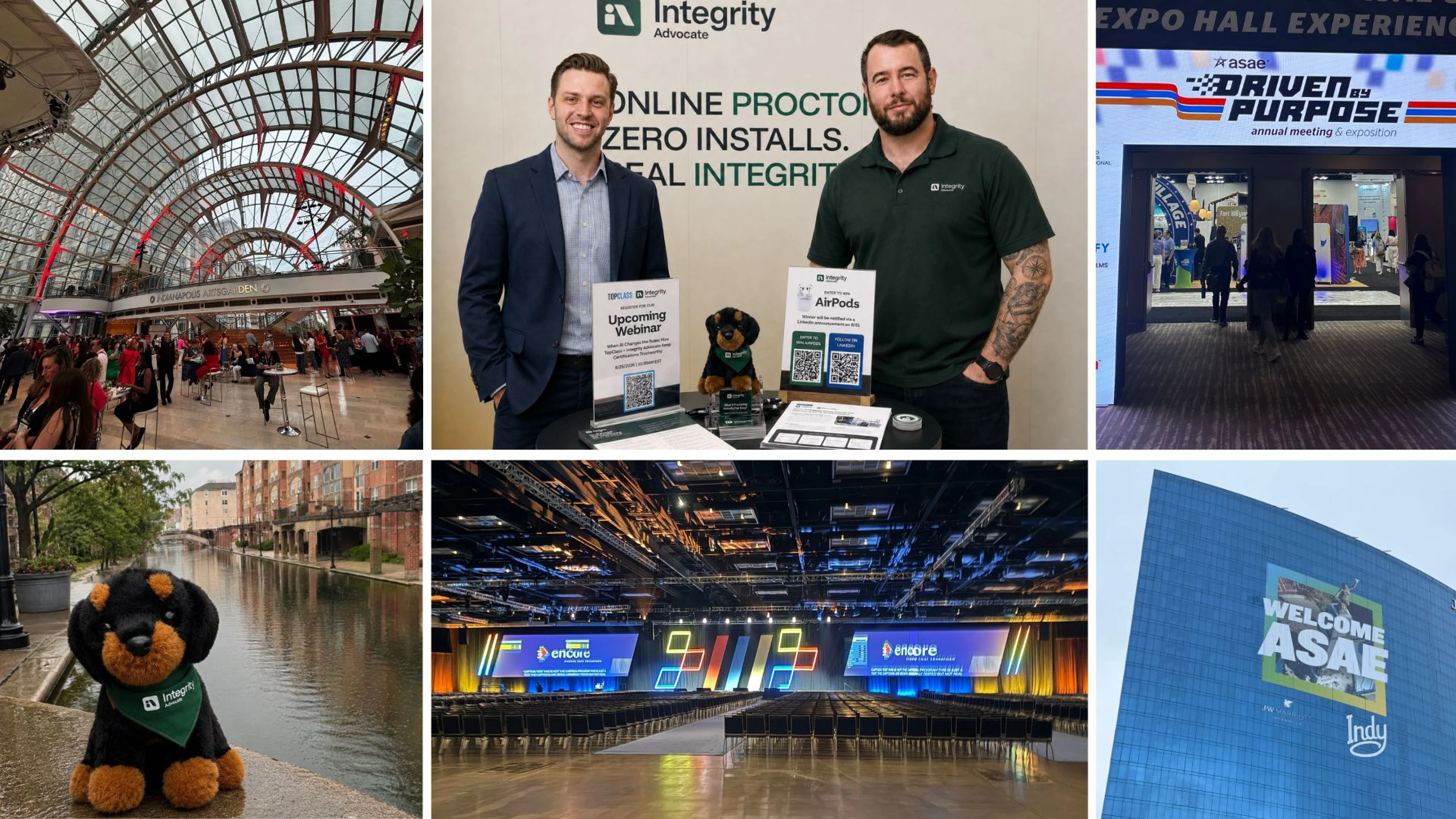
I just got back from ASAE's Annual Meeting in Indianapolis, and I'm still working through everything I heard. If you've never been, ASAE Annual is the biggest gathering of association executives in the country, and this year's theme was Driven by Purpose. That framing turned out to fit the week better than I expected, because the show floor and the session rooms were both buzzing with the same underlying question: what does it actually mean to serve your members well right now?
I went in expecting to hear a lot about membership growth and event strategy. I came home with something different. Almost every conversation I had, whether it was in a session, at a sponsor booth, or over coffee between keynotes, eventually circled back to learning. Specifically, how associations build it, how they prove it works, and how they protect it once it's out in the world.
1. Continuing education isn't the "informal" side of the business anymore
For a long time, a lot of associations treated their learning and CE offerings as a member benefit that lived somewhat separately from the core business. Nice to have, good for retention, not exactly mission-critical. That framing is gone.
What I heard over and over in Indianapolis is that association leaders now think about learning the way they think about credentialing: as a structured, accountable framework, not a loose collection of webinars and one-off workshops. IACET came up constantly, and for good reason. Getting IACET accredited and issuing verifiable CEUs isn't a box to check anymore, it's how associations signal that their education actually meets a recognized standard. That shift, from informal to formal, from "nice to have" to genuinely important, is probably the single biggest theme I took away from the whole week.
2. Formal CE training has real, measurable value, and associations are done treating it as an afterthought
Related to that first point: I sat in on more than one session where association leaders talked about the actual return on investing in properly structured continuing education. It's not just about compliance or member satisfaction scores. Strong CE programs are becoming a genuine revenue line and a genuine reputational asset. Members are willing to pay for training they trust. Employers are willing to sponsor it. Regulators and licensing bodies are willing to recognize it. But none of that works if the learning underneath it is soft. The associations getting this right are the ones investing in real instructional design, real assessment, and real verification, not just slapping a certificate on the end of a video.
3. Relevance is out. Impact is what associations are actually chasing now
This was the idea that really took some time to realize, and it came from a presentation from Bill Sheehan, Global Head of Association Strategy at D2L. Bill put it something like this: associations are no longer striving just to be relevant, they need to strive to provide impact.
At first that sounds like a subtle rewording. It isn't. Relevance is a passive approach. It's about staying in the conversation. Impact is active, and it cuts both ways. I think the important thing about this point was that impact can be positive or negative, and a lot of associations aren't accounting for the downside risk. If your learning programs are weak, if credentials can be gamed, if there's no way to verify who actually did the work, you're not just failing to be relevant. You're actively creating negative impact and negative relevance in your market. The flip side is just as true. When an association has a learning program that's genuinely strong, genuinely verified, and backed by a track record of real outcomes, that reputation compounds. It becomes a reason members join, a reason employers recognize the credential, and a reason the association keeps mattering long after "staying relevant" would have run its course.
That distinction reframed a lot of what I heard for the rest of the conference. Every session about member engagement, every booth conversation about growth, all of it came back to whether the learning experience behind the association's brand could hold up to scrutiny.
4. Association leaders care deeply about their members, and that's exactly why this matters
I want to name something that came through clearly in every room I sat in: the people running these associations are not thinking about learning as an abstract strategy exercise. They're thinking about their members as real people trying to advance their careers, keep their licenses current, and get genuine value out of their membership dollars. That care is what's driving the push toward more formal, more rigorous learning programs in the first place. Leaders don't want to hand their members a credential that doesn't mean anything. They want to hand them something that actually opens doors and helps them create career impact.
5. No association can scale that impact alone, and that's exposing some hard problems
The tension nobody can avoid: every association I talked to wants to build stronger, more credible learning programs, and almost none of them have the internal edtech capacity to do it at scale by themselves. That's where the partnership conversations came in, again and again. Associations know they need help from learning platforms, assessment tools, and credentialing technology to reach more members without diluting quality.
But moving all of this online, at scale, has created new problems that didn't exist when these programs meant a room full of people and a sign-in sheet. Fake learners. Shared logins. Credentials issued to someone who never actually did the work. Once a program moves online, the question stops being "is our content good" and becomes "can we actually prove who earned this." That's a hard problem, and it's one that's only getting more visible as more learning moves off the conference room floor and onto a screen.
Where this leaves associations
Walking away from Indianapolis, the thread connecting all of this was pretty clear to me, and it kept circling back to that "Driven by Purpose" theme. Purpose isn't a slogan on a conference banner. It's the reason associations are building real, structured, IACET-aligned learning programs in the first place. They care about their members and they know relevance alone isn't enough anymore. But that same shift toward formal, high-stakes learning is exactly what makes verification and integrity non-negotiable. A credential is only as good as the association's ability to stand behind it, and that means knowing, with confidence, that the person on the other side of the screen is who they say they are and did the work they're claiming credit for.
That's the piece we spend our time on at Integrity Advocate, and it's why conversations like this one always feel personal to me. If your association is investing in building the kind of learning program Bill Sheehan was describing, one that creates real impact instead of just chasing relevance, let's talk about how to protect it. Book a demo with our team and we'll walk you through how we help associations secure their learning programs, verify real learners, and make sure every credential you issue actually means something.
{{post-cta}}
Foire aux questions
Trouvez les réponses aux questions les plus fréquemment posées par nos clients.