March 25, 2026
|
5 min de lecture
OnDemand Webinar: Protecting the Integrity of your Licensing Program in the Age of AI
What does it take to protect a licensing program in the age of AI? This on-demand webinar covers the full lifecycle approach, from integration to credential issuance, with CMRAO's real-world results across 2,800+ exams.

Click Here to Access the On-Demand Webinar
AI has made cheating easier, faster, and harder to spot, and most licensing programs weren't built for it. This session brought together Integrity Advocate, uxpertise, and CMRAO to show what the threat actually looks like today, and what a modern, integrated approach to assessment security does about it. Brandon walked through why real protection covers the full lifecycle: seamless systems integration before the exam starts, identity verification and active monitoring during it, and verifiable credential issuance once it's done. Disconnected tools leave gaps at every stage. A fully integrated system doesn't.
CMRAO shared their real-world experience delivering the Excellence in Condominium Management program through uxpertise LMS with Integrity Advocate proctoring built in. Across more than 2,800 exam sessions, 8% were flagged as invalid, a number that would have been higher without a system in place. The live demo showed exactly how it works: one platform, no installs, and a human reviewer behind every flag.
Watch the webinar recording
Key Takeaways
Real protection covers the full lifecycle
Proctoring alone is not enough. Protecting a licensing program means addressing every stage: seamless systems integration before the exam, identity verification and active monitoring during it, and verifiable credential issuance after. Gaps at any stage are gaps that get exploited.
Seamless integration is the difference
When Integrity Advocate proctoring runs natively inside uxpertise LMS, candidates move from coursework to credentialed exam in one place, with no downloads or plug-ins. The result is less friction for candidates, less overhead for administrators, and a tighter, more defensible program.
The results speak for themselves
Since launching on uxpertise with Integrity Advocate proctoring, CMRAO has delivered over 2,800 exam sessions with 8% flagged as invalid. The system deters cheating, catches it when it happens, and gives CMRAO the confidence to issue licences with integrity.
{{post-cta}}
Continuer la lecture

AI Cheating Tools Are Outpacing LMS Defenses. Integrity Advocate Built a Solution
August 17, 2023
|
5 min de lecture
GPT-powered browser plugins can now prefill answers to online exam questions the moment they appear, and LMS platforms have no effective countermeasures. Integrity Advocate's ExposeAI is a purpose-built detection capability that identifies AI-assisted cheating during assessment sessions, integrating directly into the existing monitoring suite without any client-side installation. This post explains how these tools work, why they matter for certified training programs, and how ExposeAI addresses the threat.
A few years ago, the concern about AI in online assessments was theoretical. Today it is not. GPT-powered browser plugins can prefill answers to multiple choice exam questions the moment they appear on screen, regardless of the topic or difficulty level. The learner does not need to read the question. They do not need to understand it. The answer is already there.
Integrity Advocate has been tracking this development closely. The response is ExposeAI, a new detection capability built directly into Integrity Advocate's monitoring suite.
How GPT-Powered LMS Plugins Work
Learning Management System plugins powered by generative AI have proliferated rapidly. Among the tools currently in use are Github Copilot, AnswersAI, ConchAI, Jasper, ChatSonic, Coursology, Hyperwrite, Quillbot, and Monica, among dozens of others that continue to emerge.
These tools share several characteristics that make them particularly difficult to address through standard LMS countermeasures:
- They are inexpensive or free to obtain
- They require no technical expertise to install or activate
- Once installed, they operate automatically and continuously
- They are designed to conceal their presence and adapt to detection attempts
- New variants emerge faster than most platforms can respond
As a result, organizations relying on their LMS provider to develop effective countermeasures are unlikely to find one. LMS companies have no current solutions to this threat, and the nature of these plugins makes them unlikely to be eradicated through platform-level defenses alone.
The integrity of online assessments and certifications depends on a different approach.
Why This Matters for Assessment Integrity
The implications extend beyond academic dishonesty. For organizations issuing certifications that carry regulatory or legal weight, an assessment completed with AI assistance is not a valid measure of knowledge or competency. The certification it produces is as hollow as one issued without any training at all.
The same worker who received a fraudulent safety certification from a provider that did not deliver training could receive an equally fraudulent certification from an organization that delivered the training but could not prevent AI tools from completing the assessment on the learner's behalf. The outcome is the same: a credential that does not reflect what the person actually knows.
Introducing ExposeAI
ExposeAI is Integrity Advocate's purpose-built response to AI-assisted assessment fraud. It can be incorporated into Integrity Advocate's existing monitoring suite without any technical effort from clients, and works across the full range of devices and browsers that Integrity Advocate supports, from mobile to desktop.
ExposeAI is designed to detect the presence and use of GPT-powered plugins during an assessment session, giving organizations the visibility they need to maintain the integrity of their certification and training programs in an environment where AI tools are becoming standard equipment for learners looking to shortcut the process.
This is part of Integrity Advocate's broader commitment to staying ahead of the threats that matter most to the programs it serves. Human review remains at the core of every session. ExposeAI adds a layer of detection specifically designed for the AI-assisted cheating methods that automated systems alone cannot reliably identify.
The Broader Picture
AI cheating tools are not a passing trend. They are becoming cheaper, more capable, and more widely available. Organizations that do not have a response to this threat are issuing certifications they cannot stand behind.
Integrity Advocate's approach combines human review with purpose-built AI detection, so the results your program issues reflect what learners actually know, not what an algorithm answered for them.
{{post-cta}}

What It Takes to Successfully Roll Out Online Proctoring Inside an LMS
April 15, 2026
|
5 min de lecture
Rolling out online proctoring inside an LMS doesn't have to be disruptive. This guest post from uxpertise shares six practical steps for a smooth launch, plus how CMRAO cut support requests by 80% after switching to Integrity Advocate.
Guest blog by uxpertise
Rolling out online proctoring inside a Learning Management System (LMS) can feel daunting—for administrators and learners alike. Concerns around usability, learner stress, and an increase in customer support requests often slow adoption.
The reality is that when online proctoring is implemented thoughtfully, it can be seamless, learner-friendly, and highly effective—while actually reducing operational complexity.
Based on uxpertise’s experience supporting regulators and credentialing bodies, here’s what it truly takes to successfully roll out online proctoring inside an LMS, while ensuring reliable results and a positive learner experience.
Watch the webinar recording
1. Choose an LMS With Proctoring Already Integrated
One of the most important decisions happens before rollout even begins.
Whenever possible, organizations should choose an LMS with online proctoring already integrated, rather than relying on disconnected third-party tools. An integrated approach:
- Simplifies onboarding for administrators and learners
- Enables faster deployment of proctored exams
- Reduces technical friction and user confusion
- Minimizes IT and support dependencies
When proctoring is built directly into the LMS, learners stay in a single, familiar environment—no juggling platforms, no unnecessary steps.
2. Pilot Before Scaling
Before launching to your full learner population, run a pilot test with internal staff or a small group of learners.
A pilot helps you:
- Validate exam workflows end-to-end
- Identify usability or communication gaps
- Confirm rules and technical requirements
- Gather real user feedback
This step alone can prevent a large volume of avoidable support requests and ensures a smoother full-scale rollout.
3. Prepare Learners With Clear, Simple Resources
Learner preparation is one of the biggest drivers of success.
We recommend creating:
- A short video tutorial explaining the proctoring experience
- A simple written guide outlining key steps
- A practice proctored exam so learners can test the process in advance
Practice exams are especially effective. They reduce anxiety, build confidence, and ensure learners know exactly what to expect—long before exam day.
4. Clearly Communicate Exam Rules and Requirements
Transparency builds trust and compliance.
Make sure learners understand:
- Identification requirements (for example, government-issued ID)
- What is not permitted (phones, notes, additional devices)
- The need for a quiet, private testing environment
- Technical requirements such as camera, microphone, and internet connection
Clear expectations upfront significantly reduce issues during the exam and lower post-exam support inquiries.
5. Let Learners Know What Happens After the Exam
Many learners are uncertain about what happens once an exam is submitted.
Communicate clearly:
- How exams are reviewed
- When results will be available
- Whether any additional verification may occur
- How to get help if they have questions
This clarity reinforces confidence in the integrity of the process and reduces unnecessary follow-up requests.
6. Prioritize User Friendliness and Reliable Results
Successful online proctoring should support learners—not intimidate them.
A well-integrated solution:
- Is intuitive and easy to use
- Requires minimal technical knowledge
- Produces reliable, defensible outcomes
- Strengthens trust in assessment integrity
When learners feel supported, adoption increases and confidence in the system grows.
{{post-stat-highlight}}
Case Study: CMRAO’s 80% Reduction in Support Requests After Switching Proctoring Technology
CMRAO, a uxpertise client, had been delivering online exams using a different proctoring solution within the uxpertise LMS. While functional, the experience created friction for learners and resulted in a high volume of customer support requests.
When uxpertise made the decision to switch technology providers and integrate Integrity Advocate directly into the LMS, the impact was immediate.
After the transition, CMRAO experienced:
- An 80% reduction in customer support requests
- A noticeably easier experience for learners
- No required software downloads
- A more intuitive, user-friendly interface
- A truly seamless, all-in-one assessment environment
By combining an integrated proctoring solution with clear learner preparation and guidance, CMRAO significantly improved both learner experience and operational efficiency.
A Successful Rollout Is About Preparation, Not Complexity
Rolling out online proctoring inside an LMS doesn’t need to be complex or disruptive.
By choosing an integrated solution, piloting before launch, preparing learners proactively, and focusing on usability, organizations can:
- Reduce support requests
- Improve learner confidence
- Maintain high standards of integrity
- Scale assessments with confidence
At uxpertise, we believe the most effective proctoring solutions are the ones learners trust—because everything simply works.
Access our webinar on-demand
Ahead of the Curve: Building Trustworthy Licensing Programs in a Changing Assessment Security Landscape
Why modern regulators and credentialing bodies need integrated systems, not disconnected tools, to stay credible, compliant, and confident.
Protecting your licensing program
in the age of AI.
Watch our joint session with uxpertise and CMRAO to see how leading credentialing bodies are securing exam integrity without sacrificing the candidate experience.


Ready when you are.
OnDemand Webinar: Ensuring Integrity with uXpertise & Integrity Advocate
June 12, 2025
|
5 min de lecture
In June 2025, uxpertise and Integrity Advocate demonstrated how their partnership delivers secure, no-install online proctoring directly within the uxpertise LMS environment. The webinar covered browser-based monitoring capabilities, native bilingual support for French and English assessments, PIPEDA compliance and Canadian data residency, and the performance metrics behind more than 10 million successfully proctored sessions. This recap covers the key highlights for Canadian institutions evaluating remote assessment solutions
Date
Originally aired: June 12, 2025
A recap of the recent webinar demonstrating how Integrity Advocate integrates effortlessly with uxpertise to support secure, online assessments—no installs required.
The online proctoring landscape continues to evolve as Canadian institutions seek solutions that balance security with user experience. With the global online exam proctoring market valued at USD 836.43 million in 2023 and projected to reach USD 1.99 billion by 2029, institutions increasingly prioritize security and accessibility. In a recent webinar, uxpertise and Integrity Advocate demonstrated how their partnership addresses remote exam security challenges through seamless LMS integration and no-install proctoring technology.
The No-Install Advantage in a Growing Market
Eliminating Technical Barriers
Traditional proctoring solutions often create significant obstacles for students and IT departments through complex software installations and compatibility issues. Integrity Advocate's browser-based approach addresses these challenges by operating entirely within web browsers, eliminating the need for additional software downloads or specialized equipment.
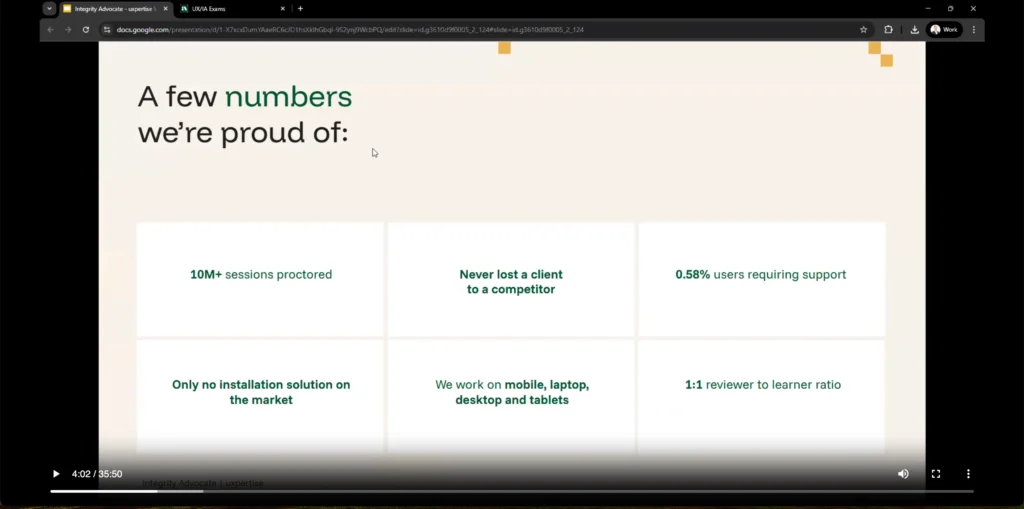
"We've proctored over 10 million sessions," noted the Integrity Advocate CEO Graeme Buchan during the webinar demonstration. This substantial volume reflects the reliability and scalability that educational institutions require when transitioning to remote assessment models.
The solution works seamlessly across multiple device types and this universal compatibility ensures equitable access for students regardless of their technology choices, addressing a critical concern as educational institutions report that 44.7% of students admit to cheating in online exams, making robust exam proctoring software essential for maintaining academic integrity.
Advanced Monitoring Without Installation
The demonstration revealed Integrity Advocate’s sophisticated monitoring capabilities that operate entirely within the browser environment:
- Identity verification using webcam technology for continuous authentication
- Environmental monitoring to detect unauthorized materials or assistance
- Screen-sharing prevention and tab-switching detection
- Audio monitoring for suspicious conversations or background noise
These features provide comprehensive security while maintaining the accessibility advantages of browser-based operation.
Seamless Integration Meets Bilingual Excellence
Native LMS Integration Capabilities
Integrity Advocate was designed from the ground up to integrate easily with leading LMS platforms like uxpertise—no plugins, no installs, no workarounds.
Supporting Canada's Bilingual Testing Standards by Design
Integrity Advocate is built to support Canada’s linguistic diversity, making it easy for institutions to deliver secure, inclusive online assessments in both French and English. Within uxpertise, this functionality comes to life with:
- User-friendly French and English interface options
- 24/7 bilingual support for students and administrators
- Proctoring procedures that reflect cultural awareness
- Full alignment with Canadian educational language standards
As the uxpertise team shared during the session, “our bilingual capabilities ensure that language is never a barrier to accessing secure online assessments.” It’s a shared commitment to accessibility—but one that starts with how Integrity Advocate was designed from day one.
Data Privacy and Regulatory Compliance
With Canadian privacy regulations being particularly comprehensive, Integrity Advocate’s online proctoring solution addresses key compliance requirements:
- Data residency options within Canadian servers for sensitive information
- PIPEDA compliance for personal information protection
- Transparent data handling policies with clear retention limits
- Student consent management systems that respect privacy rights
Real-World Success and Performance Excellence
Impressive Performance Metrics
The webinar highlighted several compelling statistics demonstrating the proctoring solution’s effectiveness in real educational environments:
Support Excellence:
- 0.58% support ticket rate - significantly below industry standards
- 24/7 multilingual support with average resolution times under 2 minutes
- Comprehensive documentation and training resources
The Future of Secure Online Assessment
Market Position and Competitive Advantages
With the automated online proctoring market projected to grow at 20.5% CAGR from 2025 to 2033, reaching an estimated USD 4.2 billion by 2033, the uxpertise-Integrity Advocate partnership positions institutions favorably for continued growth in remote assessment capabilities.
The solution differentiates itself in the competitive landscape through:
- No-install simplicity that reduces technical barriers and IT overhead
- Canadian data residency ensures compliance with local privacy regulations
- Comprehensive bilingual support for diverse educational environments
- Transparent pricing models without hidden fees or per-usage charges
- Proven scalability demonstrated through millions of successful proctored sessions
Emerging Trends and Technological Evolution
The partnership demonstrates a commitment to continuous innovation through:
- Technology and human-powered anomaly detection for more accurate identification of suspicious behaviors
- Adaptive assessment technologies that adjust to individual student learning patterns
- Integration capabilities with emerging technologies
- Quarterly feature releases based on user feedback and industry developments
Measuring Long-Term Value and ROI
Leaders should evaluate proctoring solutions based on comprehensive metrics:
- Academic integrity violation rates compared to pre-implementation baselines
- Learner completion and satisfaction rates for proctored assessments
- Faculty adoption and effectiveness measures
- Technical support burden and resolution efficiency
- Total cost of ownership, including implementation, training, and ongoing support
For Canadian institutions looking to enhance remote exam security without sacrificing accessibility, the uxpertise–Integrity Advocate collaboration demonstrates what's possible when two trusted platforms work in sync. With over 10 million sessions successfully proctored and a privacy-first design that supports both French and English users, Integrity Advocate is built for today’s assessment demands. And with North America leading the global online proctoring market, this integration offers not just proven reliability—but future-ready flexibility.
Watch the webinar recording
{{post-cta}}
Foire aux questions
Trouvez les réponses aux questions les plus fréquemment posées par nos clients.
Integrity Advocate is built directly into the uxpertise platform, so learners never leave their familiar exam environment. There is no separate login, no software to install, and no additional accounts to manage. Administrators launch proctored exams from the same interface they already use. Learn more about how Integrity Advocate connects with learning platforms.
Because Integrity Advocate is already integrated into the uxpertise platform, deployment is significantly faster than implementing a disconnected third-party tool. Most organizations can configure and pilot proctored exams within days, not months. The combination of pre-built integration, browser-based delivery, and dedicated onboarding support means your team spends less time on setup and more time on your program.