December 1, 2025
|
5 min de lecture
Online Proctoring: Key Insights From the Global Market Report, and Why Integrity Advocate Is Built for What’s Next
The Online Exam Proctoring Market 2025 Edition report confirms what many institutions and certifying bodies already sense: remote assessment has entered a new era. The global market reached $945.62 million in 2024 and is projected to more than double to $2.19 billion by 2030. This post breaks down the five most significant findings, including the continued dominance of human-centered proctoring models, surging enterprise and government demand, North America's privacy-driven expectations, and the industry-wide shift toward hybrid AI plus human review as the standard for fair, defensible assessment.


The Online Exam Proctoring Market: 2025 Edition report confirms what many institutions, certification bodies, and training organizations already feel: remote assessment has officially entered a new era. The market is expanding rapidly, expectations around privacy are rising, and organizations are demanding solutions that deliver security without unnecessary intrusion.
Below is a breakdown of the report’s most important findings, and how Integrity Advocate stands out as the solution designed for 2025 and beyond.
1. The Market Is Growing, Fast
The report shows the global online proctoring market reached $945.62M in 2024 and is projected to more than double to $2.19B by 2030 (CAGR 15.11%).
This growth isn’t just about more online learning. Organizations worldwide are searching for scalable, reliable, and compliant ways to maintain exam integrity across:
- Higher education
- Certification & licensing bodies
- Government programs
- Workforce and safety training
As budgets tighten and expectations rise, solutions that require no installation, no scheduling, and minimal administrative overhead are becoming the preferred option. Integrity Advocate offers exactly that, a secure, streamlined workflow that doesn’t weigh down learners or admins.
2. Human Oversight Remains Essential, Even as AI Accelerates
The report notes that human-centered models still dominate: live proctoring accounts for 50.59% of market share in 2024.
This underscores a key truth: Organizations want the accuracy and fairness that only human context can provide.
Automation alone simply isn’t trusted to make final decisions, especially when exam outcomes impact careers, credentials, or safety-sensitive roles.
Integrity Advocate was built on hybrid oversight long before it became an industry trend.
- AI handles scale efficiently
- Human reviewers validate context, tone, and intent
- Reports focus on clarity, not confusion
This means fewer false positives, fewer escalations, and far better outcomes for both administrators and exam takers, all without the invasiveness of live video monitoring.
3. Education Leads Today, But Enterprise Growth Is Surging
Education continues to be the largest segment, representing 53.18% of worldwide demand in 2024. Government and enterprise follow at 24.58% and 22.24% respectively.
The trend lines are clear: Remote certification, upskilling, and workforce credentialing are becoming standard across industries.
Integrity Advocate serves all three segments with equal strength:
- Education: seamless LMS integration + student-centric privacy
- Government: audit-ready documentation + compliance built in
- Enterprise & safety-critical industries: identity verification + fair, scalable oversight on any device
The same lightweight workflow works everywhere, reducing IT strain and increasing adoption speed.
4. North America Continues to Lead, Driven by Privacy Expectations
North America accounts for 41.50% of the global market, making it the most mature and demanding region.
What’s accelerating adoption?
- Digital learning expansion
- High compliance standards
- Stronger expectations around data privacy
- Growing discomfort with intrusive surveillance tools
Unlike legacy proctoring platforms, Integrity Advocate rejects the “collect everything” model. We are the only privacy-first provider that:
- Stores no biometric data
- Captures the minimum data required
- Avoids unnecessary device lockdowns
- Ensures exam-taker dignity and transparency
As privacy regulations tighten, this approach isn’t just preferred, it’s becoming required.
5. AI Adoption Is Rising, But Hybrid Models Are the Future
The report emphasizes increasing demand for AI-powered proctoring complemented by human review, not replaced by it. Industry-wide, this hybrid approach is considered more fair, more accurate, and more defensible.
Integrity Advocate has championed hybrid oversight from the beginning. Our approach ensures:
- Higher accuracy
- Lower administrative burden
- More trust from learners
- Reduced technical friction
- Better transparency in flagged events
It's everything institutions want, without the invasiveness they’ve grown tired of.
Why Integrity Advocate Is Emerging as the Clear Leader in 2026 and beyond
The trends are unmistakable, and they all point toward a solution like ours:
- Privacy-first: A direct answer to rising concerns about surveillance and data overreach.
- Hybrid Proctoring: Aligns with the report’s confirmation that human oversight remains essential.
- No-install simplicity: A critical differentiator as organizations scale online assessment.
- Seamless LMS integration: Meeting institutions exactly where they are, not forcing new systems.
- Audit-ready reporting: Reducing administrative workload and increasing compliance confidence.
- Scalable across sectors: Education, enterprise, associations, licensing boards, government, the same streamlined workflow supports them all.
Final Takeaway: The Market Is Evolving, Integrity Advocate Already Has
The report makes it clear that organizations increasingly want security + privacy, AI + human context, and scalable + simple workflows.
Integrity Advocate isn’t adapting to these trends, we were built for them.
If your institution or organization is preparing for the next chapter of online assessment, we’d love to walk you through how a privacy-first, human-backed approach can transform your testing experience. Feel free to schedule a demo here.
{{post-cta}}
Continuer la lecture

AI vs. Human vs. Hybrid Proctoring: Which Model Best Protects Exam Integrity?
October 9, 2025
|
5 min de lecture
As online testing expands across education, certification, and compliance training, the choice between AI-only, human-only, and hybrid proctoring has real consequences for exam integrity, fairness, and organizational risk. This post breaks down all three models, their pros and cons, and when each is the right fit, concluding that hybrid proctoring delivers the best combination of efficiency, accuracy, and fairness for most modern assessment environments.
The Evolving Landscape of Online Exam Security
As online testing continues to expand across education, certification, and compliance training, choosing the right proctoring model has never been more important.
AI-only tools promise automation and scalability. Human-only options offer fairness and empathy. Hybrid models combine the best of both, but which one truly protects exam integrity?
This article breaks down the three dominant proctoring approaches, their pros and cons, and what to consider when choosing the right fit for your organization.
1. AI-Only Proctoring: Fast, Scalable, and Automated, but Imperfect
AI proctoring tools use algorithms to detect suspicious behavior automatically, from unusual head movements to multiple voices or unauthorized devices.
While these systems offer speed and scalability, they also raise concerns about accuracy and bias.
Pros:
- Monitors large numbers of exams simultaneously
- Automates flagging and reporting
- Reduces administrative workload
Cons:
- High false positive rates (lighting, gaze, or accessibility issues)
- Lacks human context and judgment
- Raises data privacy and fairness concerns
AI-only systems can be efficient but risk misinterpretation, which can reduced trust among test takers.
2. Human-Only Proctoring: Fair and Contextual, but Limited in Scale
Human proctors oversee exams via live or recorded video, making real-time decisions based on context and behavior.
This model prioritizes fairness, empathy, and human oversight, but introduces scalability and scheduling challenges.
Pros:
- Accurate, contextual decision-making
- Builds trust with test takers
- Reduces false flags and misunderstandings
Cons:
- Labor-intensive and difficult to scale globally
- Higher cost per exam
- Limited flexibility for asynchronous or on-demand testing
Human-only proctoring ensures fairness but struggles to keep pace with modern testing needs.
3. Hybrid (AI + Human) Proctoring: The Best of Both Worlds
Hybrid proctoring blends automation and human oversight to deliver accuracy, fairness, and scalability.
AI handles initial detection, while human reviewers verify each flagged event before reports are finalized. This ensures efficiency without sacrificing integrity.
Pros:
- Reduces false positives with human verification
- Scales efficiently across time zones
- Protects privacy and fairness
- Provides auditable, compliant reporting
Cons:
- Requires platform integration
- May introduce slight delays in review turnaround
Hybrid proctoring creates the balance today’s organizations need, efficient technology guided by human discretion.
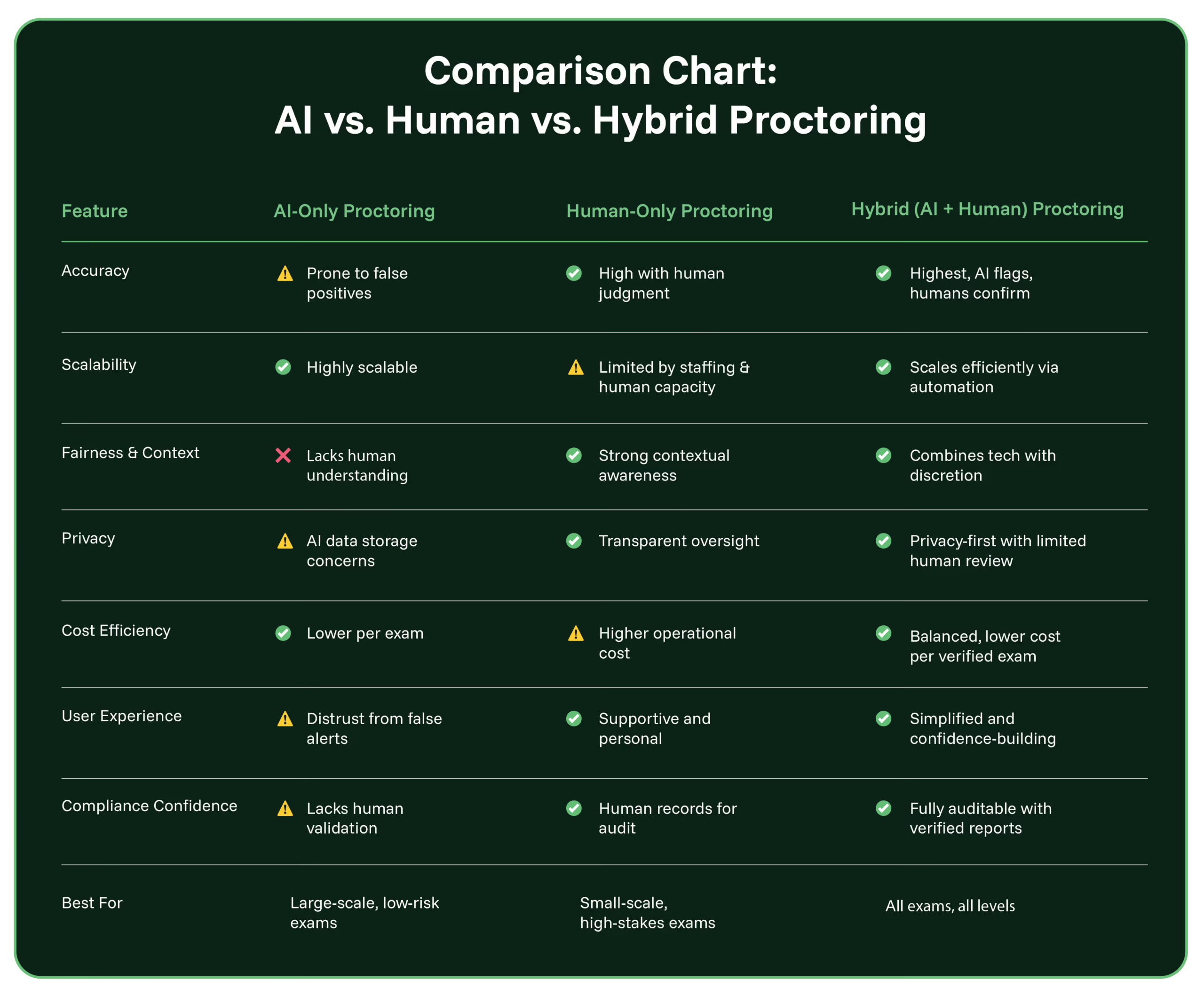
Verdict: Hybrid proctoring delivers the best combination of efficiency, accuracy, and fairness, meeting the evolving needs of modern learning and compliance environments.
When to Use Each Type of Proctoring (and When to Avoid It)
Choosing the right proctoring model isn’t just about features, it’s about fit. Here's when each approach works best, and when it might fall short.
AI-Only Proctoring
AI-only proctoring is a good fit for large-scale, low-stakes testing environments where speed and automation are priorities. It’s ideal for institutions delivering practice exams or formative assessments with minimal impact on final outcomes. If your team is constrained by staffing or budget, and real-time oversight isn’t required, AI-only can offer a fast, lightweight solution.
However, AI-only solutions are risky in high-stakes scenarios like certification, compliance, or licensure exams, especially where fairness, accessibility, and privacy are key concerns. These systems can generate false flags and lack the human context needed to distinguish genuine misconduct from harmless behavior.
Human-Only Proctoring
Human-only proctoring excels in small-group, high-stakes testing scenarios where personal interaction, empathy, and real-time judgment matter most. It's particularly useful for live, synchronous exams or specialized formats like oral exams, interviews, or hands-on assessments. If trust, fairness, and human connection are top priorities, a fully human approach ensures every test-taker is treated with context and care.
That said, this model becomes difficult to scale across large populations or global programs. It also presents challenges for asynchronous testing and tends to be more expensive due to staffing and scheduling demands. Organizations needing rapid turnaround or flexible exam windows may find this model limiting.
Hybrid Proctoring (AI + Human Review)
Hybrid proctoring combines the speed and scalability of AI with the fairness and context of human review, making it ideal for most modern assessment environments. It works especially well for mid- to high-stakes exams delivered at scale, such as workforce certification, compliance training, or higher education finals. Hybrid models support asynchronous access and bring-your-own-device testing, while still delivering human-verified, audit-ready results.
The main limitation is that some hybrid models may involve slight delays between the test and final reporting, depending on review turnaround time.
Why Hybrid Models Are the Future
Organizations are no longer choosing between technology and trust — they’re demanding both. Hybrid proctoring empowers institutions to deliver secure, privacy-compliant, and credible assessments without friction for test takers.
By combining automation and human verification, administrators get:
- Fewer false flags and student disputes
- Stronger audit trails and compliance documentation
- A smoother, more confident test-taking experience
How Integrity Advocate Sets the Standard
Integrity Advocate’s hybrid approach is designed around human-first, privacy-protected verification.
- No software installs required
- Works on any device or browser
- AI-driven detection verified by expert human reviewers
- Transparent, auditable reports administrators can trust
Integrity Advocate’s hybrid proctoring ensures fairness, compliance, and confidence in every assessment.
“Integrity Advocate integrates easily with our current system. It runs smoothly and is aesthetically pleasing; it meets the high standard we have for all our systems. It is also very effective at proctoring while not being too invasive; our users feel comfortable using it. Integrity Advocate strikes the right balance of integrity and privacy, which is hard to find!”
Ready to find the balance between automation and integrity?
Request a Demo to see how Integrity Advocate’s hybrid model redefines online exam security.
{{post-cta}}

Seamless Proctoring That Integrates Directly With Your LMS
November 20, 2025
|
5 min de lecture
Integrity Advocate integrates natively with major learning management systems and certification platforms via LTI, including D2L, Canvas, Moodle, TopClass, uxpertise, Thought Industries, and more, so organizations can activate proctoring exactly where they need it without rebuilding course structures or changing existing workflows. Learners click Begin, verify their identity, and take the assessment. Administrators access results and flagged sessions directly within the LMS. No installs, no extensions, no IT overhead, and no privacy tradeoffs.
A proctoring solution that integrates seamlessly with the platforms you already use, for simplicity and smoother workflows.
Integrity Advocate integrates natively with major LMS, certification platforms, and learning systems, including:
- D2L
- TopClass LMS
- Thought Industries
- uxpertise
- Moodle
- Coelrind
- TalentLMS
- AtomicJolt
- Canvas
- Totara
- Cirrus
- Vocal Meet
- SmarterU
- iLevel
- Isograd
- Momentum IT
- OpenLMS
- LearningCart
- StudyForge
- Healthcare Staffing Hire
- Gulf Coast Safety Council
- and other platforms
Because the integration is LTI-based, it works with your existing course structure, no rebuilding, reformatting, or duplicating content.
You activate proctoring where you need it, and your existing workflow stays exactly the same.
See a full list of our integrations
No Installs. No Plugins. No Added Steps.
Unlike legacy proctoring tools, Integrity Advocate runs entirely in the browser. That means:
- No downloads
- No browser extensions
- No permissions pop-ups
- No IT tickets
- No compatibility headaches
Exam takers simply click “Begin,” verify their identity, and take the assessment. Administrators access results directly within their LMS and review flagged activity with one click.
When proctoring feels effortless, participation increases, and support tickets drop dramatically.
A Seamless Experience for Learners and Administrators
Seamless integration isn’t just about technical compatibility; it’s about creating a consistent, intuitive experience for every user.
For Learners
✔ Familiar LMS environment
✔ Simple, no-install proctoring
✔ Device flexibility (including Chromebooks, tablets, mobile, laptops)
✔ No confusing redirects to external sites
For Administrators
✔ Same course layout, same workflow
✔ Easy activation per quiz or assessment
✔ Automated flagging and optional human review
✔ Audit-ready reporting directly in the LMS
Everything lives where your team already works.
Protecting Privacy While Simplifying Your Workflow
Many organizations assume proctoring tools create complexity, or require uncomfortable tradeoffs around learner privacy. Integrity Advocate proves they don’t have to.
Privacy-by-Design:
- No unnecessary data storage
- No invasive scanning
- Minimum data collection
- GDPR- and CCPA-aligned practices
- Only necessary evidence is captured
- Human review included for fairness and context
Learners get transparency. Admins get trustworthy, defensible results. Your organization gets compliance without added risk.
The Result: Secure Assessments Without the Overhead
Your LMS shouldn’t become harder to manage just because you need to protect exam integrity. With Integrity Advocate, security becomes an invisible part of your workflow, privacy stays fully intact, and proctoring seamlessly extends your existing assessment process rather than interrupting it.
See How Seamless Integration Works in Action
Want to see how Integrity Advocate plugs into your LMS in minutes? Schedule a demo with our team.
Secure, simple, privacy-first proctoring, already built to work where you work.
{{post-cta}}

Where Does Secure Proctoring End and Privacy Invasion Begin?
June 19, 2025
|
5 min de lecture
There is a clear line between oversight and surveillance in online proctoring, and most platforms cross it. When tools collect more data than necessary, require invasive installations, or store sensitive information beyond its purpose, they do not just create privacy exposure. They erode the trust that makes a certification meaningful. This post examines where that line is, why more surveillance does not mean more security, how rising compliance standards like ANSI/ASSP Z490.1-2024 define accountability without requiring overcollection, and what privacy-first proctoring actually looks like in practice.
A waiter is taking an online assessment to earn their alcohol serving certification. They’re at home, using a personal laptop. They scan their government ID to verify their identity. And as soon as the test starts, their webcam is on. So is screen sharing.
{{post-stat-highlight}}
Here’s the thing: online assessments like these need oversight. But that doesn’t mean they need to feel like surveillance. When proctoring tools overstep, they don’t just violate privacy—they break trust, reduce engagement and risk the credibility of the certification itself.
This isn’t about watching more screens. It’s about building systems that respect boundaries, protect integrity and actually work.
What test administrators are actually looking for
If you’re leading training, certifying professionals or managing compliance programs, chances are you didn’t wake up this morning thinking, “Let’s go shopping for proctoring software.”
What you are looking for is peace of mind. You want to:
- Make sure the right person is taking the test
- Confirm they were engaged and followed the rules
- Keep your programs compliant and your reputation protected
That’s it. You're not trying to invade someone’s personal space or collect more data than necessary—you just need reliable verification and fair oversight.
But too many platforms miss the point. They require installs that clash with IT policies, ask for broad system access, or quietly gather data that goes far beyond what's needed. And in some cases, they’ve failed to keep that data safe.
In 2020, nearly half a million user accounts from a widely used online proctoring tool—including names, email addresses, phone numbers and home addresses—were leaked after a breach. Institutions from the U.S., UK and Australia were all impacted, and the fallout was swift: student backlash, privacy concerns and institutional scrutiny from all sides.
It was a wake-up call. When proctoring crosses the line, the risks aren’t theoretical. They’re reputational—and very real.
With Integrity Advocate, privacy isn't an afterthought. It's the starting point. No excess data collection. No invasive tech. No guesswork about where that information ends up.
Because when you’re asking users to trust you with their identity, you better be ready to protect it.
Why more surveillance doesn’t mean more security
In the race to stay compliant, it’s easy to assume that collecting more data means covering more bases. But the truth is, adding layers of surveillance doesn’t make an assessment more secure—it just makes it harder to manage risk.
Think of it like airport security with no filters: scanning every bag, flagging every item and then leaving one person to sort through it all. It’s noisy, it’s overwhelming and it misses the point.
It’s the same with proctoring.
Tools that over-collect create a false sense of control while actually increasing privacy exposure, friction for users and administrative burden. What organizations really need is technology that collects only what’s necessary, and human context to help make sense of it. And now, that kind of clarity isn’t just a nice-to-have. It’s becoming a requirement.
The compliance standard is rising
This isn’t just about ethics. It’s about meeting the new reality of compliance.
ANSI/ASSP Z490.1-2024 raises the bar for how training is delivered and verified. It’s not enough to say a course was offered; you now need to prove it was completed by the right person, in the right conditions, with engagement that can stand up to scrutiny.
That means identity verification. Participation monitoring. Records that hold up under audit.
But nowhere in the standard does it say you need to surveil someone’s entire desktop or store unnecessary data just to meet the mark.
The spirit of ANSI Z490.1 is accountability—not overcollection. If your current system makes compliance feel more like risk exposure, it’s time to rethink what you're using to prove integrity in the first place.
Oversight ≠ Overreach
For us, this work has never just been about tech.
It started with a simple, serious belief: when it comes to safety-critical training, the integrity of an assessment isn’t optional. It’s how lives are protected. And how organizations prove they’re doing things the right way.
That’s why we approach oversight differently.
At Integrity Advocate, we’re not here to control every click. We’re here to confirm that the right people are showing up, engaging fully and earning results that matter.
We do that by designing for trust—not surveillance.
- No installs. No plug-ins. No hidden tracking.
- Only collecting what’s necessary to confirm identity and engagement.
- Human review of flagged sessions to ensure fairness, accuracy and discretion.
- Clear, transparent policies that respect the user and reduce risk for the organization.
Our goal isn’t to catch someone. It’s to build systems that make cheating irrelevant, because integrity is built in from the start.
Scale doesn’t have to come at a cost
Meeting compliance isn’t a small-scale problem. You might be onboarding thousands of learners, recertifying entire workforces or delivering credentials across dozens of jurisdictions.
The stakes are high. And so is the volume.
But here's the good news: you don’t have to trade trust for efficiency.
When Smart Serve Ontario needed to recertify tens of thousands of workers after a provincial policy shift, they didn’t have months to redesign their program or train their users. They needed a solution that scaled overnight.
By partnering with Integrity Advocate, they got:
- No software installs.
- No new platforms to learn.
- No additional support surge.
Just seamless, secure delivery that respected their learners, stood up to scrutiny and worked at scale.
That’s what smart oversight looks like. When compliance needs to move fast, you need a partner who can keep up without cutting corners.
So, where does secure proctoring end and privacy invasion begin?
It ends the moment the solution starts collecting more than it needs. It begins the second the user feels monitored instead of supported.
That’s the line.
For compliance officers, credentialing bodies and training leaders, that line matters more than ever. The tools you choose don’t just reflect your operational standards—they reflect your values.
Proctoring should confirm identity, not compromise it. At Integrity Advocate, we don’t believe you have to choose between security and simplicity or between compliance and compassion. You can have both. You should have both.
If your current solution is starting to raise questions about trust and compliance, it might be time for a conversation. We’re ready when you are.
{{post-cta}}
Foire aux questions
Trouvez les réponses aux questions les plus fréquemment posées par nos clients.
The global online proctoring market reached $945.62 million in 2024 and is projected to grow to $2.19 billion by 2030, at a compound annual growth rate of 15.11%, according to the Online Exam Proctoring Market 2025 Edition report.
The 2025 market report shows that human-centered proctoring models account for 50.59% of market share. This reflects a broader industry reality: automated systems can detect patterns at scale but cannot apply the judgment, context, and accountability that high-stakes assessment decisions require. Organizations issuing credentials, licenses, and certifications need outcomes they can defend, and human review is what makes a result defensible when it is challenged.
Education remains the largest segment at 53.18% of worldwide demand. Government programs account for 24.58% and enterprise for 22.24%. Both government and enterprise segments are growing as remote certification, workforce credentialing, and safety training become standard across industries. Integrity Advocate serves all three segments with the same no-install, audit-ready workflow.
North America accounts for 41.50% of the global market, driven by digital learning expansion, high compliance standards, and growing discomfort with surveillance-heavy proctoring tools. Privacy expectations in North America are particularly high, with learners and institutions increasingly demanding solutions that collect minimum necessary data, avoid unnecessary device access, and handle sensitive information transparently and responsibly.
The report emphasizes increasing demand for AI-powered proctoring complemented by human review rather than replaced by it. Industry-wide, the hybrid approach is considered more fair, more accurate, and more defensible than AI-only alternatives. This direction aligns directly with how Integrity Advocate has been built: AI handles detection at scale while trained human reviewers validate context and make documented decisions before any outcome is recorded.