February 25, 2026
|
5 min de lecture
The Credential Security Trifecta: Designing a Defensible Credential Ecosystem
Credential integrity depends on more than a single tool. It requires identity verification, assessment oversight, credential issuance, and long-term validation to operate as one connected system. As digital credentials become more visible and portable across LinkedIn profiles and employer systems, organizations need to be able to answer a harder question than "was this test monitored": is this credential defensible? This post introduces the Credential Security Trifecta, a framework connecting Learning & Assessment Infrastructure, Identity & Integrity Verification, and Secure Digital Credential Issuance into a unified chain of trust, and points to the full whitepaper for the risk landscape, common blind spots, and an implementation model.

Credential integrity is the confidence that a credential truly represents what was earned. It means the right person completed the work, the assessment was conducted fairly, and the credential was issued based on verified performance. That confidence is built across identity verification, assessment oversight, credential issuance, and long-term validation.
As digital credentials become more visible, portable, and high-stakes, organizations are being asked a more important question: Can you defend how this credential was earned?
That question requires more than a proctoring solution. It requires a system.
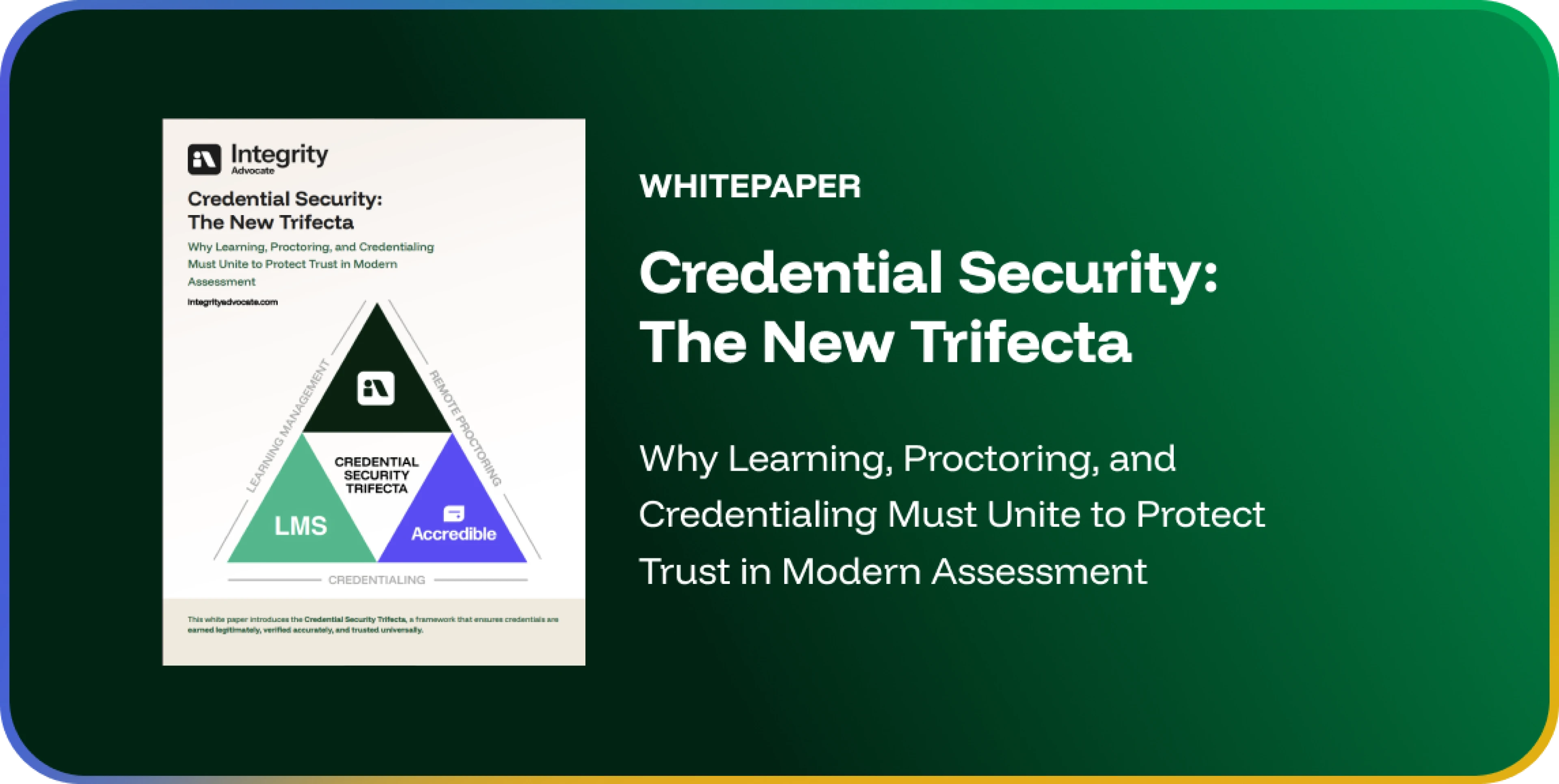
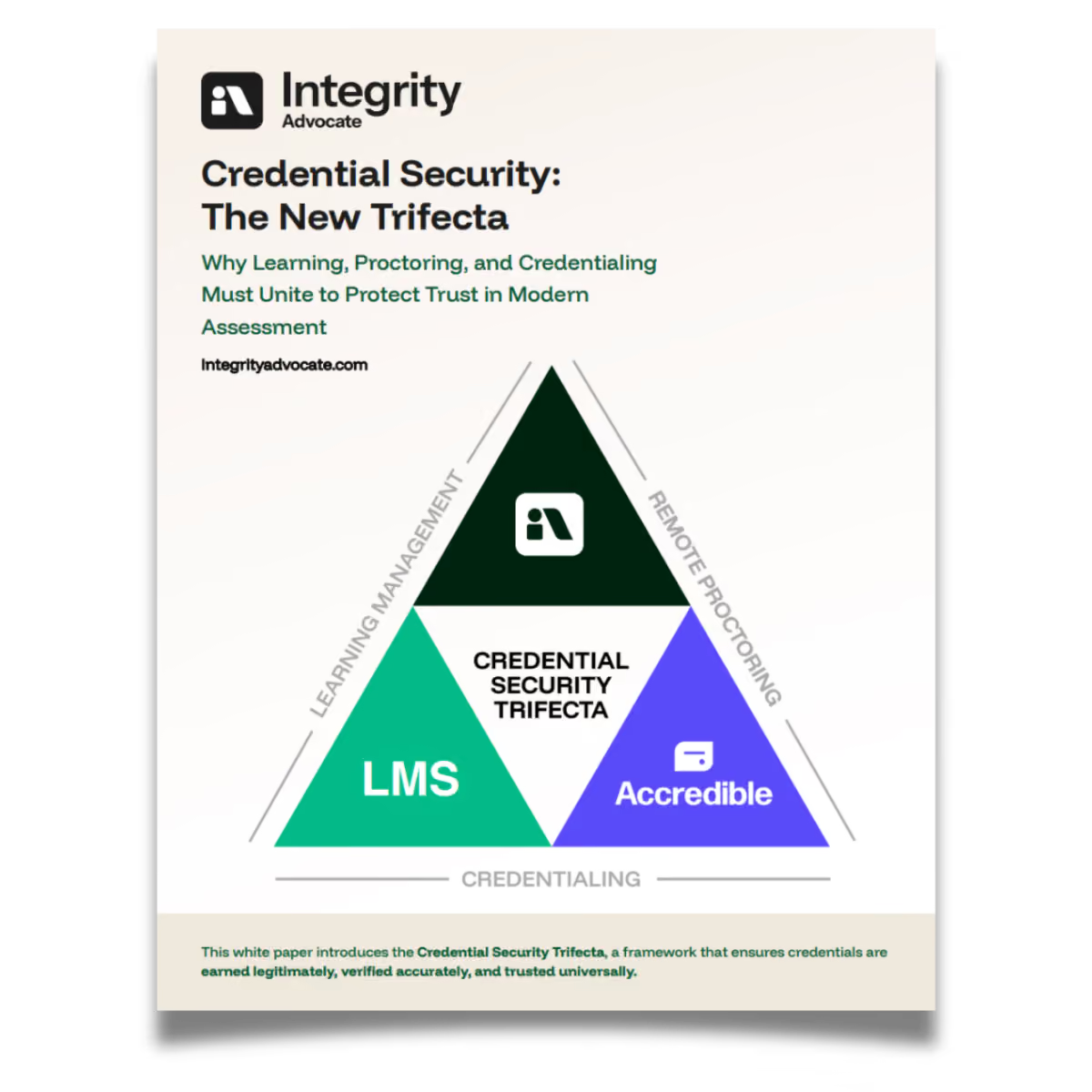
In our latest whitepaper, The Credential Security Trifecta, we outline a practical framework for designing a defensible credential ecosystem, one that connects learning, verification, and issuance into a coherent chain of trust.
Credential Security: The New Trifecta
Why Learning, Proctoring, and Credentialing Must Unite to Protect Trust in Modern Assessment
The Shift From Exam Security to Credential Security
For years, assessment security focused primarily on preventing misconduct during testing. That remains important. But today’s risk environment has expanded.
AI-enabled misconduct, identity fraud, contract cheating, and synthetic digital documents have changed the landscape. At the same time, digital credentials are widely shared across LinkedIn profiles, employer systems, and workforce platforms. They are public representations of institutional trust.
And the stakes are higher than ever. In an AI-accelerated world, institutions must be able to answer a fundamental question: can we confidently verify who earned this credential — and whether it was earned fairly? When credentials influence hiring decisions, promotions, licensure, and professional standing, the consequences of getting it wrong are significant.
That means the integrity conversation must move beyond: “Was this test monitored?” to: “Is this credential defensible?”
Credential security is not just about detecting misconduct. It’s about ensuring that identity, performance, and issuance are connected in a way that can withstand scrutiny.
Why Fragmented Systems Create Risk
Most organizations operate across three separate layers:
- A learning management system where instruction and assessment occur.
- An integrity or proctoring solution that verifies identity and behavior.
- A credentialing platform that issues digital certificates or badges.
Each layer may function well independently. The risk emerges in the gaps between them. If these systems are not intentionally aligned, you may lack:
- A clear documentation trail from identity verification to issuance
- Audit-ready evidence of how integrity was upheld
- A consistent standard across programs
- Confidence that only verified outcomes result in credentials
That fragmentation makes defensibility harder when questions arise from employers, regulators, or internal leadership.
The Credential Security Trifecta Framework
The whitepaper introduces the Credential Security Trifecta, a framework that connects three essential components into a unified architecture:
Learning & Assessment Infrastructure: Where learning is delivered and performance is measured.
Identity & Integrity Verification: Where identity is confirmed, assessment conduct is reviewed, and integrity decisions are documented to ensure performance is legitimate and defensible.
Secure Digital Credential Issuance: Where verified performance becomes a tamper-resistant, independently verifiable credential.
When these three components operate as an integrated system rather than isolated tools, they form a defensible chain of trust.
This shifts the posture from reactive security to intentional design.
What a Defensible Credential Ecosystem Looks Like
A defensible ecosystem does not rely on assumptions. It provides clarity. It enables leadership teams to answer, with confidence:
- How do we verify identity at scale?
- How do we document integrity decisions?
- How do we ensure credentials are only issued for verified performance?
- How do we validate credentials long after they are awarded?
These are governance questions as much as technical ones. They impact compliance, employer trust, learner confidence, and institutional reputation.
Designing for defensibility requires alignment across technology, process, and policy.
What You’ll Learn in the Whitepaper
The full whitepaper expands on:
- The evolving risk landscape impacting credential credibility
- Where organizations most commonly experience blind spots
- How to evaluate your current architecture
- Strategic questions leadership teams should be asking
- A practical model for implementing the Credential Security Trifecta
It is written for certification bodies, higher education leaders, workforce programs, and assessment teams responsible for protecting credential value.
If you are evaluating how your organization connects assessment integrity with credential issuance, this framework will provide clarity.
Continuer la lecture

Who We’re Certifying Matters: Why Assessment Security Must Evolve With the Credential Landscape
February 24, 2026
|
5 min de lecture
Assessment security has expanded beyond preventing cheating to protecting the long-term credibility of every credential an organization issues. Remote and hybrid delivery, AI tools reshaping candidate behavior, rising employer scrutiny of credential validity, and the rapid expansion of digital credentialing are all converging to make this a strategic rather than operational question. This post examines why credential credibility now depends on assessment security design, what the risks of getting it wrong look like across higher education, professional certification, and workforce training, and why connected, integrated systems are the only approach that produces defensible outcomes at scale.
Assessment security is no longer just about preventing cheating. It is about protecting the credibility of credentials across higher education, K-12, professional certification, associations, and workforce training.
Online exams, hybrid delivery, AI tools, and digital credentials are reshaping how learning is validated. As these systems evolve, organizations must move beyond a narrow focus on proctoring and ask a more strategic question:
Who are we certifying, and what does that credential truly represent?
The answer to that question determines whether employers trust degrees, whether associations defend certifications, and whether workforce credentials maintain real economic value.
This is where assessment security and credential integrity converge.
What Is Changing in Assessment Security in 2026?
Across sectors, several structural shifts are driving change:
- Remote and hybrid assessment delivery is now mainstream
- AI tools are reshaping how candidates interact with exams
- Privacy expectations are increasing
- Employers are scrutinizing credential validity more closely
- Digital credentialing is expanding rapidly
The online proctoring market reflects this momentum. Industry analysis shows that U.S. revenue is projected to grow from approximately $281 million in 2024 to more than $800 million by 2031, driven by online learning adoption, corporate upskilling, and global credential demand.
Growth alone does not equal trust. As scale increases, so does the responsibility to ensure defensible, fair, and meaningful outcomes.
Why Assessment Security Now Impacts Credential Credibility
Historically, assessment security focused on catching misconduct. Today, the focus must expand to protecting the long-term value of the credential itself.
Forward-thinking programs are no longer asking only how to monitor exams. They are asking how to protect integrity across the entire assessment lifecycle, from design to delivery to defensibility.
This shift affects every sector:
Higher Education
Institutions must defend the academic integrity of degrees delivered in online and hybrid formats. If employers question exam security, they question institutional standards. This tension is especially pronounced in doctoral programs, where balancing assessment security and privacy in online EdbD programs requires institutions to protect both rigor and learner trust.
K-12 Education
Digital testing is embedded into classrooms. Student privacy and fairness are as important as misconduct prevention.
Professional Certification and Associations
Certifications signal competence and readiness. Weak exam controls undermine member trust and regulatory standing.
Workforce Training and Corporate Credentialing
Employers rely on credentials as hiring signals. If assessments are unreliable, businesses lose confidence in workforce readiness programs.
Assessment security is no longer an operational decision. It is a strategic credibility decision.
The Risks of Getting Assessment Security Wrong
When assessment integrity systems fail, the consequences extend far beyond a single testing event.
Risk to Individuals
If security controls are too weak, unqualified individuals may earn credentials they have not legitimately achieved. In regulated industries such as healthcare, finance, or technical trades, that risk can impact safety and compliance.
If controls are too aggressive or poorly implemented, legitimate candidates may be unfairly flagged or disadvantaged. In K-12 and higher education, overly intrusive tools can increase anxiety, create equity concerns, and erode trust in institutions.
Risk to Workplaces
Employers depend on certifications and degrees as reliable indicators of competence. If credential integrity is inconsistent, organizations add additional screening layers, duplicate assessments, or question the issuing body altogether.
When trust declines, the credential loses value in the labor market.
Risk to Programs and Institutions
- Higher education institutions face reputational risk.
- Certification bodies face regulatory scrutiny.
- Associations risk declining member confidence.
- Workforce programs risk employer disengagement.
The cost of weak assessment security is not just fraud. It is long-term erosion of credibility.
How AI Is Redefining Online Exam Security
AI in online exams is both a challenge and an inflection point.
Research indicates widespread AI usage in academic environments, influencing integrity patterns and candidate behavior.
AI has changed how candidates prepare, how responses are generated, how external assistance is accessed.
But AI also presents an opportunity. It pushes organizations to rethink what authentic demonstration of competence looks like.
Effective assessment security now combines intelligent detection systems with contextual human review. Machine analysis can surface patterns. Human judgment ensures fairness and proportional response.
AI is not simply a threat. It is accelerating the need for smarter, connected systems.
Not All Proctoring Models Address Risk in the Same Way
Organizations today operate across a spectrum of proctoring models:
- Paper-based in-person exams
- Live remote proctoring
- Automated AI monitoring
- Browser lockdown tools
- Hybrid in-person and remote systems
- Unproctored low-stakes assessments
Each approach carries trade-offs in scalability, cost, privacy, defensibility, and candidate experience.
The challenge is not selecting a single method. The challenge is ensuring the method fits within a connected credential ecosystem.
Siloed systems introduce risk.
If identity verification happens in one platform, exam delivery in another, proctoring in a third, and credential issuance in yet another, organizations may lack a defensible chain linking candidate identity to verified outcome to issued credential.
Paper testing without digital audit trails can be difficult to defend at scale.
Unproctored online exams may be appropriate for low-stakes contexts but insufficient for high-stakes certification.
Fully automated monitoring without contextual human review may raise fairness concerns.
Disconnected systems make audit readiness difficult.
Assessment security must be designed as part of a larger system.
Why Connected Systems Matter in Modern Credentialing
The future of online proctoring and credential security is not about surveillance intensity. It is about integration and defensibility.
A modern assessment ecosystem should:
- Integrate directly with the LMS
- Align with digital credential platforms
- Support explainable review processes
- Maintain privacy-conscious data practices
- Scale across in-person, remote, and hybrid delivery
Security should not be layered on top of the credential process. It should be embedded within it.
This is particularly critical in higher education, associations, and workforce certification programs where auditability and long-term defensibility are essential.
Frequently Asked Questions About Assessment Security in 2026
Why is assessment security more important now than before?
Because remote and hybrid testing has scaled dramatically, AI tools are reshaping candidate behavior, and employers are scrutinizing credential validity more closely.
Is online proctoring enough to protect credential integrity?
No single tool is sufficient. Online proctoring must be part of a connected system that includes identity verification, review processes, and credential issuance alignment.
How should institutions choose a proctoring partner?
Institutions should look for partners who understand connected ecosystems, audit readiness, privacy considerations, and sector-specific requirements across higher education, K-12, certification, and workforce training.
Looking Ahead: Connecting Assessment Integrity to Credential Trust
The future of assessment security is not only about protecting exams.
It is about ensuring that every credential issued represents verified identity, authentic performance, and defensible standards.
Because in 2026 and beyond, who we certify matters as much as how we secure the assessment.
And the institutions that understand that connection will lead.
Building a Defensible Credential Ecosystem
If you are evaluating how your program protects exam integrity, candidate identity, and long-term credential value, the next step is understanding how these systems connect.
{{post-cta}}

Who Is Liable When Proctoring Goes Wrong? Lessons From Global Legislation and Cases
May 2, 2024
|
5 min de lecture
Courts and regulators across Canada, the EU, and the United States have consistently found that organizations deploying proctoring tools bear liability for how participant data is handled, not the software vendors they use. CASL, GDPR, BIPA, and the Cleveland State Fourth Amendment case all point to the same conclusion: the organization collecting data is the accountable party. This post examines each case and framework and explains what organizations need to do to reduce their exposure.
When a proctoring tool violates a participant's privacy, who is responsible? The software vendor? The organization that deployed it? Both?
Recent legislation and court decisions from Canada, the UK, and the United States have answered this question with increasing clarity: the liability rests with the organization running the testing, not the software provider. For anyone deploying online proctoring, this is not an abstract legal point. It is a direct operational risk.
The Core Issue
Organizations that deliver online training and testing have a legitimate need to confirm who is taking their assessments and that participants are engaging in good faith. Meeting that need often requires collecting sensitive personal data: ID images, biometric verification, session recordings, and audio. The question of who bears legal responsibility for how that data is handled has been answered by courts and regulators in ways that most organizations have not fully reckoned with.
The consistent finding across multiple jurisdictions is that the data-collecting organization, not the software vendor, is the accountable party.
CASL: The Canadian Perspective
Canada's Anti-Spam Legislation was created in 2014 to reinforce best practices in electronic communications and combat spam and related cyber threats. Among its provisions, CASL requires organizations to obtain consent and written acknowledgement before using invasive computer programs, and to provide users with assistance in removing such programs afterwards.
Under CASL, software is considered invasive if it interferes with the user's control of their computer system by opening programs, printing, or accessing files without their knowledge, or if it changes system settings, preferences, or commands without their knowledge.
Online proctoring tools that block restricted sites, monitor web use, require camera access, or install browser extensions clearly fall within this definition. And most proctoring plugins do not provide uninstall assistance, remaining active by design after the session ends to reduce support overhead for the vendor.
The risk for organizations: CASL violations carry regulatory penalties of up to $10 million per violation. If your proctoring system leaves you liable to CASL noncompliance, that exposure belongs to you, not your vendor.
GDPR: The Global Standard That Places Liability on the Data Owner
The EU's General Data Protection Regulation has established a universal standard for data privacy that reaches any organization handling the personal data of EU residents, regardless of where that organization is based.
Under GDPR, the organization running the testing is the data controller, while the proctoring tool is the data processor. Fines for inappropriate collection, storage, transfer, or deletion of personal data fall on the data controller, not the data processor.
Ireland's Data Protection Commission made this distinction explicit in a judgment against Slane Credit Union Limited, stating that processors cannot be used by controllers as a legislative safety net, and that it is essential that due diligence is carried out to ensure the protection of personal data.
GDPR fines can reach 20 million euros or 4% of a company's total worldwide annual revenue, whichever is higher. The liability for how a proctoring vendor handles learner data belongs to the organization that chose to deploy it.
BIPA: The Illinois Warning
American organizations are increasingly coming under regulatory scrutiny for proctoring practices. Illinois' Biometric Information Privacy Act is one of the most consequential examples.
BIPA places liability on organizations when biometric data is collected or used in a way that violates participant privacy, including failing to secure written consent and failing to publish a retention schedule outlining when data will be permanently destroyed.
Two landmark cases illustrate how serious this exposure can be.
BNSF Railway Co. was subject to a $228 million jury verdict for scanning the fingerprints of truck drivers without consent. The case was eventually settled for $75 million. The third-party vendor that provided the scanning technology was not implicated in the charges.
White Castle System Inc. faced a separate BIPA lawsuit in which the Illinois Supreme Court ruled that claims accrue with each individual finger scan, exposing the restaurant chain to a potential liability in the billions of dollars. White Castle ultimately settled for approximately $10 million. Again, the vendor supplying the technology was not the party held accountable.
The pattern across both cases is consistent: the organization that deployed the biometric technology bore the liability. The software vendor did not.
Cleveland State: A Fourth Amendment Violation
In 2022, a federal court found that Cleveland State University's remote testing requirement of a room scan constituted unreasonable search and seizure in violation of students' Fourth Amendment rights.
Cleveland State used two separate proctoring providers to facilitate these scans. Both were named in the decision. Neither was fined. The university bore the consequences.
This case illustrates two important points. First, the room scan requirement itself was the violation, regardless of which vendor implemented it. Second, choosing a proctoring tool that conducts room scans does not transfer the legal risk to the vendor. The organization that required the scan is the one that faces the consequences when that requirement is found to violate participant rights.
What This Means for Online Training and Testing Providers
These cases are not outliers. They reflect a consistent and accelerating trend in privacy legislation globally: organizations are responsible for the actions of any third-party software, plugins, or services they deploy. Vendor liability does not substitute for organizational accountability.
For organizations delivering online training and testing, this has direct implications for vendor selection. The question is not just whether a proctoring tool works. The question is whether deploying it creates liability for your organization under CASL, GDPR, BIPA, or other applicable legislation.
The steps that reduce that liability are straightforward: choose a vendor with documented privacy practices, confirm that data handling complies with the legislation applicable to your jurisdiction and your learners' jurisdictions, require clear data deletion timelines, and ensure that any software deployed on learner devices complies with consent and removal requirements.
How Integrity Advocate Approaches This
Integrity Advocate is designed to reduce the compliance exposure that comes with deploying a proctoring tool, not to add to it.
No installation is required in most cases, which eliminates CASL's invasive software provisions entirely for the majority of deployments. Data is collected only for its stated purpose and deleted by default within 24 hours of session completion. Consent is obtained before any data collection begins. Data is stored in GDPR-designated jurisdictions. Room scans are optional rather than mandatory, and can be enabled or disabled based on the organization's assessment of their necessity and proportionality.
These are not policy commitments. They are architectural decisions built into how the platform works.
{{post-cta}}

When AI Outsmarts Exams: Safeguarding the Value of Your Credentials
October 1, 2025
|
5 min de lecture
GPT-4 has scored in the 90th percentile on the Bar Exam, 93% on the US Medical Licensing Exam Step 1, and outperformed average test-takers on the SAT, LSAT, and graduate-level law school exams. When AI can pass the same high-stakes exams certifying bodies have relied on for decades, the credibility of those credentials is at risk. This post examines what is at stake when AI can bypass traditional exam security, where legacy tools fall short, and what a hybrid AI plus human review approach looks like for certifying bodies that need to protect the value of their credentials without compromising the candidate experience.
{{post-stat-highlight}}
These are the same high-stakes exams certifying bodies have relied on for decades to ensure that only qualified professionals enter the workforce.
So what happens when artificial intelligence can pass those very exams with ease?
The New Reality
High-stakes exams are no longer immune to disruption. With AI models like GPT-4 demonstrating near-perfect performance on medical, legal, and professional exams, certifying bodies must adapt to safeguard credential integrity.

For today's institutions, the value of your credential rests on one thing: trust in the exam process.
- Employers trust that certified professionals are competent.
- Regulators trust that licensing exams protect the public.
- Members trust that earning the credential reflects real skill and knowledge.
But if candidates can quietly lean on AI to generate passing answers, the credibility of the exam, and by extension, the credential itself, is at risk.
What’s at Stake
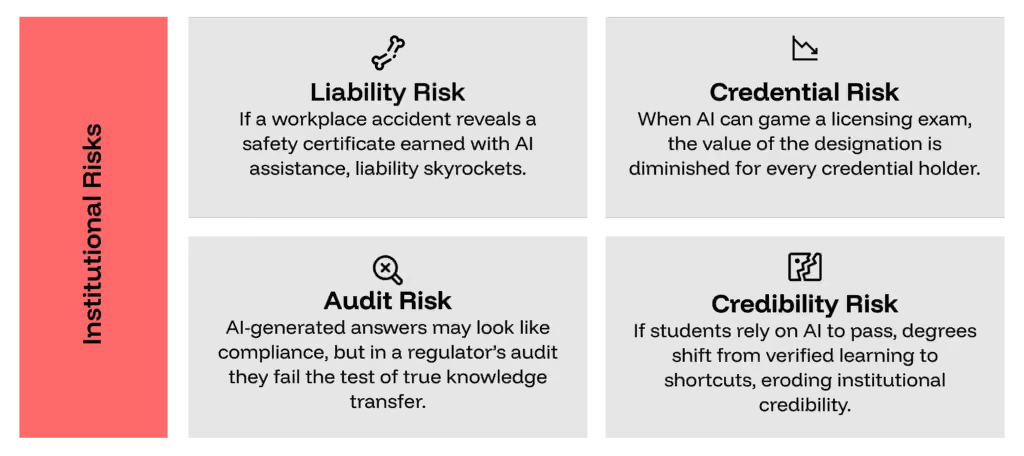
The credibility of your credential is its greatest asset. If candidates can bypass exam integrity with AI, the value of your certification program is immediately at risk.
- Credential devaluation: If AI shortcuts are widely suspected, your certification may lose its prestige and competitive advantage.
- Erosion of employer trust: Companies may question whether certified professionals truly demonstrate the required competencies.
- Regulatory and legal exposure: In fields like healthcare, aviation, or finance, compromised certifications can introduce public risk and liability.
- Member dissatisfaction: Candidates who earn their credential fairly may feel devalued if peers can “game the system.”
Why Traditional Exam Security Falls Short
Most exam security measures were designed for a pre-AI world. Legacy tools weren’t designed to detect AI-enabled misconduct. Lockdown browsers, AI-only monitoring, and human-only oversight leave dangerous gaps.
- Lockdown browsers can be bypassed or may not prevent candidates from using a second device.
- AI-only proctoring often misflags normal behaviors, leading to false accusations and poor candidate experiences.
- Human-only oversight can’t scale cost-effectively and risks overlooking subtle AI-assisted cheating.
The reality is clear: new threats require new solutions.
A Path Forward: Hybrid Security for the AI Era
To protect the integrity of credentials, institutions must embrace approaches designed for this new landscape. That means:
- Conducting a security audit: Evaluate whether current proctoring methods are resilient against AI-enabled cheating.
- Adopting hybrid proctoring: Combine AI’s efficiency with the judgment and nuance of human review to catch what machines alone cannot.
- Reducing friction for candidates: Security doesn’t have to come at the expense of user experience. Solutions should be no-install, device-agnostic, and low-support-burden to maintain accessibility.
- Communicating proactively: Show members, employers, and regulators that your organization is addressing AI head-on — not waiting for a scandal to spark change.
Protecting the Value of Certification
Your credential is more than a certificate or a badge. It represents trust, competence, and reputation. In the age of AI, safeguarding that trust means ensuring exams are secure, fair, and credible.
Because if AI can pass your exams, and nothing is done to respond, the profession itself is at risk.
At Integrity Advocate, we believe the path forward is clear: privacy-first, hybrid online proctoring. Unlike one-dimensional solutions, our approach combines the precision of AI with the judgment of human oversight to deliver both security and fairness.
With our no-install, friction-free platform, candidates can focus on their exam while organizations maintain the highest standards of integrity. Our hybrid solution ensures:
- Robust identity verification – confirming the right person is taking the exam.
- Smart monitoring – AI detects potential issues while human reviewers provide context and fairness.
- Actionable oversight – suspicious activity is clearly identified and presented to assessment administrators for confident decision-making.
- Candidate-first experience – no installs, device-agnostic access, and minimal technical barriers keep the exam environment stress-free.
By uniting technology with human judgment, Integrity Advocate helps certifying bodies protect credential value without compromising the candidate experience.
Ready to safeguard your credential in the AI era? Let’s talk.
Sources:
- Kung, T. H., et al. “Performance of ChatGPT on USMLE: Potential for AI-Assisted Medical Education Using Large Language Models.” JMIR Medical Education. 2023. Link
- Chiu, T. Y., et al. “Comparing performance of GPT-3.5, GPT-4, and GPT-4o on USMLE, PLAB, HKMLE, and NMLE medical licensing examinations.” BMC Medical Education. 2024. Link
- Reuters. “Artificial intelligence is now an A law student, study finds.” June 2025. Link
{{post-cta}}
Foire aux questions
Trouvez les réponses aux questions les plus fréquemment posées par nos clients.
The Credential Security Trifecta is a framework from Integrity Advocate that connects three components of a defensible credential ecosystem: Learning & Assessment Infrastructure where performance is measured, Identity & Integrity Verification where identity is confirmed and integrity decisions are documented, and Secure Digital Credential Issuance where verified performance becomes a tamper-resistant, independently verifiable credential. Operating as one integrated system rather than isolated tools, these three components form a defensible chain of trust.
Assessment security historically focused on preventing misconduct during testing. That remains important, but AI-enabled misconduct, identity fraud, contract cheating, and synthetic digital documents have expanded the risk. Digital credentials are now widely shared across LinkedIn profiles, employer systems, and workforce platforms, making them public representations of institutional trust. The question institutions must answer has moved from "was this test monitored" to "is this credential defensible."
Most organizations run a learning management system, an integrity or proctoring solution, and a credentialing platform as three separate layers. Each may work well on its own, but if they are not intentionally aligned, organizations can lack a clear documentation trail from identity verification to issuance, audit-ready evidence of how integrity was upheld, a consistent standard across programs, and confidence that only verified outcomes result in credentials.
It is written for certification bodies, higher education leaders, workforce programs, and assessment teams responsible for protecting credential value, particularly organizations issuing credentials that influence hiring, promotion, licensure, or professional standing.
How to verify identity at scale, how to document integrity decisions, how to ensure credentials are only issued for verified performance, and how to validate credentials long after they are awarded. These are governance questions as much as technical ones, and they affect compliance, employer trust, learner confidence, and institutional reputation.