Resource Center
Research, guides, and real-world insights on online proctoring; helping your program deliver results that are fair, trustworthy, and defensible.
10M+
Assessments secured
Zero
Data breaches in 12+ years
98%
Client retention rate
120+
Resources published
Featured article

Trust by Evidence: A New Framework for Defensible AI Decisions
Integrity Advocate has released a new whitepaper, Trust by Evidence, introducing a framework that connects AI due process, learner rights, and credential security into one model for defensible AI-assisted assessment. This post walks through what the framework covers, why AI adoption alone no longer settles the integrity question, and links to the full whitepaper download.
Assessment integrity used to mean one thing: was the exam monitored? That question is no longer enough. AI now plays a role in identity verification, proctoring flags, authorship review, scoring, and credential validation, and each of those touchpoints can be challenged.
Confidence in an outcome isn't just about whether AI was accurate. It's about whether the decision it contributed to can be explained, reviewed, appealed, and verified after the fact.
As AI becomes embedded deeper into assessment, institutions are being asked a more pointed question: Can you defend the decision AI helped you make?
That question requires more than accurate technology. It requires a system.
In our latest whitepaper, Trust by Evidence, CEO Brandon A. Smith introduces a framework that connects AI due process, learner rights, and credential security into one model for defensible outcomes.
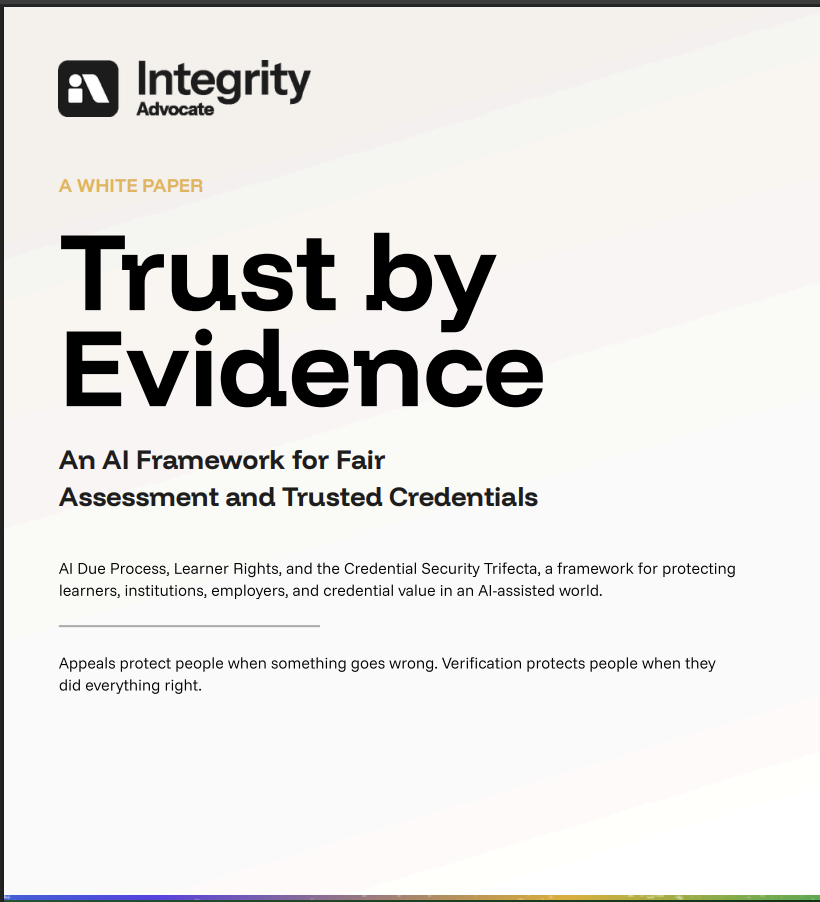
Download the whitepaper
The Shift From AI Adoption to Defensible Outcomes
For the past several years, the conversation in education and credentialing has centered on adoption: which AI tools to use, how to deploy them, how accurate they are. That conversation is largely settled. Most programs already use AI somewhere in the assessment lifecycle.
What hasn't been settled is defensibility. When an AI-influenced decision is challenged, whether by a learner, an employer, or a regulator, an institution needs to answer a specific set of questions: was there notice, meaningful human review, supporting evidence, and a path to appeal? If any of those answers are unclear, the decision isn't defensible, and the institution is exposed right along with the learner.
The next major challenge in education isn't AI adoption. It's building outcomes that hold up under scrutiny.
Why Treating AI as a Single Safeguard Creates Risk
Many programs rely on AI to do one job: flag anomalies. That model treats a flag as a finding rather than a signal, and it breaks down under three conditions:
- No documented process exists for what happens after a flag is raised.
- Human review means approving the AI's output rather than independently evaluating it.
- There's no clear path for the learner to respond, and no record for the institution to point to later.
Any one of those gaps makes an outcome difficult to defend. Together, they create real exposure, not just to individual learners, but to the institution's accreditation standing, employer trust, and legal risk.
The Trust by Evidence Framework
The whitepaper introduces Trust by Evidence, a framework that connects three ideas typically treated in isolation:
AI Due Process: A fair, documented process for any consequential decision AI contributes to, so a flagged learner has an actual process to walk through rather than a black box to accept.
The Learner Rights Layer: Seven specific rights, to know, to meaningful human review, to explanation, to evidence, to appeal, to proportionality, and to verification, that turn "the system flagged it" into a decision an institution can explain and stand behind.
The Credential Security Trifecta: A secure chain of trust connecting learning, assessment, and credentialing, where a weakness in any one layer undermines the others.
Individually, each idea is familiar. Together, they hold up under scrutiny from everyone with a stake in the outcome: the learner, the institution, employers, regulators, and the public.
What a Defensible AI-Assisted Decision Looks Like
A defensible process doesn't rely on confidence in the algorithm. It provides an actual record. It lets an institution answer, with certainty:
- Was the individual notified that AI was involved?
- Did a qualified reviewer examine the evidence, not just the score?
- Could the individual respond before a consequence was applied?
- Is there a documented, time-bound appeal path?
- Can the outcome be explained to someone outside the institution?
These are governance questions as much as technical ones. Answering them well protects accreditation standing, employer trust, and learner confidence all at once.
What You'll Learn in the Whitepaper
The full whitepaper expands on:
- Why algorithmic due process, procedural justice, and automation bias research all point toward the same conclusion for education
- The Defensible Outcomes Responsibility Matrix, a governance tool for assigning clear ownership across vendors, institutions, and credential issuers
- The five-stage AI Appeals Framework, walked through with a real worked example of a contested proctoring flag
- Sector-specific guidance for K-12, higher education, workforce certification, and employers
- A candid discussion of the framework's limitations, including cost, scale, and surveillance risk
It's written for compliance leads, credentialing bodies, assessment teams, and program leaders responsible for the outcomes their institution has to stand behind.
{{post-cta}}
All resources

Case Study: How CMRAO Set Education Standards for Condominium Managers
February 4, 2026
|
5 min read
The Condominium Management Regulatory Authority of Ontario (CMRAO) needed to deliver a new licensing course and proctor its exams to meet Ontario's education and licensing requirements for condominium managers. CMRAO adopted uxpertise's all-in-one LMS with integrated online proctoring, powered by Integrity Advocate, to deliver its Excellence in Condominium Management course entirely online while administering secure, proctored exams within the same system. Since 2021, more than 2,500 students have graduated through the program.
The Condominium Management Regulatory Authority of Ontario (CMRAO) is a not-for-profit corporation established in November 2017 by the Government of Ontario under the Condominium Management Services Act, 2015. As a regulator, CMRAO provides consumer protection for Ontarians living and investing in condominiums by regulating and licensing condominium managers and management provider businesses.
Executive Summary
Challenge: CMRAO needed to find a learning management system to host a new course and a solution for online exam proctoring. The organization created a course to obtain a limited licence, hosted online, requiring a 75% passing grade. Given the regulated nature of the industry, exam integrity through proctoring was essential.
Solution: CMRAO was initially looking for two separate solutions but found uxpertise, which offered both an LMS and integrated proctoring in one platform. CMRAO was looking for a cost-effective, Canadian solution, and uxpertise was the match.
Results: Since 2021, there have been more than 2,500 graduates of the Excellence in Condominium Management course. CMRAO started with 3 classes in 2021 and grew to 34 classes by 2024, an 11x increase in sessions.
Deliver Their Course and Ensure Integrity
To meet new education and licensing requirements for condominium managers, CMRAO adopted uxpertise's LMS combined with its integrated online proctoring service as a cost-effective, all-in-one solution. The platform allowed CMRAO to deliver the new Excellence Course entirely online, ensuring accessibility during COVID-19 while maintaining the integrity of instructor-led training. It also let them administer secure, proctored exams within the same system, streamlining the licensing process and reducing administrative complexity.
CMRAO was able to easily duplicate courses and exams for recurring sessions, with independent statistics for tracking learner progress and completion. The entire setup took only six weeks, handled primarily by one administrator, with responsive customer service resolving technical questions rapidly along the way.
Results
The CMRAO has successfully launched its Excellence in Condominium Management course, completing its mandate to set the education standard among condominium managers. From no formal training to a comprehensive course with a proctored exam, CMRAO changed the industry and advanced its mission to enhance consumer protection.
The numbers reflect that growth: CMRAO now sees an average of 220 monthly active users on the platform, with approximately 3,000 learners registered for the course in under four years. More than 1,500 learners have taken a proctored exam using the service launched in 2023, and more than 2,500 students have graduated between November 2021 and August 2025.
What's Next
Four years after launch, CMRAO is ready to expand its offering and use the platform to its full potential. Planned initiatives include continuing education courses for licensed condominium managers to support ongoing professional development, and internal staff training programs covering customer service, communication skills, and emotional intelligence.
{{post-block-quote}}
{{post-cta}}

Case Study: How Canadian Food Safety Group Expanded Access to Proctored Food Safety Training
June 5, 2025
|
5 min read
Canadian Food Safety Group operates in a complex environment where each province mandates some level of food handler training, but few require all workers to certify, leaving critical compliance gaps. Many of the workers who need this training are supporting families or funding their own education, so training needed to stay flexible, affordable, and accessible. Partnering with Integrity Advocate allowed Canadian Food Safety Group to deliver secure, proctored assessments online, with nothing to install, expanding access to food safety training for workers across Canada without driving up costs.
Canadian Food Safety Group needed a way to expand access to trusted food safety certification without sacrificing affordability or authenticity. Partnering with Integrity Advocate allowed them to deliver secure, proctored training online, available on mobile with nothing to install. That's what happens when accessibility meets integrity.
Key Outcomes
- Reduced training costs passed on to learners
- Strengthened national food safety compliance
- Scalable online proctoring with no installation
- Improved accessibility for learners across Canada
Challenge
Canadian Food Safety Group operates in a complex environment. Each province mandates some level of training, yet most don't require all food handlers to certify, leaving critical compliance gaps. In an industry where many workers are supporting families or funding their education, training needs to be flexible, affordable, and accessible to succeed. Employers also had to see the value in training every staff member, not just those required by law.
To close the gap, Canadian Food Safety Group needed a solution that could expand access to training for all food handlers, not just those legally required to certify, deliver verified, proctored assessments without raising costs for learners or organizations, remove technical barriers like app downloads or scheduled sessions, and scale nationwide to reach tens of thousands of workers across a fragmented industry.
Recognizing these challenges, they made the strategic decision to move their food safety training online, but only with a trusted proctoring partner who could maintain authenticity, security, and affordability without compromise. That's where Integrity Advocate entered the picture.
Solution
Canadian Food Safety Group knew that education, not enforcement, was the key to lasting change. By making food safety training more accessible, ongoing, and affordable, they could raise compliance rates while fostering stronger, more cohesive teams who took pride in their work.
With Integrity Advocate's no-install proctoring solution, they were able to deliver verified online assessments without requiring downloads, installations, or technical support, offer a flexible, secure training experience that works across all devices and internet connections, and maintain the authenticity and integrity of certifications without driving up costs.
Food preparation is both an art and a science, and Canadian Food Safety Group understood that both demand skill, care, and consistency. By partnering with Integrity Advocate, they made it easier for food handlers across Canada to master both.
Results
By moving their training and assessments online with Integrity Advocate, Canadian Food Safety Group reduced operational costs and passed every dollar of savings directly back to their learners. Affordability remained at the forefront, without sacrificing the security and integrity of the certification process.
Choosing a trusted Canadian partner also delivered immediate advantages: seamless collaboration, responsive support, and the confidence that comes from working with a privacy-first solution built to meet their exact needs.
Backed by Integrity Advocate's ongoing support, Canadian Food Safety Group continues to expand access to food safety training nationwide, strengthening compliance, supporting workers, and helping businesses deliver safer, higher-quality service to every customer.
{{post-cta}}

Case Study: How My Food Service License Brought ANSI-CFP Accredited Certification Online
May 14, 2026
|
5 min read
When Chris Viso founded My Food Service License, he set out to do what many thought was impossible: move an in-person food protection training program fully online. ANSI-CFP's accreditation requirements for food management exams are extensive, requiring proctored exams, verified identification, and strict monitoring to prevent notes, cellphones, or outside assistance. Integrity Advocate became a trusted partner throughout the two-year process of building the exam and securing accreditation, and remains the proctoring foundation behind My Food Service License's continued growth today.
When Chris Viso founded My Food Service License, he was taking on what many thought would be an impossible task: moving an in-person training program into the internet age.
{{post-block-quote}}
Moving things online was the obvious solution, but there were serious regulatory hurdles to clear first.
Challenge
"ANSI-CFP requirements for food management exams are extensive," Viso explained. "It has to be a proctored exam; you must verify the identification of the individual taking it. The examinee can't be with another person; they can't have things on their desk, they can't use notes, have cellphones, all that has to be strictly monitored. We have to prove that we're doing those things to the accreditation board."
The My Food Service License team spent two years building an online exam and completing the accreditation application. Throughout the process, Integrity Advocate was a trusted partner that helped bring Viso's vision to life.
ANSI-CFP Expertise
From the start, Integrity Advocate was committed to helping My Food Service License get off the ground. "We came across Integrity Advocate early in the planning stages. They genuinely seemed excited about what we were doing; they had open arms in terms of, 'How can we get you there?'" Integrity Advocate's technical expertise and experience in the sector made them a trusted partner throughout the process, from understanding ANSI-CFP regulations to building out a rule set that satisfied them.
"I would highly recommend Integrity Advocate to anyone doing high- or low-stakes testing," Viso said. "The relationship, the support, the overall product is top of the line."
Integrity Advocate stood out because it didn't require a complicated process. There was nothing to download and no access code; users kept using what they were already familiar with. A key part of that was mobile support and the ability to deliver around-the-clock results, both major advantages for busy food service workers.
"The big seller was on-demand access," Viso added. "That, in and of itself, had the ability to put us out in front of our competitors."
A Trusted Partner
Integrity Advocate and My Food Service License were aligned on the vision, but the real test was still to come. Going live and ironing out last-minute issues can challenge any relationship. Fortunately, My Food Service License had a trusted partner in Integrity Advocate, and the two organizations worked together to ensure a successful launch.
"It was super easy," Viso said. "It really says a lot about how Integrity Advocate was committed to resolving anything that came up; I've never experienced that type of service from any partner I've ever had."
Growing Together
Since going live in September 2023, "we're growing month over month," Viso said. "Integrity Advocate has continued to provide the support we need. When things came up, they were resolved quickly. And as we've grown, they've continued to deliver a high level of service."
My Food Service License's online training and exam program may be straightforward, but its impact is significant. Properly trained and certified food service staff are the first line of defense against foodborne illness. Together, My Food Service License and Integrity Advocate are making rigorous training easy to access, without compromising the integrity and value of the certification process.
{{post-cta}}

Case Study: How AIM Group Brought Ofqual-Regulated Assessments Online
January 25, 2026
|
5 min read
AIM Qualifications and Assessment Group, a leading UK Awarding Organisation, recognized that online assessments would soon become the default, but needed a solution that met Ofqual's strict regulatory standards without adding complexity for learners or administrators. AIM partnered with Coelrind and Integrity Advocate to build a seamless, fully compliant remote assessment system that works on any device, requires no installations, and upholds exam integrity across multiple UK testing centres.
Digital transformation in assessment isn't as simple as swapping a classroom for a video call. It requires purpose-built technology and strong partnerships to get it right. AIM Qualifications and Assessment Group, a leading UK Awarding Organisation, recognized that online assessments would soon become the norm, but needed a solution that met Ofqual's strict standards without adding complexity for learners or administrators.
{{post-block-quote}}
Key Outcomes
- Full regulatory compliance and alignment with Ofqual's assessment standards
- Seamless accessibility with no plug-ins or installations required
- Mobile-friendly and user-focused, working on any device
- Scalable and cost-effective across multiple UK testing centres
- Minimized technical issues through pre-exam system checks and clear instructions
Challenge
Bringing regulated assessments online comes with high stakes. Security, compliance, and accessibility all need to align without creating unnecessary barriers for test-takers. AIM Group needed a solution that upheld assessment integrity while making the process seamless for learners and administrators alike.
In-person exams were costly and difficult to scale, requiring dedicated invigilators and significant administrative overhead. Most proctoring tools on the market weren't flexible enough, many required plug-ins, lacked tablet compatibility, and introduced unnecessary hurdles for learners. And compliance was critical: every assessment had to meet strict integrity standards to ensure qualifications remained credible in a digital format.
"We were addressing two very specific issues, the tablet issue and the plug-in issue, which were making it impossible to bring one of AIM's largest clients onboard," said John O'Sullivan of Coelrind.
Why Compliance Matters
As an Ofqual-regulated Awarding Organisation, AIM Group must meet the Office of Qualifications and Examinations Regulation's high standards for fairness and security, whether assessments are delivered in person or online. That meant adhering to evolving guidelines covering the responsible use of AI in assessment security, strict invigilation requirements to prevent misconduct, and technical standards ensuring online exams remain as rigorous as traditional assessments.
Solution
AIM Group worked with Coelrind and Integrity Advocate to tailor a remote assessment system that removed technical barriers while ensuring exam integrity. Coelrind provided the technical foundation through its learning and assessment platform, enabling AIM Group to manage exam delivery across multiple testing centres. Integrity Advocate ensured security and compliance with a no-install, mobile-friendly proctoring solution aligned with Ofqual's regulations. User experience remained a top priority throughout, with built-in system checks, clear instructions, and cross-device accessibility ensuring every learner could complete their exam without frustration.
"The main goal was to make this user-friendly, for the end users... to make sure that when they get to the live exam, it all works swimmingly," Bailey said.
Results
Now fully implemented, AIM Group's system has transformed assessment delivery. "It all seems to be working well. Everyone's got a great new asset to support their learners with," Bailey said.
"Integrity Advocate is really easy to work with, really fun to work with and very responsive," Bailey added. "There's always a quick turnaround for change requests; they've kept us updated with their progress. I would recommend them 100%."
AIM Group's experience highlights the complexity of getting online assessment right, especially when working with regulated qualifications. With the right technology and strong partnerships, it's possible to deliver a solution that's easy to use, cost-effective, and puts learners first.
{{post-cta}}

Case Study: How Alliance Safety Council Took High-Risk Training Remote Without Losing Legal Defensibility
February 24, 2025
|
5 min read
Alliance Safety Council (ASC) has spent over 60 years setting the standard for high-risk workforce training in petrochemical, power generation, and manufacturing, industries where compliance isn't optional. Their in-person, proctored training model relied on identity verification and close monitoring to serve as an impartial third-party administrator for clients. As demand for remote training grew, ASC needed a solution that could match that legal defensibility without the logistical headaches, or the technical barriers that most online proctoring tools introduced. Integrity Advocate became that partner.
When safety training can mean the difference between life and death, there's no room for shortcuts. For over 60 years, Alliance Safety Council (ASC) has set the standard for high-risk workforce training, ensuring every program is legally defensible and fully compliant.
Key Outcomes
- Reduced travel and costs, as participants can now complete training from anywhere
- Improved access and scalability with a mobile-friendly system for on-site or remote training
- Maintained legal integrity through identity verification and participation monitoring
- Lower environmental impact from fewer miles traveled
Challenge
ASC serves high-risk industries like petrochemical, power generation, and manufacturing, where compliance isn't optional. To maintain legally defensible training records, ASC historically relied on in-person, proctored training. Every participant underwent identity verification and close monitoring, allowing ASC to serve as an impartial third-party administrator for its clients.
{{post-block-quote}}
Moving online risked losing the third-party oversight ASC relied on for compliance and legal defensibility. High travel costs and time off work created unnecessary barriers for workers, and most proctoring solutions on the market required software installations, failed security protocols, or introduced IT headaches for enterprise clients.
ASC needed a scalable, secure online proctoring solution that could match the integrity of their in-person process without adding complexity for learners. Beyond technology, they needed a partner who understood their challenges and could adapt alongside them.
"We didn't want to just be a customer of a software solution," Kohls emphasized. "We needed someone who had the level of patience and interest to come along on this road with us."
Results
With Integrity Advocate as a proctoring partner, Alliance Safety Council has redefined how high-risk workforce training is delivered, expanding access while maintaining the highest compliance standards. With mobile-friendly proctoring, legally defensible verification, and a trusted partner by their side, ASC has eliminated travel barriers, reducing time off work and operational costs as well as carbon footprint for participants. Workers can now complete training on-site or remotely, even during outages and unplanned events, while identity verification and participation monitoring keep training records legally defensible.
"We've never felt alone on this journey," Kohls said. "Integrity Advocate's expertise and commitment have been with us every step of the way."
A Partnership Built on Trust
Proper training protects lives, prevents accidents, and ensures workers in high-risk industries are fully prepared for their jobs. That's why finding the right partner matters: safety training isn't just about meeting requirements, it's about trusting that every worker has the skills they need to stay safe on the job.
"They've gone above and beyond to help us educate our customers," Kohls said. "There's no other vendor that would fly from Canada to South Louisiana to host a lunch-and-learn for 30 people. That's because we're more than just a customer to them, and they're more than just a vendor to us."
As workforce training evolves, Alliance Safety Council and Integrity Advocate continue to set the standard, ensuring safety programs meet the highest benchmarks for reliability, compliance, and real-world impact.
{{post-cta}}

Case Study: How BCIT Modernized Proctoring Without Compromising Student Privacy
April 16, 2026
|
5 min read
When BCIT's legacy proctoring provider began generating student frustration and privacy concerns, the institute needed a replacement that could meet some of the world's strictest privacy standards, integrate with its existing LMS, and roll out mid-year without disrupting more than 48,000 students. Integrity Advocate delivered a no-install, privacy-first solution that proctored over 13,000 exams in a single semester, with only 1% of students requiring support.
British Columbia has some of the most stringent privacy protection laws in the world, and the British Columbia Institute of Technology holds its technology partners to the same standard. When BCIT's legacy proctoring provider began generating rising privacy concerns and student frustration, across a student body of more than 48,000 and 2,000+ faculty, the institute needed a change that wouldn't disrupt learning in the process.
Key Outcomes
- 13,000+ exams proctored remotely in one semester
- Successful mid-year integration with D2L Brightspace
- Only 1% of students needed support
- Improved student satisfaction and privacy compliance
Challenge
BCIT needed a solution that could protect student privacy without compromising exam security, integrate easily with its existing D2L Brightspace LMS, reduce student support needs and administrative burden, and offer flexible, exam-level rule sets to accommodate diverse course requirements. With the COVID-19 pandemic requiring 100% of exams to move online, the transition had to happen quickly, without disrupting learning.
{{post-block-quote}}
Solution
Integrity Advocate offered BCIT a no-install, privacy-first solution that integrated seamlessly with D2L Brightspace and minimized administrative overhead. The partnership let BCIT switch proctoring providers mid-year with limited disruption, empower faculty to enable proctoring on a per-exam basis, reduce student frustration by eliminating unnecessary downloads and complexity, and improve transparency and ease of use for both students and staff.
Academic Level Validation and flexible rule sets gave faculty the control they needed, while Integrity Advocate's integration and support ensured proctoring remained effortless and trusted across every course and exam.
Results
In just five months, BCIT proctored over 13,000 remote exams with Integrity Advocate, delivering a smoother, more secure experience for students and faculty without sacrificing privacy or ease of use.
Faculty members easily enabled proctoring where needed, reducing administrative burdens and keeping student support requests under 1%, a dramatic improvement that reinforced BCIT's commitment to student satisfaction. By partnering with Integrity Advocate, BCIT met its privacy and accessibility goals and set a higher standard for modern, student-centered proctoring.
{{post-cta}}

Case Study: How the National Payroll Institute Cut Integrity Incidents in Half
July 24, 2026
|
5 min read
When the National Payroll Institute (NPI) moved its Payroll Compliance Professional and Payroll Leadership Professional designations online, its first proctoring solution created more problems than it solved. After switching to Integrity Advocate, NPI proctored more than 30,000 exams with fewer than 1% of users requiring support, cut academic integrity incidents from an average of 86 per month to 37, and reduced incident review time from weeks to 48 hours.
The National Payroll Institute issues two professional designations, the Payroll Compliance Professional and the Payroll Leadership Professional, held today by more than 21,000 members. Integrity is one of NPI's four core values, so when the COVID-19 pandemic forced a rapid shift away from honor-based, supervisor-led proctoring, NPI needed an online solution that could uphold that standard at scale.
Key Outcomes
- 57% reduction in academic integrity incidents, from an average of 86 per month down to 37
- Fewer than 1% of users require technical support
- More than 30,000 exams proctored with a seamless experience
Challenge
NPI's first attempt at online proctoring didn't hold up. The system required plugin downloads, ran on a limited set of browsers, and offered no French-language support for the 12% of NPI's membership that operates in French. Close to half of students hit a technical issue during their exam. For a body responsible for validating the competency of more than 17,000 PCP and 4,000 PLP designation holders, that wasn't a minor inconvenience. It was a threat to the credibility of the credential itself.
{{post-block-quote}}
A Complete Transformation in User Experience
After switching to Integrity Advocate, the technical support burden that used to consume staff time became close to invisible. Integration with NPI's D2L Brightspace LMS meant students could move directly from coursework into a proctored exam without separate logins or downloads, and the entire implementation took a single 45-minute setup meeting, compared to weeks of troubleshooting under the previous system.
"We're getting very little feedback," Pacella said. "And that's amazing. That speaks volumes. That's exactly what we want. You don't hear about software that works well typically... But if it didn't work, you better believe we're going to hear about it a lot."
Dramatic Improvement in Academic Integrity
Paired with a proactive integrity education module, NPI's average dropped from 86 incidents per month to 37, a reduction of more than half, and the improvement held steady over time.
"We went from an average of 86 incidents per month, and it dropped more than in half, down to 37," Pacella said. "And that's been very consistent since we implemented some of these resources and things for people to understand what academic integrity means."
The reduction wasn't just about fewer incidents. It was about quality. The incidents that remained were genuine violations, not technical false positives or misunderstandings about proctoring protocols. That let NPI's review committees spend their time on legitimate concerns instead of sorting through noise, producing more consistent, more defensible decisions.
Seamless Student Experience
Daniela Kwiatkowski, NPI's Manager of Learning and Professional Development, experienced the system firsthand when she took one of NPI's own courses. Her experience highlighted how the technology disappeared into the background, letting students focus on demonstrating their professional competency.
"Before you do it for the first time, you're thinking, how am I going to do this?" Kwiatkowski said. "I moved the camera to one corner and then I forgot about it, and it was easy to forget about it. It wasn't constantly there... now I could focus on the exam, which is what we want people to do."
Scaling Success Across the Organization
NPI's growth didn't stop once the technical problems were solved. According to Steven Van Alstine, Vice President of Professional Standards and Education, NPI moved from proctoring a few thousand students to e-proctoring every student pursuing the Payroll Compliance Professional designation, a ramp-up that happened in under three months.
"We were able to scale that up dramatically through our move to D2L Brightspace and the integration with Integrity Advocate," Van Alstine said. "There was a point at which we maybe had a few thousand students being e-proctored, to the point now where every one of our students is e-proctored... and that ramp-up happened in less than three months."
That rapid scaling extended across NPI's mixed delivery model, including partnerships with public and private academic institutions alongside direct-to-student programs, without requiring different standards across channels.
Administrative Efficiency and Confidence
Decision-making that previously took weeks now happens within 48 hours, with clear evidence and streamlined processes. The administrative team developed communication templates and tracking systems to ensure consistent, fair handling of every incident.
"Giving someone a zero on an exam or failing a course is a big deal," Kwiatkowski said. "I cannot emphasize it enough... Having the peace of mind to know this is an incident that was flagged for the right reasons... we are very confident that this is legitimate."
Advice for Other Organizations
NPI's guidance to other certifying bodies is straightforward: technical due diligence up front saves significant time later.
"There are a lot of products out there," Pacella said. "And you're going to reach out to them, and the sales team will talk a big game about all the wonderful things they can do. Take your time and understand the technical aspects of implementation before making a decision."
{{post-cta}}

Modern Threat Detection for Online Exam Integrity
December 19, 2025
|
5 min read
Modern cheating in online assessments does not always look like glancing off-screen or whispering. It is increasingly subtle, technical, and AI-powered, often operating through plugins and browser tools that bypass surface-level monitoring entirely. This post explains how Integrity Advocate's threat detection operates across three layers, environmental signals, behavioral analysis, and on-screen activity, how ExposeAI addresses AI-assisted cheating without overreach, and why human validation of every flagged event is what makes detection fair, accurate, and defensible.
Online assessments are facing a new generation of integrity threats. Cheating today doesn’t always look like someone glancing off screen or whispering into a microphone. It’s more subtle, more technical, more sophisticated, and increasingly powered by AI tools.
To protect the value of exams and credentials, proctoring must evolve beyond basic monitoring to intelligent threat detection; built to recognize modern misuse patterns (including AI-assisted cheating) across the environment, behavior, and on-screen activity, and interpret signals in context.
Active Threat Detection
Online proctoring has always depended on clear evidence: video, audio, screen capture, and review. Integrity Advocate delivers that foundation, then goes further by connecting signals across the session to pinpoint credible integrity risk.
Modern threats require systems that can:
- Identify suspicious patterns across multiple signals
- Distinguish between normal behavior and meaningful risk
- Evolve ahead of integrity threats
Monitoring the Environment: Detecting Risk Beyond the Screen
Integrity Advocate evaluates environmental signals that may indicate unauthorized assistance or compromised testing conditions, including:
- Presence of additional people or voices
- Repeated off-camera movement or positioning
- Incomplete or inconsistent room scans
- Secondary devices detected during the session
Rather than treating each signal in isolation, these indicators are evaluatend in context, reducing false positives while highlighting situations that warrant closer review.
Behavioral Analysis: Understanding How Test-Takers Interact
Behavior often tells a more complete story than any single event. Integrity Advocate analyzes behavioral patterns such as:
- Unusual gaze direction or frequency
- Repetitive movements tied to external references
- Timing irregularities that suggest outside input
- Inconsistent engagement patterns throughout the exam
These behaviors don’t automatically imply misconduct, but when patterns emerge, they can indicate elevated risk. Our system is designed to surface patterns, not jump to conclusions.
On-Screen Threat Detection: Identifying Suspicious Activity
As digital cheating methods evolve, on-screen monitoring has become critical. Integrity Advocate detects and flags suspicious on-screen activity, including:
- Unauthorized applications or system processes
- Tab switching and window focus changes
- Screen behavior inconsistent with expected exam flow
- Activity patterns associated with AI-assisted tools
This layer is especially important in the AI era, where misuse may not involve another person, but rather external tools operating quietly in the background.
Addressing AI-Assisted Cheating Without Overreach
AI presents a unique challenge in online assessments, not because it’s obvious, but because it’s increasingly subtle. Modern generative AI tools don’t just assist test-takers; they read, listen, respond in real time, and mimic human behavior, often operating through plugins and browser tools that bypass surface-level monitoring entirely.
That’s why Expose AI is designed to go beyond traditional tool blocking or reactive detection.
Integrity Advocate monitors behavior and patterns to spot use of generative AI tools, helping protect exam validity as AI-assisted cheating continues to evolve.
Our approach includes:
- Monitoring on-screen behavior patterns associated with AI-assisted workflows
- Analyzing interaction timing and response anomalies that indicate external generation or assistance
- Flagging sessions where behavior deviates from normal exam flow
Crucially, AI does not make final determinations. Expose AI surfaces risk signals, but every flagged event is validated through human review, ensuring fairness, accuracy, and defensibility, especially in high-stakes testing scenarios.
Advanced threat detection doesn’t require invasive surveillance. Integrity Advocate is built to balance effective detection with privacy-first design, recognizing that institutions need solutions that are both secure and respectful.
The landscape is changing fast. Integrity Advocate helps you navigate it, staying ahead of evolving integrity risks with detection designed for what’s happening now and what’s coming next.
Why Human Validation Is Crucial
Automated detection without oversight creates risk. Integrity Advocate combines intelligent detection with trained human reviewers who:
- Confirm whether flagged behavior represents a real integrity concern
- Provide contextual judgment that automation alone cannot
- Reduce false positives and bias
- Deliver audit-ready documentation institutions can trust
This hybrid approach ensures that decisions are accurate, fair, and explainable.
Why Hybrid AI + Human Review Delivers Fairer, More Accurate Proctoring
Built to Scale, Designed to Respect Privacy
Advanced threat detection does not require invasive surveillance. Integrity Advocate is built with a privacy-first architecture, designed to:
- Collect only what’s necessary to protect integrity
- Avoid persistent tracking or unnecessary data retention
- Support regulatory compliance and learner trust
- Balance security with a smooth, low-friction testing experience
Institutions shouldn’t have to choose between integrity and trust. With the right approach, they can have both.
The Clear Choice for Modern Assessment Security
The future of proctoring isn’t about watching everything, it’s about detecting what matters.
Integrity Advocate delivers:
- Intelligent threat detection across environment, behavior, and screen activity
- AI-aware risk analysis for modern cheating methods
- Human-validated review for defensible outcomes
- Privacy-first, no-install simplicity
- Seamless integration into existing LMS workflows
As integrity threats evolve, Integrity Advocate remains focused on what matters most: protecting exams, respecting learners, and delivering security that stands up to scrutiny.
Schedule a Demo to learn more!
{{post-cta}}

The Growing Risk of Installing Browser Extensions and Plugins
November 1, 2020
|
5 min read
Proctoring software that requires installation gives vendors access to webcams, microphones, browsing history, and personal files, often without users fully understanding what they are agreeing to. This post examines the real risks of browser extensions and plugins, the Cassidy Wolf case as a landmark example of what can go wrong, and how Integrity Advocate's no-download, browser-based architecture eliminates most of these risks by design.
As children, most of us were told never to talk to strangers. The reasoning was straightforward: not everyone can be trusted, and the risk of getting it wrong is too high.
That lesson served us well offline. Online, we seem to have forgotten it entirely.
Every day, people install applications, plugins, and browser extensions onto their devices without giving it much thought. A productivity tool here, a proctoring extension there. What most people do not realize is what can come along for the ride.
What Unfamiliar Software Can Actually Do
The risks of installing unfamiliar software range from inconvenient to serious. Depending on what is embedded in the code, a plugin or extension can:
- Infect a device with viruses or malware
- Steal personal information stored on the device or entered through the browser
- Damage or destroy the operating system
- Remotely control the device, including the webcam, without the user's knowledge
That last one is not a hypothetical.
The Cassidy Wolf Case: When a Plugin Becomes a Surveillance Tool
Miss Teen USA Cassidy Wolf was among the first public figures to experience what happens when a device is compromised through an inadvertent software installation. Her computer was infected with a Remote Administrative Tool, commonly known as a RAT, which gave a hacker complete control of her webcam without her knowledge or consent.
She was not alone. More than two dozen women had their computers compromised by the same individual. An extensive FBI investigation ultimately resulted in the hacker, a student at the time, being sentenced to prison.
The case was a turning point in public awareness about the risks of software installation. But the threat has not gone away. If anything, the volume and sophistication of malicious extensions has grown significantly since then.
Why Proctoring Extensions Deserve Extra Scrutiny
Online proctoring software sits in a uniquely sensitive position. It is installed on personal devices, often by students or workers who have no real choice in the matter. It accesses the webcam, microphone, and in some cases the full contents of the device. And it typically operates in the background, with limited visibility into what it is actually doing.
That is a significant amount of access to grant to any software, let alone software from a vendor whose code has not been independently reviewed.
There is no shortage of cases where browser extensions have caused serious harm, and proctoring extensions are not immune. Organizations that require test takers to install proctoring software are asking them to accept a level of risk that most people do not fully understand when they click install.
A Different Approach: No Download Required
Integrity Advocate was built to avoid this problem entirely.
In most cases, Integrity Advocate requires no plugin, extension, or application installation to use the service. The platform is browser-based and accessible via any secure browser, on any device, at any time. There is nothing to install, nothing running in the background, and no code sitting on a test taker's machine after the session ends.
For use cases that do require a lockdown browser, Integrity Advocate takes a fundamentally different approach than most providers:
- All code is open source, meaning anyone can inspect what it does
- The program does not send data from the device beyond what is required for the session
- The program does not receive updates after installation, which eliminates the most common vector for malicious code injection
This matters because the majority of install-based risks come from updates pushed after the initial installation, often without the user's awareness or explicit consent. Removing that vector removes most of the risk.
Applying the Lesson We Were Already Taught
We still tell children not to talk to strangers online. The same instinct that underlies that advice applies to software. If you would not hand a stranger the keys to your house, you should think carefully before granting an unfamiliar application access to your webcam, microphone, and file system.
Organizations choosing a proctoring provider have a responsibility to apply that same scrutiny on behalf of the people taking their assessments. The question is not just whether the software works. It is whether the people required to install it can trust what it does.
Want to see how a no-download proctoring solution works in practice?
Book a Demo →
{{post-cta}}