Resource Center
Research, guides, and real-world insights on online proctoring; helping your program deliver results that are fair, trustworthy, and defensible.
10M+
Assessments secured
Zero
Data breaches in 12+ years
98%
Client retention rate
120+
Resources published
Featured article

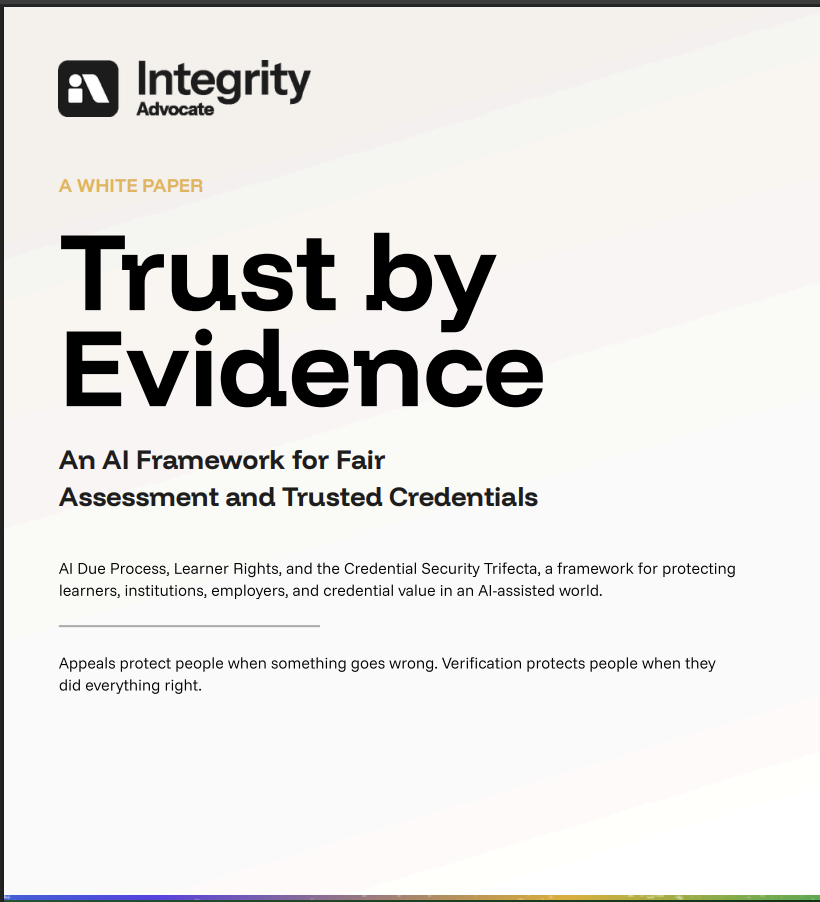
Trust by Evidence: A New Framework for Defensible AI Decisions
Integrity Advocate has released a new whitepaper, Trust by Evidence, introducing a framework that connects AI due process, learner rights, and credential security into one model for defensible AI-assisted assessment. This post walks through what the framework covers, why AI adoption alone no longer settles the integrity question, and links to the full whitepaper download.
Assessment integrity used to mean one thing: was the exam monitored? That question is no longer enough. AI now plays a role in identity verification, proctoring flags, authorship review, scoring, and credential validation, and each of those touchpoints can be challenged.
Confidence in an outcome isn't just about whether AI was accurate. It's about whether the decision it contributed to can be explained, reviewed, appealed, and verified after the fact.
As AI becomes embedded deeper into assessment, institutions are being asked a more pointed question: Can you defend the decision AI helped you make?
That question requires more than accurate technology. It requires a system.
In our latest whitepaper, Trust by Evidence, CEO Brandon A. Smith introduces a framework that connects AI due process, learner rights, and credential security into one model for defensible outcomes.
Download the whitepaper
The Shift From AI Adoption to Defensible Outcomes
For the past several years, the conversation in education and credentialing has centered on adoption: which AI tools to use, how to deploy them, how accurate they are. That conversation is largely settled. Most programs already use AI somewhere in the assessment lifecycle.
What hasn't been settled is defensibility. When an AI-influenced decision is challenged, whether by a learner, an employer, or a regulator, an institution needs to answer a specific set of questions: was there notice, meaningful human review, supporting evidence, and a path to appeal? If any of those answers are unclear, the decision isn't defensible, and the institution is exposed right along with the learner.
The next major challenge in education isn't AI adoption. It's building outcomes that hold up under scrutiny.
Why Treating AI as a Single Safeguard Creates Risk
Many programs rely on AI to do one job: flag anomalies. That model treats a flag as a finding rather than a signal, and it breaks down under three conditions:
- No documented process exists for what happens after a flag is raised.
- Human review means approving the AI's output rather than independently evaluating it.
- There's no clear path for the learner to respond, and no record for the institution to point to later.
Any one of those gaps makes an outcome difficult to defend. Together, they create real exposure, not just to individual learners, but to the institution's accreditation standing, employer trust, and legal risk.
The Trust by Evidence Framework
The whitepaper introduces Trust by Evidence, a framework that connects three ideas typically treated in isolation:
AI Due Process: A fair, documented process for any consequential decision AI contributes to, so a flagged learner has an actual process to walk through rather than a black box to accept.
The Learner Rights Layer: Seven specific rights, to know, to meaningful human review, to explanation, to evidence, to appeal, to proportionality, and to verification, that turn "the system flagged it" into a decision an institution can explain and stand behind.
The Credential Security Trifecta: A secure chain of trust connecting learning, assessment, and credentialing, where a weakness in any one layer undermines the others.
Individually, each idea is familiar. Together, they hold up under scrutiny from everyone with a stake in the outcome: the learner, the institution, employers, regulators, and the public.
What a Defensible AI-Assisted Decision Looks Like
A defensible process doesn't rely on confidence in the algorithm. It provides an actual record. It lets an institution answer, with certainty:
- Was the individual notified that AI was involved?
- Did a qualified reviewer examine the evidence, not just the score?
- Could the individual respond before a consequence was applied?
- Is there a documented, time-bound appeal path?
- Can the outcome be explained to someone outside the institution?
These are governance questions as much as technical ones. Answering them well protects accreditation standing, employer trust, and learner confidence all at once.
What You'll Learn in the Whitepaper
The full whitepaper expands on:
- Why algorithmic due process, procedural justice, and automation bias research all point toward the same conclusion for education
- The Defensible Outcomes Responsibility Matrix, a governance tool for assigning clear ownership across vendors, institutions, and credential issuers
- The five-stage AI Appeals Framework, walked through with a real worked example of a contested proctoring flag
- Sector-specific guidance for K-12, higher education, workforce certification, and employers
- A candid discussion of the framework's limitations, including cost, scale, and surveillance risk
It's written for compliance leads, credentialing bodies, assessment teams, and program leaders responsible for the outcomes their institution has to stand behind.
{{post-cta}}
All resources
Trust by Evidence: A New Framework for Defensible AI Decisions
July 22, 2026
|
5 min read
Integrity Advocate has released a new whitepaper, Trust by Evidence, introducing a framework that connects AI due process, learner rights, and credential security into one model for defensible AI-assisted assessment. This post walks through what the framework covers, why AI adoption alone no longer settles the integrity question, and links to the full whitepaper download.
Assessment integrity used to mean one thing: was the exam monitored? That question is no longer enough. AI now plays a role in identity verification, proctoring flags, authorship review, scoring, and credential validation, and each of those touchpoints can be challenged.
Confidence in an outcome isn't just about whether AI was accurate. It's about whether the decision it contributed to can be explained, reviewed, appealed, and verified after the fact.
As AI becomes embedded deeper into assessment, institutions are being asked a more pointed question: Can you defend the decision AI helped you make?
That question requires more than accurate technology. It requires a system.
In our latest whitepaper, Trust by Evidence, CEO Brandon A. Smith introduces a framework that connects AI due process, learner rights, and credential security into one model for defensible outcomes.
Download the whitepaper
The Shift From AI Adoption to Defensible Outcomes
For the past several years, the conversation in education and credentialing has centered on adoption: which AI tools to use, how to deploy them, how accurate they are. That conversation is largely settled. Most programs already use AI somewhere in the assessment lifecycle.
What hasn't been settled is defensibility. When an AI-influenced decision is challenged, whether by a learner, an employer, or a regulator, an institution needs to answer a specific set of questions: was there notice, meaningful human review, supporting evidence, and a path to appeal? If any of those answers are unclear, the decision isn't defensible, and the institution is exposed right along with the learner.
The next major challenge in education isn't AI adoption. It's building outcomes that hold up under scrutiny.
Why Treating AI as a Single Safeguard Creates Risk
Many programs rely on AI to do one job: flag anomalies. That model treats a flag as a finding rather than a signal, and it breaks down under three conditions:
- No documented process exists for what happens after a flag is raised.
- Human review means approving the AI's output rather than independently evaluating it.
- There's no clear path for the learner to respond, and no record for the institution to point to later.
Any one of those gaps makes an outcome difficult to defend. Together, they create real exposure, not just to individual learners, but to the institution's accreditation standing, employer trust, and legal risk.
The Trust by Evidence Framework
The whitepaper introduces Trust by Evidence, a framework that connects three ideas typically treated in isolation:
AI Due Process: A fair, documented process for any consequential decision AI contributes to, so a flagged learner has an actual process to walk through rather than a black box to accept.
The Learner Rights Layer: Seven specific rights, to know, to meaningful human review, to explanation, to evidence, to appeal, to proportionality, and to verification, that turn "the system flagged it" into a decision an institution can explain and stand behind.
The Credential Security Trifecta: A secure chain of trust connecting learning, assessment, and credentialing, where a weakness in any one layer undermines the others.
Individually, each idea is familiar. Together, they hold up under scrutiny from everyone with a stake in the outcome: the learner, the institution, employers, regulators, and the public.
What a Defensible AI-Assisted Decision Looks Like
A defensible process doesn't rely on confidence in the algorithm. It provides an actual record. It lets an institution answer, with certainty:
- Was the individual notified that AI was involved?
- Did a qualified reviewer examine the evidence, not just the score?
- Could the individual respond before a consequence was applied?
- Is there a documented, time-bound appeal path?
- Can the outcome be explained to someone outside the institution?
These are governance questions as much as technical ones. Answering them well protects accreditation standing, employer trust, and learner confidence all at once.
What You'll Learn in the Whitepaper
The full whitepaper expands on:
- Why algorithmic due process, procedural justice, and automation bias research all point toward the same conclusion for education
- The Defensible Outcomes Responsibility Matrix, a governance tool for assigning clear ownership across vendors, institutions, and credential issuers
- The five-stage AI Appeals Framework, walked through with a real worked example of a contested proctoring flag
- Sector-specific guidance for K-12, higher education, workforce certification, and employers
- A candid discussion of the framework's limitations, including cost, scale, and surveillance risk
It's written for compliance leads, credentialing bodies, assessment teams, and program leaders responsible for the outcomes their institution has to stand behind.
{{post-cta}}
The Three Questions That Stayed With Us After D2L Fusion
July 20, 2026
|
5 min read
D2L Fusion 2026 reinforced a clear message for the future of education: innovation must be balanced with privacy, transparency, and human judgment. Inspired by three questions posed during the conference keynote, Integrity Advocate CEO Brandon Smith reflects on why responsible AI, Privacy by Design, and Verified by Human Review™ are essential to building trust and protecting assessment integrity in an AI-driven world.
D2L Fusion wrapped in Phoenix earlier this month, and our CEO, Brandon Smith, spent the week doing what he does best: showing up on the floor, listening to educators, and bringing ideas about the future of assessment back to the team.
Brandon recorded a short recap video at the end of each day. But what stuck with him most happened during D2L's product keynote, when Chief Product Officer Christian Pantel challenged the room with three questions he couldn't stop thinking about. So he worked through what each one means for how he leads Integrity Advocate.
Here's that video:
The Three Questions
- How do we embrace technology responsibly?
- How do we safeguard learner data?
- How do we earn and maintain our stakeholders' trust?
Embrace Technology Responsibly
The first question isn't really about AI. It's about responsibility. Are we solving a real problem, or adding technology simply because we can? AI is already changing education, and it has tremendous potential to help educators and institutions make better decisions. But it shouldn't replace human judgment when those decisions have meaningful consequences.
That's one of the reasons we've doubled down on Verified by Human Review™. AI can identify patterns and surface potential concerns, but people provide the context, judgment, and accountability that technology alone can't.
Safeguard Learner Data
This was probably the easiest question for Brandon to answer, because privacy is foundational to why Integrity Advocate exists. It isn't something you add after a product is built; it shapes how the product gets built from the beginning. That means carefully considering what information is collected, why it's needed, how it's protected, and how long it's retained. It also means continuing to evaluate those decisions as expectations and regulations evolve.
In practice, that shows up in specific choices: minimizing what's captured during a proctored session in the first place, giving institutions control over retention windows rather than defaulting to "keep everything," and building review workflows so human reviewers see only what's relevant to a flagged concern. Integrity Advocate was built around Privacy by Design, and it remains one of our core principles.
Earn and Maintain Trust
This was the question that made Brandon think the longest. It's easy to say trust is important. It's much harder to earn it every day. For him, trust comes down to transparency and accountability. Sometimes that means celebrating what's working. Sometimes it means picking up the phone when something isn't.
One of his first experiences as CEO was joining an outage call with a customer. The team didn't have all the answers yet, but they were honest about what had happened, what they were doing to fix it, and how they'd prevent it from happening again. That's what earning trust looks like. It's not about being perfect. It's about showing up, taking ownership, and continuously improving.
Day by day on the ground in Phoenix
Alongside the reflection above, Brandon recorded a short recap after each day of Fusion. Here's a quick look back at all three.
Day 1 — AI Needs People
The opening keynote reinforced something I've believed for a long time: AI has incredible potential, but it isn't a replacement for educators or human expertise. Technology should support better learning experiences, not try to replace the people responsible for them.
John Baker said something that really stuck with me: that technology cannot run education. It should empower educators, not replace them. That aligns closely with how we think at Integrity Advocate. AI is an incredibly valuable tool, but it works best when paired with human judgment. Whether it's proctoring, identity verification, or reviewing assessment outcomes, people still need to be part of the decision-making process.
Key takeaway: The future isn't AI versus humans: it's AI supported by humans.
Watch Brandon's Day 1 recap here:
Day 2: Innovation Must Earn Trust
Day two shifted the conversation from what technology can do to how organizations should build and use it responsibly. One session framed the challenge around three important questions: How do we embrace innovation responsibly? How do we safeguard learner data? And how do we earn and maintain trust?
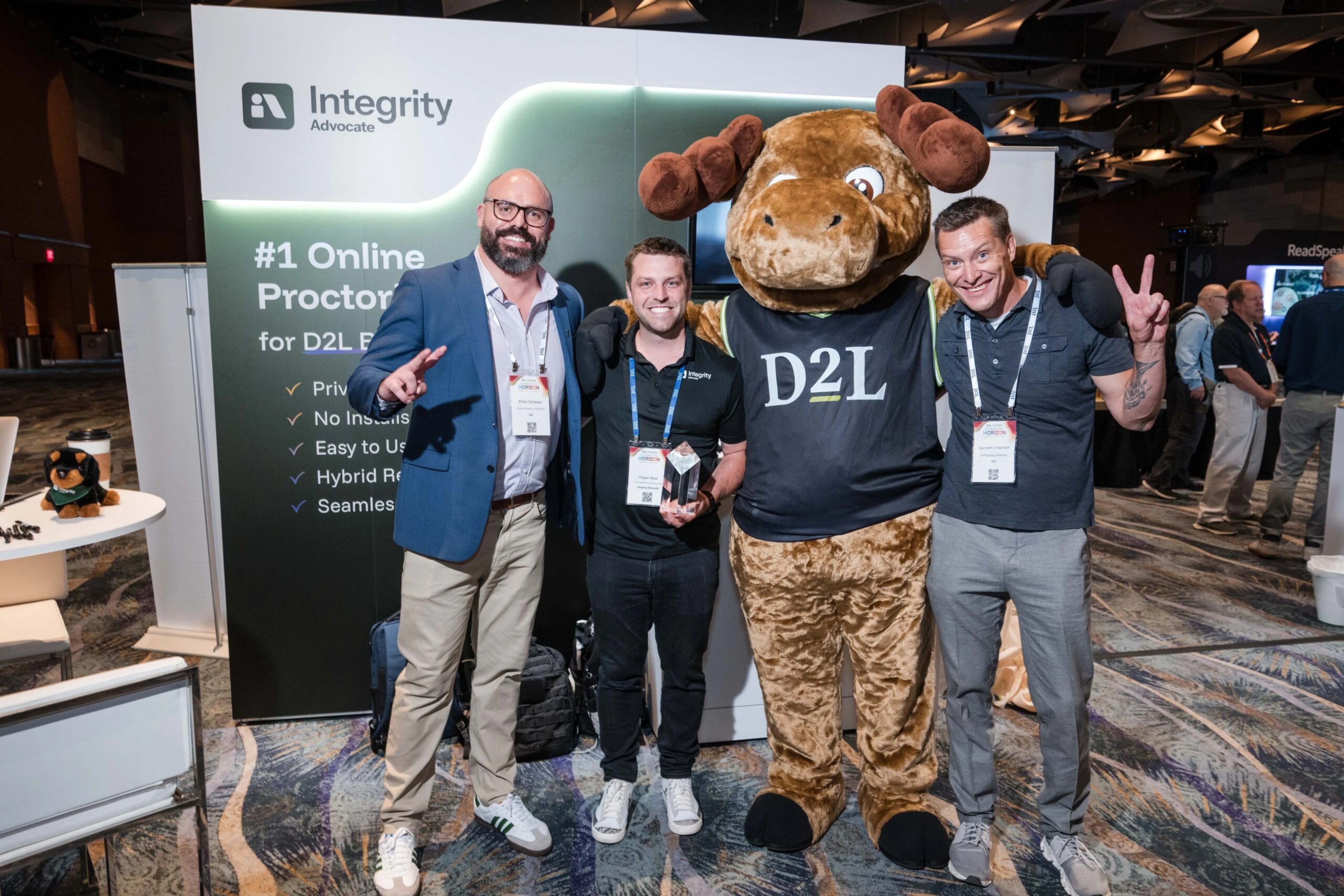
Those themes came up throughout the day in conversations about accessibility, user experience, privacy, and AI. They also made receiving D2L’s Customer Trust Award especially meaningful. The recognition reflects the work our team puts into supporting customers, building dependable partnerships, and creating technology people can trust.
The award was an honor, but it also reinforced the responsibility that comes with trust: to keep listening, keep improving, and continue putting learners and customers at the centre of how we build.
Key takeaway: Trust is not something a product claims. It is something a company earns through every interaction.
Day 3: Trust Will Be the Competitive Advantage
As Fusion wrapped up, one theme stood above everything else: organizations that succeed with AI will be the ones that balance innovation with privacy and trust.
The conversations weren't just about online proctoring anymore. We spoke with educators about broader assessment challenges and with partners about new applications for our technology. Those discussions reinforced that the opportunity extends beyond protecting exams, it's about helping organizations create trusted learning experiences wherever assessment happens.
The three questions introduced during the keynote stayed with me all week because they reflect the direction our industry is heading. As learning continues to evolve, technology alone won't be enough. Success will belong to organizations that combine responsible AI, strong privacy practices, and meaningful human oversight.
Key takeaway: The future of assessment integrity will be built on innovation, privacy, and trust—not technology alone.
Brandon shares his closing thoughts from the floor here:
Thanks to everyone who stopped by our booth, sat in on Brandon's session, or caught up with the team in Phoenix. Christian's three questions are worth sitting with, however you answer them.
Some of our favorite moments from D2L Fusion:

{{post-cta}}

ATP Innovations in Testing 2026: Key Takeaways
March 16, 2026
|
5 min read
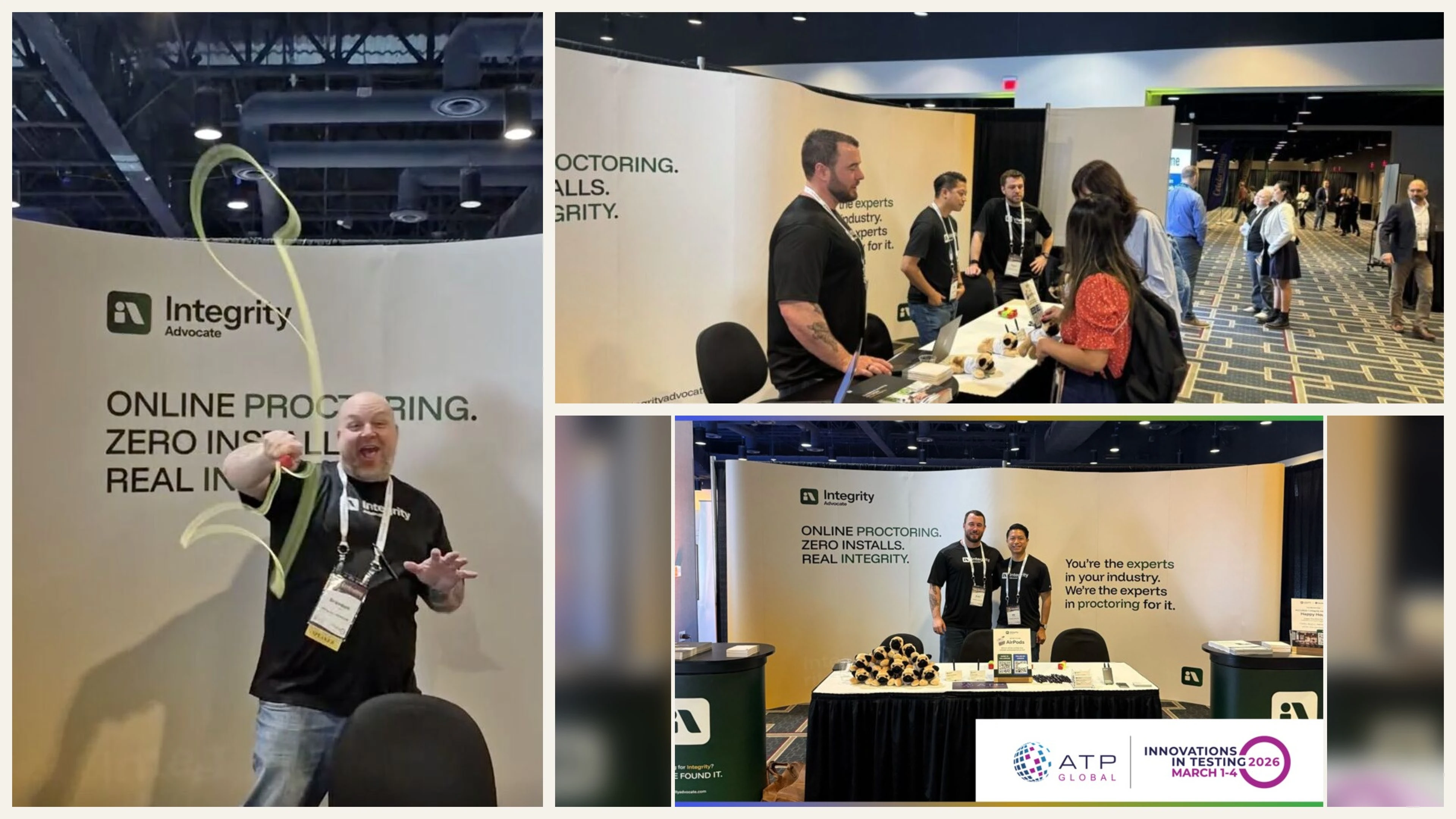
At ATP Innovations in Testing 2026, direct conversations at the Integrity Advocate booth surfaced three consistent themes: organizations moving away from traditional LMS platforms toward standalone assessment tools, strong interest in combining secure exam delivery with digital credentialing through the Accredible partnership, and a noticeable increase in organizations proactively seeking to partner with Integrity Advocate. Broader conference sessions reinforced that generative AI is reshaping the assessment lifecycle, security challenges are evolving quickly, and candidate experience is becoming a competitive differentiator for certification bodies. This post recaps what the conversations revealed and where Integrity Advocate fits into the industry's direction.
Direct Industry Feedback from our Exhibitor Booth
One of the most valuable aspects of the conference was the direct conversations we had with assessment and credentialing organizations visiting our booth. Several consistent themes emerged that provide insight into where the industry is heading and how Integrity Advocate is positioned within that evolution.

1. LMS Platforms Are Becoming Less Central to Assessment Programs
A number of organizations shared that they are moving away from traditional LMS platforms for testing programs. Instead, they are relying on standalone assessment platforms that provide the functionality they need without the overhead of managing multiple tools.
This shift reflects a broader desire to simplify technology stacks and reduce operational complexity.
Our response resonated strongly: Integrity Advocate is fully open to integration. If a customer wants to launch proctoring directly from their assessment platform, we can integrate with that system rather than requiring an LMS layer. This flexibility aligns well with how many organizations are restructuring their testing infrastructure.
2. Strong Interest in Integrated Proctoring + Credentialing
Our partnership with Accredible generated significant excitement and interest from attendees. Many organizations were enthusiastic about the ability to combine secure exam delivery with digital credentialing in a more seamless workflow.
Rather than viewing proctoring and credential issuance as separate processes, attendees responded positively to the idea of connecting the full candidate journey—from exam completion to credential award.
The collaboration between our teams worked well in practice during the conference, as we were able to walk attendees between our booths to make introductions and demonstrate how the combined solution could work in real-world implementations.
This integrated approach clearly resonated with organizations looking to modernize their credentialing programs.
3. Growing Interest in Partnerships with Integrity Advocate
Perhaps the most encouraging shift from previous years was the noticeable increase in organizations expressing interest in partnering with Integrity Advocate.
Team members noted that in prior conferences, Integrity Advocate was less widely recognized and outreach efforts often met with limited engagement. This year, the dynamic was noticeably different.
Partners proactively visited our booth, mentioning positive things they had heard about our platform and asking about opportunities to integrate with us. This represents an important change in market awareness and signals growing recognition of Integrity Advocate’s capabilities.
Our next step will be strong follow-up engagement to build on this momentum and continue developing these partnership opportunities.
Broader Industry Themes from Conference Sessions
In addition to the conversations happening at our booth, several themes emerged across conference sessions, panel discussions, and networking throughout the event.
4. AI is reshaping the assessment lifecycle
Generative AI is beginning to influence item development, form creation, and test analytics. Organizations are exploring ways to accelerate test development while maintaining psychometric integrity.
5. Security challenges are evolving rapidly
With the rise of generative AI and increasingly sophisticated test preparation tools, assessment security continues to be a major concern. Industry leaders are exploring new detection methods, analytics, and policy frameworks to protect exam integrity.
6. Candidate experience is becoming a competitive differentiator
Certification bodies are increasingly focused on improving the test-taker experience while maintaining rigorous measurement standards.
Overall Takeaway
ATP 2026 reinforced that the assessment industry is evolving quickly, with increasing emphasis on simplified technology ecosystems, integrated credentialing workflows, and strong security infrastructure.
Integrity Advocate appears well aligned with these trends. The interest shown in our integrations, our partnership with Accredible, and the growing number of organizations seeking collaboration all indicate strong momentum for our platform in the credentialing and assessment market.
{{post-cta}}
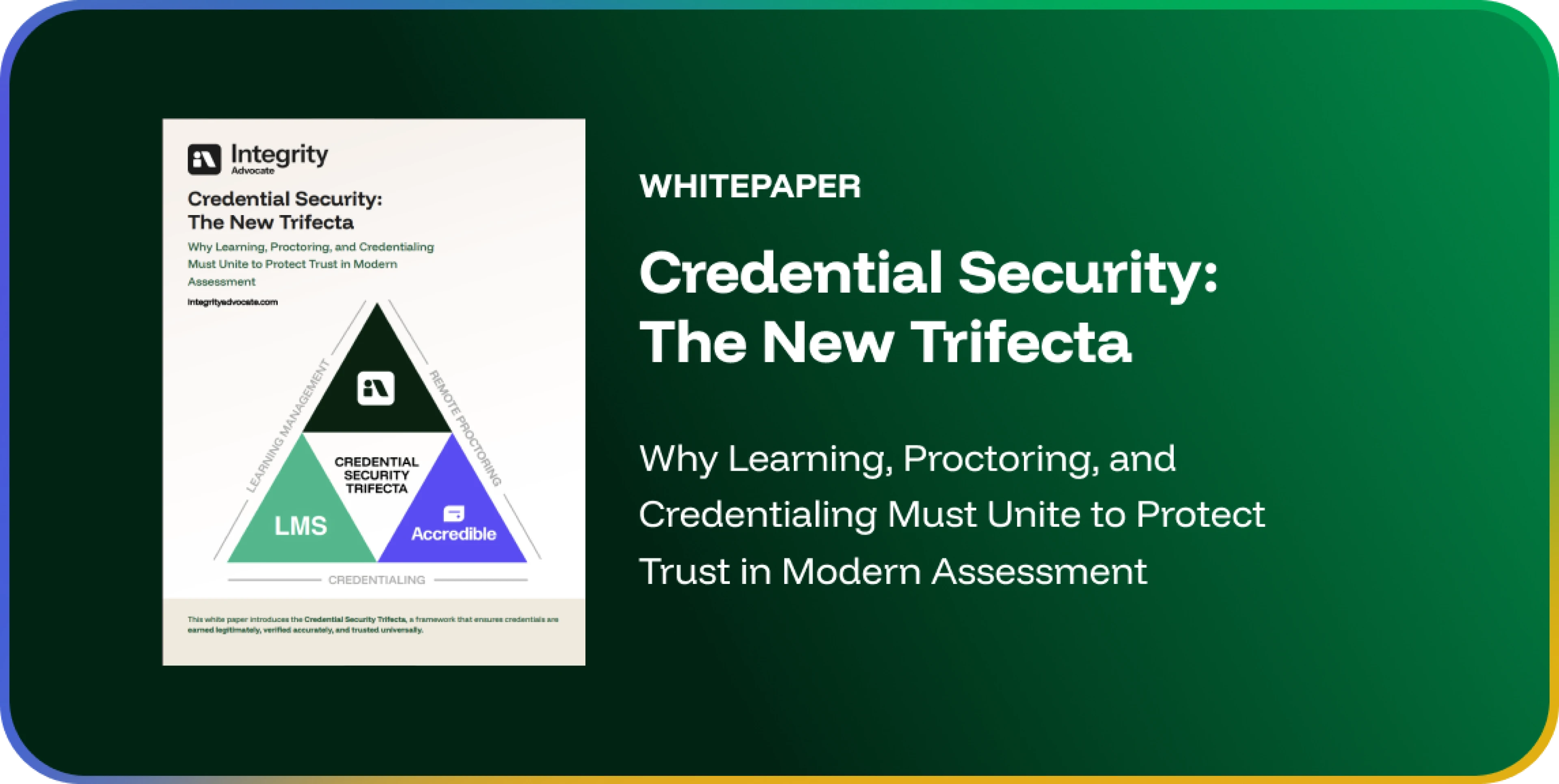
The Credential Security Trifecta: Designing a Defensible Credential Ecosystem
February 25, 2026
|
5 min read
Credential integrity depends on more than a single tool. It requires identity verification, assessment oversight, credential issuance, and long-term validation to operate as one connected system. As digital credentials become more visible and portable across LinkedIn profiles and employer systems, organizations need to be able to answer a harder question than "was this test monitored": is this credential defensible? This post introduces the Credential Security Trifecta, a framework connecting Learning & Assessment Infrastructure, Identity & Integrity Verification, and Secure Digital Credential Issuance into a unified chain of trust, and points to the full whitepaper for the risk landscape, common blind spots, and an implementation model.
Credential integrity is the confidence that a credential truly represents what was earned. It means the right person completed the work, the assessment was conducted fairly, and the credential was issued based on verified performance. That confidence is built across identity verification, assessment oversight, credential issuance, and long-term validation.
As digital credentials become more visible, portable, and high-stakes, organizations are being asked a more important question: Can you defend how this credential was earned?
That question requires more than a proctoring solution. It requires a system.
In our latest whitepaper, The Credential Security Trifecta, we outline a practical framework for designing a defensible credential ecosystem, one that connects learning, verification, and issuance into a coherent chain of trust.
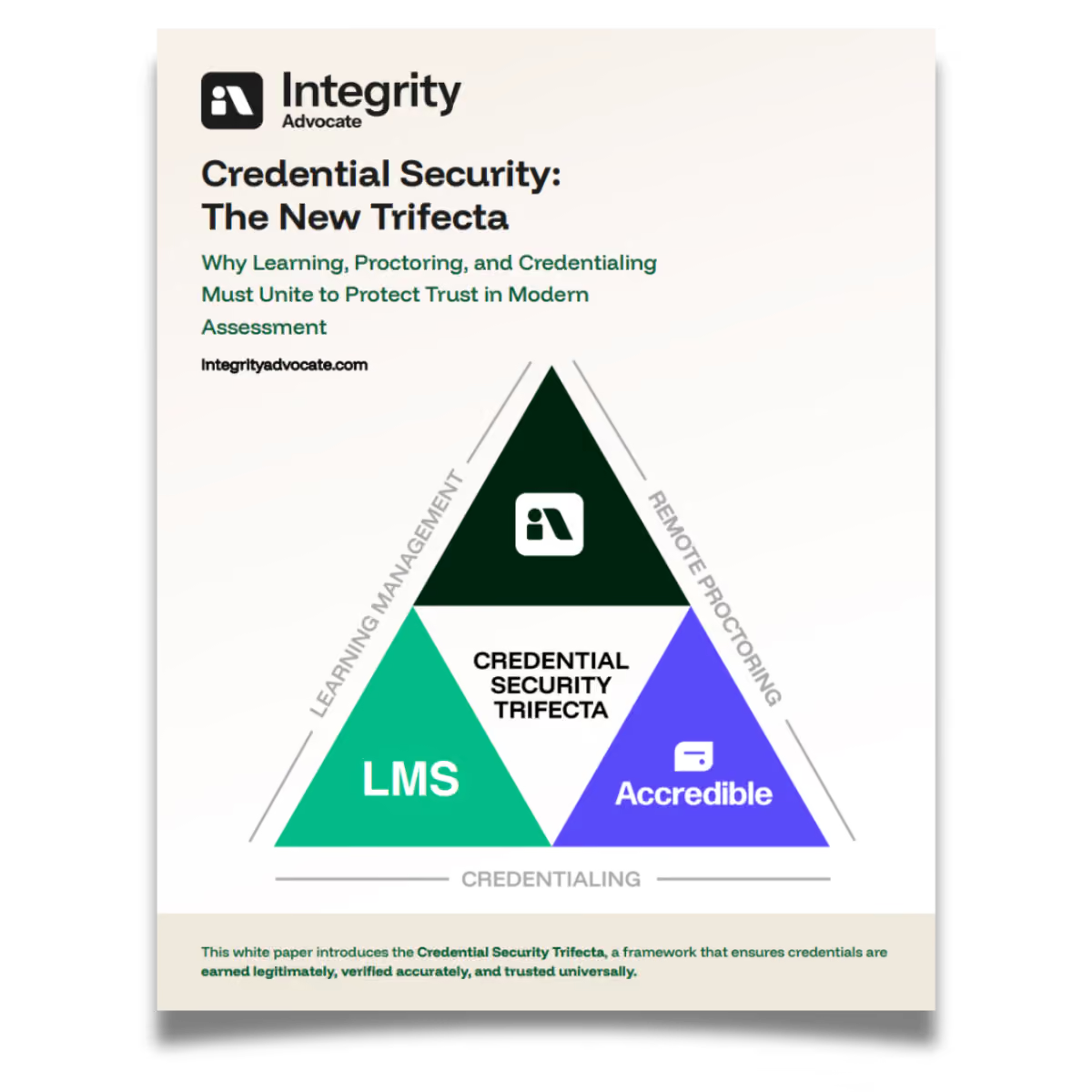
Credential Security: The New Trifecta
Why Learning, Proctoring, and Credentialing Must Unite to Protect Trust in Modern Assessment
The Shift From Exam Security to Credential Security
For years, assessment security focused primarily on preventing misconduct during testing. That remains important. But today’s risk environment has expanded.
AI-enabled misconduct, identity fraud, contract cheating, and synthetic digital documents have changed the landscape. At the same time, digital credentials are widely shared across LinkedIn profiles, employer systems, and workforce platforms. They are public representations of institutional trust.
And the stakes are higher than ever. In an AI-accelerated world, institutions must be able to answer a fundamental question: can we confidently verify who earned this credential — and whether it was earned fairly? When credentials influence hiring decisions, promotions, licensure, and professional standing, the consequences of getting it wrong are significant.
That means the integrity conversation must move beyond: “Was this test monitored?” to: “Is this credential defensible?”
Credential security is not just about detecting misconduct. It’s about ensuring that identity, performance, and issuance are connected in a way that can withstand scrutiny.
Why Fragmented Systems Create Risk
Most organizations operate across three separate layers:
- A learning management system where instruction and assessment occur.
- An integrity or proctoring solution that verifies identity and behavior.
- A credentialing platform that issues digital certificates or badges.
Each layer may function well independently. The risk emerges in the gaps between them. If these systems are not intentionally aligned, you may lack:
- A clear documentation trail from identity verification to issuance
- Audit-ready evidence of how integrity was upheld
- A consistent standard across programs
- Confidence that only verified outcomes result in credentials
That fragmentation makes defensibility harder when questions arise from employers, regulators, or internal leadership.
The Credential Security Trifecta Framework
The whitepaper introduces the Credential Security Trifecta, a framework that connects three essential components into a unified architecture:
Learning & Assessment Infrastructure: Where learning is delivered and performance is measured.
Identity & Integrity Verification: Where identity is confirmed, assessment conduct is reviewed, and integrity decisions are documented to ensure performance is legitimate and defensible.
Secure Digital Credential Issuance: Where verified performance becomes a tamper-resistant, independently verifiable credential.
When these three components operate as an integrated system rather than isolated tools, they form a defensible chain of trust.
This shifts the posture from reactive security to intentional design.
What a Defensible Credential Ecosystem Looks Like
A defensible ecosystem does not rely on assumptions. It provides clarity. It enables leadership teams to answer, with confidence:
- How do we verify identity at scale?
- How do we document integrity decisions?
- How do we ensure credentials are only issued for verified performance?
- How do we validate credentials long after they are awarded?
These are governance questions as much as technical ones. They impact compliance, employer trust, learner confidence, and institutional reputation.
Designing for defensibility requires alignment across technology, process, and policy.
What You’ll Learn in the Whitepaper
The full whitepaper expands on:
- The evolving risk landscape impacting credential credibility
- Where organizations most commonly experience blind spots
- How to evaluate your current architecture
- Strategic questions leadership teams should be asking
- A practical model for implementing the Credential Security Trifecta
It is written for certification bodies, higher education leaders, workforce programs, and assessment teams responsible for protecting credential value.
If you are evaluating how your organization connects assessment integrity with credential issuance, this framework will provide clarity.
Download the whitepaper

Who We’re Certifying Matters: Why Assessment Security Must Evolve With the Credential Landscape
February 24, 2026
|
5 min read
Assessment security has expanded beyond preventing cheating to protecting the long-term credibility of every credential an organization issues. Remote and hybrid delivery, AI tools reshaping candidate behavior, rising employer scrutiny of credential validity, and the rapid expansion of digital credentialing are all converging to make this a strategic rather than operational question. This post examines why credential credibility now depends on assessment security design, what the risks of getting it wrong look like across higher education, professional certification, and workforce training, and why connected, integrated systems are the only approach that produces defensible outcomes at scale.
Assessment security is no longer just about preventing cheating. It is about protecting the credibility of credentials across higher education, K-12, professional certification, associations, and workforce training.
Online exams, hybrid delivery, AI tools, and digital credentials are reshaping how learning is validated. As these systems evolve, organizations must move beyond a narrow focus on proctoring and ask a more strategic question:
Who are we certifying, and what does that credential truly represent?
The answer to that question determines whether employers trust degrees, whether associations defend certifications, and whether workforce credentials maintain real economic value.
This is where assessment security and credential integrity converge.
What Is Changing in Assessment Security in 2026?
Across sectors, several structural shifts are driving change:
- Remote and hybrid assessment delivery is now mainstream
- AI tools are reshaping how candidates interact with exams
- Privacy expectations are increasing
- Employers are scrutinizing credential validity more closely
- Digital credentialing is expanding rapidly
The online proctoring market reflects this momentum. Industry analysis shows that U.S. revenue is projected to grow from approximately $281 million in 2024 to more than $800 million by 2031, driven by online learning adoption, corporate upskilling, and global credential demand.
Growth alone does not equal trust. As scale increases, so does the responsibility to ensure defensible, fair, and meaningful outcomes.
Why Assessment Security Now Impacts Credential Credibility
Historically, assessment security focused on catching misconduct. Today, the focus must expand to protecting the long-term value of the credential itself.
Forward-thinking programs are no longer asking only how to monitor exams. They are asking how to protect integrity across the entire assessment lifecycle, from design to delivery to defensibility.
This shift affects every sector:
Higher Education
Institutions must defend the academic integrity of degrees delivered in online and hybrid formats. If employers question exam security, they question institutional standards. This tension is especially pronounced in doctoral programs, where balancing assessment security and privacy in online EdbD programs requires institutions to protect both rigor and learner trust.
K-12 Education
Digital testing is embedded into classrooms. Student privacy and fairness are as important as misconduct prevention.
Professional Certification and Associations
Certifications signal competence and readiness. Weak exam controls undermine member trust and regulatory standing.
Workforce Training and Corporate Credentialing
Employers rely on credentials as hiring signals. If assessments are unreliable, businesses lose confidence in workforce readiness programs.
Assessment security is no longer an operational decision. It is a strategic credibility decision.
The Risks of Getting Assessment Security Wrong
When assessment integrity systems fail, the consequences extend far beyond a single testing event.
Risk to Individuals
If security controls are too weak, unqualified individuals may earn credentials they have not legitimately achieved. In regulated industries such as healthcare, finance, or technical trades, that risk can impact safety and compliance.
If controls are too aggressive or poorly implemented, legitimate candidates may be unfairly flagged or disadvantaged. In K-12 and higher education, overly intrusive tools can increase anxiety, create equity concerns, and erode trust in institutions.
Risk to Workplaces
Employers depend on certifications and degrees as reliable indicators of competence. If credential integrity is inconsistent, organizations add additional screening layers, duplicate assessments, or question the issuing body altogether.
When trust declines, the credential loses value in the labor market.
Risk to Programs and Institutions
- Higher education institutions face reputational risk.
- Certification bodies face regulatory scrutiny.
- Associations risk declining member confidence.
- Workforce programs risk employer disengagement.
The cost of weak assessment security is not just fraud. It is long-term erosion of credibility.
How AI Is Redefining Online Exam Security
AI in online exams is both a challenge and an inflection point.
Research indicates widespread AI usage in academic environments, influencing integrity patterns and candidate behavior.
AI has changed how candidates prepare, how responses are generated, how external assistance is accessed.
But AI also presents an opportunity. It pushes organizations to rethink what authentic demonstration of competence looks like.
Effective assessment security now combines intelligent detection systems with contextual human review. Machine analysis can surface patterns. Human judgment ensures fairness and proportional response.
AI is not simply a threat. It is accelerating the need for smarter, connected systems.
Not All Proctoring Models Address Risk in the Same Way
Organizations today operate across a spectrum of proctoring models:
- Paper-based in-person exams
- Live remote proctoring
- Automated AI monitoring
- Browser lockdown tools
- Hybrid in-person and remote systems
- Unproctored low-stakes assessments
Each approach carries trade-offs in scalability, cost, privacy, defensibility, and candidate experience.
The challenge is not selecting a single method. The challenge is ensuring the method fits within a connected credential ecosystem.
Siloed systems introduce risk.
If identity verification happens in one platform, exam delivery in another, proctoring in a third, and credential issuance in yet another, organizations may lack a defensible chain linking candidate identity to verified outcome to issued credential.
Paper testing without digital audit trails can be difficult to defend at scale.
Unproctored online exams may be appropriate for low-stakes contexts but insufficient for high-stakes certification.
Fully automated monitoring without contextual human review may raise fairness concerns.
Disconnected systems make audit readiness difficult.
Assessment security must be designed as part of a larger system.
Why Connected Systems Matter in Modern Credentialing
The future of online proctoring and credential security is not about surveillance intensity. It is about integration and defensibility.
A modern assessment ecosystem should:
- Integrate directly with the LMS
- Align with digital credential platforms
- Support explainable review processes
- Maintain privacy-conscious data practices
- Scale across in-person, remote, and hybrid delivery
Security should not be layered on top of the credential process. It should be embedded within it.
This is particularly critical in higher education, associations, and workforce certification programs where auditability and long-term defensibility are essential.
Frequently Asked Questions About Assessment Security in 2026
Why is assessment security more important now than before?
Because remote and hybrid testing has scaled dramatically, AI tools are reshaping candidate behavior, and employers are scrutinizing credential validity more closely.
Is online proctoring enough to protect credential integrity?
No single tool is sufficient. Online proctoring must be part of a connected system that includes identity verification, review processes, and credential issuance alignment.
How should institutions choose a proctoring partner?
Institutions should look for partners who understand connected ecosystems, audit readiness, privacy considerations, and sector-specific requirements across higher education, K-12, certification, and workforce training.
Looking Ahead: Connecting Assessment Integrity to Credential Trust
The future of assessment security is not only about protecting exams.
It is about ensuring that every credential issued represents verified identity, authentic performance, and defensible standards.
Because in 2026 and beyond, who we certify matters as much as how we secure the assessment.
And the institutions that understand that connection will lead.
Building a Defensible Credential Ecosystem
If you are evaluating how your program protects exam integrity, candidate identity, and long-term credential value, the next step is understanding how these systems connect.
{{post-cta}}

AI and Online Exams: What the Data Reveals About Assessment Security
February 11, 2025
|
5 min read
Large-scale Wiley research surveying more than 2,900 students and instructors across North America reveals that cheating is measurably increasing in online environments, nearly half of students report using generative AI in their coursework, and 86% of instructors say students are more likely to cheat in online courses than in person. This post examines what the data reveals about the current academic integrity landscape, how AI has reshaped the threat model without changing the underlying intent behind misconduct, and how Integrity Advocate's COUNTER-AI approach responds to behavioral patterns rather than chasing specific tools.
Academic integrity isn’t disappearing. It’s being tested. Generative AI is now part of everyday academic life. Credentials carry increasing weight in employment decisions. At the same time, institutions are navigating a new assessment environment where traditional approaches to exam security no longer fully address modern risk.
What is actually happening with cheating in online courses? How much is AI-assisted behavior influencing academic misconduct? And what reduces risk without compromising privacy, accessibility, or trust?
Large-scale research surveying thousands of students and instructors across North America, conducted by Wiley, provides a clear picture of the current academic integrity landscape. The findings confirm what many institutions already sense: cheating patterns are shifting, AI is accelerating change, and assessment security must evolve accordingly.
Here’s what the numbers reveal, and what they mean for modern online proctoring and credential protection.
Cheating is increasing, particularly in online environments
Academic misconduct is not simply anecdotal. It is measurable, and Wiley’s research reflects this growing trend.
- More than half of students and instructors believe cheating will increase in the coming years
- Nearly 70% of instructors report that up to 30% of their students cheated within the past year
- 86% of instructors say students are more likely to cheat in online courses than in-person
Online and hybrid assessments are now embedded across universities, licensing boards, certification programs, and enterprise training initiatives. However, many online exams were adapted rapidly for accessibility and scale rather than intentionally designed with modern assessment security frameworks in place. When remote testing expands without proportional safeguards, risk expands with it.
The solution is building secure-by-design assessment systems that account for evolving threat models, emerging AI tools, and distributed testing environments.
AI has reshaped academic integrity and changed the threat model
Generative AI is no longer experimental; it is now a common part of the academic experience according to Wiley’s survey data.
- Nearly half of students report using generative AI in their coursework
- 46% of students say AI makes cheating easier
- Instructors consistently cite AI as a growing contributor to academic misconduct
AI tools have made cheating easier to execute, but they haven’t changed why people do it or how behavior shows up when someone is attempting to get away with misconduct. The tactics evolve quickly. The intent does not.
“AI doesn’t replace human intent. It changes how behavior shows up.”
By the time a specific AI tool is identified and restricted, three new ones have already taken its place. That means institutions cannot rely on tool-specific detection alone. They need an approach that focuses on behavior, context, and patterns of engagement rather than chasing software names.
How Integrity Advocate Responds: COUNTER-AI™
Integrity Advocate’s COUNTER-AI™ approach recognizes that AI changed the tactics, not the intent.
Rather than attempting to block or identify every possible AI tool, COUNTER-AI™ focuses on the human signals that surface during an assessment, how someone engages with the exam, how they navigate through content, and how participation patterns align with expected behavior. This behavioral, security-based framework allows institutions to identify risk without over-policing legitimate AI-assisted learning.
Combined with trained human review, COUNTER-AI™ ensures that institutions can respond proportionally and fairly. Instead of reacting to every new AI platform that emerges, Integrity Advocate adapts to the underlying behavior patterns that persist regardless of the tool being used.
The result is a modern assessment security strategy that keeps pace with AI without becoming invasive, brittle, or dependent on outdated detection lists.
Students confirm what prevention experts already know: accountability reduces cheating
Wiley’s research shows that students say they are less likely to cheat when safeguards and expectations are clear.
- 81% say grade impact would deter cheating
- 81% say serious academic consequences would deter cheating
- 69% say proctoring during online exams reduces misconduct
- 62% say clearly explained consequences reduce cheating
The takeaway isn’t that students need harsher punishment. It’s that visibility changes behavior.
In most security environments, incidents are prevented not by catching someone in the act, but by being visibly present before anything happens. The same principle applies to assessments. When oversight is real, consistent, and clearly communicated, behavior shifts before there is anything to investigate.
Security isn’t about catching people. It’s about creating an environment where integrity is the default.
Integrity Advocate embeds accountability directly into the assessment lifecycle so that presence is established from the beginning. Identity verification confirms the right individual is taking the exam, and participation monitoring creates transparency throughout the session without resorting to invasive surveillance. Students understand that the assessment environment includes thoughtful oversight, which reduces temptation while maintaining dignity.
At the same time, context matters. One unusual moment during an exam rarely tells the full story. What matters more are patterns, how someone typically moves through questions, how they engage with the screen, how their behavior aligns with expected participation. When those patterns meaningfully deviate, insight becomes clearer. Patterns of behavior reveal intent in ways tools alone never can.
By combining AI-assisted behavioral analysis with trained human review, Integrity Advocate evaluates exams in context rather than reacting to isolated blips. This ensures institutions receive fair, defensible insight while avoiding automated accusations or rigid triggers.
Because the approach is privacy-forward and human-reviewed, students experience structure without intimidation, and institutions gain deterrence without overreach. Accountability becomes part of the system itself, embedded in design rather than layered on after misconduct occurs.
Instructors are concerned about learning outcomes, not just rule enforcement
According to Wiley’s data:
- 67% of instructors worry students are not truly learning the material
- 55% worry students will not be prepared for real-world careers
- 49% worry students will not be prepared for future coursework
- Yet only 16% use cheating detection or prevention tools
When exams are compromised, the consequences extend far beyond the classroom. Unqualified individuals can enter regulated industries such as healthcare, financial services, cybersecurity, and public safety, putting organizations and communities at risk. Protecting exam integrity protects individuals, programs, the workforce, and the public.
And yet, despite the stakes, adoption of comprehensive assessment security remains uneven.
Instructors care deeply about outcomes and readiness, but many hesitate to adopt solutions that feel intrusive, complex, or operationally heavy. They want protection without friction. They want integrity that supports learning rather than disrupting it.
Integrity Advocate approaches assessment security holistically, before, during, and after the exam.
Before the assessment, seamless LMS integration keeps the experience simple for instructors and administrators. Identity verification ensures the right person is testing and reduces impersonation risk without adding complexity.
During the session, AI-assisted monitoring paired with human review minimizes false positives and provides contextual, defensible insight. This saves instructors time and preserves fairness. After the exam, audit-ready reporting supports accreditation, compliance, and appeals with documentation institutions can trust.
The future of academic integrity
Online learning is not temporary. AI is not temporary. Remote certification, licensure testing, and workforce credentialing will continue to expand. The institutions that succeed in this environment will be the ones who modernize assessment with intention and embed integrity into every stage of the process. Academic integrity is no longer about isolated detection. It is about designing systems where the right person earns the credential, earns it legitimately, and can stand behind it with confidence. These dynamics play out distinctly in programs where balancing assessment security and privacy requires careful calibration. That is the future of assessment security, and it is the future Integrity Advocate is building.
Source: Wiley, The Latest Insights into Academic Integrity: Instructor and Student Experiences, Attitudes, and the Impact of AI. Survey of 2,900+ students and instructors across North America.
https://www.wiley.com/en-us/publish/ai-insights/the-latest-insights-into-academic-integrity-instructor-and-student-experiences-attitudes-and-the-impact-of-ai-2024-update/
{{post-cta}}
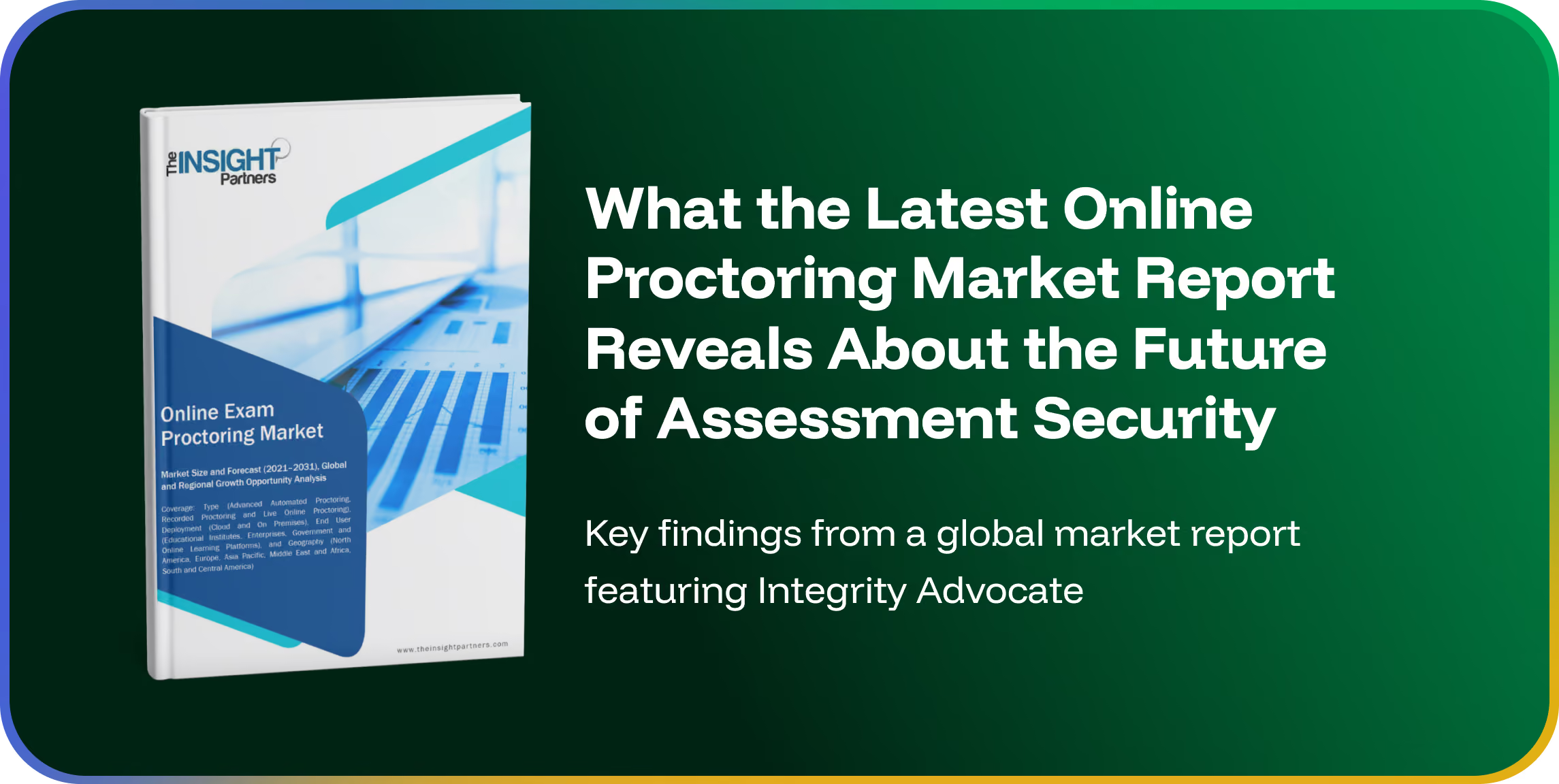
What the Latest Online Proctoring Market Report Reveals About the Future of Assessment Security
January 30, 2025
|
5 min read
The Insight Partners has released its Online Exam Proctoring Market Global Analysis and Forecast to 2031 report, featuring Integrity Advocate as part of its company analysis. The US market alone is projected to grow from $281.09 million in 2024 to $803.92 million by 2031 at a CAGR of 16.4%. This post highlights the four most important signals from the report for assessment programs planning ahead, from the sustained role of distance learning in driving demand to the growing recognition that AI alone is not sufficient and that trust, fairness, and auditability are becoming central concerns rather than secondary considerations.
The online exam proctoring market is continuing to grow, not just in size, but in complexity.
According to a recent global market report from The Insight Partners, online proctoring is being adopted across a widening range of use cases, including higher education, workforce training, professional certification, and regulated industries. Integrity Advocate was featured in the report as part of its company analysis, alongside other providers operating in the space.
Below are several key insights from the report, and what they signal for assessment programs planning for the years ahead.
The Online Proctoring Market Is Experiencing Sustained Growth
The report projects strong growth for the global online exam proctoring market through 2031, driven by continued expansion of online and hybrid learning models, workforce upskilling, and remote certification.
While growth varies by region, North America remains one of the largest and fastest-growing markets. In the United States alone, the online exam proctoring market is expected to grow from $281.09 million in 2024 to $803.92 million by 2031, representing a compound annual growth rate (CAGR) of 16.4%.
This growth reflects a broader shift in how organizations deliver and validate assessments, particularly as remote testing becomes a permanent part of education and professional development.
Online Learning Adoption Continues to Fuel Demand
One of the primary drivers cited in the report is the sustained adoption of online and distance learning.
The report notes:
“The online exam proctoring market has experienced significant growth, driven by increasing adoption of e-learning solutions, rising demand from the corporate sector, and the cost-effectiveness of online exam proctoring.”
In the U.S., this trend is reinforced by enrollment data. According to figures cited in the report, approximately 53% of postsecondary students were enrolled in at least one distance education course in fall 2022, underscoring how normalized online learning, and by extension, online assessment, has become.
As online assessments become more common, expectations around exam integrity, identity verification, and defensibility continue to rise.
AI Is a Key Market Driver, But Not the Whole Solution
AI-enhanced proctoring is identified as a major growth opportunity in the report, particularly as organizations look to scale assessment programs efficiently.
At the same time, the report emphasizes that online proctoring relies on multiple layers of oversight, noting that modern solutions often combine:
“video, audio, artificial intelligence (AI), machine learning (ML), biometric authentication, and other monitoring tools to track candidate behavior during an online exam.”
This multi-signal approach reflects a growing recognition that exam integrity cannot rely on automation alone, especially in higher-stakes environments where results may be challenged, audited, or tied to professional outcomes.
Trust, Fairness, and Auditability Are Becoming Central Concerns
Beyond growth projections, the report highlights a shift in why organizations adopt online proctoring, not just to prevent cheating, but to protect the credibility of outcomes.
Online proctoring is increasingly used to:
“ensure the credibility of online assessments and maintain academic and professional standards in remote testing environments.”
As assessment programs scale, decisions made during and after an exam must be explainable and defensible. This is pushing organizations to look beyond point solutions and consider how assessment security operates across the full lifecycle, before, during, and after the exam.
What This Means for Assessment Programs
One of the clearest signals from the data is that assessment security is evolving into a system-level concern.
Programs that succeed long-term will be those that:
- Balance AI automation with human oversight
- Protect exam integrity without excessive data collection
- Support transparent, audit-ready decisions
- Maintain trust with test-takers, institutions, and credentialing bodies
As online proctoring continues to expand into higher-stakes use cases, these considerations are becoming central, not optional.
Access the Full Market Report
For those who want to explore the full data, forecasts, and regional analysis, the complete Online Exam Proctoring Market – Global Analysis & Forecast to 2031 report is available for download.
This report was produced by The Insight Partners. Integrity Advocate is featured in the report and is sharing access for educational purposes.

Download the report
{{post-cta}}

What's Changing in Assessment Security in 2026 (And What Your Program Should Plan For)
January 26, 2025
|
5 min read
For years, the assessment security playbook was simple: secure the exam window, monitor, review incidents, move on. That approach worked until remote testing became standard, AI lowered the barrier to cheating, and credentials started facing real scrutiny from employers and regulators. The instinct to respond by adding more tools has created fragmentation rather than security. This post examines the three shifts that matter most for 2026, what the strongest programs are doing differently, and why assessment security is moving from a moment-in-time monitoring problem to a system-level responsibility that spans preparation, delivery, and defensibility.
What is changing in assessment security in 2026?
Assessment security is shifting from tool-based monitoring to system-level design that protects integrity before, during, and after delivery, while balancing trust, privacy, and defensible outcomes.
Assessment security didn't suddenly become more complicated.
It just became impossible to ignore.
For years, the playbook was simple: secure the exam window, monitor test-takers, review incidents, move on. That approach worked, until remote testing became standard, AI lowered the barrier to cheating, and credentials started facing real scrutiny from employers and regulators.
What changed isn't just how assessments are delivered. It's what happens when something goes wrong.
Today, a security gap isn't just an administrative problem. It's a threat to your program's credibility, your institution's reputation, and the trust stakeholders place in your credentials.
The mistake most organizations are making right now
When stakes rise, the instinct is to add controls. Another proctoring tool. Another identity check. Another alert system. Another layer. Individually, these decisions make sense. But together? They often create the opposite of what security is supposed to deliver.
We see it constantly:
- Administrators overwhelmed by alerts that lack context
- Test-takers frustrated by friction and false accusations
- Teams unable to explain their decisions when results are challenged
- Programs collecting far more data than they can reasonably use or defend
The problem isn't lack of effort. It's fragmentation. Layering security tools doesn't automatically create a secure system. Without intentional design, you get gaps, inconsistencies, and noise.
What the strongest programs are doing differently
The best assessment programs aren't asking "what tool should we add?" They're asking: "How do we protect integrity across the entire assessment lifecycle?" That question changes everything.
It reframes security as something that:
- Starts before the exam opens with thoughtful design and clear expectations
- Continues during delivery with proportional, meaningful oversight
- Extends after submission when outcomes must stand up to scrutiny
Security stops being a reaction and starts becoming part of your program design.
Three things to plan for in 2026
As you think about where assessment security is heading, these are the shifts that matter most:
1. Remote and hybrid testing aren't going anywhere: Remote testing is now standard, not an emergency measure. That means your security approach needs to work reliably across diverse environments, devices, and circumstances without creating unnecessary friction.
2. AI has lowered the barrier to cheating (and impersonation): Sophisticated cheating tools are now accessible to anyone. AI can generate answers, help with impersonation, and even coach test-takers in real-time. Your security needs to detect meaningful risks, not just flag normal behavior.
3. Credentials face more scrutiny than ever: Employers, regulators, and the public are asking harder questions about credential validity. If you can't defend your assessment outcomes with clear documentation and fair processes, your credentials lose value, fast. This is playing out vividly in programs balancing assessment security and privacy, where the stakes for getting both right are especially high.
What organizations should be planning for now
If you're thinking ahead to 2026, these questions matter more than feature lists:
- Are your security controls matched to your actual risk level? Low-stakes quizzes shouldn't feel like high-stakes licensing exams.
- Does security live inside your LMS workflows, or alongside them? Disconnected tools create friction, errors, and inconsistent setup.
- Can your team defend decisions without digging through hours of footage? If review takes longer than the exam itself, something's broken.
- Are you collecting only what you need; or everything, just in case? More data doesn't equal more security. It often just means more liability.
These aren't technical questions. They're design questions. And your answers reveal whether security is working for your program or against it.
The shift that's already underway
Assessment security is moving from a moment-in-time problem (monitoring the exam) to a system-level responsibility that spans preparation, delivery, and defensibility.
The programs adapting fastest aren't necessarily the ones with the most tools. They're the ones thinking about how the pieces fit together, and working with partners who help them adapt as things change.
Where to start
If you're rethinking your approach to assessment security in 2026, start here:
1. Audit your current system: Map out what happens before, during, and after your assessments. Where are the gaps? Where's the friction? Where would you struggle if a decision were challenged?
2. Match controls to risk: Not every assessment needs the same level of security. Define your risk levels and align your approach accordingly.
3. Think integration, not addition: Before adding another tool, ask whether it will connect to your existing workflows or create more fragmentation.
4. Plan for defensibility now Don't wait until you're facing an appeal or audit to figure out how you'll explain your decisions.
How Integrity Advocate fits into this shift
We built Integrity Advocate around the reality that assessment security is a system, not a single tool or moment. We support organizations across the full lifecycle:
- Before: Seamless LMS integration that keeps setup connected and consistent
- During: Identity verification and monitoring focused on meaningful signals, not noise
- After: Human-validated review and audit-ready reporting designed for defensibility
Our role isn't just to provide proctoring. It's to be your partner as assessment security continues to evolve; helping you adapt to new risks, technologies, and expectations without starting from scratch every time something changes.
Because modern assessment security isn't about adding more controls. It's about designing a system that holds up.
Ready to talk about your assessment security system?
If you're evaluating how your program needs to evolve in 2026, or you're just tired of patching together disconnected tools, we'd be glad to walk through what a system-level approach could look like for you.
{{post-cta}}

The Best Honorlock Alternative is Integrity Advocate
January 22, 2025
|
5 min read
Institutions evaluating alternatives to Honorlock are weighing concerns about invasive live monitoring, mass data storage, Chrome-only compatibility, required browser extension installation, poor student experience, and premium pricing against the need for reliable exam security. This post compares Integrity Advocate and Honorlock across privacy practices, device compatibility, human review, LMS integration, ease of use, and pricing, and explains why institutions prioritizing privacy, simplicity, and fully human-reviewed sessions are making the switch.
Choosing the right online proctoring software shouldn't mean choosing between security and privacy, or between effectiveness and ease of use. If you're evaluating an Honorlock alternative, you're likely weighing concerns about invasive monitoring, student privacy, false positives, and Honorlock pricing against your need for reliable exam security.
This online proctoring comparison breaks down the key differences between Integrity Advocate and Honorlock to help you make an informed decision for your institution's remote proctoring needs.
What Honorlock Does Well
Honorlock has established itself as a prominent online exam proctoring company in the higher education space. Before exploring an Honorlock alternative, it's worth understanding what this online proctoring platform offers. Honorlock provides several compelling features:
Advanced Security Features – Honorlock provides exam protection through AI-blocking capabilities, a lockdown browser for exams, and voice detection that catches commands like "Hey Siri." Their browser lockdown for exams prevents students from accessing unauthorized content. As a secure browser for online exams, Honorlock's exam lockdown browser creates a controlled testing environment.
Market Presence – With a significant footprint in higher education, Honorlock has built partnerships with numerous institutions and maintains strong reviews from administrators (student reviews tell a different story).
Customer Support – Users consistently report positive experiences with Honorlock's support team, which can be crucial when technical issues arise during high-stakes proctored exam periods.
Where Honorlock Falls Short
Despite these strengths, Honorlock's approach creates significant challenges that have many institutions searching for the best alternative to Honorlock:
Privacy
Data Storage – Honorlock records complete video and audio for every student session, including ID verification photos. Exam information is saved including ID verification and video recordings of exam takers, all stored for extended periods. In an era of increasing data breaches, institutions using this online proctoring service must ask: what happens when that sensitive student data falls into the wrong hands? Many organizations have responded by using Honorlock alongside less invasive proctoring tools like Respondus, forcing faculty and students to navigate multiple proctoring systems, creating frustration and a disjointed assessment security ecosystem.
Invasive Monitoring – Proctors monitor exam takers during the exam in real-time, creating a stressful testing environment. This live surveillance approach contributes to student anxiety and creates an unnecessarily intrusive experience.
Poor Student Experience – While administrators rate this remote proctoring software favorably, student reviews tell a different story. Test takers rate Honorlock approximately 1.1 out of 5 stars across thousands of reviews, citing the invasive nature of full session recording and frequent disruptions during exams.
False Positive Epidemic – One of the most frequently cited complaints about this online proctoring platform involves false flags that interrupt students during exams or create unnecessary review work for administrators. These false positives undermine both the testing experience and administrative efficiency.
Flexibility
Technical Limitations – Honorlock is Chrome only, creating major compatibility issues for students using other browsers. The platform doesn't work on phones, iPads, or tablets, limiting accessibility. Additionally, features like "Cell Phone Detection" rely on outdated technology that doesn't function as advertised. Students must install a Chrome extension just to take exams, adding unnecessary friction to the testing process.
Limited LMS Integration – Unlike flexible proctoring solutions, Honorlock offers only limited LMS integrations, restricting choice and potentially requiring workarounds.
Complexity and Cost – Honorlock pricing is among the highest in the industry. This makes them one of the most expensive online proctoring vendors. The pricing structure isn't customizable for high stakes and low stakes exams—institutions pay premium rates regardless of exam type. Only their most expensive packages offer full-exam human review, meaning budget-conscious institutions must settle for automated-only monitoring. More complicated features and reporting add time for test admins, increasing the total cost of ownership. Combined with premium Honorlock pricing and the requirement to install Chrome extensions, these complications strain both budgets and IT resources.
An Honorlock Alternative Built for Institutions, Not Surveillance
Integrity Advocate was built from the ground up to address the fundamental problems with traditional online exam proctoring. We built our software to be non-invasive, limit data storage, and remain simple for end users. As a leading Honorlock alternative, we offer enterprise online proctoring that prioritizes privacy and simplicity.
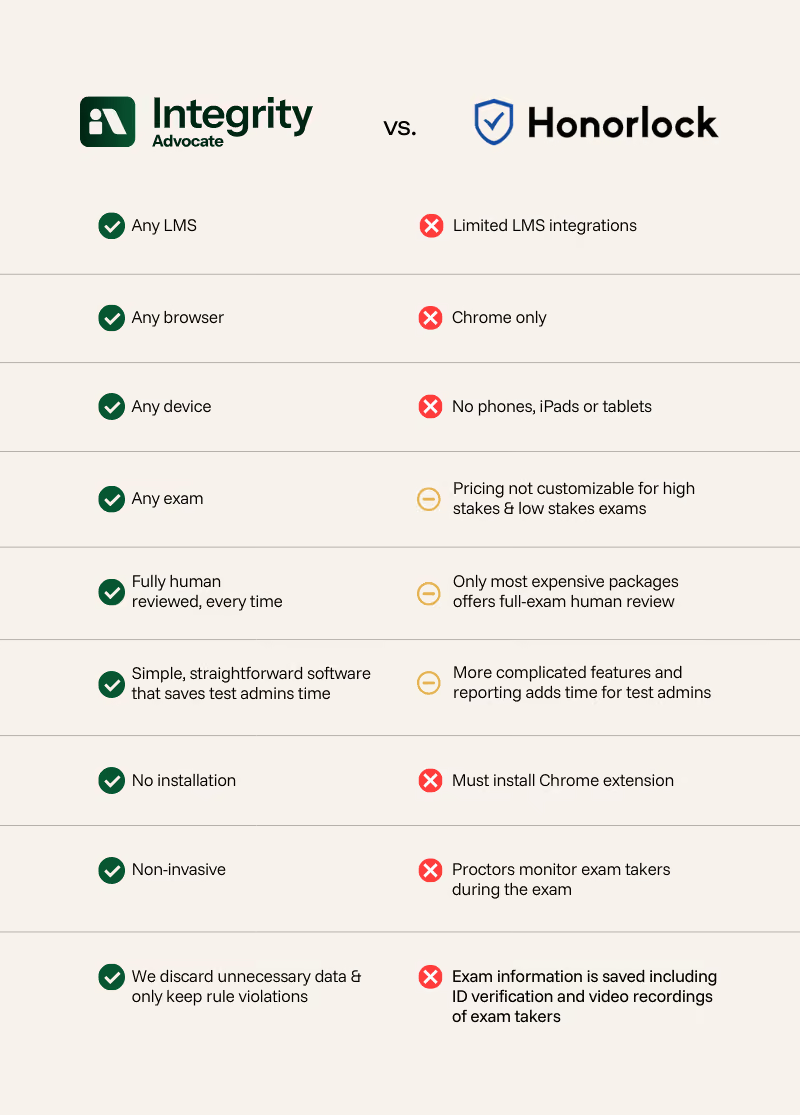
Side-by-Side: Why Institutions Choose Integrity Advocate as an Honorlock Alternative
Universal Compatibility vs. Chrome-Only Limitations
- Integrity Advocate: Works with any LMS, any browser, any device - including phones, iPads, and tablets
- Honorlock: Chrome only, limited LMS integrations, no mobile device support
Privacy-First vs. Mass Data Collection
- Integrity Advocate: Non-invasive monitoring with no live surveillance. We discard unnecessary data after review and only keep rule violations
- Honorlock: Exam information is saved including ID verification and video recordings of exam takers. Proctors monitor exam takers during the exam
Simple Access vs. Required Installation
- Integrity Advocate: No installation required - students start testing immediately
- Honorlock: Must install Chrome extension before each exam
Human Review Included vs. Premium-Only
- Integrity Advocate: Fully human reviewed, every time as standard across all packages
- Honorlock: Only most expensive packages offer full-exam human review
Flexible Pricing vs. One-Size-Fits-All
- Integrity Advocate: Pricing customizable for different exam types - pay less for low stakes exams, invest appropriately in high stakes assessments
- Honorlock: Pricing not customizable for high stakes and low stakes exams
Streamlined Software vs. Administrative Burden
- Integrity Advocate: Simple, straightforward software that saves test admins time
- Honorlock: More complicated features and reporting adds time for test admins
Privacy by Design, Not as an Afterthought
Unlike Honorlock and similar online proctoring vendors that store images and videos from every student session, Integrity Advocate offers a Honorlock alternative that eliminates this risk entirely. Our approach to secure online exams is fundamentally different:
- No mass video storage – We don't record and retain videos of every exam session, just flagged violations
- Minimal ID verification retention – We don't keep ID verification images.
- Data deletion by default – Human proctors review sessions, send any flagged violations to the exam administrator for review, then the data is deleted
- Only violations stored – We discard unnecessary data after review and only keep what's actually necessary: rule violations; this not only minimizes privacy risk, but also saves test administrators time because there is no more sifting through hours of compliant sessions. We do the heavy lifting for you.
This isn't just a privacy feature; it's a liability reduction strategy for secure online assessments. When you don't store sensitive student data long-term, you eliminate the risk of that data being compromised in a breach - a critical consideration when comparing online proctoring services.
Human Review for Every Session - Without the Intrusion
Every single Integrity Advocate session is fully human reviewed, every time, making us stand out among virtual proctoring services. But unlike Honorlock, where live proctors monitor exam takers during the exam with “pop-ins” (creating disruption and anxiety), our review happens after the exam is complete - making it truly non-invasive.
Our remote proctoring software uses AI technology to flag potential issues during the exam, then a human proctor reviews the session immediately afterward to validate the results without invasive live monitoring. This approach to remote exam proctoring means:
- No interruptions – Students complete exams without someone watching them in real-time
- Consistent quality – Human review is standard across all packages, not reserved for premium tiers like Honorlock
- More accurate flagging – Human validation with the entire session context reduces false positives that plague automated-only proctoring tools
- Better student experience – Test takers aren't subjected to the psychological pressure of live monitoring, which reduces anxiety and creates a better test experience
Simplicity That Actually Works
Proctoring software doesn't need to be complicated to be effective. Our online proctoring system works with any LMS, any browser, and any device - including phones, iPads, and tablets.
True Flexibility for Any Exam – We make it easy for test administrators to select any exam type they're proctoring (high stakes, mid stakes, low stakes) and have the rules automatically configured. Unlike Honorlock's pricing that's not customizable for different exam types, our flexible approach means you can proctor different tests differently without managing complex settings or paying premium rates for every assessment.
One Solution, Multiple Use Cases – Replace multiple proctoring services with one flexible online proctoring platform. Because we work with any LMS and don't require specific browser extensions, our remote proctoring services work consistently across your entire testing environment. Integrity Advocate has no Chrome-only limitations, device, or limited LMS integrations.
Simple, Straightforward Software That Saves Test Admins Time – While more complicated features and reporting adds time for test admins in platforms like Honorlock, Integrity Advocate streamlines the entire process. Our intuitive interface means less training, fewer support tickets, and more time focused on education rather than troubleshooting technology.
Budget-Friendly Pricing – Effective online exam security shouldn't require premium pricing. When comparing Honorlock pricing to ours, institutions find we respect institutional budgets while delivering human-reviewed proctoring for every session. This is a feature Honorlock reserves for its most expensive tier. Our approach to enterprise online proctoring delivers more value at a lower cost, with pricing that adapts to your actual needs.
The Honorlock Alternative: Making the Right Choice for Your Organization
When evaluating Honorlock vs online proctoring solutions focused on privacy and simplicity, consider what matters most to your organization:
Choose Honorlock if: You need advanced features, work exclusively within Chrome environments, and have the budget for a premium online exam proctoring solution. Your institution also needs to be prepared to manage student privacy concerns (exam information is saved including ID verification and video recordings), potential backlash over proctors monitoring exam takers during exams, device limitations (no phones, iPads, or tablets), the requirement that students must install Chrome extensions, and limited LMS integrations.
Choose Integrity Advocate as the best Honorlock alternative if: You want effective online exam security without compromising student privacy, need proctoring software that works with any LMS, any browser, and any device (including phones, iPads, and tablets), value fully human reviewed sessions every time without premium pricing, require no installation for seamless student access, prefer non-invasive monitoring over live surveillance, want simple, straightforward software that saves test admins time, need pricing customizable for different exam types, and prioritize discarding unnecessary data while only keeping rule violations. If reducing institutional liability around data storage and improving the student testing experience are priorities, Integrity Advocate is the clear choice among online proctoring vendors.
The Bottom Line: Best Proctoring Software for Privacy-First Institutions
Online proctoring companies like Honorlock have built robust feature sets, but those features come with significant trade-offs: invasive monitoring where proctors watch exam takers during exams, extensive data storage where exam information is saved including ID verification and video recordings, Chrome-only compatibility with no phones, iPads, or tablets support, required Chrome extension installation, poor student experience, limited LMS integrations, and complicated proctoring systems where more features add time for test admins.
Integrity Advocate offers a smarter Honorlock alternative for online proctoring. You don't need to extensively store every exam session or ID verification image to maintain exam integrity. Every session is fully human reviewed as standard—not just in premium packages. Our privacy-first data practices discard unnecessary data after review and only keep rule violations. The software is simple and straightforward, saving test admins time. There's no installation required and monitoring is non-invasive. It's compatible with any LMS, any browser, and any device. Pricing is customizable for both high stakes and low stakes exams. We deliver the best proctoring software without the compromises.
When conducting an online proctoring comparison, the question isn't whether you need remote proctoring. It's whether your proctoring platform should create more problems than it solves. Among exam proctoring companies, we stand apart by prioritizing what matters most: privacy, universal accessibility, user experience, effectiveness, and value.
Ready to see the difference? Discover why institutions are switching from Honorlock to Integrity Advocate for a privacy-first, human-reviewed approach to online proctoring. Experience the best online proctoring software that combines secure online assessments with respect for student privacy—without the Chrome-only limitations, installation requirements, live monitoring, or premium Honorlock pricing. Contact us today to learn more about our remote proctoring services and why we're the best alternative to Honorlock.
{{post-cta}}