|
min read
Can online proctoring stop ChatGPT? An honest answer
Online proctoring can stop much AI-assisted cheating, but no browser control blocks every tool. A defensible approach prevents known AI tools, looks at behaviour rather than tool names alone, and uses trained reviewers to confirm and document each finding.

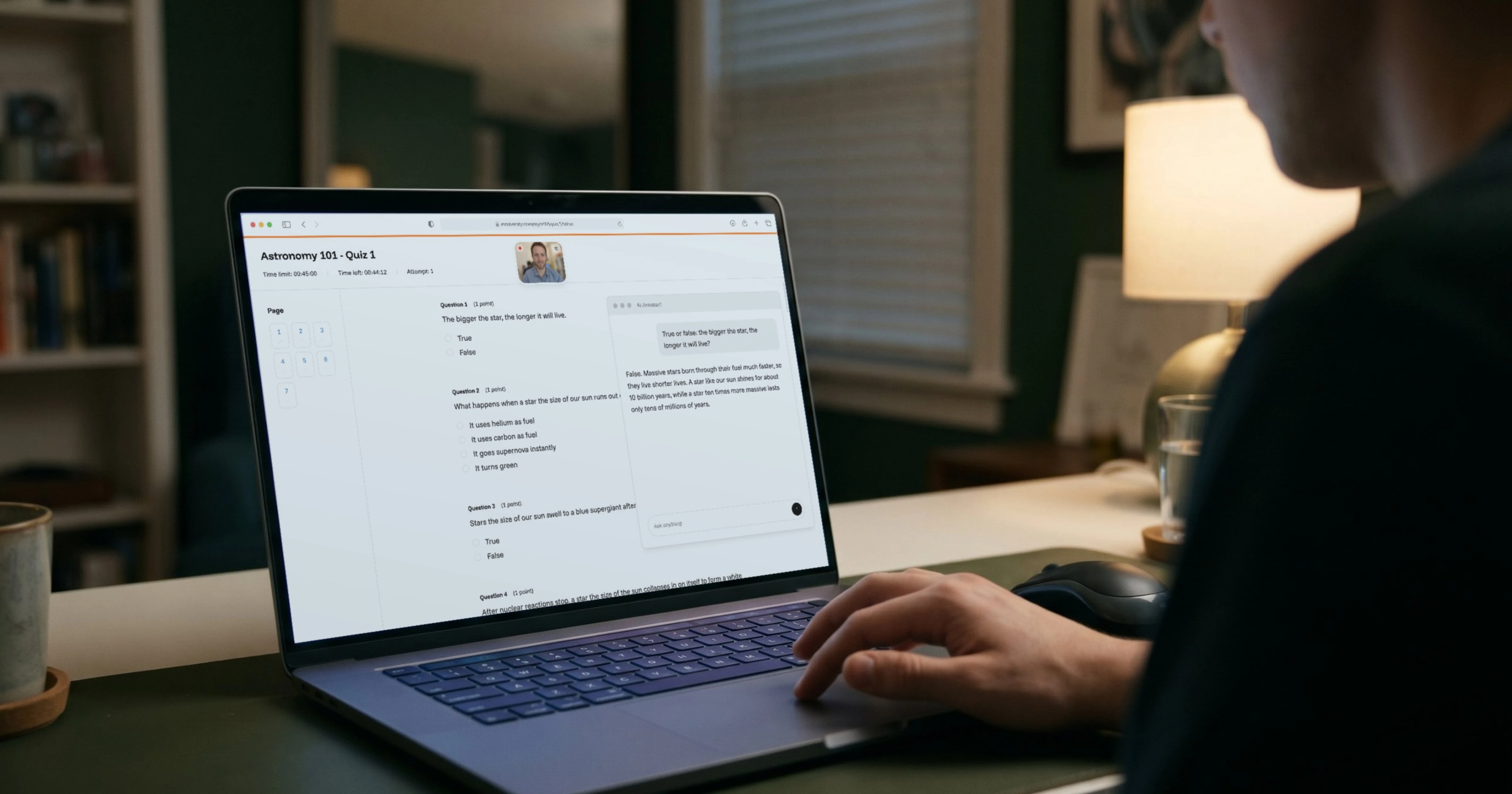
Search for how to stop ChatGPT during online exams and you'll find a confident promise: block the AI, lock the browser, and the problem goes away. It's an appealing answer, but it leaves out the part that matters most to a program that has to stand behind its results months later.
Here is the honest version. Online proctoring can stop a large share of AI-assisted cheating before it affects a result, but no browser-based control blocks every tool. New AI extensions appear constantly, some leave nothing a browser can detect, and some AI use happens outside the browser altogether. What a program needs is a system that prevents what it can, sees what it can't block, and produces a record a person can defend.
Why "we block ChatGPT" is the wrong promise
AI shows up in an exam in several forms. There are browser extensions and sidebars that read the page and suggest answers, standalone desktop apps that sit in a separate window, chatbots open on a second tab, and phones held just out of frame. A blocklist can only reflect the tools it already knows about, so anything newer passes through until someone notices it.
There is a second gap that blocking can't close. AI-assisted answering produces no reliable behavioural signal. An algorithm can tell you a session looked unusual, but it can't tell you whether a well-written answer came from a chatbot or from a strong candidate. That determination needs a person with context, and a documented reason for the conclusion they reached.
So the useful question for any program is not "does this tool block ChatGPT?" It's "what happens when something gets past the block, and what record will I have when someone asks?"
Layer one: prevent it before it reaches the result
The best outcome for everyone is a test taker who never gets the chance to use an AI tool in the first place. Browser-side controls handle this without a download or lockdown browser.
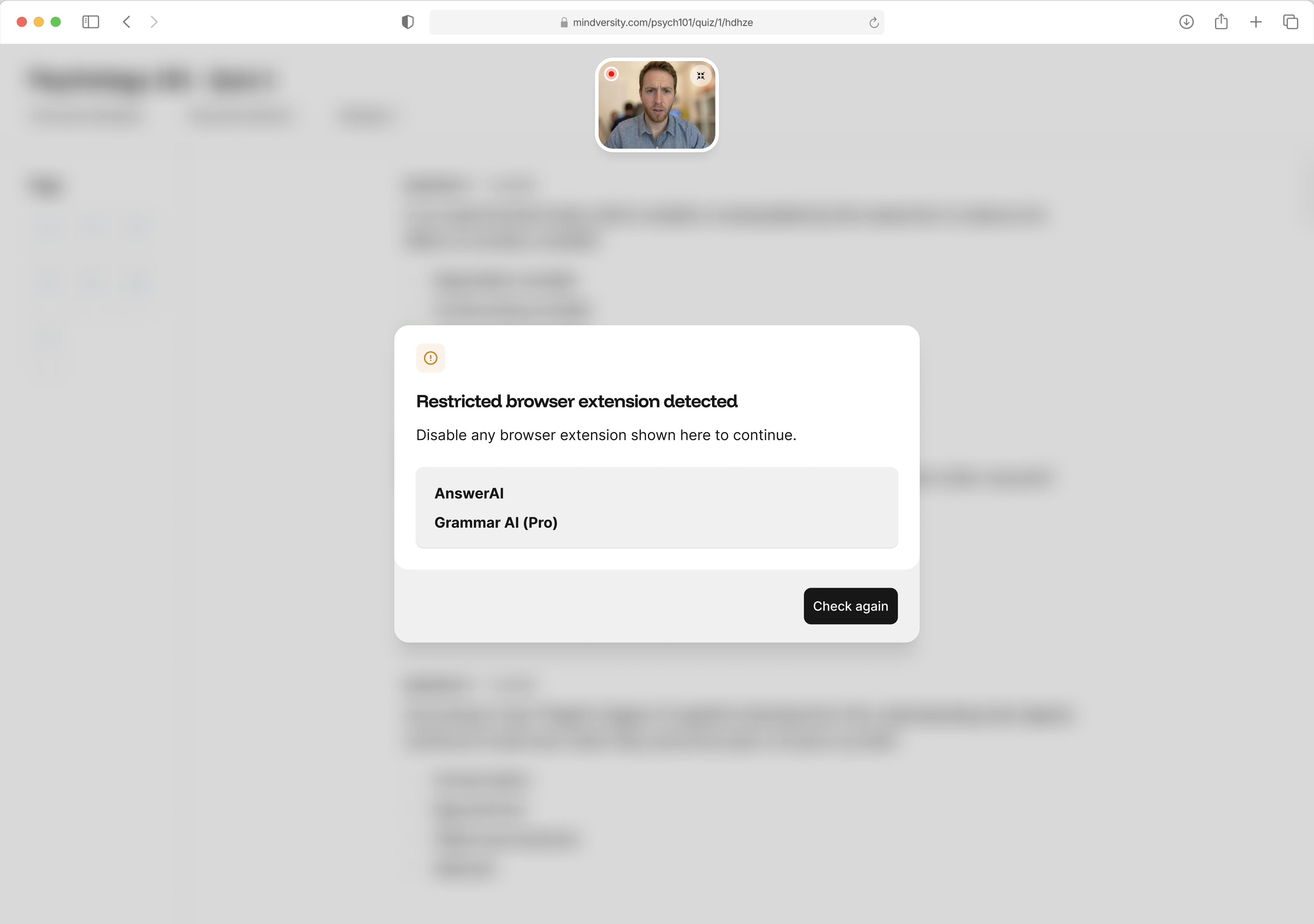
When extension blocking is turned on, Integrity Advocate checks for detectable AI browser extensions at the start of the session. If one is active, the test taker sees a clear prompt to remove it before continuing. Once it's removed, they continue with a clean session. That is a better result for the learner, and for the program, than an invalidated exam afterward.
The response is proportional to the risk. Depending on what is detected, a session may be blocked, interrupted, flagged or sent for review, so a minor signal isn't treated the same way as a serious one.
Other controls support the same goal. Full-screen and single-screen enforcement keep the exam in focus, and onscreen content protection limits copying, pasting and text selection, which makes it harder to move a question into a chatbot. Each program chooses which controls to enable, based on the stakes of the assessment.
Layer two: a trained reviewer sees what a blocklist can't
Prevention handles the tools it recognizes. For everything else, the safeguard is a person.
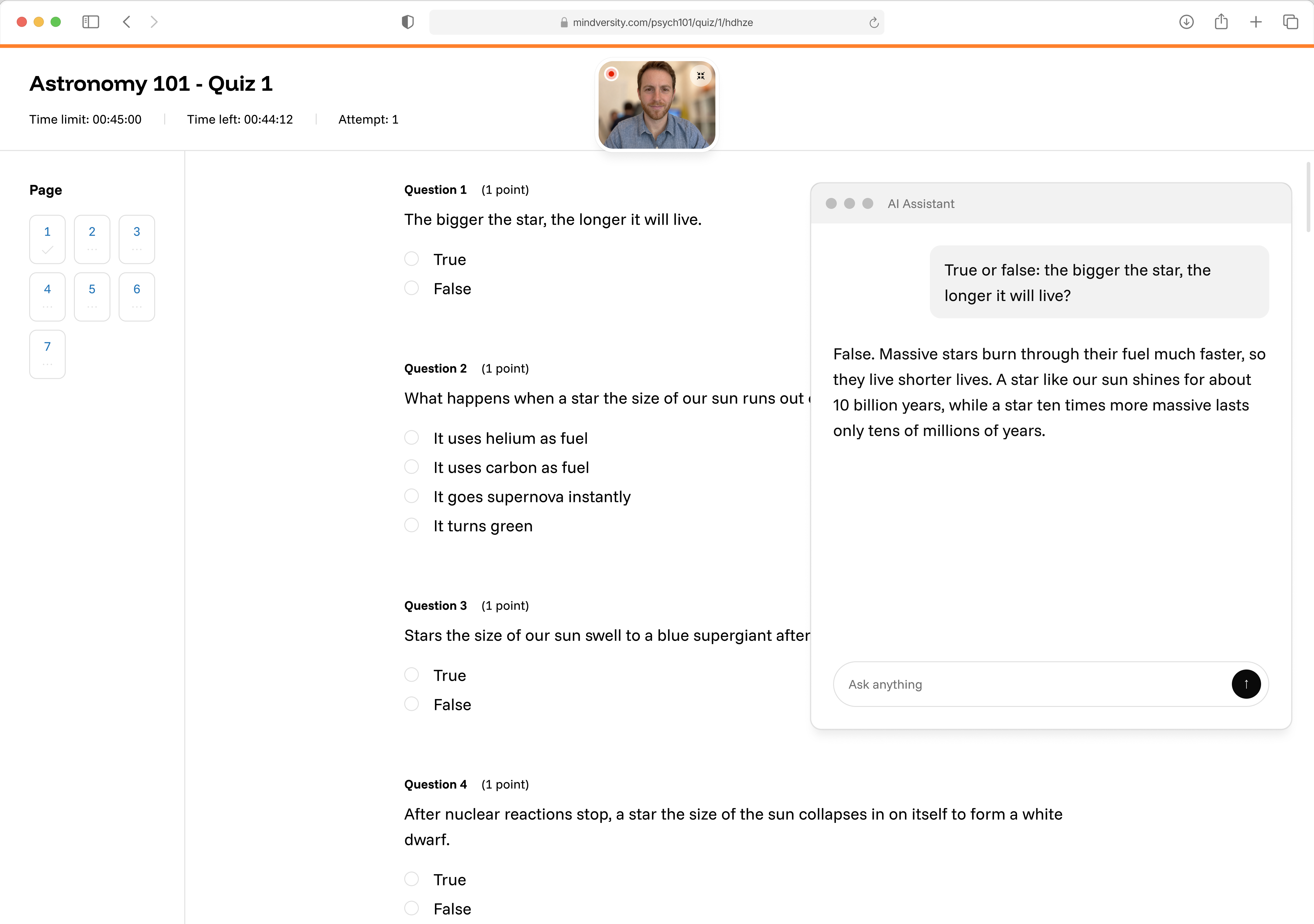
Consider a test taker who opens a standalone AI app partway through an exam. There is no extension to detect, because the app isn't running in the browser. On programs that use screen monitoring, the screen capture shows the app, and a trained reviewer confirms it as an active AI application. The same applies to a phone that appears in the camera view.
The reviewer doesn't act on a single frame. They confirm what they observe across the session, with full context, and write down what was flagged, what they saw, and why it matters under the program's rules. Context works in the test taker's favour too. A tool that is merely installed is treated differently from a tool being used to get an answer, and brief, incidental moments are weighed for what they are.
The program sets the rules and the enforcement level. The final decision about any result always belongs to the program.
Layer three: look at behaviour, not just tool names
This is where human review stops being a cost and becomes the reason the system keeps up.
New AI apps, extensions and copilots appear faster than any list can be updated, and existing tools get renamed. So rather than depending only on a catalogue of tool names, CounterAI looks at how AI misuse shows up in a session: unusual interaction patterns, attempts to evade oversight, and risk signals weighed alongside everything else happening in the session.
A trained reviewer then confirms what those signals mean. Because a person assesses each flagged session, an unfamiliar tool can be recognized the first time it appears, instead of waiting for an automated system to see it enough times to learn it. What reviewers learn feeds back into detection, so each new tool makes the system sharper rather than leaving it further behind.
The question that matters comes after the exam
Most AI-cheating content stops at the exam window. The harder moment comes later, sometimes months later. A candidate appeals a result, an employer questions a certificate, or a regulator asks how the program knows its outcomes are sound. The person answering is often a registrar, a compliance manager or a director of certification who never watched the session.
"Our tool blocks ChatGPT" won't answer that question. A defensible answer sounds like this: a trained person reviewed this session against your rules, at the enforcement level you set, and here is what they observed and why. That record keeps three things separate, the automated signal, the reviewer's confirmed finding, and the program's final decision.
For a closer look at what that record needs to contain, see What defensible assessment looks like in 2026.
In the age of AI, the cost of having no record is real. When a Brown University economics course moved its midterm to an unproctored take-home format, the class averaged 96%. The proctored, in-person final averaged 48.6%. With no monitoring, there was no institutional record of how the midterm answers were produced, and the professor was left to investigate 86 responses on his own.
Five questions to ask any proctoring provider about AI
If you're evaluating how a provider handles AI-assisted cheating, these questions get past the marketing quickly.
- What happens when a test taker uses an AI tool your system doesn't recognize yet?
- Who reviews AI-related flags, and is that review included or a paid upgrade?
- How are newly released AI tools added to detection?
- Can you show me the written record a reviewer produces for a flagged session?
- Who makes the final decision on a result, your system or my program?
The answers will tell you whether a provider is selling a block or a result you can defend.
Built for the AI tools that already exist, and the ones that don't yet
No proctoring platform can promise to block every AI tool, and a program shouldn't trust one that does. What a program can count on is a connected system: prevention for the tools that are known, trained human review for the ones that aren't, and a documented record that holds up when a result is challenged. That is what makes a result fair to the test taker, trustworthy for the program, and defensible when it counts.
{{post-cta}}
Continuer la lecture

Les outils de triche par IA dépassent les défenses des LMS. Integrity Advocate a créé une solution
August 17, 2023
|
3
min read
Les extensions de navigateur basées sur GPT peuvent désormais préremplir les réponses aux questions d'examens en ligne dès leur apparition, et les plateformes LMS ne disposent d'aucune contre-mesure efficace. ExposeAI d'Integrity Advocate est une solution de détection spécialement conçue pour identifier la triche assistée par IA lors des sessions d'évaluation, s'intégrant directement à la suite de surveillance existante sans aucune installation côté client. Cet article explique le fonctionnement de ces outils, leur importance pour les programmes de formation certifiants et la manière dont ExposeAI répond à cette menace.

Surveillance par IA vs humaine vs hybride : quel modèle protège le mieux l'intégrité des examens ?
October 9, 2025
|
4
min read
Avec l'essor des examens en ligne dans les secteurs de l'éducation, de la certification et de la formation à la conformité, le choix entre une surveillance par IA, humaine ou hybride a des conséquences réelles sur l'intégrité des examens, l'équité et les risques organisationnels. Cet article analyse ces trois modèles, leurs avantages et inconvénients, ainsi que les situations où chacun est le plus adapté, pour conclure que la surveillance hybride offre le meilleur équilibre entre efficacité, précision et équité pour la plupart des environnements d'évaluation modernes.

AI and Online Exams: What the Data Reveals About Assessment Security
February 11, 2025
|
min read
Large-scale Wiley research surveying more than 2,900 students and instructors across North America reveals that cheating is measurably increasing in online environments, nearly half of students report using generative AI in their coursework, and 86% of instructors say students are more likely to cheat in online courses than in person. This post examines what the data reveals about the current academic integrity landscape, how AI has reshaped the threat model without changing the underlying intent behind misconduct, and how Integrity Advocate's COUNTER-AI approach responds to behavioral patterns rather than chasing specific tools.