May 25, 2020
|
5 min de lecture
The Student Who Implanted a Bluetooth Device to Cheat. And What It Actually Tells Us
The student who surgically implanted a Bluetooth device to cheat in an exam made headlines. But the more important question is why the exam was so easy to cheat on. This post explores how Bloom's Taxonomy and higher-order assessment design reduce academic integrity risks at the source, lowering the burden on proctoring technology and creating a fairer experience for every test taker.


A student surgically implanted a Bluetooth device into their own ear to receive answers during a final exam. It made headlines. It was extreme, it was alarming, and it completely missed the more important question.
Why was the exam so easy to cheat on in the first place?
The conversation around academic integrity almost always focuses on the student: what they did, how they did it, and how to stop them next time. The assessment itself rarely comes under the same scrutiny. That's a problem. Because in many cases, the design of the exam is the vulnerability, and fixing it does more for integrity than any monitoring technology can.
The Variable Most Organizations Overlook
When an organization moves assessment online, two things typically happen. First, they worry about cheating. Second, they look for proctoring technology to solve it. What often gets skipped is the question that should come first: is this assessment actually designed for an online environment?
The method of assessment is a variable entirely within the organization's control. When that variable is addressed, the result is better academic integrity, a less stressful experience for test takers, and lower proctoring costs. All three, at once.
How Bloom's Taxonomy Changes the Integrity Equation
Bloom's Taxonomy is a framework for categorizing educational objectives by cognitive complexity. Developed by Benjamin Bloom in collaboration with other education experts and published in 1956, it has been refined over decades into six levels of learning:
- Remember - recall of facts and basic concepts
- Understand - explanation of ideas or concepts
- Apply - use of information in new situations
- Analyze - drawing connections and comparisons
- Evaluate - justifying a decision or course of action
- Create- producing something new from learned knowledge
Each level requires a greater degree of cognitive processing than the one before it. And crucially, each level also changes how much a proctoring system needs to do.
Why Lower-Order Questions Create Higher-Stakes Monitoring Needs
Remember
A question like "define representative democracy" or "spell rutabaga" can be answered in seconds with a quick search, a phone, or a note. Monitoring this type of question requires tracking browser activity, device use, eye movement, and the presence of others in the room. The proctoring burden is high. The assessment value is low.
Understand
Questions at this level, such as "explain the role of citizens in a representative democracy," carry the same risks. The answer can be found, copied, and paraphrased quickly enough that standard monitoring is the only safeguard.
Apply
Here the dynamic starts to shift. Application questions require a test taker to work through a problem, not just retrieve an answer. When combined with time limits, large question banks, and randomized question and answer combinations, the advantage of external resources is significantly reduced. Proctoring at this level can focus on identity verification and confirming sole participation, which is lower cost and far less invasive.
Analyze, Evaluate, and Create
At these levels, the integrity risk drops substantially. A question like "compare and contrast the economic motivations of..." or "explain the effect of X on a country's economy" requires original reasoning that cannot be copied. No search result, no friend in an earpiece, and no surgically implanted Bluetooth device provides a meaningful advantage when the question demands genuine synthesis and judgment.
The Practical Implication
Higher-order assessments don't eliminate the need for proctoring. Identity still needs to be verified. Sole participation still matters. But they do change what proctoring needs to accomplish, and that changes what it costs and how intrusive it has to be.
For organizations running online assessments, this is worth reviewing before adding monitoring layers. If your questions can be answered by someone with a phone and thirty seconds, the proctoring challenge is structural, not technological.
A More Useful Question Than "How Do We Catch Cheaters?"
The default response to academic integrity concerns is tighter controls and more invasive monitoring. That response treats the symptom. Reviewing the assessment design treats the cause.
Integrity Advocate works with organizations to look at the full assessment process, not just the monitoring window. When the exam itself is designed to require genuine knowledge and reasoning, the monitoring becomes simpler, the experience becomes fairer, and the outcomes become more defensible.
That's a better result for everyone, including the test taker who never has to wonder if an algorithm flagged them unfairly.
{{post-cta}}
Continuer la lecture

How Integrity Advocate Prevents Cheating in Online Exams
October 17, 2025
|
5 min de lecture
Online assessments should be fair, secure, and accessible. As exam tools evolve, so do attempts to game them. This post explains how Integrity Advocate prevents the most common forms of online cheating, including hidden plugins, impersonation, unauthorized devices, and off-camera assistance, through a privacy-first combination of identity verification, AI-assisted monitoring, and human review that keeps evidence audit-ready and the learner experience low-friction.
Online assessments should be fair, secure, and accessible. As online exam tools evolve, so do attempts to game the system, making online cheating prevention a crucial focus. Integrity Advocate helps you prevent cheating without adding complexity, combining identity verification, environment checks, AI-assisted monitoring, and human review to protect integrity while respecting learner privacy.
What privacy-first prevention means, and why we believe in it
Privacy-first prevention protects integrity without collecting more data than necessary or taking intrusive control of a learner’s device. It runs inside your LMS, uses targeted signals rather than full device access, and keeps data retention limited and transparent, which is vital for effective online cheating prevention.
Why we believe in it
Security should earn trust. When learners understand what is collected and why, and when the experience stays accessible and low-burden, participation improves, compliance is easier to maintain, and your outcomes are more defensible.
How it prevents cheating for online exams
- Identity Verification: Verify the right person is taking the online exam or assessment at launch and throughout the session, which reduces impersonation and proxy testing, essential components of online cheating prevention.
- Environment and behavior signals: Detect patterns tied to hidden plugins, unauthorized resources, off-camera help, and device hand-offs while minimizing false positives.
- Hybrid Proctoring: Automation surfaces risk signals at scale, trained human reviewers add context and empathy, and final decisions stay fair and defensible.
- Audit-ready evidence: Time-stamped artifacts and clear notes support quick investigations and policy enforcement.
What we prevent and how
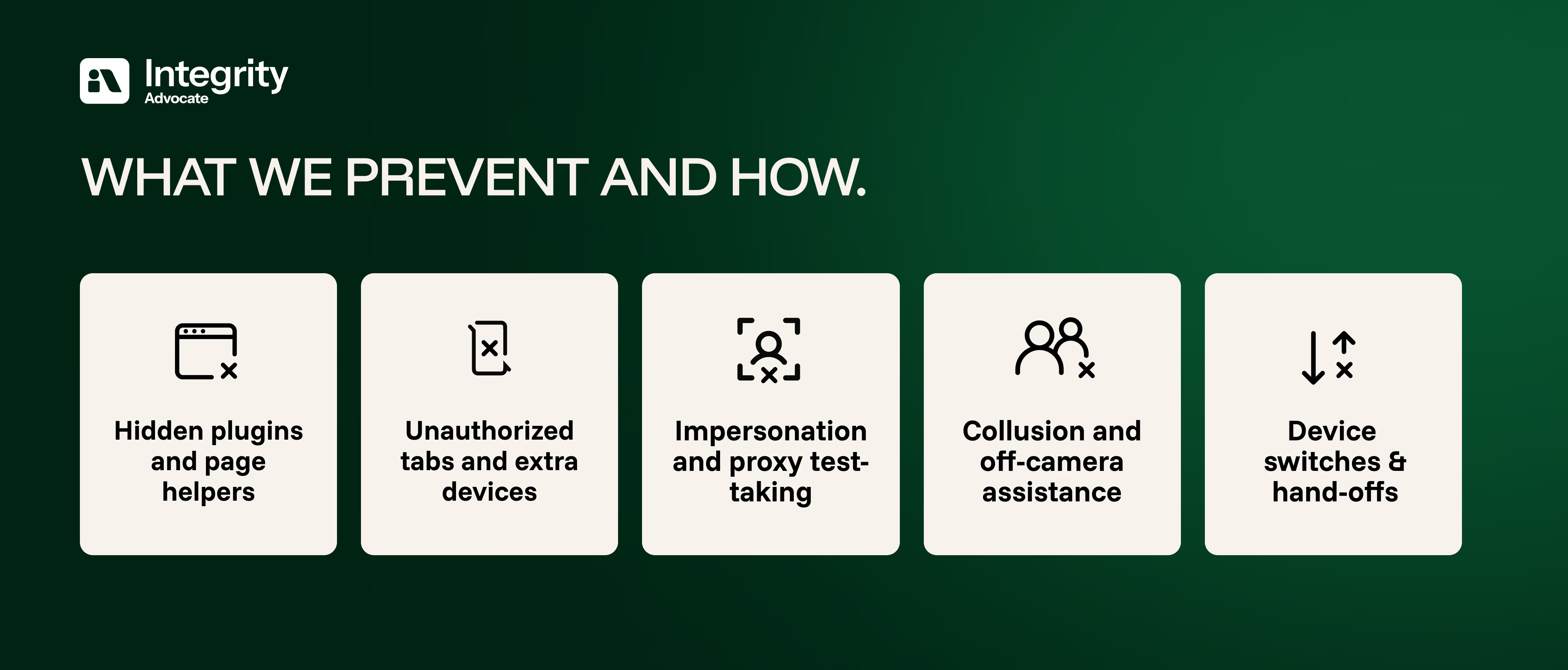
- Hidden plugins and page helpers
We surface indicators of undisclosed browser extensions and on-page answer helpers. Signals and reviewer checks identify prohibited tools, then produce clear, time-stamped evidence for online cheating prevention. - Unauthorized tabs and extra devices
Session behavior and view analysis help flag the use of outside content, second screens, and unapproved devices, aligned to your exam rules. - Impersonation and proxy test-taking
Identity checks check the exam taker to their identification and to their name in the LMS. We confirm the right person at launch and throughout the session. - Collusion and off-camera assistance
We look for signs of remote helpers, verbal cues, and presence of others. - Device switching and session hand-offs
Continuity monitoring and event patterns make mid-exam swaps visible. When something looks off, reviewers step in and your team receives defensible evidence.
Preventing these risks reliably requires the right balance of automation and human judgment to optimize online cheating prevention.
Why hybrid proctoring works
Automation finds patterns at scale and humans add context, fairness, and final judgment. Integrity Advocate blends both to reduce false positives and deliver decisions you can defend to regulators, customers, and accreditors, while keeping the experience seamless for learners with a focus on online cheating prevention.
Designed to fit your LMS and your policies
- No-install launch: Runs where your learners already are.
- Configurable rules: Align settings with your policies and industry needs.
- Accessible and global: Works across devices, bandwidth, and accommodations.
- Audit-ready reporting: Time-stamped evidence and reviewer notes streamline investigations.
What your team gains
- Clear signal, less noise: AI surfaces the right moments, reviewers handle edge cases.
- Privacy by design: Minimal collection and retention aligned to your requirements.
- Scale with confidence: From certification and licensure to workforce training and education.
- Measurable integrity: Trends and outcomes help you refine policies over time.
See it in action
Want to watch how we detect hidden plugins, prevent impersonation, and keep sessions fair without extra burden on learners? Request a demo
{{post-cta}}

AI Cheating Tools Are Outpacing LMS Defenses. Integrity Advocate Built a Solution
August 17, 2023
|
5 min de lecture
GPT-powered browser plugins can now prefill answers to online exam questions the moment they appear, and LMS platforms have no effective countermeasures. Integrity Advocate's ExposeAI is a purpose-built detection capability that identifies AI-assisted cheating during assessment sessions, integrating directly into the existing monitoring suite without any client-side installation. This post explains how these tools work, why they matter for certified training programs, and how ExposeAI addresses the threat.
A few years ago, the concern about AI in online assessments was theoretical. Today it is not. GPT-powered browser plugins can prefill answers to multiple choice exam questions the moment they appear on screen, regardless of the topic or difficulty level. The learner does not need to read the question. They do not need to understand it. The answer is already there.
Integrity Advocate has been tracking this development closely. The response is ExposeAI, a new detection capability built directly into Integrity Advocate's monitoring suite.
How GPT-Powered LMS Plugins Work
Learning Management System plugins powered by generative AI have proliferated rapidly. Among the tools currently in use are Github Copilot, AnswersAI, ConchAI, Jasper, ChatSonic, Coursology, Hyperwrite, Quillbot, and Monica, among dozens of others that continue to emerge.
These tools share several characteristics that make them particularly difficult to address through standard LMS countermeasures:
- They are inexpensive or free to obtain
- They require no technical expertise to install or activate
- Once installed, they operate automatically and continuously
- They are designed to conceal their presence and adapt to detection attempts
- New variants emerge faster than most platforms can respond
As a result, organizations relying on their LMS provider to develop effective countermeasures are unlikely to find one. LMS companies have no current solutions to this threat, and the nature of these plugins makes them unlikely to be eradicated through platform-level defenses alone.
The integrity of online assessments and certifications depends on a different approach.
Why This Matters for Assessment Integrity
The implications extend beyond academic dishonesty. For organizations issuing certifications that carry regulatory or legal weight, an assessment completed with AI assistance is not a valid measure of knowledge or competency. The certification it produces is as hollow as one issued without any training at all.
The same worker who received a fraudulent safety certification from a provider that did not deliver training could receive an equally fraudulent certification from an organization that delivered the training but could not prevent AI tools from completing the assessment on the learner's behalf. The outcome is the same: a credential that does not reflect what the person actually knows.
Introducing ExposeAI
ExposeAI is Integrity Advocate's purpose-built response to AI-assisted assessment fraud. It can be incorporated into Integrity Advocate's existing monitoring suite without any technical effort from clients, and works across the full range of devices and browsers that Integrity Advocate supports, from mobile to desktop.
ExposeAI is designed to detect the presence and use of GPT-powered plugins during an assessment session, giving organizations the visibility they need to maintain the integrity of their certification and training programs in an environment where AI tools are becoming standard equipment for learners looking to shortcut the process.
This is part of Integrity Advocate's broader commitment to staying ahead of the threats that matter most to the programs it serves. Human review remains at the core of every session. ExposeAI adds a layer of detection specifically designed for the AI-assisted cheating methods that automated systems alone cannot reliably identify.
The Broader Picture
AI cheating tools are not a passing trend. They are becoming cheaper, more capable, and more widely available. Organizations that do not have a response to this threat are issuing certifications they cannot stand behind.
Integrity Advocate's approach combines human review with purpose-built AI detection, so the results your program issues reflect what learners actually know, not what an algorithm answered for them.
{{post-cta}}

AI vs. Human vs. Hybrid Proctoring: Which Model Best Protects Exam Integrity?
October 9, 2025
|
5 min de lecture
As online testing expands across education, certification, and compliance training, the choice between AI-only, human-only, and hybrid proctoring has real consequences for exam integrity, fairness, and organizational risk. This post breaks down all three models, their pros and cons, and when each is the right fit, concluding that hybrid proctoring delivers the best combination of efficiency, accuracy, and fairness for most modern assessment environments.
The Evolving Landscape of Online Exam Security
As online testing continues to expand across education, certification, and compliance training, choosing the right proctoring model has never been more important.
AI-only tools promise automation and scalability. Human-only options offer fairness and empathy. Hybrid models combine the best of both, but which one truly protects exam integrity?
This article breaks down the three dominant proctoring approaches, their pros and cons, and what to consider when choosing the right fit for your organization.
1. AI-Only Proctoring: Fast, Scalable, and Automated, but Imperfect
AI proctoring tools use algorithms to detect suspicious behavior automatically, from unusual head movements to multiple voices or unauthorized devices.
While these systems offer speed and scalability, they also raise concerns about accuracy and bias.
Pros:
- Monitors large numbers of exams simultaneously
- Automates flagging and reporting
- Reduces administrative workload
Cons:
- High false positive rates (lighting, gaze, or accessibility issues)
- Lacks human context and judgment
- Raises data privacy and fairness concerns
AI-only systems can be efficient but risk misinterpretation, which can reduced trust among test takers.
2. Human-Only Proctoring: Fair and Contextual, but Limited in Scale
Human proctors oversee exams via live or recorded video, making real-time decisions based on context and behavior.
This model prioritizes fairness, empathy, and human oversight, but introduces scalability and scheduling challenges.
Pros:
- Accurate, contextual decision-making
- Builds trust with test takers
- Reduces false flags and misunderstandings
Cons:
- Labor-intensive and difficult to scale globally
- Higher cost per exam
- Limited flexibility for asynchronous or on-demand testing
Human-only proctoring ensures fairness but struggles to keep pace with modern testing needs.
3. Hybrid (AI + Human) Proctoring: The Best of Both Worlds
Hybrid proctoring blends automation and human oversight to deliver accuracy, fairness, and scalability.
AI handles initial detection, while human reviewers verify each flagged event before reports are finalized. This ensures efficiency without sacrificing integrity.
Pros:
- Reduces false positives with human verification
- Scales efficiently across time zones
- Protects privacy and fairness
- Provides auditable, compliant reporting
Cons:
- Requires platform integration
- May introduce slight delays in review turnaround
Hybrid proctoring creates the balance today’s organizations need, efficient technology guided by human discretion.
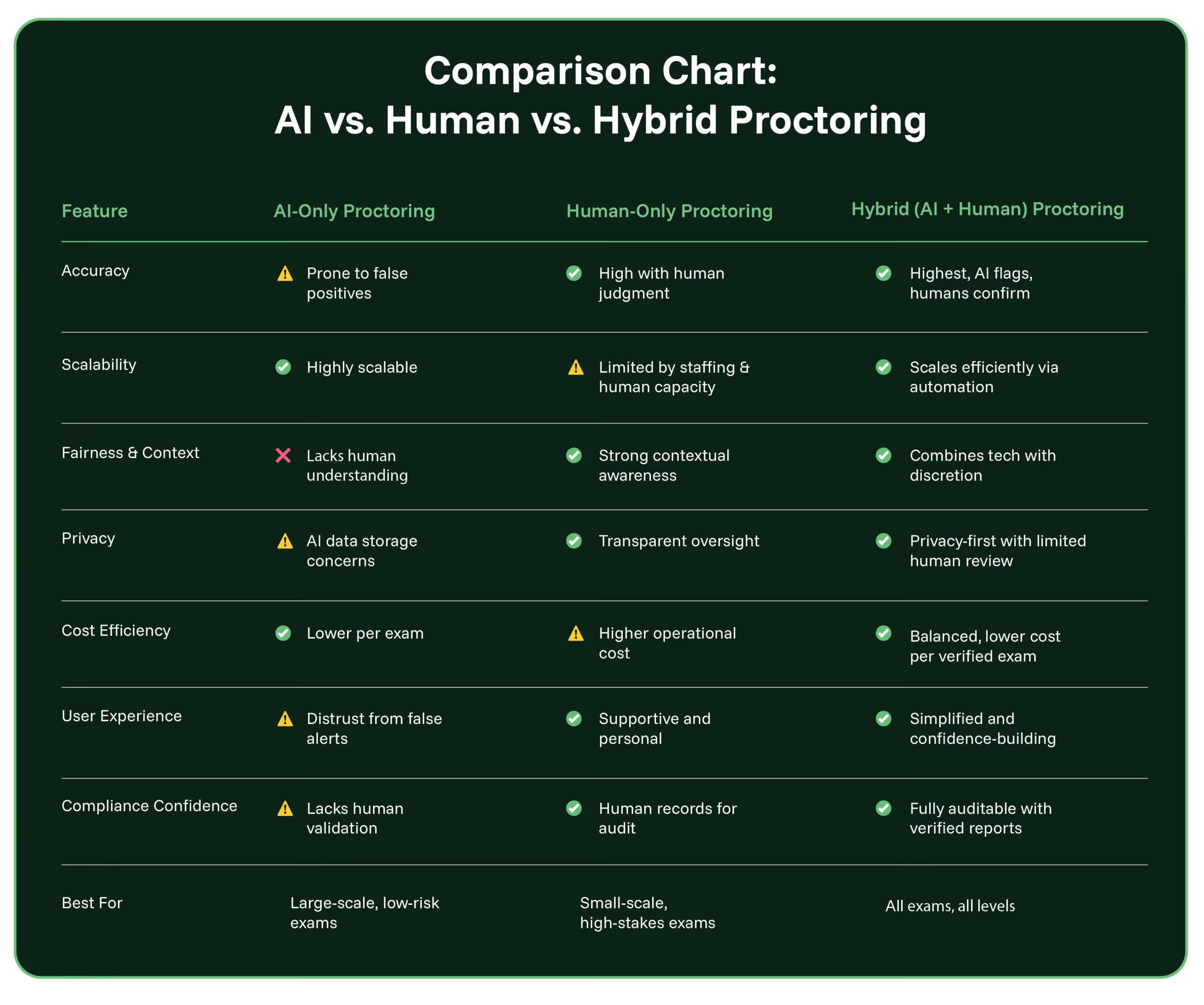
Verdict: Hybrid proctoring delivers the best combination of efficiency, accuracy, and fairness, meeting the evolving needs of modern learning and compliance environments.
When to Use Each Type of Proctoring (and When to Avoid It)
Choosing the right proctoring model isn’t just about features, it’s about fit. Here's when each approach works best, and when it might fall short.
AI-Only Proctoring
AI-only proctoring is a good fit for large-scale, low-stakes testing environments where speed and automation are priorities. It’s ideal for institutions delivering practice exams or formative assessments with minimal impact on final outcomes. If your team is constrained by staffing or budget, and real-time oversight isn’t required, AI-only can offer a fast, lightweight solution.
However, AI-only solutions are risky in high-stakes scenarios like certification, compliance, or licensure exams, especially where fairness, accessibility, and privacy are key concerns. These systems can generate false flags and lack the human context needed to distinguish genuine misconduct from harmless behavior.
Human-Only Proctoring
Human-only proctoring excels in small-group, high-stakes testing scenarios where personal interaction, empathy, and real-time judgment matter most. It's particularly useful for live, synchronous exams or specialized formats like oral exams, interviews, or hands-on assessments. If trust, fairness, and human connection are top priorities, a fully human approach ensures every test-taker is treated with context and care.
That said, this model becomes difficult to scale across large populations or global programs. It also presents challenges for asynchronous testing and tends to be more expensive due to staffing and scheduling demands. Organizations needing rapid turnaround or flexible exam windows may find this model limiting.
Hybrid Proctoring (AI + Human Review)
Hybrid proctoring combines the speed and scalability of AI with the fairness and context of human review, making it ideal for most modern assessment environments. It works especially well for mid- to high-stakes exams delivered at scale, such as workforce certification, compliance training, or higher education finals. Hybrid models support asynchronous access and bring-your-own-device testing, while still delivering human-verified, audit-ready results.
The main limitation is that some hybrid models may involve slight delays between the test and final reporting, depending on review turnaround time.
Why Hybrid Models Are the Future
Organizations are no longer choosing between technology and trust — they’re demanding both. Hybrid proctoring empowers institutions to deliver secure, privacy-compliant, and credible assessments without friction for test takers.
By combining automation and human verification, administrators get:
- Fewer false flags and student disputes
- Stronger audit trails and compliance documentation
- A smoother, more confident test-taking experience
How Integrity Advocate Sets the Standard
Integrity Advocate’s hybrid approach is designed around human-first, privacy-protected verification.
- No software installs required
- Works on any device or browser
- AI-driven detection verified by expert human reviewers
- Transparent, auditable reports administrators can trust
Integrity Advocate’s hybrid proctoring ensures fairness, compliance, and confidence in every assessment.
“Integrity Advocate integrates easily with our current system. It runs smoothly and is aesthetically pleasing; it meets the high standard we have for all our systems. It is also very effective at proctoring while not being too invasive; our users feel comfortable using it. Integrity Advocate strikes the right balance of integrity and privacy, which is hard to find!”
Ready to find the balance between automation and integrity?
Request a Demo to see how Integrity Advocate’s hybrid model redefines online exam security.
{{post-cta}}
Foire aux questions
Trouvez les réponses aux questions les plus fréquemment posées par nos clients.
A student underwent a surgical procedure to have a Bluetooth device implanted in their ear in order to receive answers during an exam without detection. The device was small enough to be invisible to proctors and inaudible to nearby students. The case drew significant attention because it illustrated the extreme lengths some individuals will go to when the perceived reward of a credential is high enough and the assessment design creates an opportunity to exploit.
It reveals two things simultaneously. First, that sufficiently motivated individuals will find increasingly sophisticated methods to circumvent monitoring, which means chasing specific cheating methods is a losing strategy for any security system. Second, and more importantly, it reveals a gap in assessment design. When an exam can be defeated by receiving answers through an audio channel, the assessment is testing recall of discrete facts rather than higher-order thinking, analysis, or application. That is an assessment design problem as much as it is a security problem.
Bloom's Taxonomy is a framework for classifying educational objectives across six levels of cognitive complexity: Remember, Understand, Apply, Analyze, Evaluate, and Create. Assessments designed at the lower levels, primarily Remember and Understand, ask learners to recall or reproduce information. These are the assessments most vulnerable to cheating because the answer can be looked up, transmitted, or generated by AI. Assessments designed at the higher levels, Apply, Analyze, Evaluate, and Create, require the learner to demonstrate genuine competence in ways that are much harder to outsource or fake. A student cannot have an answer whispered to them for a question asking them to design an original solution to a novel problem.
No, but it changes the role proctoring plays. Higher-order assessments reduce the value of simple answer transmission because the answers themselves are not the point. A Bluetooth device in someone's ear is useful for receiving the answer to a multiple choice question. It is not useful for helping someone demonstrate genuine professional judgment on a case-based scenario. That said, identity verification, participation monitoring, and human review remain essential even for higher-order assessments, because confirming that the right person completed the work under the required conditions is still a defensible outcome requirement regardless of assessment format.