September 24, 2025
|
5 min de lecture
OnDemand Webinar: The Dark Side of AI - The End of Traditional Training as We Know It with ASSP
AI is transforming how we learn and work, but it is also opening the door to new risks for training providers, compliance managers, and credentialing bodies. In this on-demand webinar presented by ASSP and Integrity Advocate, learn how deepfakes, voice synthesis, and automation tools are making it easier to falsify participation and assessment results, what the compliance and regulatory consequences are for organizations that cannot verify training completion, and what safeguards including identity verification, engagement monitoring, and audit-ready reporting actually work in the AI era.

Presented by ASSP + Integrity Advocate
AI is transforming how we learn and work, but it’s also opening the door to new risks. In this on-demand session, Integrity Advocate explores how artificial intelligence is undermining the integrity and security of online training and certification programs. You’ll learn how AI-powered impersonation, cheating, and content manipulation threaten regulatory compliance, credibility, and learner trust, and what organizations can do to safeguard against it.
This webinar is designed for training providers, compliance managers, and organizational leaders who want to protect the value of their learning programs in the AI era.
Key Takeaways
By the end of this session, you’ll understand:
- The AI challenge – how deepfakes, voice synthesis, and automation tools make it easier to falsify participation and assessment results.
- Compliance risks – why unverifiable training can expose organizations to liability and regulatory non-compliance.
- Safeguards that work – proven methods like identity verification, engagement monitoring, and audit-ready reporting.
- Accreditation standards – how bodies like IACET are adapting, and what training providers need to align with.
- Action steps – practical measures you can implement today to maintain the credibility and defensibility of your online training programs.
Watch the webinar recording
Continuer la lecture

AI-Powered Online Proctoring Software Needs Human Oversight
September 16, 2025
|
5 min de lecture
AI-powered proctoring can monitor at scale, but it cannot understand context, weigh consequences, or defend a certification decision to a regulator or accreditor. In safety-critical industries where a missed harness check or a wrongly credentialed healthcare worker can cost lives, the blind spots of automated-only proctoring become serious liabilities. This post examines what AI cannot do in high-stakes assessment, what standards like ANSI/ASSP Z490.1-2024, ISO/IEC 17024, and NCCA require in terms of defensibility and human oversight, and why the right model is AI plus human judgment rather than either alone.
Automation promises speed. But in compliance, speed without accuracy can be devastating.
AI is now woven into training and certification. It monitors test-takers, flags anomalies, and produces reports at a pace no human could match. For compliance leaders facing relentless pressure, it looks like the ideal solution: scalable, efficient, impartial.
But here’s the catch: AI doesn’t grasp the stakes of being wrong.
- A missed harness check on a construction site isn’t just noncompliance, it can mean a fatal fall.
- An overlooked question in food safety training isn’t just a technicality, it can trigger a life-threatening allergic reaction.
- A nurse credentialed without proper oversight isn’t simply a paperwork error, it’s a direct risk to patient safety.
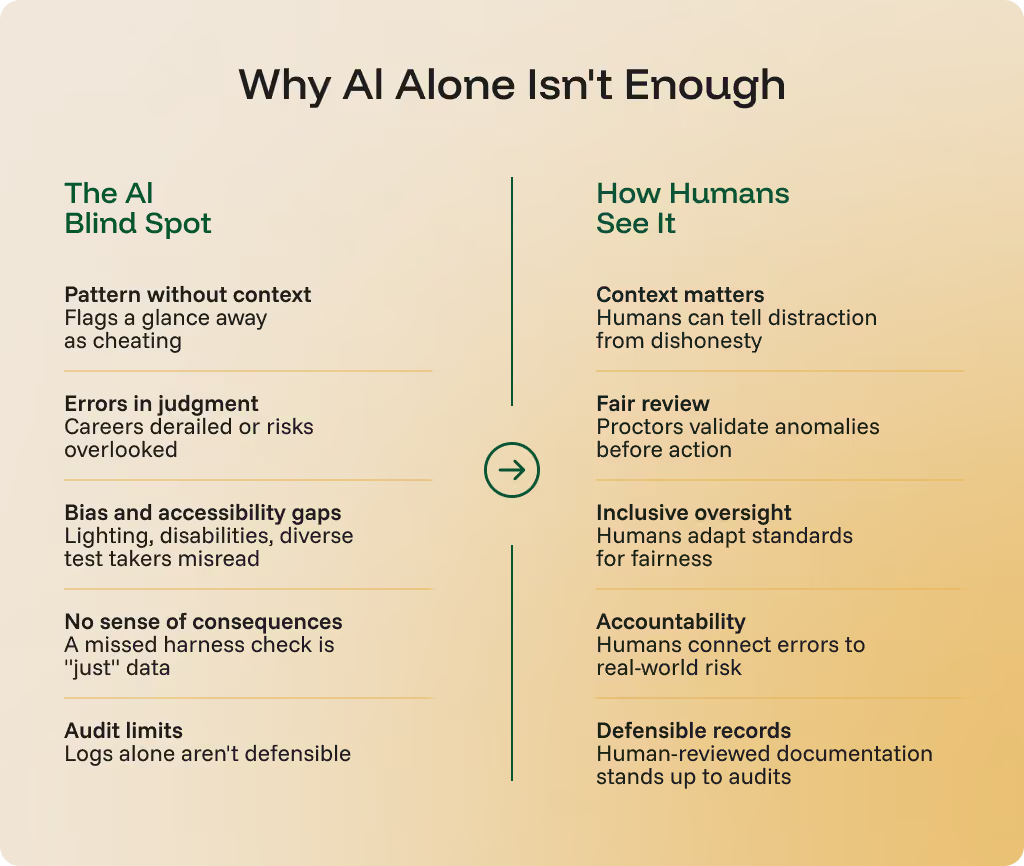
AI-powered online proctoring software can detect patterns, but it can’t weigh consequences. It can’t tell the difference between distraction and dishonesty. It can’t stand in front of an accreditor or regulator and defend a decision.
And compliance leaders know the stakes. 64% of frontline workers say injuries they’ve experienced or witnessed could have been prevented with better training, according to a YouGov survey of more than 2,000 workers in Australia, the UK, and the US. When proctoring systems prioritize speed over judgment, gaps spill from the classroom into the workplace.
{{post-stat-highlight}}
That’s why proctoring can’t be left to automation alone. Judgment, accountability, and defensibility require a human in the loop.
AI’s blind spots
For all its processing power, AI often misses the context, fairness, and consequences behind the data.
Pattern vs. context
AI can spot anomalies, but it can’t understand people. To the algorithm, a student glancing away as their child enters the room looks no different than someone searching for an answer. Without human judgment, honest learners get flagged, reputations suffer, and trust in the system erodes, all while true violations can still slip by unnoticed.
Risks of misjudgment
The real danger isn’t just inaccuracy, it’s the consequences. A nursing candidate wrongly flagged can lose months of progress, along with trust in the system meant to support them. Meanwhile, a missed violation on a commercial driving exam could place an unqualified driver behind the wheel of your company’s vehicle, endangering both reputation and public safety.
Bias and accessibility
AI models are not neutral. From lighting conditions to facial recognition inaccuracies, automation can inadvertently disadvantage test-takers with disabilities, those in non-standard testing environments, or individuals from diverse cultural backgrounds. This creates inequities that undermine the fairness of certification processes. At Integrity Advocate, we work to eliminate these inequities, making the certification process seamless, accessible, and fair for every test-taker.
No sense of consequences
Perhaps the greatest blind spot is this: AI doesn’t “understand” what a mistake means. It cannot connect a failed harness safety check to a potential fall on a job site. It doesn’t grasp that mishandled food safety could trigger an allergen outbreak. Without that ethical and practical awareness, AI remains a tool that must be guided by human oversight.
Certifications in focus: why proctoring integrity matters
The stakes of proctoring reach far beyond academia. They’re practical and sometimes life-or-death.
Consider a few high-stakes examples:
- Nursing exams and clinical credentials ensure healthcare workers can safely treat patients.
- Electrical licenses confirm that workers can install and maintain systems without risking fires or electrocution.
- Commercial Driver’s Licenses (CDL) certify drivers who transport goods and passengers across public roads.
- ServSafe and OSHA certifications guard against foodborne illness and workplace hazards.
These certifications aren’t just personal milestones. They validate competence in roles that protect lives and communities. Without trustworthy proctoring, credentials lose credibility. Organizations risk liability, and the public loses trust in the professionals meant to safeguard them.
AI-Only Proctoring Falls Short
When the stakes are high, oversight must be more than automated pattern recognition. AI can monitor, record, and flag, but it cannot fully understand context or consequences. Relying on AI alone risks undermining the very certifications designed to protect lives and communities.
ANSI and accreditation frameworks: compliance by design
The updated ANSI/ASSP Z490.1-2024 standard sets clear expectations for safety, health, and environmental (SH&E) training.
For compliance leaders, a few key takeaways stand out:
- Reliability and fairness are non-negotiable.
- Oversight and defensibility must be built into training and assessment.
- Documentation and accountability are essential in the event of an audit or incident.
These requirements go beyond what automation alone can provide. Standards demand human verification, ethical review, and the ability to defend every certification decision.
Beyond ANSI: ISO and NCCA
International standards like ISO/IEC 17024 and U.S. frameworks like the National Commission for Certifying Agencies (NCCA) reinforce the same principle: defensible certification requires human oversight. Without it, organizations risk failed audits, loss of accreditation, and legal exposure.
Hybrid Online Proctoring: AI Detection + Human Discretion
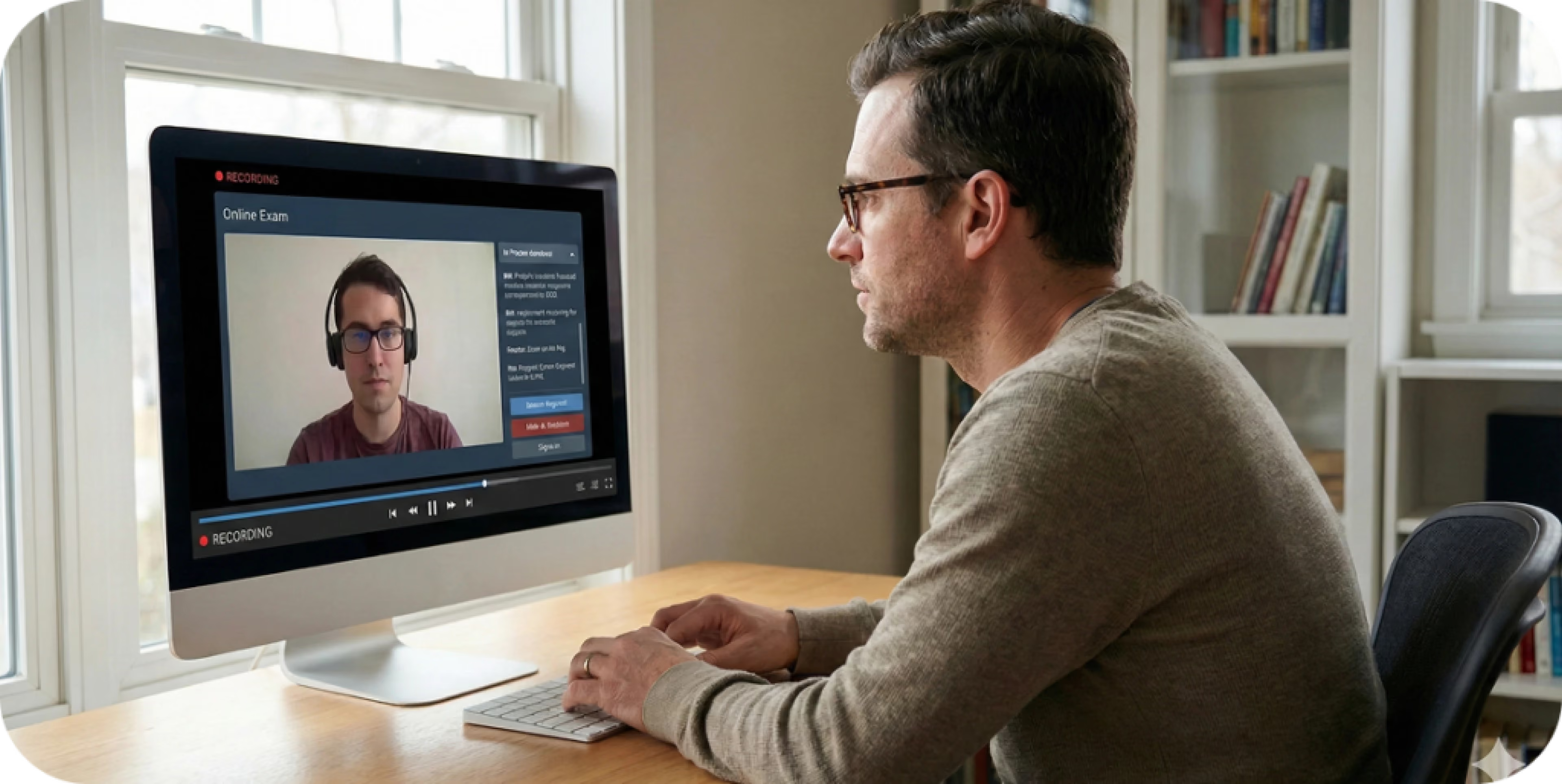
The answer is not to reject AI, but to integrate it thoughtfully. The most effective approach is AI plus human oversight, where technology enhances efficiency, but people ensure fairness, context, and compliance.
Scalable monitoring with human review
AI can monitor at scale, flagging potential anomalies. But those red flags should be reviewed by trained human proctors who can interpret context and make defensible decisions.
Audit trails and documentation
Human oversight is essential for building robust audit trails. When compliance checks or regulatory audits arise, organizations must show that their proctoring process was fair, valid, and defensible. Documentation reviewed and validated by people is far more credible than machine logs alone.
Automation accelerates, human judgment protects
AI has transformed training and monitoring with unprecedented speed and scale. Yet in safety-critical industries, automation is a tool, not a safeguard. True protection comes from human judgment, ethical oversight, and alignment with compliance standards.
With standards like ANSI/ASSP Z490.1-2024 raising the bar for defensibility, organizations must recognize that proctoring isn’t just a technical step, it’s a compliance-critical safeguard that protects lives, preserves trust, and ensures training fulfills its purpose.
Smart systems drive efficiency. Human oversight delivers safety. Together, they make compliance simple, scalable, and defensible.
Online proctoring software built for compliance and trust
When compliance is defensible, organizations, and the people they serve, are safer. That’s why proctoring must go beyond automation.
At Integrity Advocate, we combine AI efficiency with human oversight to ensure every training program is verifiable, fair, and aligned with the latest standards. That means:
- Confirmed identities
- Monitored participation
- Defended credentials
No guesswork. No blind spots. Just compliance you can stand behind.
Ready to safeguard your compliance? Let’s leverage the combined power of AI and human oversight, together.
{{post-cta}}
AI-Only, Live, or Hybrid: Which Proctoring Model Is Right for Your Program?
April 7, 2026
|
5 min de lecture
Before you compare proctoring features or pricing, the model underneath matters most. This post breaks down AI-only, live, and hybrid proctoring, where each fits, and why not all hybrid models are actually hybrid.
Not all proctoring tools work the same way. Before you compare features, pricing, or integrations, the most important decision is the model underneath the platform. If you get that wrong, everything else falls apart.
There are three approaches to online proctoring. Each has a legitimate use case. Each has a real trade-off. And one of them is consistently misunderstood as the safe middle ground when, in practice, not all hybrid models are equal.
As the market scales, programs are under more pressure than ever to choose the right model. Here is what each one actually means and what it means for your program.
The Three Proctoring Models
1. AI-Only Proctoring
AI-only platforms monitor sessions using algorithms. They track eye movement, audio patterns, browser behavior, and screen activity. When the system detects something outside expected parameters, it flags it. The report goes to your institution. Your team decides what to do with it.
The appeal is real. These tools are low cost, highly scalable, and require minimal vendor involvement. For programs running thousands of low-stakes assessments, that efficiency matters.
49% of students globally participated in online learning by March 2025 — driving demand for proctoring that scales without sacrificing accuracy. Source: Business Research Insights, 2026
The risk is also real. AI-only platforms typically flag 15 to 20 percent of all sessions. Many of those flags are not genuine integrity violations. Without a human reviewing the flag before it reaches your inbox, your team is doing that work. The savings on the tool often do not account for the time your staff spends sorting through incidents.
"When a result is challenged, the answer 'the algorithm flagged it' is not a defensible audit trail."
For programs where outcomes carry weight, that gap is a liability.
AI-only works when stakes are low, volume is high, and your institution has capacity to review flags internally.
2. Live Human Proctoring
Live proctoring puts a trained human proctor in the session in real time. The proctor monitors the exam as it happens, can communicate with the test taker, and can intervene if something goes wrong.
The accuracy is high. The human judgment is present. The audit trail is strong. For high-stakes licensing exams, certification bodies with regulatory requirements, and professional credentials where disputes are foreseeable, live proctoring has historically been the answer.
The trade-offs are scheduling and cost. Test takers need to book a time slot. Proctors need to be available. Per-session pricing adds up quickly at scale. For programs delivering hundreds or thousands of exams across flexible windows, the logistics become unworkable.
48% Of students expressed discomfort with webcam-based monitoring during exams — a signal that the model you choose directly affects learner trust in your program. Source: Business Research Insights survey, 2023
Live proctoring is also more intrusive for the learner. Being watched in real time creates anxiety that can affect performance. For programs that care about the experience of their test takers, that friction is worth accounting for.
Live proctoring works when stakes are high, volume is manageable, scheduling is structured, and real-time intervention is a non-negotiable requirement.
3. Hybrid Proctoring: The Model That Varies Most
Hybrid proctoring combines AI monitoring with human review. In principle, it offers the best of both approaches. In practice, it depends entirely on one question: when does the human review happen, and is it mandatory?
Many platforms that describe themselves as hybrid use AI for detection and offer human review as an optional tier or a paid escalation. That is not a genuine hybrid. It is AI-only with an appeal process.
Integrity Advocate is built on this model. Human review is not an upgrade.
Hybrid proctoring with mandatory human review delivers scale without shifting the review burden to your institution.
The Question to Ask Every Vendor
When a flag is raised, who reviews it, and when?
If the answer is your team reviews it, or a human reviews it if you escalate, you are looking at AI-only with extra steps. If the answer is our reviewers examine every flag before it becomes an outcome, you are looking at a genuine hybrid. That question takes 30 seconds and tells you more than a 90-minute demo will.
{{post-cta}}
Integrity Advocate and IACET Partner to Strengthen Continuing Education
September 24, 2024
|
5 min de lecture
AI-powered plugins can now complete continuing education assessments automatically, creating a growing risk that CEUs are being awarded without genuine learner participation. Integrity Advocate and IACET are partnering to provide IACET member organizations with risk assessments and resources to identify vulnerabilities and implement identity verification and participation monitoring standards that protect the integrity of their programs.
The importance of continuing education and training across critical fields like medicine, health and safety, and engineering cannot be overstated. When professionals lack the most up-to-date knowledge required for their roles, lives are put at risk.
Integrity Advocate and IACET (International Accreditors for Continuing Education and Training) are working together to deliver more secure continuing education and training. Through this partnership, we are committed to helping organizations enhance the integrity of their online learning events.
What’s the Challenge?
The landscape of online continuing education is rapidly changing. AI plug-ins can now automatically capture questions and complete assessments, creating a growing threat that continuing education units (CEUs) are being awarded without the direct participation of the intended learner.
Organizations that fail to adopt rigorous standards for ID verification and participation monitoring face significant regulatory and reputational risks. This lack of oversight has had, at times, absurd consequences — including the case of a pug that has been awarded more than 100 professional certifications.
More seriously, however, numerous organizations worldwide have faced legal action and public backlash when certificates were issued to individuals who had not completed the requisite training.
Working Together for Risk Assessment and Resources
To tackle these challenges head on, Integrity Advocate is working closely with IACET to provide members with essential resources and risk assessments. These assessments will help organizations understand their vulnerabilities and determine mitigation strategies tailored to their unique needs.
If you’re interested in learning more about our resources and support, please reach out to us.
Not an IACET member? Visit IACET to learn more about the accreditation process and the benefits.
{{post-cta}}
Foire aux questions
Trouvez les réponses aux questions les plus fréquemment posées par nos clients.
The Dark Side of AI is an on-demand webinar presented by the American Society of Safety Professionals and Integrity Advocate. It examines how artificial intelligence tools including deepfakes, voice synthesis, and automated plugins are being used to falsify participation and assessment results in online training programs, and what organizations can do to protect the integrity and compliance value of their learning programs.
The webinar is designed for training providers, compliance managers, and organizational leaders responsible for protecting the value and defensibility of online learning programs. It is particularly relevant for organizations in regulated industries where training completion carries legal and compliance weight.
The webinar covers deepfake impersonation, voice synthesis used to bypass identity checks, and AI-powered automation tools that can complete assessments without genuine learner participation. These threats make it increasingly difficult to verify that the right person completed training under the required conditions, which creates direct compliance and liability exposure.
The webinar covers identity verification to confirm the right person is completing training, engagement monitoring to confirm active participation throughout the session, audit-ready reporting that documents the training record in a way that holds up to regulatory review, and alignment with accreditation standards from bodies like IACET that are adapting their requirements in response to AI-era risks.