April 7, 2026
|
5 min de lecture
What Defensible Assessment Looks Like in 2026
AI tools have changed what cheating looks like, and most proctoring systems were built for a different problem. This post covers why an automated flag alone can't defend an outcome, and what a defensible assessment record requires in 2026.


We talk to a lot of programs right now that are dealing with the same thing. AI tools have changed what cheating looks like, and most proctoring systems were built for a problem that’s no longer the only one on the table. The gap is showing up in appeals, in complaints, and in outcomes that are getting harder and harder to defend.
What’s actually happening out there
The classic image of cheating a second phone, a friend on the other side of the room, notes taped to a monitor is still real. But it’s not the conversation we’re having with most programs anymore. The harder stuff is subtler.
AI writing tools can produce a natural, well-reasoned answer in seconds. Paraphrasing tools can disguise lifted content well enough to pass similarity checks. And the behavioral signals that used to flag something suspicious eye movements, typing pace, browser switching don’t tell you much when the assistance is happening invisibly, in another tab or on another device entirely.
The problem isn’t that AI cheating is impossible to catch. It’s that catching it requires a level of context and judgment that an algorithm alone doesn’t have.
An algorithm can tell you something looked unusual. It can’t tell you what actually happened or whether it matters. That part still requires a person.
Why a flag without a human isn't enough anymore
Automated proctoring was designed to catch visible, definable behaviors tab switching, phone use, an unauthorized person on screen. For those cases, it works. But AI-assisted cheating often leaves no visible trace at all.
So when an automated system flags something in this environment, what it's actually telling you is: something here didn't fit the expected pattern. That's a starting point, not a conclusion. The problem is when programs treat it like one.
A wrongful finding based on an automated flag isn't just uncomfortable it can seriously damage a student's record or a professional's career. And when that decision gets challenged, "the system flagged it" isn't a defensible answer. You need a record of what actually happened and a human judgment behind the decision.
{{post-stat-highlight}}
What it actually takes to be defensible
Defensibility isn't really about technology. It's about being able to look anyone in the eye a student, a candidate, a regulator, a board member and explain clearly why a decision was made and what it was based on.
In this environment, that takes three things:
- Human review on every flag, before any decision goes out. Not as an appeal process. Before the outcome is issued.
- Reviewers who are looking at AI-use patterns specifically, not just traditional integrity signals, and who understand the difference between something suspicious and something definitively wrong.
- A complete session record identity verification, monitoring log, what was flagged, what the reviewer saw, what was decided ready to export the moment someone asks.
What actually changes with human review
One question to sit with
If an outcome from one of your proctored exams was challenged today by a student, a candidate, an employer, an accreditor what could you actually put in front of them? An automated flag, or a complete human-reviewed record of what happened and why?
For programs where the result genuinely matters, that's not a rhetorical question. It's the one worth answering before you need to.
We built Integrity Advocate around exactly this human review on every flagged session, a complete audit trail for every outcome, and the kind of defensibility that holds up when someone actually pushes back.
{{post-cta}}
73%
of higher ed students report using AI tools during coursework in 2024
40%
of proctoring flags in AI-heavy environments are estimated to be false positives
Continuer la lecture
Trust by Evidence: A New Framework for Defensible AI Decisions
July 22, 2026
|
5 min de lecture
Integrity Advocate has released a new whitepaper, Trust by Evidence, introducing a framework that connects AI due process, learner rights, and credential security into one model for defensible AI-assisted assessment. This post walks through what the framework covers, why AI adoption alone no longer settles the integrity question, and links to the full whitepaper download.
Assessment integrity used to mean one thing: was the exam monitored? That question is no longer enough. AI now plays a role in identity verification, proctoring flags, authorship review, scoring, and credential validation, and each of those touchpoints can be challenged.
Confidence in an outcome isn't just about whether AI was accurate. It's about whether the decision it contributed to can be explained, reviewed, appealed, and verified after the fact.
As AI becomes embedded deeper into assessment, institutions are being asked a more pointed question: Can you defend the decision AI helped you make?
That question requires more than accurate technology. It requires a system.
In our latest whitepaper, Trust by Evidence, CEO Brandon A. Smith introduces a framework that connects AI due process, learner rights, and credential security into one model for defensible outcomes.
Download the whitepaper
The Shift From AI Adoption to Defensible Outcomes
For the past several years, the conversation in education and credentialing has centered on adoption: which AI tools to use, how to deploy them, how accurate they are. That conversation is largely settled. Most programs already use AI somewhere in the assessment lifecycle.
What hasn't been settled is defensibility. When an AI-influenced decision is challenged, whether by a learner, an employer, or a regulator, an institution needs to answer a specific set of questions: was there notice, meaningful human review, supporting evidence, and a path to appeal? If any of those answers are unclear, the decision isn't defensible, and the institution is exposed right along with the learner.
The next major challenge in education isn't AI adoption. It's building outcomes that hold up under scrutiny.
Why Treating AI as a Single Safeguard Creates Risk
Many programs rely on AI to do one job: flag anomalies. That model treats a flag as a finding rather than a signal, and it breaks down under three conditions:
- No documented process exists for what happens after a flag is raised.
- Human review means approving the AI's output rather than independently evaluating it.
- There's no clear path for the learner to respond, and no record for the institution to point to later.
Any one of those gaps makes an outcome difficult to defend. Together, they create real exposure, not just to individual learners, but to the institution's accreditation standing, employer trust, and legal risk.
The Trust by Evidence Framework
The whitepaper introduces Trust by Evidence, a framework that connects three ideas typically treated in isolation:
AI Due Process: A fair, documented process for any consequential decision AI contributes to, so a flagged learner has an actual process to walk through rather than a black box to accept.
The Learner Rights Layer: Seven specific rights, to know, to meaningful human review, to explanation, to evidence, to appeal, to proportionality, and to verification, that turn "the system flagged it" into a decision an institution can explain and stand behind.
The Credential Security Trifecta: A secure chain of trust connecting learning, assessment, and credentialing, where a weakness in any one layer undermines the others.
Individually, each idea is familiar. Together, they hold up under scrutiny from everyone with a stake in the outcome: the learner, the institution, employers, regulators, and the public.
What a Defensible AI-Assisted Decision Looks Like
A defensible process doesn't rely on confidence in the algorithm. It provides an actual record. It lets an institution answer, with certainty:
- Was the individual notified that AI was involved?
- Did a qualified reviewer examine the evidence, not just the score?
- Could the individual respond before a consequence was applied?
- Is there a documented, time-bound appeal path?
- Can the outcome be explained to someone outside the institution?
These are governance questions as much as technical ones. Answering them well protects accreditation standing, employer trust, and learner confidence all at once.
What You'll Learn in the Whitepaper
The full whitepaper expands on:
- Why algorithmic due process, procedural justice, and automation bias research all point toward the same conclusion for education
- The Defensible Outcomes Responsibility Matrix, a governance tool for assigning clear ownership across vendors, institutions, and credential issuers
- The five-stage AI Appeals Framework, walked through with a real worked example of a contested proctoring flag
- Sector-specific guidance for K-12, higher education, workforce certification, and employers
- A candid discussion of the framework's limitations, including cost, scale, and surveillance risk
It's written for compliance leads, credentialing bodies, assessment teams, and program leaders responsible for the outcomes their institution has to stand behind.
{{post-cta}}

Case Study: How Alliance Safety Council Took High-Risk Training Remote Without Losing Legal Defensibility
February 24, 2025
|
5 min de lecture
Alliance Safety Council (ASC) has spent over 60 years setting the standard for high-risk workforce training in petrochemical, power generation, and manufacturing, industries where compliance isn't optional. Their in-person, proctored training model relied on identity verification and close monitoring to serve as an impartial third-party administrator for clients. As demand for remote training grew, ASC needed a solution that could match that legal defensibility without the logistical headaches, or the technical barriers that most online proctoring tools introduced. Integrity Advocate became that partner.
When safety training can mean the difference between life and death, there's no room for shortcuts. For over 60 years, Alliance Safety Council (ASC) has set the standard for high-risk workforce training, ensuring every program is legally defensible and fully compliant.
Key Outcomes
- Reduced travel and costs, as participants can now complete training from anywhere
- Improved access and scalability with a mobile-friendly system for on-site or remote training
- Maintained legal integrity through identity verification and participation monitoring
- Lower environmental impact from fewer miles traveled
Challenge
ASC serves high-risk industries like petrochemical, power generation, and manufacturing, where compliance isn't optional. To maintain legally defensible training records, ASC historically relied on in-person, proctored training. Every participant underwent identity verification and close monitoring, allowing ASC to serve as an impartial third-party administrator for its clients.
{{post-block-quote}}
Moving online risked losing the third-party oversight ASC relied on for compliance and legal defensibility. High travel costs and time off work created unnecessary barriers for workers, and most proctoring solutions on the market required software installations, failed security protocols, or introduced IT headaches for enterprise clients.
ASC needed a scalable, secure online proctoring solution that could match the integrity of their in-person process without adding complexity for learners. Beyond technology, they needed a partner who understood their challenges and could adapt alongside them.
"We didn't want to just be a customer of a software solution," Kohls emphasized. "We needed someone who had the level of patience and interest to come along on this road with us."
Results
With Integrity Advocate as a proctoring partner, Alliance Safety Council has redefined how high-risk workforce training is delivered, expanding access while maintaining the highest compliance standards. With mobile-friendly proctoring, legally defensible verification, and a trusted partner by their side, ASC has eliminated travel barriers, reducing time off work and operational costs as well as carbon footprint for participants. Workers can now complete training on-site or remotely, even during outages and unplanned events, while identity verification and participation monitoring keep training records legally defensible.
"We've never felt alone on this journey," Kohls said. "Integrity Advocate's expertise and commitment have been with us every step of the way."
A Partnership Built on Trust
Proper training protects lives, prevents accidents, and ensures workers in high-risk industries are fully prepared for their jobs. That's why finding the right partner matters: safety training isn't just about meeting requirements, it's about trusting that every worker has the skills they need to stay safe on the job.
"They've gone above and beyond to help us educate our customers," Kohls said. "There's no other vendor that would fly from Canada to South Louisiana to host a lunch-and-learn for 30 people. That's because we're more than just a customer to them, and they're more than just a vendor to us."
As workforce training evolves, Alliance Safety Council and Integrity Advocate continue to set the standard, ensuring safety programs meet the highest benchmarks for reliability, compliance, and real-world impact.
{{post-cta}}
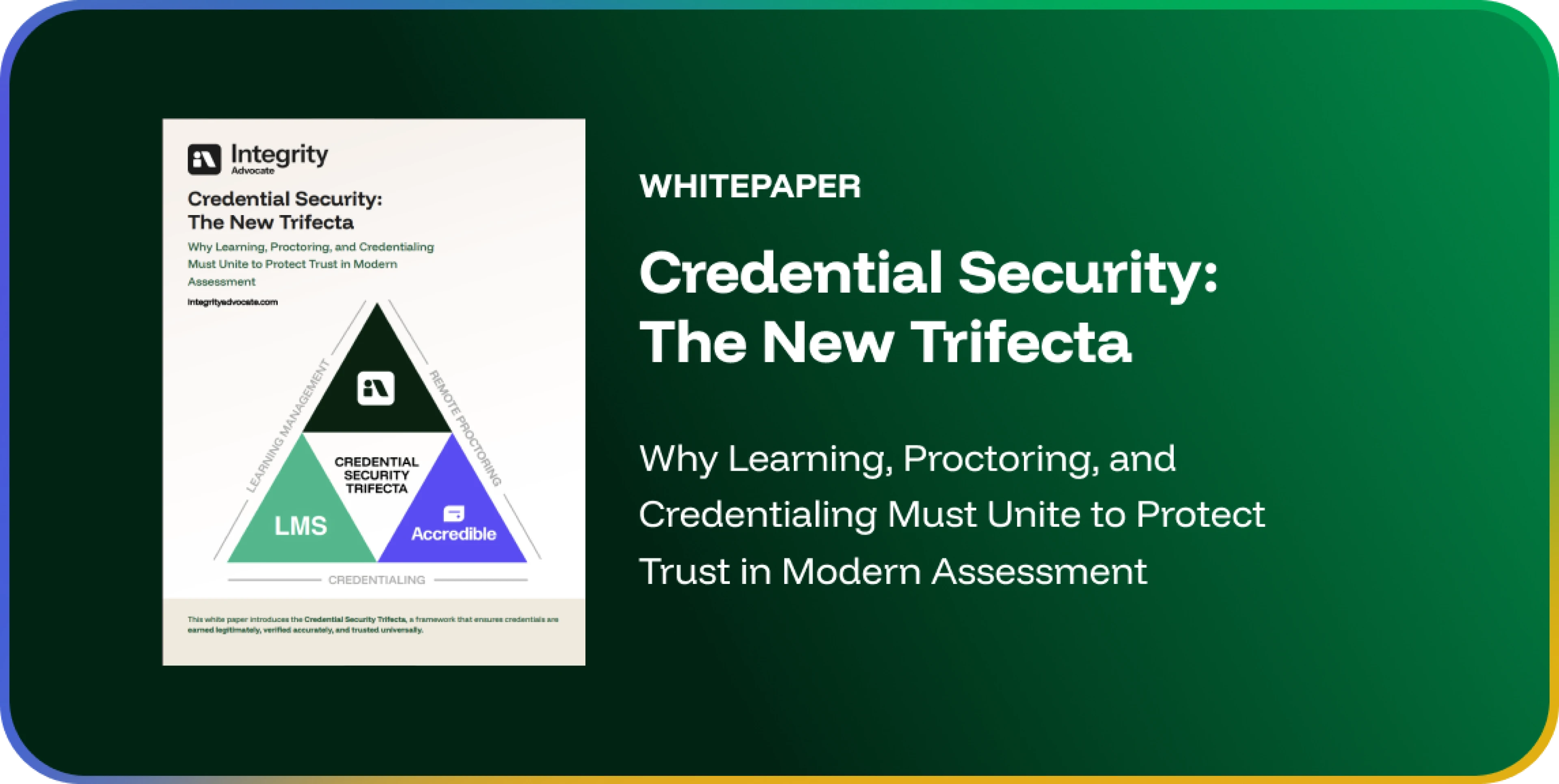
The Credential Security Trifecta: Designing a Defensible Credential Ecosystem
February 25, 2026
|
5 min de lecture
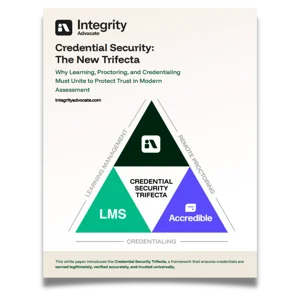
Credential integrity depends on more than a single tool. It requires identity verification, assessment oversight, credential issuance, and long-term validation to operate as one connected system. As digital credentials become more visible and portable across LinkedIn profiles and employer systems, organizations need to be able to answer a harder question than "was this test monitored": is this credential defensible? This post introduces the Credential Security Trifecta, a framework connecting Learning & Assessment Infrastructure, Identity & Integrity Verification, and Secure Digital Credential Issuance into a unified chain of trust, and points to the full whitepaper for the risk landscape, common blind spots, and an implementation model.
Credential integrity is the confidence that a credential truly represents what was earned. It means the right person completed the work, the assessment was conducted fairly, and the credential was issued based on verified performance. That confidence is built across identity verification, assessment oversight, credential issuance, and long-term validation.
As digital credentials become more visible, portable, and high-stakes, organizations are being asked a more important question: Can you defend how this credential was earned?
That question requires more than a proctoring solution. It requires a system.
In our latest whitepaper, The Credential Security Trifecta, we outline a practical framework for designing a defensible credential ecosystem, one that connects learning, verification, and issuance into a coherent chain of trust.
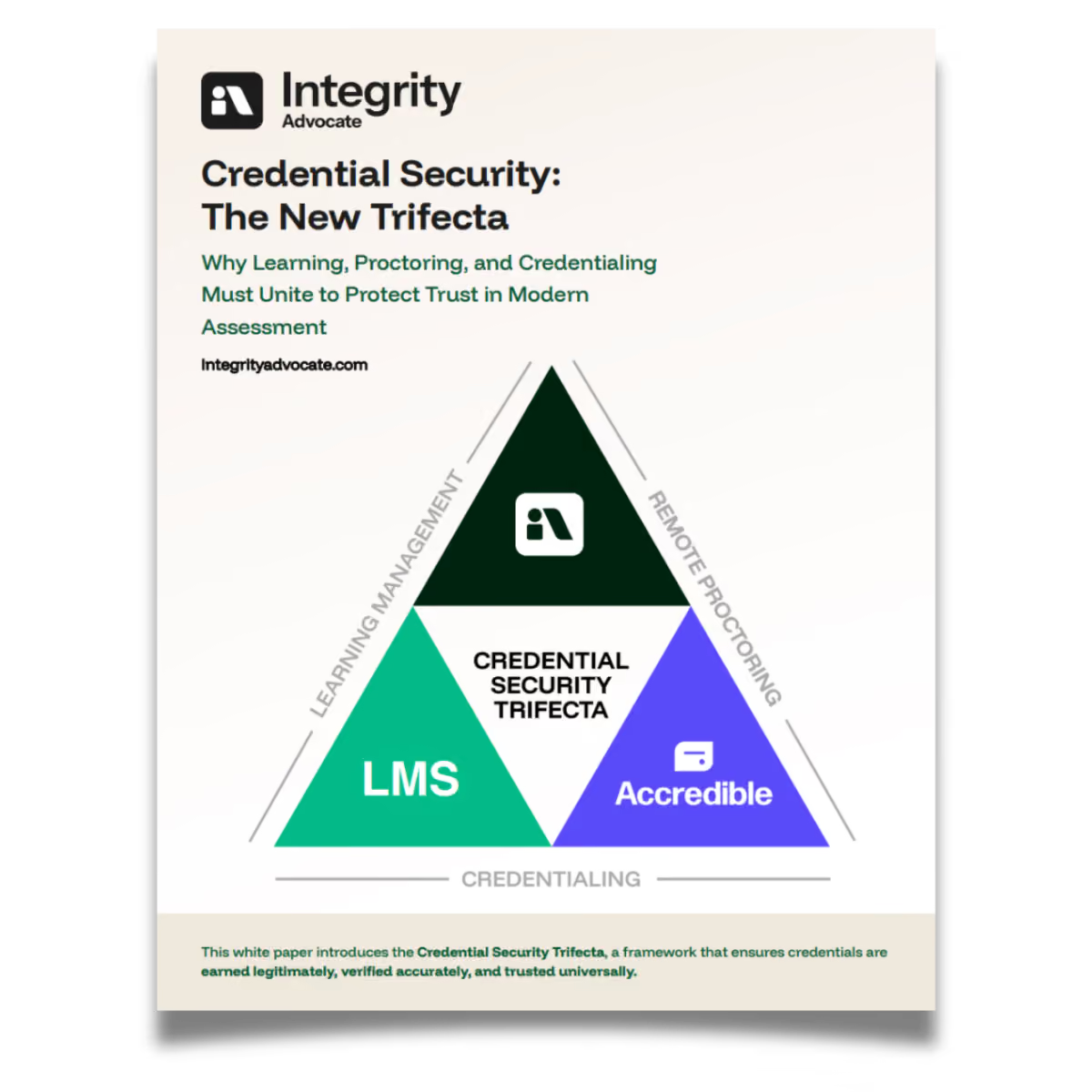
Credential Security: The New Trifecta
Why Learning, Proctoring, and Credentialing Must Unite to Protect Trust in Modern Assessment
The Shift From Exam Security to Credential Security
For years, assessment security focused primarily on preventing misconduct during testing. That remains important. But today’s risk environment has expanded.
AI-enabled misconduct, identity fraud, contract cheating, and synthetic digital documents have changed the landscape. At the same time, digital credentials are widely shared across LinkedIn profiles, employer systems, and workforce platforms. They are public representations of institutional trust.
And the stakes are higher than ever. In an AI-accelerated world, institutions must be able to answer a fundamental question: can we confidently verify who earned this credential — and whether it was earned fairly? When credentials influence hiring decisions, promotions, licensure, and professional standing, the consequences of getting it wrong are significant.
That means the integrity conversation must move beyond: “Was this test monitored?” to: “Is this credential defensible?”
Credential security is not just about detecting misconduct. It’s about ensuring that identity, performance, and issuance are connected in a way that can withstand scrutiny.
Why Fragmented Systems Create Risk
Most organizations operate across three separate layers:
- A learning management system where instruction and assessment occur.
- An integrity or proctoring solution that verifies identity and behavior.
- A credentialing platform that issues digital certificates or badges.
Each layer may function well independently. The risk emerges in the gaps between them. If these systems are not intentionally aligned, you may lack:
- A clear documentation trail from identity verification to issuance
- Audit-ready evidence of how integrity was upheld
- A consistent standard across programs
- Confidence that only verified outcomes result in credentials
That fragmentation makes defensibility harder when questions arise from employers, regulators, or internal leadership.
The Credential Security Trifecta Framework
The whitepaper introduces the Credential Security Trifecta, a framework that connects three essential components into a unified architecture:
Learning & Assessment Infrastructure: Where learning is delivered and performance is measured.
Identity & Integrity Verification: Where identity is confirmed, assessment conduct is reviewed, and integrity decisions are documented to ensure performance is legitimate and defensible.
Secure Digital Credential Issuance: Where verified performance becomes a tamper-resistant, independently verifiable credential.
When these three components operate as an integrated system rather than isolated tools, they form a defensible chain of trust.
This shifts the posture from reactive security to intentional design.
What a Defensible Credential Ecosystem Looks Like
A defensible ecosystem does not rely on assumptions. It provides clarity. It enables leadership teams to answer, with confidence:
- How do we verify identity at scale?
- How do we document integrity decisions?
- How do we ensure credentials are only issued for verified performance?
- How do we validate credentials long after they are awarded?
These are governance questions as much as technical ones. They impact compliance, employer trust, learner confidence, and institutional reputation.
Designing for defensibility requires alignment across technology, process, and policy.
What You’ll Learn in the Whitepaper
The full whitepaper expands on:
- The evolving risk landscape impacting credential credibility
- Where organizations most commonly experience blind spots
- How to evaluate your current architecture
- Strategic questions leadership teams should be asking
- A practical model for implementing the Credential Security Trifecta
It is written for certification bodies, higher education leaders, workforce programs, and assessment teams responsible for protecting credential value.
If you are evaluating how your organization connects assessment integrity with credential issuance, this framework will provide clarity.
Foire aux questions
Trouvez les réponses aux questions les plus fréquemment posées par nos clients.
It can flag behavior that doesn't match expected patterns — unusual typing rhythms, browser activity, or answer construction that looks atypical. But detecting a flag is different from determining what happened. AI-assisted cheating often leaves no visible behavioral trace at all, which is exactly why human review matters. A trained reviewer can assess what the flag actually means in context before any decision is made.
Without human review, a wrongful flag can become a wrongful outcome — and that outcome lands on a student's record or a professional's career. When it gets challenged, "the system flagged it" isn't a defense. Programs that use automated-only proctoring often find themselves without the documentation needed to justify the decision or dismiss the complaint.
At Integrity Advocate, every session that generates a flag is reviewed by a trained human reviewer before any outcome is issued. The reviewer looks at the full session context, assesses what actually happened, and documents their assessment. That record — the flag, the context, the judgment — becomes the audit trail attached to the outcome. It's what makes the decision defensible if anyone ever asks.