Resource Center
Research, guides, and real-world insights on online proctoring; helping your program deliver results that are fair, trustworthy, and defensible.
10M+
Assessments secured
Zero
Data breaches in 12+ years
98%
Client retention rate
120+
Resources published
Featured article

Trust by Evidence: A New Framework for Defensible AI Decisions
Integrity Advocate has released a new whitepaper, Trust by Evidence, introducing a framework that connects AI due process, learner rights, and credential security into one model for defensible AI-assisted assessment. This post walks through what the framework covers, why AI adoption alone no longer settles the integrity question, and links to the full whitepaper download.
Assessment integrity used to mean one thing: was the exam monitored? That question is no longer enough. AI now plays a role in identity verification, proctoring flags, authorship review, scoring, and credential validation, and each of those touchpoints can be challenged.
Confidence in an outcome isn't just about whether AI was accurate. It's about whether the decision it contributed to can be explained, reviewed, appealed, and verified after the fact.
As AI becomes embedded deeper into assessment, institutions are being asked a more pointed question: Can you defend the decision AI helped you make?
That question requires more than accurate technology. It requires a system.
In our latest whitepaper, Trust by Evidence, CEO Brandon A. Smith introduces a framework that connects AI due process, learner rights, and credential security into one model for defensible outcomes.
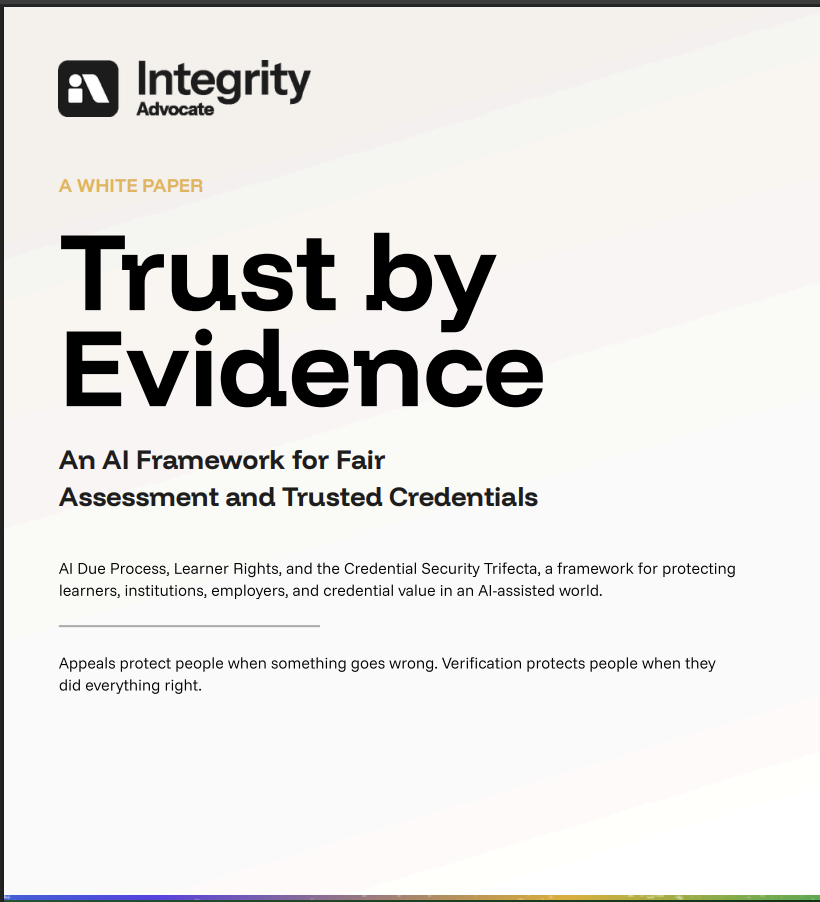
Download the whitepaper
The Shift From AI Adoption to Defensible Outcomes
For the past several years, the conversation in education and credentialing has centered on adoption: which AI tools to use, how to deploy them, how accurate they are. That conversation is largely settled. Most programs already use AI somewhere in the assessment lifecycle.
What hasn't been settled is defensibility. When an AI-influenced decision is challenged, whether by a learner, an employer, or a regulator, an institution needs to answer a specific set of questions: was there notice, meaningful human review, supporting evidence, and a path to appeal? If any of those answers are unclear, the decision isn't defensible, and the institution is exposed right along with the learner.
The next major challenge in education isn't AI adoption. It's building outcomes that hold up under scrutiny.
Why Treating AI as a Single Safeguard Creates Risk
Many programs rely on AI to do one job: flag anomalies. That model treats a flag as a finding rather than a signal, and it breaks down under three conditions:
- No documented process exists for what happens after a flag is raised.
- Human review means approving the AI's output rather than independently evaluating it.
- There's no clear path for the learner to respond, and no record for the institution to point to later.
Any one of those gaps makes an outcome difficult to defend. Together, they create real exposure, not just to individual learners, but to the institution's accreditation standing, employer trust, and legal risk.
The Trust by Evidence Framework
The whitepaper introduces Trust by Evidence, a framework that connects three ideas typically treated in isolation:
AI Due Process: A fair, documented process for any consequential decision AI contributes to, so a flagged learner has an actual process to walk through rather than a black box to accept.
The Learner Rights Layer: Seven specific rights, to know, to meaningful human review, to explanation, to evidence, to appeal, to proportionality, and to verification, that turn "the system flagged it" into a decision an institution can explain and stand behind.
The Credential Security Trifecta: A secure chain of trust connecting learning, assessment, and credentialing, where a weakness in any one layer undermines the others.
Individually, each idea is familiar. Together, they hold up under scrutiny from everyone with a stake in the outcome: the learner, the institution, employers, regulators, and the public.
What a Defensible AI-Assisted Decision Looks Like
A defensible process doesn't rely on confidence in the algorithm. It provides an actual record. It lets an institution answer, with certainty:
- Was the individual notified that AI was involved?
- Did a qualified reviewer examine the evidence, not just the score?
- Could the individual respond before a consequence was applied?
- Is there a documented, time-bound appeal path?
- Can the outcome be explained to someone outside the institution?
These are governance questions as much as technical ones. Answering them well protects accreditation standing, employer trust, and learner confidence all at once.
What You'll Learn in the Whitepaper
The full whitepaper expands on:
- Why algorithmic due process, procedural justice, and automation bias research all point toward the same conclusion for education
- The Defensible Outcomes Responsibility Matrix, a governance tool for assigning clear ownership across vendors, institutions, and credential issuers
- The five-stage AI Appeals Framework, walked through with a real worked example of a contested proctoring flag
- Sector-specific guidance for K-12, higher education, workforce certification, and employers
- A candid discussion of the framework's limitations, including cost, scale, and surveillance risk
It's written for compliance leads, credentialing bodies, assessment teams, and program leaders responsible for the outcomes their institution has to stand behind.
{{post-cta}}
All resources

The EU AI Act, GDPR, and What They Mean for Online Proctoring and Assessment Security
January 21, 2025
|
5 min read
The EU Artificial Intelligence Act and GDPR are reshaping expectations for how AI can be used in assessment environments, particularly when outcomes affect credentials, academic standing, or professional opportunities. Together they send a consistent signal: AI may support assessment security but it cannot replace human judgment. This post examines what each framework requires for high-risk AI uses in education and credentialing, what ATP guidance says about human oversight in proctoring, and what organizations can do to align with both regulations without adding unnecessary complexity to their programs.
Artificial intelligence now plays a central role in how assessments are delivered, monitored, and reviewed. From detecting potential integrity risks during an exam to supporting large-scale testing programs, AI has become embedded in modern assessment workflows.
At the same time, regulators are setting clearer expectations for how AI can be used when outcomes matter.
Two frameworks in particular are shaping this conversation:
- The EU Artificial Intelligence Act (EU AI Act)
- The General Data Protection Regulation (GDPR)
Together, they reflect a broader shift in how assessment security, online proctoring, and AI-enabled decision-making are expected to operate, with an emphasis on accountability, transparency, and trust.
Why AI regulation matters for assessments
Regulations don’t exist in isolation. While the EU AI Act and GDPR are often discussed in legal or technical terms, their implications are very real for organizations delivering exams, credentials, and training programs.
When AI is used to monitor test sessions, flag unusual behavior, or support integrity decisions, regulators are increasingly focused on how those decisions are made, not just whether AI is involved.
This places online proctoring and assessment security squarely at the center of the regulatory conversation.
Understanding the EU AI Act in an assessment context
The EU AI Act is the first comprehensive regulation written specifically to govern artificial intelligence. Rather than banning AI, it applies a risk-based framework, with stricter requirements for systems that could significantly impact individuals’ rights or opportunities.
AI systems used in education, testing, credentialing, and employment are often considered high-risk, particularly when they influence outcomes such as exam validity or access to credentials.
For these high-risk uses, the Act emphasizes:
- Meaningful human oversight
- Transparent and explainable AI outputs
- Risk management and documentation
- The ability to intervene or override automated outputs
- Avoiding over-reliance on automation
In simple terms, AI may assist, but responsibility must remain with people.
GDPR’s role in AI-driven assessment decisions
While the EU AI Act is newer, GDPR has already been shaping assessment security practices for years.
One of GDPR’s most relevant principles is its restriction on decisions made solely through automated processing when those decisions significantly affect individuals. In assessment environments, this can include integrity violations, invalidated results, or credentialing outcomes that directly impact a person’s academic or professional future.
As a result, GDPR reinforces the need for:
- Human involvement in high-stakes decisions
- Transparency into how decisions are reached
- Responsible data collection and retention
- Clear accountability when outcomes are questioned
This principle is echoed directly in guidance from the Association of Test Publishers (ATP):
{{post-block-quote}}
Together, GDPR and the EU AI Act send a consistent signal: AI can support assessment security, but it cannot replace human judgment.
What this means for online proctoring and assessment security
Online proctoring systems often rely on AI to monitor sessions, detect anomalies, and surface potential integrity concerns. These capabilities bring scale and efficiency, but they also introduce new responsibilities.
Industry guidance from ATP reflects how effective proctoring models already operate in practice:
“It is a common practice for AI to flag potential anomalies in test taker behavior and for humans to act as the second proctor.”
— ATP, Human Oversight of AI in Assessment
This hybrid approach aligns naturally with both GDPR and the EU AI Act. AI helps identify patterns and reduce noise, while trained humans apply context, fairness, and judgment before outcomes are finalized.
Fully automated approaches, by contrast, can make it harder to explain decisions, address edge cases, or confidently defend outcomes during audits, appeals, or regulatory review.
The stakes are increasing
The EU AI Act introduces meaningful enforcement mechanisms, particularly for high-risk AI systems. According to ATP’s AI Laws, Regulations and Governance Frameworks publication, certain violations may result in penalties of up to €35 million or 7% of global annual turnover, depending on the nature of the breach.
Beyond financial penalties, the broader risk is loss of trust. Assessment programs that rely on opaque automation or excessive data collection risk eroding confidence among learners, candidates, and institutional partners, even if no formal violation occurs.
Preparing for compliance without overcomplicating assessment programs
Understanding regulatory expectations is only the first step. The next question many organizations ask is how to prepare, without adding unnecessary complexity or burden.
Guidance from the e-Assessment Association reinforces that preparation does not require starting from scratch. Instead, it encourages organizations to evaluate how AI is currently used and whether existing practices support fairness, transparency, and accountability.
How companies using e-assessment can prepare for the introduction of the EU AI Act
In practice, preparation often comes down to a few core considerations:
- Where is AI used across the assessment lifecycle?
- Are high-stakes outcomes ever determined without human review?
- Can integrity decisions be clearly explained if challenged?
- Is personal data collected proportionally and retained responsibly?
Organizations that can answer these questions with confidence are already well aligned with both GDPR and the EU AI Act, regardless of enforcement timelines.
A broader view of compliance and privacy
Taken together, GDPR and the EU AI Act point toward a more sustainable model for assessment security, one that prioritizes human accountability, transparency, and privacy-first design over unchecked automation.
This shift reflects not just regulatory intent, but growing expectations from learners, credential holders, and institutions alike. Assessment security programs that are built for defensibility and trust are better positioned to adapt as regulations continue to evolve.
How Integrity Advocate supports this approach
Integrity Advocate was built with these principles at its core.
Our platform pairs intelligent detection with human review of every session, ensuring AI supports, rather than replaces, professional judgment. Privacy-first system design minimizes unnecessary data collection, while clear reviewer context and documentation support outcomes that organizations can confidently stand behind.
Rather than treating compliance and privacy as constraints, Integrity Advocate helps organizations build assessment security programs that align with today’s regulations and tomorrow’s expectations.
Moving forward with confidence
As AI regulation continues to evolve, the organizations best positioned for success will be those that focus on trust, accountability, and defensibility, not just automation.
If you’re evaluating how GDPR and the EU AI Act impact your assessment or online proctoring approach, Integrity Advocate can help you move forward with clarity and confidence.
Q: What type of online proctoring aligns best with these regulations?
A: Proctoring models that combine AI detection with meaningful human review, privacy-conscious data practices, and defensible outcomes.
{{post-cta}}

What’s Your Assessment Security Plan for 2026?
January 8, 2026
|
5 min read
As online assessment continues to scale, the complexity of protecting exam integrity has grown alongside it. AI misuse, organized cheating schemes, rising privacy expectations, and increased scrutiny around fairness and defensibility are reshaping what effective assessment security really requires. This post examines how leading programs are moving beyond reactive, one-size-fits-all proctoring toward intentional assessment protection strategies built around four principles: designing integrity into the assessment experience, strengthening security without sacrificing privacy, combining technology with human judgment, and delivering outcomes that hold up to scrutiny.
Online proctoring is foundational to how assessments are delivered today. But as adoption has grown, so has the complexity of protecting exam integrity. AI misuse, organized cheating, rising privacy expectations, and increased scrutiny around fairness and defensibility are reshaping what effective assessment security really looks like.
As we look ahead, programs face a critical question: Is your assessment security strategy keeping pace with today’s risks?
The evolving role of online proctoring in assessment security
Early online proctoring solutions focused heavily on surveillance and rule enforcement. While monitoring still plays a role, it’s no longer sufficient on its own.
Modern remote proctoring must support a broader goal: assessment protection that is fair, proportional, and defensible, for both programs and exam-takers. That means balancing security and privacy, automation and human review, scalability and accuracy.
Assessment security today isn’t just about catching misconduct. It’s about protecting the credibility of the assessment itself.
Assessment security as a strategy.
Leading programs are moving beyond one-size-fits-all online proctoring tools and adopting more intentional assessment protection strategies. Here’s what that shift looks like.
1. Designing Integrity Into the Remote Assessment Experience
Strong assessment protection starts long before an exam begins. Programs are increasingly designing integrity into their assessments, aligning exam structure, delivery methods, and proctoring configurations to the level of risk involved. Thoughtful design reduces opportunities for misconduct and allows online proctoring to function as part of a cohesive security framework, rather than a reactive safeguard.
2. Strengthening assessment security without sacrificing privacy
As remote proctoring becomes more prevalent, privacy expectations continue to rise. Assessment security that relies on invasive monitoring can undermine trust and damage the credibility of a program. In 2026, effective online proctoring must protect exam integrity without over-collecting data or creating unnecessary friction for exam-takers.
Privacy-first assessment protection is a requirement.
3. Combining technology and human judgment in online proctoring
Automation is essential for scale, but it can’t replace context. AI-powered online proctoring tools are effective at identifying anomalies and potential risks. Human review, however, remains critical for interpreting behavior, applying policy consistently, and ensuring fair outcomes.
The most defensible assessment security models in 2026 will continue to rely on a hybrid approach, where technology flags risk and humans make informed decisions.
4. Delivering defensible, trusted assessment outcomes
Assessment protection doesn’t end when the exam is submitted.
Programs must be able to stand behind their results, whether responding to learner appeals, audits, or regulatory inquiries. Transparent workflows, documented review processes, and consistent decisioning are essential components of modern assessment security. Online proctoring is only effective if the outcomes it supports are trusted.
Questions to ask as you plan your 2026 assessment security strategy
As online and remote proctoring continue to evolve, programs should be asking:
- Are our assessment security controls aligned to real risk, or legacy practices?
- Does our online proctoring approach protect exam-taker privacy as well as exam integrity?
- Are we relying too heavily on automation, or do we have meaningful human oversight?
- Can we confidently defend our assessment outcomes if they’re challenged?
Assessment protection is no longer a checkbox. It’s an ongoing strategy, one that must evolve alongside technology, expectations, and the future of remote assessment.
See how Integrity Advocate can help
Across education, credentialing, and workforce training, organizations are rethinking how online proctoring and assessment security fit into their long-term plans. How can Integrity Advocate help shape your assessment security strategy this year? Schedule a Demo today!
{{post-cta}}

Protecting Exam-Takers and Your Reputation
December 18, 2025
|
5 min read
Organizations administering online assessments face a dual responsibility: protect learners from unnecessary risk and protect the credibility of the programs and credentials they stand behind. These are not competing goals. They are two sides of the same decision. This post examines what learner protection actually requires in proctoring, from no-install design and privacy-first data handling to a low-friction exam experience, and what credential and reputation protection depends on, including trusted results, human-validated outcomes, and consistent, fair processes that stakeholders can rely on over time.
Online proctoring plays a bigger role than many people realize. It doesn’t just safeguard exam rules. It shapes how test takers experience high-stakes moments, and how institutions are perceived long after an assessment ends.
Organizations are facing a dual responsibility: protect learners from unnecessary risk, while protecting the credibility of the programs and credentials they stand behind.
The proctoring decisions institutions make today have a direct impact on trust, reputation, and long-term program health.
Protecting Learners
For learners, exams are already stressful. Proctoring shouldn’t add unnecessary anxiety or risk.
Unfortunately, many traditional approaches require software downloads, intrusive monitoring, unstable setups, or unclear instructions, which can make learners feel uneasy before an exam even begins. In some cases, they raise real concerns around device security, malware exposure, and privacy.
1) Protecting Devices With No-Install Proctoring
The safest exam experience is often the simplest one. When proctoring runs in the browser with no downloads or plugins, learners avoid unnecessary software installations and reduce exposure to malware or device-related risk. It also removes one of the most common points of failure at exam start, the install process itself.
2) Protecting Identity Through Privacy by Design
Protecting learners also means protecting their personal information. Privacy-first proctoring should collect only what’s necessary to verify identity and maintain integrity, and handle that information responsibly. When institutions can confidently explain what data is collected, how it’s used, and how long it’s retained, it builds trust, not just compliance. This is particularly true in advanced academic programs, where balancing assessment security and privacy programs means weighing rigor against learner trust.
3) Protecting the Experience
Even the most secure proctoring tool falls short if the experience is confusing or fragile. A seamless, low-friction flow helps learners start exams calmly and complete them without disruption. Fewer technical hurdles means fewer interruptions, fewer panicked support requests, and a more consistent experience for everyone.
When learners feel safe and supported, they’re more likely to engage calmly, comply with requirements, and complete assessments successfully.
Protecting learners isn’t just a user-experience issue. It’s a trust issue.
Modern Cheating and Fraud Put Programs at Risk
At the same time, institutions are facing more sophisticated forms of cheating and fraud.
From generative AI tools to coordinated test-taking schemes, off-screen assistance, and impersonation attempts, exam risks look very different than they did even a few years ago.
The stakes are high. When misconduct goes undetected, it doesn’t just affect individual results. It can undermine the credibility of an entire program, raise questions from accrediting bodies or employers, and expose organizations to reputational and legal risk.
This is why detection needs to evolve, without crossing the line into invasive surveillance.
Protecting Credentials and Your Reputation
Protecting learners is only one side of the equation. The other is protecting the credibility of your program, the value of your credential, and the trust others place in your assessments. Just as learner protection requires thoughtful design, reputation protection depends on three equally important factors:
1) Delivering Results You Can Trust
Reputation starts with confidence in outcomes. Programs need to know that exam results are accurate, fair, and defensible, especially when decisions carry real consequences.
By combining AI detection with human review, Integrity Advocate helps surface meaningful signals while ensuring context is applied before decisions are made. Clear, audit-ready reporting then gives administrators results they can understand, explain, and stand behind, without hours of manual review.
Trusted results reduce disputes, speed up decision-making, and reinforce confidence across stakeholders.
2) Protecting the Value of Your Credential
A credential is only as strong as the integrity behind it. When learners are properly verified and assessments are delivered fairly, organizations can be confident that credentials are earned honestly by the right individual. This reduces the risk of impersonation, fraud, and post-exam challenges, while lowering institutional liability.
Ultimately, the shared goal is simple: making sure the person behind the credential has truly earned it. That matters in real-world ways, whether it’s a healthcare worker administering the right medication, a forklift operator working safely on the job site, or a food and beverage professional serving responsibly and in compliance.
When credentials can’t be trusted, risk increases for everyone. Protecting credential value helps employers, partners, and accrediting bodies trust what a credential represents, not just today, but over time.
3) Protecting Program Reputation Over Time
Reputation is built through consistent, positive experiences. When exams run smoothly, learners feel respected, and results are handled fairly, programs benefit from stronger reviews, higher satisfaction, and increased trust. Over time, that trust fuels program growth and reinforces a reputation for doing assessment the right way.
Protecting your reputation isn’t a single moment. It’s the cumulative result of fair processes, trusted outcomes, and experiences people are willing to stand behind.
Security That Protects Both Sides
Protecting learners and protecting your reputation are not separate goals, they are two sides of the same decision. Integrity Advocate is built to do both. Our no-install, browser-based experience helps reduce device risk and exam-day friction, while privacy-first design protects learner identity and keeps data handling responsible and easy to explain.
On the integrity side, we help institutions detect cheating and fraud patterns that matter, pairing intelligent detection with human oversight so results are fair, clear, and defensible, without relying on invasive tactics.
The outcome is simple: calmer exam launches, fewer support escalations, more confident decisions, and greater trust in the credential. When the experience is respectful and the outcomes are reliable, programs earn stronger reviews, lower risk, and a reputation they can stand behind.
Schedule a Demo: Explore how Integrity Advocate delivers secure, privacy-first proctoring.
{{post-cta}}

Global Proctoring Built to Scale
December 17, 2025
|
5 min read
When assessment programs expand across regions, time zones, and learner populations, proctoring systems that were not built for scale start to show the strain: review timelines stretch, support tickets spike, and consistency becomes harder to maintain. True scalability is not just about geographic reach. It is about whether a solution can grow alongside a program without creating new friction for learners or new workload for administrators. This post examines the nine pillars of genuine global scale in proctoring and why hybrid AI plus human review, multilingual support, and privacy-first design are what make sustainable growth possible.
As assessment programs grow, one thing becomes clear very quickly: scale changes everything. What works for a single course or cohort doesn’t always hold up when programs expand across regions, time zones, and learner populations. Exams start happening around the clock. Volumes increase. Review queues grow. Support teams feel the pressure.
And while “global” often gets framed as geographic challenge, true scalability is about much more than reach. It’s about whether an assessment solution can grow with your program without creating new friction for learners or new workload for administrators.
Scaling Is About More Than Volume
Today’s online assessments support far more than traditional higher education exams. They power workforce training, professional certification, compliance programs, and continuing education initiatives across industries and regions.
As highlighted in our 2025 Year-in-Review, many organizations are scaling assessment programs faster than ever, often faster than internal teams can scale operations and support.
When proctoring systems aren’t built for scale, teams start to feel it quickly. Review timelines stretch. Support tickets spike. Consistency becomes harder to maintain. Admin workload grows right alongside exam volume.
Scalable proctoring should absorb growth quietly, not amplify it.
What Global Scale Really Requires
True global scale rests on a set of interconnected pillars.
Operational scalability: As exam volume increases, admin workload shouldn’t increase at the same pace. Review queues, follow-up work, and support requests need to stay predictable, even during peak testing windows.
Hybrid (AI + human review): AI helps surface suspicious activity, while trained human reviewers provide context and validation before results reach administrators. That balance keeps review efficient without sacrificing fairness, and it allows programs to scale without overwhelming internal teams.
Language and localization: Learners need to understand instructions, consent language, and system prompts in the language they’re most comfortable with. When language barriers are removed, confusion drops, exam launches are smoother, and support teams feel the difference.
Time zone coverage and availability: Global programs don’t test on a single schedule. Exams happen at all hours, and review workflows need to support that reality without introducing delays or blind spots.
Infrastructure reliability: Browser-based, low-bandwidth-friendly technology helps ensure exams can launch and complete successfully across regions with varying connectivity, devices, and environments.
Consistency across programs: Clear policies, standardized review processes, and audit-ready reporting help ensure outcomes remain defensible and fair, no matter where or when an exam takes place.
Privacy and regulatory readiness: Global scale means navigating different expectations around data protection and learner rights. Privacy-first design and clear documentation allow institutions to expand confidently without constantly reworking processes to meet new requirements.
Accessibility and inclusion: Support for assistive technologies, diverse devices, and real-world testing environments ensures that growth doesn’t leave learners behind.
Integration and ecosystem compatibility: Proctoring should fit cleanly into existing LMS workflows without requiring custom builds or retraining as organizations grow.
Finally, support models must scale, too. Clear instructions, intuitive workflows, and reduced reliance on live support allow global programs to grow without growing stress for learners or administrators.
Taken together, these pillars determine whether a proctoring solution truly scales, not just technically, but operationally and sustainably.
Why Hybrid AI + Human Review Makes Scale Possible
Human-only models struggle to keep up as volume grows. Review timelines lengthen, costs rise, and consistency becomes harder to maintain. AI-only models move faster, but often create noise, false positives, and distrust that admins have to clean up later.
Hybrid review strikes the balance. AI handles volume efficiently, while human reviewers ensure accuracy, fairness, and context. That combination keeps results reliable and review workloads manageable, even as programs expand.
Language Support as a Scaling Multiplier
Language support plays an important role in scalable proctoring, not because it’s a standalone feature, but because it reduces friction everywhere else.
Integrity Advocate supports a wide range of languages across regions including North America, Latin America, Europe, the Middle East, Africa, and Asia-Pacific. This includes global languages such as English, Spanish, French, Arabic, Chinese, and Portuguese, as well as regional variants like Latin American Spanish, Canadian French, and U.S. Spanish.
Clear communication helps learners start exams with confidence, reduces confusion at launch, and lowers language-related support requests. At scale, those small improvements add up to significant time savings for admin teams.
Scaling Without Scaling Stress
Programs that choose proctoring built for global scale often see steadier review timelines, fewer support tickets during peak periods, more consistent outcomes across regions, and less operational strain as volume increases.
As Brandon Smith notes in his analysis of where the proctoring market is headed, institutions are increasingly looking for partners they won’t outgrow, solutions that can evolve alongside their programs rather than forcing replacement every few years.
Global scale isn’t just about reaching more learners. It’s about supporting growth without adding friction, cost, or risk.
When proctoring is built on scalable infrastructure, hybrid AI plus human review, clear communication, and admin-ready reporting, programs can expand confidently without sacrificing fairness or control.
As assessment programs continue to grow across regions, devices, and use cases, the proctoring solutions that succeed will be the ones designed for real-world scale, not idealized conditions.
Schedule a demo to see how Integrity Advocate scales with your programs
{{post-cta}}

Admin-Ready Results: Why Audit-Ready Reporting Matters More Than Ever in Online Proctoring
December 16, 2025
|
5 min read
For many administrators, the most time-consuming part of secure assessment delivery happens after the exam: reviewing sessions, sorting through flags, watching recordings, and trying to turn raw data into decisions the team can stand behind. Most proctoring tools generate a lot of data but very little clarity, leaving administrators to manually reconstruct context that should already be documented. This post examines what administrators actually need from proctoring reporting, why unclear results become a bottleneck as programs scale, and how audit-ready reporting shifts proctoring from a reactive process to a streamlined one.
For many administrators, the most time-consuming part of delivering secure assessments doesn’t happen during the exam. It happens after.
Reviewing sessions. Sorting through flags. Watching recordings. Responding to questions from learners, instructors, auditors, or compliance teams. Trying to turn raw data into decisions your team can confidently stand behind.
As online assessments continue to scale, institutions are realizing that how results are delivered matters just as much as how exams are monitored. In 2026 and beyond, proctoring success is increasingly defined by whether teams receive admin-ready results supported by audit-ready online proctoring reporting, without added complexity or guesswork.
The Hidden Cost of Unclear Proctoring Results
Many proctoring tools generate a lot of data, but very little clarity. Administrators are often left with:
- long video recordings to manually review
- large numbers of low-value or ambiguous flags
- inconsistent reviewer notes
- reports that require interpretation instead of action
This creates a heavy time burden for teams already balancing multiple programs, stakeholders, and compliance requirements. It also makes audits and appeals more stressful than they need to be.
When reporting isn’t audit-ready, administrators spend valuable time recreating context after the fact instead of relying on documentation that’s already clear, complete, and defensible.
What Administrators Actually Need From Reporting
As Brandon Smith has noted in his analysis of where the proctoring market is heading, institutions are moving away from surveillance-heavy tools and toward solutions that deliver trust, transparency, and operational efficiency.
In practice, administrators want reporting that:
- clearly summarizes what happened during the exam
- filters out noise and false positives
- presents results consistently across sessions
- supports audit-ready documentation
- reduces review time instead of extending it
Admin-ready results don’t just inform decisions, they accelerate them.
Why Admin-Ready Results Are Becoming Essential
As assessment programs grow in size and complexity, unclear reporting becomes a bottleneck. Admin-ready results supported by audit-ready reporting help teams:
- review sessions faster and more consistently
- respond confidently to learner questions or appeals
- prepare for audits without scrambling for evidence
- maintain consistency across reviewers and programs
- scale assessment operations without scaling admin workload
Instead of spending hours piecing together timelines and context, administrators can focus on outcomes and next steps.
How Integrity Advocate Delivers Admin-Approved, Audit-Ready Reporting
Integrity Advocate’s reporting is designed specifically for the people responsible for running assessment programs.
Our platform pairs AI detection with human review, ensuring that flagged activity is evaluated with context before results ever reach an administrator. That means fewer false positives, clearer explanations, and reporting that’s ready to use immediately.
With Integrity Advocate, reporting is:
- structured and easy to understand
- consistent across sessions and programs
- supported by human-validated findings
- designed to be audit-ready from the start
Instead of digging through hours of footage or interpreting vague alerts, administrators receive results they can trust, explain, and defend.
Saving Time Without Sacrificing Confidence
One of the most immediate benefits of admin-ready results is time savings.
Programs using audit-ready reporting consistently see:
- faster review and follow-up
- fewer escalations and disputes
- less manual video review
- reduced back-and-forth with learners and stakeholders
Those time savings compound as programs grow. What saves minutes per exam can translate into hours or even weeks of reclaimed admin time over the course of a year.
Audit-Ready Reporting Builds Trust Across Stakeholders
Audit-ready reporting isn’t just about compliance, it’s about confidence. Clear, well-documented results help administrators explain decisions to learners and instructors, demonstrate consistency to leadership, and respond calmly to audits or appeals without scrambling for additional context. When reporting is complete and easy to understand, teams can trust their outcomes, maintain credibility across programs, and avoid having to second-guess decisions or reconstruct what happened after the fact.
Proctoring That Supports the People Behind the Program
Modern proctoring isn’t just about monitoring exams. It’s about supporting the administrators who keep programs running smoothly.
Admin-ready results supported by audit-ready reporting shift proctoring from a reactive process to a streamlined one, where results move programs forward instead of slowing them down.
As institutions evaluate proctoring solutions heading into the future, those that save time, reduce friction, and deliver results teams can trust will continue to stand out.
Schedule a demo to experience clear, trusted reporting in action
{{post-cta}}

Modern Proctoring Requires Anytime, Anywhere Access
December 15, 2025
|
5 min read
Online assessments no longer happen in controlled environments. They happen at kitchen tables and job sites, on personal phones and employer-managed laptops, across time zones and bandwidth conditions that institutions cannot control. Proctoring solutions built for a single, standardized testing environment are increasingly out of step with how people actually learn, train, and certify. This post examines the reality of modern testing environments, why device-agnostic and low-bandwidth-optimized design is now a baseline expectation, and how flexible access strengthens rather than weakens assessment integrity.
Online assessments don’t live in neat, controlled environments anymore. They happen at kitchen tables and job sites. On desktops, laptops, tablets, and phones. On personal devices, employer-managed systems, shared computers, and whatever hardware learners have access to in the moment. They happen across time zones, bandwidth conditions, and environments institutions simply can’t control.
As online assessment continues to scale, one expectation has become clear: proctoring has to work anytime, anywhere, without putting extra hurdles in front of learners or administrators.
That reality is reshaping how institutions think about proctoring and what they expect from the tools they choose.
The Reality of Modern Testing Environments
The idea of a single, standardized testing environment no longer matches how people actually learn, train, and certify today.
As we highlighted in our 2025 Year-in-Review, assessment programs are expanding well beyond traditional academic settings into workforce training, compliance programs, professional certification, and global continuing education initiatives.
That expansion brings variety. Learners might be using an employer-issued laptop one day and a personal tablet the next. They might be testing from home, a library, a training center, or a shared workspace. Some environments are quiet and stable, others are not.
Proctoring solutions that only work reliably in narrow, ideal conditions quickly start to feel out of step with this reality.
Learners Are Using More Than One Device
The need for device-agnostic access isn’t new. It reflects how people already interact with digital tools in everyday life.
A significant portion of adults rely on mobile devices as a primary or frequent way to access online services, particularly in workforce and continuing education settings. In practice, that means learners often move between desktops and laptops at home, employer-managed devices at work, tablets or Chromebooks for flexibility, and mobile devices when other options aren’t available.
When proctoring systems assume a single device type, friction shows up immediately, often before the exam even begins.
Mobile and Remote Learning Continue to Expand
Expectations around anytime, anywhere access are also shaped by how learning itself has evolved.
Research from EDUCAUSE shows that learners increasingly expect educational tools to work seamlessly across devices and environments, with mobile access playing a growing role in how learners engage with content and assessments.
This is especially true in workforce and professional education, where assessments are often completed outside traditional classrooms and on non-standard devices. In those settings, rigid technical requirements aren’t just inconvenient, they can be a barrier to participation.
Bandwidth Variability Is a Reality
Even with widespread internet access, consistent bandwidth isn’t guaranteed.
Proctoring solutions that rely on heavy downloads, constant high-resolution streaming, or strict technical requirements tend to struggle when connectivity isn’t perfect. That can lead to delayed starts, dropped sessions, or failed exams, none of which have anything to do with academic integrity.
Integrity Advocate’s browser-based, low-bandwidth-optimized approach is designed to keep exams running smoothly, even when network conditions are less than ideal.
Why Rigid Proctoring Models Fall Short
Many traditional proctoring models were built around a single use case: a learner on a personal desktop or laptop, in a quiet space, with strong internet connectivity. That assumption no longer holds.
Rigid systems often:
- fail on mobile or tablet devices
- struggle with locked-down or managed hardware
- break down in low-bandwidth environments
- require workarounds for real-world testing conditions
- increase reliance on technical support
These limitations tend to hit workforce learners, global candidates, and those without access to ideal testing setups the hardest.
Anytime, Anywhere Access Reduces Support Burden
Institutions are increasingly prioritizing proctoring solutions that reduce friction on exam day and lower the volume of support requests.
Programs consistently report that:
- fewer device restrictions lead to fewer failed exam launches
- browser-based access reduces “how do I start?” tickets
- consistent access across environments improves completion rates
Anytime, anywhere access isn’t just better for learners. It’s operationally better for administrators, too.
How Integrity Advocate Supports Anytime, Anywhere Testing
Integrity Advocate was built for modern assessment environments, not idealized ones. Our platform supports anytime, anywhere access by:
- running entirely in the browser, with no downloads or plugins
- supporting desktops, laptops, tablets, and mobile devices
- functioning reliably across varying bandwidth conditions
- integrating directly into existing LMS platforms
- reducing technical dependencies that cause exam-day issues
This flexibility allows institutions to scale assessments confidently, without forcing learners to adapt to rigid technical constraints.
Flexibility Strengthens Integrity
It’s easy to assume that tighter technical restrictions automatically lead to stronger exam integrity. In practice, the opposite is often true. When learners struggle just to access an exam, anxiety rises, trust drops, and compliance suffers. When the testing experience works smoothly, learners can focus on demonstrating what they know.
Flexible access strengthens integrity by:
- reducing stress at exam launch
- increasing participation and completion rates
- creating more consistent testing conditions
- enabling clearer, more defensible outcomes
Integrity is strongest when systems remove friction, not add it.
Conclusion
As online assessment continues to evolve, anytime, anywhere access has become a baseline expectation, not a differentiator.
Proctoring solutions that only work in narrow conditions will struggle to scale. Those designed for real-world diversity will continue to earn trust from institutions and learners alike. Modern proctoring has to meet learners where they are, on the devices they use, in the environments they test.
Schedule a demo to learn how Integrity Advocate supports flexible, reliable online assessment.
{{post-cta}}

Accessibility Is the Foundation of Fair Online Assessment
December 12, 2025
|
5 min read
Fair online assessment is not just about catching cheating. It is about whether the testing environment works consistently and equitably for every learner. When proctoring systems assume narrow definitions of normal behavior, perfect lighting, steady eye contact, high bandwidth, single devices, they do not just create friction. They create inequity. This post examines why accessibility has become central to assessment integrity, where AI-only approaches fail diverse learners, what inclusive proctoring actually requires, and how a human-backed model is the only approach that can interpret context fairly across the full range of real-world assessment conditions.
Fair online assessment isn’t defined only by how well you catch cheating, it’s defined by whether the testing environment is consistent, inclusive, and workable for every learner. A proctoring experience can be technically secure and still fail the moment it meets real life.
Because real assessments don’t happen in perfect conditions. They happen on aging laptops and shared devices. On unstable internet connections. In homes, offices, libraries, and job sites. They happen with learners who use assistive technology, require accommodations, speak different languages, or simply don’t have access to an ideal testing environment.
When proctoring systems assume a narrow definition of “normal”, perfect lighting, steady eye contact, minimal movement, high bandwidth, they don’t just introduce friction. They introduce inequity.
That’s why accessibility and inclusion aren’t secondary considerations in online assessment anymore. They are foundational to fairness, defensibility, and trust.
Why Accessibility Has Become Central to Assessment Integrity
As online testing expands across education, credentialing, and workforce training, institutions are being held to higher expectations around who assessments serve, and how.
Institutions no longer limit accessibility to formal accommodations or compliance checklists. Accessibility now includes whether an assessment system genuinely works for the full range of learners expected to participate.
The Web Content Accessibility Guidelines (WCAG) emphasize that digital systems must be perceivable, operable, understandable, and robust for all users, regardless of ability or environment.
In the United States, the Americans with Disabilities Act (ADA) and Section 508 continue to shape how institutions evaluate digital tools, including assessment platforms.
Internationally, organizations such as UNESCO have highlighted that inclusive access to digital learning and assessment is essential for equitable education and workforce participation.
These frameworks make one thing clear, accessibility is not optional, and it cannot be bolted on after the fact.
The Real-World Accessibility Gap in Traditional Proctoring
In contrast, many early online proctoring systems were built for controlled environments, strong internet, quiet rooms, single devices, and highly standardized behavior. But that model no longer reflects how people learn or test.
Today’s learners take assessments:
- in shared homes or workplaces
- on employer-managed or restricted devices
- with inconsistent bandwidth
- using assistive technologies such as screen readers
- across languages, cultures, and time zones
- while managing disabilities or neurodivergent needs
When proctoring systems aren’t designed for this reality, AI-only proctoring systems often misinterpret normal human behavior as suspicious. The result is unnecessary flags, increased anxiety, and outcomes that feel unfair, not because integrity was compromised, but because the system lacked flexibility.
Research from Educational Testing Service (ETS) reinforces this point, assessment validity depends not only on test design, but on the conditions under which tests are delivered. When delivery introduces barriers, fairness suffers.
Why AI-Only Approaches Often Exacerbate Accessibility Issues
Automation can be valuable in assessment security, but accessibility challenges often fall outside predictable patterns.
AI-only proctoring systems frequently struggle to interpret:
- involuntary or self-regulating movement
- neurodivergent behaviors
- breaks in eye contact
- assistive device use
- environmental interruptions
Without context, these signals are easily misclassified. These systems often force learners to defend themselves against automated decisions.
This doesn’t just harm the test-taker experience. It erodes trust in the assessment itself.
Accessibility requires context, and context requires human judgment.
Inclusive Proctoring Requires a Human-Centered Model
As a result, inclusive assessment systems are built on flexibility, restraint, and interpretation, not rigid enforcement.
That’s why institutions are increasingly prioritizing proctoring solutions that:
- support assistive technologies
- accommodate neurodivergent behaviors
- function reliably in low-bandwidth environments
- support multilingual learners
- adapt to shared or unpredictable testing spaces
- allow accommodations without introducing complexity
A human-backed review model plays a critical role here. When AI is used to assist detection, not replace judgment, behavior can be interpreted within real-world context instead of reduced to binary flags.
This approach leads to:
- fewer false positives
- more equitable outcomes
- clearer, more defensible decisions
- reduced stress for learners
- lower support burden for administrators
How Integrity Advocate Supports Accessibility and Inclusion
Integrity Advocate was designed with accessibility and inclusion as core principles, not add-ons.
Our platform supports inclusive testing by:
- pairing AI detection with human review, ensuring context is considered
- minimizing unnecessary surveillance that can disadvantage certain learners
- supporting low-bandwidth environments
- offering multilingual capabilities
- enabling accommodations without complex technical configurations
- integrating directly into existing LMS workflows to reduce cognitive and technical barriers
This human-first, privacy-first approach helps ensure assessments are secure without being exclusionary.
Importantly, inclusive proctoring benefits all learners, not just those with formal accommodations. When systems are designed to work for diverse needs and environments, completion rates improve, disputes decrease, and confidence in outcomes increases.
Inclusion Strengthens Integrity
There is a common misconception that accessibility and security are competing priorities. In practice, they reinforce one another.
When learners feel respected by the assessment process:
- compliance improves
- anxiety decreases
- engagement increases
- misconduct becomes easier to identify
- decisions become more defensible
Integrity is strongest when systems are designed for people, not against them.
Looking Forward
As online assessment continues to evolve, accessibility and inclusion will remain central to how institutions evaluate proctoring solutions.
Tools that only function in ideal conditions, or rely on rigid automation without human context, will struggle to meet rising expectations around fairness, equity, and trust.
Learn More - Schedule a demo to learn how inclusive proctoring can work in your environment
{{post-cta}}

Why Ease of Use & No-Install Proctoring Matters More Than Ever
December 11, 2025
|
5 min read
Proctoring works best when it is almost invisible. When the first interaction a learner has with a proctoring tool involves downloading a launcher, requesting elevated permissions, or troubleshooting errors, it introduces friction before a single question is answered. That friction drives anxiety, failed assessment starts, elevated support tickets, and lower perceived fairness. This post examines why ease of use has become a competitive advantage in proctoring, how no-install design reduces friction while maintaining integrity, and what the market is actually asking for as institutions rethink their assessment experience in 2026.
Proctoring isn’t just about catching cheaters, it’s about creating an experience that preserves trust, reduces barriers, and supports learners as they engage with assessments. As remote and hybrid testing become standard across education and workforce programs, one trend stands out: ease of use has become a competitive advantage in proctoring.
Proctoring works best when it’s almost invisible. It should quietly protect the integrity of an assessment while blending into the systems learners already know and trust. Proctoring should feel familiar, launching learners into their exams in the same environments they already use every day rather than pushing them into unfamiliar tools or workflows. When that doesn’t happen, friction shows up fast.
Technical friction, like downloads, extra logins, and multi-step setup flows, doesn’t just slow learners down. It reduces confidence, increases support needs, and indirectly becomes one of the biggest hidden costs of remote assessment.
In this post, we unpack why ease of use, especially no-install proctoring, matters in the new year and beyond, and how it impacts learners, administrators, and institutional outcomes.
Friction Isn’t Just an Annoyance, It’s a Barrier
For many test-takers, the first interaction with a proctoring tool sets the tone for the entire assessment. When that interaction involves:
- downloading a launcher
- requesting elevated permissions
- or troubleshooting unexpected errors…
…it introduces friction before a single question is answered.
That friction can lead to:
- Increased anxiety and distraction
- Failed assessment starts
- Elevated support tickets
- Accessibility barriers
- Lower perceived fairness
And while traditional proctoring vendors often treat installations and extensions as standard, learners often do not.
A privacy-first, no-install approach eliminates these barriers at the source, protecting not just the exam, but the experience. That mindset aligns directly with our philosophy of integrity without intrusion, where security and user respect coexist.
"The service itself is easy to use and is popular among our students. The implementation process went smoothly." - Verified G2 review
Where Ease Meets Respect: The Privacy Equation
As institutions invest in stronger security, a natural tension arises: how do you ensure integrity without breaching privacy? Many legacy solutions err on the side of surveillance, using broad access and extensive permissions to “cover every angle.” But in doing so, they often end up collecting data that goes well beyond what’s necessary for integrity, raising concerns that many programs simply don’t want to inherit.
That’s a central theme in discussions around where secure proctoring ends and privacy invasion begins.
A no-install experience helps resolve this tension by minimizing the data surface area, collecting only what’s essential for validating identity and behavior, and doing so in a way that feels transparent, logical, and fair to learners.
What the Market Is Actually Asking For
There’s a misconception in proctoring that more technology equals better security. But feedback from educators, training leaders, and certification bodies tells a different story: they want tools that are secure and intuitive.
In fact, recent industry thought leadership underscores how the expectations for remote assessment are shifting, away from invasive, heavy-tech tools and toward solutions that balance trust, simplicity, and integrity.
Ease of use is not just a “nice-to-have" it’s becoming a requirement for programs that care about candidate satisfaction, equity, and outcomes.
Lessons from 2025: What We’re Seeing in Adoption
In our 2025 Year in Review, one clear trend emerged: programs that reduce friction for learners are better positioned for success. That doesn’t mean sacrificing security, it means rethinking how proctoring integrates into existing workflows.
Simpler start flows mean fewer abandoned exams, fewer escalations to support teams, and a better overall test-taker experience. When learners feel respected, not surveilled, institutions see:
- Higher completion rates
- Fewer pre-exam failures
- Less demand on support staff
- More positive perceptions of assessment fairness
This has real implications for retention, reputation, and operational efficiency.
Ease of Use Is Security, Too
Security and ease of use are not opposites. In fact, when done right, they reinforce each other:
- A calm, confident test-taker is easier to assess fairly.
- Fewer tech barriers means fewer false positives in behavior analysis.
- Intuitive workflows reduce administrative overhead.
- Transparent experiences build trust.
In 2026 and beyond, proctoring will be defined not just by what it protects, but by how it protects it, and that starts with the experience learners have from the moment they click “Start.”
See How “Invisible” Proctoring Could Work in Your Program
If you’re rethinking your proctoring approach for the next year, this is a great time to evaluate whether your current tools are adding unnecessary friction.
- Are learners installing separate apps just to start an exam?
- Are support tickets piling up around exam launch?
- Are privacy questions slowing down adoption?
We’d be happy to walk through how a privacy-first, no-install model could fit your environment and security requirements.
Book a demo to see what invisible, easy-to-use proctoring can look like in practice.
{{post-cta}}

Why Hybrid AI + Human Review Delivers Fairer, More Accurate Proctoring
December 10, 2025
|
5 min read
AI-only proctoring is fast but context-blind, flagging neurodivergent behaviors, assistive technology, and environmental interruptions as suspicious. Human-only proctoring is fair but cannot scale consistently or cost-effectively. Hybrid AI plus human review combines the speed and pattern recognition of automation with the contextual judgment, empathy, and accountability that only people can provide. This post examines where each model falls short, what hybrid review actually delivers, and why it is becoming the baseline expectation for institutions that need proctoring to be both strong and humane.
As assessment programs continue to grow in scale and complexity, institutions are rethinking how proctoring decisions are made. Early AI-only solutions promised efficiency, but the reality often included something very different: false positives, confusing flags, and test-takers who felt judged by a system that didn’t understand their context. This AI-only proctoring trend has led to unnecessary administrative burden, increased support tickets, and growing distrust from test-takers.
On the other end of the spectrum, human-only proctoring doesn’t scale easily, can be inconsistent across reviewers, and often comes with higher costs and scheduling constraints.
That’s why more organizations are turning to a hybrid model, where AI handles detection at scale and human reviewers bring the context, nuance, and judgment needed to make fair, defensible decisions.
This hybrid approach blends the consistency and speed of automation with the nuance, empathy, and real-world judgment that only people can provide.
Why AI Alone Isn’t Enough
AI is very good at spotting patterns: movement in the frame, changes in lighting, new objects entering the screen, or shifts in gaze. It can scan hours of video in seconds and flag moments that stand out against the norm.
But exams don’t happen in lab conditions. They happen in real homes, workplaces, libraries, training centers, and shared spaces, with real life happening in the background.
AI alone struggles with:
- Involuntary movements: such as fidgeting, or sensory self-regulation
- Neurodivergent behaviors: like breaking eye contact, or using comfort objects
- Assistive technology: screen readers, alternative input devices, or captioning tools
- Environmental interruptions: family members walking by, doors opening, sudden noises
- Cultural differences: different norms around eye contact, gestures, or communication
- Shared environments: where other people may reasonably be nearby
What looks “suspicious” to an algorithm might simply be a student thinking, a parent checking on a child, or a worker taking an exam in the field.
When AI misreads these situations, it creates:
- unnecessary stress for test-takers
- extra work for administrators
- credibility questions about the results
That’s where human review becomes critical.
Why Human Alone Isn’t Enough
While human reviewers bring empathy, judgment, and contextual understanding to proctoring, relying on people alone creates a different set of challenges. Human-only models struggle with consistency, scalability, and efficiency, especially as assessment programs grow.
Human-only proctoring often leads to:
- Inconsistent interpretations: different reviewers may judge the same behavior differently
- Limited scalability: staffing constraints make it difficult to support large testing volumes
- Scheduling friction: requiring live availability for every exam window
- Higher operational costs: cost per session rises quickly when scaling human labor
- Slower turnaround times: reviews, escalations, and decisions depend on human bandwidth
- Greater potential for bias: unconscious assumptions may influence interpretations
And importantly, human-only oversight simply can’t match AI’s ability to scan long sessions efficiently, identify subtle environmental changes, or pattern-match at scale.
This creates an environment where:
- test-takers may be treated differently depending on who reviews their session
- administrators face delays waiting for manual review
- institutions absorb higher labor costs and logistical complexity
- stakeholders question the consistency and defensibility of evaluation outcomes
Human review is essential, but oftentimes not sufficient on its own.
Taken together, these two extremes paint a clear picture:
- AI alone is fast, but too rigid and context-blind to be fully fair.
- Humans alone are contextual and empathetic, but too limited and inconsistent to scale.
Institutions don’t need more of one or the other, they need both working together.
That’s where a hybrid AI + human review model comes in: AI handles detection at scale, while human reviewers bring the nuance, judgment, and fairness needed to make defensible decisions.
The Best of Both Worlds: Hybrid Review
A hybrid AI + human model brings together the strengths of both approaches while minimizing their limitations. Instead of choosing between speed or fairness, institutions get a workflow that delivers both, and at scale.
In a hybrid system, AI surfaces moments that may require attention, scanning for patterns and anomalies far faster than any human could. Then, trained human reviewers step in to evaluate those moments with the context, nuance, and judgment that AI simply cannot provide.
This creates a review process that is:
Faster and more efficient
AI handles the heavy lifting of detection, dramatically reducing the time humans spend reviewing full sessions or searching for notable moments.
More accurate and reliable
Human reviewers validate AI-identified events, preventing false positives and ensuring that only meaningful issues are flagged for institutions.
Fair for every test-taker
Whether a learner is using assistive technology, or simply nervous, human context helps ensure they aren’t penalized for normal or unavoidable behavior.
Transparent and defensible
Hybrid review creates clear audit trails that document both automated observations and human decisions, a critical requirement for accreditation, appeals, and internal accountability.
Consistent across sessions
AI provides consistency in detection, while humans ensure fairness in interpretation. Together, they reduce the variability and bias that can occur with human-only models.
Scalable for growing programs
AI enables institutions to handle large volumes of exams, while human reviewers are focused on meaningful, high-value decisions rather than routine monitoring.
By combining precision with empathy, hybrid review delivers a level of balance that neither AI nor humans can achieve alone. It’s a model built for modern assessments, diverse, distributed, and held to increasingly high expectations of fairness and trust.
Why Hybrid Review Is Becoming the New Baseline
More and more institutions are putting hybrid review on their “must have” list when evaluating proctoring solutions. Some of the biggest drivers include:
1. Reducing False Positives
False accusations or unnecessary investigations damage trust. Hybrid review reduces these incidents by ensuring that flagged behavior is double-checked by a human before it’s escalated or recorded as misconduct.
2. Supporting Diverse Learners
Assessment programs serve test-takers with a wide range of needs, backgrounds, and environments. Hybrid models are better equipped to ensure that neurodivergent learners, disabled test-takers, and individuals using assistive tools are treated fairly.
3. Improving Defensibility
When results are challenged, institutions need to show not just that a flag was raised, but that it was reviewed thoughtfully. Human-reviewed outcomes, supported by clear evidence, are easier to defend and explain.
4. Building Trust in the Process
When learners know there are humans involved, not just algorithms, they’re more likely to perceive the system as fair. That perception matters for participation, satisfaction, and long-term credibility.
5. Aligning With Evolving Policies
Many regulatory and professional bodies are now paying closer attention to how high-stakes decisions are made. Hybrid proctoring aligns with expectations for human oversight in processes that can impact credentials, careers, and educational pathways.
How Integrity Advocate’s Hybrid Approach Stands Apart
Hybrid review isn’t an add-on for Integrity Advocate, it’s at the core of how the system works.
Our approach:
- Uses AI to assist, not replace, human decision-making
- Ensures that all flagged moments receive human validation
- Keeps the focus on identity, participation, and policy-relevant behavior, not unnecessary surveillance
- Respects privacy by operating within a privacy-first, minimal-data framework
- Delivers clear, actionable reporting that teams can understand without needing to decode raw AI outputs
This combination of privacy-first design, seamless LMS integration, and hybrid AI + human review gives institutions what they’ve been asking for: integrity that is both strong and humane.
Building Fairness Into Every Review
Fairness shouldn’t depend on which exam a learner takes or which proctor happens to be on duty that day. It should be built into the system.
Hybrid AI + human review moves proctoring closer to that ideal by:
- balancing speed with judgment
- combining detection with understanding
- pairing integrity safeguards with respect for test-takers
For institutions, it means more reliable outcomes, fewer disputes, and a stronger foundation of trust. For learners, it means being seen as a person, not just a set of data points.
If your program is looking to reduce friction, elevate accuracy, and strengthen confidence in your assessment process, hybrid review is one of the highest-impact changes you can make. Book a Demo today!
{{post-cta}}