Resource Center
Research, guides, and real-world insights on online proctoring; helping your program deliver results that are fair, trustworthy, and defensible.
10M+
Assessments secured
Zero
Data breaches in 12+ years
98%
Client retention rate
120+
Resources published
Featured article

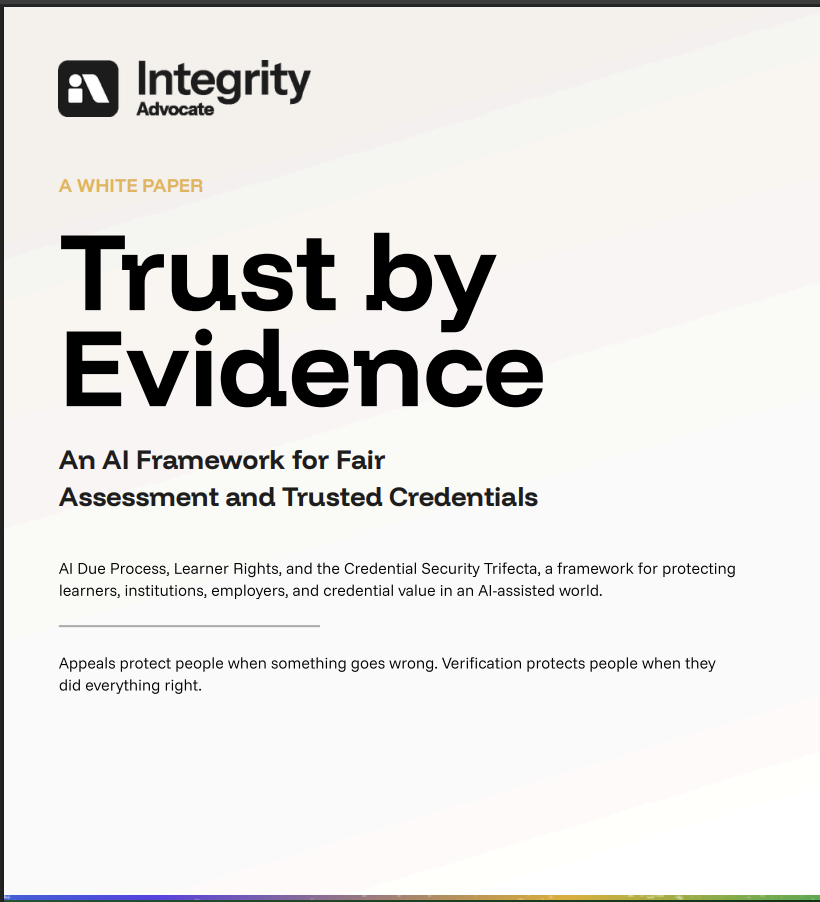
Trust by Evidence: A New Framework for Defensible AI Decisions
Integrity Advocate has released a new whitepaper, Trust by Evidence, introducing a framework that connects AI due process, learner rights, and credential security into one model for defensible AI-assisted assessment. This post walks through what the framework covers, why AI adoption alone no longer settles the integrity question, and links to the full whitepaper download.
Assessment integrity used to mean one thing: was the exam monitored? That question is no longer enough. AI now plays a role in identity verification, proctoring flags, authorship review, scoring, and credential validation, and each of those touchpoints can be challenged.
Confidence in an outcome isn't just about whether AI was accurate. It's about whether the decision it contributed to can be explained, reviewed, appealed, and verified after the fact.
As AI becomes embedded deeper into assessment, institutions are being asked a more pointed question: Can you defend the decision AI helped you make?
That question requires more than accurate technology. It requires a system.
In our latest whitepaper, Trust by Evidence, CEO Brandon A. Smith introduces a framework that connects AI due process, learner rights, and credential security into one model for defensible outcomes.
Download the whitepaper
The Shift From AI Adoption to Defensible Outcomes
For the past several years, the conversation in education and credentialing has centered on adoption: which AI tools to use, how to deploy them, how accurate they are. That conversation is largely settled. Most programs already use AI somewhere in the assessment lifecycle.
What hasn't been settled is defensibility. When an AI-influenced decision is challenged, whether by a learner, an employer, or a regulator, an institution needs to answer a specific set of questions: was there notice, meaningful human review, supporting evidence, and a path to appeal? If any of those answers are unclear, the decision isn't defensible, and the institution is exposed right along with the learner.
The next major challenge in education isn't AI adoption. It's building outcomes that hold up under scrutiny.
Why Treating AI as a Single Safeguard Creates Risk
Many programs rely on AI to do one job: flag anomalies. That model treats a flag as a finding rather than a signal, and it breaks down under three conditions:
- No documented process exists for what happens after a flag is raised.
- Human review means approving the AI's output rather than independently evaluating it.
- There's no clear path for the learner to respond, and no record for the institution to point to later.
Any one of those gaps makes an outcome difficult to defend. Together, they create real exposure, not just to individual learners, but to the institution's accreditation standing, employer trust, and legal risk.
The Trust by Evidence Framework
The whitepaper introduces Trust by Evidence, a framework that connects three ideas typically treated in isolation:
AI Due Process: A fair, documented process for any consequential decision AI contributes to, so a flagged learner has an actual process to walk through rather than a black box to accept.
The Learner Rights Layer: Seven specific rights, to know, to meaningful human review, to explanation, to evidence, to appeal, to proportionality, and to verification, that turn "the system flagged it" into a decision an institution can explain and stand behind.
The Credential Security Trifecta: A secure chain of trust connecting learning, assessment, and credentialing, where a weakness in any one layer undermines the others.
Individually, each idea is familiar. Together, they hold up under scrutiny from everyone with a stake in the outcome: the learner, the institution, employers, regulators, and the public.
What a Defensible AI-Assisted Decision Looks Like
A defensible process doesn't rely on confidence in the algorithm. It provides an actual record. It lets an institution answer, with certainty:
- Was the individual notified that AI was involved?
- Did a qualified reviewer examine the evidence, not just the score?
- Could the individual respond before a consequence was applied?
- Is there a documented, time-bound appeal path?
- Can the outcome be explained to someone outside the institution?
These are governance questions as much as technical ones. Answering them well protects accreditation standing, employer trust, and learner confidence all at once.
What You'll Learn in the Whitepaper
The full whitepaper expands on:
- Why algorithmic due process, procedural justice, and automation bias research all point toward the same conclusion for education
- The Defensible Outcomes Responsibility Matrix, a governance tool for assigning clear ownership across vendors, institutions, and credential issuers
- The five-stage AI Appeals Framework, walked through with a real worked example of a contested proctoring flag
- Sector-specific guidance for K-12, higher education, workforce certification, and employers
- A candid discussion of the framework's limitations, including cost, scale, and surveillance risk
It's written for compliance leads, credentialing bodies, assessment teams, and program leaders responsible for the outcomes their institution has to stand behind.
{{post-cta}}
All resources
Why Privacy-First Proctoring Will Define Online Assessment in 2026 (and Beyond)
December 8, 2025
|
5 min read
In 2025, privacy became the deciding factor in whether organizations adopt, keep, or replace their proctoring vendor. Learners are more vocal about surveillance. Legal and privacy teams are asking harder questions. Accreditation bodies are demanding clearer, more defensible data practices. This post explains what privacy-first proctoring actually means architecturally rather than as a marketing claim, how Integrity Advocate implements it across five specific design decisions, and why privacy-first will lead vendor decisions in 2026 as regulatory requirements tighten and learner trust becomes a measurable program outcome.
In 2025, one theme rose above all others in the world of online proctoring: privacy is now a deciding factor in whether organizations adopt, keep, or replace their proctoring vendor. As remote exams and digital credentialing continue to scale, institutions are realizing that effective proctoring isn’t just about stopping misconduct, it’s about doing it in a way that respects the people behind every assessment. This shift has been driven by a few powerful forces:
- growing public discomfort with invasive surveillance
- stricter global and institutional data protection requirements
- accreditation bodies demanding clearer, more defensible privacy practices
- test-takers becoming more vocal about what they will, and won’t, accept
It’s no longer enough to secure exams; organizations also have to secure trust. And that begins with privacy.
From “Nice to Have” to Non-Negotiable
Only a few years ago, privacy considerations were something addressed near the end of a vendor evaluation. Today, they’re the starting point. Learners, legal teams, regulators, and internal privacy officers are asking tougher, more detailed questions:
- What exactly is being recorded?
- How long is the data stored, and who can access it?
- Do test-takers have to install software on personal devices?
- Is biometric data being captured or saved?
- Does the system monitor more than is truly needed?
These aren’t niche concerns, they’re fundamental expectations. And when programs can’t answer these questions confidently, trust and adoption suffer.
This is why privacy-first proctoring has moved from a helpful differentiator to a baseline requirement for any institution serious about delivering fair, modern, and defensible assessments.
What Privacy-First Proctoring Actually Means
Many proctoring tools call themselves “privacy-friendly,” but privacy-first is something different. It’s not a marketing angle, it’s an architectural choice. It shapes how the system is built, what data it collects, and how it interacts with both learners and administrators.
Here’s what privacy-first looks like in practice with Integrity Advocate:
1. Minimal Data Collection: Only What’s Necessary
Integrity Advocate collects only what is needed to confirm identity and verify participation. No scanning of personal files, no continuous background monitoring, no broad access to the device.
This approach aligns with global data minimization standards and simplifies conversations with privacy and compliance teams.
2. A No-Install, Browser-Based Experience
Because Integrity Advocate runs directly in the browser and works within your LMS, there’s no software to download or manage, which means:
- No risk of lingering software on personal devices
- No conflicts with corporate firewalls
- Fewer technical issues and exam-day barriers
- A far less intrusive experience for test-takers
Privacy improves, and so does usability.
3. No Biometric Template Storage
While some proctoring tools rely on building biometric profiles, Integrity Advocate verifies identity without storing facial templates or other high-risk biometric data.
With global privacy regulations tightening, avoiding biometric storage removes one of the most sensitive risk categories for institutions.
4. Clear, Time-Bound Retention and Encrypted Storage
Transparency matters. Institutions want to know:
- how long exam data is kept
- how it’s encrypted
- who can access it
- when and how it’s deleted
Integrity Advocate supports strict retention timelines and secure storage practices, reducing long-term exposure and easing accreditation and audit reviews.
5. Privacy by Design, Not Added Later
Every feature of Integrity Advocate, from identity verification to participation monitoring to human review, is built with privacy constraints in mind. We don’t add privacy after development; we design around it from the start.
That mindset results in a system that is respectful, compliant, and aligned with the expectations of modern digital assessment.
Why Privacy-First Proctoring Will Lead Vendor Decisions in 2026
The move toward privacy-first proctoring isn’t slowing down, it’s accelerating. Several trends point to why institutions will prioritize these solutions in the coming year:
1. Regulatory and Accreditation Requirements Are Rising
Regulatory environments worldwide are becoming more prescriptive about personal data use. Institutions are expected to demonstrate:
- data minimization
- justified data collection
- documented retention and deletion practices
- strong encryption protocols
- thoughtful handling of sensitive data
A privacy-first proctoring partner reduces compliance burden and institutional risk.
2. Learner Trust Drives Program Success
When test-takers feel uncomfortable or monitored too aggressively, exam anxiety rises, completion rates fall, and complaints increase. Trust isn’t just a philosophical concept, it affects outcomes.
Privacy-first proctoring improves the entire assessment experience by reducing friction and creating a clearer, more respectful process for learners.
3. Usability and Privacy Are Now Interconnected
Many of the decisions that protect privacy also make proctoring easier to use:
- No installs → fewer technical failures
- Minimal monitoring → fewer permissions and pop-ups
- Embedded LMS workflows → less confusion for learners
- Transparent policies → fewer escalations on exam day
When privacy improves, usability improves, and your program benefits immediately.
4. Intrusive Tools Are Becoming Harder to Justify
Solutions that require extensive device access, deep installs, or full desktop monitoring are facing increasing resistance, from learners, privacy teams, IT departments, and regulators.
Organizations that adopted heavy client-based tools early in the remote testing surge are now looking for alternatives that carry less risk, less friction, and less complexity.
Privacy-first proctoring offers exactly that.
Privacy-First Doesn’t Mean Less Secure, It Means More Responsible
A common misconception is that privacy-first design compromises security. In reality, the opposite is true. Effective proctoring is not about collecting more data; it’s about collecting the right data in the right way.
Integrity Advocate balances:
- identity verification
- participation and engagement monitoring
- AI-assisted analysis
- human oversight for context
- transparent, reviewable reporting
This approach strengthens fairness, defensibility, and trust without relying on invasive surveillance.
As You Plan for 2026, Privacy Should Lead the Conversation
As institutions prepare for the next evolution of remote and hybrid assessment, a few key questions can guide whether your current proctoring approach is still the right fit:
- Can we clearly explain the data our proctoring tool collects and why?
- Would our privacy or legal teams feel comfortable defending these practices?
- Are learners confident and comfortable using our current system?
- Do we rely on unnecessary installs or device access we’d prefer to avoid?
- Would our approach hold up under accreditation or regulatory review?
If any of these questions reveal uncertainty, a privacy-first model may be the solution your program needs.
See How Privacy-First Proctoring Strengthens Both Trust and Integrity
Integrity Advocate proves that you don’t have to choose between protecting exams and protecting people. You can uphold integrity, support fairness, and respect privacy, all within one streamlined, secure solution.
If strengthening trust, improving usability, or modernizing your assessment strategy is on your roadmap for 2026, we’d be happy to show you how privacy-first proctoring can support your goals.
Book a Demo with Integrity Advocate
{{post-cta}}

The 2025 Year-in-Review for Online Proctoring: What We Learned and Where Assessment Security Is Heading in 2026
December 5, 2025
|
5 min read
2025 was one of the most transformational years in the online proctoring industry. Exam takers became more vocal about surveillance and data handling. AI expanded its role but confirmed its limits without human oversight. LMS-native workflows became the defining purchase factor. And the industry's attention shifted from catching misconduct to building systems that are trustworthy, transparent, and sustainable. This year-in-review covers the seven most important lessons from 2025 and the ten trends already shaping what assessment security will look like in 2026.
As 2025 comes to an end, it’s clear that the online proctoring industry has undergone one of its most transformational years yet. The conversations we had, the challenges institutions faced, and the expectations exam takers voiced have all reshaped what “good” looks like in remote assessment, shifting the focus from simply catching misconduct to building systems that are trustworthy, transparent, and sustainable.
The lessons were unmistakable. This year forced institutions and vendors alike to confront hard questions about privacy, fairness, accessibility, and the real human experience behind every exam session. In doing so, 2025 didn’t just change how we secure assessments, it reset the bar for what responsible, learner-centered online proctoring must look like going forward.
What 2025 Taught Us About Online Proctoring
1. Privacy is no longer a “feature”, it’s a requirement.
This year, exam takers became more vocal than ever about how their data is handled, what is recorded, and what surveillance technologies are being used. The demand for minimal data collection, no unnecessary storage, and low-intrusion monitoring accelerated across higher education, associations, and enterprise training.
Institutions realized that privacy-first design isn’t just good ethics, it’s good adoption strategy.
2. AI expanded its role, but human oversight remained essential.
The use of AI in proctoring continued to improve in 2025, offering better pattern recognition, anomaly detection, and flag reduction. But organizations learned a crucial truth: AI alone cannot reliably interpret context, intent, or accessibility accommodations.
The market shifted toward hybrid models where AI handles detection at scale and humans deliver fairness, nuance, and informed decision-making. This aligns with Brandon Smith’s view that “human-backed AI wins on accuracy, equity, and trust.”
3. LMS-first workflows became the defining purchase factor.
According to the 2025 Market Report, LMS integration remained one of the strongest drivers of adoption, far outweighing individual product features. Seamless integration reduced faculty workload, lowered IT overhead, and ensured more consistent student experiences.
Institutions and enterprises made it clear: If the proctoring solution adds friction, it’s not the right solution.
4. Growth continued, but it wasn’t evenly distributed.
The global market reached US$945M in 2024 and is projected to reach US$1.08B in 2025, on its way to US$2.2B by 2030. But what stood out?
- Schools & universities still lead at 53% of global demand.
- Enterprise and government sectors are now the fastest-growing segments, fueled by compliance training, certification exams, and remote workforce expansion.
- Mid-stakes assessments grew significantly, creating demand for scalable, flexible, affordable solutions.
2025 proved that proctoring is no longer an education-only tool, it’s a workforce and credentialing necessity.
5. End-user experience became a competitive differentiator.
Test takers made their expectations known:
- no downloads
- no surveillance-like monitoring
- clear instructions
- lightweight, low-stress verification
- products designed with accessibility and inclusivity in mind
User experience became a measurable component of exam integrity.
6. Institutions demanded transparency and evidence, not black-box AI.
In 2025, purchasing teams asked harder questions:
- What exactly does the AI detect?
- How accurate are the flags?
- Who verifies them?
- What data is stored, and for how long?
- Can instructors see exactly what happened during the exam without relying on vendor interpretation?
Solutions positioned as “too automated” or “too opaque” lost ground to platforms offering explainability and audit-ready reporting.
7. Flexibility and configurability beat rigid, one-size-fits-all models.
Organizations embraced layered security approaches, choosing the right level of monitoring based on exam stakes, risk tolerance, and learner population. This aligned with a broader shift away from “live proctoring for everything” toward dynamic, context-driven integrity strategies.
What’s Coming in 2026? 10 Trends That Will Shape the Next Era of Proctoring
Pulling from market data and institutional feedback, here are the biggest shifts already underway:
1. Hybrid AI + human review becomes the dominant model
In 2026, the winning approach won’t be AI-only or live-only, it will be human-backed AI. AI will handle detection at scale, while trained reviewers provide context, fairness, and defensible decisions. This combo reduces false positives and gives institutions the transparency they need for audits and appeals.
2. Privacy expectations rise, and drive buying decisions
Privacy moved from talking point to purchasing criteria in 2025, and that continues into 2026. Institutions will scrutinize what’s collected, how long it’s stored, and whether surveillance-style monitoring is truly necessary. Solutions built on minimal data, privacy-by-design, and clear documentation will move to the top of the shortlist.
3. Workforce, compliance, and credentialing programs demand tailored workflows
Mid-stakes and professional exams in construction, healthcare, financial services, hospitality, IT, and more will expand what proctoring needs to support. These programs bring shift-based teams, low-bandwidth environments, specific integrations, and varied risk profiles. Providers will win by offering industry-specific configurations and workflows, not just repurposed higher-ed models.
4. LMS- and platform-native proctoring overtakes standalone tools
Organizations are done with fragmented systems and extra logins. Proctoring will increasingly live inside LMSs and training platforms, with exams syncing automatically and settings controlled where instructors already work. If a solution adds friction to Canvas, D2L, Moodle, TopClass, or a corporate training portal, it will struggle to gain traction.
5. AI shifts from “flag everything” to “flag what matters”
Institutions don’t want long lists of noisy alerts; they want fewer, more accurate flags. AI will evolve toward better context-awareness, bias reduction, and meaningful triage that highlights only what truly needs review. The metric moves from “how much did we flag?” to “how much time and confusion did we save?”.
6. Human escalation pathways become standard, not optional
Programs increasingly expect clear answers to “who reviews what, and how?”. 2026 will normalize structured escalation paths: human verification of AI flags, documented decisions, and audit-ready summaries. Human oversight becomes a governance requirement, not just a nice-to-have.
7. Accessibility and inclusive design become baseline expectations
Accessibility will be evaluated at every step of the proctoring workflow. Institutions will favor solutions that reduce cognitive load, support assistive technologies, simplify ID verification, and avoid patterns that penalize neurodivergent or disabled exam takers. Inclusive UX becomes both a compliance obligation and a brand differentiator.
8. Identity verification gets lighter, smarter, and less intrusive
The trend is away from heavy biometric checks and toward low-friction, privacy-respecting verification. Expect growth in document-based checks, LMS-linked authentication, instructor-approved methods, and verification that’s woven into the session rather than front-loaded and stressful. Quick, repeatable, and non-invasive will be the new standard.
9. Evidence packages replace full-length recordings
Administrators don’t have time to scrub through hours of video. Proctoring platforms will increasingly provide condensed evidence packages, key clips, timestamps, and summaries, rather than raw, unfiltered recordings. This shift cuts review time, supports appeals, and makes integrity easier to manage at scale.
10. Cost transparency and total cost of ownership drive decisions
With tighter budgets, organizations will look beyond license price to the true cost of ownership, including instructor time, training, support volume, and false-positive management. Pricing models tied to heavy live proctoring or hidden add-ons will face more resistance. Transparent, predictable, tiered models aligned to exam stakes will win.
What It All Means for Integrity Advocate
For us, 2025 validated what we’ve believed for years:
Integrity doesn’t require intrusion. Security shouldn’t add friction. And exam takers deserve dignity, not surveillance.
Our commitment remains:
- privacy-first architecture
- no installs for supported LMSs
- human-backed AI for fairness and accuracy
- lightweight identity verification
- configurable security layers
- seamless LMS integrations
- accessible, inclusive UX
- transparent, audit-ready reporting
2026 will raise expectations across the industry. We’re ready, and excited, to continue shaping a future where exam integrity and humanity coexist. Schedule a demo to learn more about our approach.
{{post-cta}}

Online Proctoring: Key Insights From the Global Market Report, and Why Integrity Advocate Is Built for What’s Next
December 1, 2025
|
5 min read
The Online Exam Proctoring Market 2025 Edition report confirms what many institutions and certifying bodies already sense: remote assessment has entered a new era. The global market reached $945.62 million in 2024 and is projected to more than double to $2.19 billion by 2030. This post breaks down the five most significant findings, including the continued dominance of human-centered proctoring models, surging enterprise and government demand, North America's privacy-driven expectations, and the industry-wide shift toward hybrid AI plus human review as the standard for fair, defensible assessment.
The Online Exam Proctoring Market: 2025 Edition report confirms what many institutions, certification bodies, and training organizations already feel: remote assessment has officially entered a new era. The market is expanding rapidly, expectations around privacy are rising, and organizations are demanding solutions that deliver security without unnecessary intrusion.
Below is a breakdown of the report’s most important findings, and how Integrity Advocate stands out as the solution designed for 2025 and beyond.
1. The Market Is Growing, Fast
The report shows the global online proctoring market reached $945.62M in 2024 and is projected to more than double to $2.19B by 2030 (CAGR 15.11%).
This growth isn’t just about more online learning. Organizations worldwide are searching for scalable, reliable, and compliant ways to maintain exam integrity across:
- Higher education
- Certification & licensing bodies
- Government programs
- Workforce and safety training
As budgets tighten and expectations rise, solutions that require no installation, no scheduling, and minimal administrative overhead are becoming the preferred option. Integrity Advocate offers exactly that, a secure, streamlined workflow that doesn’t weigh down learners or admins.
2. Human Oversight Remains Essential, Even as AI Accelerates
The report notes that human-centered models still dominate: live proctoring accounts for 50.59% of market share in 2024.
This underscores a key truth: Organizations want the accuracy and fairness that only human context can provide.
Automation alone simply isn’t trusted to make final decisions, especially when exam outcomes impact careers, credentials, or safety-sensitive roles.
Integrity Advocate was built on hybrid oversight long before it became an industry trend.
- AI handles scale efficiently
- Human reviewers validate context, tone, and intent
- Reports focus on clarity, not confusion
This means fewer false positives, fewer escalations, and far better outcomes for both administrators and exam takers, all without the invasiveness of live video monitoring.
3. Education Leads Today, But Enterprise Growth Is Surging
Education continues to be the largest segment, representing 53.18% of worldwide demand in 2024. Government and enterprise follow at 24.58% and 22.24% respectively.
The trend lines are clear: Remote certification, upskilling, and workforce credentialing are becoming standard across industries.
Integrity Advocate serves all three segments with equal strength:
- Education: seamless LMS integration + student-centric privacy
- Government: audit-ready documentation + compliance built in
- Enterprise & safety-critical industries: identity verification + fair, scalable oversight on any device
The same lightweight workflow works everywhere, reducing IT strain and increasing adoption speed.
4. North America Continues to Lead, Driven by Privacy Expectations
North America accounts for 41.50% of the global market, making it the most mature and demanding region.
What’s accelerating adoption?
- Digital learning expansion
- High compliance standards
- Stronger expectations around data privacy
- Growing discomfort with intrusive surveillance tools
Unlike legacy proctoring platforms, Integrity Advocate rejects the “collect everything” model. We are the only privacy-first provider that:
- Stores no biometric data
- Captures the minimum data required
- Avoids unnecessary device lockdowns
- Ensures exam-taker dignity and transparency
As privacy regulations tighten, this approach isn’t just preferred, it’s becoming required.
5. AI Adoption Is Rising, But Hybrid Models Are the Future
The report emphasizes increasing demand for AI-powered proctoring complemented by human review, not replaced by it. Industry-wide, this hybrid approach is considered more fair, more accurate, and more defensible.
Integrity Advocate has championed hybrid oversight from the beginning. Our approach ensures:
- Higher accuracy
- Lower administrative burden
- More trust from learners
- Reduced technical friction
- Better transparency in flagged events
It's everything institutions want, without the invasiveness they’ve grown tired of.
Why Integrity Advocate Is Emerging as the Clear Leader in 2026 and beyond
The trends are unmistakable, and they all point toward a solution like ours:
- Privacy-first: A direct answer to rising concerns about surveillance and data overreach.
- Hybrid Proctoring: Aligns with the report’s confirmation that human oversight remains essential.
- No-install simplicity: A critical differentiator as organizations scale online assessment.
- Seamless LMS integration: Meeting institutions exactly where they are, not forcing new systems.
- Audit-ready reporting: Reducing administrative workload and increasing compliance confidence.
- Scalable across sectors: Education, enterprise, associations, licensing boards, government, the same streamlined workflow supports them all.
Final Takeaway: The Market Is Evolving, Integrity Advocate Already Has
The report makes it clear that organizations increasingly want security + privacy, AI + human context, and scalable + simple workflows.
Integrity Advocate isn’t adapting to these trends, we were built for them.
If your institution or organization is preparing for the next chapter of online assessment, we’d love to walk you through how a privacy-first, human-backed approach can transform your testing experience. Feel free to schedule a demo here.
{{post-cta}}
EXG2025 Recap: Key Takeaways on AI, Automation, and Responsible Innovation
November 24, 2025
|
5 min read
EXG2025 brought together leaders in testing, credentialing, AI, automation, and digital governance for one of the most forward-looking events of the year. The central message was clear: innovation must be built on integrity. This recap covers the five most important themes from the conference, from accelerating AI adoption across sectors and the maturing role of automation in credentialing workflows to the consistent emphasis on human-in-the-loop oversight, cross-functional collaboration as a competitive advantage, and the growing consensus that trust and transparency are the foundations of every responsible digital system.
The EXG2025 Conference brought together leaders in testing, credentialing, AI, automation, and digital governance for one of the most forward-looking events of the year. Organizations across industries are moving from experimentation to real-world implementation, especially when it comes to artificial intelligence, operational automation, and trust-centered innovation.
This recap highlights the most important insights from EXG2025, including trends shaping 2025, practical case studies, and why responsible technology adoption matters now more than ever.
What EXG2025 Revealed About the Future of Digital Governance
The central message at EXG2025 was clear: innovation must be built on integrity. As AI and automated systems become embedded across organizations, trust, transparency, and accountability are essential for long-term success.
Speakers repeatedly emphasized that technology moves fast, but organizations must move responsibly.
Key themes included:
- Governance models that prioritize transparency
- Responsible AI frameworks
- Human-in-the-loop oversight
- Data protection and ethical automation
- Cross-functional alignment to accelerate innovation
These themes provided a roadmap for organizations navigating rapid transformation.
Top EXG2025 Takeaways for Organizations in 2025
1. AI Adoption Is Accelerating Across All Sectors
EXG2025 showcased how quickly artificial intelligence is moving from R&D environments into production workflows. From risk scoring and content analysis to operational efficiencies, AI is now central to digital transformation strategies.
The organizations finding the most success are those implementing AI with clear governance, strong oversight, and people-first design.
2. Automation Is Driving Efficiency, But People Still Lead
Automation tools are maturing, and this year’s conference highlighted how they are reducing friction and improving accuracy across credentialing, compliance, and testing ecosystems.
Importantly, EXG2025 reinforced that automation should support, not replace, human decision-making. Human oversight remains the anchor for any trustworthy system.
3. Cross-Team Collaboration Is a Competitive Advantage
A recurring message across sessions was that organizations succeed when technology, compliance, operations, and leadership collaborate from the start.
Integrated teams are delivering faster progress and better outcomes, especially when implementing new technologies like AI and advanced security models.
4. Real-World Demos Showed That Emerging Tech Is Solving Problems Today
This year’s demos and case studies were more mature and actionable than ever before. From secure credentialing workflows to AI-assisted analysis tools, EXG2025 demonstrated how emerging technologies are producing measurable results.
The shift from ideas to implementation was one of the strongest signals of the conference.
Why Responsible Innovation Matters in 2025
A core message throughout EXG2025 was that trust is the foundation of every digital system. Whether deploying AI, modernizing governance processes, or scaling automated workflows, successful organizations are those that prioritize:
- Transparency
- Ethical decision-making
- Clear governance frameworks
- Integrity in testing and credentialing
- Human-centered oversight
These values weren’t just mentioned; they were woven into every panel, workshop, and peer conversation. I must say that I was impressed with even fellow vendors talking about this across the board. It's great to see our peers are embracing this responsibility.
Community, Collaboration, and Integrity: The Heart of EXG2025
Beyond the technical insights, EXG2025 highlighted the importance of community and collaboration. The connections, discussions, and shared problem-solving were as impactful as the sessions themselves.
At Integrity Advocate, our team continues to push forward with solutions that support responsible innovation, secure environments, and trust-centered digital governance.
EXG2025 set a clear direction for the year ahead and we’re excited to put these insights into action.
{{post-cta}}

What a 96% Midterm and a 48.6% Final Exam Reveal About Unproctored Assessments
July 14, 2026
|
5 min read
A welfare economics class at Brown University averaged 96% on a take-home midterm and 48.6% on an in-person final, a historic low for the course. Nineteen students failed. Twenty-two of the forty students who scored a perfect 100 on the midterm did not sit for the final at all. This post examines what the Brown case reveals about the two distinct failures that follow an unmonitored assessment, the upstream detection failure and the downstream adjudication failure, and why the fix is not more automation layered on top of automation but a human reviewer in the loop before a result is finalized.
A welfare economics class at Brown University took a take-home midterm this spring. The average score was 96 percent, well above the course's historical range of 65 to 80 percent. When the professor moved the final exam in person, the average dropped to 48.6 percent, a result he called a historic low for the course. Nineteen students ultimately failed.
That gap is the story. It is not really about one professor, one class, or one university. It is about what happens when an assessment has no layer of oversight between the moment a student submits an answer and the moment a grade gets issued.
What happened in the Brown University case
According to Inside Higher Ed, economics professor Roberto Serrano gave a take-home midterm for the first time in nearly two decades of teaching the course, largely to accommodate students who did not want to sit in a classroom exam after a shooting on campus in December. Enrollment in the class had also grown to 86 students, up from a typical 30, which he attributed to the promised take-home format.
When the midterm scores came back unusually high, he and his graders ran the exam through ChatGPT. Separate reporting from Fox News Digital puts a finer point on the scale of it: 40 students earned a perfect score on the midterm. The AI produced answers that closely resembled what his students had submitted, using a proof method that technically worked but read as unnatural for the level of the course. He told students he suspected widespread AI use and switched the final exam to an in-person, closed-book format. Eighteen students dropped the class outright, and nine more stayed enrolled but skipped the final exam entirely, meaning 27 students in total did not sit for it. Of those 27, 22 had scored a perfect 100 on the midterm. The final exam, taken by the 59 students who remained, averaged 48.6 percent, compared with a historical low of 65 percent for the course. The midterm was voided.
The university's response has been a point of dispute. As of the initial reporting on July 8, Serrano described the process as slow, saying Brown's Standing Committee on the Academic Code had not acknowledged evidence he first shared in late May. Serrano later wrote in an op-ed for The Free Press that he does not believe the university would have acted at all had his account not first been published by El Pais in late June and then picked up by Inside Higher Ed. Brown disputes that framing. In a statement reported by Fox News Digital on July 13, the university said its academic leaders had been in contact with Serrano as early as May, that he provided the documentation the Standing Committee needed on July 8, and that the committee is now moving the case forward under its normal procedures.
Whichever account of the timeline is more complete, the underlying pattern holds: resolving this case required a professor to independently investigate 86 exam responses, go public across three separate news outlets, and press the matter for roughly two months before a formal review process began in earnest.
Why this is a detection problem, not a discipline problem
It is worth separating two different failures here, because they call for different fixes.
The first failure was upstream. There was no oversight mechanism in place during the exam itself. A take-home format with unlimited time and no monitoring gives a student every opportunity to use an AI tool, and gives the institution no record of how the answer was actually produced. The professor's suspicion, however well founded, arrived only after the fact, based on score patterns and stylistic analysis he did personally.
The second failure is what happens next. Brown's own newly published committee report on generative AI in teaching and learning found that three-quarters of surveyed faculty are concerned about AI-enabled cheating, a figure that lines up with a 2025 national faculty survey from AAC&U and Elon University, which found that the large majority of faculty nationwide are worried about AI's effect on academic integrity and student learning. The Brown report recommends that the university avoid over-reliance on detection tools with known false-positive and false-negative rates, and that it move institutional codes toward addressing the specific mechanics of generative AI misuse rather than relying on generic academic dishonesty language.
Both of these are structural gaps. Neither is solved by asking one professor to build 86 individual cases from memory and suspicion after the semester has ended.
What a human-reviewed process would have looked like
This is where the distinction between automated and human-backed oversight actually matters, and it is worth being precise about it rather than making a sweeping claim.
An AI detection tool run after the fact, as the professor described doing informally with ChatGPT, can surface a pattern. It cannot make a defensible determination. Independent research on AI-detection accuracy backs this up: one analysis of 14 detection tools found false-positive rates as high as 50 percent and false-negative rates as high as 100 percent depending on the tool, with accuracy dropping further once AI-generated text was lightly edited or paraphrased. A tool like this has no way to distinguish a genuinely unusual but honest answer from an AI-assisted one, and it cannot document its reasoning in a way that holds up if a student challenges the finding, which is exactly the dispute now unfolding at Brown.
A proctored, human-reviewed exam changes the sequence entirely. Instead of a professor discovering an anomaly in aggregate score data weeks later, a trained reviewer looks at the flagged session at the time it happens, with the actual exam conditions in view, not just the output. That review becomes a documented record: what was flagged, who looked at it, and why a decision was made. When a result is challenged, whether by one student or by dozens at once, the institution has something concrete to point to instead of reconstructing intent from a grade curve.
This does not mean every exam needs to become high-stakes and adversarial. Brown's own committee is right that de-emphasizing punishment and building AI-aware academic codes matters too. But policy language only works if there is a way to apply it consistently and fairly at the point of assessment, not just after a problem has already reached this scale.
The scaling problem administrators are underestimating
The academic integrity director quoted in the article makes an important point: faculty are not compensated or incentivized to build cheating cases against dozens of students at once, and most institutions do not staff for it. That is a resourcing problem as much as a policy one. Tricia Bertram Gallant, who directs the Academic Integrity Office and Triton Testing Center at the University of California San Diego, made this point directly in the original reporting.
It is also precisely the moment where AI-assisted cheating changes the math. A single suspicious paper is manageable for a professor to investigate. Eighty-six unusually strong exam answers, submitted in an unmonitored take-home format, is not something any single instructor can reasonably adjudicate alone, especially without institutional support. Programs that rely entirely on faculty judgment after the fact, with no monitoring layer during the assessment itself, are the ones most exposed as AI tools become more capable and harder to detect through scoring patterns alone.
The takeaway for programs issuing results that need to hold up
Every program that issues a grade, a certificate, or a credential is implicitly telling the people who rely on that result that it means something. When an assessment has no oversight during the exam and no documented review process afterward, that claim becomes hard to defend the moment it is questioned, which is exactly what is playing out at Brown right now.
The fix is not more automation layered on top of automation. It is a human reviewer in the loop before a result is finalized, producing a record that can actually be defended. That is a different design decision than choosing a take-home format for convenience, and it is one institutions can make before their own version of this story runs in the news.
{{post-cta}}

Seamless Proctoring That Integrates Directly With Your LMS
November 20, 2025
|
5 min read
Integrity Advocate integrates natively with major learning management systems and certification platforms via LTI, including D2L, Canvas, Moodle, TopClass, uxpertise, Thought Industries, and more, so organizations can activate proctoring exactly where they need it without rebuilding course structures or changing existing workflows. Learners click Begin, verify their identity, and take the assessment. Administrators access results and flagged sessions directly within the LMS. No installs, no extensions, no IT overhead, and no privacy tradeoffs.
A proctoring solution that integrates seamlessly with the platforms you already use, for simplicity and smoother workflows.
Integrity Advocate integrates natively with major LMS, certification platforms, and learning systems, including:
- D2L
- TopClass LMS
- Thought Industries
- uxpertise
- Moodle
- Coelrind
- TalentLMS
- AtomicJolt
- Canvas
- Totara
- Cirrus
- Vocal Meet
- SmarterU
- iLevel
- Isograd
- Momentum IT
- OpenLMS
- LearningCart
- StudyForge
- Healthcare Staffing Hire
- Gulf Coast Safety Council
- and other platforms
Because the integration is LTI-based, it works with your existing course structure, no rebuilding, reformatting, or duplicating content.
You activate proctoring where you need it, and your existing workflow stays exactly the same.
See a full list of our integrations
No Installs. No Plugins. No Added Steps.
Unlike legacy proctoring tools, Integrity Advocate runs entirely in the browser. That means:
- No downloads
- No browser extensions
- No permissions pop-ups
- No IT tickets
- No compatibility headaches
Exam takers simply click “Begin,” verify their identity, and take the assessment. Administrators access results directly within their LMS and review flagged activity with one click.
When proctoring feels effortless, participation increases, and support tickets drop dramatically.
A Seamless Experience for Learners and Administrators
Seamless integration isn’t just about technical compatibility; it’s about creating a consistent, intuitive experience for every user.
For Learners
✔ Familiar LMS environment
✔ Simple, no-install proctoring
✔ Device flexibility (including Chromebooks, tablets, mobile, laptops)
✔ No confusing redirects to external sites
For Administrators
✔ Same course layout, same workflow
✔ Easy activation per quiz or assessment
✔ Automated flagging and optional human review
✔ Audit-ready reporting directly in the LMS
Everything lives where your team already works.
Protecting Privacy While Simplifying Your Workflow
Many organizations assume proctoring tools create complexity, or require uncomfortable tradeoffs around learner privacy. Integrity Advocate proves they don’t have to.
Privacy-by-Design:
- No unnecessary data storage
- No invasive scanning
- Minimum data collection
- GDPR- and CCPA-aligned practices
- Only necessary evidence is captured
- Human review included for fairness and context
Learners get transparency. Admins get trustworthy, defensible results. Your organization gets compliance without added risk.
The Result: Secure Assessments Without the Overhead
Your LMS shouldn’t become harder to manage just because you need to protect exam integrity. With Integrity Advocate, security becomes an invisible part of your workflow, privacy stays fully intact, and proctoring seamlessly extends your existing assessment process rather than interrupting it.
See How Seamless Integration Works in Action
Want to see how Integrity Advocate plugs into your LMS in minutes? Schedule a demo with our team.
Secure, simple, privacy-first proctoring, already built to work where you work.
{{post-cta}}

Integrity Without Intrusion: How Integrity Advocate Protects Exam-Taker Privacy
November 12, 2025
|
5 min read
Too many proctoring solutions swing too far toward surveillance, turning what should be a fair, secure process into an uncomfortable experience that undermines learner trust. This post explains how Integrity Advocate's privacy-first approach protects exam integrity without intrusion: data minimization by design, no downloads or device control, hybrid AI plus human review that assesses flags after the session rather than popping in mid-exam, and transparent audit-ready summaries that protect everyone involved without long video recordings or invasive monitoring.
In the era of remote learning and online credentialing, online exam proctoring must ensure test integrity, but it should also respect the people taking those exams. Too often, proctoring solutions swing too far toward surveillance, turning what should be a fair, secure process into an uncomfortable experience that feels invasive.
At Integrity Advocate, we believe there’s a better way. Our privacy-first proctoring approach is designed to protect integrity without intrusion, ensuring assessments remain credible, compliant, and human-centered.
Privacy by Design: From the Ground Up
Privacy isn’t an afterthought; it’s baked into every layer of our technology.
Integrity Advocate operates on a data-minimization model: we collect only what’s necessary to confirm identity and verify exam integrity, nothing more.
Unlike many proctoring platforms, we don’t store recordings by default, and we never use test-taker data to train AI models or for analytics beyond the scope of an assessment.
Our system is compliant with global privacy frameworks, including GDPR, PIPEDA, and FERPA, giving institutions and exam takers confidence that their data is handled ethically and securely.
No Downloads, No Device Control
Traditional proctoring tools often require software installs that grant deep access to personal computers, screen control, keystroke tracking, among other invasive practices.
Integrity Advocate takes a completely different approach. Our solution runs entirely in the browser, no downloads, no extensions, and no hidden permissions.
This means:
- No access to personal files or background apps
- No system takeovers or “remote eyes” on your device
- No need for test takers to perform awkward scans
It’s a lightweight, seamless setup that works on any modern device while preserving privacy and accessibility.
Human + AI Oversight: Fair, Not Fearful
AI is powerful, but context matters. That’s why Integrity Advocate uses a hybrid proctoring model, AI handles the heavy lifting of detecting potential issues (like multiple faces or device switching), while trained human reviewers provide the judgment and nuance that algorithms can’t.
We don’t use live proctors who “pop in” on test takers mid-exam. Instead, our reviewers assess potential flags after the session, ensuring normal, non-cheating behavior isn’t misread as a violation.
This hybrid model ensures accuracy without anxiety, maintaining exam integrity while respecting test-taker dignity.
Transparent, Defensible Results
Instead of long video recordings, administrators receive concise, context-rich summaries of any flagged activity. Each flag includes time stamps, screenshots, and reviewer note, giving decision-makers the information they need to take confident, defensible action.
This approach protects everyone involved, reducing false positives, simplifying audits, and maintaining transparency without compromising privacy.
No “Big Brother” Surveillance
Pop-in monitoring. Forced webcam scans. Mandatory software installs. These are hallmarks of the old way of proctoring, one that prioritizes control over trust.
Integrity Advocate rejects that approach. We believe secure testing environments don’t have to feel like surveillance. By combining smart automation, human oversight, and privacy-by-design principles, we deliver integrity without intrusion; ensuring a calm, fair, and respectful testing experience for every exam taker.
The Future of Testing Is Human
As remote and hybrid testing continue to expand, institutions face a choice: maintain integrity through invasive monitoring, or adopt technology that balances security with humanity. At Integrity Advocate, we’ve made our choice clear, privacy isn’t a compromise, it’s a commitment.
Because integrity means more than preventing cheating. It means respecting the people behind every test.
Interested in learning how Integrity Advocate can help your organization maintain exam integrity, without compromising privacy?
{{post-cta}}
Key Takeaways from the Conference on Test Security (COTS): Balancing Security, Integrity, and Innovation in Testing
November 7, 2025
|
5 min read
The 2025 Conference on Test Security brought together higher education institutions, certification organizations, legal experts, and technology vendors around a shared challenge: maintaining assessment integrity in an AI-driven world. Integrity Advocate CEO Brandon Smith shares his key takeaways, covering the growing non-negotiability of exam validity and security, the evolving legal landscape around misconduct and civil disputes, the uneven ethical rigor of AI tools in assessment, and the increasingly critical balance between test security and learner privacy.
The 2025 COTS Conference brought together a diverse mix of professionals from higher education, certification organizations, legal experts, and technology vendors all united around a shared challenge: maintaining the integrity of assessments in an increasingly digital and AI-driven world.
The Growing Focus on Exam Security and Validity
Across both higher education and professional certification sectors, one theme dominated the conversation; security and validity are non-negotiable. Institutions are doubling down on technologies and practices that ensure every test taker is who they say they are and that the results accurately reflect their own work. With remote and hybrid testing becoming the norm, maintaining that integrity has never been more critical, or more complex.
The Legal Landscape Is Changing
A recurring topic throughout the conference was the legal ramifications of exam misconduct. When test takers are caught cheating or engaging in fraudulent behavior, the response can’t be improvised. Organizations need clear, documented legal frameworks to protect themselves and their brands.
With the rise in reported cheating incidents comes an increase in interactions with test takers around alleged violations some of which escalate into accusations, libel, or civil disputes. The consensus: it’s essential to plan ahead, not react after the fact.
Artificial Intelligence: Promise and Pitfalls
AI was everywhere at COTS. While some vendors and institutions are embracing AI in a responsible and transparent way, others are less rigorous about the ethical guardrails they apply. The takeaway? Not all AI tools are created equal.
Decision-makers must ask tough questions, vet vendors carefully, and understand how AI is being used especially when it impacts privacy, proctoring, and identity verification. Blind trust in “smart” systems can lead to unintended consequences.
The Balancing Act: Security vs. Privacy
Perhaps the most nuanced discussions centered on finding the right balance between test security and user privacy. With test takers increasingly sensitive to how their data is collected and used, organizations are being challenged to uphold both integrity and privacy, without compromise. It’s not an either/or decision; the future of assessment requires innovative solutions that respect both principles.
A Conference of Thought Leaders
COTS continues to position itself as a true thought leadership event. Every session was rich with real-world examples, backed by data, and framed within professional and legal contexts. The mix of participants, from educators to legal professionals to technology providers, created a vibrant ecosystem of perspectives, debate, and shared problem-solving.
Final Thoughts
The future of testing isn’t just about better technology; it’s about smarter, more ethical implementation. The conversations at COTS made it clear: the organizations that thrive will be those that treat integrity as both a value and a strategy. As AI reshapes the landscape and legal accountability intensifies, preparation, transparency, and ethics will define the leaders in this space.
{{post-cta}}

Why Use a Remote Proctoring Solution for Online Assessments?
October 27, 2025
|
5 min read
As online learning expands across education, certification, and compliance training, remote proctoring has moved from a stopgap to a strategic necessity. This post covers seven reasons institutions and certifying bodies use remote proctoring, from protecting exam integrity and ensuring fairness across diverse learner populations to building defensible audit trails, supporting accessibility, reducing administrative burden, and keeping pace with the AI era of assessment, with a human-first model that balances efficiency with empathy.
How modern proctoring protects integrity, fairness, and flexibility in today’s online learning and credentialing environments.
The New Reality of Online Assessment
In just a few short years, education and credentialing have gone through a seismic shift. What once happened inside a classroom or test center now happens from living rooms, libraries, and laptops around the world.
While this flexibility has opened doors for millions of learners, it has also created new challenges: verifying who’s behind the screen, maintaining fairness, and ensuring that results truly reflect skill and knowledge, not shortcuts.
That’s why more institutions, certifying bodies, and employers are turning to remote proctoring as a core piece of their digital assessment strategy. Done right, it’s not about surveillance, it’s about trust, fairness, and credibility in the online era.
1. Protect Exam Integrity
Academic integrity is the foundation of meaningful credentials. Without it, transcripts, certifications, and compliance programs lose their value.
Remote proctoring helps protect this foundation by verifying test-taker identity, monitoring exam sessions, and ensuring that assessment rules are followed. Whether through AI-assisted detection, human review, or a hybrid approach, proctoring acts as a safeguard that deters misconduct before it starts.
{{post-stat-highlight}}
In short, visibility changes behavior. The simple knowledge that integrity measures are active drastically reduces dishonest activity.
2. Ensure Fairness Across Test-Takers
Fairness isn’t just about catching cheaters, it’s about creating a level playing field. In a remote environment, some learners have faster internet, quieter spaces, or better hardware. Others juggle family, work, or accessibility needs.
Remote proctoring helps standardize conditions so every learner has the same opportunity to demonstrate what they know. Integrated identity checks ensure that the person taking the test is the one earning the result. Session monitoring and review ensure consistent application of exam rules, regardless of time zone or location.
When implemented with empathy, clear instructions, minimal tech friction, and accessible workflows, proctoring enhances equity rather than hindering it.
3. Build Trust and Defensibility
In credentialing and compliance, perception is everything. A program’s credibility hinges on the defensibility of its results. Institutions must be able to show that proper oversight was in place should questions ever arise.
Remote proctoring provides exactly that:
- Audit trails that record activity throughout the assessment.
- AI-flagged moments that focus reviewers’ attention.
- Human validation that brings context and fairness to decisions.
For accreditation bodies, regulators, and employers, this evidence of oversight reinforces confidence in the outcomes. It’s not about suspicion, it’s about trust through transparency.
4. Support Flexibility and Accessibility
The rise of online learning has made flexibility a non-negotiable. Students expect to learn, and test, on their own schedules, across any device.
Modern proctoring solutions have evolved to meet that expectation. Lightweight systems like Integrity Advocate’s eliminate the need for software downloads or plug-ins. They adapt to diverse devices, bandwidth, and accessibility needs.
This ensures that integrity safeguards don’t come at the cost of the learner experience. Exams remain secure while respecting each user’s environment and privacy.
Did you know?
- 98% of higher-education institutions now offer online or hybrid programs.
- The e-learning market is projected to grow to $545 billion by 2030, showing that flexibility is no longer a “nice to have”, it’s the new normal.
5. Reduce Administrative Burden
Without automation, exam security can be a logistical nightmare, manual ID checks, inconsistent policies, and hours of review. Remote proctoring streamlines that entire process.
Institutions can:
- Configure proctoring settings directly inside their LMS or training platform.
- Receive detailed reports and flagged sessions without switching systems.
- Reduce the time instructors and administrators spend reviewing recordings or adjudicating disputes.
And because many modern systems (like Integrity Advocate) integrate seamlessly, setup is fast and maintenance is minimal. No new software to install, no IT headaches.
The result? Less support burden. More consistency. Greater scalability.
6. Keep Pace with Modern Learning
As online and hybrid programs expand, assessments must evolve too. Beyond education, industries like healthcare, aviation, financial compliance, and safety certification increasingly rely on remote assessment to verify competency at scale.
Remote proctoring ensures these assessments remain secure, defensible, and equitable across thousands of learners worldwide.
7. The Human-First Future of Proctoring
Integrity Advocate believes that the future of proctoring lies in balance, AI for efficiency, humans for empathy.
AI can quickly detect anomalies, but context matters. A system that relies purely on automation risks false flags, bias, and unnecessary stress. By combining AI detection with human review, hybrid proctoring ensures every decision is fair and defensible.
And by prioritizing privacy-first design, institutions can maintain compliance with global data regulations while building trust with students and staff alike.
Proctoring as a Pillar of Trust
Remote proctoring isn’t about surveillance, it’s about safeguarding trust in a digital world. It ensures fairness for learners, credibility for institutions, and confidence for employers and regulators.
When it’s done right, with transparency, respect for privacy, and a human touch, it enhances the learning experience rather than disrupting it.
Ready to see how Integrity Advocate makes proctoring seamless, privacy-conscious, and scalable? Request a Demo.
{{post-cta}}