Resource Center
Research, guides, and real-world insights on online proctoring; helping your program deliver results that are fair, trustworthy, and defensible.
10M+
Assessments secured
Zero
Data breaches in 12+ years
98%
Client retention rate
120+
Resources published
Featured article

Trust by Evidence: A New Framework for Defensible AI Decisions
Integrity Advocate has released a new whitepaper, Trust by Evidence, introducing a framework that connects AI due process, learner rights, and credential security into one model for defensible AI-assisted assessment. This post walks through what the framework covers, why AI adoption alone no longer settles the integrity question, and links to the full whitepaper download.
Assessment integrity used to mean one thing: was the exam monitored? That question is no longer enough. AI now plays a role in identity verification, proctoring flags, authorship review, scoring, and credential validation, and each of those touchpoints can be challenged.
Confidence in an outcome isn't just about whether AI was accurate. It's about whether the decision it contributed to can be explained, reviewed, appealed, and verified after the fact.
As AI becomes embedded deeper into assessment, institutions are being asked a more pointed question: Can you defend the decision AI helped you make?
That question requires more than accurate technology. It requires a system.
In our latest whitepaper, Trust by Evidence, CEO Brandon A. Smith introduces a framework that connects AI due process, learner rights, and credential security into one model for defensible outcomes.
Download the whitepaper
The Shift From AI Adoption to Defensible Outcomes
For the past several years, the conversation in education and credentialing has centered on adoption: which AI tools to use, how to deploy them, how accurate they are. That conversation is largely settled. Most programs already use AI somewhere in the assessment lifecycle.
What hasn't been settled is defensibility. When an AI-influenced decision is challenged, whether by a learner, an employer, or a regulator, an institution needs to answer a specific set of questions: was there notice, meaningful human review, supporting evidence, and a path to appeal? If any of those answers are unclear, the decision isn't defensible, and the institution is exposed right along with the learner.
The next major challenge in education isn't AI adoption. It's building outcomes that hold up under scrutiny.
Why Treating AI as a Single Safeguard Creates Risk
Many programs rely on AI to do one job: flag anomalies. That model treats a flag as a finding rather than a signal, and it breaks down under three conditions:
- No documented process exists for what happens after a flag is raised.
- Human review means approving the AI's output rather than independently evaluating it.
- There's no clear path for the learner to respond, and no record for the institution to point to later.
Any one of those gaps makes an outcome difficult to defend. Together, they create real exposure, not just to individual learners, but to the institution's accreditation standing, employer trust, and legal risk.
The Trust by Evidence Framework
The whitepaper introduces Trust by Evidence, a framework that connects three ideas typically treated in isolation:
AI Due Process: A fair, documented process for any consequential decision AI contributes to, so a flagged learner has an actual process to walk through rather than a black box to accept.
The Learner Rights Layer: Seven specific rights, to know, to meaningful human review, to explanation, to evidence, to appeal, to proportionality, and to verification, that turn "the system flagged it" into a decision an institution can explain and stand behind.
The Credential Security Trifecta: A secure chain of trust connecting learning, assessment, and credentialing, where a weakness in any one layer undermines the others.
Individually, each idea is familiar. Together, they hold up under scrutiny from everyone with a stake in the outcome: the learner, the institution, employers, regulators, and the public.
What a Defensible AI-Assisted Decision Looks Like
A defensible process doesn't rely on confidence in the algorithm. It provides an actual record. It lets an institution answer, with certainty:
- Was the individual notified that AI was involved?
- Did a qualified reviewer examine the evidence, not just the score?
- Could the individual respond before a consequence was applied?
- Is there a documented, time-bound appeal path?
- Can the outcome be explained to someone outside the institution?
These are governance questions as much as technical ones. Answering them well protects accreditation standing, employer trust, and learner confidence all at once.
What You'll Learn in the Whitepaper
The full whitepaper expands on:
- Why algorithmic due process, procedural justice, and automation bias research all point toward the same conclusion for education
- The Defensible Outcomes Responsibility Matrix, a governance tool for assigning clear ownership across vendors, institutions, and credential issuers
- The five-stage AI Appeals Framework, walked through with a real worked example of a contested proctoring flag
- Sector-specific guidance for K-12, higher education, workforce certification, and employers
- A candid discussion of the framework's limitations, including cost, scale, and surveillance risk
It's written for compliance leads, credentialing bodies, assessment teams, and program leaders responsible for the outcomes their institution has to stand behind.
{{post-cta}}
All resources

When AI Outsmarts Exams: Safeguarding the Value of Your Credentials
October 1, 2025
|
5 min read
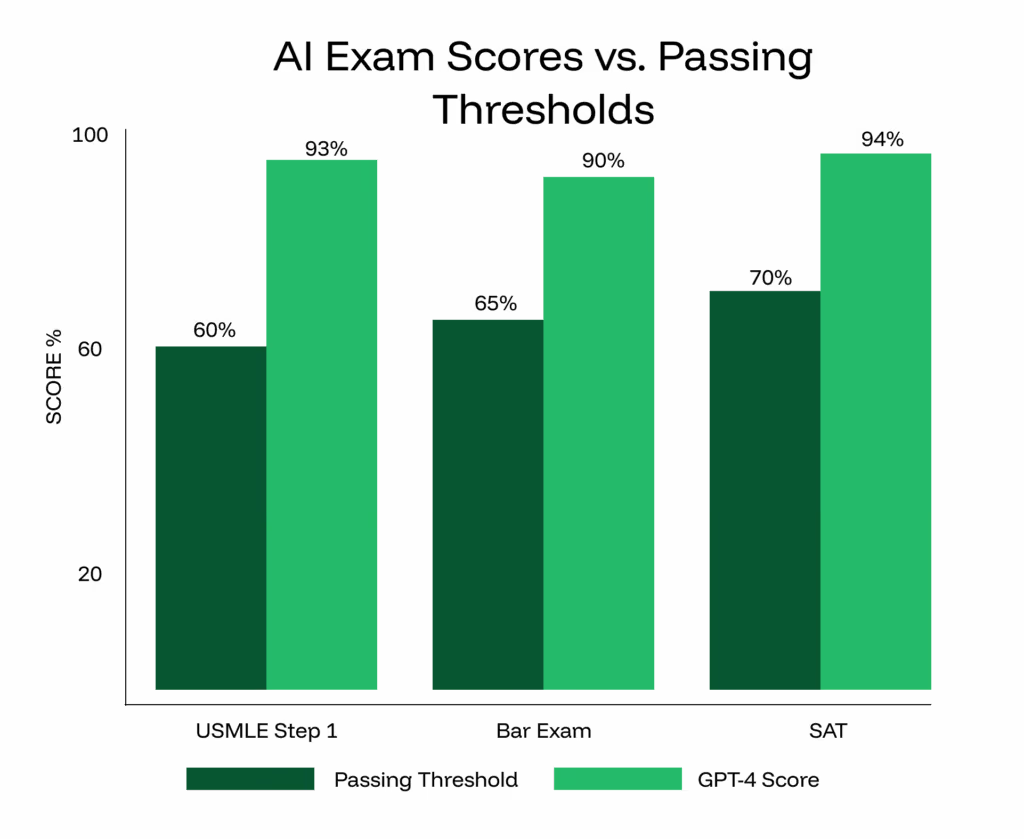
GPT-4 has scored in the 90th percentile on the Bar Exam, 93% on the US Medical Licensing Exam Step 1, and outperformed average test-takers on the SAT, LSAT, and graduate-level law school exams. When AI can pass the same high-stakes exams certifying bodies have relied on for decades, the credibility of those credentials is at risk. This post examines what is at stake when AI can bypass traditional exam security, where legacy tools fall short, and what a hybrid AI plus human review approach looks like for certifying bodies that need to protect the value of their credentials without compromising the candidate experience.
{{post-stat-highlight}}
These are the same high-stakes exams certifying bodies have relied on for decades to ensure that only qualified professionals enter the workforce.
So what happens when artificial intelligence can pass those very exams with ease?
The New Reality
High-stakes exams are no longer immune to disruption. With AI models like GPT-4 demonstrating near-perfect performance on medical, legal, and professional exams, certifying bodies must adapt to safeguard credential integrity.
For today's institutions, the value of your credential rests on one thing: trust in the exam process.
- Employers trust that certified professionals are competent.
- Regulators trust that licensing exams protect the public.
- Members trust that earning the credential reflects real skill and knowledge.
But if candidates can quietly lean on AI to generate passing answers, the credibility of the exam, and by extension, the credential itself, is at risk.
What’s at Stake
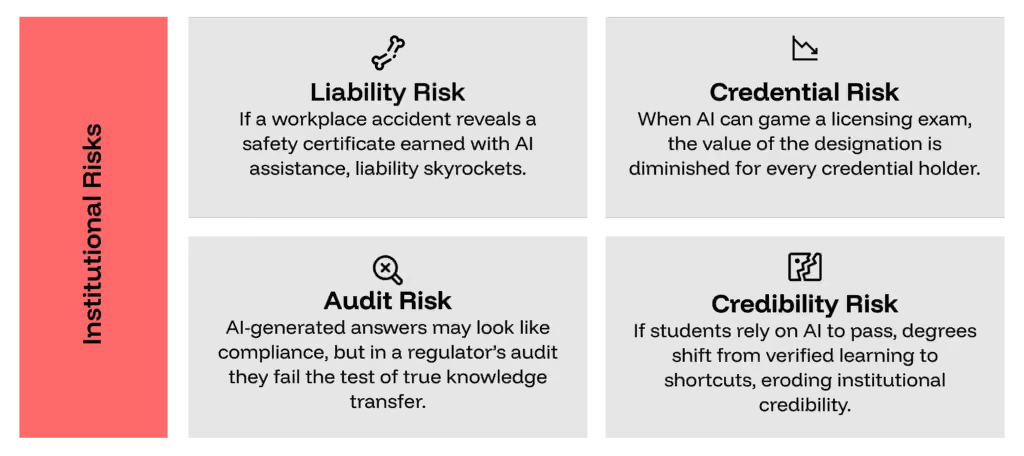
The credibility of your credential is its greatest asset. If candidates can bypass exam integrity with AI, the value of your certification program is immediately at risk.
- Credential devaluation: If AI shortcuts are widely suspected, your certification may lose its prestige and competitive advantage.
- Erosion of employer trust: Companies may question whether certified professionals truly demonstrate the required competencies.
- Regulatory and legal exposure: In fields like healthcare, aviation, or finance, compromised certifications can introduce public risk and liability.
- Member dissatisfaction: Candidates who earn their credential fairly may feel devalued if peers can “game the system.”
Why Traditional Exam Security Falls Short
Most exam security measures were designed for a pre-AI world. Legacy tools weren’t designed to detect AI-enabled misconduct. Lockdown browsers, AI-only monitoring, and human-only oversight leave dangerous gaps.
- Lockdown browsers can be bypassed or may not prevent candidates from using a second device.
- AI-only proctoring often misflags normal behaviors, leading to false accusations and poor candidate experiences.
- Human-only oversight can’t scale cost-effectively and risks overlooking subtle AI-assisted cheating.
The reality is clear: new threats require new solutions.
A Path Forward: Hybrid Security for the AI Era
To protect the integrity of credentials, institutions must embrace approaches designed for this new landscape. That means:
- Conducting a security audit: Evaluate whether current proctoring methods are resilient against AI-enabled cheating.
- Adopting hybrid proctoring: Combine AI’s efficiency with the judgment and nuance of human review to catch what machines alone cannot.
- Reducing friction for candidates: Security doesn’t have to come at the expense of user experience. Solutions should be no-install, device-agnostic, and low-support-burden to maintain accessibility.
- Communicating proactively: Show members, employers, and regulators that your organization is addressing AI head-on — not waiting for a scandal to spark change.
Protecting the Value of Certification
Your credential is more than a certificate or a badge. It represents trust, competence, and reputation. In the age of AI, safeguarding that trust means ensuring exams are secure, fair, and credible.
Because if AI can pass your exams, and nothing is done to respond, the profession itself is at risk.
At Integrity Advocate, we believe the path forward is clear: privacy-first, hybrid online proctoring. Unlike one-dimensional solutions, our approach combines the precision of AI with the judgment of human oversight to deliver both security and fairness.
With our no-install, friction-free platform, candidates can focus on their exam while organizations maintain the highest standards of integrity. Our hybrid solution ensures:
- Robust identity verification – confirming the right person is taking the exam.
- Smart monitoring – AI detects potential issues while human reviewers provide context and fairness.
- Actionable oversight – suspicious activity is clearly identified and presented to assessment administrators for confident decision-making.
- Candidate-first experience – no installs, device-agnostic access, and minimal technical barriers keep the exam environment stress-free.
By uniting technology with human judgment, Integrity Advocate helps certifying bodies protect credential value without compromising the candidate experience.
Ready to safeguard your credential in the AI era? Let’s talk.
Sources:
- Kung, T. H., et al. “Performance of ChatGPT on USMLE: Potential for AI-Assisted Medical Education Using Large Language Models.” JMIR Medical Education. 2023. Link
- Chiu, T. Y., et al. “Comparing performance of GPT-3.5, GPT-4, and GPT-4o on USMLE, PLAB, HKMLE, and NMLE medical licensing examinations.” BMC Medical Education. 2024. Link
- Reuters. “Artificial intelligence is now an A law student, study finds.” June 2025. Link
{{post-cta}}
OnDemand Webinar: The Dark Side of AI - The End of Traditional Training as We Know It with ASSP
September 24, 2025
|
5 min read
AI is transforming how we learn and work, but it is also opening the door to new risks for training providers, compliance managers, and credentialing bodies. In this on-demand webinar presented by ASSP and Integrity Advocate, learn how deepfakes, voice synthesis, and automation tools are making it easier to falsify participation and assessment results, what the compliance and regulatory consequences are for organizations that cannot verify training completion, and what safeguards including identity verification, engagement monitoring, and audit-ready reporting actually work in the AI era.
Presented by ASSP + Integrity Advocate
AI is transforming how we learn and work, but it’s also opening the door to new risks. In this on-demand session, Integrity Advocate explores how artificial intelligence is undermining the integrity and security of online training and certification programs. You’ll learn how AI-powered impersonation, cheating, and content manipulation threaten regulatory compliance, credibility, and learner trust, and what organizations can do to safeguard against it.
This webinar is designed for training providers, compliance managers, and organizational leaders who want to protect the value of their learning programs in the AI era.
Key Takeaways
By the end of this session, you’ll understand:
- The AI challenge – how deepfakes, voice synthesis, and automation tools make it easier to falsify participation and assessment results.
- Compliance risks – why unverifiable training can expose organizations to liability and regulatory non-compliance.
- Safeguards that work – proven methods like identity verification, engagement monitoring, and audit-ready reporting.
- Accreditation standards – how bodies like IACET are adapting, and what training providers need to align with.
- Action steps – practical measures you can implement today to maintain the credibility and defensibility of your online training programs.
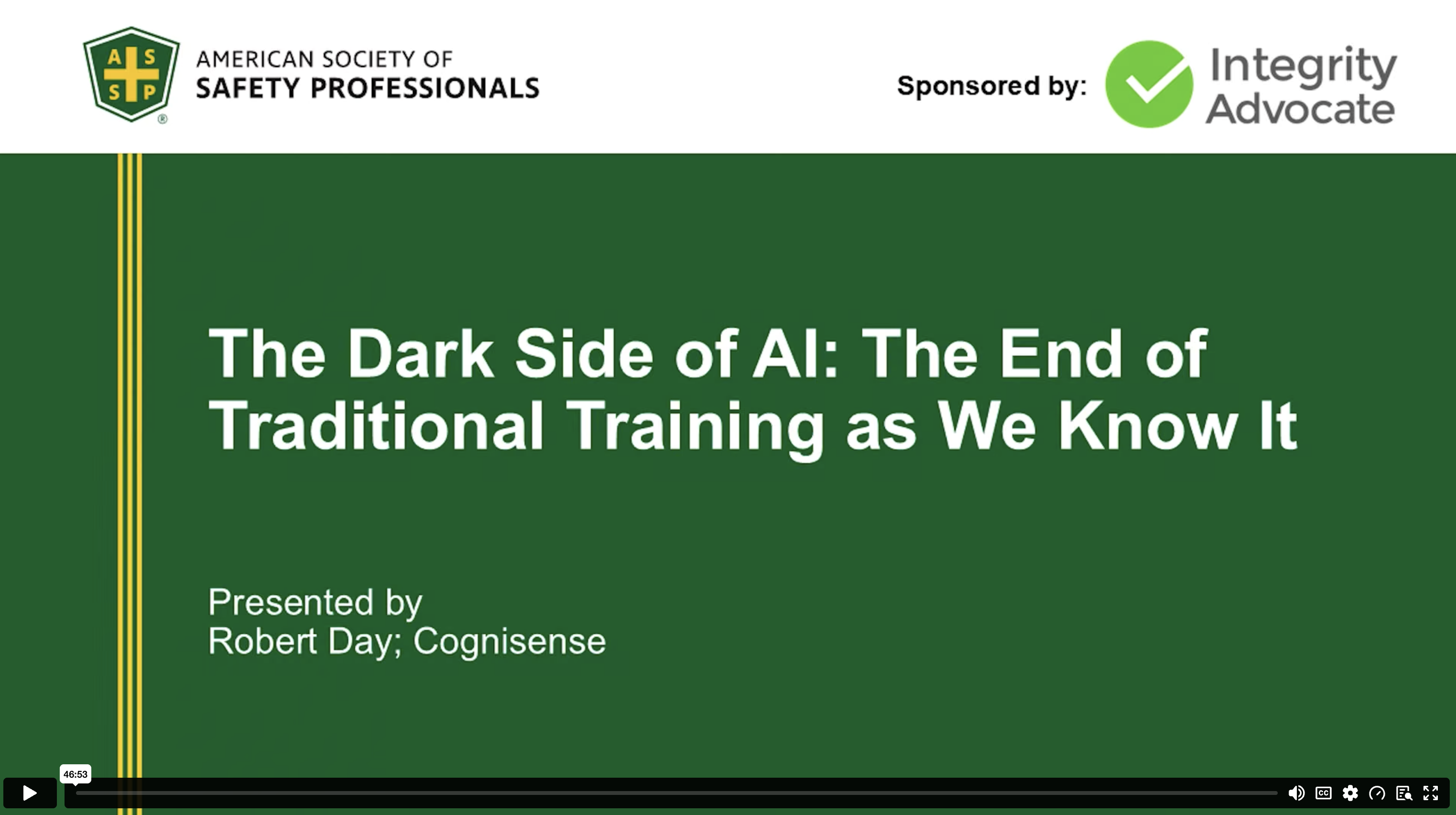
Watch the webinar recording
Feature Update: Enhanced Video Feed Out for More Efficient Review
September 19, 2025
|
5 min read
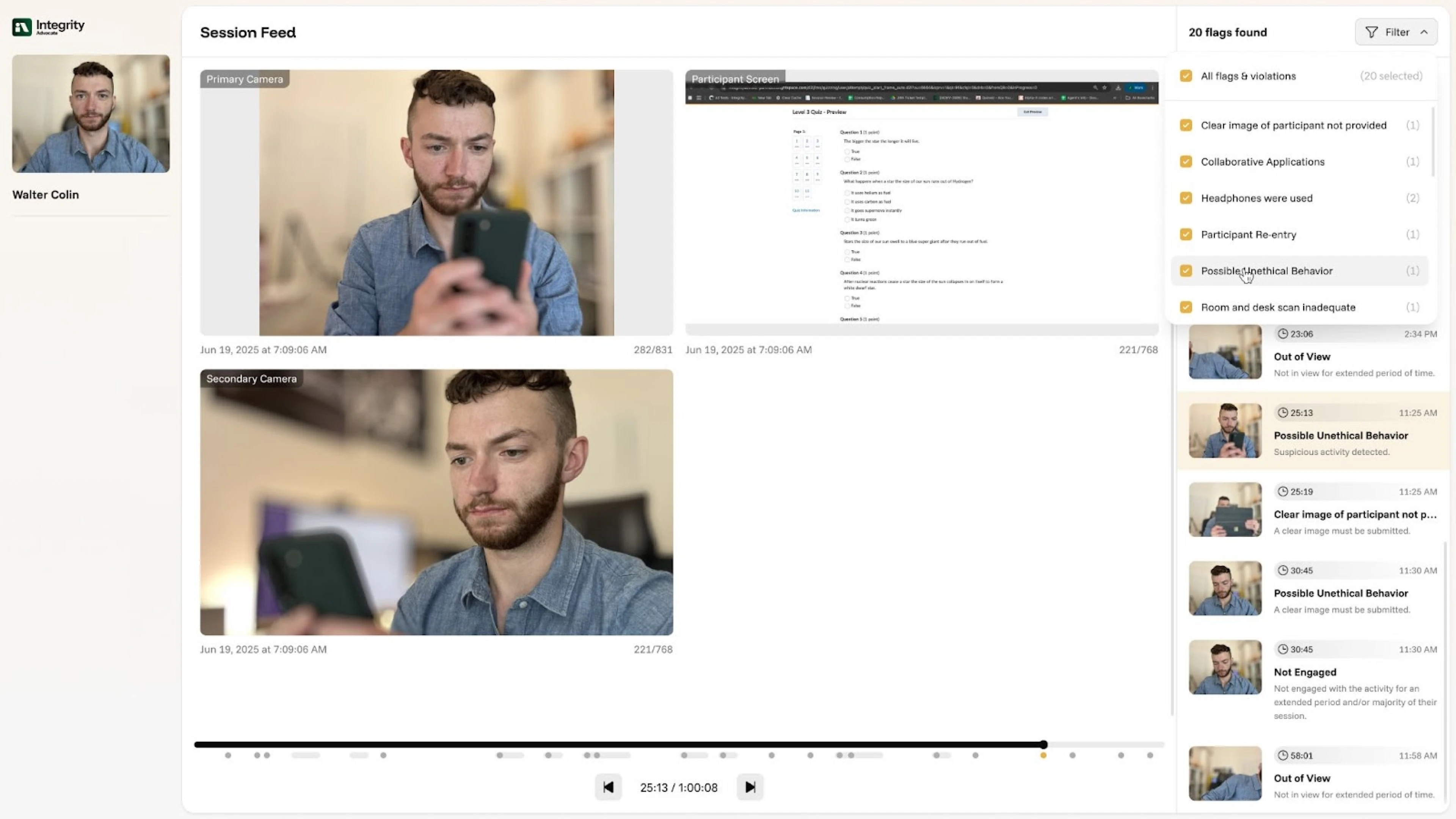
Integrity Advocate has released a major enhancement to Video Feed Out, one of the most requested updates from client administrators. Violations and flags are now marked directly in the session timeline, allowing admins to jump between flagged events instantly, filter by violation type, and review audio snippets that distinguish flagged from unflagged moments, all without toggling between the session feed and a separate violations report page.
A major upgrade is here for Video Feed Out - making it easier than ever to review session flags in context. This is one of the most requested enhancements from our clients, and when our clients have requests that will make their lives easier, we listen.
What’s New
With this update, client admins can now see flags and violations directly within the session timeline, making it easier than ever to understand events in their proper context.
Key improvements include:
- See everything in context – Violations are marked directly in the timeline.
- Review faster – Jump between flagged events instantly.
- Hear what matters – Audio snippets now clearly distinguish flagged vs. unflagged moments.
- Stay focused – Filter by violation type to streamline investigations.
Why It Matters
Previously, admins had to toggle between the full session feed and a separate violations report page. This made reviews more time-consuming and sometimes confusing.
With contextual flags built right into the timeline, reviews are now:
- Faster – eliminating back-and-forth navigation.
- More accurate – violations are shown exactly where they occurred.
- More efficient – filter by type and focus only on what matters.
This enhancement is just one example of how we take client requests seriously and build features around your needs.
This update is now available to all clients with the premium Video Feed Out feature. If you are a current client and would like to enable it, reach out to your Account Manager.
If you are interested in seeing Enhanced Video Feed Out in action, fill out the form below.
{{post-cta}}

AI-Powered Online Proctoring Software Needs Human Oversight
September 16, 2025
|
5 min read
AI-powered proctoring can monitor at scale, but it cannot understand context, weigh consequences, or defend a certification decision to a regulator or accreditor. In safety-critical industries where a missed harness check or a wrongly credentialed healthcare worker can cost lives, the blind spots of automated-only proctoring become serious liabilities. This post examines what AI cannot do in high-stakes assessment, what standards like ANSI/ASSP Z490.1-2024, ISO/IEC 17024, and NCCA require in terms of defensibility and human oversight, and why the right model is AI plus human judgment rather than either alone.
Automation promises speed. But in compliance, speed without accuracy can be devastating.
AI is now woven into training and certification. It monitors test-takers, flags anomalies, and produces reports at a pace no human could match. For compliance leaders facing relentless pressure, it looks like the ideal solution: scalable, efficient, impartial.
But here’s the catch: AI doesn’t grasp the stakes of being wrong.
- A missed harness check on a construction site isn’t just noncompliance, it can mean a fatal fall.
- An overlooked question in food safety training isn’t just a technicality, it can trigger a life-threatening allergic reaction.
- A nurse credentialed without proper oversight isn’t simply a paperwork error, it’s a direct risk to patient safety.
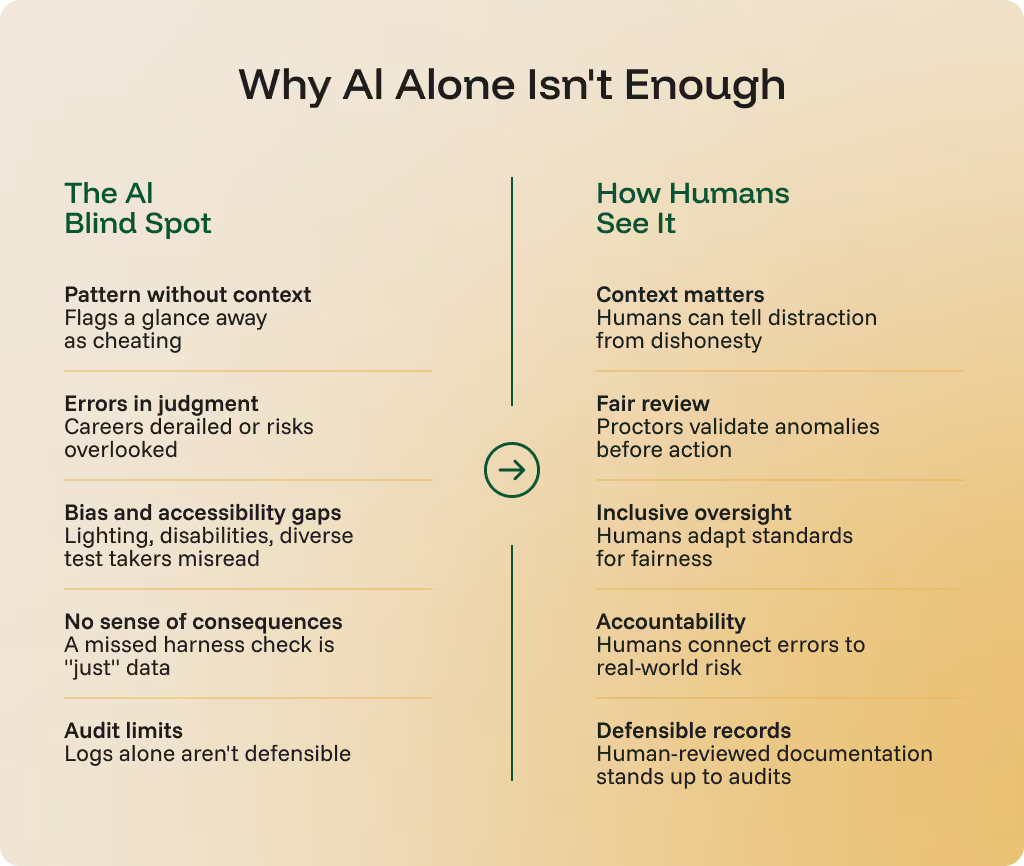
AI-powered online proctoring software can detect patterns, but it can’t weigh consequences. It can’t tell the difference between distraction and dishonesty. It can’t stand in front of an accreditor or regulator and defend a decision.
And compliance leaders know the stakes. 64% of frontline workers say injuries they’ve experienced or witnessed could have been prevented with better training, according to a YouGov survey of more than 2,000 workers in Australia, the UK, and the US. When proctoring systems prioritize speed over judgment, gaps spill from the classroom into the workplace.
{{post-stat-highlight}}
That’s why proctoring can’t be left to automation alone. Judgment, accountability, and defensibility require a human in the loop.
AI’s blind spots
For all its processing power, AI often misses the context, fairness, and consequences behind the data.
Pattern vs. context
AI can spot anomalies, but it can’t understand people. To the algorithm, a student glancing away as their child enters the room looks no different than someone searching for an answer. Without human judgment, honest learners get flagged, reputations suffer, and trust in the system erodes, all while true violations can still slip by unnoticed.
Risks of misjudgment
The real danger isn’t just inaccuracy, it’s the consequences. A nursing candidate wrongly flagged can lose months of progress, along with trust in the system meant to support them. Meanwhile, a missed violation on a commercial driving exam could place an unqualified driver behind the wheel of your company’s vehicle, endangering both reputation and public safety.
Bias and accessibility
AI models are not neutral. From lighting conditions to facial recognition inaccuracies, automation can inadvertently disadvantage test-takers with disabilities, those in non-standard testing environments, or individuals from diverse cultural backgrounds. This creates inequities that undermine the fairness of certification processes. At Integrity Advocate, we work to eliminate these inequities, making the certification process seamless, accessible, and fair for every test-taker.
No sense of consequences
Perhaps the greatest blind spot is this: AI doesn’t “understand” what a mistake means. It cannot connect a failed harness safety check to a potential fall on a job site. It doesn’t grasp that mishandled food safety could trigger an allergen outbreak. Without that ethical and practical awareness, AI remains a tool that must be guided by human oversight.
Certifications in focus: why proctoring integrity matters
The stakes of proctoring reach far beyond academia. They’re practical and sometimes life-or-death.
Consider a few high-stakes examples:
- Nursing exams and clinical credentials ensure healthcare workers can safely treat patients.
- Electrical licenses confirm that workers can install and maintain systems without risking fires or electrocution.
- Commercial Driver’s Licenses (CDL) certify drivers who transport goods and passengers across public roads.
- ServSafe and OSHA certifications guard against foodborne illness and workplace hazards.
These certifications aren’t just personal milestones. They validate competence in roles that protect lives and communities. Without trustworthy proctoring, credentials lose credibility. Organizations risk liability, and the public loses trust in the professionals meant to safeguard them.
AI-Only Proctoring Falls Short
When the stakes are high, oversight must be more than automated pattern recognition. AI can monitor, record, and flag, but it cannot fully understand context or consequences. Relying on AI alone risks undermining the very certifications designed to protect lives and communities.
ANSI and accreditation frameworks: compliance by design
The updated ANSI/ASSP Z490.1-2024 standard sets clear expectations for safety, health, and environmental (SH&E) training.
For compliance leaders, a few key takeaways stand out:
- Reliability and fairness are non-negotiable.
- Oversight and defensibility must be built into training and assessment.
- Documentation and accountability are essential in the event of an audit or incident.
These requirements go beyond what automation alone can provide. Standards demand human verification, ethical review, and the ability to defend every certification decision.
Beyond ANSI: ISO and NCCA
International standards like ISO/IEC 17024 and U.S. frameworks like the National Commission for Certifying Agencies (NCCA) reinforce the same principle: defensible certification requires human oversight. Without it, organizations risk failed audits, loss of accreditation, and legal exposure.
Hybrid Online Proctoring: AI Detection + Human Discretion
The answer is not to reject AI, but to integrate it thoughtfully. The most effective approach is AI plus human oversight, where technology enhances efficiency, but people ensure fairness, context, and compliance.
Scalable monitoring with human review
AI can monitor at scale, flagging potential anomalies. But those red flags should be reviewed by trained human proctors who can interpret context and make defensible decisions.
Audit trails and documentation
Human oversight is essential for building robust audit trails. When compliance checks or regulatory audits arise, organizations must show that their proctoring process was fair, valid, and defensible. Documentation reviewed and validated by people is far more credible than machine logs alone.
Automation accelerates, human judgment protects
AI has transformed training and monitoring with unprecedented speed and scale. Yet in safety-critical industries, automation is a tool, not a safeguard. True protection comes from human judgment, ethical oversight, and alignment with compliance standards.
With standards like ANSI/ASSP Z490.1-2024 raising the bar for defensibility, organizations must recognize that proctoring isn’t just a technical step, it’s a compliance-critical safeguard that protects lives, preserves trust, and ensures training fulfills its purpose.
Smart systems drive efficiency. Human oversight delivers safety. Together, they make compliance simple, scalable, and defensible.
Online proctoring software built for compliance and trust
When compliance is defensible, organizations, and the people they serve, are safer. That’s why proctoring must go beyond automation.
At Integrity Advocate, we combine AI efficiency with human oversight to ensure every training program is verifiable, fair, and aligned with the latest standards. That means:
- Confirmed identities
- Monitored participation
- Defended credentials
No guesswork. No blind spots. Just compliance you can stand behind.
Ready to safeguard your compliance? Let’s leverage the combined power of AI and human oversight, together.
{{post-cta}}
Welcoming Brandon A. Smith as Integrity Advocate’s New CEO
August 26, 2025
|
5 min read
Integrity Advocate announces Brandon A. Smith as its new Chief Executive Officer. Brandon brings extensive experience leading and scaling SaaS platforms across higher education, professional certification, and workforce development. His background in assessment integrity, compliance, and learner success aligns directly with Integrity Advocate's mission to protect the value of credentials while maintaining fairness, accessibility, and privacy for every test-taker.
We’re excited to share an important milestone in Integrity Advocate’s journey: Brandon A. Smith has joined our team as Chief Executive Officer.
Brandon brings a wealth of experience leading and scaling SaaS platforms across higher education, professional certification, and workforce development markets. With a career rooted in advancing assessment integrity, compliance, and learner success, his expertise and vision align perfectly with our mission.
Why This Is Important
Remote testing continues to evolve rapidly, and trust in assessments has never been more critical. At Integrity Advocate, we’ve always been committed to balancing fairness, accountability, and accessibility, ensuring organizations can protect the value of their credentials without sacrificing user experience or privacy.
Brandon’s leadership marks the next chapter in our growth. His track record of building and scaling EdTech organizations positions us to expand our impact across certification programs, professional development, and higher education globally.
A Message from Brandon
“Trust in assessment has never been more important. I’m excited to join Integrity Advocate’s mission to protect fairness, accountability, and accessibility in remote testing. I look forward to working with this talented team to build solutions that strengthen exam integrity while respecting every test-taker.”
What’s Ahead
Under Brandon’s guidance, Integrity Advocate will continue to innovate on our AI-enhanced proctoring solutions while staying true to our human-centered approach. This means:
- Protecting exam integrity with smarter, more secure technology.
- Supporting compliance requirements across industries.
- Respecting the rights and privacy of every test-taker.
We believe this balance is the future of proctoring, and we’re thrilled to have Brandon leading us forward.
No-Installation Online Proctoring: TopClass LMS Integration with Integrity Advocate
August 15, 2025
|
5 min read
TopClass LMS and Integrity Advocate demonstrated their integration in a recent webinar, showing how no-installation, privacy-first proctoring can be enabled with a single checkbox in the TopClass environment. Key highlights include Integrity Advocate's founding philosophy that user privacy and exam security do not require software installation, over 10 million sessions proctored with a 0.58% support rate, human review on every session by background-checked reviewers, customizable security levels from basic ID verification to comprehensive monitoring, and 24/7 global availability for on-demand exam scheduling.
Discover how no-installation online proctoring delivers secure, privacy-first exam monitoring with seamless TopClass LMS integration - key insights from the TopClass webinar.
Executive Summary
TopClass’ recent webinar highlighted the seamless integration between TopClass LMS and Integrity Advocate's no-installation online proctoring platform. The session demonstrated how privacy-first exam security can be achieved without compromising user experience, featuring insights from Director of Operations & Partnerships Fraser Reid and CEO Graeme Buchan on their proven proctoring solution.
Watch Webinar
Key Highlights
No-Installation Proctoring Philosophy
Integrity Advocate was founded on the principle that user privacy and exam security don't require software installation. As CEO, Graeme explained:
"We were founded 10 years ago with the philosophy that user privacy and security don't need to be sacrificed for the sake of integrity. We know that your users don't want to install software on their devices."
Their browser-based proctoring platform eliminates the technical challenges and privacy concerns associated with traditional proctoring software, making it the industry's leading no-installation solution for remote exam monitoring.
Proven Performance Metrics
Integrity Advocate has proctored over 10 million exam sessions, with industry-leading support efficiency metrics. As the team shared:
"Only 0.58% of our users actually required support last year... from a proctoring standpoint, we lead the industry in terms of our percentage of users who require support."
This demonstrates the platform's reliability and user-friendly design. The company maintains exceptional client retention, never losing a client to competitors.
Simple LMS Integration
The TopClass LMS integration requires only a single checkbox to enable Integrity Advocate's proctoring platform. This streamlined approach eliminates administrative complexity and reduces exam administrators' setup time.
Privacy-First Data Handling
Built on privacy by design principles, the platform minimizes data collection, keeps only required information, shares only what's necessary, and deletes data as soon as possible. Most exam data is automatically deleted within 24 hours, with only flagged violations retained for regulatory compliance periods.
Human-Reviewed Exam Security
Every proctoring session receives human review and validation, providing contextual judgment that automated systems cannot match. As Graeme noted:
"Every single one of our sessions is reviewed and validated by a human reviewer. The importance of having that human in the loop is the ability to apply subjective discretion."
All reviewers complete background checks and 60-day training programs, and 100% of their work is audited by mentors with over five years of experience.
AI-Era Exam Security
With the rapid emergence of AI tools and GPT plugins for academic assistance, Integrity Advocate maintains cutting-edge detection capabilities. Their proctors receive continuous training on evolving cheating methods, ensuring exam security keeps pace with technological advances.
Customizable Security Levels
The proctoring platform offers flexible rule configurations ranging from basic ID verification (Level 1) to comprehensive monitoring (Level 4). Higher security levels include full-screen enforcement, device restrictions, and continuous presence monitoring to match specific exam requirements.
24/7 Global Proctoring
With strategically located proctors across multiple time zones, the platform provides 24/7/365 availability for on-demand exam scheduling, supporting global organizations and flexible testing requirements.
Efficient Support Model
Integrity Advocate's web chat support system handles most user inquiries efficiently, with over 60% of users able to self-serve. This streamlined approach addresses common questions quickly while maintaining phone support availability for complex issues.
Quality Assurance
Integrity Advocate audits 60% of all proctoring sessions to maintain quality standards and accountability. This human oversight ensures consistent service delivery and builds trust with educational institutions and certification bodies.
Conclusion
The TopClass webinar showcased how no-installation online proctoring can deliver robust exam security while maintaining user privacy and administrative simplicity. Integrity Advocate's TopClass LMS integration offers educational institutions a comprehensive solution combining:
- No-installation technology that eliminates software deployment challenges
- Privacy-first data handling with automatic deletion and minimal data collection
- Human-reviewed sessions providing contextual judgment beyond automated detection
- Flexible security levels adaptable to different exam requirements
- 24/7 global availability supporting diverse scheduling needs
With over 10 million proctored sessions and industry-leading support efficiency, this partnership represents a mature solution for organizations seeking enhanced exam security without compromising user experience or privacy compliance.
For more information about the TopClass LMS and Integrity Advocate integration, interested parties can contact their TopClass account manager or contact the Integrity Advocate team directly for a custom demonstration.
{{post-cta}}

How Training Leaders Keep Compliance Simple and Scalable
July 25, 2025
|
5 min read
Compliance looks different across workplace safety, healthcare, corporate training, and professional credentialing, but the pressure feels the same. When the systems meant to help compliance leaders do their jobs, from LMS platforms to proctoring tools to verification workflows, add complexity instead of removing it, compliance becomes a bottleneck. This post examines why operational efficiency should be a compliance requirement in its own right, what breaks when training infrastructure cannot keep up, and what a system that actually works looks like for the compliance program managers responsible for keeping everything on track.
Compliance means different things, but the pressure feels the same
Workplace compliance, like most everything in life, isn’t one-size-fits-all.
- In workplace safety, it’s proving every frontline worker completed the required training before setting foot on site.
- In healthcare, it’s confirming that clinical staff are credentialed, re-certified and fully documented.
- In corporate settings, it’s ensuring onboarding, DEI, or cybersecurity training happens on time.
- And in certifying bodies or professional associations, it’s about safeguarding the value of credentials issued under your name.
Different industries, different standards, but one shared reality: compliance is high-stakes, high-pressure and increasingly complex.
The systems meant to help people in your position—sometimes your LMS, your proctoring tools, or your verification workflows—often make it harder, like having to write the same message to a support team, again.
When your tools can’t keep up, compliance becomes a bottleneck.
- Training deadlines get missed.
- Credentialing gaps go unnoticed.
- Audits get harder to pass.
- Support tickets pile up, wasting time your team doesn’t have.
The worst part? Everyone’s still doing the work—just with more stress, more confusion and less confidence in the system.
For teams already stretched thin, this isn’t sustainable. That’s why operational efficiency should be a compliance requirement all its own.
Why complexity keeps creeping in
Most compliance leaders aren’t struggling because they’re unprepared. They’re struggling because the systems supporting them weren’t designed with real-world complexity in mind.
Some platforms require installs that don’t play nicely with zero-trust environments. Others force mobile learners into desktop workflows. Many still bolt privacy on as an afterthought—resulting in data storage liabilities and confused users who just want to take their training and move on.
If staying compliant in an industry means hours of manual oversight, chasing participation records across tools and playing IT middleman every time someone can’t log in…that’s a system built for burnout—literally. 59% of compliance officers report feeling burned out, with 51% experiencing high levels of job stress. These roles sit at the intersection of risk, regulation and responsibility, with limited resources and even less room for error.
Whether you're managing safety recertifications across hundreds of sites, preparing for an audit or overseeing mandated training across departments, compliance matters.
Yet all too often, the people responsible for keeping things compliant are left stitching together workarounds, handling preventable support requests and double-checking tools that were supposed to make life easier.
A day in the life of a Compliance Program Manager
Your team just launched a last-minute rollout of mandatory safety training across three regions, with an end-of-week deadline.
In most organizations, that scenario means:
- Dozens of workers struggling to access the platform on shared or outdated devices
- IT pulled into install issues, permissions gaps or browser quirks
- Participation records scattered across learning systems, inboxes and spreadsheets
- Monday spent fielding emails from operations leads who just want to know who's cleared and who hasn’t
The most frustrating part is that your team executed everything correctly. Delays often stem not from planning errors but from system inefficiencies.
This is the hidden cost of convoluted compliance infrastructure: The more energy expended on troubleshooting, the less available for strategy.
For everyone, the stakes are high. According to IBM’s 2024 Cost of a Data Breach Report, the global average cost of a data breach reached $4.9 million, the highest on record and a 10% increase over last year. In fact, breaches involving data stored across multiple environments (like hybrid systems or cloud-based tools) cost even more, underscoring how fragmented platforms can turn compliance gaps into financial liabilities.
Whether you're coordinating OSHA-required safety training, prepping for a site audit, or managing re-certification in a BYOD environment, compliance is a responsibility that can ripple through your entire operation. That’s when things fall through the cracks.
What’s at stake—and how to stay ahead
When compliance systems fall short, the consequences add up fast:
- Escalating Penalties: In 2023, OSHA issued over 250 citations with initial penalties exceeding $100,000, driven by more violations categorized as “willful or repeated,” which carry fines up to $161,323 per violation.
- Audit Failures Due to Poor Documentation: Poor documentation and incomplete audit records are a leading cause of failed audits, with missing or disorganized evidence often undermining credibility and slowing down compliance reviews.
- Erosion of Stakeholder Trust: A single missed requirement in a safety-critical environment can undermine confidence among stakeholders, including employees, regulators and the public.
If you want to keep your team ahead of the curve, use this checklist to quickly gut-check your current infrastructure:
- Can users access the platform with installing apps or plug-ins?
- Are identity and participation clearly verified, with audit-ready records?
- Does the system support mobile use and data minimization by design?
- Will your team need to step in when users need support?
- Can you pull a clear report the moment leadership or regulators ask?
If any of these answers are unclear, it’s a compliance risk.
Let’s make our Compliance Training Manager’s day better
Same rollout. Same deadline. But this time, the system does its job—so you can do yours.
- The training link works the first time, on every device. No installations, no permissions errors, no browser gymnastics.
- Identity is verified in seconds, without collecting more personal information than necessary.
- Participation is monitored from start to finish, with real humans reviewing cases so you’re not left second-guessing the results.
When your operations lead asks who’s completed training? You have the report ready before they finish the sentence.
Just ask Smart Serve Ontario. When a provincial mandate triggered a 20x surge in training volume, they needed a solution that could handle scale without sacrificing oversight. With Integrity Advocate’s no-install, mobile-first platform, they supported thousands of learners in real time while keeping the program compliant.
When a system works, the people behind it can too.
That’s why we believe operational efficiency should be the baseline for every compliance program.
Through intentional platform design, expert partnership and a passion for empowering people, Integrity Advocate helps compliance leaders spend less time fixing and more time leading.
No installs.
No confusion.
Just streamlined compliance you (and everyone else) can count on.
Ready to streamline your compliance workflows? Let’s make it easier—together.
{{post-cta}}

Support That Scales: Proctoring Built for Any Device, Anywhere, Anytime
July 15, 2025
|
5 min read
When a national safety organization faces a recertification deadline that sends training volumes 20 times above normal, with learners logging in from job sites, personal phones, and areas with limited bandwidth, the proctoring platform either holds or it does not. This post examines what breaks when training infrastructure cannot scale, the real-world cost of downtime and failed identity checks in mission-critical industries, and how Integrity Advocate supports high-volume rollouts without service disruption, software installation, or a spike in support demand.
Professional training doesn't only happen during business hours.
For late-night learners, global teams and high-stakes rollouts, the ability to verify identity, track participation and prove compliance—anytime, anywhere—is essential.
That kind of access sounds simple, but in practice, it’s anything but. According to a report by Imprivata and the Ponemon Institute, just 28% of IT leaders believe their organization can adequately secure mobile devices and access to sensitive data. Meanwhile, productivity losses from downtime on shared devices add up to over 872 hours lost per week, while an average $5.45 million lost annually to missing devices alone.
What’s the takeaway in all this? In mobile-first environments, training infrastructure that can’t scale (or worse, that introduces security or usability roadblocks) quickly becomes a liability. Whether it’s healthcare, retail, or manufacturing, organizations are discovering that flexibility without oversight is just another form of risk.
This is where scalable proctoring infrastructure becomes indispensable. The right tools ensure the right person completed their assessment, stayed engaged and left behind a clear, auditable record. All without adding friction, requiring installs or generating costly IT overhead.
Built to keep pace with your workforce
When training is essential to doing the job, whether for safety compliance, regulatory credentials or global certifications, systems have to perform under pressure. And in enterprise environments, that pressure isn’t occasional. It’s constant.
Organizations today are rolling out training to workforces that span shifts, regions and roles. That means late-night modules, onboarding from the field and recertifications happening across time zones. When those sessions hit a technical snag, the impact ripples.
- One failed login can delay an entire shift.
- One broken identity check can stall a recertification deadline.
- One missing audit trail can escalate into a compliance liability.
Since many of these programs run on shared devices or in BYOD environments, complexity compounds fast. In mission-critical industries like healthcare and manufacturing, delays don’t just impact productivity, they raise safety risks. In manufacturing, unplanned downtime can cost an average of $260,000 per hour, with equipment failure responsible for nearly 70% of these incidents. These failures can often stem from human error, such as when employees skip steps or misuse machinery due to poor training or rushed onboarding.
That’s where reliable, verifiable training becomes essential. When organizations can prove not just that training was assigned, but that it was completed, understood and monitored, they reduce the likelihood of mistakes that lead to breakdowns. When those assessments are delivered without delay—across shifts, regions, and devices—they help keep production lines moving and compliance risk in check.
When training tools fail to keep pace, it’s not just learners who lose time. It’s the entire system.
What breaks when your training system can’t scale
It’s not always obvious when a platform isn’t built for high volume, then it gets pressure-tested—and the cracks start to show. Here’s what can go wrong when your training infrastructure falls short:
- Help desks get overwhelmed. Minor friction points turn into major support backlogs when hundreds (or thousands) of users run into the same issue at once.
- Learners abandon or delay training. If systems are slow, confusing or inconsistent across devices, users will disengage, especially in mobile or after-hours environments.
- Compliance teams lose visibility. Without clear, verifiable records of participation and identity, oversight becomes fragmented and audit risk increases.
- Delays derail productivity. In critical operations, even short disruptions can stall onboarding, extend downtime or delay recertifications.
- Reputation takes a hit. When learners, regulators or partners experience unreliable systems, it reflects on the credibility of your credentials or compliance program.
Consider a medical training provider issuing certifications for frontline healthcare roles. If their assessment platform fails to detect impersonation or AI-generated responses during a critical exam, what’s going to happen? The risk isn’t limited to the individual who cheated. It undermines the perceived value of every credential issued through that system.
So aren’t most assessment security tools built for scalability? Well..many can handle volume on paper. But far fewer are designed to maintain reliability, oversight and integrity when tested in the real world—under pressure, across time zones, and on a range of personal devices.
What real-world scale actually looks like
Picture this: A national safety organization announces a recertification deadline that affects thousands of frontline workers. In a single week, training volume spikes to more than 20 times the usual load.
Learners log in from job sites, personal phones and public Wi-Fi. Some are in rural areas with limited bandwidth. Others are squeezing assessments in between overnight shifts. On top of it all, every single session has to be secure, compliant and verifiable—because the stakes are high, and regulators are watching.
These are the conditions modern training systems need to meet to ensure admin and support teams don’t burn out. And so the integrity of every credential holds up under pressure.
Online proctoring built for the pressure
At Integrity Advocate, scalability isn’t a feature, it’s a standard. Our platform supports organizations where training never stops, learners are always on the move and there’s no room for downtime.
- We've supported rollouts with 20x traffic spikes—without service disruption
- Our support rate remains under 0.58%, even at scale
- We’ve done it all with no installs, no downloads and no added risk
Whether you're certifying workers across shifts, regions or regulatory jurisdictions, we help you deliver training that holds up under pressure—because in compliance-driven environments, it’s not just about training more people. It’s about protecting what that training stands for.
Scaling secure training online takes more than software, it takes a partner you can count on. So count us in.
{{post-cta}}

What Mobile-First Proctoring Means for the Future of Online Training
July 3, 2025
|
5 min read
Frontline workers, remote teams, and field-based professionals cannot wait for a desktop to complete compliance training. Mobile-first proctoring addresses that reality, but mobile access cannot mean compromised security, weaker identity verification, or gaps in compliance records. This post examines who benefits from mobile-first assessment, why browser-based no-install design is essential for both accessibility and security, the compliance implications of BYOD workforces, and how Smart Serve Ontario scaled to handle over 20 times normal test volumes on mobile without a single software installation.
For too long, online training and assessment have been held down by rigid systems restricted to desktops.
Dedicated testing spaces, clunky installs and inflexible tech have created barriers that slow down progress. But today’s workforce isn’t confined to cubicles—and their training tools shouldn’t be either.x
Welcome to the era of mobile-first proctoring - any device, anywhere, anytime.
From friction to freedom: why mobile-first matters
It’s 2025. AI is everywhere. Everyone has a pocket computer. Yet, far too many training platforms still treat mobile access like an afterthought.
For frontline workers, remote teams and field-based professionals, mobile-friendly training is how work gets done. They rely on it to learn new procedures, complete compliance modules and stay up to date on safety protocols without having to hunt down a desktop or deal with complicated installs.
That kind of accessibility matters—but it’s only half the equation.
Training also needs to meet the same security, compliance and accountability standards as traditional setups.That’s why mobile-first can’t mean adapting desktop-first tools with clunky plugins or limited features.
Who benefits from mobile training?
In an always-on world, learners need tools that meet them where they are, not where the infrastructure happens to be. A mobile-first approach empowers:
- Rural learners and remote communities who can’t rely on fast internet or modern hardware
- Field employees in industries like construction, oil and gas, or transportation who need on-the-go compliance training
- Gig workers and seasonal staff without access to company-issued devices or secure corporate networks
- Global organizations with learners across time zones, bandwidth and language requirements
This isn’t hypothetical.
When a new recertification mandate shot test volumes over 20x the normal level, Smart Serve Ontario needed a solution that could scale and support thousands of mobile learners on demand. They chose Integrity Advocate. By removing tech barriers such as installs or plugins, mobile-first proctoring helps ensure every worker can stay certified and every organization compliant.
Mobile doesn’t mean compromised
Let’s be clear: a robust, mobile-first platform designed from the get-go isn’t a watered-down version of real proctoring. It's a full-featured experience that includes:
- Identity verification to ensure the right person is taking the test
- Participation monitoring to confirm engagement throughout the session
- Human-reviewed record and review options for flagged behavior
- Privacy-by-design technology that works without storing unnecessary personal data
A DHS study and AT&T’s Global State of Cybersecurity survey found that more than half of organizations experienced data breaches due to mobile devices. The culprit? Not always hackers—often the users themselves. Personal devices running outdated software, sideloaded apps or insecure networks introduced vulnerabilities companies never saw coming.
That’s why Integrity Advocate takes a different approach.
Our platform runs in-browser, requires no downloads and doesn’t rely on third-party apps—removing a major attack surface. It’s fully managed, with no storage of unnecessary personal data, and doesn’t leave organizations at the mercy of end-user behavior or mobile device configuration. You get the accessibility of mobile-first training with the control of enterprise-grade compliance.
Why compliance leaders are embracing the shift
Training organizations, safety councils and global certifiers are already moving toward mobile-first assessment. Why? Because it aligns better with modern operations, cuts administrative burden and helps protect both reputations and results.
{{post-stat-highlight}}
When a construction worker completes required safety training between jobs, or a health care trainee verifies their identity during a break, the organization gets more than just a completed module. They get proof of participation, verifiable identity and compliance-grade oversight—all without chasing down paper records or managing one-off tech issues.
At scale, the business case grows even stronger. Companies that switch to BYOD smartphones can save up to $341 per employee while enabling access across time zones, connection types and devices. With the global BYOD market projected to reach US $331.6 billion by 2030, it’s clear this is the future of modern testing and credentialing.
The future of professional training is untethered
As professional training evolves, one thing is clear: it’s no longer tied to testing centers, corporate networks or traditional devices. But with that freedom comes responsibility.
In a mobile, BYOD-enabled world, security, verification and data privacy can’t be afterthoughts. Compliance doesn’t pause just because someone’s on a job site or logging in from a phone.
That’s why Integrity Advocate was built differently.
No installs. No third-party apps. No unnecessary data collection. Just seamless, compliant, secure assessments—anytime, anywhere, on any device.
We make training accessible. We make compliance effortless. And we make sure the only thing learners carry with them is confidence.
Any device, anywhere, anytime.
Curious how mobile-first proctoring could work for your team? Let’s talk about your training goals—and how we can help you meet them.
{{post-cta}}