Resource Center
Research, guides, and real-world insights on online proctoring; helping your program deliver results that are fair, trustworthy, and defensible.
10M+
Assessments secured
Zero
Data breaches in 12+ years
98%
Client retention rate
120+
Resources published
Featured article

Trust by Evidence: A New Framework for Defensible AI Decisions
Integrity Advocate has released a new whitepaper, Trust by Evidence, introducing a framework that connects AI due process, learner rights, and credential security into one model for defensible AI-assisted assessment. This post walks through what the framework covers, why AI adoption alone no longer settles the integrity question, and links to the full whitepaper download.
Assessment integrity used to mean one thing: was the exam monitored? That question is no longer enough. AI now plays a role in identity verification, proctoring flags, authorship review, scoring, and credential validation, and each of those touchpoints can be challenged.
Confidence in an outcome isn't just about whether AI was accurate. It's about whether the decision it contributed to can be explained, reviewed, appealed, and verified after the fact.
As AI becomes embedded deeper into assessment, institutions are being asked a more pointed question: Can you defend the decision AI helped you make?
That question requires more than accurate technology. It requires a system.
In our latest whitepaper, Trust by Evidence, CEO Brandon A. Smith introduces a framework that connects AI due process, learner rights, and credential security into one model for defensible outcomes.
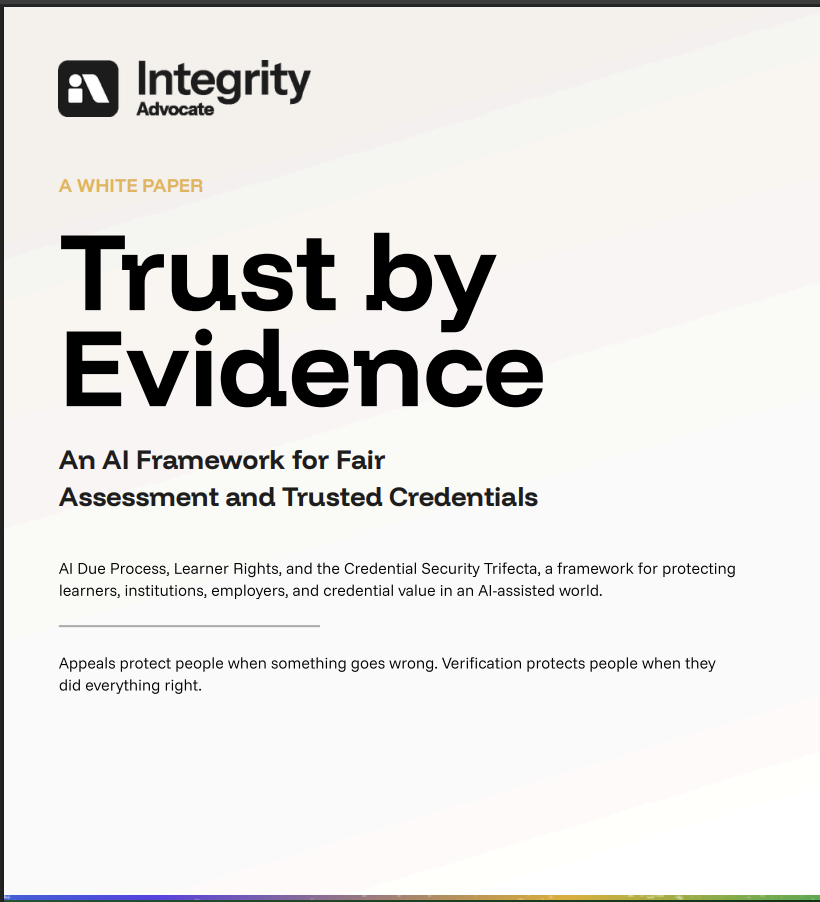
Download the whitepaper
The Shift From AI Adoption to Defensible Outcomes
For the past several years, the conversation in education and credentialing has centered on adoption: which AI tools to use, how to deploy them, how accurate they are. That conversation is largely settled. Most programs already use AI somewhere in the assessment lifecycle.
What hasn't been settled is defensibility. When an AI-influenced decision is challenged, whether by a learner, an employer, or a regulator, an institution needs to answer a specific set of questions: was there notice, meaningful human review, supporting evidence, and a path to appeal? If any of those answers are unclear, the decision isn't defensible, and the institution is exposed right along with the learner.
The next major challenge in education isn't AI adoption. It's building outcomes that hold up under scrutiny.
Why Treating AI as a Single Safeguard Creates Risk
Many programs rely on AI to do one job: flag anomalies. That model treats a flag as a finding rather than a signal, and it breaks down under three conditions:
- No documented process exists for what happens after a flag is raised.
- Human review means approving the AI's output rather than independently evaluating it.
- There's no clear path for the learner to respond, and no record for the institution to point to later.
Any one of those gaps makes an outcome difficult to defend. Together, they create real exposure, not just to individual learners, but to the institution's accreditation standing, employer trust, and legal risk.
The Trust by Evidence Framework
The whitepaper introduces Trust by Evidence, a framework that connects three ideas typically treated in isolation:
AI Due Process: A fair, documented process for any consequential decision AI contributes to, so a flagged learner has an actual process to walk through rather than a black box to accept.
The Learner Rights Layer: Seven specific rights, to know, to meaningful human review, to explanation, to evidence, to appeal, to proportionality, and to verification, that turn "the system flagged it" into a decision an institution can explain and stand behind.
The Credential Security Trifecta: A secure chain of trust connecting learning, assessment, and credentialing, where a weakness in any one layer undermines the others.
Individually, each idea is familiar. Together, they hold up under scrutiny from everyone with a stake in the outcome: the learner, the institution, employers, regulators, and the public.
What a Defensible AI-Assisted Decision Looks Like
A defensible process doesn't rely on confidence in the algorithm. It provides an actual record. It lets an institution answer, with certainty:
- Was the individual notified that AI was involved?
- Did a qualified reviewer examine the evidence, not just the score?
- Could the individual respond before a consequence was applied?
- Is there a documented, time-bound appeal path?
- Can the outcome be explained to someone outside the institution?
These are governance questions as much as technical ones. Answering them well protects accreditation standing, employer trust, and learner confidence all at once.
What You'll Learn in the Whitepaper
The full whitepaper expands on:
- Why algorithmic due process, procedural justice, and automation bias research all point toward the same conclusion for education
- The Defensible Outcomes Responsibility Matrix, a governance tool for assigning clear ownership across vendors, institutions, and credential issuers
- The five-stage AI Appeals Framework, walked through with a real worked example of a contested proctoring flag
- Sector-specific guidance for K-12, higher education, workforce certification, and employers
- A candid discussion of the framework's limitations, including cost, scale, and surveillance risk
It's written for compliance leads, credentialing bodies, assessment teams, and program leaders responsible for the outcomes their institution has to stand behind.
{{post-cta}}
All resources

The Hidden ROI of a Great User Experience in Online Proctoring
June 25, 2025
|
5 min read
User experience in online proctoring is not a design preference. It is a business outcome. When learners struggle to launch an assessment, verify their identity, or navigate an unfamiliar platform, the consequences are measurable: abandoned exams, avoidable support tickets, missed compliance deadlines, and credential risk. This post makes the business case for frictionless proctoring, connects UX directly to compliance standards like ANSI/ASSP Z490.1-2024 and GDPR, and provides a practical checklist for evaluating any proctoring platform against both criteria.
User experience is more than aesthetics.
It’s ease of access.
It’s stress reduction.
It’s whether your learners can start and finish a high-stakes training exam without technical hiccups, confusion or a call to support.
In industries that rely on secure assessments—like workplace safety, certification and professional training—where compliance pressure meets real-world complexity, UX can be the quiet variable that makes or breaks success.
Too often, organizations prioritize visual polish over functionality, choosing sleek-looking platforms that create more problems than they solve. Others hyper-focus on security and compliance (as they should!) but overlook how the platform actually performs under pressure. If users can’t launch a test, verify their identity easily or navigate the process with confidence, the tool stops being an asset and starts being a liability.
Let’s talk about the return on doing things right.
The business case for better UX
In high-stakes, compliance-driven environments, the design of your proctoring solution directly influences learner behavior and, by extension, business outcomes.
Research on online learning consistently shows that confusing, hard-to-navigate systems discourage learners and disrupt behavioral engagement. As one study put it: “A disorganized LMS will discourage students and create unnecessary frustration.”
That frustration has consequences.
When learners struggle to access, understand or complete assessments, organizations pay the price:
- Learners abandon exams or disengage midway
- Administrators are pulled into unnecessary troubleshooting
- Support teams are overwhelmed with avoidable tickets
- Compliance goals are missed due to incomplete or invalid training
Each of these pain points eats into your ROI through lost time, missed certifications or reputational risk. That’s why a streamlined, no-install solution like Integrity Advocate doesn’t just support the user—it safeguards the entire training program. By eliminating friction, reducing confusion and boosting learner confidence, good UX becomes a subtle but powerful business advantage.
Compliance and the new standard of accountability
Frameworks like ANSI/ASSP Z490.1-2024 and GDPR may focus on occupational safety and data privacy domains, but they share a common expectation: systems must be built with the user in mind.
The updated ANSI standard raises the bar for training programs, emphasizing not just content but how that content is delivered. Training must be accessible, effective and verifiable. GDPR reinforces the same principle from a privacy angle. Its mandate for data minimization requires that organizations collect only what’s necessary, building trust by reducing exposure and respecting user boundaries.
So when training fails to meet compliance standards like these—when it’s ineffective, inaccessible, or poorly delivered—the consequences aren’t just digital. They’re human. That’s why standards like ANSI/ASSP Z490.1-2024 are evolving to ensure training does more than meet requirements. It needs to stick. It needs to protect.
What does user-centric compliance look like?
- Training that works on any device, with no downloads or technical hurdles
- Seamless identity verification that doesn't require excessive data collection
- Monitoring that confirms engagement without violating user privacy
- Support that’s fast, helpful and always available
When tech gets in the way, trust breaks down
When students describe what makes a great learning experience, the message is clear. According to EDUCAUSE’s 2025 Student and Technology Report, only 34% of students who believe their institution is “behind the times” in technology adoption are satisfied with their learning tech and support services. In contrast, 85% of students who perceive their institution as cutting-edge report high satisfaction.
Satisfaction starts with tools that reduce stress, not add to it.
- Learners want intuitive login systems and reliable access
- Confusing platforms disrupt focus and lead to disengagement
- Technical issues with assessments erode confidence in the entire credentialing process
Users themselves are asking for simpler, more seamless platforms. When it’s not, even minor friction points can become trust breakers. As one EDUCAUSE respondent summed up clearly: “Any technological issues I have had... have been quickly righted by IT support or professors.”
That level of responsiveness builds trust. In higher education, students often rely on IT or instructors to step in when tech fails. But in workforce training, compliance testing or professional certification environments, that safety net rarely exists. There's no time for help desk tickets or make-up exams when the stakes are high and the schedules are tight.
That’s where reliability becomes ROI.
The cost of getting it wrong
Compliance standards were developed for a reason. Gaps in your training system’s integrity don’t just show up in learner complaints online—they show up in audit findings, reputational hits and real-world risk.
- Retesting costs: Every invalid assessment leads to rework. For many organizations, this results in lost hours, disrupted schedules and, in some industries, extended periods of non-compliance.
- Lost productivity: If learners can’t complete their training, they can’t start work. That’s downtime for the team and delays for you.
- Brand and credential risk: For those in sectors such as certifying bodies and training organizations, a poor test experience reflects directly on the value of your credential. If people don’t trust the process, they won’t trust the outcome.
In other words, poor UX isn't just frustrating. It costs you.
What to look for in a proctoring platform
Whether you're onboarding a new training partner or auditing an existing tool, use this quick checklist to evaluate user experience and compliance-readiness:
- Can users start and finish an assessment without admin or IT support?
- Does the platform work reliably across devices and browsers?
- Does it avoid installs, downloads or browser plug-ins that introduce friction or risk?
- Are identity checks fast, secure and designed to minimize the amount of personal data collected or stored?
- Is participation monitored in a way that ensures compliance—ideally with the added context and fairness of human review?
- What percentage of users require support, and how quickly are those issues resolved?
If your answer to any of these is “we’re not sure,” it might be time to reevaluate.
Online proctoring, trusted by organizations who can’t afford to get it wrong
For safety regulators, credentialing bodies, global corporations and training providers, failure can be costly.
When assessments go wrong, the fallout can include everything from invalid credentials to regulatory penalties. In some jurisdictions, failure to meet standards such as CASL (Canada’s Anti-Spam Legislation) can result in fines of up to $10 million per violation—and yes, that includes tools that improperly collect or store data.
It’s why Integrity Advocate has long championed a privacy-by-design approach to compliance. We don’t just secure the testing environment, we protect organizations, individuals and the integrity of the process itself.
- When fewer than 0.58% of users require support, your admin team stays focused.
- When assessments run seamlessly, your learners stay engaged.
- When every step—from identity verification to participation monitoring—is intuitive, ethical and effective, your organization saves time, reduces risk and strengthens credibility.
That’s the hidden ROI of great user experience. And it’s our standard.
{{post-cta}}

Where Does Secure Proctoring End and Privacy Invasion Begin?
June 19, 2025
|
5 min read
There is a clear line between oversight and surveillance in online proctoring, and most platforms cross it. When tools collect more data than necessary, require invasive installations, or store sensitive information beyond its purpose, they do not just create privacy exposure. They erode the trust that makes a certification meaningful. This post examines where that line is, why more surveillance does not mean more security, how rising compliance standards like ANSI/ASSP Z490.1-2024 define accountability without requiring overcollection, and what privacy-first proctoring actually looks like in practice.
A waiter is taking an online assessment to earn their alcohol serving certification. They’re at home, using a personal laptop. They scan their government ID to verify their identity. And as soon as the test starts, their webcam is on. So is screen sharing.
{{post-stat-highlight}}
Here’s the thing: online assessments like these need oversight. But that doesn’t mean they need to feel like surveillance. When proctoring tools overstep, they don’t just violate privacy—they break trust, reduce engagement and risk the credibility of the certification itself.
This isn’t about watching more screens. It’s about building systems that respect boundaries, protect integrity and actually work.
What test administrators are actually looking for
If you’re leading training, certifying professionals or managing compliance programs, chances are you didn’t wake up this morning thinking, “Let’s go shopping for proctoring software.”
What you are looking for is peace of mind. You want to:
- Make sure the right person is taking the test
- Confirm they were engaged and followed the rules
- Keep your programs compliant and your reputation protected
That’s it. You're not trying to invade someone’s personal space or collect more data than necessary—you just need reliable verification and fair oversight.
But too many platforms miss the point. They require installs that clash with IT policies, ask for broad system access, or quietly gather data that goes far beyond what's needed. And in some cases, they’ve failed to keep that data safe.
In 2020, nearly half a million user accounts from a widely used online proctoring tool—including names, email addresses, phone numbers and home addresses—were leaked after a breach. Institutions from the U.S., UK and Australia were all impacted, and the fallout was swift: student backlash, privacy concerns and institutional scrutiny from all sides.
It was a wake-up call. When proctoring crosses the line, the risks aren’t theoretical. They’re reputational—and very real.
With Integrity Advocate, privacy isn't an afterthought. It's the starting point. No excess data collection. No invasive tech. No guesswork about where that information ends up.
Because when you’re asking users to trust you with their identity, you better be ready to protect it.
Why more surveillance doesn’t mean more security
In the race to stay compliant, it’s easy to assume that collecting more data means covering more bases. But the truth is, adding layers of surveillance doesn’t make an assessment more secure—it just makes it harder to manage risk.
Think of it like airport security with no filters: scanning every bag, flagging every item and then leaving one person to sort through it all. It’s noisy, it’s overwhelming and it misses the point.
It’s the same with proctoring.
Tools that over-collect create a false sense of control while actually increasing privacy exposure, friction for users and administrative burden. What organizations really need is technology that collects only what’s necessary, and human context to help make sense of it. And now, that kind of clarity isn’t just a nice-to-have. It’s becoming a requirement.
The compliance standard is rising
This isn’t just about ethics. It’s about meeting the new reality of compliance.
ANSI/ASSP Z490.1-2024 raises the bar for how training is delivered and verified. It’s not enough to say a course was offered; you now need to prove it was completed by the right person, in the right conditions, with engagement that can stand up to scrutiny.
That means identity verification. Participation monitoring. Records that hold up under audit.
But nowhere in the standard does it say you need to surveil someone’s entire desktop or store unnecessary data just to meet the mark.
The spirit of ANSI Z490.1 is accountability—not overcollection. If your current system makes compliance feel more like risk exposure, it’s time to rethink what you're using to prove integrity in the first place.
Oversight ≠ Overreach
For us, this work has never just been about tech.
It started with a simple, serious belief: when it comes to safety-critical training, the integrity of an assessment isn’t optional. It’s how lives are protected. And how organizations prove they’re doing things the right way.
That’s why we approach oversight differently.
At Integrity Advocate, we’re not here to control every click. We’re here to confirm that the right people are showing up, engaging fully and earning results that matter.
We do that by designing for trust—not surveillance.
- No installs. No plug-ins. No hidden tracking.
- Only collecting what’s necessary to confirm identity and engagement.
- Human review of flagged sessions to ensure fairness, accuracy and discretion.
- Clear, transparent policies that respect the user and reduce risk for the organization.
Our goal isn’t to catch someone. It’s to build systems that make cheating irrelevant, because integrity is built in from the start.
Scale doesn’t have to come at a cost
Meeting compliance isn’t a small-scale problem. You might be onboarding thousands of learners, recertifying entire workforces or delivering credentials across dozens of jurisdictions.
The stakes are high. And so is the volume.
But here's the good news: you don’t have to trade trust for efficiency.
When Smart Serve Ontario needed to recertify tens of thousands of workers after a provincial policy shift, they didn’t have months to redesign their program or train their users. They needed a solution that scaled overnight.
By partnering with Integrity Advocate, they got:
- No software installs.
- No new platforms to learn.
- No additional support surge.
Just seamless, secure delivery that respected their learners, stood up to scrutiny and worked at scale.
That’s what smart oversight looks like. When compliance needs to move fast, you need a partner who can keep up without cutting corners.
So, where does secure proctoring end and privacy invasion begin?
It ends the moment the solution starts collecting more than it needs. It begins the second the user feels monitored instead of supported.
That’s the line.
For compliance officers, credentialing bodies and training leaders, that line matters more than ever. The tools you choose don’t just reflect your operational standards—they reflect your values.
Proctoring should confirm identity, not compromise it. At Integrity Advocate, we don’t believe you have to choose between security and simplicity or between compliance and compassion. You can have both. You should have both.
If your current solution is starting to raise questions about trust and compliance, it might be time for a conversation. We’re ready when you are.
{{post-cta}}
OnDemand Webinar: 30K Proctored Exams, Zero Headaches: National Payroll Institute Keeps Support Under 1%
June 2, 2025
|
5 min read
Before Integrity Advocate, nearly 50% of National Payroll Institute students experienced issues with online proctoring. After implementation, that figure dropped to virtually zero. This webinar recap covers NPI's full transformation: a 57% reduction in academic integrity incidents, 30,000 or more exams proctored seamlessly, sub-1% support rates, and a scaling from a few thousand to every student being e-proctored in less than three months. Three NPI leaders share what the experience looked like from the inside and what they would tell other organizations considering a proctoring solution.
Date
Originally aired: June 24, 2025
How Integrity Advocate Transformed Online Proctoring for the National Payroll Institute
Solution: Integrity Advocate E-Proctoring Platform
{{post-stat-highlight}}
Before implementing Integrity Advocate in 2020, the National Payroll Institute (NPI) faced significant challenges with its existing online proctoring solution. With over 15,000 course registrations annually and a growing need for remote assessment integrity, NPI was eager to ensure a seamless experience for users and administrators.
The COVID-19 pandemic forced NPI to rapidly pivot from its honor-based supervisor proctoring system to a fully online solution. Technical issues, compatibility problems, and frustrated students plagued their first attempt at online proctoring. The situation became critical as NPI's membership had grown from 4,000 members decades ago to over 17,000 PCP designation holders and 4,000 PLP designation holders, all requiring reliable assessment integrity.
Christopher Pacella, Manager of Professional Accreditation and Standards, knew there had to be a better way. The previous system required plugin downloads, only worked on specific browsers, lacked French language support for their 12% francophone membership, and caused technical headaches for students and administrators. With integrity being one of NPI's four core values, the technical barriers undermined their fundamental mission.
{{post-block-quote}}
The reality was apparent - their proctoring system needed a complete overhaul to support NPI's mission of maintaining the highest standards of professional payroll excellence.
A Complete Transformation in User Experience
Fast-forward to today using Integrity Advocate, and the transformation has been remarkable. What used to be a source of constant technical support tickets has become virtually invisible to users. The seamless integration with D2L Brightspace meant students could focus on their assessments rather than troubleshooting technology. This transformation was particularly crucial for NPI's diverse student population, which includes many professionals who returned to education later in their careers and may not be as comfortable with complex technical systems.
"We're getting very little [feedback]. And that's amazing. That speaks volumes. That's exactly what we want. You don't hear about software that works well typically... But if it didn't work, you better believe we're going to hear about it a lot. And that was the big difference between the system that we previously had, where we heard all sorts of feedback, and Integrity Advocate, where it just works." - Christopher Pacella, Manager of Professional Accreditation and Standards
The implementation process was remarkably smooth, requiring only a 45-minute setup meeting compared to the weeks of troubleshooting that characterized their previous solution. This efficiency allowed NPI's technical team to redirect their efforts from crisis management to strategic educational initiatives that better serve their members.
Dramatic Improvement in Academic Integrity
One of the most significant improvements was in academic integrity incident management. NPI saw remarkable results after implementing a comprehensive academic integrity education module combined with Integrity Advocate's seamless proctoring. The institute's proactive approach to education and reliable technology created an environment where students understood expectations and could meet them without technical barriers.
"We went from an average of 86 incidents per month, and it dropped more than in half, down to 37. And that's been very consistent since we implemented some of these resources and things for people to understand what academic integrity means." - Christopher Pacella, Manager of Professional Accreditation and Standards
The reduction wasn't just about fewer incidents - it was about quality. The remaining incidents were genuine violations rather than accidental technical issues or misunderstandings about proctoring protocols. This improvement meant that NPI's review committees could focus their time on legitimate concerns rather than sorting through technical false positives, leading to more consistent and fair decision-making processes.
Seamless Student Experience
The transformation was equally dramatic for students. Daniela Kwiatkowski, Manager of Learning and Professional Development, experienced the system firsthand when she took one of NPI's courses. Her experience highlighted how the technology disappeared into the background, allowing students to concentrate on demonstrating their professional competency. This was particularly important for NPI's student population, many of whom are working professionals balancing career responsibilities with continuing education requirements.
"Before you do it for the first time, you're thinking, how am I going to do this? I've to write this exam that's stressful enough, and somebody will be watching me... I moved the camera to one corner and then I forgot about it, and it was easy to forget about it. It wasn't constantly there. [Like] oh, it's watching you. It was put in a corner, now [I could] focus on the exam, which is what we want people to do." - Daniela Kwiatkowski, Manager of Learning and Professional Development
This improvement in user experience had cascading effects throughout the organization. Students could focus on demonstrating their payroll expertise rather than wrestling with technology. The reduced anxiety around the proctoring process meant that assessment results better reflected actual knowledge and competency. This directly supported NPI's goal of ensuring that designation holders truly possess the skills they represent to employers.
Scaling Success Across the Organization
The partnership with Integrity Advocate enabled NPI to scale its proctoring operations dramatically while maintaining quality and integrity. This scalability proved crucial during the pandemic when remote learning accelerated rapidly, but it continues to support NPI's growing membership and expanding course offerings. The ability to handle volume without compromising academic integrity standards has become a competitive advantage for the organization.
"We were able to scale that up dramatically through our move to D2L Brightspace and the integration with Integrity Advocate. There was a point at which we maybe had a few thousand students being e-proctored, to the point now where every one of our students is e-proctored through the payroll compliance professional designation... And that ramp-up happened in less than three months." - Steven Van Alstine, Vice President of Professional Standards and Education
The rapid scaling capability also supported NPI's diverse delivery methods, including partnerships with public and private academic institutions alongside their direct-to-student programs. This flexibility has allowed NPI to expand its reach while maintaining consistent standards across all delivery channels.
Administrative Efficiency and Confidence
From an administrative perspective, the transformation was equally impressive. Decision-making that previously took weeks now happens within 48 hours, with clear evidence and streamlined processes. The administrative team developed communication templates and tracking systems that ensure consistent and fair handling of all incidents. This systematic approach has created a defensible process that stands up to appeals and maintains the organization's reputation for fairness and integrity.
"Giving someone a zero on an exam or failing a course is a big deal. I cannot emphasize it enough... Having the peace of mind to know this is an incident [that was] flagged for the right reasons. We can see that this is a violation, [it] gives us the peace of mind to say, okay, we know that if we're going to give them a zero or fail them or whatever the consequences are, we are very confident that this is legitimate." - Daniela Kwiatkowski, Manager of Learning and Professional Development
The administrative experience became so streamlined that what used to consume significant staff time troubleshooting technical issues now allows the team to focus on genuine student support and educational excellence. This shift has improved job satisfaction for staff members who can now concentrate on meaningful educational work rather than technical crisis management.
Advice for Other Organizations
Having experienced both the challenges of problematic proctoring solutions and the success of the right partnership, the NPI team offers clear guidance for other organizations. Their journey from a 50% student issue rate to virtually zero technical problems provides valuable lessons for any organization considering e-proctoring solutions. The team emphasizes the importance of thorough due diligence and learning from organizations that have successfully navigated similar transformations.
"There are a lot of products out there. And you're going to reach out to them, and the sales team will talk a big game about all the wonderful things they can do. Take your time and understand the technical aspects of implementation before making a decision. And if you want to save yourself a lot of time, start with Integrity Advocate, because we've already done that research for you and know that it works." - Christopher Pacella, Manager of Professional Accreditation and Standards
The NPI team's recommendation reflects their comprehensive experience with multiple solutions and their understanding of the actual costs of implementation challenges. Their advice emphasizes that the initial technology decision impacts not just technical performance but also student experience, administrative efficiency, and ultimately the organization's ability to fulfill its educational mission.
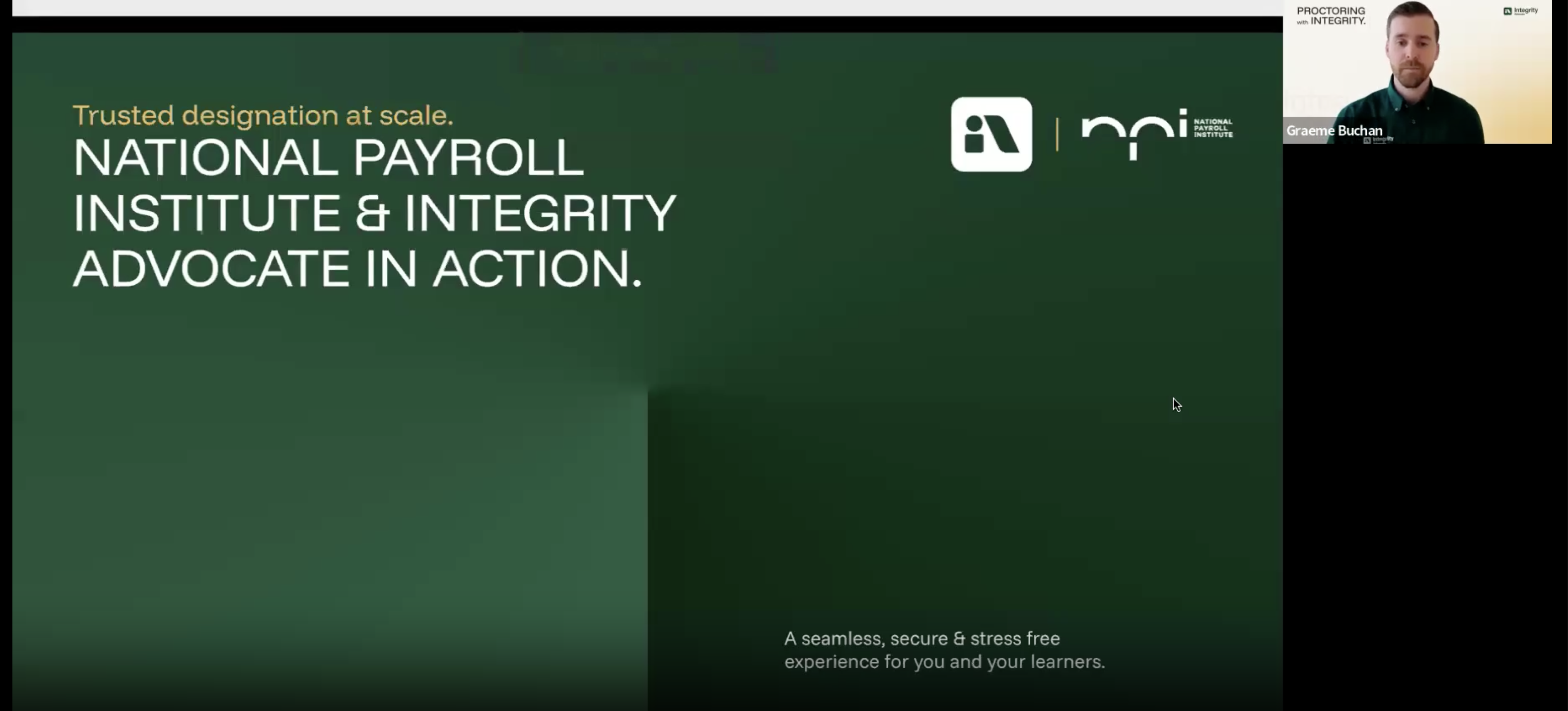
Watch the webinar recording
{{post-cta}}

What Percent of Your Learners Require Support? Only 0.58% of Ours Do.
June 5, 2025
|
5 min read
High support rates in online proctoring are almost always a design problem, not a learner problem. When platforms require downloads, permissions, and complex setup steps, support volume spikes and assessment credibility suffers. Integrity Advocate's support rate is 0.58%, the lowest in the industry, because the platform was built to eliminate the friction that generates those calls in the first place. This post explains what drives support volume, why it matters for compliance as well as learner experience, and what a frictionless proctoring design actually looks like.
You know the moment. You're trying to join a time-sensitive meeting. Or launch something important. The link won’t open. The app wants a permissions update. Your camera’s off, your stress is on, and now you’re refreshing several tabs while watching those three little dots repeat over and over as a support agent finally starts typing back.
In most tech environments, that kind of chaos is expected. In online proctoring, it’s practically baked in.
At Integrity Advocate, we pride ourselves on support needs under 1%, always.
We built our platform to eliminate that moment - for learners, administrators, and anyone else touching an assessment. Because whether people are logging in from a job site or their kitchen table, a secure, seamless experience shouldn't come with unnecessary installs or support on speed dial.
Online proctoring support volume is more than a technical metric
When the stakes are high, the experience matters. Delayed logins, install issues, forgotten passwords or confusing navigation create friction that can add stress and derail performance before the test even begins.
For learners, that anxiety isn't theoretical. According to the 2022 EDUCAUSE Student Technology Report, over three-quarters (77%) of students experienced at least one technology issue in the past academic year, with over half (51%) reporting that these issues caused them stress.
Imagine a construction worker attempting to complete a mandatory safety certification on a job site. Having to download unfamiliar software or navigate a complex user experience, leads to delays and mounting frustration. Each minute spent troubleshooting is a minute not spent ensuring workplace safety.
Support volume—how often users need help—is one of the clearest signals that something's wrong. A tech glitch is frustrating, but it also creates apprehension. When learners don't feel confident in the system, the entire assessment loses credibility.
In all industries, that has a ripple effect. A poor user experience can compromise participation and ultimately undermine the defensibility of any program.
When users aren’t constantly seeking help,
- The experience is working as intended
- Learners aren’t forced to install software on their devices
- Administrators aren’t drowning in tickets
And most importantly, the focus stays where it belongs: on learning, trust and outcomes.
Support design should be intentional
Support volume doesn’t spike because users are doing something wrong—it usually means the system is. Downloads, login issues, permissions prompts and device restrictions may seem small in isolation, but they add up fast when the stakes are high.
If a learner hits a wall during setup, or an admin has to walk every user through the same confusing step, that’s not helping anyone.
At Integrity Advocate, our support rate is just 0.58%—the industry’s lowest. That means fewer than 1 in 200 users ever need to contact us. For us that means support needs under 1%, always.
Proctoring in the time of ANSI/ASSP Z490.1-2024
Organizations trying to meet testing compliance standards like ANSI/ASSP Z490.1-2024, system stability and defensibility matter more than ever. Regulators are increasingly focused on whether training was actually received and completed.
A pile of support tickets? That signals risk.
According to ANSI/ASSP Z490.1-2024, training programs must be able to demonstrate both delivery and participation. The standard emphasizes learner engagement, accessibility and defensibility, especially in high-risk industries where training directly impacts public and workplace safety. If learners are derailed by preventable technical issues, the integrity of the assessment can quickly unravel.
That’s why system stability shouldn’t just be a technical preference. It’s a compliance necessity.
Online proctoring that gets it right
Proctoring with Integrity Advocate was built to be as invisible as possible in the best way.
- No installs means there are no permissions or administrative roadblocks.
- Browser-based means nothing to download and no guessing games.
- Integrated into the LMS means learners don’t have to remember a second login or bounce between tabs.
- Compatibility checks run automatically to flag issues before testing begins.
- Built-in accessibility (WCAG 2.1 AA compliant) ensures no one gets stuck due to ability, device, or bandwidth.
We designed out the chaos to help learners reduce test-taking anxiety and stay focused on demonstrating what they know—not wrestling with the testing platform.
When testing works, everyone thrives
Proctoring was designed to protect what the test is meant to measure. When the technology disappears into the background, learners can focus on proving what they know. And when we reduce friction and anxiety, we create space for achievement, fairness and growth.
At Integrity Advocate, we believe assessment should support people. That’s how we protect trust. That’s how we build a better future.
Want online proctoring that puts people first? We’d love to talk.
{{post-cta}}
OnDemand Webinar: Ensuring Integrity with uXpertise & Integrity Advocate
June 12, 2025
|
5 min read
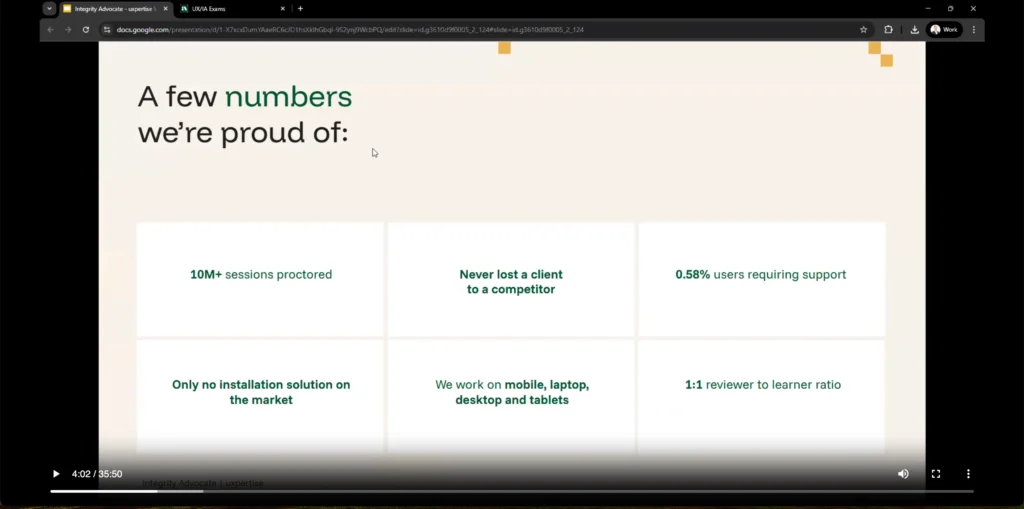
In June 2025, uxpertise and Integrity Advocate demonstrated how their partnership delivers secure, no-install online proctoring directly within the uxpertise LMS environment. The webinar covered browser-based monitoring capabilities, native bilingual support for French and English assessments, PIPEDA compliance and Canadian data residency, and the performance metrics behind more than 10 million successfully proctored sessions. This recap covers the key highlights for Canadian institutions evaluating remote assessment solutions
Date
Originally aired: June 12, 2025
A recap of the recent webinar demonstrating how Integrity Advocate integrates effortlessly with uxpertise to support secure, online assessments—no installs required.
The online proctoring landscape continues to evolve as Canadian institutions seek solutions that balance security with user experience. With the global online exam proctoring market valued at USD 836.43 million in 2023 and projected to reach USD 1.99 billion by 2029, institutions increasingly prioritize security and accessibility. In a recent webinar, uxpertise and Integrity Advocate demonstrated how their partnership addresses remote exam security challenges through seamless LMS integration and no-install proctoring technology.
The No-Install Advantage in a Growing Market
Eliminating Technical Barriers
Traditional proctoring solutions often create significant obstacles for students and IT departments through complex software installations and compatibility issues. Integrity Advocate's browser-based approach addresses these challenges by operating entirely within web browsers, eliminating the need for additional software downloads or specialized equipment.
"We've proctored over 10 million sessions," noted the Integrity Advocate CEO Graeme Buchan during the webinar demonstration. This substantial volume reflects the reliability and scalability that educational institutions require when transitioning to remote assessment models.
The solution works seamlessly across multiple device types and this universal compatibility ensures equitable access for students regardless of their technology choices, addressing a critical concern as educational institutions report that 44.7% of students admit to cheating in online exams, making robust exam proctoring software essential for maintaining academic integrity.
Advanced Monitoring Without Installation
The demonstration revealed Integrity Advocate’s sophisticated monitoring capabilities that operate entirely within the browser environment:
- Identity verification using webcam technology for continuous authentication
- Environmental monitoring to detect unauthorized materials or assistance
- Screen-sharing prevention and tab-switching detection
- Audio monitoring for suspicious conversations or background noise
These features provide comprehensive security while maintaining the accessibility advantages of browser-based operation.
Seamless Integration Meets Bilingual Excellence
Native LMS Integration Capabilities
Integrity Advocate was designed from the ground up to integrate easily with leading LMS platforms like uxpertise—no plugins, no installs, no workarounds.
Supporting Canada's Bilingual Testing Standards by Design
Integrity Advocate is built to support Canada’s linguistic diversity, making it easy for institutions to deliver secure, inclusive online assessments in both French and English. Within uxpertise, this functionality comes to life with:
- User-friendly French and English interface options
- 24/7 bilingual support for students and administrators
- Proctoring procedures that reflect cultural awareness
- Full alignment with Canadian educational language standards
As the uxpertise team shared during the session, “our bilingual capabilities ensure that language is never a barrier to accessing secure online assessments.” It’s a shared commitment to accessibility—but one that starts with how Integrity Advocate was designed from day one.
Data Privacy and Regulatory Compliance
With Canadian privacy regulations being particularly comprehensive, Integrity Advocate’s online proctoring solution addresses key compliance requirements:
- Data residency options within Canadian servers for sensitive information
- PIPEDA compliance for personal information protection
- Transparent data handling policies with clear retention limits
- Student consent management systems that respect privacy rights
Real-World Success and Performance Excellence
Impressive Performance Metrics
The webinar highlighted several compelling statistics demonstrating the proctoring solution’s effectiveness in real educational environments:
Support Excellence:
- 0.58% support ticket rate - significantly below industry standards
- 24/7 multilingual support with average resolution times under 2 minutes
- Comprehensive documentation and training resources
The Future of Secure Online Assessment
Market Position and Competitive Advantages
With the automated online proctoring market projected to grow at 20.5% CAGR from 2025 to 2033, reaching an estimated USD 4.2 billion by 2033, the uxpertise-Integrity Advocate partnership positions institutions favorably for continued growth in remote assessment capabilities.
The solution differentiates itself in the competitive landscape through:
- No-install simplicity that reduces technical barriers and IT overhead
- Canadian data residency ensures compliance with local privacy regulations
- Comprehensive bilingual support for diverse educational environments
- Transparent pricing models without hidden fees or per-usage charges
- Proven scalability demonstrated through millions of successful proctored sessions
Emerging Trends and Technological Evolution
The partnership demonstrates a commitment to continuous innovation through:
- Technology and human-powered anomaly detection for more accurate identification of suspicious behaviors
- Adaptive assessment technologies that adjust to individual student learning patterns
- Integration capabilities with emerging technologies
- Quarterly feature releases based on user feedback and industry developments
Measuring Long-Term Value and ROI
Leaders should evaluate proctoring solutions based on comprehensive metrics:
- Academic integrity violation rates compared to pre-implementation baselines
- Learner completion and satisfaction rates for proctored assessments
- Faculty adoption and effectiveness measures
- Technical support burden and resolution efficiency
- Total cost of ownership, including implementation, training, and ongoing support
For Canadian institutions looking to enhance remote exam security without sacrificing accessibility, the uxpertise–Integrity Advocate collaboration demonstrates what's possible when two trusted platforms work in sync. With over 10 million sessions successfully proctored and a privacy-first design that supports both French and English users, Integrity Advocate is built for today’s assessment demands. And with North America leading the global online proctoring market, this integration offers not just proven reliability—but future-ready flexibility.
Watch the webinar recording
{{post-cta}}

How To Lose A Client to a Competitor in 10 Ways
May 22, 2025
|
5 min read
Good technology is the baseline. What keeps clients is how a partner shows up when things get complicated. This post walks through the ten most common reasons organizations switch proctoring providers, from poor support and compliance abandonment to privacy shortcuts and platforms that cannot scale, and explains how Integrity Advocate is built to do the opposite at every turn.
Good tech matters—it should be secure, simple and able to scale—but that’s just the baseline. What really counts is how you show up for the people who depend on you.
Over time, we’ve seen the patterns. We know the reasons organizations switch providers, and we’ve built Integrity Advocate to do the opposite.
Here are ten of the biggest pitfalls, and how we make sure our partners don’t get stuck in them.
1. Ignore support tickets.
Nothing says “we’ve moved on” like radio silence when clients need help.
➜ We believe support should be available before you even know you need it. Our industry-leading support rate is just 0.58%, meaning fewer than 1 in 200 learners ever need to contact us. And when they do, we’re there 24/7 with live help across chat, email and phone.
2. Make it complicated.
If it takes an installation guide or an IT department and a prayer to get started, you’ve already lost.
➜ We’re browser-based, device-agnostic and install-free. No plugins. No apps. Just a seamless experience that works anywhere, on any device without frustrating your learners or burdening your IT team.
3. Act like a vendor, not a partner.
Hand off a platform, disappear and hope for the best.
➜ We show up from the start and stay in the loop. Our team helps guide implementation, interprets regulation changes and can even sit in on calls with your regulators and stakeholders. When things shift, we’re already there.
4. Build for software, not for people.
Design a sleek platform, then watch learners struggle to use it.
➜ We prioritize accessibility, not just aesthetics. Our platform works on mobile, tablets, laptops—you name it. No testing labs, no special equipment, no complicated setups. Just secure, verified assessments learners can complete anywhere.
5. Overpromise and underdeliver.
Say yes to everything. Deliver on… less.
➜We don’t bluff. Our track record speaks for itself and we’re transparent about what we do and how we do it. If we say we’ve got it, we mean it.
6. Leave clients to figure out compliance on their own.
Nothing says “you’re on your own” like dodging regulatory guidance.
➜ We stay ahead of the curve so you don’t have to. Whether you need support navigating new standards, prepping for an audit or defending training decisions, our experts are in your corner and ready to assist with clear, actionable guidance.
7. Treat privacy like a box to check.
Collect more data than needed. Store it longer than necessary. Hope nobody notices.
➜ We’re the only proctoring provider built on Privacy by Design principles. We collect only what’s necessary, never retain biometric data and protect every user with ethical safeguards built into our system from the very beginning.
8. Scale poorly.
Support five learners flawlessly. Struggle with five thousand.
➜ We support organizations of all sizes with consistent performance and trusted infrastructure. Whether it’s a handful of assessments or thousands in a single day, we’re built to keep up.
9. Forget what’s at stake.
See your service as a tool and not a safeguard for real people in high-risk industries.
➜ We know that training protects lives. That’s why we’re passionate about verifying identity, monitoring participation and ensuring assessments hold up under scrutiny. Behind every test is someone counting on it.
10. Treat retention like luck.
Hope clients stick around instead of giving them a reason to.
➜ We build relationships, not contracts. Our clients stay because we make life easier, safer and more compliant—and we keep earning their trust long after the onboarding ends.
{{post-cta}}

ANSI/ASSP Z490.1-2024 Is Here. Is Your Training Compliant?
May 15, 2025
|
5 min read
The ANSI/ASSP Z490.1-2024 update consolidates in-person and online Safety, Health and Environmental training into a single unified standard for the first time. Organizations can no longer simply assign a course and mark it complete. They must verify who completed the training, confirm active participation, prevent unauthorized assistance, and maintain a record that holds up to regulatory scrutiny. This guide walks safety and compliance teams through what has changed, where most current systems fall short, and how to meet the new standard without overhauling existing infrastructure.
A no-nonsense guide for safety and compliance teams adapting to ANSI/ASSP Z490.1-2024
The rules have changed. And if you’re in charge of keeping workers safe, delivering training or meeting compliance standards, you’ve likely felt the ripple.
The ANSI/ASSP Z490.1-2024 is no minor update. For the first time, both in-person and online Safety, Health and Environmental (SH&E) training are held to the same gold standard.
It’s no longer enough to say training was “offered.” You have to prove it was delivered, received and understood by the right person, in the right way, with a record to show for it.
The challenge? Most current systems weren’t built for that.
Here’s what this shift means for compliance, what to prioritize first and how to avoid the missteps that can cost you.
What’s actually new?
The ANSI/ASSP Z490.1-2024 update brings some big changes. It consolidates what were once two separate standards—Z490.1 for in-person training and Z490.2 for eLearning—into a single, unified standard for all Safety, Health and Environmental (SH&E) training.
That means no matter how your training is delivered, the expectations are the same.
You can’t just assign a course and call it complete. You have to:
- Verify the identity of the learner,
- Confirm the learner’s participation in the training,
- Prevent unauthorized assistance (human or AI),
- Communicate results promptly,
- And have a record that stands up to scrutiny.
Regulators want to see due diligence from organizations that take safety and accountability seriously. Organizations need systems that demonstrate training was handled with care, intention and oversight.
The compliance gap: identity, participation and proof
Traditional LMS’ rely on user credentials to grant access. But usernames and passwords don’t confirm who actually completed the training or whether they were even in the room.
That’s a problem. Because when safety is on the line, assumptions can cost lives.
Training is meant to protect people and prepare them for the risks they face and the responsibilities they carry. If you can’t confirm who took the training or whether they were engaged, there’s more than just compliance at stake. You’re carrying a safety risk, a legal liability and a missed opportunity to do right by your workforce.
The updated ANSI/ASSP standard puts the responsibility squarely on the employer. In the event of an incident, “we assigned the module” won’t hold up. To truly protect your organization and your people, you need training that’s verifiable. That means:
- Identity verification that confirms the right person took the training
- Participation monitoring that confirms they were present and engaged
- Data protection that respects user privacy while keeping your records defensible
It's more than business
Safety incidents put everything under the microscope. Leadership. Processes. Credibility. It’s not just your operations on the line, it’s trust. And behind that?
People’s lives. The ones training is meant to protect.
Common missteps in online training we’ve seen
Even with the best intentions, training programs can fall short, particularly when the systems in place weren’t built with today’s standards in mind.
If your current setup relies on a simple login and password, there may be gaps you haven’t considered. And if you’re using software that requires downloads or installations, you might be introducing friction for learners.
Here are a few areas where we often see room for improvement:
- Unverified attendance records that can’t confirm who actually completed the training
- Limited or no tracking of learner engagement
- Software installs that conflict with device security protocols
- Surveillance methods that may violate privacy laws
- No clear audit trail to support due diligence when it matters most
The good news is that these are fixable gaps. There are better, easier ways to meet compliance requirements today without compromising user experience, privacy or peace of mind.
What due diligence really looks like
No matter your industry—construction, food service, healthcare, manufacturing—safety training exists for a reason. Not to fill a quota. Not to tick a box.
We know you care about your workforce. You wouldn’t be reading this if you didn’t. But caring isn’t always enough, especially when systems are outdated, fragmented or easy to bypass.
Real responsibility means having a system that holds up under pressure. But how do you build a system like that without overhauling everything?
It doesn’t have to be complicated. The right tools do the heavy lifting quietly in the background, verifying identity and participation without interrupting the learning experience. No software installs. No extra logins. No support tickets flooding your inbox.
Just reliable, responsible training that works (because it’s built to).
How to get started without starting over
Already delivering training digitally? Great. You don’t need to scrap your system—you just need to make sure it can hold up under today’s standards.
Here are a few questions to help you evaluate where you stand:
- Can we confirm who completed each training session?
- Can we demonstrate that participants were engaged throughout?
- Could we confidently show this information to a regulator or investigator?
If any of those questions give you pause, it might be time to take a closer look.
Taking the Integrity Advocate approach
At Integrity Advocate, we don’t just provide tools. We partner with you to navigate compliance confidently, especially when standards change and the pressure’s on.
We help organizations meet the ANSI/ASSP Z490.1-2024 standard with:
✓ No-install identity verification and participation monitoring
✓ Mobile-friendly access that meets your learners where they are
✓ Privacy by Design to protect your organization and your people
✓ Human reviews for fairness, discretion and accountability
✓ Seamless integration and full support within your existing LMS
Need help interpreting what this new standard means for your organization? We’ll guide you through it. Meeting with regulators or external reviewers? We’ve been there too, and we’ll sit in right beside you.
Rethinking safety training in light of ANSI/ASSP Z490.1-2024
The latest ANSI update is the perfect moment to pause and reassess how we deliver training, protect our teams and uphold accountability.
Integrity Advocate is here to help you make this shift with confidence. From no-install record and review proctoring to industry-leading support levels, we make it easier to meet the standard. When training is verifiable, ethical and accessible, it doesn’t just check a box—it builds trust, saves time and protects lives.
We believe compliance can be better. And when we work together, it is.
{{post-cta}}
OnDemand Webinar: Improving CEU Integrity in the Age of AI with IACET
December 4, 2024
|
5 min read
In November 2024, Integrity Advocate sat down with IACET president Randy Bowman to discuss how AI tools and GPT-powered plugins are changing the landscape of online continuing education. The conversation covered how emerging technologies compromise the integrity of accreditation standards, how to meet IACET standard 8.1 requirements for learner identity verification, how to document due diligence around genuine participation, and what recent court cases mean for organizational liability when training does not meet IACET standards.
AI is changing the world of online continuing education in so many different ways.
IACET standards provide a useful framework for navigating these changes, but ultimately it is up to accredited organizations to ensure their learning events meet requirements. In November, 2024, we sat down with IACET president Randy Bowman to discuss the changing landscape of continuing education and — in particular — the impact AI and GPT plugins are having on online assessments.
Topics We Covered:
- How emerging technologies, including AI/GPT, can compromise the integrity of standards and accreditation processes, and why existing controls may be insufficient for combatting them.
- How to meet IACET/ANSI standard section 8.1 guidance for verifying learner identity, both in person and online.
- How to ensure genuine participation in learning events and document due diligence around these efforts
- What’s at stake when training doesn’t meet IACET standards: how recent court cases have shifted the conversation around liability
We've embedded some highlights below. You can also watch the full presentation at https://www.iacet.org/events/archived-webinars/ (registration is required, though viewing the presentation is free once you've created an account).
GPT 'Study Aid' Plugins — How They Work
Are GPT Plugins Consuming Test Questions?
Online vs. In-Person Learning Events: Ensuring a Consistent Level of Integrity
Is it Possible to Completely AI-proof an Online Exam?
Bonus for IACET-accredited firms — get our compliance guidance for IACET standard 8.1:
{{post-cta}}

More Flags ≠ More Security: How Smarter Review Saves Admins Time and Stress
January 12, 2026
|
5 min read
Flag overload is one of the most common and least discussed problems in online proctoring. When AI-only systems flag everything from background noise to lighting changes, administrators are left sorting through queues of low-risk alerts to find the few that actually matter. This post explains why more flags do not equal more security, how human review filters out noise before it reaches the administrator queue, and what a smarter review model looks like in practice, including a side-by-side comparison of AI-only versus AI plus human review across flagging volume, admin workload, and decision quality.
If you are using an online proctoring tool, and your post-exam review process feels overwhelming, it’s usually not because too little is being flagged, it’s because too much is.
As online and remote assessments scale, many programs respond by tightening controls and increasing automation. On paper, it sounds like a strong security posture. In practice, it often creates a different problem entirely: flag overload.
And that overload lands squarely on administrators.
The Hidden Cost of “Too Many Flags”
When AI-only proctoring systems flag everything from background noise to lighting changes, administrators are left sorting through long queues of low-risk alerts to find the few that actually matter.
That leads to:
- Hours spent reviewing non-issues
- Increased stress during post-exam review cycles
- Slower score releases and decision-making
- Fatigue that makes true violations harder to spot
More data doesn’t automatically mean better security. In many cases, it creates more work — without improving outcomes.
A simple rule of thumb:
More flags ≠ more security.
Why Post-Exam Review Is Where Programs Feel the Pain
The post-exam phase is where integrity decisions become real. This is the moment where:
- Administrators must determine if a violation truly occurred
- Programs need defensible outcomes they can stand behind
- Appeals, audits, or compliance reviews may follow
When every flagged event is treated equally, administrators are forced into a reactive role, reviewing volume instead of focusing on risk.
That’s where smarter review models make the biggest difference.
How Human Review Changes the Equation
Integrity Advocate was designed to reduce noise, not increase it.
Instead of passing every automated flag directly to administrators, Integrity Advocate uses highly trained human reviewers to evaluate context before an incident ever reaches your queue.
Human reviewers can:
- Distinguish normal behavior from suspicious activity
- Understand environmental and accessibility factors
- Identify patterns that automation alone can’t
- Filter out false positives before they create work
The result? Administrators see fewer, higher-quality incidents, and only when action is truly needed.
AI vs. Human Review: A Practical Comparison
Here’s a simple way to think about the difference:
Automation is powerful, but without human judgment, it often creates more work than it removes.
What This Means for Administrators
When human review is built into the process:
- Post-exam review time drops significantly
- Admins spend time on real integrity issues, not noise
- Stress and cognitive load are reduced
- Decisions are easier to defend and explain
Security becomes proactive instead of reactive, and review workflows become sustainable, even at scale.
Smarter Security Is About Focus, Not Surveillance
Strong assessment security isn’t about watching everything. It’s about identifying what actually matters, and acting with confidence when it does.
By combining AI efficiency with human judgment, Integrity Advocate helps programs protect assessment integrity without overwhelming the people responsible for it.
Because the goal isn’t more flags. It’s better outcomes.
{{post-cta}}