November 7, 2025
|
5 min read
Key Takeaways from the Conference on Test Security (COTS): Balancing Security, Integrity, and Innovation in Testing
The 2025 Conference on Test Security brought together higher education institutions, certification organizations, legal experts, and technology vendors around a shared challenge: maintaining assessment integrity in an AI-driven world. Integrity Advocate CEO Brandon Smith shares his key takeaways, covering the growing non-negotiability of exam validity and security, the evolving legal landscape around misconduct and civil disputes, the uneven ethical rigor of AI tools in assessment, and the increasingly critical balance between test security and learner privacy.

The 2025 COTS Conference brought together a diverse mix of professionals from higher education, certification organizations, legal experts, and technology vendors all united around a shared challenge: maintaining the integrity of assessments in an increasingly digital and AI-driven world.
The Growing Focus on Exam Security and Validity
Across both higher education and professional certification sectors, one theme dominated the conversation; security and validity are non-negotiable. Institutions are doubling down on technologies and practices that ensure every test taker is who they say they are and that the results accurately reflect their own work. With remote and hybrid testing becoming the norm, maintaining that integrity has never been more critical, or more complex.
The Legal Landscape Is Changing
A recurring topic throughout the conference was the legal ramifications of exam misconduct. When test takers are caught cheating or engaging in fraudulent behavior, the response can’t be improvised. Organizations need clear, documented legal frameworks to protect themselves and their brands.
With the rise in reported cheating incidents comes an increase in interactions with test takers around alleged violations some of which escalate into accusations, libel, or civil disputes. The consensus: it’s essential to plan ahead, not react after the fact.
Artificial Intelligence: Promise and Pitfalls
AI was everywhere at COTS. While some vendors and institutions are embracing AI in a responsible and transparent way, others are less rigorous about the ethical guardrails they apply. The takeaway? Not all AI tools are created equal.
Decision-makers must ask tough questions, vet vendors carefully, and understand how AI is being used especially when it impacts privacy, proctoring, and identity verification. Blind trust in “smart” systems can lead to unintended consequences.
The Balancing Act: Security vs. Privacy
Perhaps the most nuanced discussions centered on finding the right balance between test security and user privacy. With test takers increasingly sensitive to how their data is collected and used, organizations are being challenged to uphold both integrity and privacy, without compromise. It’s not an either/or decision; the future of assessment requires innovative solutions that respect both principles.
A Conference of Thought Leaders
COTS continues to position itself as a true thought leadership event. Every session was rich with real-world examples, backed by data, and framed within professional and legal contexts. The mix of participants, from educators to legal professionals to technology providers, created a vibrant ecosystem of perspectives, debate, and shared problem-solving.
Final Thoughts
The future of testing isn’t just about better technology; it’s about smarter, more ethical implementation. The conversations at COTS made it clear: the organizations that thrive will be those that treat integrity as both a value and a strategy. As AI reshapes the landscape and legal accountability intensifies, preparation, transparency, and ethics will define the leaders in this space.
{{post-cta}}
Keep reading
Key Takeaways from eAA | What “The Trust Imperative” Actually Means for Assessment Right Now
June 19, 2026
|
5 min read
At the 2026 e-Assessment Association International Conference in London, the central theme was trust - specifically, how assessment programs can stay ahead of rapidly evolving AI-enabled cheating while preserving human oversight, candidate experience, and the credibility of every credential they issue.
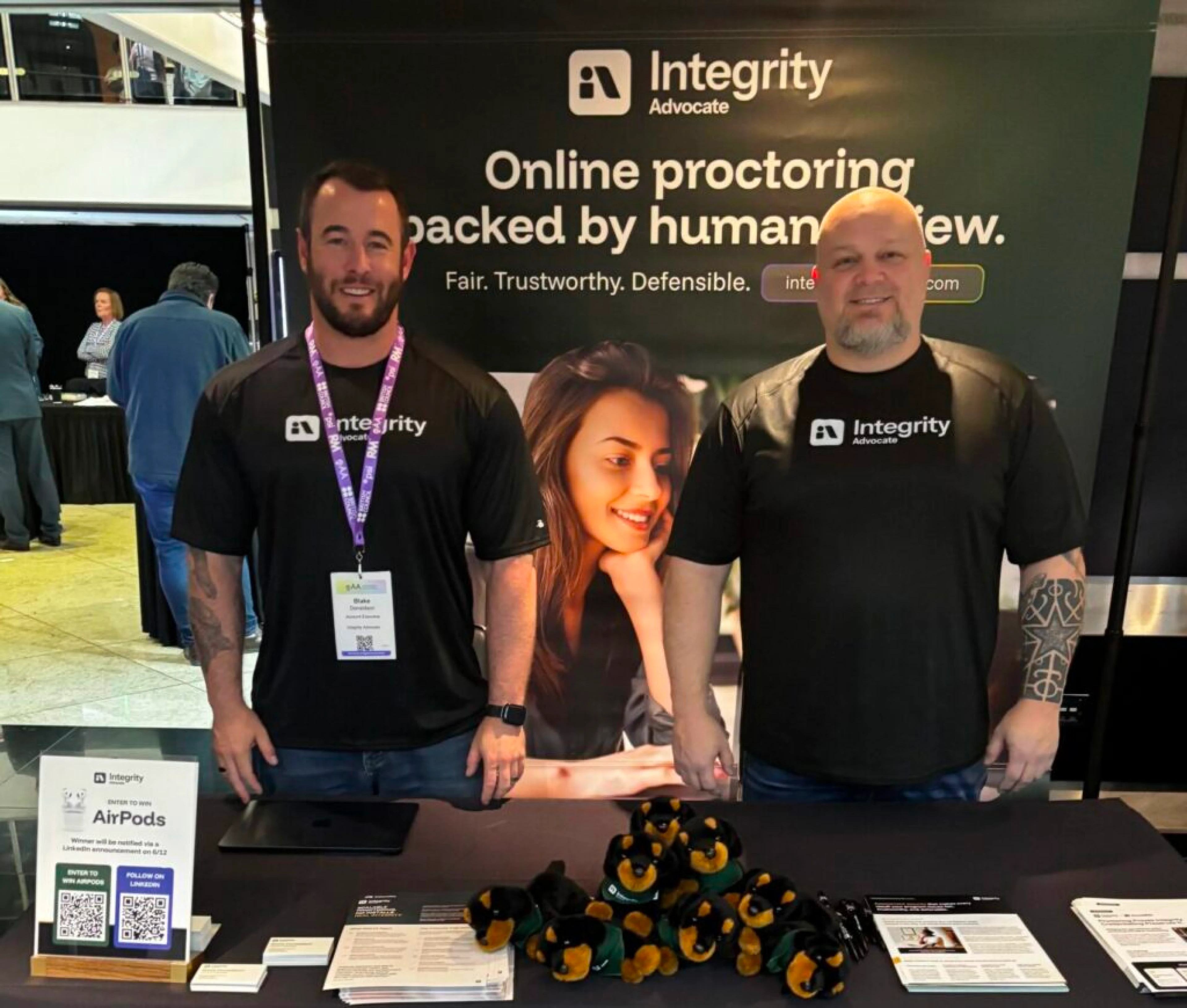
Last week I was in London for the e-Assessment Association’s 2026 International Conference, and if I had to distill three days of conversations, keynotes, and hallway debates into a single word, it would be this: trust.
Not trust as a buzzword. Trust as a genuine crisis question. As AI capabilities accelerate and new tools emerge faster than most teams can keep up with, the field is being forced to reckon with something foundational: do assessment results still mean what we say they mean?
That tension ran through nearly every session I attended, and it’s one our industry can’t afford to get wrong.

The Threat Landscape Is Moving Fast
One of the clearest messages from the conference was that assessment security is no longer a static problem. Cheating technologies are growing more sophisticated by the month. What worked two years ago may not be sufficient today, and relying on yesterday’s approach while hoping for the best is not a strategy.
At the same time, there’s a real risk of overcorrecting. Security measures that create friction, penalize legitimate candidates, or feel invasive erode trust from a different direction. The most mature programs in the room were the ones thinking about security, accessibility, and candidate experience as a unified design challenge rather than competing priorities.

Human Oversight Is Not Negotiable
One point emerged from this conference without serious debate: keeping a human in the loop is not optional. Multiple sessions, including remarks from several CEOs, affirmed that governance, transparency, and meaningful human involvement are essential to maintaining confidence in assessment outcomes.
This is not a novel position for us at Integrity Advocate. It is the architecture we have built around since day one. But it was validating to hear it stated so clearly and so universally, particularly at a moment when the industry is under pressure to automate everything in the name of efficiency.
When an assessment result affects someone’s career, their credential, their livelihood, cutting corners on human review is not a cost savings. It is a liability.
Candidate Experience Is Now a Trust Variable
Something I found particularly valuable in this year’s programming was the explicit connection being drawn between candidate experience and assessment integrity. Fairness used to be discussed almost exclusively through the lens of psychometrics and policy. That framing is expanding.
How candidates are treated during an assessment, whether the process feels transparent, whether accommodations are genuinely accessible, whether the communication is clear, these factors now register as trust signals for institutions, employers, and regulators alike. A technically sound exam delivered badly is still a trust problem.

The Takeaway I’m Bringing Home
The strongest assessment programs are designing trust in from the beginning, not retrofitting it as a compliance requirement after the fact. That principle is easy to say and genuinely hard to operationalize, especially when the tooling, the regulations, and the threat environment are all shifting simultaneously.
What gives me optimism is that the people in that room in London were asking the right questions. The eAA has always been a community that takes this work seriously, and this year’s conference reflected that.
AI is not going away. The integrity gap will not close on its own. But with the right governance structures, the right human oversight, and a genuine commitment to candidate experience, it is a solvable problem.
I’m leaving with new ideas, new connections, and renewed conviction that this is exactly the work worth doing.
{{post-cta}}

Integrity Advocate Achieves SOC 2 Type II Certification for the Third Consecutive Year
February 26, 2024
|
5 min read
Integrity Advocate has achieved SOC 2 Type II certification for the third consecutive year, verified by auditors at the Johanson Group and supported by security partner Carbide. This post explains what SOC 2 Type II involves, why annual recertification matters more than a one-time audit, and what it means for organizations using Integrity Advocate to handle sensitive learner data.
Integrity Advocate has completed SOC 2 Type II certification for the third consecutive year, with support from auditors at the Johanson Group and security partner Carbide.
SOC 2 Type II compliance represents an ongoing commitment to security, privacy, and the responsible handling of sensitive data. For partners, clients, and learners, it means the systems and processes protecting their information have been independently verified under real-world operating conditions, not just reviewed on paper.
What SOC 2 Type II Certification Involves
SOC 2 Type II is not a one-time audit. It is an extended review conducted over several months that evaluates how effectively an organization's security and privacy controls perform under actual operating conditions. The process includes defining security controls, implementing appropriate policies, conducting risk assessments, and continuously monitoring systems to ensure those controls hold up over time.
The Type II designation is significant. Where Type I confirms that controls exist at a point in time, Type II confirms that those controls operated effectively over an extended period. It is the higher standard, and the one that matters most to organizations evaluating a vendor's security posture.
Why Integrity Advocate Pursues SOC 2 Certification
SOC 2 Type II certification is commonly obtained by SaaS vendors to demonstrate effective security controls to enterprise clients and partners. At Integrity Advocate, the motivation goes further than that.
Data security is a responsibility, not a checkbox. Integrity Advocate handles sensitive data on behalf of clients every day, including government-issued ID images, biometric data, and session recordings. The people whose data this is should never have to wonder whether it is being handled securely. SOC 2 certification is one way of demonstrating that the answer is yes, backed by independent verification rather than self-assertion.
Trust is earned through consistent practice. SOC 2 Type II measures controls over time, not at a single moment. Achieving it three consecutive years reflects a sustained commitment to maintaining security standards as threats evolve, not a one-time effort to pass an audit.
Certification makes partnership easier. SOC 2 Type II is recognized across industries as a universal standard based on proven security practices. For organizations in higher education, professional certification, industrial training, and corporate learning evaluating a proctoring vendor, SOC 2 certification provides independent confirmation that Integrity Advocate's security controls meet the standard their own compliance teams require.
The Partners Behind the Process
Throughout the certification process, Integrity Advocate worked closely with auditors from the Johanson Group, whose expertise guided the audit with transparent communication and a shared commitment to rigorous standards. Integrity Advocate also leveraged Carbide as its security platform to support the process.
What This Means for Clients and Partners
For Integrity Advocate clients and partners, SOC 2 Type II certification is straightforward confirmation that the platform handling your learners' data meets independently verified security standards. It sits alongside Integrity Advocate's 12-plus years of operation with zero data breaches and 98% client retention as part of a consistent track record, not a single credential.
For more information about how Integrity Advocate handles data security and privacy, visit the Privacy page.
{{post-cta}}
OnDemand Webinar: Improving CEU Integrity in the Age of AI with IACET
December 4, 2024
|
5 min read
In November 2024, Integrity Advocate sat down with IACET president Randy Bowman to discuss how AI tools and GPT-powered plugins are changing the landscape of online continuing education. The conversation covered how emerging technologies compromise the integrity of accreditation standards, how to meet IACET standard 8.1 requirements for learner identity verification, how to document due diligence around genuine participation, and what recent court cases mean for organizational liability when training does not meet IACET standards.
AI is changing the world of online continuing education in so many different ways.
IACET standards provide a useful framework for navigating these changes, but ultimately it is up to accredited organizations to ensure their learning events meet requirements. In November, 2024, we sat down with IACET president Randy Bowman to discuss the changing landscape of continuing education and — in particular — the impact AI and GPT plugins are having on online assessments.
Topics We Covered:
- How emerging technologies, including AI/GPT, can compromise the integrity of standards and accreditation processes, and why existing controls may be insufficient for combatting them.
- How to meet IACET/ANSI standard section 8.1 guidance for verifying learner identity, both in person and online.
- How to ensure genuine participation in learning events and document due diligence around these efforts
- What’s at stake when training doesn’t meet IACET standards: how recent court cases have shifted the conversation around liability
We've embedded some highlights below. You can also watch the full presentation at https://www.iacet.org/events/archived-webinars/ (registration is required, though viewing the presentation is free once you've created an account).
GPT 'Study Aid' Plugins — How They Work
Are GPT Plugins Consuming Test Questions?
Online vs. In-Person Learning Events: Ensuring a Consistent Level of Integrity
Is it Possible to Completely AI-proof an Online Exam?
Bonus for IACET-accredited firms — get our compliance guidance for IACET standard 8.1:
{{post-cta}}
Frequently asked questions
Find answers to the most commonly asked questions from our clients.
The Conference on Test Security is an annual event that brings together professionals from higher education, professional certification, legal practice, and assessment technology to address the challenges of maintaining exam integrity in a digital and AI-driven environment. COTS is considered one of the leading thought leadership events in the assessment security space.
Five themes dominated the 2025 conference. Security and validity are non-negotiable, with institutions doubling down on technologies that confirm identity and ensure results reflect genuine knowledge. The legal landscape is changing, with misconduct incidents increasingly escalating into civil disputes that require documented legal frameworks rather than improvised responses. AI tools vary significantly in their ethical rigor, and decision-makers must vet vendors carefully. The balance between test security and learner privacy requires solutions that uphold both principles simultaneously. And the organizations that lead will be those that treat integrity as a strategic value rather than a compliance obligation.
As cheating incidents increase and remote testing expands, disputes around alleged violations are more frequently escalating into formal accusations, libel claims, and civil proceedings. Organizations that handle misconduct without clear, documented legal frameworks expose themselves to significant liability. The COTS 2025 consensus was that preparation before an incident occurs, including transparent policies and defensible documentation, is essential.
Not all AI tools apply the same ethical standards or transparency to how they detect, flag, and report behavior. Decision-makers should ask how AI is used in the flagging process, whether human review is applied before decisions are made, how bias and false positives are managed, what data is collected and for how long, and whether the vendor can clearly explain every decision the system produces. Blind trust in automated systems without understanding these details creates risk for both institutions and test-takers.
The most important insight from COTS 2025 on this topic is that security and privacy are not in conflict when a system is designed correctly from the start. Privacy-first proctoring collects only what is necessary, retains data only as long as required, and applies human judgment rather than broad surveillance to every decision. Organizations that treat this as an either/or choice are working with the wrong framework. The right approach is one that upholds both principles simultaneously through intentional design.