October 20, 2025
|
5 min de lecture
The Certification Integrity Gap in Construction: Why Compliance Alone Won’t Keep Workers, or Projects, Safe
The construction industry spends an estimated $1.6 billion annually on safety training. Yet in 2023, nearly one in five workplace fatalities still occurred in construction. When online certifications can be completed by clicking through questions without genuine engagement, the credential offers the appearance of compliance without the substance. This post examines the certification integrity gap in construction, how unverified credentials create liability for general contractors and specialty trades alike, and how Integrity Advocate's hybrid proctoring model delivers audit-ready verification that holds up under OSHA, WHMIS, and Red Seal review.


The Compliance Illusion
Every construction leader understands the stakes: a single safety lapse can cost lives, delay multimillion-dollar projects, and tarnish reputations. Yet despite billions invested in training and certification each year, preventable incidents persist.
{{post-stat-highlight}}
Unverified online certifications are fast becoming construction’s hidden vulnerability. Without verification, a “passed” test may only prove that someone clicked through questions, not that they understand life-critical protocols. In an audit or an incident review, that’s a liability no company can afford.
The New Certification Landscape
With remote training and hybrid workforces on the rise, the way construction professionals earn their safety and trade credentials has changed. But verification hasn’t kept pace.
Key challenges include:
- Identity uncertainty: Who actually took the exam?
- Scalability gaps: Remote worksites and rotating crews make in-person proctoring impractical.
- Audit exposure: Clients and regulators increasingly demand proof of authenticity, not just certificates.
- Worker pushback: Time-intensive testing processes create friction, especially for subcontractors or traveling trades.
The Role of Proctoring in Safety Certification
Before diving into solutions, it’s worth clarifying what proctoring really means in the world of safety training. In construction, the stakes are quite high, these aren’t just grades, they’re life-critical credentials that authorize someone to operate equipment, enter confined spaces, or oversee site safety.
A proctor, whether human, AI, or both, acts as an independent witness during the certification exam. Their job is to confirm that the right person is taking the test, that the environment is secure (no outside help, no unauthorized devices), and that results are credible enough to stand up under regulatory scrutiny.
When done right, proctoring transforms certification from a “check-the-box” exercise into a defensible process that protects workers, employers, and the public. That’s where Integrity Advocate’s approach goes beyond traditional models.
Integrity Advocate’s Verification Model: Proctoring That’s Built for the Jobsite
Traditional, classroom-style proctoring wasn’t designed for rotating crews, remote sites, or tight build schedules. Integrity Advocate adapts proctoring to how construction really works: on demand, in the field, and defensible.
How it works: hybrid by design
Our system monitors each session and flags anomalies, for example, multiple faces in frame, device switching, or the presence of unauthorized materials, then routes them to trained human reviewers who ensure fairness, context, and accurate decisions. Automation gives you scale, humans provide judgment.
What you get: outcomes that hold up under scrutiny
- Proof of identity on every session so you know the right person earned the credential.
- Audit-ready records to defend compliance in OSHA, WHMIS, or Red Seal reviews.
- Scalable deployment across GCs, specialty subs, and training providers—one standard everyone can trust.
- Low-friction experience for workers with no installs required in typical workflows, no rigid scheduling, and minimal disruption to site operations.
“A certificate means little if you can’t verify who earned it. Our hybrid model ensures every credential is defensible, to regulators, insurers, and clients alike.” — Brandon Smith, CEO, Integrity Advocate
General Contractors: Protecting the Entire Project Ecosystem
For general contractors, compliance risk doesn’t stop at your payroll. Every subcontractor, temp crew, and vendor working under your supervision impacts your safety record.
Because many projects require proof of OSHA 10/30 or provincial equivalents, you’re accountable for ensuring every badge on site reflects legitimate training. There are some issues that make this harder than it should be:
- Limited visibility into subcontractor credentialing
- Time-sensitive project schedules that discourage retesting
- Exposure to client audits and insurance verification
How Integrity Advocate helps:
- Provides a unified verification layer across all participating vendors
- Delivers defensible records you can produce during audits or pre-qualification checks
- Enables remote certification that doesn’t delay mobilization or disrupt project flow
The result: General contractors gain peace of mind knowing certifications can be trusted, and project risk is measurably reduced.
Electrical & Specialty Trades: Ensuring Safety in High-Risk Environments
In electrical, mechanical, and other specialty trades, a single oversight can be catastrophic. Arc flash hazards, confined spaces, and fall protection failures often trace back to incomplete or falsified training records.
Industry snapshot:
- Electrical work represents 8% of all fatal construction injuries, with electrocution ranking consistently among OSHA’s “Fatal Four.”
- Trade licensing and safety certifications, like Red Seal, WHMIS, or Fall Protection, are mandatory, yet verification often ends at “check the box.”
Smaller firms often rely on external training vendors, which can lead to technicians sharing logins or completing online assessments without supervision, ultimately reducing control over verification quality.
How Integrity Advocate helps:
- Embeds proctoring verification directly within your existing LMS or vendor training modules.
- Produces audit-ready session logs proving that the credential was earned under secure, monitored conditions.
- Offers mobile access for traveling technicians or field supervisors who need to certify between job sites.
Impact: Electrical and specialty trades can now demonstrate compliance not just on paper, but in proof that holds up under inspection or litigation.
Union vs. Non-Union: Balancing Standardization and Autonomy
Union-affiliated construction programs often maintain rigorous training pipelines through joint apprenticeship training committees (JATCs) and safety schools. Non-union contractors, by contrast, frequently rely on a mix of vendor-provided e-learning and on-site toolbox talks.
For unionized organizations, the challenge lies in verifying distributed training across locals and maintaining uniform standards, as unverified digital testing can quickly erode the hard-earned trust of regulators and clients.
For non-union firms, limited internal training infrastructure often leads to reliance on external providers that may not guarantee exam integrity, putting project bids at risk when verifiable credentials are required for participation.
How Integrity Advocate bridges both worlds:
- Enables consistent verification protocols across union and non-union sites.
- Provides neutral, third-party assurance that credentials meet defensibility standards.
- Supports collaboration with union training councils or private academies to integrate secure testing workflows.
Where to Start
- Identify high-risk credentials > Fall Protection, Confined Space, WHMIS, OSHA 10/30, Red Seal Trade Exams.
- Map current verification gaps > Who issues certificates? Are results defensible?
- Pilot Integrity Advocate with one crew or certification type.
- Scale enterprise-wide > once verified results demonstrate reduced audit findings and increased compliance confidence.
Key Takeaway
Compliance without verification is a false sense of security. In an industry where one overlooked hazard can stop a project, or cost a life, construction leaders must evolve from “certified” to “verified.”
{{post-cta}}
In 2023, OSHA reported almost 1 in 5 workplace fatalities occurred in construction. Fall protection, hazard communication, and scaffolding violations remain top offenders year after year. Meanwhile, the construction industry spends an estimated $1.6 billion annually on craft, leadership, and safety training, proof that the intent is there, but the outcomes still hinge on one critical question: can you trust the credentials your workers hold?
Continuer la lecture

Safety vs. Profit: What the Valor Indictment Says About Online Training
April 23, 2023
|
5 min de lecture
The indictment of Valor Security and Investigations for issuing thousands of fraudulent safety certificates, connected to the death of construction worker Ivan Frias, illustrates what is at stake when safety training is treated as a commodity rather than a genuine investment in worker safety. This post examines the Valor case, the conditions that enabled it, and what verified identity and participation monitoring look like as the standard safety training must meet.
In February 2023, New York-based construction training provider Valor Security and Investigations, along with six of its executives, was indicted on charges that the company issued thousands of safety certificates without providing any training at all. The words belong to Manhattan District Attorney Alvin Bragg, who described it as thousands and thousands of safety certificates and cards issued without any training whatsoever.
The charges stem from a November 2022 incident in which construction worker Ivan Frias fell to his death from the 15th floor of a job site on West End Avenue. Frias was safety certified. He had, on paper, completed an eight-hour fall prevention course. He was one of more than 20,000 Valor-certified workers who allegedly received little or no actual safety training.
This is not an abstract compliance problem. A person died.
The System That Made This Possible
Valor's alleged fraud may be extreme, but the conditions that enabled it are not unusual. They reflect a broader pattern in how safety training is treated by some employers and some training providers.
For some employers, safety training is viewed as an expense to be minimized rather than an investment in the people doing the work. The demand for cheaper, faster, easier certification creates a market for providers willing to supply it. Valor appears to have been built to serve exactly that demand.
Training companies can be complicit in this. When the priority is volume and convenience rather than the integrity of the program, corners get cut. Verification gets skipped. Participation goes unconfirmed. A certificate gets issued that represents nothing.
That attitude then reaches the workers themselves. Disillusioned by a system that treats their safety as a formality, many disengage from training altogether. They navigate hazardous job sites without the knowledge they were supposed to have. The certificate says they are qualified. The training says otherwise.
What the Indictment Establishes
The Valor case is not just a criminal matter. It is a public statement about what verified training actually means, and what happens when it is absent.
Courts have consistently held that for safety training to carry legal and regulatory weight, it must involve confirmation of who completed it and whether they participated. The Valor indictment reinforces this standard at the criminal level. Issuing a certificate without delivering training is not just a compliance failure. It is fraud.
For employers, the implication is direct. A training record that cannot confirm identity or participation is not a defense in a regulatory investigation or a wrongful death proceeding. It is evidence of negligence.
What Meaningful Reform Looks Like
The Valor case makes clear that voluntary standards are not sufficient. Regulatory agencies need to strengthen oversight and codify what courts have already established: that valid safety training requires verified identity and confirmed participation.
Employers need to recognize that the cost of cutting corners is not abstract. It is measured in the lives of workers who trusted that their training prepared them for what they would face on the job.
And the industry needs to move past treating safety training as a checkbox. A certificate that was never earned is not protection. It is a liability, for the employer, for the certifying organization, and most importantly for the worker whose name is on it.
Every worker has the right to return home safely at the end of each day. Verified training is one of the most direct ways employers can uphold that right. Anything less is a failure of responsibility.
{{post-cta}}
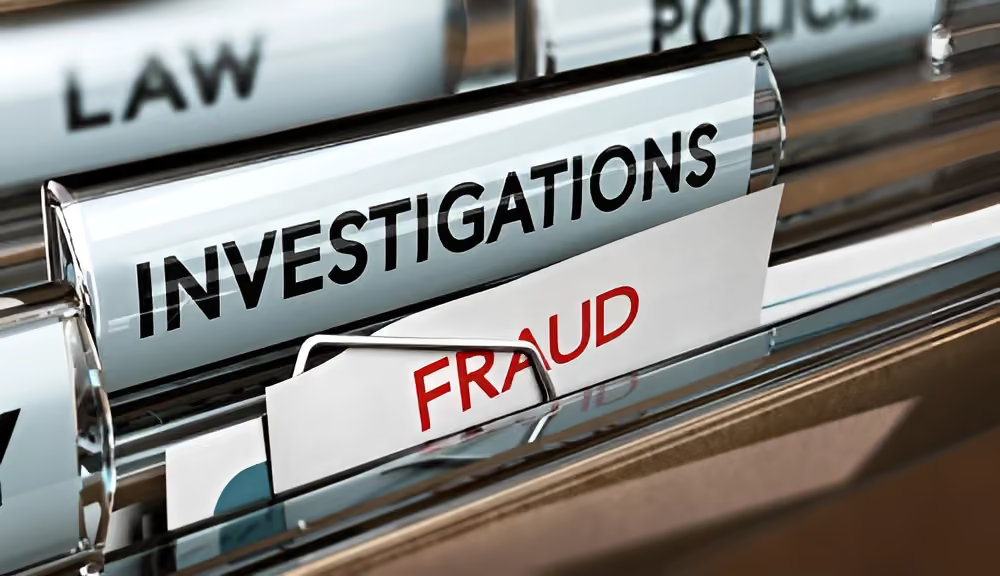
Why Do Regulators Consider Some Certifications Fraudulent?
April 3, 2023
|
5 min de lecture
A registered training organization in Australia was charged with issuing fraudulent certifications after participants left training early. The RCMP uncovered a counterfeiting operation selling fake H2S Alive and First Aid certifications to workers who had completed no training at all. This post examines what makes a certification fraudulent, what the legal consequences are for employers, and how identity verification and participation monitoring protect organizations from the same exposure.
Most people assume fraud means stealing or pretending to be someone else. In the world of workplace training and certification, the definition is broader than that. Fraud is also when a person receives credit for something they did not, in fact, do.
That definition has real consequences for employers, and two recent cases make it impossible to ignore.
When Certifications Become Fraudulent
In Australia, a registered training organization was charged with issuing false documents to multiple trainees. The organization marked participants as attending a full two-day training when they had actually left at noon each day. Participants received certifications to operate forklifts and erect scaffolding without meeting the full training requirements. The organization faced significant financial penalties as a result.
In Canada, the Royal Canadian Mounted Police uncovered a large-scale counterfeiting operation selling fake training certifications for safety credentials including H2S Alive and First Aid/CPR. H2S Alive is issued to people working with hydrogen sulphide, a highly flammable and toxic chemical. The people who purchased these certificates did not miss half a course. They did not participate in any training at all.
In both cases, employees and their colleagues were put at risk. That risk includes injury, loss of limb, and death.
Why This Happens More Often Than Organizations Realize
It is far too common for certificates to be issued without confirming identity or full participation. Most people do not think twice about the consequences of leaving a training session early. Few would assume that attending training where identity and attendance are not confirmed could result in a regulator declaring their certificate fraudulent.
But that is exactly what happens.
Employers carry a legal and moral responsibility to protect their employees and their organization from risk. Employee certifications are a promise to colleagues, clients, and regulators that your workforce meets industry standards. If you cannot demonstrate that your employees actually completed the required training, that promise is hollow and the certification that represents it may be worthless.
Without a trusted mechanism to verify identity and participation, the consequences range from reputational damage to financial penalties to legal action.
Who Is at Greatest Risk
Workers who operate heavy machinery or work with dangerous chemicals face the highest physical risk from fraudulent certifications. But employees across all roles must be able to demonstrate proof of training that holds up to scrutiny.
The Australian case resulted in financial penalties and a loss of public trust. For organizations in regulated industries, that combination of reputational and financial damage can have lasting consequences that far exceed the cost of implementing proper verification in the first place.
How Organizations Are Addressing This
The solution starts with how training organizations are selected and evaluated. For in-person training, careful vetting of providers is essential. For online training, which now accounts for the majority of workplace learning, the training organization must use an identity verification and participation monitoring solution.
Effective online proctoring uses a combination of human review and AI to verify that the right employee takes the right training and stays engaged throughout, without adding significant cost or administrative burden.
Safety-conscious businesses and industry safety organizations are increasingly requiring verified training, allowing them to take advantage of online delivery without compromising legal compliance or risk management. This trend is accelerating across industries where the consequences of unverified training are most severe.
Choosing verified online training gives employers documented evidence that their workforce completed training as required, evidence that holds up in regulatory investigations and legal proceedings.
{{post-cta}}

Who Is Liable When Proctoring Goes Wrong? Lessons From Global Legislation and Cases
May 2, 2024
|
5 min de lecture
Courts and regulators across Canada, the EU, and the United States have consistently found that organizations deploying proctoring tools bear liability for how participant data is handled, not the software vendors they use. CASL, GDPR, BIPA, and the Cleveland State Fourth Amendment case all point to the same conclusion: the organization collecting data is the accountable party. This post examines each case and framework and explains what organizations need to do to reduce their exposure.
When a proctoring tool violates a participant's privacy, who is responsible? The software vendor? The organization that deployed it? Both?
Recent legislation and court decisions from Canada, the UK, and the United States have answered this question with increasing clarity: the liability rests with the organization running the testing, not the software provider. For anyone deploying online proctoring, this is not an abstract legal point. It is a direct operational risk.
The Core Issue
Organizations that deliver online training and testing have a legitimate need to confirm who is taking their assessments and that participants are engaging in good faith. Meeting that need often requires collecting sensitive personal data: ID images, biometric verification, session recordings, and audio. The question of who bears legal responsibility for how that data is handled has been answered by courts and regulators in ways that most organizations have not fully reckoned with.
The consistent finding across multiple jurisdictions is that the data-collecting organization, not the software vendor, is the accountable party.
CASL: The Canadian Perspective
Canada's Anti-Spam Legislation was created in 2014 to reinforce best practices in electronic communications and combat spam and related cyber threats. Among its provisions, CASL requires organizations to obtain consent and written acknowledgement before using invasive computer programs, and to provide users with assistance in removing such programs afterwards.
Under CASL, software is considered invasive if it interferes with the user's control of their computer system by opening programs, printing, or accessing files without their knowledge, or if it changes system settings, preferences, or commands without their knowledge.
Online proctoring tools that block restricted sites, monitor web use, require camera access, or install browser extensions clearly fall within this definition. And most proctoring plugins do not provide uninstall assistance, remaining active by design after the session ends to reduce support overhead for the vendor.
The risk for organizations: CASL violations carry regulatory penalties of up to $10 million per violation. If your proctoring system leaves you liable to CASL noncompliance, that exposure belongs to you, not your vendor.
GDPR: The Global Standard That Places Liability on the Data Owner
The EU's General Data Protection Regulation has established a universal standard for data privacy that reaches any organization handling the personal data of EU residents, regardless of where that organization is based.
Under GDPR, the organization running the testing is the data controller, while the proctoring tool is the data processor. Fines for inappropriate collection, storage, transfer, or deletion of personal data fall on the data controller, not the data processor.
Ireland's Data Protection Commission made this distinction explicit in a judgment against Slane Credit Union Limited, stating that processors cannot be used by controllers as a legislative safety net, and that it is essential that due diligence is carried out to ensure the protection of personal data.
GDPR fines can reach 20 million euros or 4% of a company's total worldwide annual revenue, whichever is higher. The liability for how a proctoring vendor handles learner data belongs to the organization that chose to deploy it.
BIPA: The Illinois Warning
American organizations are increasingly coming under regulatory scrutiny for proctoring practices. Illinois' Biometric Information Privacy Act is one of the most consequential examples.
BIPA places liability on organizations when biometric data is collected or used in a way that violates participant privacy, including failing to secure written consent and failing to publish a retention schedule outlining when data will be permanently destroyed.
Two landmark cases illustrate how serious this exposure can be.
BNSF Railway Co. was subject to a $228 million jury verdict for scanning the fingerprints of truck drivers without consent. The case was eventually settled for $75 million. The third-party vendor that provided the scanning technology was not implicated in the charges.
White Castle System Inc. faced a separate BIPA lawsuit in which the Illinois Supreme Court ruled that claims accrue with each individual finger scan, exposing the restaurant chain to a potential liability in the billions of dollars. White Castle ultimately settled for approximately $10 million. Again, the vendor supplying the technology was not the party held accountable.
The pattern across both cases is consistent: the organization that deployed the biometric technology bore the liability. The software vendor did not.
Cleveland State: A Fourth Amendment Violation
In 2022, a federal court found that Cleveland State University's remote testing requirement of a room scan constituted unreasonable search and seizure in violation of students' Fourth Amendment rights.
Cleveland State used two separate proctoring providers to facilitate these scans. Both were named in the decision. Neither was fined. The university bore the consequences.
This case illustrates two important points. First, the room scan requirement itself was the violation, regardless of which vendor implemented it. Second, choosing a proctoring tool that conducts room scans does not transfer the legal risk to the vendor. The organization that required the scan is the one that faces the consequences when that requirement is found to violate participant rights.
What This Means for Online Training and Testing Providers
These cases are not outliers. They reflect a consistent and accelerating trend in privacy legislation globally: organizations are responsible for the actions of any third-party software, plugins, or services they deploy. Vendor liability does not substitute for organizational accountability.
For organizations delivering online training and testing, this has direct implications for vendor selection. The question is not just whether a proctoring tool works. The question is whether deploying it creates liability for your organization under CASL, GDPR, BIPA, or other applicable legislation.
The steps that reduce that liability are straightforward: choose a vendor with documented privacy practices, confirm that data handling complies with the legislation applicable to your jurisdiction and your learners' jurisdictions, require clear data deletion timelines, and ensure that any software deployed on learner devices complies with consent and removal requirements.
How Integrity Advocate Approaches This
Integrity Advocate is designed to reduce the compliance exposure that comes with deploying a proctoring tool, not to add to it.
No installation is required in most cases, which eliminates CASL's invasive software provisions entirely for the majority of deployments. Data is collected only for its stated purpose and deleted by default within 24 hours of session completion. Consent is obtained before any data collection begins. Data is stored in GDPR-designated jurisdictions. Room scans are optional rather than mandatory, and can be enabled or disabled based on the organization's assessment of their necessity and proportionality.
These are not policy commitments. They are architectural decisions built into how the platform works.
{{post-cta}}
Foire aux questions
Trouvez les réponses aux questions les plus fréquemment posées par nos clients.
When safety certifications can be completed by clicking through questions without genuine engagement, there is no way to confirm that the credential reflects real knowledge. In an audit or incident review, a certificate that cannot prove who earned it or under what conditions creates direct liability for the employer. As OSHA enforcement intensifies and clients and insurers demand proof of authenticity, unverifiable records are becoming construction's hidden vulnerability.
Integrity Advocate supports verification for the high-risk credentials most commonly required on construction sites, including Fall Protection, Confined Space Entry, WHMIS, OSHA 10 and 30, and Red Seal Trade Exams. The platform integrates directly with existing LMS platforms and external training vendor modules, adding identity verification and participation monitoring without requiring a separate system or software installation.
Integrity Advocate's hybrid model uses AI to monitor sessions and flag anomalies such as multiple faces in frame, device switching, or unauthorized materials, then routes flagged events to trained human reviewers who assess context and make defensible decisions. This gives construction organizations the scale of automation across remote sites and rotating crews, combined with the fairness and accuracy of human judgment. Every session produces audit-ready records that hold up under OSHA, WHMIS, or Red Seal review.
General contractors are accountable for the safety records of every subcontractor, temp crew, and vendor working under their supervision. Integrity Advocate provides a unified verification layer across all participating vendors, delivering defensible records that can be produced during audits or pre-qualification checks and enabling remote certification that does not delay project mobilization.
Yes. Integrity Advocate is browser-based and requires no software installation, working on any device including smartphones and tablets. This makes it practical for traveling technicians, field supervisors, and workers completing certifications between job sites or in areas with limited connectivity. The platform supports on-demand testing with no rigid scheduling requirements.