Ease of Use
+7 pts above avg
95%
IA
95%
AVG
88%

Recherches, guides et analyses concrètes sur la surveillance d'examens en ligne ; pour aider votre programme à obtenir des résultats équitables, fiables et défendables.
Évaluations sécurisées
Violations de données en plus de 12 ans
Taux de fidélisation client
Ressources publiées

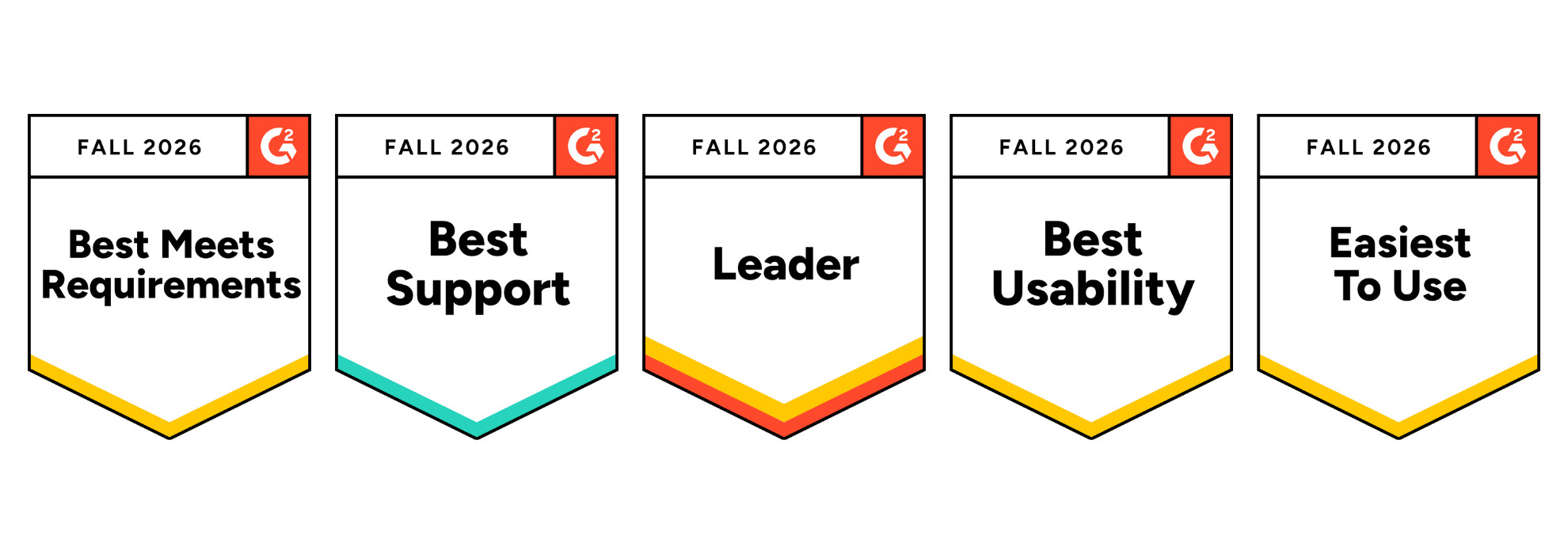
Integrity Advocate has been ranked #1 for Online Proctoring Usability on G2 for the third consecutive season. Based on verified customer feedback, we also earned five Fall 2026 badges recognizing usability, ease of use, support, and overall leadership.
Integrity Advocate has once again been ranked #1 in G2’s Usability Index for Online Proctoring, marking our third consecutive season at the top of the category.
In the Fall 2026 report, Integrity Advocate earned an overall G2 Index Score of 8.60, ahead of Honorlock, Proctorio, Quilgo, Talview, and Meazure Learning. We also earned five G2 badges, including Best Usability, Easiest to Use, and Best Meets Requirements, and were recognized as a Leader in the online proctoring category.
These recognitions are based on feedback from verified users. For us, that is what makes them meaningful. They reflect the experiences of the people who administer assessments, support test takers, and rely on the results.
Integrity Advocate earned the highest overall score in the Fall 2026 Online Proctoring Usability Index:
This is not only another first-place ranking. Our overall index score increased from 8.45 in Summer 2026 to 8.60 in Fall 2026, extending Integrity Advocate’s position at the top of the category.
G2 is the largest peer-to-peer software review platform in the world. Their Usability Index ranks products within a category based on three user-rated dimensions:
Every score comes from authenticated, verified reviews. Companies cannot pay to improve their position. There is no sponsorship or placement influencing the results. The index score reflects what users say about their experience with the product.
Integrity Advocate scored above the online proctoring category average across every usability measure included in the report:
User adoption stands out in particular. Integrity Advocate scored 17 points above the category average and 28 points above Honorlock.
That matters because a platform can have an impressive feature list and still create friction when people are asked to use it. Strong adoption suggests that the experience works in practice, not only during a product demonstration.
In addition to ranking first in the Usability Index, Integrity Advocate earned five G2 badges for Fall 2026 and was recognized as a Leader in online proctoring.
The Best Usability, Easiest to Use, and Best Meets Requirements badges reinforce something we have always believed: assessment security should be strong without being unnecessarily complicated.
Organizations should not have to choose between protecting an assessment and delivering an experience people can successfully use.
Online proctoring sits at a sensitive point in the assessment experience. Test takers may already be under pressure, while administrators need to protect exam integrity without creating unnecessary technical problems or support demands.
A platform that is difficult to access or manage can lead to:
Integrity Advocate was designed to remove those barriers.
There is no software to install and no browser extension to manage. The platform works across devices and browsers and integrates into existing assessment workflows. Test takers can access their assessments without navigating a separate, unfamiliar system, while administrators gain clear evidence and the context needed to evaluate results.
Usability is not separate from assessment integrity. When a platform works consistently, more attention can remain where it belongs: on the assessment and the credibility of its outcome.
Ease of use should never require an organization to compromise on accuracy or defensibility.
Integrity Advocate combines intelligent detection with Verified Human Review™ to provide context behind potential assessment violations. Instead of asking administrators to make decisions based only on an automated flag, our proctoring solutions can provide a clear, reviewable record supported by human judgment.
The result is an approach that protects assessment integrity while remaining practical for the people responsible for administering the program and fair to the people taking the assessment.
Across reviews, users consistently highlight the qualities reflected in the Fall 2026 report: straightforward implementation, ease of use for learners and administrators, seamless LMS integration, responsive support, and a privacy-first approach to assessment integrity.
As one verified user shared:
{{post-block-quote}}
That experience is what the rankings ultimately represent. Not simply a score, but whether the platform helps organizations protect assessments without placing unnecessary friction on their teams or test takers. View more customer stories here.
If you are currently comparing online proctoring solutions, usability should be evaluated alongside security, privacy, and review quality.
Consider asking:
The Fall 2026 G2 results provide an independent view of how leading platforms perform across many of these considerations.
Being ranked #1 once is exciting. Remaining at the top for three consecutive seasons tells a stronger story.
It shows that organizations do not have to accept unnecessary complexity as the price of protecting their assessments. Online proctoring can be secure, privacy-first, easy to administer, and straightforward for test takers.
That is the experience Integrity Advocate was built to provide, and we are grateful to every customer who shared their experience on G2.
The G2 ranking reflects a platform that has been in continuous operation for over a decade:
{{post-cta}}

April 7, 2026
|
5 min de lecture
AI tools have changed what cheating looks like, and most proctoring systems were built for a different problem. This post covers why an automated flag alone can't defend an outcome, and what a defensible assessment record requires in 2026.
We talk to a lot of programs right now that are dealing with the same thing. AI tools have changed what cheating looks like, and most proctoring systems were built for a problem that’s no longer the only one on the table. The gap is showing up in appeals, in complaints, and in outcomes that are getting harder and harder to defend.
The classic image of cheating a second phone, a friend on the other side of the room, notes taped to a monitor is still real. But it’s not the conversation we’re having with most programs anymore. The harder stuff is subtler.
AI writing tools can produce a natural, well-reasoned answer in seconds. Paraphrasing tools can disguise lifted content well enough to pass similarity checks. And the behavioral signals that used to flag something suspicious eye movements, typing pace, browser switching don’t tell you much when the assistance is happening invisibly, in another tab or on another device entirely.
The problem isn’t that AI cheating is impossible to catch. It’s that catching it requires a level of context and judgment that an algorithm alone doesn’t have.
An algorithm can tell you something looked unusual. It can’t tell you what actually happened or whether it matters. That part still requires a person.
Automated proctoring was designed to catch visible, definable behaviors tab switching, phone use, an unauthorized person on screen. For those cases, it works. But AI-assisted cheating often leaves no visible trace at all.
So when an automated system flags something in this environment, what it's actually telling you is: something here didn't fit the expected pattern. That's a starting point, not a conclusion. The problem is when programs treat it like one.
A wrongful finding based on an automated flag isn't just uncomfortable it can seriously damage a student's record or a professional's career. And when that decision gets challenged, "the system flagged it" isn't a defensible answer. You need a record of what actually happened and a human judgment behind the decision.
{{post-stat-highlight}}
Defensibility isn't really about technology. It's about being able to look anyone in the eye a student, a candidate, a regulator, a board member and explain clearly why a decision was made and what it was based on.
In this environment, that takes three things:
If an outcome from one of your proctored exams was challenged today by a student, a candidate, an employer, an accreditor what could you actually put in front of them? An automated flag, or a complete human-reviewed record of what happened and why?
For programs where the result genuinely matters, that's not a rhetorical question. It's the one worth answering before you need to.
We built Integrity Advocate around exactly this human review on every flagged session, a complete audit trail for every outcome, and the kind of defensibility that holds up when someone actually pushes back.
{{post-cta}}

October 18, 2021
|
5 min de lecture
Most proctoring platforms accumulate years of student identity data, session recordings, and behavioral information, and their privacy policies explicitly allow that data to be transferred in a business sale. This post examines the risk of data stockpiling, the 400,000-student breach that demonstrated what happens when that data is targeted, and how Integrity Advocate's data minimization approach eliminates the risk by not holding data that does not need to exist.
At the heart of genuine privacy protection is a concept that sounds straightforward: data minimization. If personal data is never collected in the first place, it cannot be leaked, hacked, or sold. It cannot be transferred to a buyer in an acquisition. It cannot appear on the dark web.
The problem is that data minimization runs directly against the financial incentives of most technology companies. User data increases company valuation. The more a platform collects and retains, the more it is worth to investors, acquirers, and advertisers. For proctoring companies specifically, years of student behavioral data, identity images, and session recordings represent a significant asset on the balance sheet.
That asset belongs to your learners. And most of them have no idea it is being accumulated.
A review of privacy policies from proctoring companies around the world reveals language like this:
"In the event we sell some or all of our assets, it is possible your personal data could be one of the assets transferred to the purchaser."
"We may disclose your personal information to third parties if we are involved in a merger, acquisition, or sale of any or all of our business and/or our assets to a third party."
These are not edge cases buried in fine print. They are standard provisions in proctoring company privacy policies. They mean that the identity images, session recordings, and behavioral data your learners submitted for the purpose of completing an assessment can be transferred to an entirely different organization without their knowledge or consent.
The volume of data retained and the length of time it is kept directly increases the likelihood that it will be used, intentionally or unintentionally, in ways that harm the individuals it belongs to.
Encryption certificates and security procedures are frequently cited as assurances. They are not guarantees. A well-known proctoring service was breached despite these assurances, resulting in years of data involving over 400,000 students being obtained illegally and shared on the dark web.
The lesson is not that security measures are useless. It is that the most effective security measure is not having the data to begin with. Why would anyone hack a system that holds nothing of value?
Data minimization is not a policy position. It is an architectural decision. It means building a platform that:
Integrity Advocate deletes session recordings and identity images within 24 hours of completion for sessions with no violations. Personal data is not included as a transferable asset in any business transaction. As a Canadian company operating outside US jurisdiction, the data available on the vast majority of users in the unlikely event of a compelled disclosure would be limited to a name and a facial image represented as a string of code.
Before selecting a proctoring provider, organizations should be able to answer these questions from the vendor's privacy policy and data processing documentation:
If the answers are not clearly documented, that is itself an answer.
{{post-cta}}

March 18, 2021
|
5 min de lecture
Online training completion records are not the same as verified training, and courts are making that distinction with real consequences for employers. This post examines the R. v. Rose's Well Services case, the legal standard for due diligence in workforce training, and what organizations in high-risk industries need to do to ensure their online training holds up when it matters most.
Your organization spent money on an online safety training program. Employees completed it. You have completion records. You feel confident that if something goes wrong, you can demonstrate due diligence.
You may be wrong.
Courts and regulators are increasingly drawing a distinction between online training that can be verified and online training that cannot. If your platform cannot confirm who completed the training and whether they actually participated, that training may not count when it matters most.
Workforce training moved from the classroom to the screen gradually, then all at once. The cost savings are real, the scheduling flexibility is genuine, and for many organizations online training is now the only practical option for reaching a distributed workforce.
But the shift to online created a problem that classroom training never had: how do you prove that the right person completed the training, and that they actually engaged with it rather than clicking play and walking away?
In a physical classroom, an instructor can confirm attendance and participation. Online, without the right technology, you cannot. And in high-risk industries, that gap has real legal consequences.
The landmark case of R. v. Rose's Well Services Ltd. made this problem impossible to ignore. During the investigation, an employee admitted to completing online training on behalf of other employees. The employer had training records. The employer had completion data. None of it mattered, because the records could not demonstrate that the right people had actually done the training.
Courts determining fault in workplace incidents use due diligence as a central test. Did the employer take all reasonably practical steps to prevent the incident? Providing online training that cannot be verified does not satisfy that test.
The legal counsel of a multinational energy company put it plainly:
"Making our safety orientation and training available on the web and requesting that personnel take the training without the ability to provide documented evidence that personnel had actually completed the required safety orientation and training would, in my opinion, not be reviewed positively in an analysis of whether a company had satisfied its due diligence requirements in the event of an incident. Due diligence is a company's only defense against a strict liability offense."
That is not a hypothetical risk. It is a legal opinion from inside a major organization that had already thought carefully about what their online training program would look like in front of a judge.
Without identity verification, there is no way to confirm that the person who registered for the training is the person who completed it. The Rose's Well Services case is not an isolated incident. Proxy completion is a known problem in workplace training, particularly for mandatory compliance courses that employees view as a checkbox rather than a learning opportunity.
Completion records show that a course was finished. They do not show that anyone watched it, read it, or absorbed any of it. A learner who clicks play, leaves the room, and returns to click through the assessment has a completion record identical to one who engaged with every module. In a regulatory investigation, that distinction matters.
Even if training was completed legitimately, an employer who cannot provide documented evidence of who completed it and how they participated is in a weak position. Regulators and courts do not give credit for training that cannot be verified.
Some organizations, including Spectra Energy, have responded to this problem by removing online training from high-risk content categories entirely, citing security concerns around confirming student attendance. That is a significant operational step backward.
The Chartered Professionals in Human Resources of Alberta has taken a different position, advising that technology exists that mitigates the issues facing compromised training by verifying both the identity and participation of trainees.
That technology exists. The question is whether your organization is using it.
Verified online training confirms three things that unverified training cannot:
Integrity Advocate has worked with organizations across construction, mining, oil and gas, and other high-risk industries to help hundreds of thousands of personnel complete training online in a way that meets regulatory standards and holds up as evidence of due diligence.
The difference between online training that counts and online training that does not is not the content of the course. It is whether you can prove who did it and that they were there for it.
Organizations running online workforce training face a straightforward decision. Implement training without identity verification and participation monitoring, and accept the legal and regulatory exposure that comes with it. Or implement training with the technology to verify both, and be able to demonstrate due diligence if it ever matters in court.
With Integrity Advocate, that second option does not require rebuilding your training program. It works with your existing LMS and course content, adding the verification layer that transforms a completion record into a defensible document.
{{post-cta}}

May 14, 2026
|
5 min de lecture
When Chris Viso founded My Food Service License, he set out to do what many thought was impossible: move an in-person food protection training program fully online. ANSI-CFP's accreditation requirements for food management exams are extensive, requiring proctored exams, verified identification, and strict monitoring to prevent notes, cellphones, or outside assistance. Integrity Advocate became a trusted partner throughout the two-year process of building the exam and securing accreditation, and remains the proctoring foundation behind My Food Service License's continued growth today.
When Chris Viso founded My Food Service License, he was taking on what many thought would be an impossible task: moving an in-person training program into the internet age.
{{post-block-quote}}
Moving things online was the obvious solution, but there were serious regulatory hurdles to clear first.
"ANSI-CFP requirements for food management exams are extensive," Viso explained. "It has to be a proctored exam; you must verify the identification of the individual taking it. The examinee can't be with another person; they can't have things on their desk, they can't use notes, have cellphones, all that has to be strictly monitored. We have to prove that we're doing those things to the accreditation board."
The My Food Service License team spent two years building an online exam and completing the accreditation application. Throughout the process, Integrity Advocate was a trusted partner that helped bring Viso's vision to life.
From the start, Integrity Advocate was committed to helping My Food Service License get off the ground. "We came across Integrity Advocate early in the planning stages. They genuinely seemed excited about what we were doing; they had open arms in terms of, 'How can we get you there?'" Integrity Advocate's technical expertise and experience in the sector made them a trusted partner throughout the process, from understanding ANSI-CFP regulations to building out a rule set that satisfied them.
"I would highly recommend Integrity Advocate to anyone doing high- or low-stakes testing," Viso said. "The relationship, the support, the overall product is top of the line."
Integrity Advocate stood out because it didn't require a complicated process. There was nothing to download and no access code; users kept using what they were already familiar with. A key part of that was mobile support and the ability to deliver around-the-clock results, both major advantages for busy food service workers.
"The big seller was on-demand access," Viso added. "That, in and of itself, had the ability to put us out in front of our competitors."
Integrity Advocate and My Food Service License were aligned on the vision, but the real test was still to come. Going live and ironing out last-minute issues can challenge any relationship. Fortunately, My Food Service License had a trusted partner in Integrity Advocate, and the two organizations worked together to ensure a successful launch.
"It was super easy," Viso said. "It really says a lot about how Integrity Advocate was committed to resolving anything that came up; I've never experienced that type of service from any partner I've ever had."
Since going live in September 2023, "we're growing month over month," Viso said. "Integrity Advocate has continued to provide the support we need. When things came up, they were resolved quickly. And as we've grown, they've continued to deliver a high level of service."
My Food Service License's online training and exam program may be straightforward, but its impact is significant. Properly trained and certified food service staff are the first line of defense against foodborne illness. Together, My Food Service License and Integrity Advocate are making rigorous training easy to access, without compromising the integrity and value of the certification process.
{{post-cta}}

October 21, 2025
|
5 min de lecture
Private security is one of the fastest-growing sectors in North America, with more than 1.1 million guards employed in the US alone. Many earn their credentials through unproctored online exams that are easy to manipulate and nearly impossible to defend in an audit. A single lapse, whether an untrained guard or an expired credential, can lead to use-of-force incidents, lost client contracts, and license jeopardy. This post examines the verification gap in private security credentialing, the regulatory tightening underway in states including California, New York, and New Mexico, and how hybrid proctoring converts a vulnerable step in the talent pipeline into a source of defensible proof.
In an industry built on vigilance, one of the biggest risks often hides in plain sight: unverified employee certifications.
Across North America, private security is one of the fastest-growing sectors, employing more than 1.1 million guards in the U.S. and over 100,000 in Canada. Many earn their credentials through un-proctored online exams that are easy to manipulate and nearly impossible to defend if audited.
A single lapse, such as an untrained guard or expired credential, can lead to use-of-force incidents, lawsuits, or terminated client contracts. In a field built on trust and liability protection, that’s a risk no firm can afford.
Every state and province has its own licensing body, from California’s BSIS Guard Card to Ontario’s 40-hour Basic Security Training. While the curriculum is standardized, the testing process often is not.
Some training providers still issue certificates through basic online exams without confirming who took the test or how it was completed. This opens the door to impersonation, collaboration, or the use of unauthorized aids, issues that stay hidden until a compliance audit or incident brings them to light.
When regulators or clients request proof, “we trusted our vendor” will not hold up. You need verifiable, auditable evidence that every guard earned their credential legitimately.
State licensing boards and auditors are tightening their expectations. Several states, including California, New York, and New Mexico, have strengthened requirements for identity verification in guard licensing renewals and compliance reviews in 2024.
For larger firms and government contractors, missing verification documentation can delay license renewals, restrict site access, or lead to disqualification in competitive bids. The shift from “trained” to “provably trained” is already underway.
Proctoring is the process of confirming a test taker’s identity and safeguarding the integrity of the exam. In practice, modern online proctoring combines automated monitoring with human review to validate who is testing and how they complete the assessment.
How it closes the gap:
For private security, verified testing converts a vulnerable step in the talent pipeline into a source of proof. Each credential is tied to the right person, completed under valid conditions, and backed by records you can defend.
Turnover is high and new hires must get licensed quickly to meet client demand. Verified online testing lets recruits certify remotely, saving scheduling time while maintaining defensible compliance. Firms can scale faster without risking audit failures or fraudulent completions.
In hospitality and nightlife settings, liability is constant. A verified certification process provides proof that staff are trained in de-escalation and use-of-force protocols, protecting both employers and clients if incidents occur.
For armed roles requiring firearms or use-of-force certification, regulators and insurance carriers expect evidence that each guard completed training personally and ethically. Verified testing creates the defensible record needed for renewal cycles and legal review.
Supervisors are responsible for verifying dozens of licenses and renewals at once. Hybrid proctoring eliminates manual record-checking by providing automated audit trails and verifiable data, reducing administrative load and ensuring compliance readiness at all times.
Private investigators operate under strict confidentiality and often handle sensitive information that can influence legal outcomes. For them, verified training is not just a requirement but a professional safeguard.
Beyond compliance, verified exams reduce operational friction. Security firms using verified online proctoring report:
Verification isn’t just about preventing cheating. It’s about building efficiency, trust, and defensibility into your entire credentialing process.
Trust in private security is earned by proving readiness, not just claiming it. Verifiable credentials turn training records into operational assurance. They help you pass client audits, maintain site access, and resolve incident reviews with clarity. With privacy-by-design testing and retrievable evidence, you protect your people, your clients, and your reputation without slowing the work.
Integrity Advocate focuses on the moments that matter in certification, from enrollment to renewal, so your team stays provably qualified.
See how Integrity Advocate can help security organizations protect compliance, reduce liability, and strengthen trust. Request a Demo
{{post-cta}}

May 6, 2024
|
5 min de lecture
The cannabis industry is projected to reach $46 billion in US sales by 2028, but as growth accelerates, compliance risks are multiplying just as fast. When employee certifications like CannSell, SellSafe, and Selling It Right are completed online without identity verification, compliance becomes a paper exercise that fails when regulators look closely. This post examines the real cost of unverifiable cannabis certifications, the financial penalties and license risks that follow, and how Integrity Advocate's hybrid proctoring model transforms compliance from a liability into a competitive advantage.
In a rapidly growing, highly regulated industry, integrity in certification is the difference between thriving and losing your license.
{{post-stat-highlight}}
In most U.S. states and all Canadian provinces, regulators require cannabis retailers and producers to ensure that every employee handling, selling, or cultivating cannabis completes state-mandated training such as CannSell, SellSafe, or Selling It Right. These certifications cover responsible sales, product safety, and ID verification.
But here’s the problem: many of these exams are taken online without supervision. When there’s no way to verify who actually completed the test, compliance becomes an illusion.
For many dispensaries, certification has become a check-the-box exercise, a formality that is more about paperwork than real protection. Yet the fallout from one unverified certification can be severe:
A fake or incomplete certification does not just fail an audit, it endangers your entire operation.
Unlike traditional retail, cannabis employers face a unique mix of legal, ethical, and reputational risk.
Training verification is not just about following rules, it is about proving to regulators, investors, and customers that your operation values integrity and accountability. That is where verified, proctored certification comes in.
Modern tools that combine AI-assisted proctoring with human review allow employees to complete their certifications anywhere without compromising authenticity.
This hybrid approach ensures every exam taker is who they claim to be and provides an audit-ready record that stands up to any compliance review.
This is not about punishing employees, it is about protecting them too. Budtenders and cultivators are often the first line of defense against compliance breaches, and most want to do their jobs right. Verified certification:
According to a 2025 Deloitte Cannabis Report, 83 percent of consumers say they are more likely to trust and purchase from cannabis retailers who emphasize compliance and product integrity.
That trust begins with verified credentials.
Integrity Advocate helps cannabis businesses across North America ensure their certifications are both legitimate and defensible.
Our system blends advanced AI detection with human judgment to confirm authenticity, safeguard your license, and protect your team, all while fitting seamlessly into existing training workflows such as CannSell and SellSafe.
With verifiable records in place, your next audit is not a stress test, it is a showcase of your professionalism.
In cannabis, integrity is not optional. It is a competitive advantage.
Protect your license. Strengthen your reputation. See how verified proctoring keeps cannabis businesses compliant →
{{post-cta}}

October 20, 2025
|
5 min de lecture
Every clinician's credential is a promise that they have been properly trained, evaluated, and are ready to deliver safe care. But when mandatory healthcare training is completed online without identity verification or participation monitoring, institutions are left trusting what they cannot prove. This post examines the certification integrity gap across hospitals, clinics, and long-term care settings, the audit and patient safety risks that unverifiable credentials create, and how Integrity Advocate's hybrid proctoring model delivers defensible, audit-ready verification across the healthcare compliance continuum.
Every clinician’s credential is a promise, that they’ve been properly trained, evaluated, and are ready to deliver safe, high-quality care. But in an increasingly digital certification world, that promise is only as strong as the system verifying it.
Today, many healthcare professionals complete mandatory training online, from BLS renewals and HIPAA compliance to advanced board certifications, but without a verification layer, institutions are left trusting what they can’t prove.
A certificate that can’t be verified isn’t just a compliance concern. It’s a patient safety issue.
Unchecked, this gap exposes hospitals and care providers to:
When healthcare depends on trust, verification isn’t optional, it’s foundational.
From onboarding new nurses to renewing advanced practice licenses, the process is complex, high-volume, and often fragmented across departments and systems.
Digital training platforms and e-learning modules have made it easier to deliver education , but not necessarily to prove that it was completed correctly.
Key challenges include:
In healthcare, proctoring isn’t about policing employees, it’s about protecting patients.
A proctor serves as an independent verifier, confirming that the right individual completed the exam under compliant conditions.
When the certification validates someone’s ability to perform CPR, handle patient data, or manage infection control, proctoring becomes a matter of patient safety and regulatory integrity.
Effective proctoring transforms online certification from a “self-attested” task into a defensible, auditable process, one that holds up under Joint Commission inspections or Ministry of Health reviews.
Traditional proctoring systems were built for academic exams, not healthcare operations. They assume static schedules, single locations, and lengthy exam sessions, a mismatch for shift-based clinicians and mobile care teams.
Integrity Advocate’s hybrid verification model bridges that gap. Designed for high-stakes industries like healthcare, it combines AI and human review to protect integrity while minimizing disruption to patient care.
Here’s how it works:
This model delivers:
“A certificate means little if you can’t verify who earned it. In healthcare, that difference can impact lives. Our hybrid model ensures every credential is defensible, to regulators, insurers, and patients alike.” Brandon Smith, CEO, Integrity Advocate
Hospitals operate under constant scrutiny from accreditation bodies and auditors. One unverifiable credential, a lapsed ACLS certification or falsified HIPAA training, can jeopardize patient safety and accreditation status.
Integrity Advocate gives hospital compliance teams defensible evidence that every training requirement was completed by the correct individual, reducing audit risk and protecting institutional reputation.
Top Certifications:
BLS, ACLS, HIPAA, OSHA Bloodborne Pathogens, CE/CME renewals
Primary Benefit:
Audit-proof credentialing that reinforces a culture of safety and accountability.
Clinics and outpatient centers often face the same compliance requirements as hospitals, without the same administrative infrastructure. With staff rotating between sites or working remotely, traditional proctoring isn’t practical.
Integrity Advocate enables remote, real-time verification that aligns with flexible work models. Staff can complete certifications from any device while maintaining compliance integrity.
Top Certifications:
Privacy training, infection control, telehealth competency, continuing education modules
Primary Benefit:
Centralized verification and recordkeeping across multiple locations and telehealth teams.
In long-term care, compliance isn’t just regulatory, it’s moral. Facilities depend on consistent, verified training to prevent falls, medication errors, and infection outbreaks.
Integrity Advocate helps LTC and continuing education providers ensure that required credentials (CPR, infection prevention, WHMIS/OSHA, abuse prevention) are verifiable, defensible, and renewals are tracked automatically.
Top Certifications:
BLS, First Aid, WHMIS/OSHA, Resident Safety, Abuse Prevention
Primary Benefit:
Increased defensibility and confidence for audits, inspections, and insurance renewals.
Healthcare organizations face rising regulatory pressure and shrinking resources. According to recent compliance studies, audit frequency rose by 38% in 2024, while staff turnover hit record highs.
Verification closes the gap between training completed and competency proven. It transforms compliance from a reactive process into a safeguard for patient safety and institutional trust.
Patient safety begins long before anyone steps into a hospital room, it starts with verified credentials. In healthcare, the integrity of your certifications is the integrity of your care. See how leading healthcare organizations are closing the certification integrity gap. Request a Demo
{{post-cta}}

October 20, 2025
|
5 min de lecture
The construction industry spends an estimated $1.6 billion annually on safety training. Yet in 2023, nearly one in five workplace fatalities still occurred in construction. When online certifications can be completed by clicking through questions without genuine engagement, the credential offers the appearance of compliance without the substance. This post examines the certification integrity gap in construction, how unverified credentials create liability for general contractors and specialty trades alike, and how Integrity Advocate's hybrid proctoring model delivers audit-ready verification that holds up under OSHA, WHMIS, and Red Seal review.
Every construction leader understands the stakes: a single safety lapse can cost lives, delay multimillion-dollar projects, and tarnish reputations. Yet despite billions invested in training and certification each year, preventable incidents persist.
{{post-stat-highlight}}
Unverified online certifications are fast becoming construction’s hidden vulnerability. Without verification, a “passed” test may only prove that someone clicked through questions, not that they understand life-critical protocols. In an audit or an incident review, that’s a liability no company can afford.
With remote training and hybrid workforces on the rise, the way construction professionals earn their safety and trade credentials has changed. But verification hasn’t kept pace.
Key challenges include:
Before diving into solutions, it’s worth clarifying what proctoring really means in the world of safety training. In construction, the stakes are quite high, these aren’t just grades, they’re life-critical credentials that authorize someone to operate equipment, enter confined spaces, or oversee site safety.
A proctor, whether human, AI, or both, acts as an independent witness during the certification exam. Their job is to confirm that the right person is taking the test, that the environment is secure (no outside help, no unauthorized devices), and that results are credible enough to stand up under regulatory scrutiny.
When done right, proctoring transforms certification from a “check-the-box” exercise into a defensible process that protects workers, employers, and the public. That’s where Integrity Advocate’s approach goes beyond traditional models.
Traditional, classroom-style proctoring wasn’t designed for rotating crews, remote sites, or tight build schedules. Integrity Advocate adapts proctoring to how construction really works: on demand, in the field, and defensible.
How it works: hybrid by design
Our system monitors each session and flags anomalies, for example, multiple faces in frame, device switching, or the presence of unauthorized materials, then routes them to trained human reviewers who ensure fairness, context, and accurate decisions. Automation gives you scale, humans provide judgment.
What you get: outcomes that hold up under scrutiny
“A certificate means little if you can’t verify who earned it. Our hybrid model ensures every credential is defensible, to regulators, insurers, and clients alike.” — Brandon Smith, CEO, Integrity Advocate
For general contractors, compliance risk doesn’t stop at your payroll. Every subcontractor, temp crew, and vendor working under your supervision impacts your safety record.
Because many projects require proof of OSHA 10/30 or provincial equivalents, you’re accountable for ensuring every badge on site reflects legitimate training. There are some issues that make this harder than it should be:
How Integrity Advocate helps:
The result: General contractors gain peace of mind knowing certifications can be trusted, and project risk is measurably reduced.
In electrical, mechanical, and other specialty trades, a single oversight can be catastrophic. Arc flash hazards, confined spaces, and fall protection failures often trace back to incomplete or falsified training records.
Industry snapshot:
Smaller firms often rely on external training vendors, which can lead to technicians sharing logins or completing online assessments without supervision, ultimately reducing control over verification quality.
How Integrity Advocate helps:
Impact: Electrical and specialty trades can now demonstrate compliance not just on paper, but in proof that holds up under inspection or litigation.
Union-affiliated construction programs often maintain rigorous training pipelines through joint apprenticeship training committees (JATCs) and safety schools. Non-union contractors, by contrast, frequently rely on a mix of vendor-provided e-learning and on-site toolbox talks.
For unionized organizations, the challenge lies in verifying distributed training across locals and maintaining uniform standards, as unverified digital testing can quickly erode the hard-earned trust of regulators and clients.
For non-union firms, limited internal training infrastructure often leads to reliance on external providers that may not guarantee exam integrity, putting project bids at risk when verifiable credentials are required for participation.
How Integrity Advocate bridges both worlds:
Compliance without verification is a false sense of security. In an industry where one overlooked hazard can stop a project, or cost a life, construction leaders must evolve from “certified” to “verified.”
{{post-cta}}

October 17, 2025
|
5 min de lecture
Restaurants and hospitality operators invest in food safety and alcohol service certifications to protect their business, their team, and the public. But when those exams are taken online without identity verification or participation monitoring, the certification offers the appearance of compliance without the substance. This post examines the hidden costs of unverifiable certifications in food service, how impersonation and exam shortcuts create real liability, and how Integrity Advocate integrates with ServSafe, TIPS, FoodSafe, and Smart Serve to deliver verifiable, audit-ready compliance without disrupting operations.
Every restaurant leader knows the checklist: ServSafe, TIPS, Food Handler, Smart Serve. You invest in training, pay the fees, and trust your team to complete the certifications that keep your business compliant. But what if those certifications, the very ones meant to protect your reputation, aren’t as secure as they seem?
Across North America, restaurants are facing mounting pressure from regulators, insurers, and brand auditors to prove their certifications are valid. And with exams increasingly taken online, the risk of fraud, impersonation, and shortcut-taking has never been higher.
When a certification lacks integrity, it’s more than a technicality, it’s a liability.
In short, paper-based trust isn’t enough in a digital world.
Integrity Advocate was built to solve this problem, helping organizations in food service, hospitality, and beyond safeguard both their certification integrity and their reputation.
Here’s how it works: simple, secure, and human-first.
Integrity Advocate integrates directly into the systems you already rely on, like ServSafe, TIPS, FoodSafe, or your existing LMS or training portal, without requiring any downloads, separate logins, or complicated setup. Employees launch their certification exam just as they normally would, and our solution runs quietly behind the scenes, verifying their identity and maintaining exam integrity from start to finish.
Our platform is built on Privacy by Design, meaning we collect only what’s necessary to confirm identity and compliance, nothing more. Test takers aren’t subjected to invasive screen captures or unnecessary data storage. Instead, they experience a respectful, transparent process that keeps them focused on the assessment itself.
“Integrity Advocate works on all devices. We don’t hear any complaints, you don’t need to download any applications. The validation is very quick, the turnaround is very quick, the support is great, and it’s on demand.” Ellie Johnson, Operations Manager, Smart Serve Ontario (Responsible Alcohol Service Program) See Smart Serve’s Experience →
During the exam, AI technology detects behaviors that could compromise integrity, such as another person entering the frame, device switching, or unauthorized materials in view. When something is flagged, a certified human reviewer steps in to interpret context, eliminating false positives and ensuring fair, accurate results.
Because Integrity Advocate works within existing environments, it adapts to the unique demands of restaurants and hospitality operations: high turnover, tight schedules, and constant compliance pressure. The result is a secure, no-install, hybrid proctoring solution that protects your brand, respects your team, and simplifies compliance without disrupting service or adding complexity.
Our platform combines AI-driven detection with human review, ensuring every exam session is verified, secure, and defensible in an audit.
Restaurants don’t have time to coordinate in-person testing or manage complex software. That’s why Integrity Advocate integrates directly with leading certification providers, including ServSafe, TIPS, and FoodSafe, so your staff can certify from anywhere, anytime, on any device.
With no installs, no scheduling headaches, and no disruption to service, your teams can stay compliant without missing a shift.
Food safety and alcohol compliance shouldn’t be about checking a box, they should be about protecting people, communities, and livelihoods.
At Integrity Advocate, we believe technology should simplify compliance, not complicate it. That’s why our approach is rooted in Privacy by Design, Human Oversight, and Seamless Integration, the same principles that guide every industry we serve.
“I would highly recommend Integrity Advocate to anyone doing high- or low-stakes testing. The relationship, the support, the overall product is top of the line.”
Chris Viso, Founder, My Food Service License (ServSafe Training Partner) Read the Story
Request a Demo to see how food service & hospitality institutions across North America are transforming compliance from a liability into a competitive advantage.
{{post-cta}}