Ease of Use
+7 pts above avg
95%
IA
95%
AVG
88%

Recherches, guides et analyses concrètes sur la surveillance d'examens en ligne ; pour aider votre programme à obtenir des résultats équitables, fiables et défendables.
Évaluations sécurisées
Violations de données en plus de 12 ans
Taux de fidélisation client
Ressources publiées

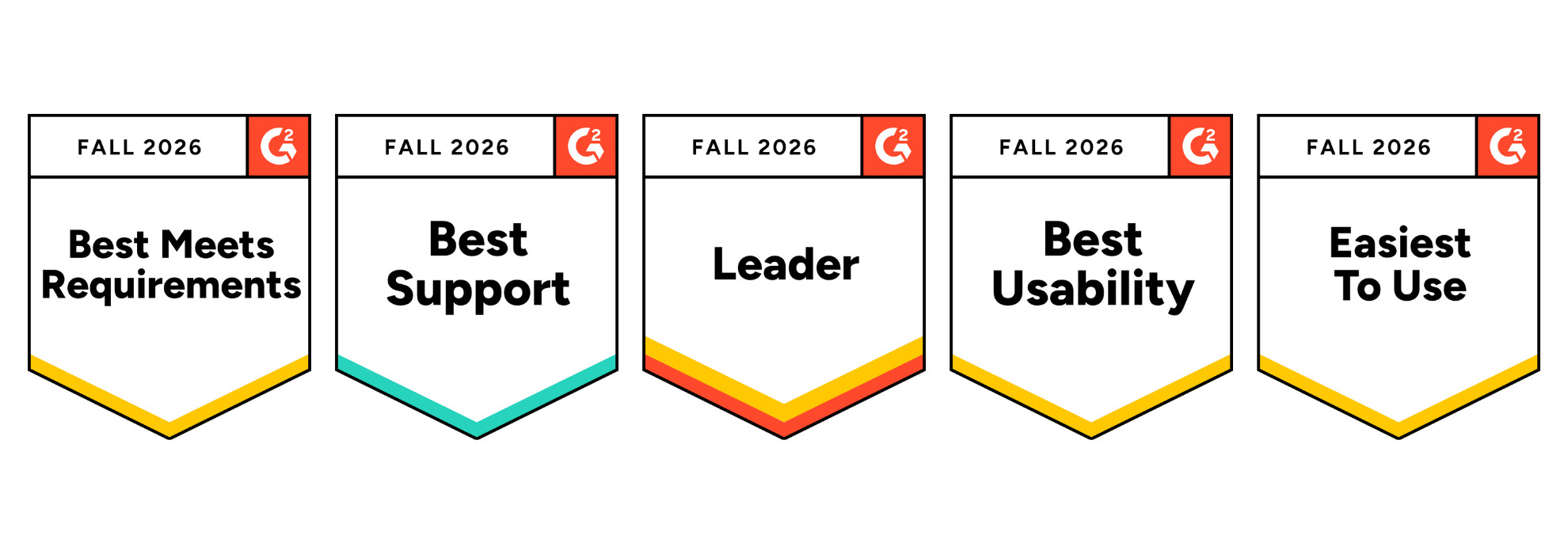
Integrity Advocate has been ranked #1 for Online Proctoring Usability on G2 for the third consecutive season. Based on verified customer feedback, we also earned five Fall 2026 badges recognizing usability, ease of use, support, and overall leadership.
Integrity Advocate has once again been ranked #1 in G2’s Usability Index for Online Proctoring, marking our third consecutive season at the top of the category.
In the Fall 2026 report, Integrity Advocate earned an overall G2 Index Score of 8.60, ahead of Honorlock, Proctorio, Quilgo, Talview, and Meazure Learning. We also earned five G2 badges, including Best Usability, Easiest to Use, and Best Meets Requirements, and were recognized as a Leader in the online proctoring category.
These recognitions are based on feedback from verified users. For us, that is what makes them meaningful. They reflect the experiences of the people who administer assessments, support test takers, and rely on the results.
Integrity Advocate earned the highest overall score in the Fall 2026 Online Proctoring Usability Index:
This is not only another first-place ranking. Our overall index score increased from 8.45 in Summer 2026 to 8.60 in Fall 2026, extending Integrity Advocate’s position at the top of the category.
G2 is the largest peer-to-peer software review platform in the world. Their Usability Index ranks products within a category based on three user-rated dimensions:
Every score comes from authenticated, verified reviews. Companies cannot pay to improve their position. There is no sponsorship or placement influencing the results. The index score reflects what users say about their experience with the product.
Integrity Advocate scored above the online proctoring category average across every usability measure included in the report:
User adoption stands out in particular. Integrity Advocate scored 17 points above the category average and 28 points above Honorlock.
That matters because a platform can have an impressive feature list and still create friction when people are asked to use it. Strong adoption suggests that the experience works in practice, not only during a product demonstration.
In addition to ranking first in the Usability Index, Integrity Advocate earned five G2 badges for Fall 2026 and was recognized as a Leader in online proctoring.
The Best Usability, Easiest to Use, and Best Meets Requirements badges reinforce something we have always believed: assessment security should be strong without being unnecessarily complicated.
Organizations should not have to choose between protecting an assessment and delivering an experience people can successfully use.
Online proctoring sits at a sensitive point in the assessment experience. Test takers may already be under pressure, while administrators need to protect exam integrity without creating unnecessary technical problems or support demands.
A platform that is difficult to access or manage can lead to:
Integrity Advocate was designed to remove those barriers.
There is no software to install and no browser extension to manage. The platform works across devices and browsers and integrates into existing assessment workflows. Test takers can access their assessments without navigating a separate, unfamiliar system, while administrators gain clear evidence and the context needed to evaluate results.
Usability is not separate from assessment integrity. When a platform works consistently, more attention can remain where it belongs: on the assessment and the credibility of its outcome.
Ease of use should never require an organization to compromise on accuracy or defensibility.
Integrity Advocate combines intelligent detection with Verified Human Review™ to provide context behind potential assessment violations. Instead of asking administrators to make decisions based only on an automated flag, our proctoring solutions can provide a clear, reviewable record supported by human judgment.
The result is an approach that protects assessment integrity while remaining practical for the people responsible for administering the program and fair to the people taking the assessment.
Across reviews, users consistently highlight the qualities reflected in the Fall 2026 report: straightforward implementation, ease of use for learners and administrators, seamless LMS integration, responsive support, and a privacy-first approach to assessment integrity.
As one verified user shared:
{{post-block-quote}}
That experience is what the rankings ultimately represent. Not simply a score, but whether the platform helps organizations protect assessments without placing unnecessary friction on their teams or test takers. View more customer stories here.
If you are currently comparing online proctoring solutions, usability should be evaluated alongside security, privacy, and review quality.
Consider asking:
The Fall 2026 G2 results provide an independent view of how leading platforms perform across many of these considerations.
Being ranked #1 once is exciting. Remaining at the top for three consecutive seasons tells a stronger story.
It shows that organizations do not have to accept unnecessary complexity as the price of protecting their assessments. Online proctoring can be secure, privacy-first, easy to administer, and straightforward for test takers.
That is the experience Integrity Advocate was built to provide, and we are grateful to every customer who shared their experience on G2.
The G2 ranking reflects a platform that has been in continuous operation for over a decade:
{{post-cta}}

December 16, 2025
|
5 min de lecture
For many administrators, the most time-consuming part of secure assessment delivery happens after the exam: reviewing sessions, sorting through flags, watching recordings, and trying to turn raw data into decisions the team can stand behind. Most proctoring tools generate a lot of data but very little clarity, leaving administrators to manually reconstruct context that should already be documented. This post examines what administrators actually need from proctoring reporting, why unclear results become a bottleneck as programs scale, and how audit-ready reporting shifts proctoring from a reactive process to a streamlined one.
For many administrators, the most time-consuming part of delivering secure assessments doesn’t happen during the exam. It happens after.
Reviewing sessions. Sorting through flags. Watching recordings. Responding to questions from learners, instructors, auditors, or compliance teams. Trying to turn raw data into decisions your team can confidently stand behind.
As online assessments continue to scale, institutions are realizing that how results are delivered matters just as much as how exams are monitored. In 2026 and beyond, proctoring success is increasingly defined by whether teams receive admin-ready results supported by audit-ready online proctoring reporting, without added complexity or guesswork.
Many proctoring tools generate a lot of data, but very little clarity. Administrators are often left with:
This creates a heavy time burden for teams already balancing multiple programs, stakeholders, and compliance requirements. It also makes audits and appeals more stressful than they need to be.
When reporting isn’t audit-ready, administrators spend valuable time recreating context after the fact instead of relying on documentation that’s already clear, complete, and defensible.
As Brandon Smith has noted in his analysis of where the proctoring market is heading, institutions are moving away from surveillance-heavy tools and toward solutions that deliver trust, transparency, and operational efficiency.
In practice, administrators want reporting that:
Admin-ready results don’t just inform decisions, they accelerate them.
As assessment programs grow in size and complexity, unclear reporting becomes a bottleneck. Admin-ready results supported by audit-ready reporting help teams:
Instead of spending hours piecing together timelines and context, administrators can focus on outcomes and next steps.
Integrity Advocate’s reporting is designed specifically for the people responsible for running assessment programs.
Our platform pairs AI detection with human review, ensuring that flagged activity is evaluated with context before results ever reach an administrator. That means fewer false positives, clearer explanations, and reporting that’s ready to use immediately.
With Integrity Advocate, reporting is:
Instead of digging through hours of footage or interpreting vague alerts, administrators receive results they can trust, explain, and defend.
One of the most immediate benefits of admin-ready results is time savings.
Programs using audit-ready reporting consistently see:
Those time savings compound as programs grow. What saves minutes per exam can translate into hours or even weeks of reclaimed admin time over the course of a year.
Audit-ready reporting isn’t just about compliance, it’s about confidence. Clear, well-documented results help administrators explain decisions to learners and instructors, demonstrate consistency to leadership, and respond calmly to audits or appeals without scrambling for additional context. When reporting is complete and easy to understand, teams can trust their outcomes, maintain credibility across programs, and avoid having to second-guess decisions or reconstruct what happened after the fact.
Modern proctoring isn’t just about monitoring exams. It’s about supporting the administrators who keep programs running smoothly.
Admin-ready results supported by audit-ready reporting shift proctoring from a reactive process to a streamlined one, where results move programs forward instead of slowing them down.
As institutions evaluate proctoring solutions heading into the future, those that save time, reduce friction, and deliver results teams can trust will continue to stand out.
Schedule a demo to experience clear, trusted reporting in action
{{post-cta}}
November 7, 2025
|
5 min de lecture
The 2025 Conference on Test Security brought together higher education institutions, certification organizations, legal experts, and technology vendors around a shared challenge: maintaining assessment integrity in an AI-driven world. Integrity Advocate CEO Brandon Smith shares his key takeaways, covering the growing non-negotiability of exam validity and security, the evolving legal landscape around misconduct and civil disputes, the uneven ethical rigor of AI tools in assessment, and the increasingly critical balance between test security and learner privacy.
The 2025 COTS Conference brought together a diverse mix of professionals from higher education, certification organizations, legal experts, and technology vendors all united around a shared challenge: maintaining the integrity of assessments in an increasingly digital and AI-driven world.
Across both higher education and professional certification sectors, one theme dominated the conversation; security and validity are non-negotiable. Institutions are doubling down on technologies and practices that ensure every test taker is who they say they are and that the results accurately reflect their own work. With remote and hybrid testing becoming the norm, maintaining that integrity has never been more critical, or more complex.
A recurring topic throughout the conference was the legal ramifications of exam misconduct. When test takers are caught cheating or engaging in fraudulent behavior, the response can’t be improvised. Organizations need clear, documented legal frameworks to protect themselves and their brands.
With the rise in reported cheating incidents comes an increase in interactions with test takers around alleged violations some of which escalate into accusations, libel, or civil disputes. The consensus: it’s essential to plan ahead, not react after the fact.
AI was everywhere at COTS. While some vendors and institutions are embracing AI in a responsible and transparent way, others are less rigorous about the ethical guardrails they apply. The takeaway? Not all AI tools are created equal.
Decision-makers must ask tough questions, vet vendors carefully, and understand how AI is being used especially when it impacts privacy, proctoring, and identity verification. Blind trust in “smart” systems can lead to unintended consequences.
Perhaps the most nuanced discussions centered on finding the right balance between test security and user privacy. With test takers increasingly sensitive to how their data is collected and used, organizations are being challenged to uphold both integrity and privacy, without compromise. It’s not an either/or decision; the future of assessment requires innovative solutions that respect both principles.
COTS continues to position itself as a true thought leadership event. Every session was rich with real-world examples, backed by data, and framed within professional and legal contexts. The mix of participants, from educators to legal professionals to technology providers, created a vibrant ecosystem of perspectives, debate, and shared problem-solving.
The future of testing isn’t just about better technology; it’s about smarter, more ethical implementation. The conversations at COTS made it clear: the organizations that thrive will be those that treat integrity as both a value and a strategy. As AI reshapes the landscape and legal accountability intensifies, preparation, transparency, and ethics will define the leaders in this space.
{{post-cta}}

October 27, 2025
|
5 min de lecture
As online learning expands across education, certification, and compliance training, remote proctoring has moved from a stopgap to a strategic necessity. This post covers seven reasons institutions and certifying bodies use remote proctoring, from protecting exam integrity and ensuring fairness across diverse learner populations to building defensible audit trails, supporting accessibility, reducing administrative burden, and keeping pace with the AI era of assessment, with a human-first model that balances efficiency with empathy.
How modern proctoring protects integrity, fairness, and flexibility in today’s online learning and credentialing environments.
In just a few short years, education and credentialing have gone through a seismic shift. What once happened inside a classroom or test center now happens from living rooms, libraries, and laptops around the world.
While this flexibility has opened doors for millions of learners, it has also created new challenges: verifying who’s behind the screen, maintaining fairness, and ensuring that results truly reflect skill and knowledge, not shortcuts.
That’s why more institutions, certifying bodies, and employers are turning to remote proctoring as a core piece of their digital assessment strategy. Done right, it’s not about surveillance, it’s about trust, fairness, and credibility in the online era.
Academic integrity is the foundation of meaningful credentials. Without it, transcripts, certifications, and compliance programs lose their value.
Remote proctoring helps protect this foundation by verifying test-taker identity, monitoring exam sessions, and ensuring that assessment rules are followed. Whether through AI-assisted detection, human review, or a hybrid approach, proctoring acts as a safeguard that deters misconduct before it starts.
{{post-stat-highlight}}
In short, visibility changes behavior. The simple knowledge that integrity measures are active drastically reduces dishonest activity.
Fairness isn’t just about catching cheaters, it’s about creating a level playing field. In a remote environment, some learners have faster internet, quieter spaces, or better hardware. Others juggle family, work, or accessibility needs.
Remote proctoring helps standardize conditions so every learner has the same opportunity to demonstrate what they know. Integrated identity checks ensure that the person taking the test is the one earning the result. Session monitoring and review ensure consistent application of exam rules, regardless of time zone or location.
When implemented with empathy, clear instructions, minimal tech friction, and accessible workflows, proctoring enhances equity rather than hindering it.
In credentialing and compliance, perception is everything. A program’s credibility hinges on the defensibility of its results. Institutions must be able to show that proper oversight was in place should questions ever arise.
Remote proctoring provides exactly that:
For accreditation bodies, regulators, and employers, this evidence of oversight reinforces confidence in the outcomes. It’s not about suspicion, it’s about trust through transparency.
The rise of online learning has made flexibility a non-negotiable. Students expect to learn, and test, on their own schedules, across any device.
Modern proctoring solutions have evolved to meet that expectation. Lightweight systems like Integrity Advocate’s eliminate the need for software downloads or plug-ins. They adapt to diverse devices, bandwidth, and accessibility needs.
This ensures that integrity safeguards don’t come at the cost of the learner experience. Exams remain secure while respecting each user’s environment and privacy.
Did you know?
Without automation, exam security can be a logistical nightmare, manual ID checks, inconsistent policies, and hours of review. Remote proctoring streamlines that entire process.
Institutions can:
And because many modern systems (like Integrity Advocate) integrate seamlessly, setup is fast and maintenance is minimal. No new software to install, no IT headaches.
The result? Less support burden. More consistency. Greater scalability.
As online and hybrid programs expand, assessments must evolve too. Beyond education, industries like healthcare, aviation, financial compliance, and safety certification increasingly rely on remote assessment to verify competency at scale.
Remote proctoring ensures these assessments remain secure, defensible, and equitable across thousands of learners worldwide.
Integrity Advocate believes that the future of proctoring lies in balance, AI for efficiency, humans for empathy.
AI can quickly detect anomalies, but context matters. A system that relies purely on automation risks false flags, bias, and unnecessary stress. By combining AI detection with human review, hybrid proctoring ensures every decision is fair and defensible.
And by prioritizing privacy-first design, institutions can maintain compliance with global data regulations while building trust with students and staff alike.
Remote proctoring isn’t about surveillance, it’s about safeguarding trust in a digital world. It ensures fairness for learners, credibility for institutions, and confidence for employers and regulators.
When it’s done right, with transparency, respect for privacy, and a human touch, it enhances the learning experience rather than disrupting it.
Ready to see how Integrity Advocate makes proctoring seamless, privacy-conscious, and scalable? Request a Demo.
{{post-cta}}
December 4, 2024
|
5 min de lecture
In November 2024, Integrity Advocate sat down with IACET president Randy Bowman to discuss how AI tools and GPT-powered plugins are changing the landscape of online continuing education. The conversation covered how emerging technologies compromise the integrity of accreditation standards, how to meet IACET standard 8.1 requirements for learner identity verification, how to document due diligence around genuine participation, and what recent court cases mean for organizational liability when training does not meet IACET standards.
AI is changing the world of online continuing education in so many different ways.
IACET standards provide a useful framework for navigating these changes, but ultimately it is up to accredited organizations to ensure their learning events meet requirements. In November, 2024, we sat down with IACET president Randy Bowman to discuss the changing landscape of continuing education and — in particular — the impact AI and GPT plugins are having on online assessments.
We've embedded some highlights below. You can also watch the full presentation at https://www.iacet.org/events/archived-webinars/ (registration is required, though viewing the presentation is free once you've created an account).
Bonus for IACET-accredited firms — get our compliance guidance for IACET standard 8.1:
{{post-cta}}

September 25, 2024
|
5 min de lecture
Safety Mentor, an IACET-accredited training provider in the health, safety, and environmental sector, has partnered with Integrity Advocate to deliver verifiable online continuing education and training. The partnership addresses the growing threat of AI plugins completing CEU assessments without learner participation, and is designed to meet IACET requirements while maintaining a low-friction learner experience across all devices without installation.
Safety Mentor and Integrity Advocate are proud to announce a collaboration aimed at delivering verifiable online continuing education and training. Together, we are working to enhance protection against AI study aids and other threats to the integrity of continuing education learning events.
{{post-block-quote}}
Recently, the International Accreditors for Continuing Education and Training issued a notice to member organizations about the crucial need for robust processes to verify learner identity and participation in continuing education learning events. With AI plugins now capable of automatically completing assessment questions, there is a growing threat of continuing education units being awarded without the direct participation of the intended learner.
As an IACET-accredited training provider, Safety Mentor understands the importance of integrity in the design, development, and implementation of continuing education programming. By verifying learner identities and confirming participation, Integrity Advocate and Safety Mentor will work together to mitigate occupational health and safety risks, maintain regulatory compliance, support organizational due diligence, and elevate the evaluation of learner competency.
In choosing to work with Integrity Advocate, Safety Mentor prioritized the learner experience alongside verification standards. Integrity Advocate works on all devices and operating systems without requiring installation or browser plugins.
{{post-stat-highlight}}
The result is a learner experience that meets IACET requirements without adding burden to the learner or support staff. Together, Integrity Advocate and Safety Mentor will provide verifiable continuing education programming for occupational health and safety professionals that is secure, accessible, and held to the same standard as in-person training.
{{post-cta}}

September 17, 2024
|
5 min de lecture
Just 0.58% of Integrity Advocate learners required support during their exam last year. This post breaks down the five design decisions behind that number: no installation or plugins, full mobile and tablet compatibility, on-demand availability with no scheduling requirement, Privacy by Design data handling, and a simple interface that learners can navigate without assistance. For organizations running online exams at scale, each of these directly reduces the administrative burden and cost of support.
Last year, just 0.58% of Integrity Advocate learners required support during their exam. That’s less than one person for every hundred.
Why is this number significant? In our conversations with clients and prospective customers, a resounding theme is the desire to keep support rates as low as possible. Learners require support for a number of reasons: device compatibility issues; download and installation issues; connectivity issues — each of these things takes time and effort to resolve, and leads to general frustration among participants.
If you run online exams, qualifications or continuing education programming, ask yourself: what are these issues costing you? We break down some of these ‘hidden costs’ in a separate blog post, but we encourage all organizations to do an audit and really dig into the impact this is having on their bottom line.
So, this begs the question: what are we doing differently? There isn’t any one answer — in reality, it’s a combination of multiple innovations, as well as an overarching commitment to the learner experience. That being said, here’s a look behind the scenes at the top five secrets to our industry-leading support.
Our number one secret to low support is to remove the biggest learner pain point: installation. Integrity Advocate is the only proctor that doesn’t require the learner to download and install an app or browser plug-in. This is particularly helpful in large organizations with device policies that may prohibit the installation of third-party software. Plus, it’s just easier for learners: simply log in, follow the instructions on screen and take their exam.
Because Integrity Advocate works without plug-ins, it’s fully compatible with all mobile devices, tablets, Chromebooks and their operating systems. That’s great news for learners on the go; not only does it offer BYOD convenience, it eliminates panicked support calls from learners trying to get up and running on an unfamiliar device. Plus, Integrity Advocate has a low bandwidth protection for seamless operation in areas with poor wifi or mobile connectivity.
Tech troubles aren’t the only frustration learners typically experience with online proctoring. There’s also scheduling. Requiring that participants complete their exam at a specific time negates the benefits of online learning — and creates additional admin hassles and support issues. Fortunately, Integrity Advocate’s services are all available on demand — any time, any place, with less stress for everyone.
Learners concerned about invasive proctoring systems will be happy to know that Integrity Advocate is built on Privacy by Design principles, which means we only collect the data we need, use it for its required purpose (ie — we don't sell it) and delete it as soon as possible. This leads to fewer support calls, data deletion requests and privacy issues. (As an added bonus, this greatly simplifies compliance with GDPR, CCPA and related legislation.)
By now it should be pretty clear that we’ve done a lot of backend work to make Integrity Advocate the easiest-to-use proctoring solution. But what does that look like in practice? Book a demo.
See? Simple. Easy. Secure. Our goal always has and always will be to provide the best service possible to our customers and we take great pride in leading the industry in terms of support rates.
{{post-cta}}
September 20, 2023
|
5 min de lecture
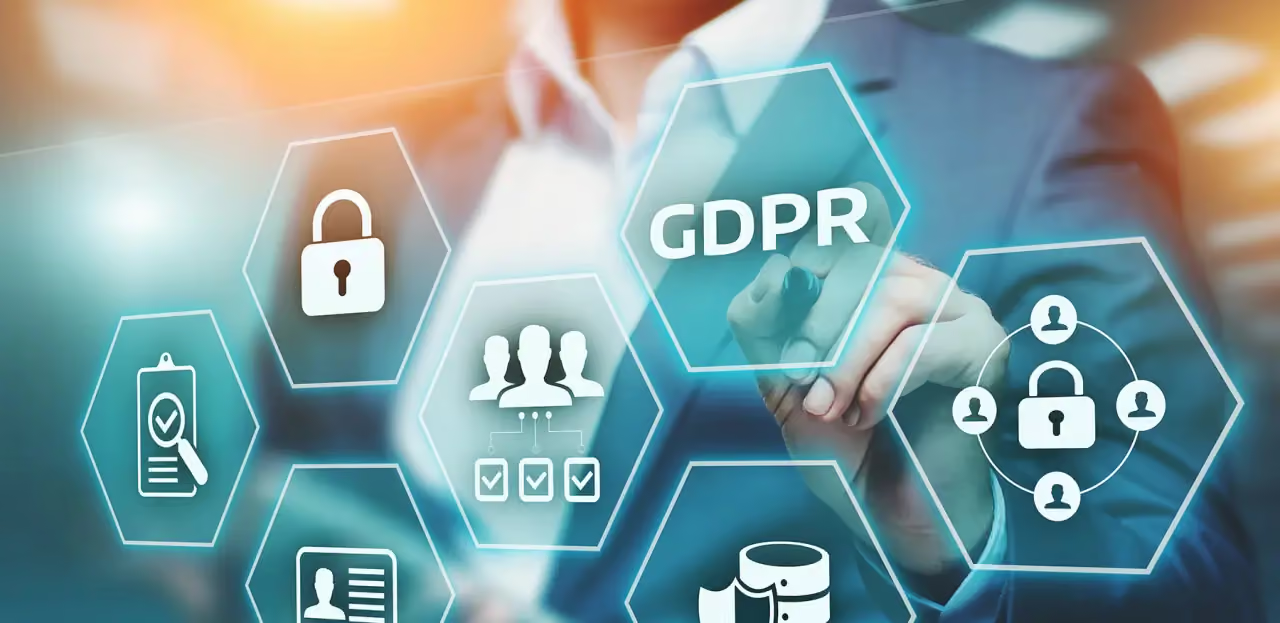
Many proctoring companies claim GDPR compliance, but those claims are largely self-reported and rest on frameworks that have already been legally challenged. The EU-US Privacy Shield was invalidated in 2020, and its replacement relies on self-certification that does not resolve the underlying conflict between the US Patriot Act and GDPR's prohibition on non-consensual data disclosure. This post examines why US-based data storage creates a structural GDPR problem, what the DPF self-certification actually involves, and why Integrity Advocate's Canadian infrastructure and Privacy by Design architecture represent a substantively different approach.
Many online proctoring companies claim GDPR compliance. It is worth asking what that claim actually means, and whether it can be verified.
The short answer is that GDPR compliance claims are largely self-reported. There is no mandatory third-party verification process that a company must pass before making the claim. For organizations choosing a proctoring vendor on the basis of GDPR compliance, this creates a significant due diligence gap.
Many proctoring companies are registered in the United States or store data within US jurisdiction. This creates a direct conflict with GDPR that no privacy policy can resolve.
Data protection laws across the EU prohibit the disclosure of personal data without a data subject's consent or knowledge. The US Patriot Act gives the US government the ability to compel data disclosure from US-based companies or companies storing data on US infrastructure, without that consent and without notifying the individual.
A proctoring company that stores learner data on US servers and claims GDPR compliance is operating under two conflicting legal obligations. When those obligations conflict, US law governs US-based companies. The GDPR claim does not change that.
Many US-based organizations attempted to address this conflict by certifying under the EU-US Privacy Shield program, which was designed to provide a legal mechanism for transatlantic data transfers that satisfied GDPR requirements.
On July 16, 2020, Europe's top court invalidated the EU-US Privacy Shield, finding that the transfer mechanism did not ensure compliance with the level of protection required by EU law. The certification that many companies had pointed to as evidence of GDPR compliance was rendered invalid overnight.
Following the 2020 decision, negotiations between the EU and the US produced a new framework. On July 13, 2023, the US Department of Commerce launched the Data Privacy Framework program, intended to allow eligible US companies to self-certify their participation in the EU-US Data Privacy Framework.
The mechanism for self-certification is a short questionnaire and a fee to the US International Trade Administration, ranging from $375 to $4,875 USD depending on the company's revenue.
Critics have already noted that the new framework faces the same fundamental shortcomings as its Privacy Shield predecessor, including the unresolved tension between US surveillance law and EU privacy rights. Self-certification through a paid questionnaire does not resolve the underlying Patriot Act conflict.
For a proctoring vendor's GDPR compliance claim to be substantive rather than self-reported, it needs to rest on something more than a certification program that can be obtained by filling out a form and paying a fee.
The most reliable indicator is where the data actually lives. If learner data is stored outside US jurisdiction, on infrastructure not subject to US government compelled disclosure, the conflict between the Patriot Act and GDPR does not arise.
Integrity Advocate's GDPR compliance is grounded in the same Privacy by Design architecture that underpins GDPR itself. All data is hosted in GDPR-designated jurisdictions, out of reach of governments with compelled data access authority. Integrity Advocate collects only what is necessary to confirm a learner's identity and compliance with exam rules, most of which is automatically deleted within 24 hours of session completion.
This is not a self-certification. It is an architectural position.
Before accepting a GDPR compliance claim at face value, organizations should be able to answer the following:
If the answers are not clearly documented, the GDPR compliance claim deserves further scrutiny.
{{post-cta}}

April 23, 2023
|
5 min de lecture
The indictment of Valor Security and Investigations for issuing thousands of fraudulent safety certificates, connected to the death of construction worker Ivan Frias, illustrates what is at stake when safety training is treated as a commodity rather than a genuine investment in worker safety. This post examines the Valor case, the conditions that enabled it, and what verified identity and participation monitoring look like as the standard safety training must meet.
In February 2023, New York-based construction training provider Valor Security and Investigations, along with six of its executives, was indicted on charges that the company issued thousands of safety certificates without providing any training at all. The words belong to Manhattan District Attorney Alvin Bragg, who described it as thousands and thousands of safety certificates and cards issued without any training whatsoever.
The charges stem from a November 2022 incident in which construction worker Ivan Frias fell to his death from the 15th floor of a job site on West End Avenue. Frias was safety certified. He had, on paper, completed an eight-hour fall prevention course. He was one of more than 20,000 Valor-certified workers who allegedly received little or no actual safety training.
This is not an abstract compliance problem. A person died.
Valor's alleged fraud may be extreme, but the conditions that enabled it are not unusual. They reflect a broader pattern in how safety training is treated by some employers and some training providers.
For some employers, safety training is viewed as an expense to be minimized rather than an investment in the people doing the work. The demand for cheaper, faster, easier certification creates a market for providers willing to supply it. Valor appears to have been built to serve exactly that demand.
Training companies can be complicit in this. When the priority is volume and convenience rather than the integrity of the program, corners get cut. Verification gets skipped. Participation goes unconfirmed. A certificate gets issued that represents nothing.
That attitude then reaches the workers themselves. Disillusioned by a system that treats their safety as a formality, many disengage from training altogether. They navigate hazardous job sites without the knowledge they were supposed to have. The certificate says they are qualified. The training says otherwise.
The Valor case is not just a criminal matter. It is a public statement about what verified training actually means, and what happens when it is absent.
Courts have consistently held that for safety training to carry legal and regulatory weight, it must involve confirmation of who completed it and whether they participated. The Valor indictment reinforces this standard at the criminal level. Issuing a certificate without delivering training is not just a compliance failure. It is fraud.
For employers, the implication is direct. A training record that cannot confirm identity or participation is not a defense in a regulatory investigation or a wrongful death proceeding. It is evidence of negligence.
The Valor case makes clear that voluntary standards are not sufficient. Regulatory agencies need to strengthen oversight and codify what courts have already established: that valid safety training requires verified identity and confirmed participation.
Employers need to recognize that the cost of cutting corners is not abstract. It is measured in the lives of workers who trusted that their training prepared them for what they would face on the job.
And the industry needs to move past treating safety training as a checkbox. A certificate that was never earned is not protection. It is a liability, for the employer, for the certifying organization, and most importantly for the worker whose name is on it.
Every worker has the right to return home safely at the end of each day. Verified training is one of the most direct ways employers can uphold that right. Anything less is a failure of responsibility.
{{post-cta}}
March 25, 2026
|
5 min de lecture
What does it take to protect a licensing program in the age of AI? This on-demand webinar covers the full lifecycle approach, from integration to credential issuance, with CMRAO's real-world results across 2,800+ exams.
Click Here to Access the On-Demand Webinar
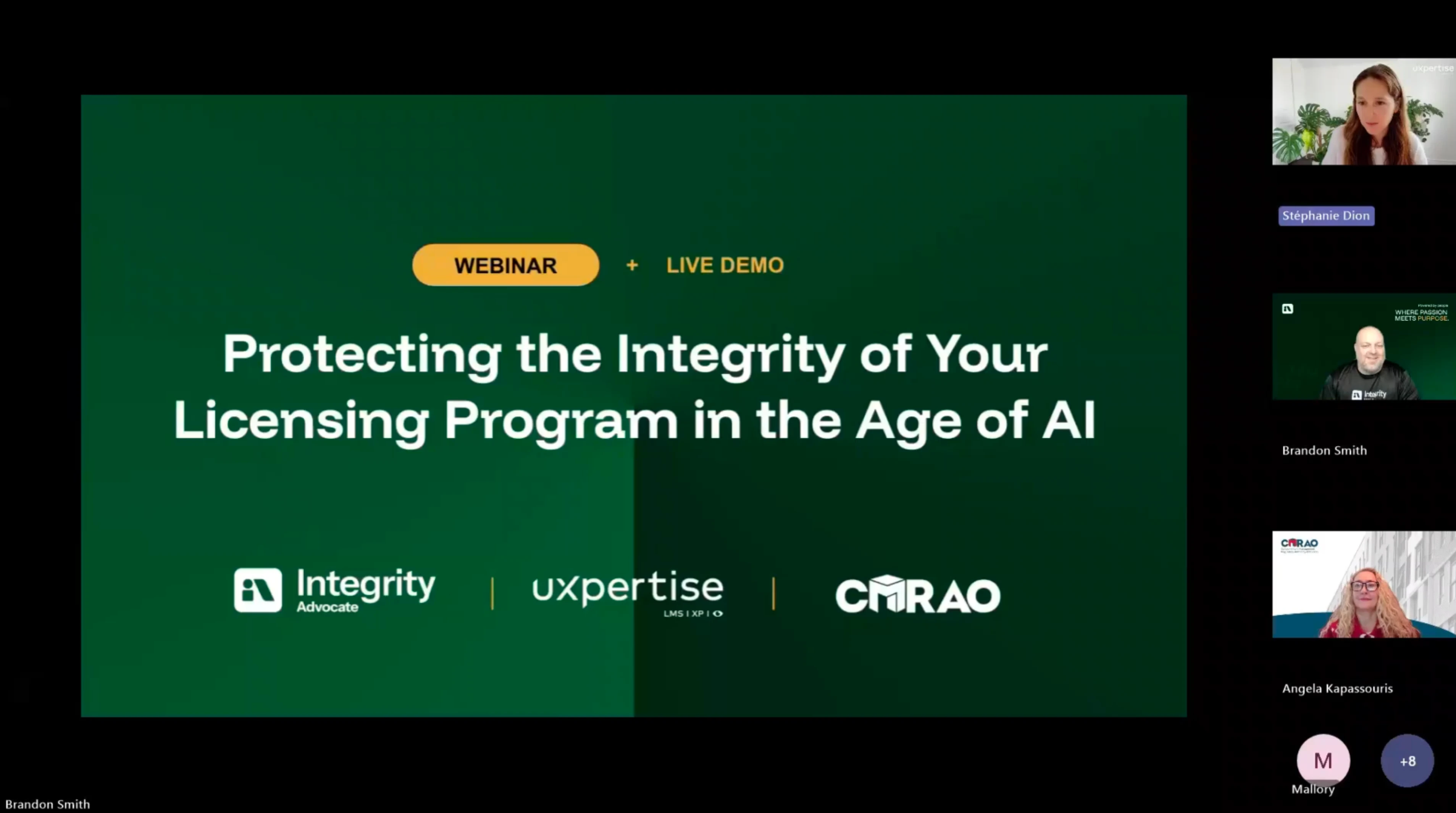
AI has made cheating easier, faster, and harder to spot, and most licensing programs weren't built for it. This session brought together Integrity Advocate, uxpertise, and CMRAO to show what the threat actually looks like today, and what a modern, integrated approach to assessment security does about it. Brandon walked through why real protection covers the full lifecycle: seamless systems integration before the exam starts, identity verification and active monitoring during it, and verifiable credential issuance once it's done. Disconnected tools leave gaps at every stage. A fully integrated system doesn't.
CMRAO shared their real-world experience delivering the Excellence in Condominium Management program through uxpertise LMS with Integrity Advocate proctoring built in. Across more than 2,800 exam sessions, 8% were flagged as invalid, a number that would have been higher without a system in place. The live demo showed exactly how it works: one platform, no installs, and a human reviewer behind every flag.
Proctoring alone is not enough. Protecting a licensing program means addressing every stage: seamless systems integration before the exam, identity verification and active monitoring during it, and verifiable credential issuance after. Gaps at any stage are gaps that get exploited.
When Integrity Advocate proctoring runs natively inside uxpertise LMS, candidates move from coursework to credentialed exam in one place, with no downloads or plug-ins. The result is less friction for candidates, less overhead for administrators, and a tighter, more defensible program.
Since launching on uxpertise with Integrity Advocate proctoring, CMRAO has delivered over 2,800 exam sessions with 8% flagged as invalid. The system deters cheating, catches it when it happens, and gives CMRAO the confidence to issue licences with integrity.
{{post-cta}}