Ease of Use
+7 pts above avg
95%
IA
95%
AVG
88%

Recherches, guides et analyses concrètes sur la surveillance d'examens en ligne ; pour aider votre programme à obtenir des résultats équitables, fiables et défendables.
Évaluations sécurisées
Violations de données en plus de 12 ans
Taux de fidélisation client
Ressources publiées

Integrity Advocate has been ranked #1 for Online Proctoring Usability on G2 for the third consecutive season. Based on verified customer feedback, we also earned five Fall 2026 badges recognizing usability, ease of use, support, and overall leadership.
Integrity Advocate has once again been ranked #1 in G2’s Usability Index for Online Proctoring, marking our third consecutive season at the top of the category.
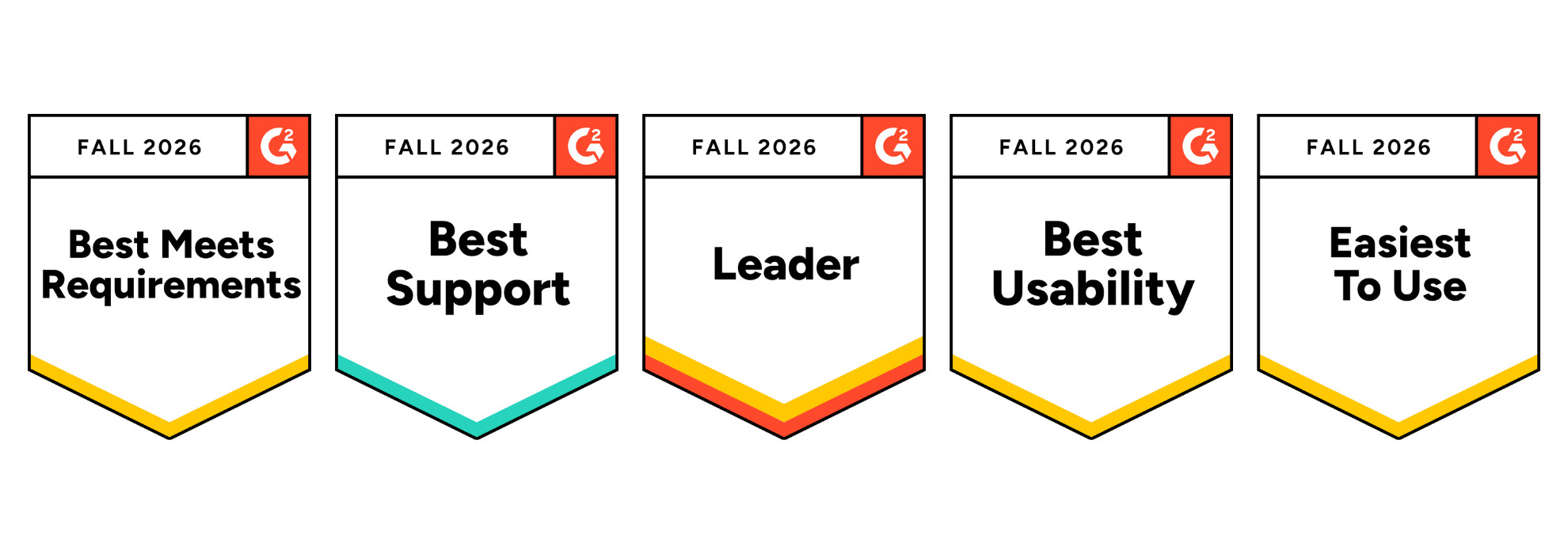
In the Fall 2026 report, Integrity Advocate earned an overall G2 Index Score of 8.60, ahead of Honorlock, Proctorio, Quilgo, Talview, and Meazure Learning. We also earned five G2 badges, including Best Usability, Easiest to Use, and Best Meets Requirements, and were recognized as a Leader in the online proctoring category.
These recognitions are based on feedback from verified users. For us, that is what makes them meaningful. They reflect the experiences of the people who administer assessments, support test takers, and rely on the results.
Integrity Advocate earned the highest overall score in the Fall 2026 Online Proctoring Usability Index:
This is not only another first-place ranking. Our overall index score increased from 8.45 in Summer 2026 to 8.60 in Fall 2026, extending Integrity Advocate’s position at the top of the category.
G2 is the largest peer-to-peer software review platform in the world. Their Usability Index ranks products within a category based on three user-rated dimensions:
Every score comes from authenticated, verified reviews. Companies cannot pay to improve their position. There is no sponsorship or placement influencing the results. The index score reflects what users say about their experience with the product.
Integrity Advocate scored above the online proctoring category average across every usability measure included in the report:
User adoption stands out in particular. Integrity Advocate scored 17 points above the category average and 28 points above Honorlock.
That matters because a platform can have an impressive feature list and still create friction when people are asked to use it. Strong adoption suggests that the experience works in practice, not only during a product demonstration.
In addition to ranking first in the Usability Index, Integrity Advocate earned five G2 badges for Fall 2026 and was recognized as a Leader in online proctoring.
The Best Usability, Easiest to Use, and Best Meets Requirements badges reinforce something we have always believed: assessment security should be strong without being unnecessarily complicated.
Organizations should not have to choose between protecting an assessment and delivering an experience people can successfully use.
Online proctoring sits at a sensitive point in the assessment experience. Test takers may already be under pressure, while administrators need to protect exam integrity without creating unnecessary technical problems or support demands.
A platform that is difficult to access or manage can lead to:
Integrity Advocate was designed to remove those barriers.
There is no software to install and no browser extension to manage. The platform works across devices and browsers and integrates into existing assessment workflows. Test takers can access their assessments without navigating a separate, unfamiliar system, while administrators gain clear evidence and the context needed to evaluate results.
Usability is not separate from assessment integrity. When a platform works consistently, more attention can remain where it belongs: on the assessment and the credibility of its outcome.
Ease of use should never require an organization to compromise on accuracy or defensibility.
Integrity Advocate combines intelligent detection with Verified Human Review™ to provide context behind potential assessment violations. Instead of asking administrators to make decisions based only on an automated flag, our proctoring solutions can provide a clear, reviewable record supported by human judgment.
The result is an approach that protects assessment integrity while remaining practical for the people responsible for administering the program and fair to the people taking the assessment.
Across reviews, users consistently highlight the qualities reflected in the Fall 2026 report: straightforward implementation, ease of use for learners and administrators, seamless LMS integration, responsive support, and a privacy-first approach to assessment integrity.
As one verified user shared:
{{post-block-quote}}
That experience is what the rankings ultimately represent. Not simply a score, but whether the platform helps organizations protect assessments without placing unnecessary friction on their teams or test takers. View more customer stories here.
If you are currently comparing online proctoring solutions, usability should be evaluated alongside security, privacy, and review quality.
Consider asking:
The Fall 2026 G2 results provide an independent view of how leading platforms perform across many of these considerations.
Being ranked #1 once is exciting. Remaining at the top for three consecutive seasons tells a stronger story.
It shows that organizations do not have to accept unnecessary complexity as the price of protecting their assessments. Online proctoring can be secure, privacy-first, easy to administer, and straightforward for test takers.
That is the experience Integrity Advocate was built to provide, and we are grateful to every customer who shared their experience on G2.
The G2 ranking reflects a platform that has been in continuous operation for over a decade:
{{post-cta}}
September 24, 2025
|
5 min de lecture
AI is transforming how we learn and work, but it is also opening the door to new risks for training providers, compliance managers, and credentialing bodies. In this on-demand webinar presented by ASSP and Integrity Advocate, learn how deepfakes, voice synthesis, and automation tools are making it easier to falsify participation and assessment results, what the compliance and regulatory consequences are for organizations that cannot verify training completion, and what safeguards including identity verification, engagement monitoring, and audit-ready reporting actually work in the AI era.
AI is transforming how we learn and work, but it’s also opening the door to new risks. In this on-demand session, Integrity Advocate explores how artificial intelligence is undermining the integrity and security of online training and certification programs. You’ll learn how AI-powered impersonation, cheating, and content manipulation threaten regulatory compliance, credibility, and learner trust, and what organizations can do to safeguard against it.
This webinar is designed for training providers, compliance managers, and organizational leaders who want to protect the value of their learning programs in the AI era.
By the end of this session, you’ll understand:

September 16, 2025
|
5 min de lecture
AI-powered proctoring can monitor at scale, but it cannot understand context, weigh consequences, or defend a certification decision to a regulator or accreditor. In safety-critical industries where a missed harness check or a wrongly credentialed healthcare worker can cost lives, the blind spots of automated-only proctoring become serious liabilities. This post examines what AI cannot do in high-stakes assessment, what standards like ANSI/ASSP Z490.1-2024, ISO/IEC 17024, and NCCA require in terms of defensibility and human oversight, and why the right model is AI plus human judgment rather than either alone.
AI is now woven into training and certification. It monitors test-takers, flags anomalies, and produces reports at a pace no human could match. For compliance leaders facing relentless pressure, it looks like the ideal solution: scalable, efficient, impartial.
But here’s the catch: AI doesn’t grasp the stakes of being wrong.
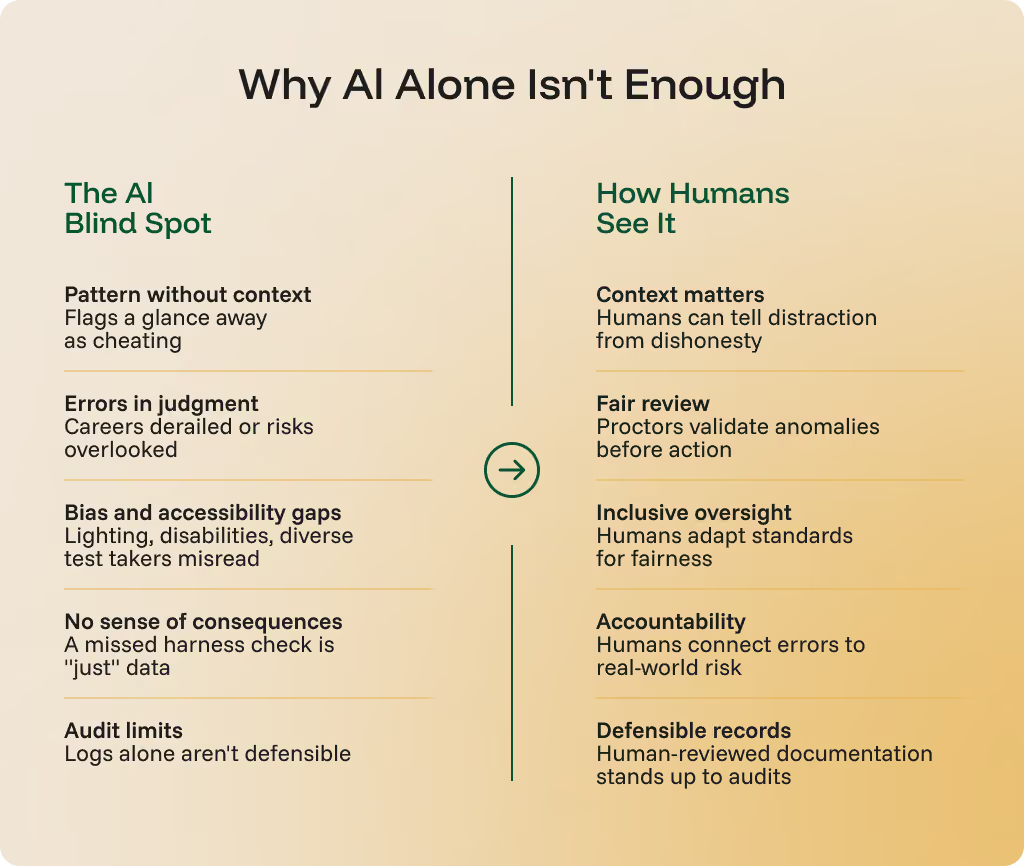
AI-powered online proctoring software can detect patterns, but it can’t weigh consequences. It can’t tell the difference between distraction and dishonesty. It can’t stand in front of an accreditor or regulator and defend a decision.
And compliance leaders know the stakes. 64% of frontline workers say injuries they’ve experienced or witnessed could have been prevented with better training, according to a YouGov survey of more than 2,000 workers in Australia, the UK, and the US. When proctoring systems prioritize speed over judgment, gaps spill from the classroom into the workplace.
{{post-stat-highlight}}
That’s why proctoring can’t be left to automation alone. Judgment, accountability, and defensibility require a human in the loop.
For all its processing power, AI often misses the context, fairness, and consequences behind the data.
AI can spot anomalies, but it can’t understand people. To the algorithm, a student glancing away as their child enters the room looks no different than someone searching for an answer. Without human judgment, honest learners get flagged, reputations suffer, and trust in the system erodes, all while true violations can still slip by unnoticed.
The real danger isn’t just inaccuracy, it’s the consequences. A nursing candidate wrongly flagged can lose months of progress, along with trust in the system meant to support them. Meanwhile, a missed violation on a commercial driving exam could place an unqualified driver behind the wheel of your company’s vehicle, endangering both reputation and public safety.
AI models are not neutral. From lighting conditions to facial recognition inaccuracies, automation can inadvertently disadvantage test-takers with disabilities, those in non-standard testing environments, or individuals from diverse cultural backgrounds. This creates inequities that undermine the fairness of certification processes. At Integrity Advocate, we work to eliminate these inequities, making the certification process seamless, accessible, and fair for every test-taker.
Perhaps the greatest blind spot is this: AI doesn’t “understand” what a mistake means. It cannot connect a failed harness safety check to a potential fall on a job site. It doesn’t grasp that mishandled food safety could trigger an allergen outbreak. Without that ethical and practical awareness, AI remains a tool that must be guided by human oversight.
The stakes of proctoring reach far beyond academia. They’re practical and sometimes life-or-death.
Consider a few high-stakes examples:
These certifications aren’t just personal milestones. They validate competence in roles that protect lives and communities. Without trustworthy proctoring, credentials lose credibility. Organizations risk liability, and the public loses trust in the professionals meant to safeguard them.
When the stakes are high, oversight must be more than automated pattern recognition. AI can monitor, record, and flag, but it cannot fully understand context or consequences. Relying on AI alone risks undermining the very certifications designed to protect lives and communities.
The updated ANSI/ASSP Z490.1-2024 standard sets clear expectations for safety, health, and environmental (SH&E) training.
For compliance leaders, a few key takeaways stand out:
These requirements go beyond what automation alone can provide. Standards demand human verification, ethical review, and the ability to defend every certification decision.
International standards like ISO/IEC 17024 and U.S. frameworks like the National Commission for Certifying Agencies (NCCA) reinforce the same principle: defensible certification requires human oversight. Without it, organizations risk failed audits, loss of accreditation, and legal exposure.
The answer is not to reject AI, but to integrate it thoughtfully. The most effective approach is AI plus human oversight, where technology enhances efficiency, but people ensure fairness, context, and compliance.
AI can monitor at scale, flagging potential anomalies. But those red flags should be reviewed by trained human proctors who can interpret context and make defensible decisions.
Human oversight is essential for building robust audit trails. When compliance checks or regulatory audits arise, organizations must show that their proctoring process was fair, valid, and defensible. Documentation reviewed and validated by people is far more credible than machine logs alone.
AI has transformed training and monitoring with unprecedented speed and scale. Yet in safety-critical industries, automation is a tool, not a safeguard. True protection comes from human judgment, ethical oversight, and alignment with compliance standards.
With standards like ANSI/ASSP Z490.1-2024 raising the bar for defensibility, organizations must recognize that proctoring isn’t just a technical step, it’s a compliance-critical safeguard that protects lives, preserves trust, and ensures training fulfills its purpose.
Smart systems drive efficiency. Human oversight delivers safety. Together, they make compliance simple, scalable, and defensible.
When compliance is defensible, organizations, and the people they serve, are safer. That’s why proctoring must go beyond automation.
At Integrity Advocate, we combine AI efficiency with human oversight to ensure every training program is verifiable, fair, and aligned with the latest standards. That means:
No guesswork. No blind spots. Just compliance you can stand behind.
{{post-cta}}
August 26, 2025
|
5 min de lecture
Integrity Advocate announces Brandon A. Smith as its new Chief Executive Officer. Brandon brings extensive experience leading and scaling SaaS platforms across higher education, professional certification, and workforce development. His background in assessment integrity, compliance, and learner success aligns directly with Integrity Advocate's mission to protect the value of credentials while maintaining fairness, accessibility, and privacy for every test-taker.
We’re excited to share an important milestone in Integrity Advocate’s journey: Brandon A. Smith has joined our team as Chief Executive Officer.
Brandon brings a wealth of experience leading and scaling SaaS platforms across higher education, professional certification, and workforce development markets. With a career rooted in advancing assessment integrity, compliance, and learner success, his expertise and vision align perfectly with our mission.
Remote testing continues to evolve rapidly, and trust in assessments has never been more critical. At Integrity Advocate, we’ve always been committed to balancing fairness, accountability, and accessibility, ensuring organizations can protect the value of their credentials without sacrificing user experience or privacy.
Brandon’s leadership marks the next chapter in our growth. His track record of building and scaling EdTech organizations positions us to expand our impact across certification programs, professional development, and higher education globally.
“Trust in assessment has never been more important. I’m excited to join Integrity Advocate’s mission to protect fairness, accountability, and accessibility in remote testing. I look forward to working with this talented team to build solutions that strengthen exam integrity while respecting every test-taker.”
Under Brandon’s guidance, Integrity Advocate will continue to innovate on our AI-enhanced proctoring solutions while staying true to our human-centered approach. This means:
We believe this balance is the future of proctoring, and we’re thrilled to have Brandon leading us forward.

April 15, 2026
|
5 min de lecture
Rolling out online proctoring inside an LMS doesn't have to be disruptive. This guest post from uxpertise shares six practical steps for a smooth launch, plus how CMRAO cut support requests by 80% after switching to Integrity Advocate.
Guest blog by uxpertise
Rolling out online proctoring inside a Learning Management System (LMS) can feel daunting—for administrators and learners alike. Concerns around usability, learner stress, and an increase in customer support requests often slow adoption.
The reality is that when online proctoring is implemented thoughtfully, it can be seamless, learner-friendly, and highly effective—while actually reducing operational complexity.
Based on uxpertise’s experience supporting regulators and credentialing bodies, here’s what it truly takes to successfully roll out online proctoring inside an LMS, while ensuring reliable results and a positive learner experience.
One of the most important decisions happens before rollout even begins.
Whenever possible, organizations should choose an LMS with online proctoring already integrated, rather than relying on disconnected third-party tools. An integrated approach:
When proctoring is built directly into the LMS, learners stay in a single, familiar environment—no juggling platforms, no unnecessary steps.
Before launching to your full learner population, run a pilot test with internal staff or a small group of learners.
A pilot helps you:
This step alone can prevent a large volume of avoidable support requests and ensures a smoother full-scale rollout.
Learner preparation is one of the biggest drivers of success.
We recommend creating:
Practice exams are especially effective. They reduce anxiety, build confidence, and ensure learners know exactly what to expect—long before exam day.
Transparency builds trust and compliance.
Make sure learners understand:
Clear expectations upfront significantly reduce issues during the exam and lower post-exam support inquiries.
Many learners are uncertain about what happens once an exam is submitted.
Communicate clearly:
This clarity reinforces confidence in the integrity of the process and reduces unnecessary follow-up requests.
Successful online proctoring should support learners—not intimidate them.
A well-integrated solution:
When learners feel supported, adoption increases and confidence in the system grows.
{{post-stat-highlight}}
CMRAO, a uxpertise client, had been delivering online exams using a different proctoring solution within the uxpertise LMS. While functional, the experience created friction for learners and resulted in a high volume of customer support requests.
When uxpertise made the decision to switch technology providers and integrate Integrity Advocate directly into the LMS, the impact was immediate.
After the transition, CMRAO experienced:
By combining an integrated proctoring solution with clear learner preparation and guidance, CMRAO significantly improved both learner experience and operational efficiency.
Rolling out online proctoring inside an LMS doesn’t need to be complex or disruptive.
By choosing an integrated solution, piloting before launch, preparing learners proactively, and focusing on usability, organizations can:
At uxpertise, we believe the most effective proctoring solutions are the ones learners trust—because everything simply works.
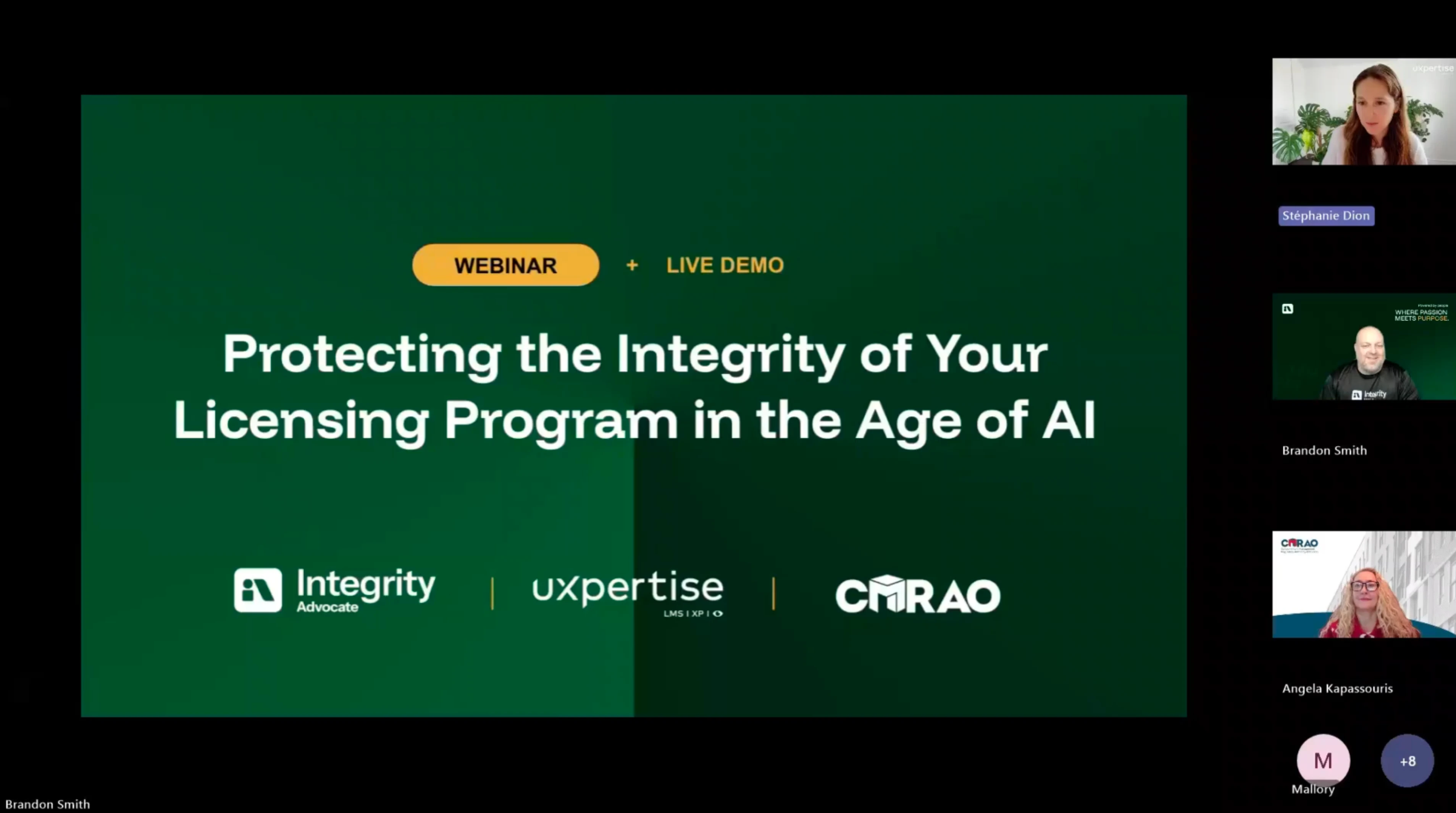
Ahead of the Curve: Building Trustworthy Licensing Programs in a Changing Assessment Security Landscape
Why modern regulators and credentialing bodies need integrated systems, not disconnected tools, to stay credible, compliant, and confident.
Watch our joint session with uxpertise and CMRAO to see how leading credentialing bodies are securing exam integrity without sacrificing the candidate experience.



May 18, 2026
|
5 min de lecture
All proctoring vendors say they verify identity, but they don't all mean the same thing. Explore where automated-only ID checks fall short and what to ask when evaluating a platform.
There’s a difference between an algorithm saying “these two images match” and a trained person saying “I reviewed this ID and confirmed it.” One is a data point. The other is evidence. When a result gets challenged, you need evidence. Here’s something worth knowing about online proctoring vendors: they all say they verify identity. What they don’t all mean is the same thing. And that gap, between capturing an image and actually confirming who someone is, is where a lot of programs are quietly sitting on risk they haven’t fully thought through. If you’re currently evaluating proctoring platforms, or you’re starting to wonder what your current vendor actually does when a test taker shows up to an exam, this is for you. We’re going to cover what identity verification in online assessment actually looks like, where automated-only systems run into trouble, and what it takes to produce a result that holds up when it counts. What identity verification actually means in an online exam context
The basics are simple. Identity verification confirms that the person taking your assessment is the person who enrolled for it. Most platforms handle this by asking test takers to hold a government-issued ID up to their camera, capturing a live photo, and comparing the two. What varies, a lot, is what happens after those images are captured. In a fully automated system, an algorithm makes the comparison and moves on. In Integrity Advocate’s human-reviewed system, a trained reviewer examines the ID and live photo after the session is completed, verifying both that the ID is a genuine match and that the same person was there for the entire assessment. That’s a meaningfully different thing.
That might sound like a subtle difference right now. It won’t feel subtle when you’re sitting across from an accreditor, or responding to a candidate appeal, or explaining your identity controls to a regulatory body. “Our algorithm flagged it” and “a trained reviewer verified the ID match and confirmed the same person was present for the entire session” don’t carry the same weight in that room.
Before you evaluate any solution, it’s worth being clear about what you’re actually protecting against. Identity verification in online assessment is mainly a defence against three things.
Someone other than the enrolled candidate sits the exam. Could be a friend, a sibling, or a professional impersonator hired through a contract cheating service. In high-stakes contexts, professional certification, regulatory licensing, safety-critical credentials, the consequences go well beyond academic dishonesty. They touch public trust in the credential itself. That’s a different kind of problem.
Proxy testing is impersonation at scale, and it’s growing. The same infrastructure that made remote work possible made organized contract cheating more accessible too. Professional exam-sitters exist. They’ve been around for years and they’ve gotten more sophisticated as online testing has expanded.
What makes proxy testing particularly hard to catch with automation is that the person attempting the ID check is often well-prepared. They may have a convincing fake or borrowed ID. They may have done this before, for other clients, on other platforms. An algorithm looking for obvious facial mismatches isn’t going to catch someone who’s specifically prepared to pass that check.
{{post-stat-highlight}}
Automated systems compare images. They measure how closely two images match. They’re not built to assess whether a document looks legitimate, whether something about it seems off, or whether the context around the ID presentation is consistent with someone who is genuinely who they say they are.
If you need a recent illustration of just how thin that defense is: a UK nonprofit surveyed around 1,300 children aged 9 to 16 and found that about half believe online age verification checks are easy to bypass. One documented method was drawing a fake mustache on their face with a makeup pencil. A 12-year-old was verified as 15. It worked. Other workarounds included pointing webcams at video game characters and making unusual facial expressions until the software stopped trying. TechCrunch covered it in May 2026.
These are AI systems built specifically for facial verification. A makeup pencil broke them. In an exam context, where a candidate may have a professional credential, a licence, or a career on the line, the motivation to try something is considerably higher; and the workarounds available are more sophisticated than drawn-on facial hair. Automated ID checks in high-stakes assessments face the same fundamental vulnerability, with significantly higher consequences when something slips through.
Beyond outright manipulation, non-standard ID documents from other countries are a real operational headache for automated systems. A document that an algorithm can’t parse correctly – because it looks different from its training data, often gets flagged for the wrong reasons. Not because anything is wrong. Just because it looks unfamiliar. That’s a fairness problem as much as it is a fraud one.
Speed and scale, those are the real advantages of fully automated ID verification. They’re genuine. The problem is that optimising for speed and scale means accepting trade-offs that start to matter the moment your results have any real consequence attached to them.
When a fully automated system approves an identity check, what it creates is a timestamp and a confidence score. That score tells you how closely two images matched according to the model. It doesn’t tell you that a human looked at the documents and made a judgment call.
The moment an outcome is challenged, that distinction is everything. There’s a big difference between “our algorithm scored the match at 94.3%” and “a trained reviewer examined the ID and the live photo and confirmed the identity match.” One is data. The other is documentation. If you’ve ever had to respond to an accreditor asking about your identity controls, you know which one you want to be holding.
Facial recognition systems are trained on datasets. Those datasets have gaps, and those gaps don’t affect all test takers equally. People with darker skin tones, older candidates, people with facial differences or disabilities, and test takers presenting documents from underrepresented countries, these populations consistently get worse outcomes from automated systems.
In a program serving thousands of test takers across many countries, these aren’t rare edge cases. They’re a predictable share of your assessment cycle. A system that handles them badly is a system that consistently disadvantages specific groups of people. That’s both a fairness problem and a real compliance exposure under frameworks like WCAG and AODA.
A lot of programs serve test takers with documented accommodations. Some of those accommodations affect how a test taker looks at the identity check stage. A test taker with a visual impairment may present their ID differently. Someone with a facial difference may not match their ID photo the way an algorithm expects.
An automated system has no way to know an accommodation exists. A human reviewer can, because that information can be passed to them before the check happens. They apply the context, the check goes smoothly, and the test taker isn’t penalized for something their program already knew about and approved.
Human review at Integrity Advocate isn’t a fallback for when automation fails. It’s the standard for every single check. That changes what the whole process produces, and what you can do with the results.
A trained reviewer looking at an ID document and a live photo is doing something different from what a facial recognition model does. They’re not just asking “do these two images match?” They’re assessing whether the identity claim is plausible, taking in the quality of the document, the context of the photo, whether something feels off. That’s judgment. It’s not something you can fully replicate with a model.
It also means programs can explain what happened. Not just cite a score. “A trained reviewer examined the ID and the live photo and confirmed the match” is a sentence a human can understand, investigate, and stand behind.
At Integrity Advocate, every identity check creates a time-stamped record permanently attached to the session. What was verified, when, and by whom. If an outcome from that session ever gets challenged, the identity verification record is already part of the documentation, not sitting in a separate system you have to dig through.
Appeals rarely come with advance warning. Programs that have a complete, human-confirmed record don’t have to reconstruct anything after the fact. The evidence was created at the moment of verification. It hasn’t changed.
Here’s something that doesn’t get talked about enough: people behave differently when they know a human is watching. A test taker who knows their government-issued ID will be examined by a trained reviewer before the exam starts isn’t approaching that check the same way as someone who knows it’s algorithmic.
Programs that shift from automated-only to human-reviewed verification consistently see a change in the behaviour of the small slice of candidates who were willing to try something. The check itself becomes a deterrent. You catch less because less gets attempted.
If you’re shopping around, or starting to question what your current vendor actually does, here are the questions that cut through the noise.
A lot of platforms say “human review.” What they mean is that a human reviews AI-flagged sessions only, and only when the algorithm decides something is worth escalating. At Integrity Advocate, a trained reviewer looks at every session after it’s completed, verifying the ID match and confirming the same person was present throughout. That’s the question to ask: is every session reviewed, or only the ones the algorithm flags?
Ask to see a sample identity verification record. If the answer is a confidence score and a timestamp, that’s an automated log. A defensible record includes the ID image, the live photo, the match determination, who made it, and when. If you can’t show an accreditor a complete documentation trail, the check isn’t giving you what you actually need.
Ask specifically what happens when a test taker shows up with an ID from a country with an unfamiliar format, or when an accommodation affects how they look at the check stage. If the answer is vague or relies heavily on “the algorithm handles it,” that tells you something important about how these scenarios were thought about when the product was designed.
Identity verification collects sensitive data. Ask specifically what’s collected, how long it’s retained, and whether it’s used for anything beyond the identity check. If you have GDPR, FERPA, or PIPEDA obligations, and most programs doing anything at scale do, you need clear answers here before you commit.
Automated identity verification is better than nothing. That’s true. But if your program issues results that actually mean something, credentials that affect career progression, licences that protect public safety, certifications that carry professional weight, “better than nothing” isn’t where you want to land.
What you need is a check that creates a record you can stand behind. Something that answers not just “did the algorithm approve this?” but “can we show that a qualified person verified this person’s identity before the exam began?” Those are different questions, and they get different responses from the people who ask them.
The cost of getting identity verification wrong doesn’t show up at the time of the exam. It shows up later, when results are challenged, when accreditors start asking questions, when credential fraud surfaces somewhere down the line. By then, piecing together what happened is hard. Having a complete record from the moment of verification isn’t.
{{post-cta}}

May 22, 2026
|
5 min de lecture
Online EdD programs face a growing tension: assessments must be secure, but doctoral learners expect their privacy to be respected. In this guest post, Research.com's Stephanie Dion explores how institutions can move beyond surveillance-heavy models toward verification-based systems, risk-based authentication, and faculty preparedness that protect both academic integrity and learner trust.
The rapid growth of doctoral-level education delivered through digital platforms has transformed how institutions design, deliver, and evaluate learning. While flexibility and accessibility have improved, new challenges have emerged around maintaining academic integrity without compromising learner privacy. Programs must now navigate a complex balance between safeguarding assessments and respecting personal data boundaries.
Modern online learning environments—especially within advanced doctoral pathways—require systems that are both secure and ethically designed. Achieving this balance is critical not only for institutional credibility but also for learner trust.
Doctoral programs have always emphasized rigorous evaluation standards. However, the shift to remote delivery has introduced new vulnerabilities, from identity fraud to unauthorized collaboration. Within an EdD context, where research-based outputs and professional practice are central, the stakes are even higher.
Institutions are increasingly turning to layered assessment strategies that combine human oversight with technological safeguards. Yet, implementing these systems without overstepping privacy expectations remains a nuanced challenge.
Balancing these risks requires thoughtful system design and governance.

One of the most effective approaches to maintaining integrity without excessive monitoring is the use of digital credential verification systems. These tools enable institutions to validate learner achievements and identities through secure, traceable methods.
Rather than relying solely on real-time surveillance, verification systems focus on verifying the authenticity of outcomes. This shift allows institutions to uphold standards while reducing reliance on invasive monitoring practices. Similar conversations around the importance of verified credentials and accountability are explored in Integrity Advocate’s article on the case for verified credentials in private security.
To better understand broader approaches to protecting credentials in digital ecosystems, exploring resources on the future of assessment security and credential integrity can provide additional context.
Recent findings from the OECD highlight that trust in digital education systems is strongly correlated with transparency in data usage and governance. A 2023 report emphasizes that learners are more likely to engage fully when they understand how their data is collected, stored, and protected.
This insight reinforces the importance of designing systems that prioritize both security and transparency, particularly within online doctoral programs.
Creating secure yet respectful assessment environments requires a shift from surveillance-heavy models to privacy-conscious frameworks. Institutions must evaluate each tool and process through both a security and ethical lens, particularly when balancing the need for security with the responsibility of protecting learners and institutional reputation.
These considerations highlight the need for balanced, sustainable solutions.
Remote assessment monitoring remains a critical component of many programs, but it must be implemented thoughtfully. Online proctoring technologies can provide valuable oversight when used appropriately, yet they often raise concerns about privacy and data usage.
Institutions are now exploring hybrid models that combine automated monitoring with human review, reducing reliance on invasive techniques. Recent findings discussed in AI and online exams: what the data reveals about assessment security further highlight how institutions are adopting smarter, risk-based approaches to digital assessment monitoring.
For a deeper look into how monitoring technologies are evolving, the discussion on online proctoring offers valuable industry insights.
Technology alone cannot ensure assessment integrity within modern doctoral education. Faculty members and program administrators play a central role in creating ethical, secure, and privacy-conscious evaluation environments. Without proper training, even advanced assessment systems may be implemented inconsistently, increasing both security risks and learner concerns.
Online EdD programs often involve complex assignments such as research projects, reflective analysis, and applied leadership evaluations. These formats require instructors to understand not only digital assessment tools but also ethical data practices, accessibility considerations, and evolving academic integrity standards.
Institutions that invest in faculty preparedness can improve consistency across assessment processes while strengthening learner trust. Professional development initiatives frequently include training in secure assessment design, responsible use of proctoring technologies, and privacy-focused communication practices. As online doctoral education continues to expand, many academic leaders are also exploring accelerated pathways for advanced educational leadership training through resources such as the Research.com list of shortest online EdD programs, which highlights flexible options for professionals pursuing doctoral advancement.
By prioritizing faculty readiness alongside technological safeguards, institutions can create more balanced online EdD programs that protect both academic integrity and learner privacy.
As education continues to evolve, digital credential verification systems will play an increasingly central role in maintaining trust. These systems offer a scalable solution that aligns with both security requirements and privacy expectations.
Emerging technologies such as decentralized identity and zero-knowledge proofs are set to further enhance verification processes, allowing institutions to confirm authenticity without exposing sensitive data.
Several emerging trends highlighted in what’s changing in assessment security in 2026 are already shaping how institutions approach assessment integrity and learner privacy.
These developments signal a shift toward more ethical and efficient systems.
{{post-cta}}
September 2, 2026
|
5 min de lecture
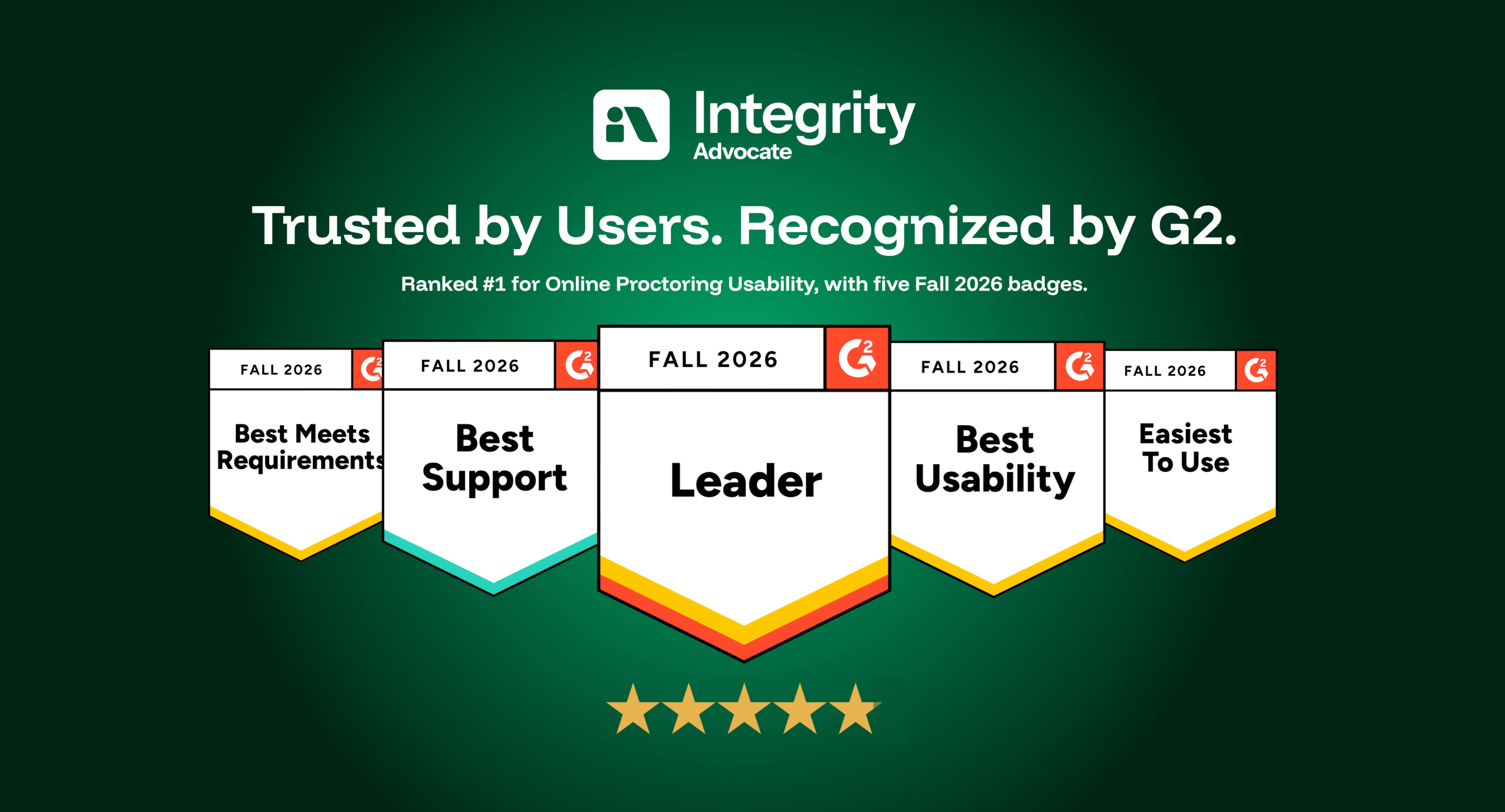
Integrity Advocate has been ranked #1 for Online Proctoring Usability on G2 for the third consecutive season. Based on verified customer feedback, we also earned five Fall 2026 badges recognizing usability, ease of use, support, and overall leadership.
Integrity Advocate has once again been ranked #1 in G2’s Usability Index for Online Proctoring, marking our third consecutive season at the top of the category.
In the Fall 2026 report, Integrity Advocate earned an overall G2 Index Score of 8.60, ahead of Honorlock, Proctorio, Quilgo, Talview, and Meazure Learning. We also earned five G2 badges, including Best Usability, Easiest to Use, and Best Meets Requirements, and were recognized as a Leader in the online proctoring category.
These recognitions are based on feedback from verified users. For us, that is what makes them meaningful. They reflect the experiences of the people who administer assessments, support test takers, and rely on the results.
Integrity Advocate earned the highest overall score in the Fall 2026 Online Proctoring Usability Index:
This is not only another first-place ranking. Our overall index score increased from 8.45 in Summer 2026 to 8.60 in Fall 2026, extending Integrity Advocate’s position at the top of the category.
G2 is the largest peer-to-peer software review platform in the world. Their Usability Index ranks products within a category based on three user-rated dimensions:
Every score comes from authenticated, verified reviews. Companies cannot pay to improve their position. There is no sponsorship or placement influencing the results. The index score reflects what users say about their experience with the product.
Integrity Advocate scored above the online proctoring category average across every usability measure included in the report:
User adoption stands out in particular. Integrity Advocate scored 17 points above the category average and 28 points above Honorlock.
That matters because a platform can have an impressive feature list and still create friction when people are asked to use it. Strong adoption suggests that the experience works in practice, not only during a product demonstration.
In addition to ranking first in the Usability Index, Integrity Advocate earned five G2 badges for Fall 2026 and was recognized as a Leader in online proctoring.
The Best Usability, Easiest to Use, and Best Meets Requirements badges reinforce something we have always believed: assessment security should be strong without being unnecessarily complicated.
Organizations should not have to choose between protecting an assessment and delivering an experience people can successfully use.
Online proctoring sits at a sensitive point in the assessment experience. Test takers may already be under pressure, while administrators need to protect exam integrity without creating unnecessary technical problems or support demands.
A platform that is difficult to access or manage can lead to:
Integrity Advocate was designed to remove those barriers.
There is no software to install and no browser extension to manage. The platform works across devices and browsers and integrates into existing assessment workflows. Test takers can access their assessments without navigating a separate, unfamiliar system, while administrators gain clear evidence and the context needed to evaluate results.
Usability is not separate from assessment integrity. When a platform works consistently, more attention can remain where it belongs: on the assessment and the credibility of its outcome.
Ease of use should never require an organization to compromise on accuracy or defensibility.
Integrity Advocate combines intelligent detection with Verified Human Review™ to provide context behind potential assessment violations. Instead of asking administrators to make decisions based only on an automated flag, our proctoring solutions can provide a clear, reviewable record supported by human judgment.
The result is an approach that protects assessment integrity while remaining practical for the people responsible for administering the program and fair to the people taking the assessment.
Across reviews, users consistently highlight the qualities reflected in the Fall 2026 report: straightforward implementation, ease of use for learners and administrators, seamless LMS integration, responsive support, and a privacy-first approach to assessment integrity.
As one verified user shared:
{{post-block-quote}}
That experience is what the rankings ultimately represent. Not simply a score, but whether the platform helps organizations protect assessments without placing unnecessary friction on their teams or test takers. View more customer stories here.
If you are currently comparing online proctoring solutions, usability should be evaluated alongside security, privacy, and review quality.
Consider asking:
The Fall 2026 G2 results provide an independent view of how leading platforms perform across many of these considerations.
Being ranked #1 once is exciting. Remaining at the top for three consecutive seasons tells a stronger story.
It shows that organizations do not have to accept unnecessary complexity as the price of protecting their assessments. Online proctoring can be secure, privacy-first, easy to administer, and straightforward for test takers.
That is the experience Integrity Advocate was built to provide, and we are grateful to every customer who shared their experience on G2.
The G2 ranking reflects a platform that has been in continuous operation for over a decade:
{{post-cta}}

June 16, 2026
|
5 min de lecture
This blog post compares the leading no-download, browser-based proctoring platforms across key criteria - device compatibility, AI cheating detection, privacy design, and implementation friction - making the case that Integrity Advocate stands apart by including human review at every pricing tier as a standard feature, not an add-on.
Before a single question is answered, your proctoring platform has already made an impression.
Some no-download proctoring tools get out of the way entirely. Open a browser, click a link, begin. Others require a software download, a browser extension, or a system-level install before an exam can begin.
That distinction matters more than most buyers realize. The install prompt is not a minor inconvenience. It is a compatibility risk, a support burden, a privacy exposure, and the first signal your learners receive about what this experience is going to feel like. We have seen programs lose candidates before the exam starts simply because an install failed on a managed device, a browser was unsupported, or a permission prompt could not be resolved in time.
For programs where results carry real consequences, the no-download question also raises a harder one: if getting into the exam is this complicated, how confident are you in what the platform is doing once they are inside?
This guide covers what no-download, browser-based proctoring actually means, where the leading platforms differ on the criteria that determine whether outcomes hold up, and how to find the right fit for your program, whether you run a university course, a professional certification, a workforce training program, or a compliance assessment.
A genuinely no-download platform runs entirely within a standard browser session. No extension to install before the exam. No lockdown browser to download. No system-level permissions that extend beyond what proctoring actually requires. A learner opens a link and begins, on any device, any browser, anywhere.
Several platforms in this comparison approach the no-download question differently. Some require a Chrome extension added before the exam, which means the platform runs within Chrome specifically. Others use a dedicated secure browser that candidates download and install. Understanding which category a platform falls into matters for programs with diverse device environments, distributed learner populations, or managed corporate devices where installs require IT authorization.
The no-download question is not about convenience. It is about whether your platform works for the full range of people who need to take your assessments, including field workers on tablets, employees on managed corporate laptops, and learners who are not sitting at a desktop in a controlled environment.
Getting learners into the exam without friction is necessary. It is not sufficient. The platforms in this comparison were evaluated across four dimensions that determine whether results are worth standing behind:
Not every platform marketed as browser-based delivers the same experience, or the same level of confidence in outcomes. Here is how the leading tools compare across the criteria that determine whether results are fair, trustworthy, and defensible.
Integrity Advocate is a fully browser-based proctoring platform with no download, no extension, and no install required. It runs on any device and browser, integrates with any LMS, and is built around a privacy-first architecture that collects only what is necessary to protect assessment integrity. Zero data breaches in over 12 years of operation.
What sets Integrity Advocate apart from every other platform in this space: human review is included at every pricing tier by default. Every flagged session is reviewed by a trained person before any decision is made. That is not a premium add-on. It is the standard. The result is outcomes that are not just automated flags – they are documented, reasoned judgments that hold up to scrutiny and in audits.
G2 #1 Ease of Use. 98% client retention. Fair, trustworthy, and defensible by design.
Based on publicly available documentation, G2 reviews, and vendor-published feature listings. Features subject to change.
No-download access gets learners in. What happens once the exam is underway is what determines whether results can be trusted.
Most platforms rely on AI-based flagging, algorithms that surface alerts without human judgment applied to them. A flag is not a decision. When a result gets questioned, you need something more than an algorithm to back it up.
Integrity Advocate puts a trained reviewer behind every flagged session before any outcome is issued. That human review layer is not a premium tier, it is built into every plan, for every program. The result is not just a monitored exam. It is a documented, reasoned judgment that holds up in audits and under appeal.
That is why 98% of Integrity Advocate clients stay. Not because switching is hard. Because the outcomes are worth keeping.
{{post-cta}}

April 16, 2026
|
5 min de lecture
When BCIT's legacy proctoring provider began generating student frustration and privacy concerns, the institute needed a replacement that could meet some of the world's strictest privacy standards, integrate with its existing LMS, and roll out mid-year without disrupting more than 48,000 students. Integrity Advocate delivered a no-install, privacy-first solution that proctored over 13,000 exams in a single semester, with only 1% of students requiring support.
British Columbia has some of the most stringent privacy protection laws in the world, and the British Columbia Institute of Technology holds its technology partners to the same standard. When BCIT's legacy proctoring provider began generating rising privacy concerns and student frustration, across a student body of more than 48,000 and 2,000+ faculty, the institute needed a change that wouldn't disrupt learning in the process.
BCIT needed a solution that could protect student privacy without compromising exam security, integrate easily with its existing D2L Brightspace LMS, reduce student support needs and administrative burden, and offer flexible, exam-level rule sets to accommodate diverse course requirements. With the COVID-19 pandemic requiring 100% of exams to move online, the transition had to happen quickly, without disrupting learning.
{{post-block-quote}}
Integrity Advocate offered BCIT a no-install, privacy-first solution that integrated seamlessly with D2L Brightspace and minimized administrative overhead. The partnership let BCIT switch proctoring providers mid-year with limited disruption, empower faculty to enable proctoring on a per-exam basis, reduce student frustration by eliminating unnecessary downloads and complexity, and improve transparency and ease of use for both students and staff.
Academic Level Validation and flexible rule sets gave faculty the control they needed, while Integrity Advocate's integration and support ensured proctoring remained effortless and trusted across every course and exam.
In just five months, BCIT proctored over 13,000 remote exams with Integrity Advocate, delivering a smoother, more secure experience for students and faculty without sacrificing privacy or ease of use.
Faculty members easily enabled proctoring where needed, reducing administrative burdens and keeping student support requests under 1%, a dramatic improvement that reinforced BCIT's commitment to student satisfaction. By partnering with Integrity Advocate, BCIT met its privacy and accessibility goals and set a higher standard for modern, student-centered proctoring.
{{post-cta}}