Ease of Use
+7 pts above avg
95%
IA
95%
AVG
88%

Recherches, guides et analyses concrètes sur la surveillance d'examens en ligne ; pour aider votre programme à obtenir des résultats équitables, fiables et défendables.
Évaluations sécurisées
Violations de données en plus de 12 ans
Taux de fidélisation client
Ressources publiées

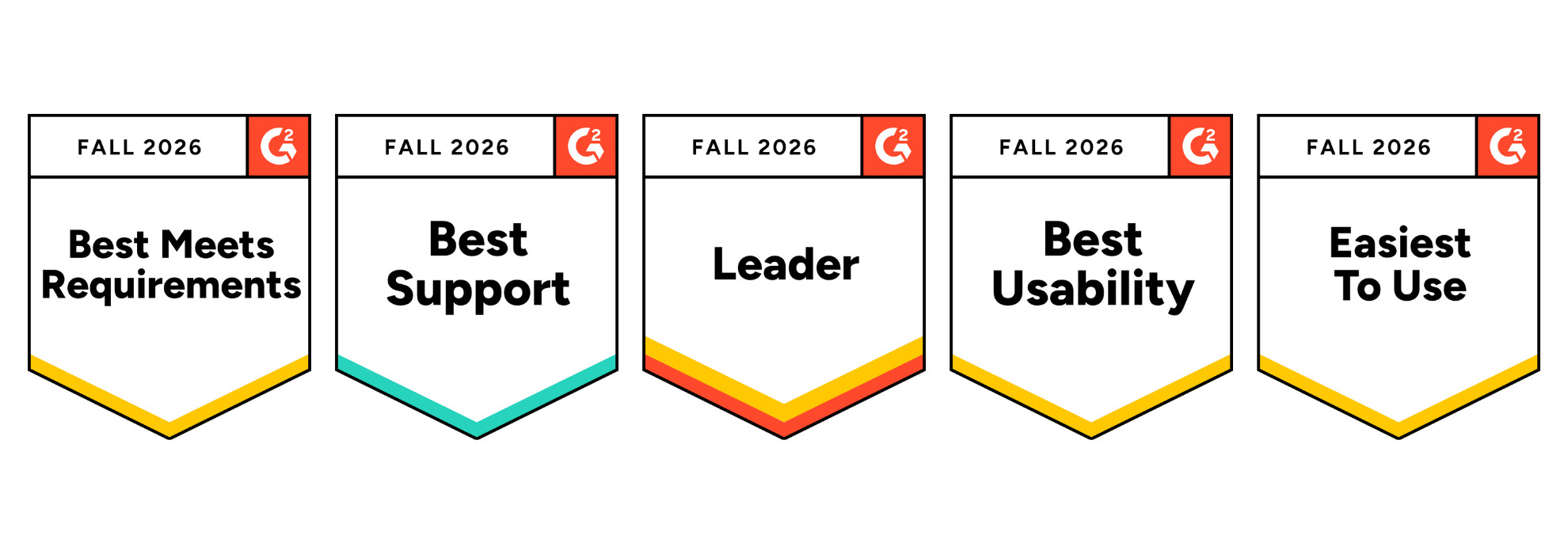
Integrity Advocate has been ranked #1 for Online Proctoring Usability on G2 for the third consecutive season. Based on verified customer feedback, we also earned five Fall 2026 badges recognizing usability, ease of use, support, and overall leadership.
Integrity Advocate has once again been ranked #1 in G2’s Usability Index for Online Proctoring, marking our third consecutive season at the top of the category.
In the Fall 2026 report, Integrity Advocate earned an overall G2 Index Score of 8.60, ahead of Honorlock, Proctorio, Quilgo, Talview, and Meazure Learning. We also earned five G2 badges, including Best Usability, Easiest to Use, and Best Meets Requirements, and were recognized as a Leader in the online proctoring category.
These recognitions are based on feedback from verified users. For us, that is what makes them meaningful. They reflect the experiences of the people who administer assessments, support test takers, and rely on the results.
Integrity Advocate earned the highest overall score in the Fall 2026 Online Proctoring Usability Index:
This is not only another first-place ranking. Our overall index score increased from 8.45 in Summer 2026 to 8.60 in Fall 2026, extending Integrity Advocate’s position at the top of the category.
G2 is the largest peer-to-peer software review platform in the world. Their Usability Index ranks products within a category based on three user-rated dimensions:
Every score comes from authenticated, verified reviews. Companies cannot pay to improve their position. There is no sponsorship or placement influencing the results. The index score reflects what users say about their experience with the product.
Integrity Advocate scored above the online proctoring category average across every usability measure included in the report:
User adoption stands out in particular. Integrity Advocate scored 17 points above the category average and 28 points above Honorlock.
That matters because a platform can have an impressive feature list and still create friction when people are asked to use it. Strong adoption suggests that the experience works in practice, not only during a product demonstration.
In addition to ranking first in the Usability Index, Integrity Advocate earned five G2 badges for Fall 2026 and was recognized as a Leader in online proctoring.
The Best Usability, Easiest to Use, and Best Meets Requirements badges reinforce something we have always believed: assessment security should be strong without being unnecessarily complicated.
Organizations should not have to choose between protecting an assessment and delivering an experience people can successfully use.
Online proctoring sits at a sensitive point in the assessment experience. Test takers may already be under pressure, while administrators need to protect exam integrity without creating unnecessary technical problems or support demands.
A platform that is difficult to access or manage can lead to:
Integrity Advocate was designed to remove those barriers.
There is no software to install and no browser extension to manage. The platform works across devices and browsers and integrates into existing assessment workflows. Test takers can access their assessments without navigating a separate, unfamiliar system, while administrators gain clear evidence and the context needed to evaluate results.
Usability is not separate from assessment integrity. When a platform works consistently, more attention can remain where it belongs: on the assessment and the credibility of its outcome.
Ease of use should never require an organization to compromise on accuracy or defensibility.
Integrity Advocate combines intelligent detection with Verified Human Review™ to provide context behind potential assessment violations. Instead of asking administrators to make decisions based only on an automated flag, our proctoring solutions can provide a clear, reviewable record supported by human judgment.
The result is an approach that protects assessment integrity while remaining practical for the people responsible for administering the program and fair to the people taking the assessment.
Across reviews, users consistently highlight the qualities reflected in the Fall 2026 report: straightforward implementation, ease of use for learners and administrators, seamless LMS integration, responsive support, and a privacy-first approach to assessment integrity.
As one verified user shared:
{{post-block-quote}}
That experience is what the rankings ultimately represent. Not simply a score, but whether the platform helps organizations protect assessments without placing unnecessary friction on their teams or test takers. View more customer stories here.
If you are currently comparing online proctoring solutions, usability should be evaluated alongside security, privacy, and review quality.
Consider asking:
The Fall 2026 G2 results provide an independent view of how leading platforms perform across many of these considerations.
Being ranked #1 once is exciting. Remaining at the top for three consecutive seasons tells a stronger story.
It shows that organizations do not have to accept unnecessary complexity as the price of protecting their assessments. Online proctoring can be secure, privacy-first, easy to administer, and straightforward for test takers.
That is the experience Integrity Advocate was built to provide, and we are grateful to every customer who shared their experience on G2.
The G2 ranking reflects a platform that has been in continuous operation for over a decade:
{{post-cta}}

June 24, 2026
|
5 min de lecture
AI-only proctoring flags behavior. It doesn't evaluate it. When automated systems skip human review, wrongful invalidations follow, and programs are left with outcomes they can't defend.
A student finishes a high-stakes licensing exam. They followed every rule. The automated proctoring system flagged them anyway, unusual eye movement, a glance off-screen, a pause the algorithm found suspicious. This is a common example of AI proctoring false positives. The result gets invalidated.
No human ever looked at the session. No one evaluated whether any of it actually constituted cheating. The outcome went out the door based entirely on pattern-matching software making a call it was never designed to make.
That’s the AI proctoring false positive problem. And it isn’t a software glitch or an edge case. It’s what happens when automated flags are treated as decisions.
A false positive is when a proctoring system flags a test taker for suspected misconduct, and the flagged behavior wasn’t actually a violation.
This happens more than people expect. The behaviors that trigger automated flags are often completely ordinary:
A human reviewer with a few seconds of context can usually tell the difference. An algorithm can’t. It sees patterns. It doesn’t see people.
Automated proctoring systems do one thing well: they detect anomalies at scale. They’re fast, consistent, and cheap to run. What they can’t do is evaluate whether an anomaly matters.
Flagging is not deciding. Someone still has to look at what was flagged and make a judgment call about whether it rises to the level of misconduct. When AI-only platforms skip that step, when a flag becomes an outcome without any human ever weighing in, you get false positives baked into your process.
That’s the design flaw. The technology does what it was built to do. The problem is treating its output as something it was never meant to be.
An algorithm identifies anomalies. It doesn’t evaluate them.
The flag is not the decision. That part still requires a person.
The downstream effects of a wrongful flag aren’t abstract. They show up in real ways.
Results that can’t be defended: When an outcome is invalidated based on an automated flag alone, you have no documented judgment to point to, just an algorithm’s output. If that result is challenged in an appeal, a grievance, or a legal proceeding, “the system flagged it” isn’t a sufficient answer.
Liability exposure: Organizations issuing regulated credentials in healthcare, food safety, financial services, and similar fields face real consequences when they can’t substantiate an outcome. One indefensible invalidation can undo years of program credibility.
Trust that erodes quietly: Candidates who feel unfairly flagged, or watch a peer get penalized without explanation, lose confidence in the program. Stanford research published in Cell Press found that over half of writing samples from non-native English speakers were misclassified as AI-generated by automated detectors, while native samples were identified accurately. The same bias risk exists in proctoring systems that act on flags without human review.
Compliance exposure: Privacy regulations in Canada, the EU, and the US restrict what behavioral and biometric data can be collected and how it can be used. Automated systems that collect broadly and act without human review create audit risk, especially where proportionality is a legal requirement.
If false positives were already a challenge with conventional exam conditions, add AI-assisted cheating to the picture and automated proctoring’s limitations get worse.
AI cheating tools, such as answer generators, paraphrasing engines, and real-time lookup, leave no behavioral fingerprint. There’s no eye movement pattern to detect, no device anomaly, no audio signal. A candidate using an AI tool looks identical to one who simply knows the material.
Automated systems have no way to distinguish between the two. Some platforms compensate by flagging more aggressively — which only increases false positive rates. JISC’s 2025 guidance on AI detection found that even a 1% false positive rate across a large institution could generate thousands of wrongful accusations annually, without catching a single genuine case of AI-assisted cheating.
The only layer that can evaluate what an algorithm can’t is a person reviewing the session with context. That’s not a workaround. That’s the whole point.
This has become one of the most common questions from programs evaluating proctoring platforms, and the answer depends heavily on how you ask it.
Many platforms offer human review. Some make it an optional add-on. Some include it at higher tiers. A few build it in by default. The gap between those options is significant: if human review is optional, the vast majority of flagged sessions will never receive it. Flags become outcomes. The problem persists.
The question worth asking isn’t “does this platform offer human review?” It’s: “Does every flagged session get reviewed by a person before any outcome is issued, at every price point, without paying extra?”
The platform is built on one principle that addresses the AI proctoring false positive problem directly: a flag is not a decision.
Every session that gets flagged is reviewed by a trained human reviewer before any outcome goes out. Not as a premium feature. Not as an upgrade. As the default, at every price point, for every client.
That review produces something an automated system never can: a documented judgment. A record of what was observed, what was evaluated, and what conclusion was reached. When a result gets challenged, and sometimes they do, that record is what the program defends with.
A few other things worth knowing:
{{post-cta}}

June 25, 2020
|
5 min de lecture
PIPEDA sets 10 fair information principles that apply directly to online proctoring, and most platforms were not built with them in mind. This guide walks through each principle and explains exactly how Integrity Advocate meets it, from limiting data collection and requiring meaningful consent to human review on every flagged session and proactive transparency with test takers.
If your organization delivers online proctoring or participation monitoring in Canada, PIPEDA applies to you. The Personal Information Protection and Electronic Documents Act governs how the private sector collects, uses, and discloses personal information, and online proctoring sits squarely within its scope.
This guide draws from Integrity Advocate's PIPEDA compliance brief to explain exactly how IA's platform meets each of the 10 fair information principles, so your organization can deploy online proctoring with confidence that your privacy obligations are covered.
PIPEDA became law on April 13, 2000, and applies to organizations' commercial activities across most of Canada. Alberta, British Columbia, and Quebec have substantially similar provincial privacy laws that apply instead, though PIPEDA continues to govern interprovincial and international transfers of personal information. For healthcare information, Ontario, New Brunswick, Newfoundland, and Labrador are also subject to similar provincial legislation.
For online proctoring specifically, PIPEDA applies to any personal information collected from test takers during identity verification or session monitoring, including images, behavioral data, and session recordings.
The impact of PIPEDA on online education services is direct. Organizations are accountable for the personal data they hold, including documentation of what data exists, why it is retained, who has access to it, and how it is protected.
PIPEDA also places emphasis on Privacy by Design, meaning privacy protections must be built into information systems from the start, not added as an afterthought. For proctoring platforms, this means the way data is collected, processed, and deleted needs to be addressed at the architecture level, not the policy level alone.
PIPEDA requires organizations to establish a privacy management program and designate a person responsible for compliance.
Integrity Advocate's entire platform is built around protecting individual privacy while maintaining assessment integrity. This includes recognizing what constitutes personal information, minimizing collection, limiting use, deleting data as soon as it is no longer required, restricting access, and ensuring full transparency with test takers.
Organizations must identify and document why personal information is being collected before or at the time of collection.
Integrity Advocate requires informed consent from each test taker through a privacy policy that explains specifically why their information is being requested and how it will be used and deleted.
Consent under PIPEDA must be meaningful. People must understand what they are agreeing to.
Integrity Advocate provides privacy statements and policies in plain language and in over 70 languages, so every test taker can give genuine informed consent before their session begins, regardless of their primary language.
Only the personal information required to fulfill a legitimate identified purpose should be collected.
Integrity Advocate is designed to minimize what it collects. For example, the platform monitors whether a user accesses other browser tabs without recording which tabs or pages were visited. On return visits, users can be verified biometrically against a prior confirmed image, eliminating the need to present government-issued ID again.
Personal information must only be used for the purpose for which it was collected, retained only as long as necessary, and not disclosed unnecessarily.
Integrity Advocate operates as an intermediary between the organization and the test taker's personal data, similar to how a payment processor protects both parties in a transaction. When a session is flagged, only the test taker's image and the minimum number of images required to substantiate a rule violation are shared with the organization. Data from fully compliant sessions is not disclosed. Integrity Advocate does not transfer or provide access to all personal information collected during a session.
Organizations must minimize the possibility of using incorrect information when making decisions about individuals.
Integrity Advocate uses AI in the review of sessions, but every automated finding requires human review and verification before any conclusion is recorded. This ensures that decisions about test takers are based on accurate, contextually reviewed information rather than algorithmic flags alone.
Personal information must be protected with security appropriate to its sensitivity.
Integrity Advocate uses 256-bit encryption in transit and at rest, stores data on AWS infrastructure in Montreal by default, and holds SOC 2 certification. The platform has maintained zero data breaches across 12 or more years of operation.
Organizations must make their privacy policies and practices readily available.
Integrity Advocate's privacy practices are documented and accessible to both client organizations and test takers. Organizations deploying Integrity Advocate can direct test takers to clear privacy information before any session begins.
Individuals have the right to know what personal information an organization holds about them and to have inaccurate information corrected.
Integrity Advocate proactively addresses this by sending each test taker an email after their session is completed and reviewed. The email details what information was retained and what conclusions were drawn, eliminating the need for test takers to make a formal request.
Organizations must have a straightforward complaint handling and investigation process.
The post-session email creates a direct and transparent channel for test takers to raise concerns and have records corrected where required. This approach supports both the spirit and the letter of PIPEDA's challenge principle.
What separates Integrity Advocate from most proctoring platforms is that privacy is not a compliance layer added on top of the product. It is built into the architecture. Data minimization, deletion timelines, restricted disclosure, and human review in place of purely automated decisions are not policies written after the fact. They are product decisions made from the start.
That is what PIPEDA's Privacy by Design principle requires. And it is what your organization needs from a proctoring partner when your learners' data is on the line.
For a complete breakdown of how Integrity Advocate meets each PIPEDA principle, including the full compliance table, download the official compliance brief.
Download the PIPEDA Compliance Brief →
Ready to see how it works in practice?
Book a Demo →
{{post-cta}}
June 19, 2026
|
5 min de lecture
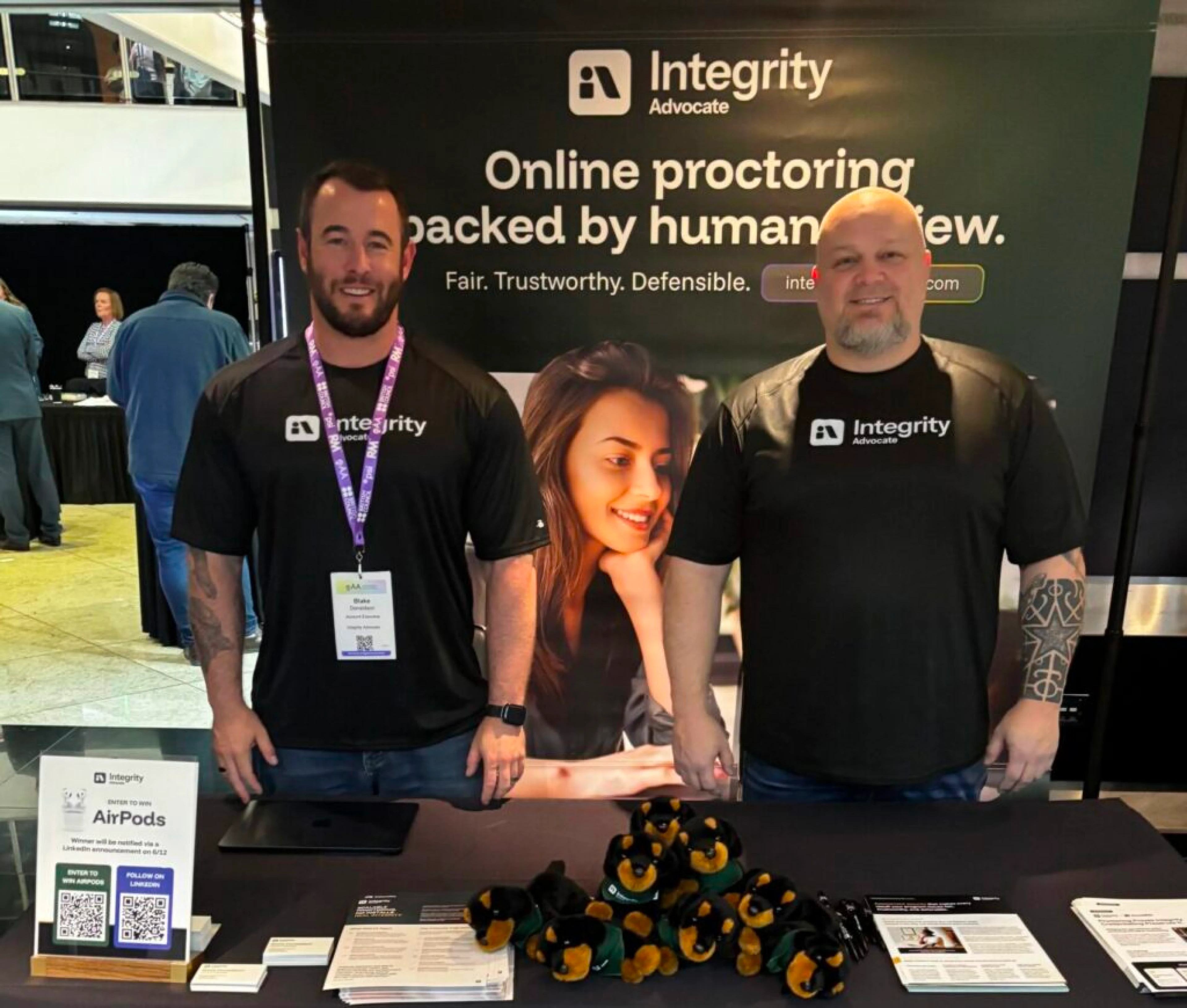
At the 2026 e-Assessment Association International Conference in London, the central theme was trust - specifically, how assessment programs can stay ahead of rapidly evolving AI-enabled cheating while preserving human oversight, candidate experience, and the credibility of every credential they issue.
Last week I was in London for the e-Assessment Association’s 2026 International Conference, and if I had to distill three days of conversations, keynotes, and hallway debates into a single word, it would be this: trust.
Not trust as a buzzword. Trust as a genuine crisis question. As AI capabilities accelerate and new tools emerge faster than most teams can keep up with, the field is being forced to reckon with something foundational: do assessment results still mean what we say they mean?
That tension ran through nearly every session I attended, and it’s one our industry can’t afford to get wrong.

One of the clearest messages from the conference was that assessment security is no longer a static problem. Cheating technologies are growing more sophisticated by the month. What worked two years ago may not be sufficient today, and relying on yesterday’s approach while hoping for the best is not a strategy.
At the same time, there’s a real risk of overcorrecting. Security measures that create friction, penalize legitimate candidates, or feel invasive erode trust from a different direction. The most mature programs in the room were the ones thinking about security, accessibility, and candidate experience as a unified design challenge rather than competing priorities.

One point emerged from this conference without serious debate: keeping a human in the loop is not optional. Multiple sessions, including remarks from several CEOs, affirmed that governance, transparency, and meaningful human involvement are essential to maintaining confidence in assessment outcomes.
This is not a novel position for us at Integrity Advocate. It is the architecture we have built around since day one. But it was validating to hear it stated so clearly and so universally, particularly at a moment when the industry is under pressure to automate everything in the name of efficiency.
When an assessment result affects someone’s career, their credential, their livelihood, cutting corners on human review is not a cost savings. It is a liability.
Something I found particularly valuable in this year’s programming was the explicit connection being drawn between candidate experience and assessment integrity. Fairness used to be discussed almost exclusively through the lens of psychometrics and policy. That framing is expanding.
How candidates are treated during an assessment, whether the process feels transparent, whether accommodations are genuinely accessible, whether the communication is clear, these factors now register as trust signals for institutions, employers, and regulators alike. A technically sound exam delivered badly is still a trust problem.

The strongest assessment programs are designing trust in from the beginning, not retrofitting it as a compliance requirement after the fact. That principle is easy to say and genuinely hard to operationalize, especially when the tooling, the regulations, and the threat environment are all shifting simultaneously.
What gives me optimism is that the people in that room in London were asking the right questions. The eAA has always been a community that takes this work seriously, and this year’s conference reflected that.
AI is not going away. The integrity gap will not close on its own. But with the right governance structures, the right human oversight, and a genuine commitment to candidate experience, it is a solvable problem.
I’m leaving with new ideas, new connections, and renewed conviction that this is exactly the work worth doing.
{{post-cta}}

February 25, 2026
|
5 min de lecture
Accredible and Integrity Advocate have announced a strategic partnership that connects verified online proctoring directly to secure digital credential issuance. The integration ensures credentials are automatically issued only to verified test takers who complete assessments without misconduct, closing the critical gap that exists when proctoring and credentialing systems operate independently. Initial support is available for D2L Brightspace environments, with a unified offering for new customers launching in Spring 2026.
FOR IMMEDIATE RELEASE | Mountain View, Calif. & Calgary, AB, Canada (March 2026)
New integration connects verified online proctored exams with digital credential issuance, protecting trust from test to certification
Accredible, the world’s leading digital badging platform, and Integrity Advocate, the most trusted online proctoring solution, today announced a strategic partnership to connect verified proctoring with secure digital credential issuance. The integration ensures credentials are automatically issued only to verified test takers who complete assessments without misconduct, helping programs preserve trust, defensibility, and brand integrity at scale.
As remote and online assessment continues to scale, credential fraud and assessment misconduct pose significant risks to program integrity and organizational reputation. While many testing and certification programs rely on proctoring or digital credentialing solutions independently, these systems are often deployed in isolation. The result is a critical gap: exams may be monitored and verified, but credentials are issued separately without a defensible, auditable link back to verified assessment participation.
The Accredible and Integrity Advocate partnership closes that gap by connecting assessment integrity directly to credential issuance. Integrity Advocate handles identity verification and ensures no exam misconduct. When a test taker passes an exam with verified human results, Accredible automatically issues secure, tamper-proof digital credentials within the program’s existing Learning Management System (LMS). Test administrators configure credentialing and proctoring rules within the LMS, and the system enforces them consistently at any scale.
{{post-block-quote}}
For testing and certification teams, the integration reduces manual reconciliation, simplifies exception handling, and strengthens defensibility across audits, appeals, and accreditation reviews. Programs can scale with confidence, knowing credentials are awarded consistently and backed by verified assessment evidence. Test takers experience fair, secure assessments and timely delivery of verifiable credentials, while employers and regulators gain a reliable way to verify authenticity long after the exam — protecting the value of the credential and every legitimate credential holder.
“A credential is only as trustworthy as the process that created it,” said Danny King, CEO and co-founder of Accredible. “This partnership gives programs a defensible way to protect their brand and stand behind every credential they award at scale.”
The Accredible and Integrity Advocate integration is available now, with initial support for D2L Brightspace environments. In Spring 2026, the companies will launch a unified offering that enables new customers to purchase both proctoring and credentialing services together. Existing customers can add credentialing or proctoring capabilities through their current provider relationship.
Accredible and Integrity Advocate will be showcasing the integration at the ATP Innovations in Testing Conference, March 1-4, 2026. To learn more about the integration, visit integrityadvocate.com/lms-integrations/accredible.
Integrity Advocate delivers modern online proctoring that protects assessment integrity through identity verification and intelligent exam monitoring. Trusted by certification bodies, training organizations, and educational institutions, Integrity Advocate supports compliance and accreditation with clear, audit-ready records, without compromising privacy or accessibility. Learn more at integrityadvocate.com.
Accredible is the world’s leading digital badging platform, enabling education and training leaders to increase learner engagement and drive program growth. Over 2,300 organizations, including Google, IAPP, McGraw Hill, Rutgers, Skillsoft, and the University of Cambridge, rely on Accredible to manage and measure everything from issuing digital certificates and badges to visualizing learning pathways to spotlighting certified learners. Founded in 2013, Accredible has helped issue and verify over 170 million career-advancing credentials. To learn more, visit accredible.com.
{{post-cta}}
July 22, 2026
|
5 min de lecture
Integrity Advocate has released a new whitepaper, Trust by Evidence, introducing a framework that connects AI due process, learner rights, and credential security into one model for defensible AI-assisted assessment. This post walks through what the framework covers, why AI adoption alone no longer settles the integrity question, and links to the full whitepaper download.
Assessment integrity used to mean one thing: was the exam monitored? That question is no longer enough. AI now plays a role in identity verification, proctoring flags, authorship review, scoring, and credential validation, and each of those touchpoints can be challenged.
Confidence in an outcome isn't just about whether AI was accurate. It's about whether the decision it contributed to can be explained, reviewed, appealed, and verified after the fact.
As AI becomes embedded deeper into assessment, institutions are being asked a more pointed question: Can you defend the decision AI helped you make?
That question requires more than accurate technology. It requires a system.
In our latest whitepaper, Trust by Evidence, CEO Brandon A. Smith introduces a framework that connects AI due process, learner rights, and credential security into one model for defensible outcomes.
For the past several years, the conversation in education and credentialing has centered on adoption: which AI tools to use, how to deploy them, how accurate they are. That conversation is largely settled. Most programs already use AI somewhere in the assessment lifecycle.
What hasn't been settled is defensibility. When an AI-influenced decision is challenged, whether by a learner, an employer, or a regulator, an institution needs to answer a specific set of questions: was there notice, meaningful human review, supporting evidence, and a path to appeal? If any of those answers are unclear, the decision isn't defensible, and the institution is exposed right along with the learner.
The next major challenge in education isn't AI adoption. It's building outcomes that hold up under scrutiny.
Many programs rely on AI to do one job: flag anomalies. That model treats a flag as a finding rather than a signal, and it breaks down under three conditions:
Any one of those gaps makes an outcome difficult to defend. Together, they create real exposure, not just to individual learners, but to the institution's accreditation standing, employer trust, and legal risk.
The whitepaper introduces Trust by Evidence, a framework that connects three ideas typically treated in isolation:
AI Due Process: A fair, documented process for any consequential decision AI contributes to, so a flagged learner has an actual process to walk through rather than a black box to accept.
The Learner Rights Layer: Seven specific rights, to know, to meaningful human review, to explanation, to evidence, to appeal, to proportionality, and to verification, that turn "the system flagged it" into a decision an institution can explain and stand behind.
The Credential Security Trifecta: A secure chain of trust connecting learning, assessment, and credentialing, where a weakness in any one layer undermines the others.
Individually, each idea is familiar. Together, they hold up under scrutiny from everyone with a stake in the outcome: the learner, the institution, employers, regulators, and the public.
A defensible process doesn't rely on confidence in the algorithm. It provides an actual record. It lets an institution answer, with certainty:
These are governance questions as much as technical ones. Answering them well protects accreditation standing, employer trust, and learner confidence all at once.
The full whitepaper expands on:
It's written for compliance leads, credentialing bodies, assessment teams, and program leaders responsible for the outcomes their institution has to stand behind.
{{post-cta}}

October 9, 2025
|
5 min de lecture
As online testing expands across education, certification, and compliance training, the choice between AI-only, human-only, and hybrid proctoring has real consequences for exam integrity, fairness, and organizational risk. This post breaks down all three models, their pros and cons, and when each is the right fit, concluding that hybrid proctoring delivers the best combination of efficiency, accuracy, and fairness for most modern assessment environments.
As online testing continues to expand across education, certification, and compliance training, choosing the right proctoring model has never been more important.
AI-only tools promise automation and scalability. Human-only options offer fairness and empathy. Hybrid models combine the best of both, but which one truly protects exam integrity?
This article breaks down the three dominant proctoring approaches, their pros and cons, and what to consider when choosing the right fit for your organization.
AI proctoring tools use algorithms to detect suspicious behavior automatically, from unusual head movements to multiple voices or unauthorized devices.
While these systems offer speed and scalability, they also raise concerns about accuracy and bias.
Pros:
Cons:
AI-only systems can be efficient but risk misinterpretation, which can reduced trust among test takers.
Human proctors oversee exams via live or recorded video, making real-time decisions based on context and behavior.
This model prioritizes fairness, empathy, and human oversight, but introduces scalability and scheduling challenges.
Pros:
Cons:
Human-only proctoring ensures fairness but struggles to keep pace with modern testing needs.
Hybrid proctoring blends automation and human oversight to deliver accuracy, fairness, and scalability.
AI handles initial detection, while human reviewers verify each flagged event before reports are finalized. This ensures efficiency without sacrificing integrity.
Pros:
Cons:
Hybrid proctoring creates the balance today’s organizations need, efficient technology guided by human discretion.
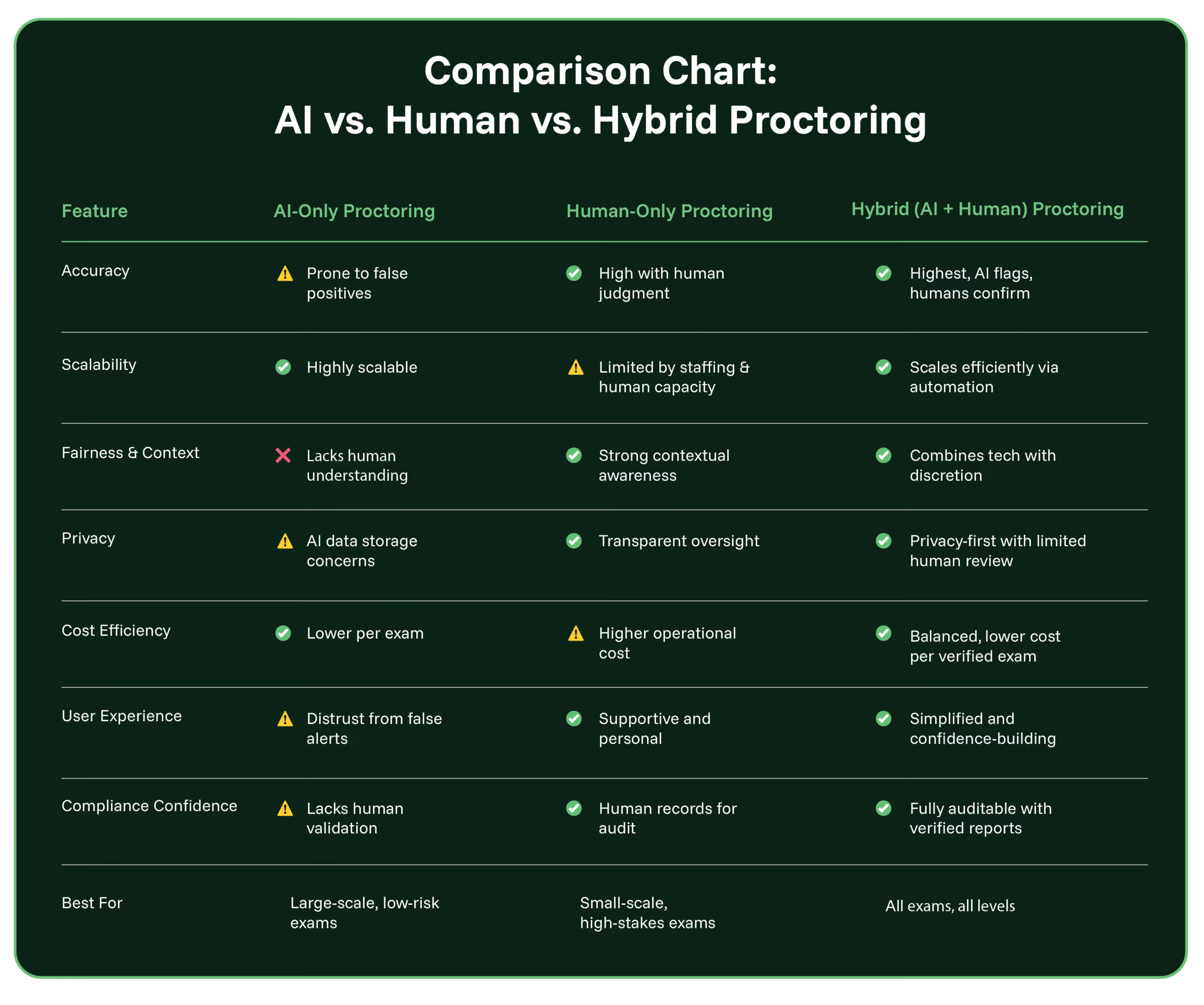
Verdict: Hybrid proctoring delivers the best combination of efficiency, accuracy, and fairness, meeting the evolving needs of modern learning and compliance environments.
Choosing the right proctoring model isn’t just about features, it’s about fit. Here's when each approach works best, and when it might fall short.
AI-only proctoring is a good fit for large-scale, low-stakes testing environments where speed and automation are priorities. It’s ideal for institutions delivering practice exams or formative assessments with minimal impact on final outcomes. If your team is constrained by staffing or budget, and real-time oversight isn’t required, AI-only can offer a fast, lightweight solution.
However, AI-only solutions are risky in high-stakes scenarios like certification, compliance, or licensure exams, especially where fairness, accessibility, and privacy are key concerns. These systems can generate false flags and lack the human context needed to distinguish genuine misconduct from harmless behavior.
Human-only proctoring excels in small-group, high-stakes testing scenarios where personal interaction, empathy, and real-time judgment matter most. It's particularly useful for live, synchronous exams or specialized formats like oral exams, interviews, or hands-on assessments. If trust, fairness, and human connection are top priorities, a fully human approach ensures every test-taker is treated with context and care.
That said, this model becomes difficult to scale across large populations or global programs. It also presents challenges for asynchronous testing and tends to be more expensive due to staffing and scheduling demands. Organizations needing rapid turnaround or flexible exam windows may find this model limiting.
Hybrid proctoring combines the speed and scalability of AI with the fairness and context of human review, making it ideal for most modern assessment environments. It works especially well for mid- to high-stakes exams delivered at scale, such as workforce certification, compliance training, or higher education finals. Hybrid models support asynchronous access and bring-your-own-device testing, while still delivering human-verified, audit-ready results.
The main limitation is that some hybrid models may involve slight delays between the test and final reporting, depending on review turnaround time.
Organizations are no longer choosing between technology and trust — they’re demanding both. Hybrid proctoring empowers institutions to deliver secure, privacy-compliant, and credible assessments without friction for test takers.
By combining automation and human verification, administrators get:
Integrity Advocate’s hybrid approach is designed around human-first, privacy-protected verification.
Integrity Advocate’s hybrid proctoring ensures fairness, compliance, and confidence in every assessment.
“Integrity Advocate integrates easily with our current system. It runs smoothly and is aesthetically pleasing; it meets the high standard we have for all our systems. It is also very effective at proctoring while not being too invasive; our users feel comfortable using it. Integrity Advocate strikes the right balance of integrity and privacy, which is hard to find!”
Ready to find the balance between automation and integrity?
Request a Demo to see how Integrity Advocate’s hybrid model redefines online exam security.
{{post-cta}}

July 9, 2026
|
5 min de lecture
Most proctoring platforms are built to detect cheating after it happens. Integrity Advocate's security-based framework is designed to prevent it through deterrence, proportional response, and human-reviewed evidence, with Counter-AI as one component of a broader system built to adapt as threats evolve. This post introduces the framework and links to the full white paper.
There is a meaningful difference between a proctoring system that catches violations after they happen and one designed so that violations are less likely to happen in the first place.
Most platforms focus on detection: flag the behavior, generate a report, let the program sort out what it means. The problem with that model is that it puts the burden on test takers, creates false positives, and produces results that are hard to stand behind when challenged.
Integrity Advocate takes a different approach, one grounded in a principle that applies equally well in physical security, public safety, and assessment integrity: the most effective systems deter problems before they occur, respond proportionally when they do, and produce evidence that holds up to scrutiny.
{{download-resource-cta}}
The presence of proctoring changes behavior. Most test takers who know their session is being monitored by a real person, not just logged by an algorithm, approach the assessment the way it was intended. No intervention needed.
This is why the combination of visible monitoring and human review is more effective than automated detection alone. It is not just about catching the problem. It is about creating conditions where the problem is far less likely to arise.
Not every behavioral signal warrants the same response. A proportional approach distinguishes between a minor anomaly and a genuine concern, applying appropriate controls without penalizing test takers for things that do not actually matter.
This is what separates a system that generates noise from one that produces clarity. Fewer false positives. Less administrative burden. More defensible outcomes.
When a result is challenged, the question is not whether the system flagged something. It is whether a person reviewed it, made a judgment, and documented their reasoning.
Integrity Advocate's human review process ensures that every flagged session is assessed by a trained reviewer before any outcome is recorded. That is what makes the result defensible, and what allows programs to stand behind what they issue.
AI cheating tools are the most urgent current threat, and Integrity Advocate's Counter-AI capability addresses them directly. But a sustainable integrity strategy cannot be built around detecting one category of tool. It has to be designed to adapt as threats evolve.
That is the difference between a feature and a framework.
{{post-stat-highlight}}
The full white paper walks through exactly how this works in practice, including how each control layer functions, how Counter-AI fits within the broader system, and what proportional enforcement looks like for programs of different sizes and risk levels.
{{post-cta}}

April 3, 2023
|
5 min de lecture
A registered training organization in Australia was charged with issuing fraudulent certifications after participants left training early. The RCMP uncovered a counterfeiting operation selling fake H2S Alive and First Aid certifications to workers who had completed no training at all. This post examines what makes a certification fraudulent, what the legal consequences are for employers, and how identity verification and participation monitoring protect organizations from the same exposure.
Most people assume fraud means stealing or pretending to be someone else. In the world of workplace training and certification, the definition is broader than that. Fraud is also when a person receives credit for something they did not, in fact, do.
That definition has real consequences for employers, and two recent cases make it impossible to ignore.
In Australia, a registered training organization was charged with issuing false documents to multiple trainees. The organization marked participants as attending a full two-day training when they had actually left at noon each day. Participants received certifications to operate forklifts and erect scaffolding without meeting the full training requirements. The organization faced significant financial penalties as a result.
In Canada, the Royal Canadian Mounted Police uncovered a large-scale counterfeiting operation selling fake training certifications for safety credentials including H2S Alive and First Aid/CPR. H2S Alive is issued to people working with hydrogen sulphide, a highly flammable and toxic chemical. The people who purchased these certificates did not miss half a course. They did not participate in any training at all.
In both cases, employees and their colleagues were put at risk. That risk includes injury, loss of limb, and death.
It is far too common for certificates to be issued without confirming identity or full participation. Most people do not think twice about the consequences of leaving a training session early. Few would assume that attending training where identity and attendance are not confirmed could result in a regulator declaring their certificate fraudulent.
But that is exactly what happens.
Employers carry a legal and moral responsibility to protect their employees and their organization from risk. Employee certifications are a promise to colleagues, clients, and regulators that your workforce meets industry standards. If you cannot demonstrate that your employees actually completed the required training, that promise is hollow and the certification that represents it may be worthless.
Without a trusted mechanism to verify identity and participation, the consequences range from reputational damage to financial penalties to legal action.
Workers who operate heavy machinery or work with dangerous chemicals face the highest physical risk from fraudulent certifications. But employees across all roles must be able to demonstrate proof of training that holds up to scrutiny.
The Australian case resulted in financial penalties and a loss of public trust. For organizations in regulated industries, that combination of reputational and financial damage can have lasting consequences that far exceed the cost of implementing proper verification in the first place.
The solution starts with how training organizations are selected and evaluated. For in-person training, careful vetting of providers is essential. For online training, which now accounts for the majority of workplace learning, the training organization must use an identity verification and participation monitoring solution.
Effective online proctoring uses a combination of human review and AI to verify that the right employee takes the right training and stays engaged throughout, without adding significant cost or administrative burden.
Safety-conscious businesses and industry safety organizations are increasingly requiring verified training, allowing them to take advantage of online delivery without compromising legal compliance or risk management. This trend is accelerating across industries where the consequences of unverified training are most severe.
Choosing verified online training gives employers documented evidence that their workforce completed training as required, evidence that holds up in regulatory investigations and legal proceedings.
{{post-cta}}

August 4, 2022
|
5 min de lecture
Integrity Advocate has completed its integration with Canvas LMS, enabling institutions and organizations using Canvas to deploy identity verification, participation monitoring, and online proctoring directly within their existing LMS environment without end user installation requirements.
Calgary, Alberta — August 4, 2022 — Integrity Advocate today announced the completion of their integration with Canvas LMS, one of the world's leading learning management systems.
Integrity Advocate's services include the verification of learner identity, monitoring of training participation, and the proctoring and invigilation of online examinations across all devices and browsers, without the requirement of end user installation or a high speed internet connection.
The Canvas integration extends Integrity Advocate's reach to institutions and organizations already operating within the Canvas ecosystem, allowing them to deploy identity verification and proctoring directly within their existing LMS environment without additional technical overhead.
Integrity Advocate supports Higher Education, K-12, Associations, Designation Providers, and Corporate Training organizations in ensuring the integrity of their online events through the verification of learner identity, participation, and rule compliance.
"We're committed to making online learning the best experience it can possibly be," says Integrity Advocate's CTO. "We've developed an incredibly powerful suite of digital tools that support the integrity of online learning. We're incredibly excited to integrate with Canvas LMS."
For more information on remote proctoring for Canvas, visit our integrations page.
{{post-cta}}