Ease of Use
+7 pts above avg
95%
IA
95%
AVG
88%

Recherches, guides et analyses concrètes sur la surveillance d'examens en ligne ; pour aider votre programme à obtenir des résultats équitables, fiables et défendables.
Évaluations sécurisées
Violations de données en plus de 12 ans
Taux de fidélisation client
Ressources publiées

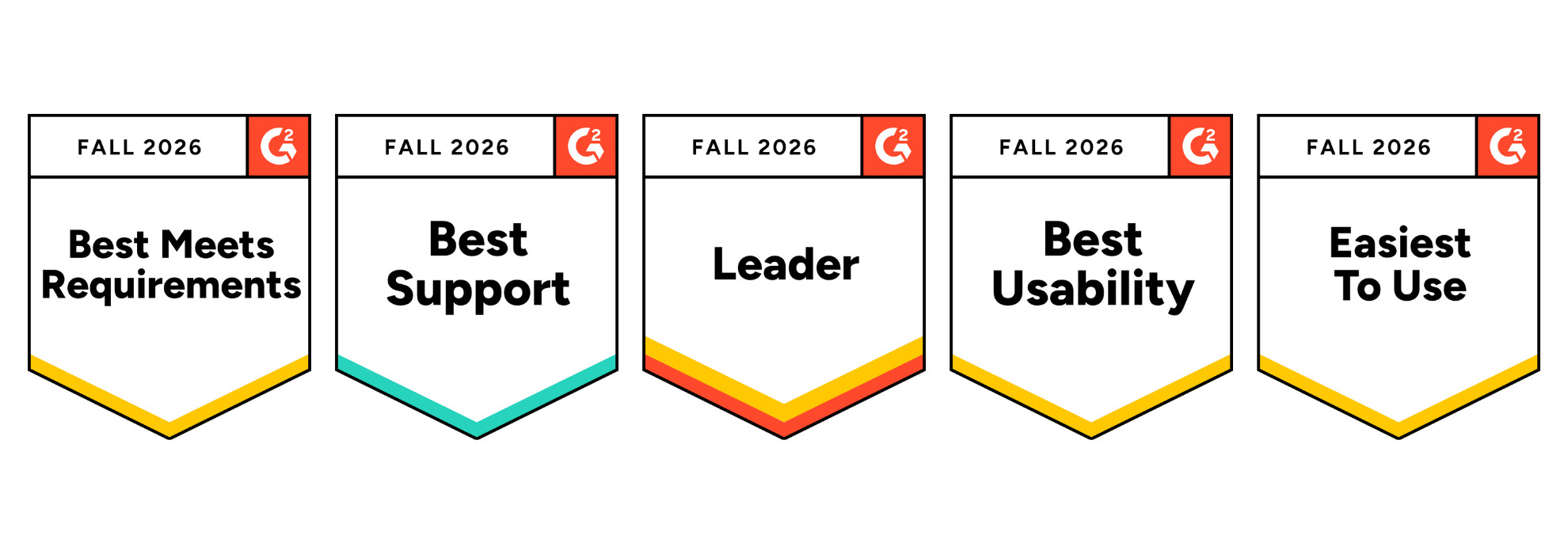
Integrity Advocate has been ranked #1 for Online Proctoring Usability on G2 for the third consecutive season. Based on verified customer feedback, we also earned five Fall 2026 badges recognizing usability, ease of use, support, and overall leadership.
Integrity Advocate has once again been ranked #1 in G2’s Usability Index for Online Proctoring, marking our third consecutive season at the top of the category.
In the Fall 2026 report, Integrity Advocate earned an overall G2 Index Score of 8.60, ahead of Honorlock, Proctorio, Quilgo, Talview, and Meazure Learning. We also earned five G2 badges, including Best Usability, Easiest to Use, and Best Meets Requirements, and were recognized as a Leader in the online proctoring category.
These recognitions are based on feedback from verified users. For us, that is what makes them meaningful. They reflect the experiences of the people who administer assessments, support test takers, and rely on the results.
Integrity Advocate earned the highest overall score in the Fall 2026 Online Proctoring Usability Index:
This is not only another first-place ranking. Our overall index score increased from 8.45 in Summer 2026 to 8.60 in Fall 2026, extending Integrity Advocate’s position at the top of the category.
G2 is the largest peer-to-peer software review platform in the world. Their Usability Index ranks products within a category based on three user-rated dimensions:
Every score comes from authenticated, verified reviews. Companies cannot pay to improve their position. There is no sponsorship or placement influencing the results. The index score reflects what users say about their experience with the product.
Integrity Advocate scored above the online proctoring category average across every usability measure included in the report:
User adoption stands out in particular. Integrity Advocate scored 17 points above the category average and 28 points above Honorlock.
That matters because a platform can have an impressive feature list and still create friction when people are asked to use it. Strong adoption suggests that the experience works in practice, not only during a product demonstration.
In addition to ranking first in the Usability Index, Integrity Advocate earned five G2 badges for Fall 2026 and was recognized as a Leader in online proctoring.
The Best Usability, Easiest to Use, and Best Meets Requirements badges reinforce something we have always believed: assessment security should be strong without being unnecessarily complicated.
Organizations should not have to choose between protecting an assessment and delivering an experience people can successfully use.
Online proctoring sits at a sensitive point in the assessment experience. Test takers may already be under pressure, while administrators need to protect exam integrity without creating unnecessary technical problems or support demands.
A platform that is difficult to access or manage can lead to:
Integrity Advocate was designed to remove those barriers.
There is no software to install and no browser extension to manage. The platform works across devices and browsers and integrates into existing assessment workflows. Test takers can access their assessments without navigating a separate, unfamiliar system, while administrators gain clear evidence and the context needed to evaluate results.
Usability is not separate from assessment integrity. When a platform works consistently, more attention can remain where it belongs: on the assessment and the credibility of its outcome.
Ease of use should never require an organization to compromise on accuracy or defensibility.
Integrity Advocate combines intelligent detection with Verified Human Review™ to provide context behind potential assessment violations. Instead of asking administrators to make decisions based only on an automated flag, our proctoring solutions can provide a clear, reviewable record supported by human judgment.
The result is an approach that protects assessment integrity while remaining practical for the people responsible for administering the program and fair to the people taking the assessment.
Across reviews, users consistently highlight the qualities reflected in the Fall 2026 report: straightforward implementation, ease of use for learners and administrators, seamless LMS integration, responsive support, and a privacy-first approach to assessment integrity.
As one verified user shared:
{{post-block-quote}}
That experience is what the rankings ultimately represent. Not simply a score, but whether the platform helps organizations protect assessments without placing unnecessary friction on their teams or test takers. View more customer stories here.
If you are currently comparing online proctoring solutions, usability should be evaluated alongside security, privacy, and review quality.
Consider asking:
The Fall 2026 G2 results provide an independent view of how leading platforms perform across many of these considerations.
Being ranked #1 once is exciting. Remaining at the top for three consecutive seasons tells a stronger story.
It shows that organizations do not have to accept unnecessary complexity as the price of protecting their assessments. Online proctoring can be secure, privacy-first, easy to administer, and straightforward for test takers.
That is the experience Integrity Advocate was built to provide, and we are grateful to every customer who shared their experience on G2.
The G2 ranking reflects a platform that has been in continuous operation for over a decade:
{{post-cta}}

February 9, 2021
|
5 min de lecture
Ontario universities, colleges, hospitals, and designated agencies are subject to FIPPA, and every vendor handling learner personal information must meet its standards. This guide walks through FIPPA's seven key principles and explains how Integrity Advocate meets each one, from limiting collection to automated data deletion, proactive learner notification, and human review that limits what gets shared with institutions.
If your organization is a university, college, hospital, or designated agency in Ontario, the Freedom of Information and Protection of Privacy Act applies to every vendor you work with that handles personal information, including your online proctoring platform.
FIPPA has governed Ontario institutions since June 10, 2006. It establishes a uniform regulatory framework for how personal information is collected, used, disclosed, retained, and destroyed. For online proctoring, which collects identity data, session recordings, and behavioral information from learners, FIPPA compliance is not optional. It is a condition of operating within Ontario's public sector ecosystem.
This guide walks through FIPPA's seven key principles and explains exactly how Integrity Advocate meets each one.
The Freedom of Information and Protection of Privacy Act serves two purposes. First, it gives individuals the right to access information held by Ontario government institutions. Second, and more relevant to online proctoring, it protects the privacy of individuals by limiting how institutions and their service providers collect, use, and disclose personal information.
FIPPA applies to all Ontario government ministries and any agency, board, commission, corporation, or other body designated as an institution under the regulations. In practice, this includes Ontario universities, colleges, hospitals, and a broad range of publicly designated organizations.
When an Ontario institution uses an online proctoring platform, the vendor handling learner data becomes accountable to FIPPA standards. Choosing a vendor that does not meet those standards creates compliance risk for your institution.
FIPPA places emphasis on Privacy by Design, meaning privacy protections must be built into information systems from the ground up, not layered on after the fact. For proctoring platforms, this means the architecture itself must reflect the principles of collection limitation, purpose restriction, and timely data destruction.
Organizations using proctoring vendors that collect more data than necessary, retain it longer than required, or share it without appropriate controls are exposed to FIPPA investigations, Information and Privacy Commissioner findings, and reputational risk with learners who have a right to know how their data is handled.
FIPPA limits the collection of personal information to authorized activities and requires that collection come directly from the individual except in limited circumstances.
Integrity Advocate collects only what is required to verify a learner's identity and monitor their session. If a learner is not permitted to access other browser tabs during their assessment, Integrity Advocate monitors exactly that and nothing more. Other proctoring providers routinely collect browsing history, desktop file lists, and program inventories that go well beyond what any assessment requires.
The only data Integrity Advocate receives from sources other than the learner directly is the learner's first name, last name, and email address, which comes from the Learning Management System solely for the purposes of identity verification and session communication.
FIPPA requires that individuals be informed of the collection of their personal information before it occurs.
Integrity Advocate presents its privacy policy to every user at the start of every session. Users must actively accept the policy before any personal information is collected. The privacy policy and session instructions are available in dozens of languages to ensure that consent is genuinely informed, regardless of the learner's primary language.
FIPPA limits the use and controls the sharing of personal information to authorized activities only.
Integrity Advocate provides a full human review service specifically designed to limit what gets shared with client organizations. When a session produces no violations, no session media is shared. When a session is flagged, only the minimum information required to document the specific concern is shared, with unrelated personal information redacted. This is the opposite of how most proctoring platforms operate, where full session recordings are routinely handed over to institutions regardless of whether a violation occurred.
FIPPA requires that processes be in place to keep personal information accurate.
Integrity Advocate session findings represent a documented snapshot of what occurred during a specific assessment. Because findings are based on human review rather than automated algorithmic flags, the information recorded is assessed for accuracy before it becomes part of any record. Session data does not change over time, which eliminates the risk of drift or corruption that can affect systems relying on ongoing data updates.
FIPPA requires that individuals be able to obtain access to their own personal information for a defined period.
Integrity Advocate eliminates the need for learners to submit formal access requests by proactively notifying every user by email after their session is completed and reviewed. The notification details what information was retained beyond the session and what conclusions were drawn. Learners know exactly what is on file about them without having to ask.
FIPPA requires that personal information be kept secure and confidential.
Integrity Advocate uses 256-bit encryption for all data in transit and at rest, stores data on AWS infrastructure in Montreal by default, and has maintained zero data breaches across 12 or more years of operation. The platform holds SOC 2 certification, providing independent third-party verification of security controls. Compliant user identification images and session media are deleted within 24 hours of session completion. Personal data that does not exist cannot be breached.
FIPPA requires that the disposal and destruction of personal information be authorized and secure.
Every piece of personal data collected by Integrity Advocate carries a programmatically applied time-to-live setting. When a session is complete, deletion occurs automatically and exactly as communicated to the learner. There is no manual process, no exception handling, and no risk of data persisting beyond its intended retention period.
FIPPA is one of several privacy frameworks that Ontario institutions need to navigate. Depending on the nature of your program and the location of your learners, PIPEDA, PIPA, GDPR, and FERPA may also apply. Integrity Advocate is built to support compliance across multiple frameworks simultaneously, with the same foundational Privacy by Design architecture underlying each.
For Ontario institutions specifically, Integrity Advocate provides the documentation, audit trail, and data handling practices your compliance and legal teams need to demonstrate that your proctoring vendor meets FIPPA's standards.
{{post-cta}}

May 25, 2020
|
5 min de lecture
The student who surgically implanted a Bluetooth device to cheat in an exam made headlines. But the more important question is why the exam was so easy to cheat on. This post explores how Bloom's Taxonomy and higher-order assessment design reduce academic integrity risks at the source, lowering the burden on proctoring technology and creating a fairer experience for every test taker.
A student surgically implanted a Bluetooth device into their own ear to receive answers during a final exam. It made headlines. It was extreme, it was alarming, and it completely missed the more important question.
Why was the exam so easy to cheat on in the first place?
The conversation around academic integrity almost always focuses on the student: what they did, how they did it, and how to stop them next time. The assessment itself rarely comes under the same scrutiny. That's a problem. Because in many cases, the design of the exam is the vulnerability, and fixing it does more for integrity than any monitoring technology can.
When an organization moves assessment online, two things typically happen. First, they worry about cheating. Second, they look for proctoring technology to solve it. What often gets skipped is the question that should come first: is this assessment actually designed for an online environment?
The method of assessment is a variable entirely within the organization's control. When that variable is addressed, the result is better academic integrity, a less stressful experience for test takers, and lower proctoring costs. All three, at once.
Bloom's Taxonomy is a framework for categorizing educational objectives by cognitive complexity. Developed by Benjamin Bloom in collaboration with other education experts and published in 1956, it has been refined over decades into six levels of learning:
Each level requires a greater degree of cognitive processing than the one before it. And crucially, each level also changes how much a proctoring system needs to do.
A question like "define representative democracy" or "spell rutabaga" can be answered in seconds with a quick search, a phone, or a note. Monitoring this type of question requires tracking browser activity, device use, eye movement, and the presence of others in the room. The proctoring burden is high. The assessment value is low.
Questions at this level, such as "explain the role of citizens in a representative democracy," carry the same risks. The answer can be found, copied, and paraphrased quickly enough that standard monitoring is the only safeguard.
Here the dynamic starts to shift. Application questions require a test taker to work through a problem, not just retrieve an answer. When combined with time limits, large question banks, and randomized question and answer combinations, the advantage of external resources is significantly reduced. Proctoring at this level can focus on identity verification and confirming sole participation, which is lower cost and far less invasive.
At these levels, the integrity risk drops substantially. A question like "compare and contrast the economic motivations of..." or "explain the effect of X on a country's economy" requires original reasoning that cannot be copied. No search result, no friend in an earpiece, and no surgically implanted Bluetooth device provides a meaningful advantage when the question demands genuine synthesis and judgment.
Higher-order assessments don't eliminate the need for proctoring. Identity still needs to be verified. Sole participation still matters. But they do change what proctoring needs to accomplish, and that changes what it costs and how intrusive it has to be.
For organizations running online assessments, this is worth reviewing before adding monitoring layers. If your questions can be answered by someone with a phone and thirty seconds, the proctoring challenge is structural, not technological.
The default response to academic integrity concerns is tighter controls and more invasive monitoring. That response treats the symptom. Reviewing the assessment design treats the cause.
Integrity Advocate works with organizations to look at the full assessment process, not just the monitoring window. When the exam itself is designed to require genuine knowledge and reasoning, the monitoring becomes simpler, the experience becomes fairer, and the outcomes become more defensible.
That's a better result for everyone, including the test taker who never has to wonder if an algorithm flagged them unfairly.
{{post-cta}}

January 1, 2020
|
5 min de lecture
BIPA sets strict standards for how organizations must collect, store, and use biometric data in Illinois, and online proctoring platforms fall squarely within its scope. This guide breaks down what BIPA requires, where proctoring platforms create compliance risk, and how Integrity Advocate is designed to support your obligations, from informed consent and data deletion to zero commercial use of biometric data.
If your organization uses online proctoring and operates in Illinois, or serves Illinois residents, the Biometric Information Privacy Act applies to you. And unlike most privacy legislation, BIPA has teeth. Private individuals can sue directly, without needing to prove actual harm, and statutory damages start at $1,000 per negligent violation and $5,000 per intentional one.
This is not a checkbox compliance exercise. It is a legal and reputational risk that organizations need to address before they deploy any technology that touches biometric data.
This guide explains what BIPA requires, how it applies to online proctoring specifically, and how Integrity Advocate is built to support your organization's compliance obligations.
The Biometric Information Privacy Act is an Illinois state law that establishes standards for how companies must collect, store, use, and disclose biometric information. It was enacted in 2008 and remains one of the strictest biometric privacy laws in the United States.
BIPA covers any information based on an individual's biometric identifiers, including:
For online proctoring, the most relevant category is facial geometry. Any platform that uses facial recognition or AI-based facial monitoring to verify identity or flag behavior is collecting biometric data under BIPA's definition.
BIPA places four core obligations on organizations that collect biometric data:
Organizations must have a publicly available written policy establishing a retention schedule and guidelines for permanently destroying biometric data. Data must not be retained beyond the purpose for which it was collected, or beyond three years, whichever comes first.
Before collecting biometric data, organizations must inform individuals in writing that biometric data is being collected, state the specific purpose and length of time for which it will be used, and obtain a written release. Consent cannot be buried in general terms and conditions.
Organizations are prohibited from selling, leasing, trading, or otherwise profiting from an individual's biometric data. This applies to vendors and service providers as well.
Biometric data must be stored, transmitted, and protected using the same standard of care as other sensitive and confidential information, and in a manner consistent with the reasonable standard of care within the organization's industry.
Most online proctoring platforms collect biometric data as a core function. Facial recognition for identity verification, AI monitoring of facial expressions and eye movement, and behavioral biometric analysis all fall within BIPA's scope when delivered to Illinois residents.
The risk isn't hypothetical. Courts have consistently ruled that BIPA applies broadly, and class action litigation against organizations using biometric technology without proper consent frameworks has resulted in significant settlements.
The question isn't whether your proctoring platform uses biometric data. It almost certainly does. The question is whether it handles that data in a way that protects your organization.
Integrity Advocate's identity verification and proctoring services are designed with biometric privacy obligations in mind.
Informed consent is built into the process. Test takers are informed of what data is collected, why it is collected, and how it will be used before any session begins. Consent is obtained as a documented step in the onboarding process, not assumed through general terms.
Data is not sold or used for commercial benefit. Integrity Advocate does not sell, lease, or repurpose biometric or session data for any secondary use. Data collected during a proctoring session is used solely for the purpose of that assessment.
Sensitive data is deleted promptly. Facial images and identity verification data are deleted within 24 hours of session completion, unless retention is required for a specific dispute resolution purpose. This supports compliance with BIPA's retention requirements.
Security standards are robust. Integrity Advocate uses 256-bit encryption in transit and at rest, stores data on AWS infrastructure in Montreal by default, and has maintained zero data breaches across 12+ years of operation.
Human review replaces over-reliance on facial AI. Rather than making automated decisions based on facial monitoring alone, every flagged session is reviewed by a trained person before any outcome is recorded. This reduces the risk of inaccurate findings and limits the extent to which facial geometry data drives decisions.
BIPA is one of several privacy frameworks that organizations using online proctoring need to consider. Depending on where your test takers are located, GDPR, PIPEDA, FERPA, and other state-level legislation may also apply. Integrity Advocate is built to operate across jurisdictions, with privacy-first architecture that supports compliance across multiple frameworks simultaneously.
BIPA litigation is active and growing. Organizations that collect biometric data without proper consent frameworks, retain it beyond its purpose, or work with vendors who repurpose it commercially are exposed. Statutory damages per violation, multiplied across a class of test takers, add up quickly.
Choosing a proctoring partner that takes biometric privacy seriously is not just a compliance decision. It is a risk management decision.
{{post-cta}}

July 31, 2026
|
5 min de lecture
Downloaded software, browser extensions, and compatibility checks don't just frustrate test takers, they generate a real, recurring cost in help desk tickets and IT hours. See what happens to that cost when a proctoring platform removes the download requirement entirely.
Every proctoring tool that requires a download, an extension, or a compatibility check has a hidden line item: the help desk. It rarely shows up in a vendor's pricing page, and it almost never gets factored into a buying decision. But it shows up every semester, every testing window, every audit season, in the form of support tickets, IT hours, and test takers who never make it into the exam.
If you're budgeting online proctoring as a software expense instead of an operational expense, you're probably overlooking one of its biggest costs: IT support.
Most proctoring tools that rely on downloaded software or browser extensions, create a predictable chain of costs that has nothing to do with the exam itself:
None of this is a one-time setup cost. It repeats every testing cycle, for as long as the tool requires local installation to function. IT budgets in higher education are already stretched, with EDUCAUSE's most recent benchmarking data putting median central IT spend at roughly $1,600 per student FTE. A proctoring tool that quietly adds to that load is a cost worth naming, not absorbing.
Support contact rate, the percentage of test takers who need to reach out for help before or during an exam, is one of the most under-used numbers in vendor evaluation. It's a direct proxy for how much of your team's time a proctoring tool will quietly absorb.
A platform with nothing to install has nothing to break, misconfigure, or get blocked by a firewall, and that shows up consistently in how programs actually run at scale:
Those aren't outcomes you get from a better help article. They're outcomes you get from removing the reason people needed help in the first place.
It's easy to file "no downloads required" under user experience and move on. In practice, it's an operational and financial decision that affects three groups at once.
Test takers launch directly from their LMS, on any device or browser, with identity verification completed automatically at check-in. There's no plug-in to find, no extension to approve, no compatibility check to fail. (For a closer look at how this compares across the market, see Top No-Download, Browser-Based Proctoring Tools.)
Administrators and IT teams stop being the first line of defense for a vendor's technical requirements. Rollouts move faster because there's no local software to deploy, license, or troubleshoot across a fleet of devices your team doesn't fully control, especially when test takers are using their own laptops. That's also what makes integration directly with your existing LMS possible without a parallel IT project.
Programs avoid the credibility problem that comes with technical friction: when a meaningful share of test takers can't complete an exam because of a download issue, that's not a security event, but it is a program integrity event. It raises fair, hard questions about whether every test taker had equal access to demonstrate what they know.
Complete assessment security depends on more than catching irregular behavior. It depends on every test taker having a fair, equal path into the exam, and on every flagged session being reviewed by a trained person before any outcome is issued, not just processed by an algorithm.
A tool that quietly filters out test takers who couldn't install its software isn't more secure. It's excluding people before the exam even starts, and that's a fairness problem your program will eventually have to explain. A no-install platform backed by human review removes that exclusion at the front door and gives every reviewed outcome a record your program can actually stand behind.
The next time a proctoring vendor's pricing page crosses your desk, the software cost isn't the full picture. Ask for the support contact rate. Ask what happens when a test taker's device can't run the required software. Ask how many IT hours your team spent last testing cycle on issues that had nothing to do with academic integrity.
If the answer involves a help desk queue, that's not a technology problem. It's a design choice, and it's one your program is paying for every single testing window.
{{post-cta}}

January 8, 2026
|
5 min de lecture
As online assessment continues to scale, the complexity of protecting exam integrity has grown alongside it. AI misuse, organized cheating schemes, rising privacy expectations, and increased scrutiny around fairness and defensibility are reshaping what effective assessment security really requires. This post examines how leading programs are moving beyond reactive, one-size-fits-all proctoring toward intentional assessment protection strategies built around four principles: designing integrity into the assessment experience, strengthening security without sacrificing privacy, combining technology with human judgment, and delivering outcomes that hold up to scrutiny.
Online proctoring is foundational to how assessments are delivered today. But as adoption has grown, so has the complexity of protecting exam integrity. AI misuse, organized cheating, rising privacy expectations, and increased scrutiny around fairness and defensibility are reshaping what effective assessment security really looks like.
As we look ahead, programs face a critical question: Is your assessment security strategy keeping pace with today’s risks?
Early online proctoring solutions focused heavily on surveillance and rule enforcement. While monitoring still plays a role, it’s no longer sufficient on its own.
Modern remote proctoring must support a broader goal: assessment protection that is fair, proportional, and defensible, for both programs and exam-takers. That means balancing security and privacy, automation and human review, scalability and accuracy.
Assessment security today isn’t just about catching misconduct. It’s about protecting the credibility of the assessment itself.
Leading programs are moving beyond one-size-fits-all online proctoring tools and adopting more intentional assessment protection strategies. Here’s what that shift looks like.
Strong assessment protection starts long before an exam begins. Programs are increasingly designing integrity into their assessments, aligning exam structure, delivery methods, and proctoring configurations to the level of risk involved. Thoughtful design reduces opportunities for misconduct and allows online proctoring to function as part of a cohesive security framework, rather than a reactive safeguard.
As remote proctoring becomes more prevalent, privacy expectations continue to rise. Assessment security that relies on invasive monitoring can undermine trust and damage the credibility of a program. In 2026, effective online proctoring must protect exam integrity without over-collecting data or creating unnecessary friction for exam-takers.
Privacy-first assessment protection is a requirement.
Automation is essential for scale, but it can’t replace context. AI-powered online proctoring tools are effective at identifying anomalies and potential risks. Human review, however, remains critical for interpreting behavior, applying policy consistently, and ensuring fair outcomes.
The most defensible assessment security models in 2026 will continue to rely on a hybrid approach, where technology flags risk and humans make informed decisions.
Assessment protection doesn’t end when the exam is submitted.
Programs must be able to stand behind their results, whether responding to learner appeals, audits, or regulatory inquiries. Transparent workflows, documented review processes, and consistent decisioning are essential components of modern assessment security. Online proctoring is only effective if the outcomes it supports are trusted.
As online and remote proctoring continue to evolve, programs should be asking:
Assessment protection is no longer a checkbox. It’s an ongoing strategy, one that must evolve alongside technology, expectations, and the future of remote assessment.
Across education, credentialing, and workforce training, organizations are rethinking how online proctoring and assessment security fit into their long-term plans. How can Integrity Advocate help shape your assessment security strategy this year? Schedule a Demo today!
{{post-cta}}

December 11, 2025
|
5 min de lecture
Proctoring works best when it is almost invisible. When the first interaction a learner has with a proctoring tool involves downloading a launcher, requesting elevated permissions, or troubleshooting errors, it introduces friction before a single question is answered. That friction drives anxiety, failed assessment starts, elevated support tickets, and lower perceived fairness. This post examines why ease of use has become a competitive advantage in proctoring, how no-install design reduces friction while maintaining integrity, and what the market is actually asking for as institutions rethink their assessment experience in 2026.
Proctoring isn’t just about catching cheaters, it’s about creating an experience that preserves trust, reduces barriers, and supports learners as they engage with assessments. As remote and hybrid testing become standard across education and workforce programs, one trend stands out: ease of use has become a competitive advantage in proctoring.
Proctoring works best when it’s almost invisible. It should quietly protect the integrity of an assessment while blending into the systems learners already know and trust. Proctoring should feel familiar, launching learners into their exams in the same environments they already use every day rather than pushing them into unfamiliar tools or workflows. When that doesn’t happen, friction shows up fast.
Technical friction, like downloads, extra logins, and multi-step setup flows, doesn’t just slow learners down. It reduces confidence, increases support needs, and indirectly becomes one of the biggest hidden costs of remote assessment.
In this post, we unpack why ease of use, especially no-install proctoring, matters in the new year and beyond, and how it impacts learners, administrators, and institutional outcomes.
For many test-takers, the first interaction with a proctoring tool sets the tone for the entire assessment. When that interaction involves:
…it introduces friction before a single question is answered.
That friction can lead to:
And while traditional proctoring vendors often treat installations and extensions as standard, learners often do not.
A privacy-first, no-install approach eliminates these barriers at the source, protecting not just the exam, but the experience. That mindset aligns directly with our philosophy of integrity without intrusion, where security and user respect coexist.
"The service itself is easy to use and is popular among our students. The implementation process went smoothly." - Verified G2 review
As institutions invest in stronger security, a natural tension arises: how do you ensure integrity without breaching privacy? Many legacy solutions err on the side of surveillance, using broad access and extensive permissions to “cover every angle.” But in doing so, they often end up collecting data that goes well beyond what’s necessary for integrity, raising concerns that many programs simply don’t want to inherit.
That’s a central theme in discussions around where secure proctoring ends and privacy invasion begins.
A no-install experience helps resolve this tension by minimizing the data surface area, collecting only what’s essential for validating identity and behavior, and doing so in a way that feels transparent, logical, and fair to learners.
There’s a misconception in proctoring that more technology equals better security. But feedback from educators, training leaders, and certification bodies tells a different story: they want tools that are secure and intuitive.
In fact, recent industry thought leadership underscores how the expectations for remote assessment are shifting, away from invasive, heavy-tech tools and toward solutions that balance trust, simplicity, and integrity.
Ease of use is not just a “nice-to-have" it’s becoming a requirement for programs that care about candidate satisfaction, equity, and outcomes.
In our 2025 Year in Review, one clear trend emerged: programs that reduce friction for learners are better positioned for success. That doesn’t mean sacrificing security, it means rethinking how proctoring integrates into existing workflows.
Simpler start flows mean fewer abandoned exams, fewer escalations to support teams, and a better overall test-taker experience. When learners feel respected, not surveilled, institutions see:
This has real implications for retention, reputation, and operational efficiency.
Security and ease of use are not opposites. In fact, when done right, they reinforce each other:
In 2026 and beyond, proctoring will be defined not just by what it protects, but by how it protects it, and that starts with the experience learners have from the moment they click “Start.”
If you’re rethinking your proctoring approach for the next year, this is a great time to evaluate whether your current tools are adding unnecessary friction.
We’d be happy to walk through how a privacy-first, no-install model could fit your environment and security requirements.
Book a demo to see what invisible, easy-to-use proctoring can look like in practice.
{{post-cta}}
June 2, 2025
|
5 min de lecture
Before Integrity Advocate, nearly 50% of National Payroll Institute students experienced issues with online proctoring. After implementation, that figure dropped to virtually zero. This webinar recap covers NPI's full transformation: a 57% reduction in academic integrity incidents, 30,000 or more exams proctored seamlessly, sub-1% support rates, and a scaling from a few thousand to every student being e-proctored in less than three months. Three NPI leaders share what the experience looked like from the inside and what they would tell other organizations considering a proctoring solution.
Date
Originally aired: June 24, 2025
{{post-stat-highlight}}
Before implementing Integrity Advocate in 2020, the National Payroll Institute (NPI) faced significant challenges with its existing online proctoring solution. With over 15,000 course registrations annually and a growing need for remote assessment integrity, NPI was eager to ensure a seamless experience for users and administrators.
The COVID-19 pandemic forced NPI to rapidly pivot from its honor-based supervisor proctoring system to a fully online solution. Technical issues, compatibility problems, and frustrated students plagued their first attempt at online proctoring. The situation became critical as NPI's membership had grown from 4,000 members decades ago to over 17,000 PCP designation holders and 4,000 PLP designation holders, all requiring reliable assessment integrity.
Christopher Pacella, Manager of Professional Accreditation and Standards, knew there had to be a better way. The previous system required plugin downloads, only worked on specific browsers, lacked French language support for their 12% francophone membership, and caused technical headaches for students and administrators. With integrity being one of NPI's four core values, the technical barriers undermined their fundamental mission.
{{post-block-quote}}
The reality was apparent - their proctoring system needed a complete overhaul to support NPI's mission of maintaining the highest standards of professional payroll excellence.
Fast-forward to today using Integrity Advocate, and the transformation has been remarkable. What used to be a source of constant technical support tickets has become virtually invisible to users. The seamless integration with D2L Brightspace meant students could focus on their assessments rather than troubleshooting technology. This transformation was particularly crucial for NPI's diverse student population, which includes many professionals who returned to education later in their careers and may not be as comfortable with complex technical systems.
"We're getting very little [feedback]. And that's amazing. That speaks volumes. That's exactly what we want. You don't hear about software that works well typically... But if it didn't work, you better believe we're going to hear about it a lot. And that was the big difference between the system that we previously had, where we heard all sorts of feedback, and Integrity Advocate, where it just works." - Christopher Pacella, Manager of Professional Accreditation and Standards
The implementation process was remarkably smooth, requiring only a 45-minute setup meeting compared to the weeks of troubleshooting that characterized their previous solution. This efficiency allowed NPI's technical team to redirect their efforts from crisis management to strategic educational initiatives that better serve their members.
One of the most significant improvements was in academic integrity incident management. NPI saw remarkable results after implementing a comprehensive academic integrity education module combined with Integrity Advocate's seamless proctoring. The institute's proactive approach to education and reliable technology created an environment where students understood expectations and could meet them without technical barriers.
"We went from an average of 86 incidents per month, and it dropped more than in half, down to 37. And that's been very consistent since we implemented some of these resources and things for people to understand what academic integrity means." - Christopher Pacella, Manager of Professional Accreditation and Standards
The reduction wasn't just about fewer incidents - it was about quality. The remaining incidents were genuine violations rather than accidental technical issues or misunderstandings about proctoring protocols. This improvement meant that NPI's review committees could focus their time on legitimate concerns rather than sorting through technical false positives, leading to more consistent and fair decision-making processes.
The transformation was equally dramatic for students. Daniela Kwiatkowski, Manager of Learning and Professional Development, experienced the system firsthand when she took one of NPI's courses. Her experience highlighted how the technology disappeared into the background, allowing students to concentrate on demonstrating their professional competency. This was particularly important for NPI's student population, many of whom are working professionals balancing career responsibilities with continuing education requirements.
"Before you do it for the first time, you're thinking, how am I going to do this? I've to write this exam that's stressful enough, and somebody will be watching me... I moved the camera to one corner and then I forgot about it, and it was easy to forget about it. It wasn't constantly there. [Like] oh, it's watching you. It was put in a corner, now [I could] focus on the exam, which is what we want people to do." - Daniela Kwiatkowski, Manager of Learning and Professional Development
This improvement in user experience had cascading effects throughout the organization. Students could focus on demonstrating their payroll expertise rather than wrestling with technology. The reduced anxiety around the proctoring process meant that assessment results better reflected actual knowledge and competency. This directly supported NPI's goal of ensuring that designation holders truly possess the skills they represent to employers.
The partnership with Integrity Advocate enabled NPI to scale its proctoring operations dramatically while maintaining quality and integrity. This scalability proved crucial during the pandemic when remote learning accelerated rapidly, but it continues to support NPI's growing membership and expanding course offerings. The ability to handle volume without compromising academic integrity standards has become a competitive advantage for the organization.
"We were able to scale that up dramatically through our move to D2L Brightspace and the integration with Integrity Advocate. There was a point at which we maybe had a few thousand students being e-proctored, to the point now where every one of our students is e-proctored through the payroll compliance professional designation... And that ramp-up happened in less than three months." - Steven Van Alstine, Vice President of Professional Standards and Education
The rapid scaling capability also supported NPI's diverse delivery methods, including partnerships with public and private academic institutions alongside their direct-to-student programs. This flexibility has allowed NPI to expand its reach while maintaining consistent standards across all delivery channels.
From an administrative perspective, the transformation was equally impressive. Decision-making that previously took weeks now happens within 48 hours, with clear evidence and streamlined processes. The administrative team developed communication templates and tracking systems that ensure consistent and fair handling of all incidents. This systematic approach has created a defensible process that stands up to appeals and maintains the organization's reputation for fairness and integrity.
"Giving someone a zero on an exam or failing a course is a big deal. I cannot emphasize it enough... Having the peace of mind to know this is an incident [that was] flagged for the right reasons. We can see that this is a violation, [it] gives us the peace of mind to say, okay, we know that if we're going to give them a zero or fail them or whatever the consequences are, we are very confident that this is legitimate." - Daniela Kwiatkowski, Manager of Learning and Professional Development
The administrative experience became so streamlined that what used to consume significant staff time troubleshooting technical issues now allows the team to focus on genuine student support and educational excellence. This shift has improved job satisfaction for staff members who can now concentrate on meaningful educational work rather than technical crisis management.
Having experienced both the challenges of problematic proctoring solutions and the success of the right partnership, the NPI team offers clear guidance for other organizations. Their journey from a 50% student issue rate to virtually zero technical problems provides valuable lessons for any organization considering e-proctoring solutions. The team emphasizes the importance of thorough due diligence and learning from organizations that have successfully navigated similar transformations.
"There are a lot of products out there. And you're going to reach out to them, and the sales team will talk a big game about all the wonderful things they can do. Take your time and understand the technical aspects of implementation before making a decision. And if you want to save yourself a lot of time, start with Integrity Advocate, because we've already done that research for you and know that it works." - Christopher Pacella, Manager of Professional Accreditation and Standards
The NPI team's recommendation reflects their comprehensive experience with multiple solutions and their understanding of the actual costs of implementation challenges. Their advice emphasizes that the initial technology decision impacts not just technical performance but also student experience, administrative efficiency, and ultimately the organization's ability to fulfill its educational mission.
{{post-cta}}

April 17, 2023
|
5 min de lecture
Food manager certification programs face four recurring challenges: inadequate identity verification, scheduling barriers, installation-based security risks, and equity issues created by AI-only proctoring. The Chipotle $25 million fine demonstrates what is at stake when food safety training compliance falls short. This post examines each challenge and explains how Integrity Advocate's installation-free, human-reviewed proctoring addresses all four.
Maintaining food safety across restaurants, processing plants, grocery stores, and other food handling environments is a complex, multi-layered challenge. Workers handle food directly. Managers set policies, define processes, and own the day-to-day culture of operations. Different roles require different training, and the stakes at the management level are particularly high.
When food manager certification programs fall short, the consequences are not abstract. In 2020, Chipotle incurred a $25 million fine because it failed to ensure that employees understood and complied with its food safety protocols. The fine followed a series of foodborne illness outbreaks between 2015 and 2018 that affected more than 1,100 people.
As Assistant Attorney General Jody Hunt stated at the time, the case highlights why it is important for restaurants and members of the food services industry to ensure that managers and employees consistently follow food safety policies.
Training is the first line of defense. And for online food manager certification specifically, there are four areas where most programs fall short.
In the US, state-level agencies determine training requirements for food handlers, generally following standards defined by the American National Accreditation Board's Conference for Food Protection Standards, which is based on American National Standards Institute guidelines.
Food safety manager certification applies to managers and team leads, the people responsible for those with food handler certification. It requires a deeper understanding of foodborne illness prevention, HACCP principles, sanitation practices, and regulatory requirements. ANAB/ANSI standards require that food manager certification exams are proctored and that test takers verify their identity before starting.
For certification to be meaningful, the person taking the exam must be who they say they are and must follow the rules throughout the session. ANAB/ANSI standards are explicit about this requirement.
The problem is that many proctoring services claim to check participant IDs without applying any meaningful standard of scrutiny. In many cases, a library card or gym card is accepted without question. When the identity check is that superficial, the system is open to abuse and the certification it produces is vulnerable to challenge.
Integrity Advocate's identity verification process confirms that the person completing the exam matches a government-issued photo ID, with human review of flagged sessions before any outcome is recorded. That is the standard that ANAB/ANSI compliance actually requires.
Food service workers often work long, unpredictable hours. Unless proctored certification exams are available on demand, finding time to complete them is genuinely difficult. When workers can find the time, some proctoring systems make them wait, with reported wait times of 45 minutes or longer before a session can begin.
On-demand proctoring that is available at any time, on any device, eliminates this barrier entirely. A food service manager working a split shift should be able to complete a proctored certification exam during their break, not schedule around a proctoring provider's availability.
Most proctoring services require participants to install software, browser plugins, or extensions to enable remote monitoring. This can involve bypassing standard security restrictions, changing system settings, or disabling antivirus software. Participants typically receive no follow-up support, no instructions for re-enabling security features, and no help uninstalling the proctoring software after the exam.
For certifying organizations, this creates practical and legal exposure. Installation requirements increase participant support demands significantly and introduce security risks that the organization then shares responsibility for.
Integrity Advocate requires no installation. The platform is browser-based and works on any device without changing security settings, disabling protections, or leaving software behind after the session ends.
Online proctoring systems that require specific devices, operating systems, or browser configurations create disadvantages for participants who do not have access to the required setup. Food service and related industries are diverse workplaces. A certification system that privileges certain technological configurations over others introduces inequity into a process that is supposed to be objective.
AI-based proctoring compounds this problem. Systems that rely on automated behavioral monitoring without human oversight leave no room for context, nuance, or accommodation. A participant with a disability that affects eye movement could be flagged for a violation they did not commit, with no meaningful review process to catch the error.
Integrity Advocate's browser-based platform works on any device without configuration requirements, and every automated flag is reviewed by a trained person before any finding is recorded. That combination addresses both the access and the fairness dimension of equity in online certification.
Solving for these four challenges starts at the design and implementation stage. An online food manager certification program built on a foundation of proper identity verification, on-demand availability, no installation requirements, and human-reviewed proctoring produces certifications that mean what they are supposed to mean and hold up to regulatory scrutiny.
Integrity Advocate's identity verification and participation monitoring tools are built for assessments in high-stakes industries, with a seamless, installation-free experience that works for anyone, at any time, from any device.
For a real-world example of how this works in practice, read our case study with Smart Serve Ontario.
{{post-cta}}

April 4, 2023
|
5 min de lecture
Integrity Advocate has announced a strategic integration with Open LMS, combining identity verification and human-reviewed proctoring with Open LMS's learning management platform. The integration allows educators to deploy proctored assessments directly within Open LMS without additional technical overhead.
Integrity Advocate has announced a strategic partnership with Open LMS, a leading provider of open-source learning management systems used by educational institutions worldwide.
The integration combines Integrity Advocate's identity verification and human-reviewed online proctoring with Open LMS's cloud-based learning management platform, giving institutions and educators a comprehensive solution for securing online assessments directly within their existing LMS environment.
Open LMS provides a robust suite of features including course management, student engagement tools, and analytics. Integrity Advocate adds identity verification, participation monitoring, and human review of flagged sessions, so every assessment result issued through the platform is fair, trustworthy, and defensible.
The partnership streamlines how online proctoring is deployed within Open LMS, allowing educators to create and manage proctored assessments without additional technical overhead or separate systems.
Integrity Advocate's CEO, said: "We are thrilled to collaborate with Open LMS. Together, we can offer a comprehensive solution to uphold academic integrity in online education. Our partnership will benefit educators and institutions. It will help maintain academic rigor, guarantee the accuracy of assessments, and safeguard the value of their academic programs."
This integration enables educational institutions to deliver secure and impartial online assessments regardless of where students are located, with the confidence that every flagged session is reviewed by a trained person before any outcome is recorded.
For more information on proctoring for Open LMS visit our integrations page
{{post-cta}}