Ease of Use
+7 pts above avg
95%
IA
95%
AVG
88%

Recherches, guides et analyses concrètes sur la surveillance d'examens en ligne ; pour aider votre programme à obtenir des résultats équitables, fiables et défendables.
Évaluations sécurisées
Violations de données en plus de 12 ans
Taux de fidélisation client
Ressources publiées

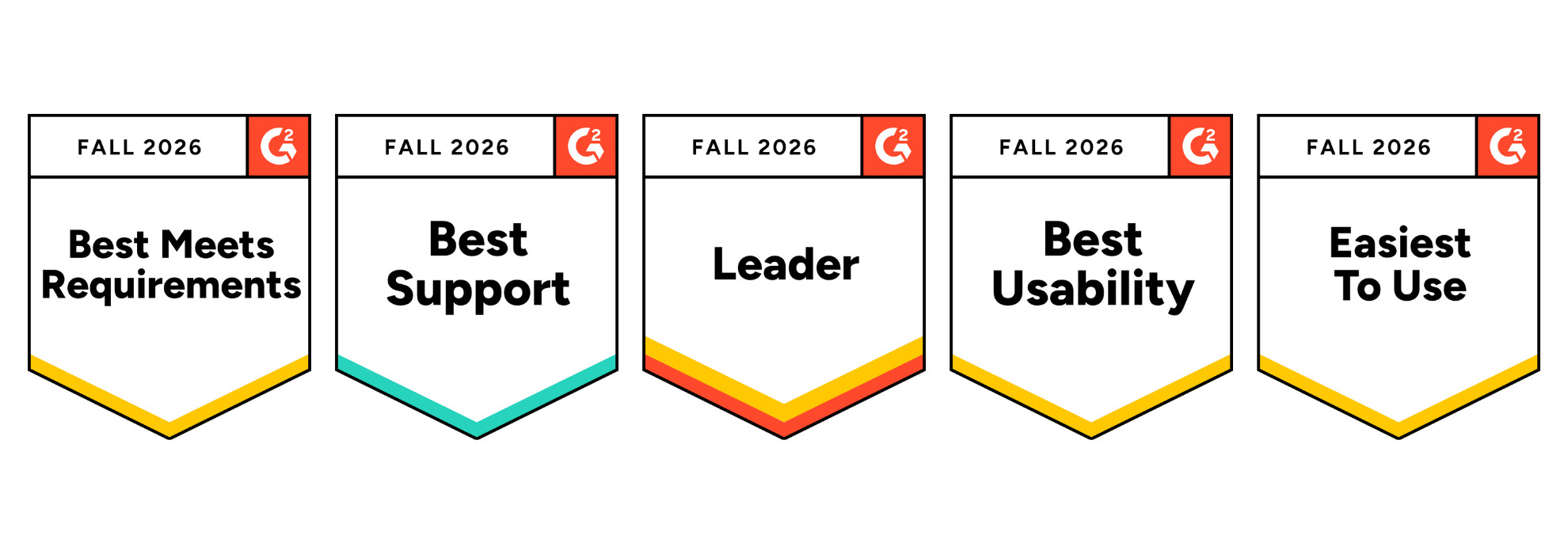
Integrity Advocate has been ranked #1 for Online Proctoring Usability on G2 for the third consecutive season. Based on verified customer feedback, we also earned five Fall 2026 badges recognizing usability, ease of use, support, and overall leadership.
Integrity Advocate has once again been ranked #1 in G2’s Usability Index for Online Proctoring, marking our third consecutive season at the top of the category.
In the Fall 2026 report, Integrity Advocate earned an overall G2 Index Score of 8.60, ahead of Honorlock, Proctorio, Quilgo, Talview, and Meazure Learning. We also earned five G2 badges, including Best Usability, Easiest to Use, and Best Meets Requirements, and were recognized as a Leader in the online proctoring category.
These recognitions are based on feedback from verified users. For us, that is what makes them meaningful. They reflect the experiences of the people who administer assessments, support test takers, and rely on the results.
Integrity Advocate earned the highest overall score in the Fall 2026 Online Proctoring Usability Index:
This is not only another first-place ranking. Our overall index score increased from 8.45 in Summer 2026 to 8.60 in Fall 2026, extending Integrity Advocate’s position at the top of the category.
G2 is the largest peer-to-peer software review platform in the world. Their Usability Index ranks products within a category based on three user-rated dimensions:
Every score comes from authenticated, verified reviews. Companies cannot pay to improve their position. There is no sponsorship or placement influencing the results. The index score reflects what users say about their experience with the product.
Integrity Advocate scored above the online proctoring category average across every usability measure included in the report:
User adoption stands out in particular. Integrity Advocate scored 17 points above the category average and 28 points above Honorlock.
That matters because a platform can have an impressive feature list and still create friction when people are asked to use it. Strong adoption suggests that the experience works in practice, not only during a product demonstration.
In addition to ranking first in the Usability Index, Integrity Advocate earned five G2 badges for Fall 2026 and was recognized as a Leader in online proctoring.
The Best Usability, Easiest to Use, and Best Meets Requirements badges reinforce something we have always believed: assessment security should be strong without being unnecessarily complicated.
Organizations should not have to choose between protecting an assessment and delivering an experience people can successfully use.
Online proctoring sits at a sensitive point in the assessment experience. Test takers may already be under pressure, while administrators need to protect exam integrity without creating unnecessary technical problems or support demands.
A platform that is difficult to access or manage can lead to:
Integrity Advocate was designed to remove those barriers.
There is no software to install and no browser extension to manage. The platform works across devices and browsers and integrates into existing assessment workflows. Test takers can access their assessments without navigating a separate, unfamiliar system, while administrators gain clear evidence and the context needed to evaluate results.
Usability is not separate from assessment integrity. When a platform works consistently, more attention can remain where it belongs: on the assessment and the credibility of its outcome.
Ease of use should never require an organization to compromise on accuracy or defensibility.
Integrity Advocate combines intelligent detection with Verified Human Review™ to provide context behind potential assessment violations. Instead of asking administrators to make decisions based only on an automated flag, our proctoring solutions can provide a clear, reviewable record supported by human judgment.
The result is an approach that protects assessment integrity while remaining practical for the people responsible for administering the program and fair to the people taking the assessment.
Across reviews, users consistently highlight the qualities reflected in the Fall 2026 report: straightforward implementation, ease of use for learners and administrators, seamless LMS integration, responsive support, and a privacy-first approach to assessment integrity.
As one verified user shared:
{{post-block-quote}}
That experience is what the rankings ultimately represent. Not simply a score, but whether the platform helps organizations protect assessments without placing unnecessary friction on their teams or test takers. View more customer stories here.
If you are currently comparing online proctoring solutions, usability should be evaluated alongside security, privacy, and review quality.
Consider asking:
The Fall 2026 G2 results provide an independent view of how leading platforms perform across many of these considerations.
Being ranked #1 once is exciting. Remaining at the top for three consecutive seasons tells a stronger story.
It shows that organizations do not have to accept unnecessary complexity as the price of protecting their assessments. Online proctoring can be secure, privacy-first, easy to administer, and straightforward for test takers.
That is the experience Integrity Advocate was built to provide, and we are grateful to every customer who shared their experience on G2.
The G2 ranking reflects a platform that has been in continuous operation for over a decade:
{{post-cta}}

July 25, 2025
|
5 min de lecture
Compliance looks different across workplace safety, healthcare, corporate training, and professional credentialing, but the pressure feels the same. When the systems meant to help compliance leaders do their jobs, from LMS platforms to proctoring tools to verification workflows, add complexity instead of removing it, compliance becomes a bottleneck. This post examines why operational efficiency should be a compliance requirement in its own right, what breaks when training infrastructure cannot keep up, and what a system that actually works looks like for the compliance program managers responsible for keeping everything on track.
Workplace compliance, like most everything in life, isn’t one-size-fits-all.
Different industries, different standards, but one shared reality: compliance is high-stakes, high-pressure and increasingly complex.
The systems meant to help people in your position—sometimes your LMS, your proctoring tools, or your verification workflows—often make it harder, like having to write the same message to a support team, again.
When your tools can’t keep up, compliance becomes a bottleneck.
The worst part? Everyone’s still doing the work—just with more stress, more confusion and less confidence in the system.
For teams already stretched thin, this isn’t sustainable. That’s why operational efficiency should be a compliance requirement all its own.
Most compliance leaders aren’t struggling because they’re unprepared. They’re struggling because the systems supporting them weren’t designed with real-world complexity in mind.
Some platforms require installs that don’t play nicely with zero-trust environments. Others force mobile learners into desktop workflows. Many still bolt privacy on as an afterthought—resulting in data storage liabilities and confused users who just want to take their training and move on.
If staying compliant in an industry means hours of manual oversight, chasing participation records across tools and playing IT middleman every time someone can’t log in…that’s a system built for burnout—literally. 59% of compliance officers report feeling burned out, with 51% experiencing high levels of job stress. These roles sit at the intersection of risk, regulation and responsibility, with limited resources and even less room for error.
Whether you're managing safety recertifications across hundreds of sites, preparing for an audit or overseeing mandated training across departments, compliance matters.
Yet all too often, the people responsible for keeping things compliant are left stitching together workarounds, handling preventable support requests and double-checking tools that were supposed to make life easier.
Your team just launched a last-minute rollout of mandatory safety training across three regions, with an end-of-week deadline.
In most organizations, that scenario means:
The most frustrating part is that your team executed everything correctly. Delays often stem not from planning errors but from system inefficiencies.
This is the hidden cost of convoluted compliance infrastructure: The more energy expended on troubleshooting, the less available for strategy.
For everyone, the stakes are high. According to IBM’s 2024 Cost of a Data Breach Report, the global average cost of a data breach reached $4.9 million, the highest on record and a 10% increase over last year. In fact, breaches involving data stored across multiple environments (like hybrid systems or cloud-based tools) cost even more, underscoring how fragmented platforms can turn compliance gaps into financial liabilities.
Whether you're coordinating OSHA-required safety training, prepping for a site audit, or managing re-certification in a BYOD environment, compliance is a responsibility that can ripple through your entire operation. That’s when things fall through the cracks.
When compliance systems fall short, the consequences add up fast:
If you want to keep your team ahead of the curve, use this checklist to quickly gut-check your current infrastructure:
If any of these answers are unclear, it’s a compliance risk.
Same rollout. Same deadline. But this time, the system does its job—so you can do yours.
When your operations lead asks who’s completed training? You have the report ready before they finish the sentence.
Just ask Smart Serve Ontario. When a provincial mandate triggered a 20x surge in training volume, they needed a solution that could handle scale without sacrificing oversight. With Integrity Advocate’s no-install, mobile-first platform, they supported thousands of learners in real time while keeping the program compliant.
That’s why we believe operational efficiency should be the baseline for every compliance program.
Through intentional platform design, expert partnership and a passion for empowering people, Integrity Advocate helps compliance leaders spend less time fixing and more time leading.
No installs.
No confusion.
Just streamlined compliance you (and everyone else) can count on.
{{post-cta}}

March 21, 2023
|
5 min de lecture
A pug recently completed alcohol service, forklift operation, emergency response, and boat operator certifications online, without identity verification or participation monitoring. The serious point: when online training programs skip these measures, credentials become meaningless and liability follows. This post makes the case for verified online training with Integrity Advocate through a story that is hard to forget.
Recently, the Integrity Advocate team has taken notice of a new trend in online training. No, it's not AI for once.
From skilled trades to professional certifications, more training providers are eliminating barriers and making programming accessible to a whole new class of learners: dogs.
Historically, things like ID verification and subject matter knowledge have prevented our canine friends from obtaining professional credentials. But now, with training increasingly delivered online and compliance measures often left optional, dogs are getting certified to do things and go places they have never been allowed to before.
Most providers do not advertise the dog-friendliness of their training. But once you see how easy it is to create an account without a valid ID or ace an exam using a GPT-powered plugin, it is clear that accessibility has taken on a whole new meaning.
So far, we know of at least one pug, probably the most certified dog in the world right now, that has successfully completed the following online certifications:
Alcohol service certification: She has achieved the requirements necessary to work in the hospitality industry as it relates to responsible alcohol service. Just do not ask her to make you a martini.
Forklift operation certification: According to her credentials, she understands the fundamentals of safe forklift use and is a valuable asset in warehouse and logistics industries.
Emergency response certification: She is CPR and AED certified. No thumbs? No problem. She can provide life-saving first aid assistance in emergencies, according to this certification.
Boat operator licensing: Dogs love water, so it was only natural for a pug like her to get her boat license. And with all the other work she has been doing, having time to relax at the lake is more important than ever.
How did a pug become the most certified pug in the world?
Simple: none of the training programs she completed required participation monitoring or identity verification.
She got a little help setting up her account and paying the test fee. But after that, it was all canine. Thanks to a few study aid browser plugins, the fact that she could not read or answer the questions herself did not stop her from earning a perfect score.
As more training moves online and more organizations cut corners on measures like identity verification and browser monitoring, we fully expect to see a rise in professionally certified dogs. Pugs, golden retrievers, even the occasional overachieving border collie. All ready to serve alcohol, drive forklifts, and perform CPR.
Unfortunately for the canine certification community, regulatory bodies are not amused. The Standards Council of Canada has introduced new standards requiring that the person's identity has been confirmed prior to or at the time of the training, and that the training is completed by the person whose identity was confirmed.
In other words: dogs need not apply.
While this may be disappointing news for our four-legged friends, it is a step in the right direction for organizations that care about credibility, safety, and compliance.
Twenty years ago, it would have been unthinkable for a pug to get forklift certified. Today, it only takes a few minutes. If that is not a red flag, we do not know what is.
Online training without identity verification and participation monitoring is not just a compliance gap. It is a liability. When anyone, or anything, can complete a certification without confirming who they are or whether they genuinely engaged with the content, the credential becomes meaningless. And in industries where those credentials are supposed to protect public safety, meaningless credentials are dangerous.
Integrity Advocate verifies learner identity and confirms participation in every session, so the certifications your program issues mean what they are supposed to mean.
{{post-cta}}

June 10, 2026
|
5 min de lecture
Online safety training scaled compliance but it also created an accountability gap that most programs haven't closed. When an incident happens, a timestamp isn't enough; what protects your organization is a verified record proving the right person completed the training, with real engagement, that holds up under scrutiny.
June is National Safety Month. At Integrity Advocate, we work with organizations in regulated industries every day, the people responsible for making sure workers know what to do, and can prove it. This month always sharpens that focus.
The National Safety Council puts real numbers behind why this matters. According to NSC data, 4,337 workers died from preventable causes on the job in 2024. That is a 5% decrease from 2023. Progress is happening. But preventable means exactly that; those deaths did not have to happen.
The Bureau of Labor Statistics adds more weight to the picture. Employers reported 2.5 million nonfatal workplace injuries and illnesses in 2024, down 3.1% from the year prior. The top three causes resulting in days away from work were contact incidents, overexertion, and slips, trips, and falls.
Source: Avetta Insights and Impact Report, 2025
Most organizations operating in regulated industries have mandatory safety training programs in place. Certifications, compliance courses, onboarding modules. The infrastructure exists. What is harder to answer is whether that training actually reaches the people it is meant to protect.
There is a meaningful difference between a worker who was assigned a course and a worker who completed it, genuinely engaged with it, and can be held accountable for what they learned. That difference tends to surface at the worst possible moment.
We know from learning research that retention drops sharply when people can move through content without real engagement. Clicking through slides, finishing an assessment with a second browser tab open, or having a coworker complete a course on someone else’s behalf are not fringe scenarios. They happen. And in environments where a certification is supposed to reflect real knowledge, that creates a serious liability.
When an incident occurs and an organization cannot demonstrate that its workers received and understood the required training, the consequences go well beyond the immediate human cost:
The data on what verified, consistent compliance produces is not ambiguous. OSHA’s own research shows that organizations with structured safety and health programs consistently outperform their peers on injury rates, workers’ compensation costs, and audit outcomes. The gap between organizations that treat compliance as a system and those that treat it as a checkbox shows up in the numbers every time.
The question every safety and compliance leader should be asking is not just whether training was provided. It is whether they can prove it was completed by the right person, with genuine engagement, in a way that will hold up to scrutiny.
The industries with the highest rates of workplace injury are also the ones most likely to have mandatory certification and compliance training requirements. That overlap is not a coincidence. It is the reason training accountability matters so much in these sectors.
In none of these industries is training optional or aspirational, it is a legal requirement, a liability protection, and in many cases the most direct line between a worker going home at the end of a shift and not.
As organizations moved safety training online, the efficiency gains were real. Training became more scalable, more cost-effective, and more accessible for distributed workforces. Those benefits are not going away. Online delivery is now the standard in most regulated industries.
But it introduced a problem that does not get discussed enough. In a classroom or on a job site, there is inherent accountability: someone is present, someone is watching. When training moves to a screen, that oversight disappears unless you deliberately build it back in. And most organizations have not.
The result is that completion becomes the goal rather than competency. Workers click through slides. Assessments get finished with a browser tab open on the side. In some cases, a coworker completes a course on behalf of someone else. These are not edge cases, they are compliance failures waiting to be discovered.
Attorneys handling workplace injury claims put it plainly: employees are often described as “experienced” or “shown once,” which in practice becomes a substitute for structured, verified training. In a legal context, when something goes wrong, the question is not whether someone had been around the job long enough. It is whether they were properly equipped to do it safely and consistently under pressure. That distinction is what gets tested in litigation.
What protects organizations from that exposure is verified completion. Not just a timestamp that says someone clicked through a module, but a confirmed record showing the right person completed the training, engaged with the material throughout, and did not have assistance. That level of documentation is what separates a defensible compliance program from one that looks fine on paper until it is tested.
At Integrity Advocate, this is the problem we built our platform to solve. Our proctoring is browser-based with no software installation required, which matters because safety training does not happen in controlled computer labs. It happens on job sites, in field offices, on shared devices, by workers who are not at corporate desks. Every AI flag in our system is reviewed by a human before any decision is made. No completion is rubber-stamped. Every record is built to withstand scrutiny.
For safety and compliance leaders, that is not a nice-to-have. It is the difference between a training program that protects your organization and one that only appears to.
Organizations with mature safety training programs share a few consistent characteristics that separate verified compliance from paper compliance.
The NSC’s theme for National Safety Month this year is Moving Safety Forward. Moving forward requires more than updated content libraries and awareness campaigns, it requires closing the loop between training delivery and training verification.
The research is clear on this. Organizations that sustain long-term compliance programs do not just check a box year over year. They build systems where training is taken seriously, completion is verified, and records can withstand scrutiny. The 45% lower fatality rate among organizations with more than a decade of consistent compliance engagement is not a coincidence. It is the compounding effect of accountability done right, over time.
The organizations that will see meaningful, sustained reductions in preventable injuries over the next decade are the ones treating training accountability as a safety mechanism and not just an administrative requirement.
We are proud to work alongside the safety professionals, compliance officers, and learning leaders doing that work every day. If your organization delivers safety-critical training online and you are not confident you can answer who completed it, when, and under what conditions, that is a gap worth taking seriously.
{{post-cta}}

January 21, 2025
|
5 min de lecture
The EU Artificial Intelligence Act and GDPR are reshaping expectations for how AI can be used in assessment environments, particularly when outcomes affect credentials, academic standing, or professional opportunities. Together they send a consistent signal: AI may support assessment security but it cannot replace human judgment. This post examines what each framework requires for high-risk AI uses in education and credentialing, what ATP guidance says about human oversight in proctoring, and what organizations can do to align with both regulations without adding unnecessary complexity to their programs.
Artificial intelligence now plays a central role in how assessments are delivered, monitored, and reviewed. From detecting potential integrity risks during an exam to supporting large-scale testing programs, AI has become embedded in modern assessment workflows.
At the same time, regulators are setting clearer expectations for how AI can be used when outcomes matter.
Two frameworks in particular are shaping this conversation:
Together, they reflect a broader shift in how assessment security, online proctoring, and AI-enabled decision-making are expected to operate, with an emphasis on accountability, transparency, and trust.
Regulations don’t exist in isolation. While the EU AI Act and GDPR are often discussed in legal or technical terms, their implications are very real for organizations delivering exams, credentials, and training programs.
When AI is used to monitor test sessions, flag unusual behavior, or support integrity decisions, regulators are increasingly focused on how those decisions are made, not just whether AI is involved.
This places online proctoring and assessment security squarely at the center of the regulatory conversation.
The EU AI Act is the first comprehensive regulation written specifically to govern artificial intelligence. Rather than banning AI, it applies a risk-based framework, with stricter requirements for systems that could significantly impact individuals’ rights or opportunities.
AI systems used in education, testing, credentialing, and employment are often considered high-risk, particularly when they influence outcomes such as exam validity or access to credentials.
For these high-risk uses, the Act emphasizes:
In simple terms, AI may assist, but responsibility must remain with people.
While the EU AI Act is newer, GDPR has already been shaping assessment security practices for years.
One of GDPR’s most relevant principles is its restriction on decisions made solely through automated processing when those decisions significantly affect individuals. In assessment environments, this can include integrity violations, invalidated results, or credentialing outcomes that directly impact a person’s academic or professional future.
As a result, GDPR reinforces the need for:
This principle is echoed directly in guidance from the Association of Test Publishers (ATP):
{{post-block-quote}}
Together, GDPR and the EU AI Act send a consistent signal: AI can support assessment security, but it cannot replace human judgment.
Online proctoring systems often rely on AI to monitor sessions, detect anomalies, and surface potential integrity concerns. These capabilities bring scale and efficiency, but they also introduce new responsibilities.
Industry guidance from ATP reflects how effective proctoring models already operate in practice:
“It is a common practice for AI to flag potential anomalies in test taker behavior and for humans to act as the second proctor.”
— ATP, Human Oversight of AI in Assessment
This hybrid approach aligns naturally with both GDPR and the EU AI Act. AI helps identify patterns and reduce noise, while trained humans apply context, fairness, and judgment before outcomes are finalized.
Fully automated approaches, by contrast, can make it harder to explain decisions, address edge cases, or confidently defend outcomes during audits, appeals, or regulatory review.
The EU AI Act introduces meaningful enforcement mechanisms, particularly for high-risk AI systems. According to ATP’s AI Laws, Regulations and Governance Frameworks publication, certain violations may result in penalties of up to €35 million or 7% of global annual turnover, depending on the nature of the breach.
Beyond financial penalties, the broader risk is loss of trust. Assessment programs that rely on opaque automation or excessive data collection risk eroding confidence among learners, candidates, and institutional partners, even if no formal violation occurs.
Understanding regulatory expectations is only the first step. The next question many organizations ask is how to prepare, without adding unnecessary complexity or burden.
Guidance from the e-Assessment Association reinforces that preparation does not require starting from scratch. Instead, it encourages organizations to evaluate how AI is currently used and whether existing practices support fairness, transparency, and accountability.
How companies using e-assessment can prepare for the introduction of the EU AI Act
In practice, preparation often comes down to a few core considerations:
Organizations that can answer these questions with confidence are already well aligned with both GDPR and the EU AI Act, regardless of enforcement timelines.
Taken together, GDPR and the EU AI Act point toward a more sustainable model for assessment security, one that prioritizes human accountability, transparency, and privacy-first design over unchecked automation.
This shift reflects not just regulatory intent, but growing expectations from learners, credential holders, and institutions alike. Assessment security programs that are built for defensibility and trust are better positioned to adapt as regulations continue to evolve.
Integrity Advocate was built with these principles at its core.
Our platform pairs intelligent detection with human review of every session, ensuring AI supports, rather than replaces, professional judgment. Privacy-first system design minimizes unnecessary data collection, while clear reviewer context and documentation support outcomes that organizations can confidently stand behind.
Rather than treating compliance and privacy as constraints, Integrity Advocate helps organizations build assessment security programs that align with today’s regulations and tomorrow’s expectations.
As AI regulation continues to evolve, the organizations best positioned for success will be those that focus on trust, accountability, and defensibility, not just automation.
If you’re evaluating how GDPR and the EU AI Act impact your assessment or online proctoring approach, Integrity Advocate can help you move forward with clarity and confidence.
Q: What type of online proctoring aligns best with these regulations?
A: Proctoring models that combine AI detection with meaningful human review, privacy-conscious data practices, and defensible outcomes.
{{post-cta}}

December 18, 2025
|
5 min de lecture
Organizations administering online assessments face a dual responsibility: protect learners from unnecessary risk and protect the credibility of the programs and credentials they stand behind. These are not competing goals. They are two sides of the same decision. This post examines what learner protection actually requires in proctoring, from no-install design and privacy-first data handling to a low-friction exam experience, and what credential and reputation protection depends on, including trusted results, human-validated outcomes, and consistent, fair processes that stakeholders can rely on over time.
Online proctoring plays a bigger role than many people realize. It doesn’t just safeguard exam rules. It shapes how test takers experience high-stakes moments, and how institutions are perceived long after an assessment ends.
Organizations are facing a dual responsibility: protect learners from unnecessary risk, while protecting the credibility of the programs and credentials they stand behind.
The proctoring decisions institutions make today have a direct impact on trust, reputation, and long-term program health.
For learners, exams are already stressful. Proctoring shouldn’t add unnecessary anxiety or risk.
Unfortunately, many traditional approaches require software downloads, intrusive monitoring, unstable setups, or unclear instructions, which can make learners feel uneasy before an exam even begins. In some cases, they raise real concerns around device security, malware exposure, and privacy.
The safest exam experience is often the simplest one. When proctoring runs in the browser with no downloads or plugins, learners avoid unnecessary software installations and reduce exposure to malware or device-related risk. It also removes one of the most common points of failure at exam start, the install process itself.
Protecting learners also means protecting their personal information. Privacy-first proctoring should collect only what’s necessary to verify identity and maintain integrity, and handle that information responsibly. When institutions can confidently explain what data is collected, how it’s used, and how long it’s retained, it builds trust, not just compliance. This is particularly true in advanced academic programs, where balancing assessment security and privacy programs means weighing rigor against learner trust.
Even the most secure proctoring tool falls short if the experience is confusing or fragile. A seamless, low-friction flow helps learners start exams calmly and complete them without disruption. Fewer technical hurdles means fewer interruptions, fewer panicked support requests, and a more consistent experience for everyone.
When learners feel safe and supported, they’re more likely to engage calmly, comply with requirements, and complete assessments successfully.
Protecting learners isn’t just a user-experience issue. It’s a trust issue.
At the same time, institutions are facing more sophisticated forms of cheating and fraud.
From generative AI tools to coordinated test-taking schemes, off-screen assistance, and impersonation attempts, exam risks look very different than they did even a few years ago.
The stakes are high. When misconduct goes undetected, it doesn’t just affect individual results. It can undermine the credibility of an entire program, raise questions from accrediting bodies or employers, and expose organizations to reputational and legal risk.
This is why detection needs to evolve, without crossing the line into invasive surveillance.
Protecting learners is only one side of the equation. The other is protecting the credibility of your program, the value of your credential, and the trust others place in your assessments. Just as learner protection requires thoughtful design, reputation protection depends on three equally important factors:
Reputation starts with confidence in outcomes. Programs need to know that exam results are accurate, fair, and defensible, especially when decisions carry real consequences.
By combining AI detection with human review, Integrity Advocate helps surface meaningful signals while ensuring context is applied before decisions are made. Clear, audit-ready reporting then gives administrators results they can understand, explain, and stand behind, without hours of manual review.
Trusted results reduce disputes, speed up decision-making, and reinforce confidence across stakeholders.
A credential is only as strong as the integrity behind it. When learners are properly verified and assessments are delivered fairly, organizations can be confident that credentials are earned honestly by the right individual. This reduces the risk of impersonation, fraud, and post-exam challenges, while lowering institutional liability.
Ultimately, the shared goal is simple: making sure the person behind the credential has truly earned it. That matters in real-world ways, whether it’s a healthcare worker administering the right medication, a forklift operator working safely on the job site, or a food and beverage professional serving responsibly and in compliance.
When credentials can’t be trusted, risk increases for everyone. Protecting credential value helps employers, partners, and accrediting bodies trust what a credential represents, not just today, but over time.
Reputation is built through consistent, positive experiences. When exams run smoothly, learners feel respected, and results are handled fairly, programs benefit from stronger reviews, higher satisfaction, and increased trust. Over time, that trust fuels program growth and reinforces a reputation for doing assessment the right way.
Protecting your reputation isn’t a single moment. It’s the cumulative result of fair processes, trusted outcomes, and experiences people are willing to stand behind.
Protecting learners and protecting your reputation are not separate goals, they are two sides of the same decision. Integrity Advocate is built to do both. Our no-install, browser-based experience helps reduce device risk and exam-day friction, while privacy-first design protects learner identity and keeps data handling responsible and easy to explain.
On the integrity side, we help institutions detect cheating and fraud patterns that matter, pairing intelligent detection with human oversight so results are fair, clear, and defensible, without relying on invasive tactics.
The outcome is simple: calmer exam launches, fewer support escalations, more confident decisions, and greater trust in the credential. When the experience is respectful and the outcomes are reliable, programs earn stronger reviews, lower risk, and a reputation they can stand behind.
Schedule a Demo: Explore how Integrity Advocate delivers secure, privacy-first proctoring.
{{post-cta}}

October 1, 2025
|
5 min de lecture
GPT-4 has scored in the 90th percentile on the Bar Exam, 93% on the US Medical Licensing Exam Step 1, and outperformed average test-takers on the SAT, LSAT, and graduate-level law school exams. When AI can pass the same high-stakes exams certifying bodies have relied on for decades, the credibility of those credentials is at risk. This post examines what is at stake when AI can bypass traditional exam security, where legacy tools fall short, and what a hybrid AI plus human review approach looks like for certifying bodies that need to protect the value of their credentials without compromising the candidate experience.
{{post-stat-highlight}}
These are the same high-stakes exams certifying bodies have relied on for decades to ensure that only qualified professionals enter the workforce.
So what happens when artificial intelligence can pass those very exams with ease?
High-stakes exams are no longer immune to disruption. With AI models like GPT-4 demonstrating near-perfect performance on medical, legal, and professional exams, certifying bodies must adapt to safeguard credential integrity.

For today's institutions, the value of your credential rests on one thing: trust in the exam process.
But if candidates can quietly lean on AI to generate passing answers, the credibility of the exam, and by extension, the credential itself, is at risk.
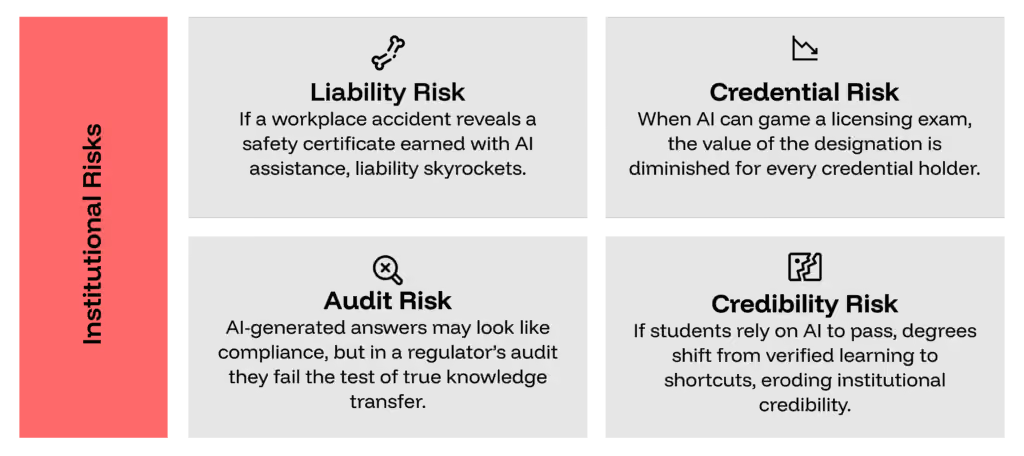
The credibility of your credential is its greatest asset. If candidates can bypass exam integrity with AI, the value of your certification program is immediately at risk.
Most exam security measures were designed for a pre-AI world. Legacy tools weren’t designed to detect AI-enabled misconduct. Lockdown browsers, AI-only monitoring, and human-only oversight leave dangerous gaps.
The reality is clear: new threats require new solutions.
To protect the integrity of credentials, institutions must embrace approaches designed for this new landscape. That means:
Your credential is more than a certificate or a badge. It represents trust, competence, and reputation. In the age of AI, safeguarding that trust means ensuring exams are secure, fair, and credible.
Because if AI can pass your exams, and nothing is done to respond, the profession itself is at risk.
At Integrity Advocate, we believe the path forward is clear: privacy-first, hybrid online proctoring. Unlike one-dimensional solutions, our approach combines the precision of AI with the judgment of human oversight to deliver both security and fairness.
With our no-install, friction-free platform, candidates can focus on their exam while organizations maintain the highest standards of integrity. Our hybrid solution ensures:
By uniting technology with human judgment, Integrity Advocate helps certifying bodies protect credential value without compromising the candidate experience.
Ready to safeguard your credential in the AI era? Let’s talk.
Sources:
{{post-cta}}

September 19, 2025
|
5 min de lecture
Integrity Advocate has released a major enhancement to Video Feed Out, one of the most requested updates from client administrators. Violations and flags are now marked directly in the session timeline, allowing admins to jump between flagged events instantly, filter by violation type, and review audio snippets that distinguish flagged from unflagged moments, all without toggling between the session feed and a separate violations report page.
A major upgrade is here for Video Feed Out - making it easier than ever to review session flags in context. This is one of the most requested enhancements from our clients, and when our clients have requests that will make their lives easier, we listen.
With this update, client admins can now see flags and violations directly within the session timeline, making it easier than ever to understand events in their proper context.
Key improvements include:
Previously, admins had to toggle between the full session feed and a separate violations report page. This made reviews more time-consuming and sometimes confusing.
With contextual flags built right into the timeline, reviews are now:
This enhancement is just one example of how we take client requests seriously and build features around your needs.
This update is now available to all clients with the premium Video Feed Out feature. If you are a current client and would like to enable it, reach out to your Account Manager.
If you are interested in seeing Enhanced Video Feed Out in action, fill out the form below.
{{post-cta}}

June 5, 2025
|
5 min de lecture
High support rates in online proctoring are almost always a design problem, not a learner problem. When platforms require downloads, permissions, and complex setup steps, support volume spikes and assessment credibility suffers. Integrity Advocate's support rate is 0.58%, the lowest in the industry, because the platform was built to eliminate the friction that generates those calls in the first place. This post explains what drives support volume, why it matters for compliance as well as learner experience, and what a frictionless proctoring design actually looks like.
You know the moment. You're trying to join a time-sensitive meeting. Or launch something important. The link won’t open. The app wants a permissions update. Your camera’s off, your stress is on, and now you’re refreshing several tabs while watching those three little dots repeat over and over as a support agent finally starts typing back.
In most tech environments, that kind of chaos is expected. In online proctoring, it’s practically baked in.
At Integrity Advocate, we pride ourselves on support needs under 1%, always.
We built our platform to eliminate that moment - for learners, administrators, and anyone else touching an assessment. Because whether people are logging in from a job site or their kitchen table, a secure, seamless experience shouldn't come with unnecessary installs or support on speed dial.
When the stakes are high, the experience matters. Delayed logins, install issues, forgotten passwords or confusing navigation create friction that can add stress and derail performance before the test even begins.
For learners, that anxiety isn't theoretical. According to the 2022 EDUCAUSE Student Technology Report, over three-quarters (77%) of students experienced at least one technology issue in the past academic year, with over half (51%) reporting that these issues caused them stress.
Imagine a construction worker attempting to complete a mandatory safety certification on a job site. Having to download unfamiliar software or navigate a complex user experience, leads to delays and mounting frustration. Each minute spent troubleshooting is a minute not spent ensuring workplace safety.
Support volume—how often users need help—is one of the clearest signals that something's wrong. A tech glitch is frustrating, but it also creates apprehension. When learners don't feel confident in the system, the entire assessment loses credibility.
In all industries, that has a ripple effect. A poor user experience can compromise participation and ultimately undermine the defensibility of any program.
When users aren’t constantly seeking help,
And most importantly, the focus stays where it belongs: on learning, trust and outcomes.
Support volume doesn’t spike because users are doing something wrong—it usually means the system is. Downloads, login issues, permissions prompts and device restrictions may seem small in isolation, but they add up fast when the stakes are high.
If a learner hits a wall during setup, or an admin has to walk every user through the same confusing step, that’s not helping anyone.
At Integrity Advocate, our support rate is just 0.58%—the industry’s lowest. That means fewer than 1 in 200 users ever need to contact us. For us that means support needs under 1%, always.
Organizations trying to meet testing compliance standards like ANSI/ASSP Z490.1-2024, system stability and defensibility matter more than ever. Regulators are increasingly focused on whether training was actually received and completed.
A pile of support tickets? That signals risk.
According to ANSI/ASSP Z490.1-2024, training programs must be able to demonstrate both delivery and participation. The standard emphasizes learner engagement, accessibility and defensibility, especially in high-risk industries where training directly impacts public and workplace safety. If learners are derailed by preventable technical issues, the integrity of the assessment can quickly unravel.
That’s why system stability shouldn’t just be a technical preference. It’s a compliance necessity.
Proctoring with Integrity Advocate was built to be as invisible as possible in the best way.
We designed out the chaos to help learners reduce test-taking anxiety and stay focused on demonstrating what they know—not wrestling with the testing platform.
Proctoring was designed to protect what the test is meant to measure. When the technology disappears into the background, learners can focus on proving what they know. And when we reduce friction and anxiety, we create space for achievement, fairness and growth.
At Integrity Advocate, we believe assessment should support people. That’s how we protect trust. That’s how we build a better future.
Want online proctoring that puts people first? We’d love to talk.
{{post-cta}}
September 24, 2024
|
5 min de lecture
AI-powered plugins can now complete continuing education assessments automatically, creating a growing risk that CEUs are being awarded without genuine learner participation. Integrity Advocate and IACET are partnering to provide IACET member organizations with risk assessments and resources to identify vulnerabilities and implement identity verification and participation monitoring standards that protect the integrity of their programs.
The importance of continuing education and training across critical fields like medicine, health and safety, and engineering cannot be overstated. When professionals lack the most up-to-date knowledge required for their roles, lives are put at risk.
Integrity Advocate and IACET (International Accreditors for Continuing Education and Training) are working together to deliver more secure continuing education and training. Through this partnership, we are committed to helping organizations enhance the integrity of their online learning events.
The landscape of online continuing education is rapidly changing. AI plug-ins can now automatically capture questions and complete assessments, creating a growing threat that continuing education units (CEUs) are being awarded without the direct participation of the intended learner.
Organizations that fail to adopt rigorous standards for ID verification and participation monitoring face significant regulatory and reputational risks. This lack of oversight has had, at times, absurd consequences — including the case of a pug that has been awarded more than 100 professional certifications.
More seriously, however, numerous organizations worldwide have faced legal action and public backlash when certificates were issued to individuals who had not completed the requisite training.
To tackle these challenges head on, Integrity Advocate is working closely with IACET to provide members with essential resources and risk assessments. These assessments will help organizations understand their vulnerabilities and determine mitigation strategies tailored to their unique needs.
If you’re interested in learning more about our resources and support, please reach out to us.
Not an IACET member? Visit IACET to learn more about the accreditation process and the benefits.
{{post-cta}}