Ease of Use
+7 pts above avg
95%
IA
95%
AVG
88%

Recherches, guides et analyses concrètes sur la surveillance d'examens en ligne ; pour aider votre programme à obtenir des résultats équitables, fiables et défendables.
Évaluations sécurisées
Violations de données en plus de 12 ans
Taux de fidélisation client
Ressources publiées

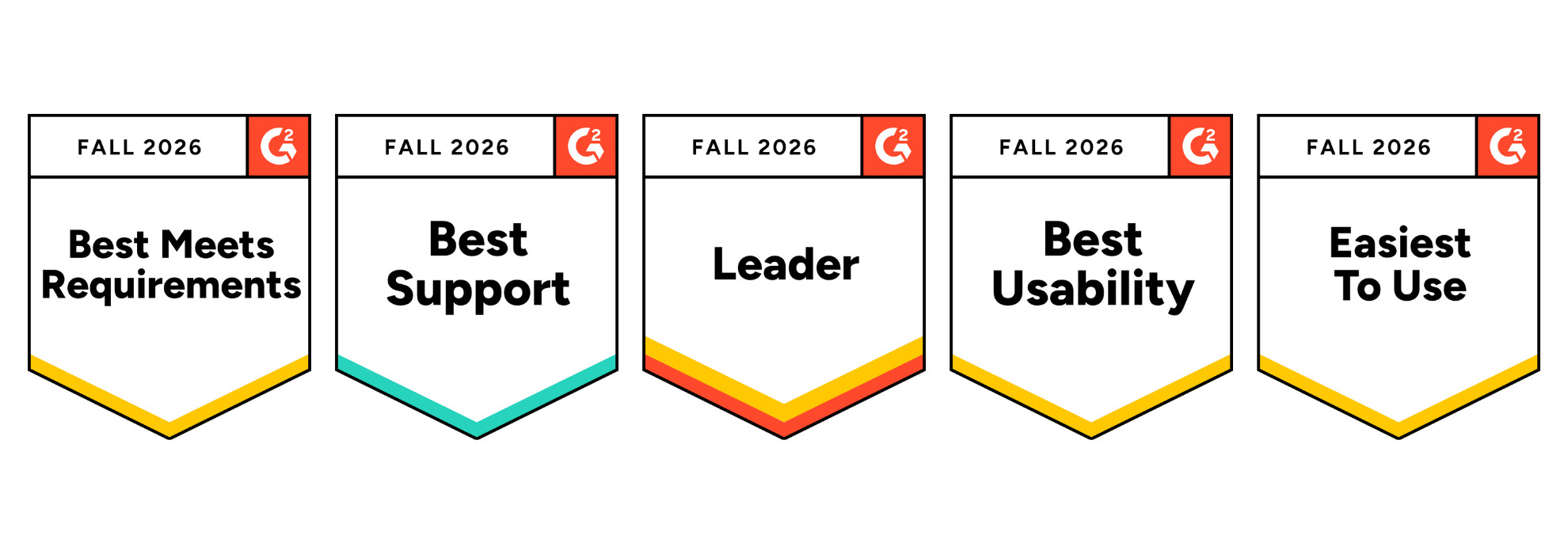
Integrity Advocate has been ranked #1 for Online Proctoring Usability on G2 for the third consecutive season. Based on verified customer feedback, we also earned five Fall 2026 badges recognizing usability, ease of use, support, and overall leadership.
Integrity Advocate has once again been ranked #1 in G2’s Usability Index for Online Proctoring, marking our third consecutive season at the top of the category.
In the Fall 2026 report, Integrity Advocate earned an overall G2 Index Score of 8.60, ahead of Honorlock, Proctorio, Quilgo, Talview, and Meazure Learning. We also earned five G2 badges, including Best Usability, Easiest to Use, and Best Meets Requirements, and were recognized as a Leader in the online proctoring category.
These recognitions are based on feedback from verified users. For us, that is what makes them meaningful. They reflect the experiences of the people who administer assessments, support test takers, and rely on the results.
Integrity Advocate earned the highest overall score in the Fall 2026 Online Proctoring Usability Index:
This is not only another first-place ranking. Our overall index score increased from 8.45 in Summer 2026 to 8.60 in Fall 2026, extending Integrity Advocate’s position at the top of the category.
G2 is the largest peer-to-peer software review platform in the world. Their Usability Index ranks products within a category based on three user-rated dimensions:
Every score comes from authenticated, verified reviews. Companies cannot pay to improve their position. There is no sponsorship or placement influencing the results. The index score reflects what users say about their experience with the product.
Integrity Advocate scored above the online proctoring category average across every usability measure included in the report:
User adoption stands out in particular. Integrity Advocate scored 17 points above the category average and 28 points above Honorlock.
That matters because a platform can have an impressive feature list and still create friction when people are asked to use it. Strong adoption suggests that the experience works in practice, not only during a product demonstration.
In addition to ranking first in the Usability Index, Integrity Advocate earned five G2 badges for Fall 2026 and was recognized as a Leader in online proctoring.
The Best Usability, Easiest to Use, and Best Meets Requirements badges reinforce something we have always believed: assessment security should be strong without being unnecessarily complicated.
Organizations should not have to choose between protecting an assessment and delivering an experience people can successfully use.
Online proctoring sits at a sensitive point in the assessment experience. Test takers may already be under pressure, while administrators need to protect exam integrity without creating unnecessary technical problems or support demands.
A platform that is difficult to access or manage can lead to:
Integrity Advocate was designed to remove those barriers.
There is no software to install and no browser extension to manage. The platform works across devices and browsers and integrates into existing assessment workflows. Test takers can access their assessments without navigating a separate, unfamiliar system, while administrators gain clear evidence and the context needed to evaluate results.
Usability is not separate from assessment integrity. When a platform works consistently, more attention can remain where it belongs: on the assessment and the credibility of its outcome.
Ease of use should never require an organization to compromise on accuracy or defensibility.
Integrity Advocate combines intelligent detection with Verified Human Review™ to provide context behind potential assessment violations. Instead of asking administrators to make decisions based only on an automated flag, our proctoring solutions can provide a clear, reviewable record supported by human judgment.
The result is an approach that protects assessment integrity while remaining practical for the people responsible for administering the program and fair to the people taking the assessment.
Across reviews, users consistently highlight the qualities reflected in the Fall 2026 report: straightforward implementation, ease of use for learners and administrators, seamless LMS integration, responsive support, and a privacy-first approach to assessment integrity.
As one verified user shared:
{{post-block-quote}}
That experience is what the rankings ultimately represent. Not simply a score, but whether the platform helps organizations protect assessments without placing unnecessary friction on their teams or test takers. View more customer stories here.
If you are currently comparing online proctoring solutions, usability should be evaluated alongside security, privacy, and review quality.
Consider asking:
The Fall 2026 G2 results provide an independent view of how leading platforms perform across many of these considerations.
Being ranked #1 once is exciting. Remaining at the top for three consecutive seasons tells a stronger story.
It shows that organizations do not have to accept unnecessary complexity as the price of protecting their assessments. Online proctoring can be secure, privacy-first, easy to administer, and straightforward for test takers.
That is the experience Integrity Advocate was built to provide, and we are grateful to every customer who shared their experience on G2.
The G2 ranking reflects a platform that has been in continuous operation for over a decade:
{{post-cta}}

April 14, 2022
|
5 min de lecture
Online proctoring platforms routinely fail test takers with disabilities through room scan requirements, biometric systems that flag facial differences, and eye tracking that penalizes neurological variation. This post examines where the industry gets it wrong, what accessibility legislation now requires, and how Integrity Advocate is built to assess every test taker fairly, with WCAG 2.1 AA compliance and human review on every flagged session.
Most online proctoring platforms were not designed with disabled test takers in mind. That's not an assumption, it shows up in the product.
Some platforms require test takers to physically lift their monitor and scan the room. Others use AI-based facial monitoring that flags people with facial deformities as suspicious. Eye-tracking systems penalize unconventional eye movements — the kind that are entirely normal for people with certain neurological or visual conditions. These aren't edge cases. They're design failures that exclude a significant portion of the population from participating in online assessment at all.
As accessibility legislation tightens globally and courts begin issuing financial penalties, proctoring providers can no longer treat accessibility as optional. This post looks at what's at stake, where the industry is falling short, and what responsible design actually looks like.
A disability is broadly defined as a physical or mental impairment that substantially limits one or more major life activities. The scale of the population affected is significant:
These individuals are active participants in education, professional development, and certification. They sit exams. They complete workplace training. They pursue credentials. And when a proctoring platform isn't designed to accommodate them, they are effectively locked out of those opportunities.
The accessibility failures in online proctoring tend to fall into three categories:
Asking a test taker to lift and rotate their monitor to scan their environment assumes a level of physical ability that many people don't have. For someone with a spinal cord injury, limited upper body mobility, or a motor impairment, this requirement isn't just inconvenient. It makes the exam inaccessible.
AI-based facial recognition and monitoring tools are trained on datasets that often underrepresent people with facial differences, asymmetrical features, or conditions that affect facial muscle movement. When these systems flag a test taker as suspicious based on appearance rather than behavior, the result is discriminatory, and the test taker has no recourse against an algorithm.
Eye tracking is used by some platforms to detect when a candidate looks away from the screen, interpreting it as potential cheating. For test takers with nystagmus, ADHD, autism, or certain visual processing conditions, atypical eye movement is normal. Penalizing it is both inaccurate and unfair.
Numerous countries have begun actively enforcing digital accessibility rights, including equivalent access to electronic and information technology. In Canada, the Accessible Canada Act sets federal obligations. In the United States, Section 508 and the ADA apply to digital services. In the UK and EU, accessibility standards are increasingly enforceable with real financial consequences.
Organizations that use non-compliant proctoring platforms carry risk. When a test taker with a disability is excluded or penalized by your proctoring tool, the liability doesn't rest only with the vendor. It rests with your program too.
The solution isn't accommodation after the fact. It's accessibility built into the design from the start. That means:
The current benchmark is WCAG 2.1 AA — the Web Content Accessibility Guidelines that set the international standard for digital accessibility. Any proctoring platform that cannot demonstrate WCAG 2.1 AA compliance should not be considered a complete solution.
Integrity Advocate is built on a straightforward principle: assessment integrity should never come at the cost of a test taker's rights.
That means no room scans requiring physical ability beyond what the assessment demands. It means human review on every flagged session, so that an unusual eye movement or facial difference is assessed by a trained person with context — not an algorithm making an automated call. It means a no-download, browser-based platform that works with assistive technologies without friction.
Integrity Advocate is WCAG 2.1 AA compliant and designed to work for the full range of people who take exams, not just those who fit a narrow definition of typical.
Privacy and accessibility are not constraints on assessment integrity. They are part of what makes an outcome trustworthy.
Online proctoring platforms that haven't prioritized accessibility aren't just falling behind on compliance. They're actively excluding people with disabilities from the credentials and opportunities those assessments unlock.
Your program deserves a proctoring partner that takes this seriously, one where every test taker, regardless of ability, can be assessed fairly.
{{post-cta}}

February 4, 2026
|
5 min de lecture
The Condominium Management Regulatory Authority of Ontario (CMRAO) needed to deliver a new licensing course and proctor its exams to meet Ontario's education and licensing requirements for condominium managers. CMRAO adopted uxpertise's all-in-one LMS with integrated online proctoring, powered by Integrity Advocate, to deliver its Excellence in Condominium Management course entirely online while administering secure, proctored exams within the same system. Since 2021, more than 2,500 students have graduated through the program.
The Condominium Management Regulatory Authority of Ontario (CMRAO) is a not-for-profit corporation established in November 2017 by the Government of Ontario under the Condominium Management Services Act, 2015. As a regulator, CMRAO provides consumer protection for Ontarians living and investing in condominiums by regulating and licensing condominium managers and management provider businesses.
Challenge: CMRAO needed to find a learning management system to host a new course and a solution for online exam proctoring. The organization created a course to obtain a limited licence, hosted online, requiring a 75% passing grade. Given the regulated nature of the industry, exam integrity through proctoring was essential.
Solution: CMRAO was initially looking for two separate solutions but found uxpertise, which offered both an LMS and integrated proctoring in one platform. CMRAO was looking for a cost-effective, Canadian solution, and uxpertise was the match.
Results: Since 2021, there have been more than 2,500 graduates of the Excellence in Condominium Management course. CMRAO started with 3 classes in 2021 and grew to 34 classes by 2024, an 11x increase in sessions.
To meet new education and licensing requirements for condominium managers, CMRAO adopted uxpertise's LMS combined with its integrated online proctoring service as a cost-effective, all-in-one solution. The platform allowed CMRAO to deliver the new Excellence Course entirely online, ensuring accessibility during COVID-19 while maintaining the integrity of instructor-led training. It also let them administer secure, proctored exams within the same system, streamlining the licensing process and reducing administrative complexity.
CMRAO was able to easily duplicate courses and exams for recurring sessions, with independent statistics for tracking learner progress and completion. The entire setup took only six weeks, handled primarily by one administrator, with responsive customer service resolving technical questions rapidly along the way.
The CMRAO has successfully launched its Excellence in Condominium Management course, completing its mandate to set the education standard among condominium managers. From no formal training to a comprehensive course with a proctored exam, CMRAO changed the industry and advanced its mission to enhance consumer protection.
The numbers reflect that growth: CMRAO now sees an average of 220 monthly active users on the platform, with approximately 3,000 learners registered for the course in under four years. More than 1,500 learners have taken a proctored exam using the service launched in 2023, and more than 2,500 students have graduated between November 2021 and August 2025.
Four years after launch, CMRAO is ready to expand its offering and use the platform to its full potential. Planned initiatives include continuing education courses for licensed condominium managers to support ongoing professional development, and internal staff training programs covering customer service, communication skills, and emotional intelligence.
{{post-block-quote}}
{{post-cta}}

June 5, 2025
|
5 min de lecture
Canadian Food Safety Group operates in a complex environment where each province mandates some level of food handler training, but few require all workers to certify, leaving critical compliance gaps. Many of the workers who need this training are supporting families or funding their own education, so training needed to stay flexible, affordable, and accessible. Partnering with Integrity Advocate allowed Canadian Food Safety Group to deliver secure, proctored assessments online, with nothing to install, expanding access to food safety training for workers across Canada without driving up costs.
Canadian Food Safety Group needed a way to expand access to trusted food safety certification without sacrificing affordability or authenticity. Partnering with Integrity Advocate allowed them to deliver secure, proctored training online, available on mobile with nothing to install. That's what happens when accessibility meets integrity.
Canadian Food Safety Group operates in a complex environment. Each province mandates some level of training, yet most don't require all food handlers to certify, leaving critical compliance gaps. In an industry where many workers are supporting families or funding their education, training needs to be flexible, affordable, and accessible to succeed. Employers also had to see the value in training every staff member, not just those required by law.
To close the gap, Canadian Food Safety Group needed a solution that could expand access to training for all food handlers, not just those legally required to certify, deliver verified, proctored assessments without raising costs for learners or organizations, remove technical barriers like app downloads or scheduled sessions, and scale nationwide to reach tens of thousands of workers across a fragmented industry.
Recognizing these challenges, they made the strategic decision to move their food safety training online, but only with a trusted proctoring partner who could maintain authenticity, security, and affordability without compromise. That's where Integrity Advocate entered the picture.
Canadian Food Safety Group knew that education, not enforcement, was the key to lasting change. By making food safety training more accessible, ongoing, and affordable, they could raise compliance rates while fostering stronger, more cohesive teams who took pride in their work.
With Integrity Advocate's no-install proctoring solution, they were able to deliver verified online assessments without requiring downloads, installations, or technical support, offer a flexible, secure training experience that works across all devices and internet connections, and maintain the authenticity and integrity of certifications without driving up costs.
Food preparation is both an art and a science, and Canadian Food Safety Group understood that both demand skill, care, and consistency. By partnering with Integrity Advocate, they made it easier for food handlers across Canada to master both.
By moving their training and assessments online with Integrity Advocate, Canadian Food Safety Group reduced operational costs and passed every dollar of savings directly back to their learners. Affordability remained at the forefront, without sacrificing the security and integrity of the certification process.
Choosing a trusted Canadian partner also delivered immediate advantages: seamless collaboration, responsive support, and the confidence that comes from working with a privacy-first solution built to meet their exact needs.
Backed by Integrity Advocate's ongoing support, Canadian Food Safety Group continues to expand access to food safety training nationwide, strengthening compliance, supporting workers, and helping businesses deliver safer, higher-quality service to every customer.
{{post-cta}}

February 24, 2026
|
5 min de lecture
Assessment security has expanded beyond preventing cheating to protecting the long-term credibility of every credential an organization issues. Remote and hybrid delivery, AI tools reshaping candidate behavior, rising employer scrutiny of credential validity, and the rapid expansion of digital credentialing are all converging to make this a strategic rather than operational question. This post examines why credential credibility now depends on assessment security design, what the risks of getting it wrong look like across higher education, professional certification, and workforce training, and why connected, integrated systems are the only approach that produces defensible outcomes at scale.
Assessment security is no longer just about preventing cheating. It is about protecting the credibility of credentials across higher education, K-12, professional certification, associations, and workforce training.
Online exams, hybrid delivery, AI tools, and digital credentials are reshaping how learning is validated. As these systems evolve, organizations must move beyond a narrow focus on proctoring and ask a more strategic question:
Who are we certifying, and what does that credential truly represent?
The answer to that question determines whether employers trust degrees, whether associations defend certifications, and whether workforce credentials maintain real economic value.
This is where assessment security and credential integrity converge.
Across sectors, several structural shifts are driving change:
The online proctoring market reflects this momentum. Industry analysis shows that U.S. revenue is projected to grow from approximately $281 million in 2024 to more than $800 million by 2031, driven by online learning adoption, corporate upskilling, and global credential demand.
Growth alone does not equal trust. As scale increases, so does the responsibility to ensure defensible, fair, and meaningful outcomes.
Historically, assessment security focused on catching misconduct. Today, the focus must expand to protecting the long-term value of the credential itself.
Forward-thinking programs are no longer asking only how to monitor exams. They are asking how to protect integrity across the entire assessment lifecycle, from design to delivery to defensibility.
This shift affects every sector:
Institutions must defend the academic integrity of degrees delivered in online and hybrid formats. If employers question exam security, they question institutional standards. This tension is especially pronounced in doctoral programs, where balancing assessment security and privacy in online EdbD programs requires institutions to protect both rigor and learner trust.
Digital testing is embedded into classrooms. Student privacy and fairness are as important as misconduct prevention.
Certifications signal competence and readiness. Weak exam controls undermine member trust and regulatory standing.
Employers rely on credentials as hiring signals. If assessments are unreliable, businesses lose confidence in workforce readiness programs.
Assessment security is no longer an operational decision. It is a strategic credibility decision.
When assessment integrity systems fail, the consequences extend far beyond a single testing event.
If security controls are too weak, unqualified individuals may earn credentials they have not legitimately achieved. In regulated industries such as healthcare, finance, or technical trades, that risk can impact safety and compliance.
If controls are too aggressive or poorly implemented, legitimate candidates may be unfairly flagged or disadvantaged. In K-12 and higher education, overly intrusive tools can increase anxiety, create equity concerns, and erode trust in institutions.
Employers depend on certifications and degrees as reliable indicators of competence. If credential integrity is inconsistent, organizations add additional screening layers, duplicate assessments, or question the issuing body altogether.
When trust declines, the credential loses value in the labor market.
The cost of weak assessment security is not just fraud. It is long-term erosion of credibility.
AI in online exams is both a challenge and an inflection point.
Research indicates widespread AI usage in academic environments, influencing integrity patterns and candidate behavior.
AI has changed how candidates prepare, how responses are generated, how external assistance is accessed.
But AI also presents an opportunity. It pushes organizations to rethink what authentic demonstration of competence looks like.
Effective assessment security now combines intelligent detection systems with contextual human review. Machine analysis can surface patterns. Human judgment ensures fairness and proportional response.
AI is not simply a threat. It is accelerating the need for smarter, connected systems.
Organizations today operate across a spectrum of proctoring models:
Each approach carries trade-offs in scalability, cost, privacy, defensibility, and candidate experience.
The challenge is not selecting a single method. The challenge is ensuring the method fits within a connected credential ecosystem.
Siloed systems introduce risk.
If identity verification happens in one platform, exam delivery in another, proctoring in a third, and credential issuance in yet another, organizations may lack a defensible chain linking candidate identity to verified outcome to issued credential.
Paper testing without digital audit trails can be difficult to defend at scale.
Unproctored online exams may be appropriate for low-stakes contexts but insufficient for high-stakes certification.
Fully automated monitoring without contextual human review may raise fairness concerns.
Disconnected systems make audit readiness difficult.
Assessment security must be designed as part of a larger system.
The future of online proctoring and credential security is not about surveillance intensity. It is about integration and defensibility.
A modern assessment ecosystem should:
Security should not be layered on top of the credential process. It should be embedded within it.
This is particularly critical in higher education, associations, and workforce certification programs where auditability and long-term defensibility are essential.
Because remote and hybrid testing has scaled dramatically, AI tools are reshaping candidate behavior, and employers are scrutinizing credential validity more closely.
No single tool is sufficient. Online proctoring must be part of a connected system that includes identity verification, review processes, and credential issuance alignment.
Institutions should look for partners who understand connected ecosystems, audit readiness, privacy considerations, and sector-specific requirements across higher education, K-12, certification, and workforce training.
The future of assessment security is not only about protecting exams.
It is about ensuring that every credential issued represents verified identity, authentic performance, and defensible standards.
Because in 2026 and beyond, who we certify matters as much as how we secure the assessment.
And the institutions that understand that connection will lead.
If you are evaluating how your program protects exam integrity, candidate identity, and long-term credential value, the next step is understanding how these systems connect.
{{post-cta}}

January 26, 2025
|
5 min de lecture
For years, the assessment security playbook was simple: secure the exam window, monitor, review incidents, move on. That approach worked until remote testing became standard, AI lowered the barrier to cheating, and credentials started facing real scrutiny from employers and regulators. The instinct to respond by adding more tools has created fragmentation rather than security. This post examines the three shifts that matter most for 2026, what the strongest programs are doing differently, and why assessment security is moving from a moment-in-time monitoring problem to a system-level responsibility that spans preparation, delivery, and defensibility.
Assessment security is shifting from tool-based monitoring to system-level design that protects integrity before, during, and after delivery, while balancing trust, privacy, and defensible outcomes.
It just became impossible to ignore.
For years, the playbook was simple: secure the exam window, monitor test-takers, review incidents, move on. That approach worked, until remote testing became standard, AI lowered the barrier to cheating, and credentials started facing real scrutiny from employers and regulators.
What changed isn't just how assessments are delivered. It's what happens when something goes wrong.
Today, a security gap isn't just an administrative problem. It's a threat to your program's credibility, your institution's reputation, and the trust stakeholders place in your credentials.
When stakes rise, the instinct is to add controls. Another proctoring tool. Another identity check. Another alert system. Another layer. Individually, these decisions make sense. But together? They often create the opposite of what security is supposed to deliver.
We see it constantly:
The problem isn't lack of effort. It's fragmentation. Layering security tools doesn't automatically create a secure system. Without intentional design, you get gaps, inconsistencies, and noise.
The best assessment programs aren't asking "what tool should we add?" They're asking: "How do we protect integrity across the entire assessment lifecycle?" That question changes everything.
It reframes security as something that:
Security stops being a reaction and starts becoming part of your program design.
As you think about where assessment security is heading, these are the shifts that matter most:
1. Remote and hybrid testing aren't going anywhere: Remote testing is now standard, not an emergency measure. That means your security approach needs to work reliably across diverse environments, devices, and circumstances without creating unnecessary friction.
2. AI has lowered the barrier to cheating (and impersonation): Sophisticated cheating tools are now accessible to anyone. AI can generate answers, help with impersonation, and even coach test-takers in real-time. Your security needs to detect meaningful risks, not just flag normal behavior.
3. Credentials face more scrutiny than ever: Employers, regulators, and the public are asking harder questions about credential validity. If you can't defend your assessment outcomes with clear documentation and fair processes, your credentials lose value, fast. This is playing out vividly in programs balancing assessment security and privacy, where the stakes for getting both right are especially high.
If you're thinking ahead to 2026, these questions matter more than feature lists:
These aren't technical questions. They're design questions. And your answers reveal whether security is working for your program or against it.
Assessment security is moving from a moment-in-time problem (monitoring the exam) to a system-level responsibility that spans preparation, delivery, and defensibility.
The programs adapting fastest aren't necessarily the ones with the most tools. They're the ones thinking about how the pieces fit together, and working with partners who help them adapt as things change.
If you're rethinking your approach to assessment security in 2026, start here:
1. Audit your current system: Map out what happens before, during, and after your assessments. Where are the gaps? Where's the friction? Where would you struggle if a decision were challenged?
2. Match controls to risk: Not every assessment needs the same level of security. Define your risk levels and align your approach accordingly.
3. Think integration, not addition: Before adding another tool, ask whether it will connect to your existing workflows or create more fragmentation.
4. Plan for defensibility now Don't wait until you're facing an appeal or audit to figure out how you'll explain your decisions.
We built Integrity Advocate around the reality that assessment security is a system, not a single tool or moment. We support organizations across the full lifecycle:
Our role isn't just to provide proctoring. It's to be your partner as assessment security continues to evolve; helping you adapt to new risks, technologies, and expectations without starting from scratch every time something changes.
Because modern assessment security isn't about adding more controls. It's about designing a system that holds up.
If you're evaluating how your program needs to evolve in 2026, or you're just tired of patching together disconnected tools, we'd be glad to walk through what a system-level approach could look like for you.
{{post-cta}}

December 17, 2025
|
5 min de lecture
When assessment programs expand across regions, time zones, and learner populations, proctoring systems that were not built for scale start to show the strain: review timelines stretch, support tickets spike, and consistency becomes harder to maintain. True scalability is not just about geographic reach. It is about whether a solution can grow alongside a program without creating new friction for learners or new workload for administrators. This post examines the nine pillars of genuine global scale in proctoring and why hybrid AI plus human review, multilingual support, and privacy-first design are what make sustainable growth possible.
As assessment programs grow, one thing becomes clear very quickly: scale changes everything. What works for a single course or cohort doesn’t always hold up when programs expand across regions, time zones, and learner populations. Exams start happening around the clock. Volumes increase. Review queues grow. Support teams feel the pressure.
And while “global” often gets framed as geographic challenge, true scalability is about much more than reach. It’s about whether an assessment solution can grow with your program without creating new friction for learners or new workload for administrators.
Today’s online assessments support far more than traditional higher education exams. They power workforce training, professional certification, compliance programs, and continuing education initiatives across industries and regions.
As highlighted in our 2025 Year-in-Review, many organizations are scaling assessment programs faster than ever, often faster than internal teams can scale operations and support.
When proctoring systems aren’t built for scale, teams start to feel it quickly. Review timelines stretch. Support tickets spike. Consistency becomes harder to maintain. Admin workload grows right alongside exam volume.
Scalable proctoring should absorb growth quietly, not amplify it.
True global scale rests on a set of interconnected pillars.
Operational scalability: As exam volume increases, admin workload shouldn’t increase at the same pace. Review queues, follow-up work, and support requests need to stay predictable, even during peak testing windows.
Hybrid (AI + human review): AI helps surface suspicious activity, while trained human reviewers provide context and validation before results reach administrators. That balance keeps review efficient without sacrificing fairness, and it allows programs to scale without overwhelming internal teams.
Language and localization: Learners need to understand instructions, consent language, and system prompts in the language they’re most comfortable with. When language barriers are removed, confusion drops, exam launches are smoother, and support teams feel the difference.
Time zone coverage and availability: Global programs don’t test on a single schedule. Exams happen at all hours, and review workflows need to support that reality without introducing delays or blind spots.
Infrastructure reliability: Browser-based, low-bandwidth-friendly technology helps ensure exams can launch and complete successfully across regions with varying connectivity, devices, and environments.
Consistency across programs: Clear policies, standardized review processes, and audit-ready reporting help ensure outcomes remain defensible and fair, no matter where or when an exam takes place.
Privacy and regulatory readiness: Global scale means navigating different expectations around data protection and learner rights. Privacy-first design and clear documentation allow institutions to expand confidently without constantly reworking processes to meet new requirements.
Accessibility and inclusion: Support for assistive technologies, diverse devices, and real-world testing environments ensures that growth doesn’t leave learners behind.
Integration and ecosystem compatibility: Proctoring should fit cleanly into existing LMS workflows without requiring custom builds or retraining as organizations grow.
Finally, support models must scale, too. Clear instructions, intuitive workflows, and reduced reliance on live support allow global programs to grow without growing stress for learners or administrators.
Taken together, these pillars determine whether a proctoring solution truly scales, not just technically, but operationally and sustainably.
Human-only models struggle to keep up as volume grows. Review timelines lengthen, costs rise, and consistency becomes harder to maintain. AI-only models move faster, but often create noise, false positives, and distrust that admins have to clean up later.
Hybrid review strikes the balance. AI handles volume efficiently, while human reviewers ensure accuracy, fairness, and context. That combination keeps results reliable and review workloads manageable, even as programs expand.
Language support plays an important role in scalable proctoring, not because it’s a standalone feature, but because it reduces friction everywhere else.
Integrity Advocate supports a wide range of languages across regions including North America, Latin America, Europe, the Middle East, Africa, and Asia-Pacific. This includes global languages such as English, Spanish, French, Arabic, Chinese, and Portuguese, as well as regional variants like Latin American Spanish, Canadian French, and U.S. Spanish.
Clear communication helps learners start exams with confidence, reduces confusion at launch, and lowers language-related support requests. At scale, those small improvements add up to significant time savings for admin teams.
Programs that choose proctoring built for global scale often see steadier review timelines, fewer support tickets during peak periods, more consistent outcomes across regions, and less operational strain as volume increases.
As Brandon Smith notes in his analysis of where the proctoring market is headed, institutions are increasingly looking for partners they won’t outgrow, solutions that can evolve alongside their programs rather than forcing replacement every few years.
Global scale isn’t just about reaching more learners. It’s about supporting growth without adding friction, cost, or risk.
When proctoring is built on scalable infrastructure, hybrid AI plus human review, clear communication, and admin-ready reporting, programs can expand confidently without sacrificing fairness or control.
As assessment programs continue to grow across regions, devices, and use cases, the proctoring solutions that succeed will be the ones designed for real-world scale, not idealized conditions.
Schedule a demo to see how Integrity Advocate scales with your programs
{{post-cta}}

June 19, 2025
|
5 min de lecture
There is a clear line between oversight and surveillance in online proctoring, and most platforms cross it. When tools collect more data than necessary, require invasive installations, or store sensitive information beyond its purpose, they do not just create privacy exposure. They erode the trust that makes a certification meaningful. This post examines where that line is, why more surveillance does not mean more security, how rising compliance standards like ANSI/ASSP Z490.1-2024 define accountability without requiring overcollection, and what privacy-first proctoring actually looks like in practice.
A waiter is taking an online assessment to earn their alcohol serving certification. They’re at home, using a personal laptop. They scan their government ID to verify their identity. And as soon as the test starts, their webcam is on. So is screen sharing.
{{post-stat-highlight}}
Here’s the thing: online assessments like these need oversight. But that doesn’t mean they need to feel like surveillance. When proctoring tools overstep, they don’t just violate privacy—they break trust, reduce engagement and risk the credibility of the certification itself.
This isn’t about watching more screens. It’s about building systems that respect boundaries, protect integrity and actually work.
If you’re leading training, certifying professionals or managing compliance programs, chances are you didn’t wake up this morning thinking, “Let’s go shopping for proctoring software.”
What you are looking for is peace of mind. You want to:
That’s it. You're not trying to invade someone’s personal space or collect more data than necessary—you just need reliable verification and fair oversight.
But too many platforms miss the point. They require installs that clash with IT policies, ask for broad system access, or quietly gather data that goes far beyond what's needed. And in some cases, they’ve failed to keep that data safe.
In 2020, nearly half a million user accounts from a widely used online proctoring tool—including names, email addresses, phone numbers and home addresses—were leaked after a breach. Institutions from the U.S., UK and Australia were all impacted, and the fallout was swift: student backlash, privacy concerns and institutional scrutiny from all sides.
It was a wake-up call. When proctoring crosses the line, the risks aren’t theoretical. They’re reputational—and very real.
With Integrity Advocate, privacy isn't an afterthought. It's the starting point. No excess data collection. No invasive tech. No guesswork about where that information ends up.
Because when you’re asking users to trust you with their identity, you better be ready to protect it.
In the race to stay compliant, it’s easy to assume that collecting more data means covering more bases. But the truth is, adding layers of surveillance doesn’t make an assessment more secure—it just makes it harder to manage risk.
Think of it like airport security with no filters: scanning every bag, flagging every item and then leaving one person to sort through it all. It’s noisy, it’s overwhelming and it misses the point.
It’s the same with proctoring.
Tools that over-collect create a false sense of control while actually increasing privacy exposure, friction for users and administrative burden. What organizations really need is technology that collects only what’s necessary, and human context to help make sense of it. And now, that kind of clarity isn’t just a nice-to-have. It’s becoming a requirement.
This isn’t just about ethics. It’s about meeting the new reality of compliance.
ANSI/ASSP Z490.1-2024 raises the bar for how training is delivered and verified. It’s not enough to say a course was offered; you now need to prove it was completed by the right person, in the right conditions, with engagement that can stand up to scrutiny.
That means identity verification. Participation monitoring. Records that hold up under audit.
But nowhere in the standard does it say you need to surveil someone’s entire desktop or store unnecessary data just to meet the mark.
The spirit of ANSI Z490.1 is accountability—not overcollection. If your current system makes compliance feel more like risk exposure, it’s time to rethink what you're using to prove integrity in the first place.
For us, this work has never just been about tech.
It started with a simple, serious belief: when it comes to safety-critical training, the integrity of an assessment isn’t optional. It’s how lives are protected. And how organizations prove they’re doing things the right way.
That’s why we approach oversight differently.
At Integrity Advocate, we’re not here to control every click. We’re here to confirm that the right people are showing up, engaging fully and earning results that matter.
We do that by designing for trust—not surveillance.
Our goal isn’t to catch someone. It’s to build systems that make cheating irrelevant, because integrity is built in from the start.
Meeting compliance isn’t a small-scale problem. You might be onboarding thousands of learners, recertifying entire workforces or delivering credentials across dozens of jurisdictions.
The stakes are high. And so is the volume.
But here's the good news: you don’t have to trade trust for efficiency.
When Smart Serve Ontario needed to recertify tens of thousands of workers after a provincial policy shift, they didn’t have months to redesign their program or train their users. They needed a solution that scaled overnight.
By partnering with Integrity Advocate, they got:
Just seamless, secure delivery that respected their learners, stood up to scrutiny and worked at scale.
That’s what smart oversight looks like. When compliance needs to move fast, you need a partner who can keep up without cutting corners.
It ends the moment the solution starts collecting more than it needs. It begins the second the user feels monitored instead of supported.
That’s the line.
For compliance officers, credentialing bodies and training leaders, that line matters more than ever. The tools you choose don’t just reflect your operational standards—they reflect your values.
Proctoring should confirm identity, not compromise it. At Integrity Advocate, we don’t believe you have to choose between security and simplicity or between compliance and compassion. You can have both. You should have both.
{{post-cta}}

September 26, 2024
|
5 min de lecture
Smart Serve Ontario, Canada's only alcohol certification provider to proctor its exams, replaced an invasive, installation-based proctoring system with Integrity Advocate in 2019. The results: support contacts dropped to 0.01% of users, processing time fell to 10 to 12 minutes, and more than 99.9% of users now complete proctoring without requiring any assistance. This case study walks through the challenges, the solution, and what other certification organizations can learn from Smart Serve's transformation.
When you’re the source of alcohol service training for a provincial population of more than 15 million people, there’s a lot riding on your ability to provide fast, easy-to-use certification. That’s exactly the position Smart Serve Ontario (SSO) was in when they chose Integrity Advocate as their complete solution for online ID verification, participation monitoring, reviewing and support.
Recently, we sat down with SSO’s Executive Director, Richard Anderson, to talk about the organization’s evolving training requirements, and why he thinks similar alcohol and food server training organizations should consider adopting Integrity Advocate.
To understand the challenges facing SSO, you need to understand Ontario. The province is home to more than 40% of Canada’s population, representing dozens of languages and ethnic groups spread out over 415,000 square miles. If you live in Ontario, and you sell, serve, handle or deliver alcohol, you need Smart Serve certification.
{{post-block-quote}}
With such a diverse group of participants, a major challenge for Smart Serve Ontario is making sure training is accessible and easy-to-use for everyone who needs it.
Smart Serve Ontario was an early adopter of online training; when they first started working with Integrity Advocate, in 2019, the organization already had a robust online training program built out. However, their proctoring solution at the time was raising some significant red flags around privacy and accessibility:
“With our previous proctoring solution, you had to download an app, which people objected to; there was also a scheduling component that was inconvenient,” said Anderson.
"With our previous proctoring solution, you had to download an app, which people objected to; there was also a scheduling component that was inconvenient,” said Anderson.
What drew them to Integrity Advocate was the platform’s ability to offer a full-service solution — technology, reviewing and support from one vendor — that is customizable, and built for privacy and accessibility.
"“ntegrity Advocate works on all devices. We don’t hear any complaints, you don’t need to download any applications. The validation is very quick, the turnaround is very quick, the support is great, and it’s on demand. We don’t have any complaints from our users. We’ve been very happy!”
Things were going great. And in 2023, a major certification change would create a stress test that proved the scalability of Integrity Advocate’s solution.
{{post-cta}}

April 24, 2024
|
5 min de lecture
Ofqual's General Conditions of Recognition place specific requirements on Awarding Organisations using remote invigilation in England, covering learner identity verification, assessment confidentiality, reasonable adjustments, and assessment delivery standards. This guide walks through each relevant condition and explains how Integrity Advocate is configured to support Awarding Organisations in meeting Ofqual's expectations, from government-issued ID verification and GDPR-compliant session review to AI detection and support rates below 1%.
If your organisation issues regulated qualifications in England, the Office of Qualifications and Examinations Regulation governs how those qualifications are delivered and assessed. Ofqual does not prescribe exactly what compliance looks like. Instead, it sets conditions and principles that Awarding Organisations must understand and apply, balancing sometimes competing interests including academic integrity, accessibility, privacy, and learner experience.
For online proctoring and remote invigilation specifically, Ofqual's General Conditions of Recognition place clear expectations on how assessments must be delivered, how learner identity must be confirmed, and how the integrity of assessment materials must be maintained.
This guide walks through the key Ofqual conditions relevant to remote invigilation and explains how Integrity Advocate is built to support Awarding Organisations in meeting each one.
The Office of Qualifications and Examinations Regulation is a non-ministerial government department that regulates qualifications, exams, and tests in England. Established under the Apprenticeships, Skills, Children and Learning Act 2009 and also covered by the Education Act 2011, Ofqual sets rules for regulated qualifications including those related to education and vocational training.
Ofqual's stated priorities for 2022 to 2025 are quality and fairness for students and apprentices, clarity and effectiveness in the qualifications market, shaping the future of assessment and qualifications, and developing Ofqual as an effective and inclusive regulator.
For Awarding Organisations using remote invigilation to deliver assessments, Ofqual compliance requires addressing four key condition areas: confidentiality of assessment materials, registration and identity verification of learners, reasonable adjustments, and completion of the assessment under the required conditions.
Ofqual requires Awarding Organisations to take all reasonable steps to ensure that assessment materials remain confidential throughout the development and delivery process. For online assessments, this includes preventing participants from printing, copying, screenshotting, or otherwise distributing assessment content.
Integrity Advocate integrates directly with the assessment platform, allowing Awarding Organisations to restrict access to assessment materials. Where evidence must be collected for investigation or adjudication that could contain assessment materials, Awarding Organisations retain discretion over the extent and duration of access and storage. Integrity Advocate also provides the option to restrict and document printing, copy-pasting, and screenshotting of assessment materials during a session, reducing the risk of content becoming publicly accessible.
Ofqual requires that each learner taking a regulated qualification is registered in a way that permits clear and unique identification. All forms of high-stakes assessment require that the identity of the individual taking the assessment is verified. A candidate sitting an examination under another candidate's name constitutes malpractice or maladministration.
Integrity Advocate verifies learner identity at the point of registration using government-issued photo ID, confirming that the image on the ID matches the learner present and that the name on the ID matches the name provided at registration. Where a learner's identity has been previously confirmed, Integrity Advocate eliminates the need for repeat ID checks, streamlining the assessment process without compromising verification standards.
Ofqual requires Awarding Organisations to have clear arrangements for making reasonable adjustments in relation to regulated qualifications, in accordance with Equalities Law.
Integrity Advocate's interface design accommodates dyslexia, visual impairment, and colour blindness. The user experience can be configured to accommodate physical disabilities and anxiety disorders. All integrations provide a secure opt-out capability for use in situations where accommodations make standard invigilation unnecessary, and invigilation findings can be overridden manually where reasonable accommodation factors were not accounted for.
Ofqual requires Awarding Organisations to take all reasonable steps to ensure that evidence generated by a learner in an assessment is generated by that learner. Ofqual guidance notes that awarding organisations are likely to comply when they carry out regular checks that assessments are completed under the required conditions, including some unannounced checks.
Integrity Advocate addresses this through two options for reviewing assessment conditions:
Option 1: Flagged session review. Integrity Advocate's invigilators review sessions and flag those where potential rule violations occur. Flagged sessions can be overruled by the Awarding Organisation and do not include media unrelated to the suspected infraction. This is the preferred option where GDPR compliance is a necessary consideration.
Option 2: Full session review. Complete session recordings, including media not flagged by invigilators, can be reviewed where deemed necessary by the Awarding Organisation and supported by a privacy impact assessment.
Integrity Advocate also supports monthly reviews of cumulative data to ensure rules are being enforced and to monitor the frequency of noncompliance.
On learner privacy, Ofqual-referenced research found that around 40% of examinees experiencing remote invigilation reported a sense of intrusion to their privacy. Integrity Advocate addresses this directly: more invasive functions such as room scans are not mandatory and can be enabled or disabled based on the Awarding Organisation's assessment of their value and privacy impact. The system can also monitor for the difference between a learner talking to themselves and a conversation with others, without requiring audio recording of the session.
On AI-assisted cheating, Ofqual has noted that generative AI tools present challenges for remote invigilation that are becoming increasingly important as AI tools are more widely used in the education sector. Integrity Advocate monitors for and can restrict the use of AI-enabled browser plugins, cellular phones, and on-device communication tools. ExposeAI, Integrity Advocate's dedicated AI detection capability, uses a combination of technological and human review to identify AI-powered study aid tools that can automatically answer questions without learner input.
Ofqual guidance identifies negative indicators for compliance, including assessments that add unnecessary costs to learners by requiring specific equipment not reasonably obtainable. Research cited by Ofqual also notes that not all candidates are comfortable with technology, and this can affect their ability to sit assessments under remote invigilation.
Integrity Advocate works on all laptops, desktops, tablets, mobile devices, and Chromebooks without requiring installation, eliminating the likelihood that a learner will be disadvantaged by a requirement to access specific or costly devices.
Integrity Advocate's Integrity Lock feature restricts the use of multiple monitors and flags attempts to access other tabs or programs, without requiring installation. This reduces the stress and anxiety associated with technical setup requirements and creates a more even assessment experience across learner populations.
Integrity Advocate also provides a no-cost demo mode that learners can use to familiarise themselves with the technology before their assessment, alongside What to Expect pages with frequently asked questions. As a result, Awarding Organisations using Integrity Advocate typically see support requests from fewer than 1% of learners, compared to an industry standard of 25 to 40%.
Ofqual guidance recognises that Awarding Organisations have multiple and sometimes competing interests: academic integrity, accessibility, privacy under GDPR, security, human rights, and the technological constraints of their learner populations. Ofqual does not require organisations to maximise any one of these at the expense of others. It requires them to understand the principles and achieve a reasonable balance.
Integrity Advocate is designed to support that balance. Settings are configurable, not prescriptive. Invasive features are optional. Privacy protections are built in by default. And human review ensures that automated findings are assessed in context before any outcome is recorded.
{{post-cta}}