Ease of Use
+7 pts above avg
95%
IA
95%
AVG
88%

Recherches, guides et analyses concrètes sur la surveillance d'examens en ligne ; pour aider votre programme à obtenir des résultats équitables, fiables et défendables.
Évaluations sécurisées
Violations de données en plus de 12 ans
Taux de fidélisation client
Ressources publiées

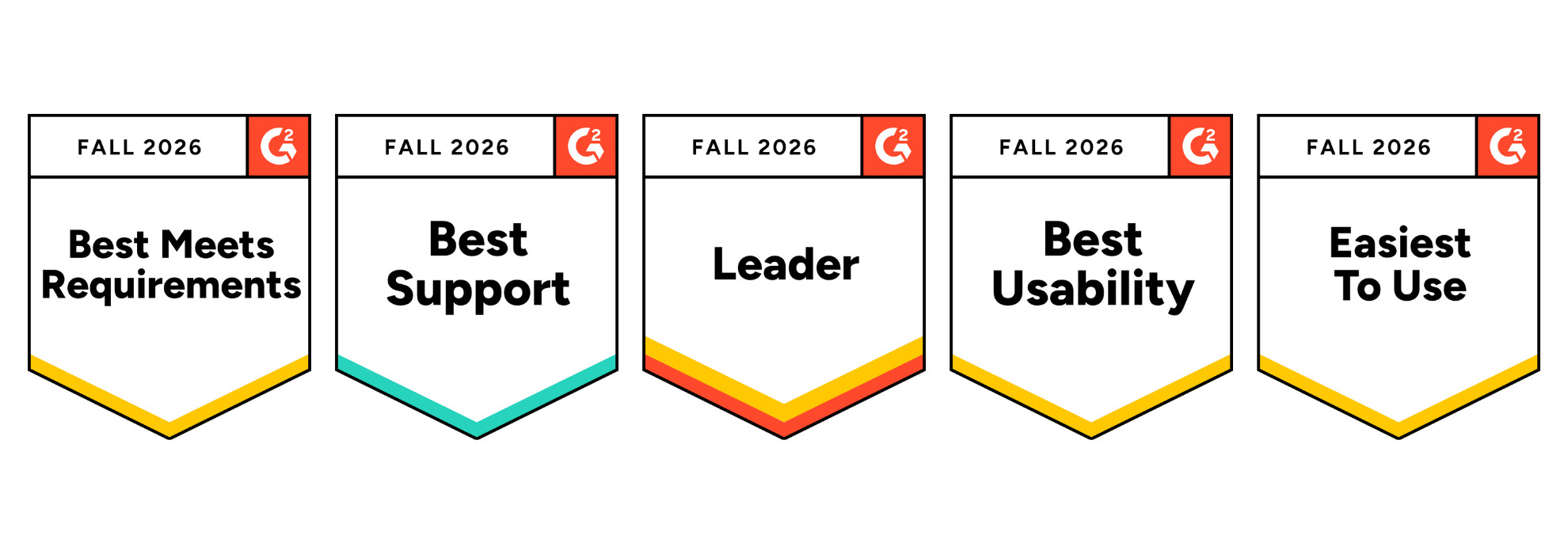
Integrity Advocate has been ranked #1 for Online Proctoring Usability on G2 for the third consecutive season. Based on verified customer feedback, we also earned five Fall 2026 badges recognizing usability, ease of use, support, and overall leadership.
Integrity Advocate has once again been ranked #1 in G2’s Usability Index for Online Proctoring, marking our third consecutive season at the top of the category.
In the Fall 2026 report, Integrity Advocate earned an overall G2 Index Score of 8.60, ahead of Honorlock, Proctorio, Quilgo, Talview, and Meazure Learning. We also earned five G2 badges, including Best Usability, Easiest to Use, and Best Meets Requirements, and were recognized as a Leader in the online proctoring category.
These recognitions are based on feedback from verified users. For us, that is what makes them meaningful. They reflect the experiences of the people who administer assessments, support test takers, and rely on the results.
Integrity Advocate earned the highest overall score in the Fall 2026 Online Proctoring Usability Index:
This is not only another first-place ranking. Our overall index score increased from 8.45 in Summer 2026 to 8.60 in Fall 2026, extending Integrity Advocate’s position at the top of the category.
G2 is the largest peer-to-peer software review platform in the world. Their Usability Index ranks products within a category based on three user-rated dimensions:
Every score comes from authenticated, verified reviews. Companies cannot pay to improve their position. There is no sponsorship or placement influencing the results. The index score reflects what users say about their experience with the product.
Integrity Advocate scored above the online proctoring category average across every usability measure included in the report:
User adoption stands out in particular. Integrity Advocate scored 17 points above the category average and 28 points above Honorlock.
That matters because a platform can have an impressive feature list and still create friction when people are asked to use it. Strong adoption suggests that the experience works in practice, not only during a product demonstration.
In addition to ranking first in the Usability Index, Integrity Advocate earned five G2 badges for Fall 2026 and was recognized as a Leader in online proctoring.
The Best Usability, Easiest to Use, and Best Meets Requirements badges reinforce something we have always believed: assessment security should be strong without being unnecessarily complicated.
Organizations should not have to choose between protecting an assessment and delivering an experience people can successfully use.
Online proctoring sits at a sensitive point in the assessment experience. Test takers may already be under pressure, while administrators need to protect exam integrity without creating unnecessary technical problems or support demands.
A platform that is difficult to access or manage can lead to:
Integrity Advocate was designed to remove those barriers.
There is no software to install and no browser extension to manage. The platform works across devices and browsers and integrates into existing assessment workflows. Test takers can access their assessments without navigating a separate, unfamiliar system, while administrators gain clear evidence and the context needed to evaluate results.
Usability is not separate from assessment integrity. When a platform works consistently, more attention can remain where it belongs: on the assessment and the credibility of its outcome.
Ease of use should never require an organization to compromise on accuracy or defensibility.
Integrity Advocate combines intelligent detection with Verified Human Review™ to provide context behind potential assessment violations. Instead of asking administrators to make decisions based only on an automated flag, our proctoring solutions can provide a clear, reviewable record supported by human judgment.
The result is an approach that protects assessment integrity while remaining practical for the people responsible for administering the program and fair to the people taking the assessment.
Across reviews, users consistently highlight the qualities reflected in the Fall 2026 report: straightforward implementation, ease of use for learners and administrators, seamless LMS integration, responsive support, and a privacy-first approach to assessment integrity.
As one verified user shared:
{{post-block-quote}}
That experience is what the rankings ultimately represent. Not simply a score, but whether the platform helps organizations protect assessments without placing unnecessary friction on their teams or test takers. View more customer stories here.
If you are currently comparing online proctoring solutions, usability should be evaluated alongside security, privacy, and review quality.
Consider asking:
The Fall 2026 G2 results provide an independent view of how leading platforms perform across many of these considerations.
Being ranked #1 once is exciting. Remaining at the top for three consecutive seasons tells a stronger story.
It shows that organizations do not have to accept unnecessary complexity as the price of protecting their assessments. Online proctoring can be secure, privacy-first, easy to administer, and straightforward for test takers.
That is the experience Integrity Advocate was built to provide, and we are grateful to every customer who shared their experience on G2.
The G2 ranking reflects a platform that has been in continuous operation for over a decade:
{{post-cta}}

February 11, 2025
|
5 min de lecture
Large-scale Wiley research surveying more than 2,900 students and instructors across North America reveals that cheating is measurably increasing in online environments, nearly half of students report using generative AI in their coursework, and 86% of instructors say students are more likely to cheat in online courses than in person. This post examines what the data reveals about the current academic integrity landscape, how AI has reshaped the threat model without changing the underlying intent behind misconduct, and how Integrity Advocate's COUNTER-AI approach responds to behavioral patterns rather than chasing specific tools.
Academic integrity isn’t disappearing. It’s being tested. Generative AI is now part of everyday academic life. Credentials carry increasing weight in employment decisions. At the same time, institutions are navigating a new assessment environment where traditional approaches to exam security no longer fully address modern risk.
What is actually happening with cheating in online courses? How much is AI-assisted behavior influencing academic misconduct? And what reduces risk without compromising privacy, accessibility, or trust?
Large-scale research surveying thousands of students and instructors across North America, conducted by Wiley, provides a clear picture of the current academic integrity landscape. The findings confirm what many institutions already sense: cheating patterns are shifting, AI is accelerating change, and assessment security must evolve accordingly.
Here’s what the numbers reveal, and what they mean for modern online proctoring and credential protection.
Academic misconduct is not simply anecdotal. It is measurable, and Wiley’s research reflects this growing trend.
Online and hybrid assessments are now embedded across universities, licensing boards, certification programs, and enterprise training initiatives. However, many online exams were adapted rapidly for accessibility and scale rather than intentionally designed with modern assessment security frameworks in place. When remote testing expands without proportional safeguards, risk expands with it.
The solution is building secure-by-design assessment systems that account for evolving threat models, emerging AI tools, and distributed testing environments.
Generative AI is no longer experimental; it is now a common part of the academic experience according to Wiley’s survey data.
AI tools have made cheating easier to execute, but they haven’t changed why people do it or how behavior shows up when someone is attempting to get away with misconduct. The tactics evolve quickly. The intent does not.
“AI doesn’t replace human intent. It changes how behavior shows up.”
By the time a specific AI tool is identified and restricted, three new ones have already taken its place. That means institutions cannot rely on tool-specific detection alone. They need an approach that focuses on behavior, context, and patterns of engagement rather than chasing software names.
Integrity Advocate’s COUNTER-AI™ approach recognizes that AI changed the tactics, not the intent.
Rather than attempting to block or identify every possible AI tool, COUNTER-AI™ focuses on the human signals that surface during an assessment, how someone engages with the exam, how they navigate through content, and how participation patterns align with expected behavior. This behavioral, security-based framework allows institutions to identify risk without over-policing legitimate AI-assisted learning.
Combined with trained human review, COUNTER-AI™ ensures that institutions can respond proportionally and fairly. Instead of reacting to every new AI platform that emerges, Integrity Advocate adapts to the underlying behavior patterns that persist regardless of the tool being used.
The result is a modern assessment security strategy that keeps pace with AI without becoming invasive, brittle, or dependent on outdated detection lists.
Wiley’s research shows that students say they are less likely to cheat when safeguards and expectations are clear.
The takeaway isn’t that students need harsher punishment. It’s that visibility changes behavior.
In most security environments, incidents are prevented not by catching someone in the act, but by being visibly present before anything happens. The same principle applies to assessments. When oversight is real, consistent, and clearly communicated, behavior shifts before there is anything to investigate.
Security isn’t about catching people. It’s about creating an environment where integrity is the default.
Integrity Advocate embeds accountability directly into the assessment lifecycle so that presence is established from the beginning. Identity verification confirms the right individual is taking the exam, and participation monitoring creates transparency throughout the session without resorting to invasive surveillance. Students understand that the assessment environment includes thoughtful oversight, which reduces temptation while maintaining dignity.
At the same time, context matters. One unusual moment during an exam rarely tells the full story. What matters more are patterns, how someone typically moves through questions, how they engage with the screen, how their behavior aligns with expected participation. When those patterns meaningfully deviate, insight becomes clearer. Patterns of behavior reveal intent in ways tools alone never can.
By combining AI-assisted behavioral analysis with trained human review, Integrity Advocate evaluates exams in context rather than reacting to isolated blips. This ensures institutions receive fair, defensible insight while avoiding automated accusations or rigid triggers.
Because the approach is privacy-forward and human-reviewed, students experience structure without intimidation, and institutions gain deterrence without overreach. Accountability becomes part of the system itself, embedded in design rather than layered on after misconduct occurs.
According to Wiley’s data:
When exams are compromised, the consequences extend far beyond the classroom. Unqualified individuals can enter regulated industries such as healthcare, financial services, cybersecurity, and public safety, putting organizations and communities at risk. Protecting exam integrity protects individuals, programs, the workforce, and the public.
And yet, despite the stakes, adoption of comprehensive assessment security remains uneven.
Instructors care deeply about outcomes and readiness, but many hesitate to adopt solutions that feel intrusive, complex, or operationally heavy. They want protection without friction. They want integrity that supports learning rather than disrupting it.
Integrity Advocate approaches assessment security holistically, before, during, and after the exam.
Before the assessment, seamless LMS integration keeps the experience simple for instructors and administrators. Identity verification ensures the right person is testing and reduces impersonation risk without adding complexity.
During the session, AI-assisted monitoring paired with human review minimizes false positives and provides contextual, defensible insight. This saves instructors time and preserves fairness. After the exam, audit-ready reporting supports accreditation, compliance, and appeals with documentation institutions can trust.
Online learning is not temporary. AI is not temporary. Remote certification, licensure testing, and workforce credentialing will continue to expand. The institutions that succeed in this environment will be the ones who modernize assessment with intention and embed integrity into every stage of the process. Academic integrity is no longer about isolated detection. It is about designing systems where the right person earns the credential, earns it legitimately, and can stand behind it with confidence. These dynamics play out distinctly in programs where balancing assessment security and privacy requires careful calibration. That is the future of assessment security, and it is the future Integrity Advocate is building.
Source: Wiley, The Latest Insights into Academic Integrity: Instructor and Student Experiences, Attitudes, and the Impact of AI. Survey of 2,900+ students and instructors across North America.
https://www.wiley.com/en-us/publish/ai-insights/the-latest-insights-into-academic-integrity-instructor-and-student-experiences-attitudes-and-the-impact-of-ai-2024-update/
{{post-cta}}
January 30, 2025
|
5 min de lecture
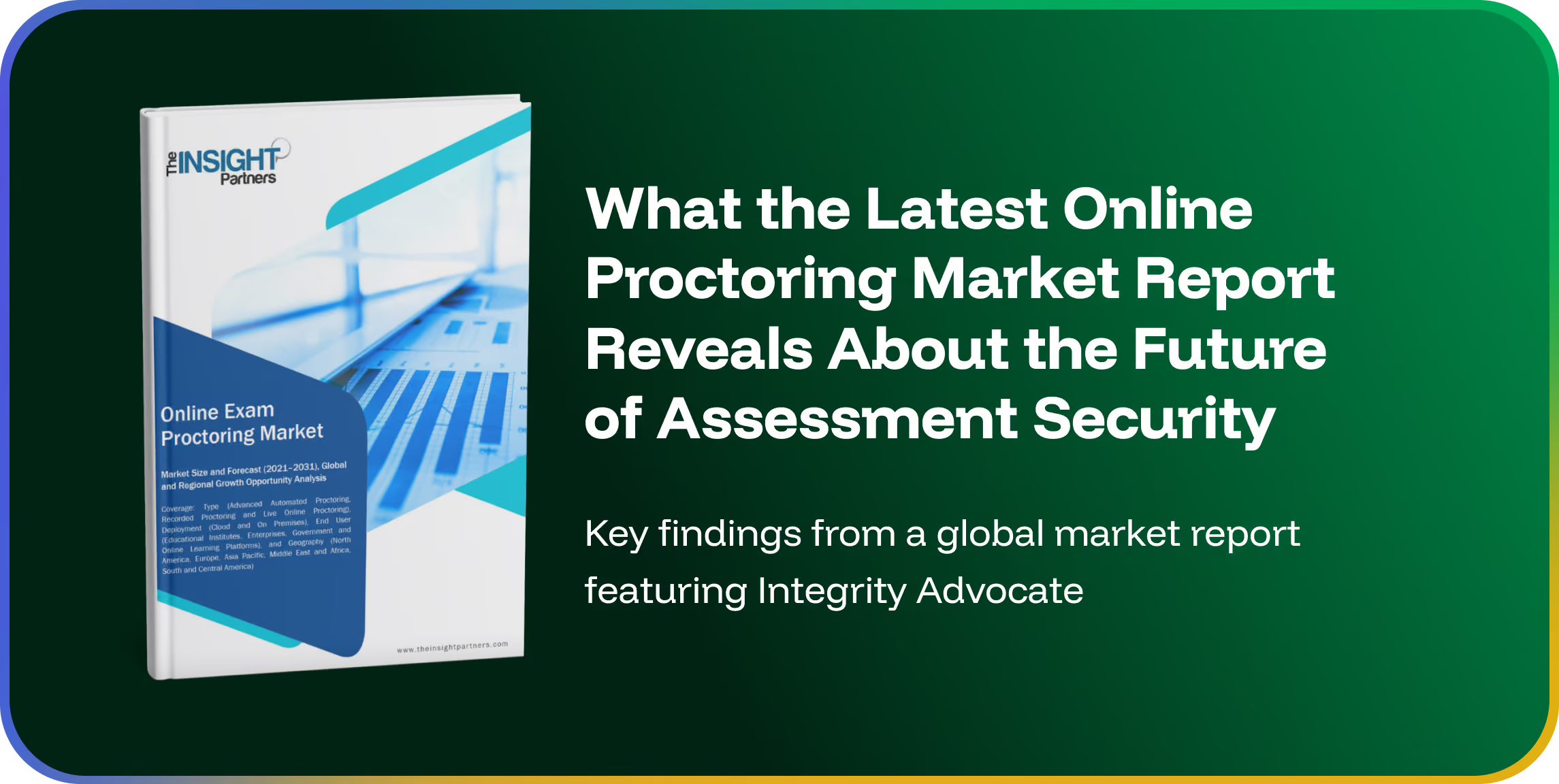
The Insight Partners has released its Online Exam Proctoring Market Global Analysis and Forecast to 2031 report, featuring Integrity Advocate as part of its company analysis. The US market alone is projected to grow from $281.09 million in 2024 to $803.92 million by 2031 at a CAGR of 16.4%. This post highlights the four most important signals from the report for assessment programs planning ahead, from the sustained role of distance learning in driving demand to the growing recognition that AI alone is not sufficient and that trust, fairness, and auditability are becoming central concerns rather than secondary considerations.
According to a recent global market report from The Insight Partners, online proctoring is being adopted across a widening range of use cases, including higher education, workforce training, professional certification, and regulated industries. Integrity Advocate was featured in the report as part of its company analysis, alongside other providers operating in the space.
Below are several key insights from the report, and what they signal for assessment programs planning for the years ahead.
The report projects strong growth for the global online exam proctoring market through 2031, driven by continued expansion of online and hybrid learning models, workforce upskilling, and remote certification.
While growth varies by region, North America remains one of the largest and fastest-growing markets. In the United States alone, the online exam proctoring market is expected to grow from $281.09 million in 2024 to $803.92 million by 2031, representing a compound annual growth rate (CAGR) of 16.4%.
This growth reflects a broader shift in how organizations deliver and validate assessments, particularly as remote testing becomes a permanent part of education and professional development.
One of the primary drivers cited in the report is the sustained adoption of online and distance learning.
The report notes:
“The online exam proctoring market has experienced significant growth, driven by increasing adoption of e-learning solutions, rising demand from the corporate sector, and the cost-effectiveness of online exam proctoring.”
In the U.S., this trend is reinforced by enrollment data. According to figures cited in the report, approximately 53% of postsecondary students were enrolled in at least one distance education course in fall 2022, underscoring how normalized online learning, and by extension, online assessment, has become.
As online assessments become more common, expectations around exam integrity, identity verification, and defensibility continue to rise.
AI-enhanced proctoring is identified as a major growth opportunity in the report, particularly as organizations look to scale assessment programs efficiently.
At the same time, the report emphasizes that online proctoring relies on multiple layers of oversight, noting that modern solutions often combine:
“video, audio, artificial intelligence (AI), machine learning (ML), biometric authentication, and other monitoring tools to track candidate behavior during an online exam.”
This multi-signal approach reflects a growing recognition that exam integrity cannot rely on automation alone, especially in higher-stakes environments where results may be challenged, audited, or tied to professional outcomes.
Beyond growth projections, the report highlights a shift in why organizations adopt online proctoring, not just to prevent cheating, but to protect the credibility of outcomes.
Online proctoring is increasingly used to:
“ensure the credibility of online assessments and maintain academic and professional standards in remote testing environments.”
As assessment programs scale, decisions made during and after an exam must be explainable and defensible. This is pushing organizations to look beyond point solutions and consider how assessment security operates across the full lifecycle, before, during, and after the exam.
One of the clearest signals from the data is that assessment security is evolving into a system-level concern.
Programs that succeed long-term will be those that:
As online proctoring continues to expand into higher-stakes use cases, these considerations are becoming central, not optional.
For those who want to explore the full data, forecasts, and regional analysis, the complete Online Exam Proctoring Market – Global Analysis & Forecast to 2031 report is available for download.
This report was produced by The Insight Partners. Integrity Advocate is featured in the report and is sharing access for educational purposes.
{{download-resource-cta}}
{{post-cta}}

December 15, 2025
|
5 min de lecture
Online assessments no longer happen in controlled environments. They happen at kitchen tables and job sites, on personal phones and employer-managed laptops, across time zones and bandwidth conditions that institutions cannot control. Proctoring solutions built for a single, standardized testing environment are increasingly out of step with how people actually learn, train, and certify. This post examines the reality of modern testing environments, why device-agnostic and low-bandwidth-optimized design is now a baseline expectation, and how flexible access strengthens rather than weakens assessment integrity.
Online assessments don’t live in neat, controlled environments anymore. They happen at kitchen tables and job sites. On desktops, laptops, tablets, and phones. On personal devices, employer-managed systems, shared computers, and whatever hardware learners have access to in the moment. They happen across time zones, bandwidth conditions, and environments institutions simply can’t control.
As online assessment continues to scale, one expectation has become clear: proctoring has to work anytime, anywhere, without putting extra hurdles in front of learners or administrators.
That reality is reshaping how institutions think about proctoring and what they expect from the tools they choose.
The idea of a single, standardized testing environment no longer matches how people actually learn, train, and certify today.
As we highlighted in our 2025 Year-in-Review, assessment programs are expanding well beyond traditional academic settings into workforce training, compliance programs, professional certification, and global continuing education initiatives.
That expansion brings variety. Learners might be using an employer-issued laptop one day and a personal tablet the next. They might be testing from home, a library, a training center, or a shared workspace. Some environments are quiet and stable, others are not.
Proctoring solutions that only work reliably in narrow, ideal conditions quickly start to feel out of step with this reality.
The need for device-agnostic access isn’t new. It reflects how people already interact with digital tools in everyday life.
A significant portion of adults rely on mobile devices as a primary or frequent way to access online services, particularly in workforce and continuing education settings. In practice, that means learners often move between desktops and laptops at home, employer-managed devices at work, tablets or Chromebooks for flexibility, and mobile devices when other options aren’t available.
When proctoring systems assume a single device type, friction shows up immediately, often before the exam even begins.
Expectations around anytime, anywhere access are also shaped by how learning itself has evolved.
Research from EDUCAUSE shows that learners increasingly expect educational tools to work seamlessly across devices and environments, with mobile access playing a growing role in how learners engage with content and assessments.
This is especially true in workforce and professional education, where assessments are often completed outside traditional classrooms and on non-standard devices. In those settings, rigid technical requirements aren’t just inconvenient, they can be a barrier to participation.
Even with widespread internet access, consistent bandwidth isn’t guaranteed.
Proctoring solutions that rely on heavy downloads, constant high-resolution streaming, or strict technical requirements tend to struggle when connectivity isn’t perfect. That can lead to delayed starts, dropped sessions, or failed exams, none of which have anything to do with academic integrity.
Integrity Advocate’s browser-based, low-bandwidth-optimized approach is designed to keep exams running smoothly, even when network conditions are less than ideal.
Many traditional proctoring models were built around a single use case: a learner on a personal desktop or laptop, in a quiet space, with strong internet connectivity. That assumption no longer holds.
Rigid systems often:
These limitations tend to hit workforce learners, global candidates, and those without access to ideal testing setups the hardest.
Institutions are increasingly prioritizing proctoring solutions that reduce friction on exam day and lower the volume of support requests.
Programs consistently report that:
Anytime, anywhere access isn’t just better for learners. It’s operationally better for administrators, too.
Integrity Advocate was built for modern assessment environments, not idealized ones. Our platform supports anytime, anywhere access by:
This flexibility allows institutions to scale assessments confidently, without forcing learners to adapt to rigid technical constraints.
It’s easy to assume that tighter technical restrictions automatically lead to stronger exam integrity. In practice, the opposite is often true. When learners struggle just to access an exam, anxiety rises, trust drops, and compliance suffers. When the testing experience works smoothly, learners can focus on demonstrating what they know.
Flexible access strengthens integrity by:
Integrity is strongest when systems remove friction, not add it.
As online assessment continues to evolve, anytime, anywhere access has become a baseline expectation, not a differentiator.
Proctoring solutions that only work in narrow conditions will struggle to scale. Those designed for real-world diversity will continue to earn trust from institutions and learners alike. Modern proctoring has to meet learners where they are, on the devices they use, in the environments they test.
Schedule a demo to learn how Integrity Advocate supports flexible, reliable online assessment.
{{post-cta}}

December 12, 2025
|
5 min de lecture
Fair online assessment is not just about catching cheating. It is about whether the testing environment works consistently and equitably for every learner. When proctoring systems assume narrow definitions of normal behavior, perfect lighting, steady eye contact, high bandwidth, single devices, they do not just create friction. They create inequity. This post examines why accessibility has become central to assessment integrity, where AI-only approaches fail diverse learners, what inclusive proctoring actually requires, and how a human-backed model is the only approach that can interpret context fairly across the full range of real-world assessment conditions.
Fair online assessment isn’t defined only by how well you catch cheating, it’s defined by whether the testing environment is consistent, inclusive, and workable for every learner. A proctoring experience can be technically secure and still fail the moment it meets real life.
Because real assessments don’t happen in perfect conditions. They happen on aging laptops and shared devices. On unstable internet connections. In homes, offices, libraries, and job sites. They happen with learners who use assistive technology, require accommodations, speak different languages, or simply don’t have access to an ideal testing environment.
When proctoring systems assume a narrow definition of “normal”, perfect lighting, steady eye contact, minimal movement, high bandwidth, they don’t just introduce friction. They introduce inequity.
That’s why accessibility and inclusion aren’t secondary considerations in online assessment anymore. They are foundational to fairness, defensibility, and trust.
As online testing expands across education, credentialing, and workforce training, institutions are being held to higher expectations around who assessments serve, and how.
Institutions no longer limit accessibility to formal accommodations or compliance checklists. Accessibility now includes whether an assessment system genuinely works for the full range of learners expected to participate.
The Web Content Accessibility Guidelines (WCAG) emphasize that digital systems must be perceivable, operable, understandable, and robust for all users, regardless of ability or environment.
In the United States, the Americans with Disabilities Act (ADA) and Section 508 continue to shape how institutions evaluate digital tools, including assessment platforms.
Internationally, organizations such as UNESCO have highlighted that inclusive access to digital learning and assessment is essential for equitable education and workforce participation.
These frameworks make one thing clear, accessibility is not optional, and it cannot be bolted on after the fact.
In contrast, many early online proctoring systems were built for controlled environments, strong internet, quiet rooms, single devices, and highly standardized behavior. But that model no longer reflects how people learn or test.
Today’s learners take assessments:
When proctoring systems aren’t designed for this reality, AI-only proctoring systems often misinterpret normal human behavior as suspicious. The result is unnecessary flags, increased anxiety, and outcomes that feel unfair, not because integrity was compromised, but because the system lacked flexibility.
Research from Educational Testing Service (ETS) reinforces this point, assessment validity depends not only on test design, but on the conditions under which tests are delivered. When delivery introduces barriers, fairness suffers.
Automation can be valuable in assessment security, but accessibility challenges often fall outside predictable patterns.
AI-only proctoring systems frequently struggle to interpret:
Without context, these signals are easily misclassified. These systems often force learners to defend themselves against automated decisions.
This doesn’t just harm the test-taker experience. It erodes trust in the assessment itself.
Accessibility requires context, and context requires human judgment.
As a result, inclusive assessment systems are built on flexibility, restraint, and interpretation, not rigid enforcement.
That’s why institutions are increasingly prioritizing proctoring solutions that:
A human-backed review model plays a critical role here. When AI is used to assist detection, not replace judgment, behavior can be interpreted within real-world context instead of reduced to binary flags.
This approach leads to:
Integrity Advocate was designed with accessibility and inclusion as core principles, not add-ons.
Our platform supports inclusive testing by:
This human-first, privacy-first approach helps ensure assessments are secure without being exclusionary.
Importantly, inclusive proctoring benefits all learners, not just those with formal accommodations. When systems are designed to work for diverse needs and environments, completion rates improve, disputes decrease, and confidence in outcomes increases.
There is a common misconception that accessibility and security are competing priorities. In practice, they reinforce one another.
When learners feel respected by the assessment process:
Integrity is strongest when systems are designed for people, not against them.
As online assessment continues to evolve, accessibility and inclusion will remain central to how institutions evaluate proctoring solutions.
Tools that only function in ideal conditions, or rely on rigid automation without human context, will struggle to meet rising expectations around fairness, equity, and trust.
{{post-cta}}

November 20, 2025
|
5 min de lecture
Integrity Advocate integrates natively with major learning management systems and certification platforms via LTI, including D2L, Canvas, Moodle, TopClass, uxpertise, Thought Industries, and more, so organizations can activate proctoring exactly where they need it without rebuilding course structures or changing existing workflows. Learners click Begin, verify their identity, and take the assessment. Administrators access results and flagged sessions directly within the LMS. No installs, no extensions, no IT overhead, and no privacy tradeoffs.
Integrity Advocate integrates natively with major LMS, certification platforms, and learning systems, including:
Because the integration is LTI-based, it works with your existing course structure, no rebuilding, reformatting, or duplicating content.
You activate proctoring where you need it, and your existing workflow stays exactly the same.
See a full list of our integrations
Unlike legacy proctoring tools, Integrity Advocate runs entirely in the browser. That means:
Exam takers simply click “Begin,” verify their identity, and take the assessment. Administrators access results directly within their LMS and review flagged activity with one click.
When proctoring feels effortless, participation increases, and support tickets drop dramatically.
Seamless integration isn’t just about technical compatibility; it’s about creating a consistent, intuitive experience for every user.
✔ Familiar LMS environment
✔ Simple, no-install proctoring
✔ Device flexibility (including Chromebooks, tablets, mobile, laptops)
✔ No confusing redirects to external sites
✔ Same course layout, same workflow
✔ Easy activation per quiz or assessment
✔ Automated flagging and optional human review
✔ Audit-ready reporting directly in the LMS
Everything lives where your team already works.
Many organizations assume proctoring tools create complexity, or require uncomfortable tradeoffs around learner privacy. Integrity Advocate proves they don’t have to.
Learners get transparency. Admins get trustworthy, defensible results. Your organization gets compliance without added risk.
Your LMS shouldn’t become harder to manage just because you need to protect exam integrity. With Integrity Advocate, security becomes an invisible part of your workflow, privacy stays fully intact, and proctoring seamlessly extends your existing assessment process rather than interrupting it.
Want to see how Integrity Advocate plugs into your LMS in minutes? Schedule a demo with our team.
Secure, simple, privacy-first proctoring, already built to work where you work.
{{post-cta}}
October 14, 2025
|
5 min de lecture
The ANSI Z490.1-2024 update merges in-person and online Safety, Health and Environmental training requirements for the first time, raising the bar for verifiability, accountability, and audit-readiness. In this on-demand webinar hosted by D2L and Integrity Advocate, industry experts break down what has changed, why check-the-box safety training no longer meets compliance expectations, and how the D2L and Integrity Advocate integration delivers verifiable, learner-friendly SHE programs with identity verification, participation monitoring, and audit-ready documentation.
The safety training landscape is evolving, and with the latest ANSI Z490 standard updates, organizations must adapt quickly to ensure compliance, accountability, and learner verification. In this exclusive webinar hosted by D2L and Integrity Advocate, industry experts break down what’s changed, why it matters, and how technology can help you meet new compliance requirements with confidence.
In this on-demand session, you’ll learn:
Whether you’re an EHS leader, training provider, or compliance manager, this session will help you navigate today’s regulatory landscape, and transform your safety programs into trusted, defensible, and learner-centric experiences.
Watch the Webinar
Access the on-demand recording to learn how D2L and Integrity Advocate are helping organizations modernize SH&E compliance training. Access the Webinar on Demand.
{{post-cta}}

May 22, 2025
|
5 min de lecture
Good technology is the baseline. What keeps clients is how a partner shows up when things get complicated. This post walks through the ten most common reasons organizations switch proctoring providers, from poor support and compliance abandonment to privacy shortcuts and platforms that cannot scale, and explains how Integrity Advocate is built to do the opposite at every turn.
Good tech matters—it should be secure, simple and able to scale—but that’s just the baseline. What really counts is how you show up for the people who depend on you.
Over time, we’ve seen the patterns. We know the reasons organizations switch providers, and we’ve built Integrity Advocate to do the opposite.
Here are ten of the biggest pitfalls, and how we make sure our partners don’t get stuck in them.
Nothing says “we’ve moved on” like radio silence when clients need help.
➜ We believe support should be available before you even know you need it. Our industry-leading support rate is just 0.58%, meaning fewer than 1 in 200 learners ever need to contact us. And when they do, we’re there 24/7 with live help across chat, email and phone.
If it takes an installation guide or an IT department and a prayer to get started, you’ve already lost.
➜ We’re browser-based, device-agnostic and install-free. No plugins. No apps. Just a seamless experience that works anywhere, on any device without frustrating your learners or burdening your IT team.
Hand off a platform, disappear and hope for the best.
➜ We show up from the start and stay in the loop. Our team helps guide implementation, interprets regulation changes and can even sit in on calls with your regulators and stakeholders. When things shift, we’re already there.
Design a sleek platform, then watch learners struggle to use it.
➜ We prioritize accessibility, not just aesthetics. Our platform works on mobile, tablets, laptops—you name it. No testing labs, no special equipment, no complicated setups. Just secure, verified assessments learners can complete anywhere.
Say yes to everything. Deliver on… less.
➜We don’t bluff. Our track record speaks for itself and we’re transparent about what we do and how we do it. If we say we’ve got it, we mean it.
Nothing says “you’re on your own” like dodging regulatory guidance.
➜ We stay ahead of the curve so you don’t have to. Whether you need support navigating new standards, prepping for an audit or defending training decisions, our experts are in your corner and ready to assist with clear, actionable guidance.
Collect more data than needed. Store it longer than necessary. Hope nobody notices.
➜ We’re the only proctoring provider built on Privacy by Design principles. We collect only what’s necessary, never retain biometric data and protect every user with ethical safeguards built into our system from the very beginning.
Support five learners flawlessly. Struggle with five thousand.
➜ We support organizations of all sizes with consistent performance and trusted infrastructure. Whether it’s a handful of assessments or thousands in a single day, we’re built to keep up.
See your service as a tool and not a safeguard for real people in high-risk industries.
➜ We know that training protects lives. That’s why we’re passionate about verifying identity, monitoring participation and ensuring assessments hold up under scrutiny. Behind every test is someone counting on it.
Hope clients stick around instead of giving them a reason to.
➜ We build relationships, not contracts. Our clients stay because we make life easier, safer and more compliant—and we keep earning their trust long after the onboarding ends.
{{post-cta}}

May 15, 2025
|
5 min de lecture
The ANSI/ASSP Z490.1-2024 update consolidates in-person and online Safety, Health and Environmental training into a single unified standard for the first time. Organizations can no longer simply assign a course and mark it complete. They must verify who completed the training, confirm active participation, prevent unauthorized assistance, and maintain a record that holds up to regulatory scrutiny. This guide walks safety and compliance teams through what has changed, where most current systems fall short, and how to meet the new standard without overhauling existing infrastructure.
A no-nonsense guide for safety and compliance teams adapting to ANSI/ASSP Z490.1-2024
The rules have changed. And if you’re in charge of keeping workers safe, delivering training or meeting compliance standards, you’ve likely felt the ripple.
The ANSI/ASSP Z490.1-2024 is no minor update. For the first time, both in-person and online Safety, Health and Environmental (SH&E) training are held to the same gold standard.
It’s no longer enough to say training was “offered.” You have to prove it was delivered, received and understood by the right person, in the right way, with a record to show for it.
The challenge? Most current systems weren’t built for that.
Here’s what this shift means for compliance, what to prioritize first and how to avoid the missteps that can cost you.
The ANSI/ASSP Z490.1-2024 update brings some big changes. It consolidates what were once two separate standards—Z490.1 for in-person training and Z490.2 for eLearning—into a single, unified standard for all Safety, Health and Environmental (SH&E) training.
That means no matter how your training is delivered, the expectations are the same.
You can’t just assign a course and call it complete. You have to:
Regulators want to see due diligence from organizations that take safety and accountability seriously. Organizations need systems that demonstrate training was handled with care, intention and oversight.
Traditional LMS’ rely on user credentials to grant access. But usernames and passwords don’t confirm who actually completed the training or whether they were even in the room.
That’s a problem. Because when safety is on the line, assumptions can cost lives.
Training is meant to protect people and prepare them for the risks they face and the responsibilities they carry. If you can’t confirm who took the training or whether they were engaged, there’s more than just compliance at stake. You’re carrying a safety risk, a legal liability and a missed opportunity to do right by your workforce.
The updated ANSI/ASSP standard puts the responsibility squarely on the employer. In the event of an incident, “we assigned the module” won’t hold up. To truly protect your organization and your people, you need training that’s verifiable. That means:
Safety incidents put everything under the microscope. Leadership. Processes. Credibility. It’s not just your operations on the line, it’s trust. And behind that?
People’s lives. The ones training is meant to protect.
Even with the best intentions, training programs can fall short, particularly when the systems in place weren’t built with today’s standards in mind.
If your current setup relies on a simple login and password, there may be gaps you haven’t considered. And if you’re using software that requires downloads or installations, you might be introducing friction for learners.
Here are a few areas where we often see room for improvement:
The good news is that these are fixable gaps. There are better, easier ways to meet compliance requirements today without compromising user experience, privacy or peace of mind.
No matter your industry—construction, food service, healthcare, manufacturing—safety training exists for a reason. Not to fill a quota. Not to tick a box.
We know you care about your workforce. You wouldn’t be reading this if you didn’t. But caring isn’t always enough, especially when systems are outdated, fragmented or easy to bypass.
Real responsibility means having a system that holds up under pressure. But how do you build a system like that without overhauling everything?
It doesn’t have to be complicated. The right tools do the heavy lifting quietly in the background, verifying identity and participation without interrupting the learning experience. No software installs. No extra logins. No support tickets flooding your inbox.
Just reliable, responsible training that works (because it’s built to).
Already delivering training digitally? Great. You don’t need to scrap your system—you just need to make sure it can hold up under today’s standards.
Here are a few questions to help you evaluate where you stand:
If any of those questions give you pause, it might be time to take a closer look.
At Integrity Advocate, we don’t just provide tools. We partner with you to navigate compliance confidently, especially when standards change and the pressure’s on.
We help organizations meet the ANSI/ASSP Z490.1-2024 standard with:
✓ No-install identity verification and participation monitoring
✓ Mobile-friendly access that meets your learners where they are
✓ Privacy by Design to protect your organization and your people
✓ Human reviews for fairness, discretion and accountability
✓ Seamless integration and full support within your existing LMS
Need help interpreting what this new standard means for your organization? We’ll guide you through it. Meeting with regulators or external reviewers? We’ve been there too, and we’ll sit in right beside you.
The latest ANSI update is the perfect moment to pause and reassess how we deliver training, protect our teams and uphold accountability.
Integrity Advocate is here to help you make this shift with confidence. From no-install record and review proctoring to industry-leading support levels, we make it easier to meet the standard. When training is verifiable, ethical and accessible, it doesn’t just check a box—it builds trust, saves time and protects lives.
We believe compliance can be better. And when we work together, it is.
{{post-cta}}

January 12, 2026
|
5 min de lecture
Flag overload is one of the most common and least discussed problems in online proctoring. When AI-only systems flag everything from background noise to lighting changes, administrators are left sorting through queues of low-risk alerts to find the few that actually matter. This post explains why more flags do not equal more security, how human review filters out noise before it reaches the administrator queue, and what a smarter review model looks like in practice, including a side-by-side comparison of AI-only versus AI plus human review across flagging volume, admin workload, and decision quality.
If you are using an online proctoring tool, and your post-exam review process feels overwhelming, it’s usually not because too little is being flagged, it’s because too much is.
As online and remote assessments scale, many programs respond by tightening controls and increasing automation. On paper, it sounds like a strong security posture. In practice, it often creates a different problem entirely: flag overload.
And that overload lands squarely on administrators.
When AI-only proctoring systems flag everything from background noise to lighting changes, administrators are left sorting through long queues of low-risk alerts to find the few that actually matter.
That leads to:
More data doesn’t automatically mean better security. In many cases, it creates more work — without improving outcomes.
A simple rule of thumb:
More flags ≠ more security.
The post-exam phase is where integrity decisions become real. This is the moment where:
When every flagged event is treated equally, administrators are forced into a reactive role, reviewing volume instead of focusing on risk.
That’s where smarter review models make the biggest difference.
Integrity Advocate was designed to reduce noise, not increase it.
Instead of passing every automated flag directly to administrators, Integrity Advocate uses highly trained human reviewers to evaluate context before an incident ever reaches your queue.
Human reviewers can:
The result? Administrators see fewer, higher-quality incidents, and only when action is truly needed.
Here’s a simple way to think about the difference:
Automation is powerful, but without human judgment, it often creates more work than it removes.
When human review is built into the process:
Security becomes proactive instead of reactive, and review workflows become sustainable, even at scale.
Strong assessment security isn’t about watching everything. It’s about identifying what actually matters, and acting with confidence when it does.
By combining AI efficiency with human judgment, Integrity Advocate helps programs protect assessment integrity without overwhelming the people responsible for it.
Because the goal isn’t more flags. It’s better outcomes.
{{post-cta}}